North Carolina; Slavery & AbolitionBiblio.com
239 résultats
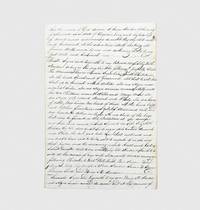
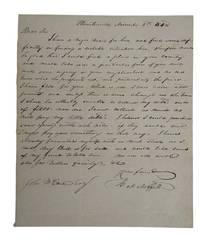
1842209651842. Slavery North Carolina Letter signed offering a "negro man" to settle debts. Letter signed by "H.M. Moffett" of Huntersville Virginia now West Virginia. Dated November 8th 1842. Measures 9.5" by 7.75". The letter reads in full: "Dear Sir I have a negro man for hire and find some difficulty in finding a suitable situation here therefore would be glad that I could find a place in your country and would take in as a particular favor if you will make some inquiring in your neighborhood and let me know what the prospects are and particularly the price- I have $200 for you which is all I can raise at present and unless their is some change in the times I shall be utterly unable to collect my debts of $1600 now due. I can't collect as much as will pay my little debts. I believe I could purchase some young cattle with notes if they would . I might pay you something in that negro sic. I have already furnished myself with as much stock as I need my Bull is for sale and would like some of my friends to take him. We are all well also Jan sic Millers family - . -- your friend H.M. Moffett." The letter was likely penned by Henry Hiller Moffett second Clerk of Pocahontas county Virginia present day West Virginia. Moffett is listed in the 1850 census with eight enslaved persons. Original folds some minor foxing. Overall very good condition. unknown
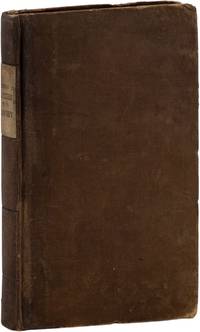
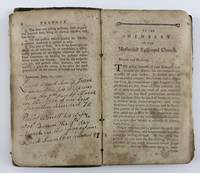
183384791Lexington KY: Abraham Skillman 1833. First Edition. First printing. 12mo 18.5cm; original brown cloth-covered boards; viii207pp. Respined to style with facsimile printed spine label; Bookplate of the Young Men's Christian Institute New Haven to front pastedown; bookseller's ticket Williams' Bookstore Under the Old South Meeting House Boston at base of front flyleaf; pencil signature faded and illegible to front endpaper. Complete sound and Good. <br /> <br /> One of a tiny number of pre-Civil War abolitionist texts to have been written by a Virginia author. Paxton 1784-1868 was a Presbyterian minister born in Rockbridge County Virginia and educated at Princeton Theological Seminary; it is likely his mentorship there under Charles Hodge helped develop Paxton's antislavery sentiments. In 1826 after publishing an essay asserting the institution of slavery to be incompatible with the teachings of the Bible Paxton was expelled from his pastorship of Cumberland Presbyterian Church near Farmville in south-central Virginia. The present text addressed to his former congregation recounts the events of his expulsion reprints the essay in question and adds a series of epistolary essays supporting his theological position in oppostion to slavery. <br /> <br /> The existence of any abolitionist sentiment during this period in Virginia's history is remarkable in itself. For a native-born minister to willfully preach the gospel of antislavery even the relatively conservative version of abolitionism professed by Paxton before a congregation whose sentiments on the subject would have been diametrically opposed - and which doubtless included a number of slaveholding families - must have amounted to apostasy in some congregants' eyes. By publishing the present work Paxton essentially doubled down on his unpopular beliefs making him in this cataloguer's eyes a rather remarkable figure. We find it surprising that so little biographical information exists regarding Paxton. His name barely appears in the scholarly literature on the period; perhaps because no mention of abolition is made in either the title nor the sub-title of his book the work is rarely discussed in articles on the antebellum southern antislavery movement. Though reasonably available institutionally Letters on Slavery is perenially scarce in commerce having appeared at auction only three times in the current century. This a quite decent copy in a discreetly restored binding. SABIN 59264. DUMOND Antislavery Bibliography p.89. LCP AFRO-AMERICANA 7501. Abraham Skillman unknown
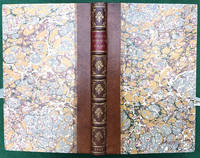
180158147<p>ELOQUENT ARGUMENT FOR ABOLITION OF THE SLAVE TRADE BY A WEST INDIES SLAVE OWNER - WITH A DESCRIPTION OF SUGAR PLANTATIONS</p><p>Full title: 'Letters on the Cultivation of the Otaheite Cane; the Manufacture of Sugar and Rum; the Saving of Molasses; the Care and Preservation of Stock; with the Attention and Anxiety which is due to Negroes. To these Topics are added a few other Particulars analogous to the Subject of the Letters; and also Speech on the Slave Trade the most important Feature in West Indian Cultivation.'</p><p>first edition 8vo. xvi 248 248 1 blank 249-290 291-301 prospectus with detailed contents for book on Leeward Islands 1 blankpp large folding table at p.247 modern quarter rich tan calf spine panelled by raised bands with the panels richly gilt tooled red morocco title label marbled sides scattered foxing some light old water staining to lower and fore margins most noticeable in gatherings B and L and never obtrusive else a nice copy in a very handsome binding.</p><p>SABIN 9850 Goldsmiths'-Kress no. 18156.4 Rare Books Hub records none at auction. <br />Clement Caines d. 1817-1822 trained as a barrister in London inherited his family's sugar plantations in St. Kitts around 1778 and became the largest slave owner in the island. In the General Assembly of the Leeward Islands in 1798 he advocated the abolition of the slave trade better treatment for enslaved workers and an end to the slave trade. He wrote extensively on the desirability of humane treatment for plantation slaves and the abolition of the slave trade as well as political topics including his support for the Embargo. <br />The first part of this book effectively a detailed description the workings of a West Indian sugar cane plantation benefits from Caines's first hand experience of the topic. The second part p.249-288 contains his 'Speech on the Slave Trade' delivered to the General Assembly of the Leeward Islands in March 1798 which was discussing a resolution that the abolition of slave trade 'would be oppressive to the British planter destructive to the sugar colonies and consequently to the British Revenue and of no benefit to the Africans themselves'. Caines unambiguously stated "the slave-trade ought to be abolished. It ought to be abolished immediately. It ought immediately to be abolished for the sake and benefit of the planter". Caines argued that the slave trade was injurious not only to the slaves but to their owners. Having observed the death rates from exposure overwork and disease involved in forest clearing he bluntly stated that slave labour "cements with blood the walls of every sugar-work that is raised where forests grew". He stated that his business had "never been delegated to others. The slaves who were committed to my care performed their work under my own eyes. My time was passed with them and my attention devoted to them and their condition. I could not fail then to become acquainted with their wants and sufferings - to remark their sickness disability and premature decay: - the diseases among their men the sterility of their women and the death among their children". He directly challenged his hearers for their calculation "that a hardy African can be purchased for less than a Creole infant can be reared" and their consequent failure to provide adequate housing for mothers and children. He reports that about a quarter of newly arrived slaves on discovering their situation "pine and droop linger rather than live and shortly sink into the grave". Only an end to the importation of new slaves could disrupt the planters' callous calculation that they could "run our Negroes for two or three years" in the certainty that they could be then be replaced. Caines's familiarity with the actuality of slave life and his eloquent and direct illustration of it give this work an especial power.</p><p><br />Interestingly in 1811 Caines wrote to both Thomas Jefferson and James Madison sending copies of his publications vide https://founders.archives.gov/documents/Jefferson/03-03-02-0394 .</p> Printed for Messrs Robinson hardcover
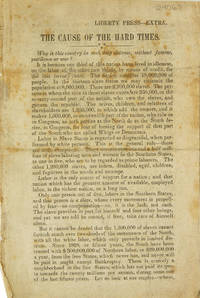
184324068Utica 1843. 4pp. 1 vols. 8vo. Disbound spotted and soiled separated along spine else a good copy of this rare piece. 4pp. 1 vols. 8vo. Rare. An "Extra" to the "Liberty Press" relating to slavery and the "deep distress" and idleness caused by slavery. The author signed "Truth-Teller" attributes most of the labor problems and many of the economic ones to the instution of slavery. He recommends allowing Florida a place in the Union as a free state and Congress guaranteeing each state a republican form of government which he feels would bring about the end of slavery. <br/><br/> unknown
1836216961836. Slavery & Abolition CHILD Lydia Marie. An Appeal in Favor of That Class of Americans Called Africans. New York: Published by John S. Taylor 1836. Second edition. Illustrated with 2 plates. Coleridge quote on title page. In original blue cloth boards with embossing and gilt to spine. 8vo 216 pages. Child was a vocal abolitionist women's rights activist anti-American expansionist and proponent of racial equality amongst African and Native Americans. An Appeal in Favor of That Class of Americans Called Africans was the first written by a white woman in support of the immediate emancipation of slaves without compensation to their enslavers. Child begins by writing about the history of the slave trade as well as harrowing stories on it's detrimental and immoral faculties in order to engage readers to action. One illustrated plate showcases shackles and chains used on enslaved individuals. First published in 1833 Child's work was a prominent contribution to the abolitionist movement and her writing influenced many notable figures including Harriet Beecher Stowe and Frederick Douglass. Missing frontispiece some foxing to pages some wear to covers. Small tear affecting a few words in the fist first sentence on page 127. Binding is tight and text is clean and legible. Overall very good condition. unknown
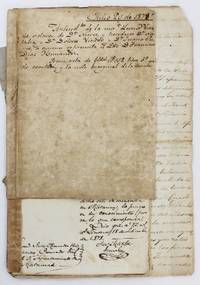
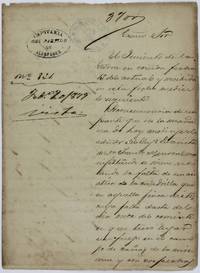
18784011Various places in Cuba 1878. Overall good. 29 leaves varying sizes. In contemporary ad hoc selfwrappers loosely stitched. Rear wrap tattered. Varying degrees of toning and wear. Scattered offsetting throughout. Fascinating gathering of documents and letters that present several cases of Cuban slaves applying for their own freedom in 1878. The gradual abolition of slavery on the island was enacted by Spain in 1880 but prior to this there were several bureaucratic mechanisms by which enslaved people could apply for or purchase their own manumission. The most interesting case amongst the present manuscript documents is the claim of a male slave that states he was born free in Puerto Rico but was somehow included in an inheritance as a young boy transported to Cuba and sold into slavery:<br /> <br /> "Un individuo que hoy se encuentran en la Cárcel del Alacranes y que dice nombrase Juhan ó José Julian Quintana y ser esclavo actualmente de Dn. Serapio Hernandez dueño de los ingenios Escorial ubicado en Colon y Sta. Rosa en Limonar y vecino de esa Ciudad calle del Rio ha solicitado se le restituyan un derechos de libertad por haber nacídolibre en Puerto Rico de donde á la edad de 5 ó 6 años le trajeron à esta Ysla y vencieron como esclavo."<br /> <br /> Interesting for the study of manumission in late-colonial Cuba and certainly worthy of further research. unknown
18792090Cuba 1879. About very good. 3pp. on a small bifolium. Contemporary ink stamps; accomplished in a fairly legible hand. Minor wear. A few small wormholes. Light tanning and dust soiling. Brief but very interesting manuscript report on the case of a missing Chinese indentured servant in the district of Alagranes near Matanzas. On February 18 1879 the owner of the plantation Juanita reports the missing person stating that there was a fire in his sugar cane field and it is thought that the laborer might have been burned. It seems that the present document serves to register the case with regional authorities in Matanzas and is a good record of the bureaucracy controlling indentured servitude in Cuba at this time. unknown
1864106752<p>9 leaves of blue lined paper written in ink on rectos only. 31.5x20 cm 12¼x8" set in custom-made half cloth folder .Minor aging old folds; near fine. Official court document from Bexar County Texas summarizing the case of "Jim Owen a free person of African descent thirty years of age a resident of said county and state" who "desires to choose an owner and mistress and has selected for his mistress Sephrony Kerr…" Owen states that "he was brought from the State of Illinois to his state in 1850 before he was of lawful age by one John H. Burrus… who has since said time assumed a kind of guardianship over your petitioner without lawful authority…" All seemed on track until John H. Burrus filed suit stating that he was the "owner of said petitioner Owen" and "proof was not made that said petitioner is a free man of African descent" and "the negro Jim Owen… is his slave that he was brought to this State by the respondent in January 1850 as is slave and has been so held and owned up to the present time…" A new trial was granted and Kerr and Owen's petition denied. An appeal was allowed contingent on paying to Burrus a surety bond of $1500. A fascinating glimpse into the legal morass surrounding slavery as the Civil War raged and the "peculiar institution" of slavery was soon to be ended by force of arms.</p>
18393013Washington D.C. 1839. Fair. 3pp. Large folio. Separated into six pieces with a very small section of the final attestation lacking altogether. Still highly readable. A wounded but important document. A rare and historically-important document relating to slavery in the District of Columbia which was outlawed on April 16 1862 nearly nine months before the issuance of the Emancipation Proclamation. The present document is an indenture made between William G. Howison and Alexander Hunter Esquire both citizens of Washington D.C. associated with property conveyed to Hunter by the deceased Joseph Birch. In 1824 Birch conveyed to Hunter land "and also a negro man slave for life named Lewis - another named George - two horses - 4 cows - 3 calves." The document indicates that Lewis was subsequently sold for four hundred dollars and George was sold to Birch in his lifetime. Documents recording the movement of slaves within the District especially among two citizens of the city are rare in the market. unknown
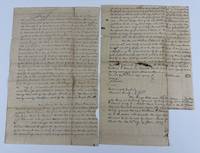
18353546Southampton Va 1835. Fair. 8pp. of manuscript plus a loose sheet of manuscript measuring 12.5 x 4 inches written within a book on family medicine. Book disbound lacking title page and first text leaf some gatherings and leaves loose or detached. Some age toning to manuscript leaves. A unique manuscript family genealogy for the Worrell family of Virginia as recorded by several hands in the margins and blank portions of two middle pages and on a few terminal and end leaves of a contemporary copy of a sammelband of two early American imprints -- The Family Adviser 1793 and John Wesley's Primitive Physic 1795 revised and corrected and on a single folded sheet folded and laid into the book. The entries within the book detail the births of the children of Josiah and Alice Worrell and sometimes their in-laws. An example of the former: "Lewis Worrell Son of Josiah Worrell & Alice his wife was born March 7 / 1774." And an example of the latter: "Polley Worrell wife of the said Lewis Worrell was born March the 9th / 1781." The entries continue much the same with the latest-dated entry reading: "Benj. Eldridge Worrell Son of Lewis Worrell & Temperance his wife was born June 21st 1835." Sometime presumably in the 1790s a member of the family also listed out a long accounting of the births of Josiah Worrell's children on a longer piece of paper folded into the present work. Titled in manuscript "Ages of Josiah Worrell's children" this sheet again begins with Lewis Worrell and lists a total of six members of the Worrell family.<br /> <br /> Most interestingly the bottom of this sheet also contains the births of four family slaves. This listing reads as follows: "Negro Ages. Ben was born the 8th day of June 1783. Solomon was born Dec. 20th 1785. Simon was born Feby. the 14th 1790. Isam was born the 20th Dec. 1792." The inclusion of the birth dates of four slaves is highly unusual in a family record of this type but remains valuable information on the lives of these four enslaved men owned by the Worrell family. unknown
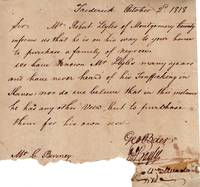
181812956Frederick MD: October 2 1818. 1p. docketed on verso. Roughly torn along bottom edge minor foxing and spotting. Good condition. An uncommon document in Maryland slave history in which George Baer the future mayor of Frederick and a few other men attest that another local citizen named Robert Lyles is not a slave trader. The document reads in part: "Lyles is on his way to your house to purchase a family of negroes. We have known Mr. Lyles many years and have never heard of his Trafficking in Slaves nor do we believe that in this instance he has any other view but to purchase them for his own use." Baer served as mayor of Frederick from 1820 to 1823; his correspondent "C. Burney" is perhaps Clotworthy Birney 1765-1845 a farmer and real estate trader living near Taney Town. An unusual Maryland slave document concerning a slave owner who just wants to buy slaves for his own use not traffic in them because that's somehow better. October 2 unknown
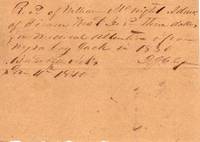
184012966Batesville AR: January 11 1840. 1p. 4 x 5.5 inches docketed on verso. Old horizontal fold toning. Very good. An interesting manuscript record of slave care in Arkansas in the 1830s. The short but impactful document reads in full: "Recd of William McNight Admin. Of Hiram West Decd three dollars for medical attention upon negro boy Jack in 1836. Batesville Ark. Jan 11 1840 DJ Chipman." Such documents are increasingly rare in the market and more uncommon than slave sale documents from the same period. Arkansas has just achieved statehood four years before the presetn document was written. January 11 unknown
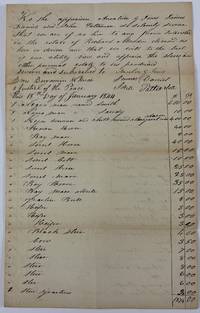
184413105St. Genevieve County MO: January 18 1844. 4pp. on a single folded sheet. Original folds minor wear. Very good condition. A sobering manuscript inventory from the estate of Richard Maddin following his death in Missouri in 1843 detailing his "slaves and other personal" property. The inventory begins by listing the enslaved persons by name along with an assignation of value for each of them as such: "1 Negro man named Smith $600. 1 Negro man named Sandy $10. 1 Negro woman and child named Margaret and Jason $400." The inventory then goes on to list the other property beginning with a long list of livestock followed by equipment household goods and so forth. The document is certified and witnessed by a number of local citizens who attest to the "full and perfect inventory of the goods chattles and personal estate" of the deceased Mr. Maddin. The reasoning is unclear why the second listed slave Sandy was worth only $10. January 18 unknown
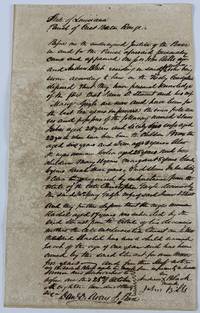
183613107East Baton Rouge Parish LA: October 25 1836. 1p. on a single folded sheet integral blank docketed on verso. Old folds moderate toning and foxing short closed tear along one fold line a few small instances of ink burn. Overall good condition. An interesting document of legal testimony involving numerous named slaves in Louisiana in 1836 ranging in age from one year to almost thirty years of age and including seven children. According to the docketing the document is effectively a "Title to Slaves." The deponents were two local citizens John Bills and Andrew Black who had "personal knowledge of the fact that James D. Stuart and his wife Mary Gayle are now and have been for the last ten years & upwards the bona fide owners and possessors of the following named slaves: Juba Aged 25 and Sicily his wife aged 22 to whom have been born the children Braxton aged six years and Dan aged 3 years. Also the negro woman Celia aged 28 years and her children Mary 11 years Margaret 8 years Charley 6 years Sarah three years which slaves Juba Sicily & Celia were acquired by inheritance from the estate of Christopher Gayle. And they further depose that the negro woman Rachel aged 17 years was inherited by the said Stuart from the estate of his deceased mother.and that the said Rachel has now a child named Jacob of the age of one year." The document is signed by Black Bills and the Justice of the Peace Daniel D. Avery. Documents involving slave inheritance of and subsequent ownership by not one but both members of a marriage are exceedingly rare. October 25 unknown
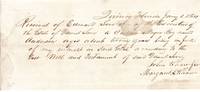
186413103Quincy FL: January 1 1864. 1p. of manuscript docketed on verso. Old crease minor staining. Very good. A short but impactful and somewhat unusual document memorializing the inheritance of a young slave named "Anderson aged about twenty years" from a Florida estate in the penultimate year of the Civil War. Anderson was formerly owned by Daniel Love of Gadsden County and is here inherited by "John Shaw for Margaret E. Shaw" by Love's executor and likely brother Edward Love. The document is dated New Year's Day 1864. An unusual occurrence of a Florida slave being transmitted to a woman through inheritance. January 1 unknown
1819190417Albemarle County VA: 1819-1823. A revealing survival from early 19th-century Virginia: the last will and testament of Isaac Hardin a prominent citizen and first legal owner of the land now known as the Greenwood historic district in Albemarle County. The will transfers ownership of 13 enslaved persons. In his will written in June 1819 and notarized and effected in May 1823 the ailing Hardin leaves the vast majority of his possessions to his wife Elizabeth. This includes the mansion house and plantation along with a number of enslaved persons: Juber Milly Milly's children Willis and Mary Ann and two girls named Hannah and Pheby. The enslaved people are mentioned in the will after Hardin's property and before the listing of his livestock. Later in the will he also transfers legal ownership of a man named Anderson to his oldest son Berry M. Hardin and of six other enslaved people to his daughter Lucinda Scott. The will was signed by Hardin with his mark and witnessed by four individuals on June 26 1819 and was later notarized on May 31 1823. We can assume that Hardin's will was carried out upon his death in 1820 and advertisements for a trust sale in 1830 tell us that much of this same property was later auctioned off including all of the enslaved men and women left to Elizabeth except for Hannah and Pheby who were singled out as Elizabeth's "to have and to hold and to dispose of as she may think proper". Bifolium handwritten on three pages docketed and with remnants of wax seal on fourth page. Old folds some damage to second leaf from where seal was removed not touching text. Very good. unknown
1842106407<p>Folded letter sheet four pages and remnant of wax seal. Creases at folds normal aging; otherwise very good or better. The letter is to Henry J. Carter Stockbridge Mass. from his brother. An unemployed 20 year-old Massachusetts teacher who had left home the year before in "exceeding hard times" Edward had gone to Baltimore – where some 50 teachers were out of work – and taken a job working for a wealthy man who had 4 acres of farm land worked by slaves. "…he has given me the office of overseer to look after the blacks in their work. O but you ought to see me walk over the lot with my cane in my hand to see how my work is going on. Then you ought to see the darky when he wants anything of me come up and take off his hat before he speaks…" Praising the "fine folks live in this beautiful part of the world" Carter proves that even a Massachusetts Yankee could quickly adapt to Southern culture and make peace with slavery. The letter is unsigned. </p>
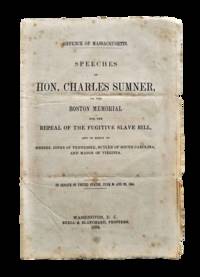
1854176351854. Abolition African Americana SUMNER Charles. Defence of Massachusetts. Speeches of Hon. Charles Sumner on the Boston Memorial for the Repeal of the Fugitive Slave Bill and in Reply To Messrs. Jones of Tennessee Butler of South Carolina And Mason of Virginia in the Senate of the United States June 26 and 28 1854. Washington D.C.: Buell & Blanchard Printers 1854. At the time that this description is being written just three copies are recorded in American institutions. OCLC search results are at best an estimate and can vary over time. The Memorial referred to in the title was a request by 2900 undersigners chiefly men of Boston Mass. to repeal the Fugitive Slave Bill of 1850. What follows is a transcription of Massachusetts Senator and famous abolitionist Charles Sumner's speeches in the ensuing debate: "Mr Jones. asks 'Can anyone suppose that if the Fugitive Slave Act be repealed this Union can exist' To which I reply at once that if the Union in any way be dependent on an Act-- I cannot call it a law-- so revolting in every regard as to that which he refers then it ought not to exist." Sumner goes on to argue amongst other things that the Fugitive Slave Act is parallel to the hated Stamp Act that sparked the Revolutionary War as well as to make spirited rebukes against the pro-slavery Senators Butler Mason and Jones: "The veteran Senator from Virginia Mr. Mason complained that I had characterized one of his "constituents" a person who went all the way from Virginia to Boston in pursuit of a slave as a Slave-Hunter. Sire I choose to call things by their right names. White I call white and black I call black. And where a person degrades himself to the work of chasing a fellow man who under the guidance of the north star has saught a freeman's home far away from the cofle and the chain that person whomsoever he may be I call a Slave-Hunter." Eight sheets folded to make one sixteen-page signature which is stitched along the left edge. Foxing throguhout pages chipped along margins. Dampstaining along two page edges. Delicate but in good condition. <br /> <br /> Charles Sumner January 6 1811 - March 11 1874 was an American statesman and United States Senator from Massachusetts. As an academic lawyer and a powerful orator Sumner was the leader of the anti-slavery forces in the state and a leader of the Radical Republicans in the U.S. Senate during the American Civil War. During Reconstruction he fought to minimize the power of the ex-Confederates and guarantee equal rights to the freedmen. During the war he was a leader of the Radical Republican faction that criticized President Lincoln for being too moderate on the South. Sumner specialized in foreign affairs and worked closely with Lincoln to ensure the British and the French refrained from intervening on the side of the Confederacy during the Civil War. As the chief Radical leader in the Senate during Reconstruction Sumner fought hard to provide equal civil and voting rights for the freedmen on the grounds that "consent of the governed" was a basic principle of American republicanism and to block ex-Confederates from power so they would not reverse the gains made from the Union's victory in the Civil War. unknown
1817SLAVERY005957W. Alexander York. 1817. First U.K. edition with additions to the Philadelphia printing. 12mo. 156 pages including 4 pages of adverts. Frontispiece. Original boards with paper backstrip and title label. Anthony Benezet 1713-1784 was a leading abolitionist.Early nameplates Thomas Marsh and Robert Langdon on front pastedown. Some foxing to prelims. Cup ring to front cover. Backstrip defective label rubbed. Very good. Scarce in original state. W. Alexander, York. hardcover