239 résultats
184524737<p>Mary B. Selden was the grandmother of Eleanor Love Selden who married John Augustine Washington III in 1843. She regrets not being able to furnish Washington with the services of one of her slaves as a stacker for the upcoming wheat harvest.</p><p>Still a faithful employee West Ford worked for the Washington family well into the nineteenth century including delivering this letter.</p><p>The letter includes a list of two dozen slaves written in pencil by John Augustine Washington III.</p><p><strong>SLAVERY. MOUNT VERNON. WEST FORD. MARY BOWLES ARMISTEAD SELDEN.</strong> Autograph Letter Signed to John Augustine Washington III hand delivered by West Ford; <strong>JOHN AUGUSTINE WASHINGTON III</strong>. Autograph List of Slaves. Single folio leaf with autograph address on verso. Alexandria Virginia 1845.</p><p><strong>Complete Transcript</strong></p><p><em>My dear Augustine</em></p><p><em> I am very sorry to be unable to render you the service you require. I have a very fine stacker but he is hired by the year to M<u>r</u> Young as I did not expect to have employment enough for him at M<u>t</u> Ida. Another year if you wish it you can have him I receive very small wages for him and as a stacker I have never known any one equal to him.</em></p><p><em>I am very sorry to hear that Nelly is sick. I hope she will be well enough to come up and meet the bridal party on thursday.</em><em> I received a letter from Eliza to day in which she says they will be at M<u>t</u> Ida that day but will bring no company with them. It will give great pleasure to them and to me if M<u>rs</u> Washington</em><em> Nelly and yourself will come up on that day. M<u>rs</u> Lippitt</em><em> will have a room ready for any of the party that will favour her with their company she must by no means be left behind.</em></p><p><em> Most truly and affectionately / yrs</em></p><p><em>M. B. Selden</em></p><p><2></p><p>Address: <em>John A. Washington Esq. / M<u>t</u> Vernon / By West Ford</em></p><p>Docketing by John Augustine Washington III: <em>Mrs. M. B. Selden</em></p><p>List of slaves in pencil by John Augustine Washington III:</p><p><em>Phil</em> b. 1790</p><p><em>Hannah</em> b. 1826</p><p><em>Gabe</em> b. 1820 <em>Eliza</em> b. 1811</p><p><em>Ned</em> b. 1827 <em>Jim</em> Michum b. 1795</p><p><em>Edmund</em> b. 1827 <em>John</em> b. 1833</p><p><em>Betty</em> b. 1833 <em>Mary</em> b. 1819</p><p><em>West</em> <em>Fanny</em> "Belongs to my wife"</p><p><em>Sarah </em> b. 1809 <em>Dennis</em> b. 1838</p><p><em>Hannah</em> <em>Nelly</em> b. 1836</p><p><em>William</em> b. 1830 <em>Jim</em> Starks b. 1805</p><p><em>Joe</em> b. 1832 <em>Sally</em> b. 1827</p><p><em>Ephraim</em> b. 1834 <em>Tom</em> b. 1835 "bound to me till Oct 1856"</p><p><em>West</em> b. 1838</p><p><em>Jesse</em> b. 1785</p><p><strong>Historical Background</strong></p><p>Farmers in mid-nineteenth-century Virginia typically planted winter wheat in September and October and harvested it in the following June. After wheat had been cut a stacker tied the wheat into bundles and piled the bundles in shocks to dry in the field. After the shocks dried they would be stored in a barn or carefully built stack capped with grass to shed the rain until threshing time. Even after Cyrus McCormick developed his mechanical grain reaper in the 1830s men needed to follow the machine to bundle and stack the wheat. Building a good stack was an important skill and those workers free or enslaved who knew how to do so were very valuable at harvest time.</p><p><strong>Mary Bowles Armistead Alexander Selden</strong> 1783-1846 was born in Hanover Virginia. She married Charles Alexander Jr. 1772-1812 with whom she had five children including Louisa Elizabeth Fontaine Alexander 1802-1827. After her first husband's death she married Dr. Wilson Cary Selden 1761-1835. She was his third wife and they had three children. By his first wife Dr. Selden was the father of Wilson Cary Selden Jr. 1796-1843. In 1822 Wilson Cary Selden Jr. married Louisa Elizabeth Fontaine Alexander and they became the parents of Eleanor Love Selden 1824-1860 who married John A. Washington III. Thus Mary Bowles Selden was both the grandmother and step-grandmother of Eleanor Nelly Washington. At the time she wrote this letter she was living at Mount Ida a 6000-acre plantation that stretched along two miles of the Potomac River north of Alexandria Virginia and fewer than ten miles from Mount Vernon. Her first husband built the neoclassical mansion of Mount Ida in 1808.</p><p><strong>John Augustine Washington III</strong> 1821-1861 was born in Blakeley West Virginia the son of John Augustine Washington II and Jane Charlotte Blackburn Washington and graduated from the University of Virginia in 1840. His father inherited George Washington's Mount Vernon estate in 1829 but it passed to his wife at his death in 1832. In 1841 Augustine Washington proposed to manage Mount Vernon for his mother. When she died in 1855 the plantation passed to him. In 1858 after offering the property to both the federal government and to the State of Virginia he sold 200 acres of the Mount Vernon estate including the mansion outbuildings and family tomb to the Mount Vernon Ladies' Association for $200000. Washington married Eleanor Nelly Love Selden 1824-1860 in 1843 and they had seven children. In 1860 he owned 22 slaves. In 1861 Washington joined the Confederate Army as a lieutenant colonel and served as an aide-de-camp to General Robert E. Lee. He was killed while conducting reconnaissance at the Battle of Cheat Mountain in September 1861.</p><p><strong>West Ford</strong> ca. 1784-1863 was born on the Bushfield Plantation in Westmoreland County Virginia to an enslaved woman owned by George Washington's brother John Augustine Washington. When George Washington visited West Ford was his personal attendant. When John Augustine Washington's widow Hannah died in 1802 she granted Ford his freedom at age 21. Bushrod Washington George Washington's nephew and heir to Mount Vernon freed Ford in 1806 and Ford continued working for the Washington family. According to family oral history Ford's mother Venus told her mistress Hannah Washington that he was George Washington's son. Nearly all historians doubt the claim though one of Washington's nephews certainly could have been the father.</p><p>In 1812 West Ford married Priscella Bell a free woman. Their four children—William Daniel Jane and Julia—were educated on the Mount Vernon Plantation despite laws which restricted the instruction of African Americans. When Bushrod Washington died in 1829 he willed 160 acres of land adjacent to Mount Vernon to West Ford who continued to live on the Mount Vernon estate.</p><p>Over the next several years West Ford was frequently highlighted in the media making his private life a matter of public record. In 1850 two Virginia newspapers—the <em>Alexandria Gazette</em> and the <em>Virginia Advertiser</em>—carried articles describing his prestigious position and authority at Mount Vernon. In 1857 an entry in the Fairfax County Deed Books noted that Ford divided his land among his four children. In 1858 Ford was sketched a second time this time by historian and artist Benson Lossing. In March 1859 <em>Harper's New Monthly Magazine</em> published Lossing's feature on Mount Vernon and included his sketch of Ford. Ford told the reporter of his property on Little Hunting Creek where he planned to retire after the Washington estate was no longer in the Washington family.</p><p>In June 1863 an ailing West Ford was brought back to the Mount Vernon estate by the Mount Vernon Ladies' Association. The association cared for West Ford until his death on July 20 1863.</p><p><strong>Condition</strong></p><p>Foxing and show through particularly near the signature.</p>
188435270Chicago: Jansen McClug & Co 1884. First Edition. Wraps. Very good. Stitched wraps. Two copies. 8 pages. Original covers present and in very good condition. The Thirteenth Amenment passed the Congress in April 1864 officially ending Slavery. Jansen, McClug & Co unknown
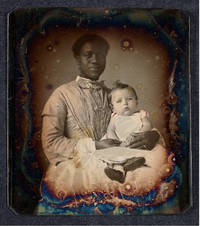
185332820729<p>Two sixth-plate daguerreotypes cased together. Left: nurse and child "Bradford & Ellen Sherwood his nurse" right: parents "Jonathan P. Harrison & his wife Caroline Denny Harrison". White family's cheeks are hand-tinted and the baby's dress is hand-colored. Some spots edges tarnished.</p><p><strong>A tremendous pair.</strong> Jonathan P. Harrison born 23 December 1829 and his wife Caroline Denny Harrison born c. 1834 are in one portrait while their son Bradford born c. 1853 and his black nurse Ellen Sherwood are in the other.</p><p>The Harrison family moved from Talbot County on Maryland's Eastern Shore to Texas in the 1850s to pursue ranching and farming opportunities. According to the U.S. Census in 1860 the family lived in Corpus Christi Texas with Jonathan reported as 29 years old Caroline 26 and Bradford 7 indicating a date of 1853 for this photograph.</p><p>The Harrisons and Dennys were prominent Maryland and Texas families. Jonathan served with the 1st Texas Cavalry during the Civil War. Identified daguerreotype portraits of slaves are rare and linked pairs such as this set are very rare. It is conceivable that Ellen Sherwood was a free black but given the status of the Harrison and Denny families it seems probable that she was a slave.</p><p>This splendid pair of photographs vividly demonstrates the complexity of black-white relationships in the antebellum South.</p><p><strong>Provenance: "Jonathan P. Harrison & his wife Caroline Denny Harrison / Their child Bradford & Ellen Sherwood his nurse" identified in a manuscript note beneath the right daguerreotype in the hand of Jonathan's niece Patty Belle Tilghman 1851-1931.</strong> See Hanson <em>Old Kent: The Eastern Shore of Maryland</em> p. 96.</p>
1858660371858. Dividing Prize Money After the Capture of a Slave Ship Slavery. United States. In the Senate of the United States. February 21 1858-Ordered to Be Printed. Mr. Polk Made the Following Adverse Report To Accompany Bill S. C. of C. 108.: The Committee of Claims To Whom was Referred the Opinion of the Court of Claims in the Case of O.H. Berryman and Others Report: The Claimants in this Case are the Officers and Crew of the United States Schooner "On-Ka-Hy-E" drop-head title. Washington DC: S.n. 1858. 13 pp. Octavo 9" x 5-1/2". Disbound light rubbing to extremities some toning and light foxing. $100. 35th Congress 1st Session Senate Rep. Com. No. 33. This speech disputes the distribution of prize money between the Federal government and the crew that captured the slave ship Laurens. unknown
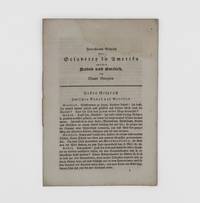
1845332998United States 1845. 16pp. 8vo. Self-wrappers dampstaining. 16pp. 8vo. An anti-slavery work in German written in the form of a dialogue between Gottlieb who argues that the slave trade is a sin and Nabob who begins by arguing in defense of slavery but is swayed by Gottlieb's arguments. unknown
184618128London; Chapman Brothers. 1846. The True 1st Edition. Hardback. Very good copy in the original blind-blocked fine-ribbed cloth. Minor nick to the spine crown with the usual dust-dulling to the bands and panel edges. Remains an uncommonly well-preserved example of a scarce and seminal title; 296 pages; Physical desc. : 296 p. ; 22 cm. Intended by the publisher as the first in a 'Library' of political and literary importance for discerning readers. Subject: Slaves - United States - Social conditions. The Clarke Family Narrative - Witness accounts - Jonathan Walker's Trial - etc. London; Chapman Brothers. hardcover
18161138361816. First Edition. SLAVERY. The Interference of the British Legislature in the Internal Concerns of the West India Islands Respecting Their Slaves Deprecated. London: J. Mawman 1816. Slim octavo modern blue-gray paper wrappers; pp. 58. $1800.First edition of this defense of the West Indian slave trade arguing against emancipation.Cloaked in pro-abolition language and anonymously written by a person claiming to be an abolitionist this work is actually a zealous condemnation of British interference in the slave trade of the West Indies. After briefly discussing the abolition movement the 1807 act abolishing slavery in britain and prominent anti-slavery organization the author sets out to make his main argument: that a bill requiring registry of slaves in the West Indies would infringe on the rights of those colonies. The author swiftly aligns himself with the interests of the West Indian Planters arguing that abolishing slavery is a different cause from emancipating people of African descent. He points out that this bill is merely the first in a projected series of measures meant to emancipate the Black population of the West Indies. Set in the awkward period between 1807 and 1833 when slavery in Britain was illegal but the slave trade still thrived abroad this work makes sense of obvious hypocrisy by arguing that slavery was permitted by God and that Blacks of African descent were better off as slaves than in Africa. The will of those against slavery proved stronger and complete abolition eventually became the law of the land. Sabin 34904. Kress 21649. This work last appeared at auction over 25 years ago; prior to that it had not been seen since the 1940s.Interior quite clean with only slight pressure offsetting toning to spine of modern wrappers. A beautiful copy in fine condition. unknown
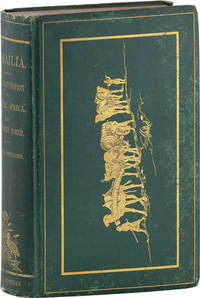
187561084New York: Harper and Brothers 1875. First American Edition. Octavo 24cm. Green cloth stamped in gilt; brown coated endpapers; 542pp; steel-engraved frontispiece 2 wood-enraved frontispieces 2 color maps 1 folding and 48 wood-engraved plates all with tissue guards. Inscribed "Charles V. Payne from his friend M. R. E. Christmas 1874" on front free endpaper; the same inscription is repeated with the date 1875 on a front flyleaf. A sound copy externally rubbed with superficial silverfishing to both boards internally clean with two central gatherings pulled but not fully detached short tear to folding map at gutter: just Very Good. <br /> <br /> Samuel Baker 1821-1893 was a noted British explorer of Africa. In 1860 he was appointed "governor-general of the equatorial Nile basin" by the Khedive Ismail of Egypt with duties including "annexing the equatorial Nile basin establishing Egyptian authority over the region south of Gondokoro suppressing the slave trade" and more ODNB. His success was mixed: he successfully annexed Gondokoro and did suppress the slave trade but failed to establish secure control of the region ODNB. This account published after his return to England details how he "raised and trained a fighting force.to crush" the slave trade Czech. CZECH p.11. Harper and Brothers unknown
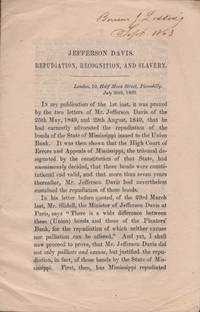
186335488London: R. J. Walker 1863. First Edition. Wraps. Fair. Wraps. 12 pages. Title on page 1. Tissue and glue patch repairs made to pages 11 and 12. Inscribed and signed top of page 1 by historian and author Benson J. Lossing. The author R. J. Walker was a Democrat Senator from Mississippi in the years 1835-45. He was a staunch pro-Union advocate during the Civil War. Fair condition due to the reapirs. R. J. Walker unknown
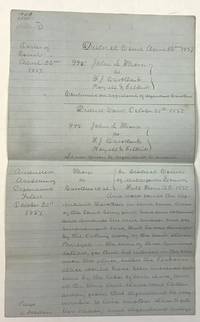
185740346Matagorda County Texas 1857. Six pages in neat ink manuscript on lined pale blue legal paper. Fine. The document is probably the record for Carothers' appeal of the Court's judgment in favor of Thorn.<br /> <br /> The parties having waived a jury trial the Court found in favor of Thorn the Plaintiff. In addition to the failure to pay Thorn for the hire of Taswell Thorn claimed that Carothers had failed to pay $100 rent to Thorn for farming on Thorn's property. <br /> Carothers said that the slave Bridget upon whom Carothers had relied for performing work on the property had been "taken away" apparently by Thorn during the term of the agreement. Bridget's absence Carothers said caused his nonperformance and thus excused his failure to pay. The Court disagreed and ordered Carothers to pay the amount of the notes plus costs and interest. unknown
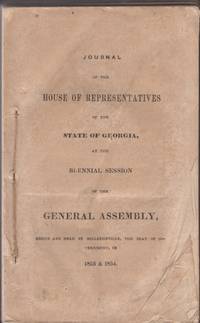
185335359n.p.: Georgia 1853. Wraps. Fair. String bound wraps. 1011 pages 1 page blank 1 37 page Index 1 page blank 1. Title page is page 1. Page 1 is toned and creased. Rear wrap is lightly toned with a few spots. Text block is not trimmed and the pages are uncut at the top edge. Moderate toning and foxing to the contents. <br /> <br /> Contents include a section on Slave and Free Persons of Color laws. Printer information or location not provided on the title page. A similar copy held by Emory University states the 1853 & 1854 Journal was printed in Savannah by S. T. Chapman. Emory's copy is has 904 pages while this copy has 1011 pages. Also Emory's copy does not have the hyphen in the word Biennial on the printed title page. Georgia unknown
18651260191865. First Edition. CONSTITUTION. Journal of the House of Delegates of the State of Virginia. for the Session of 18645. Alexandria: D. Turner 1865. Octavo original front printed wrapper respined renewed rear wrapper original string stitching; pp. 1-3 4-83 1. Housed in a custom chemise and clamshell box. $4500.First edition one of 500 copies of the momentous Journal featuring its February 9 1865 entry on the Alexandria Virginia government's passage of the 13th Amendment mere days after the U.S. Congress the first of the four Unionist southern states to pass the Amendment also featuring the governor's Message noting: ""though we have in inherited from our fathers of the revolution the blessings of a great nation yet they also left to us an inheritance of African slavery which has proved a bitter dreg in our cup of freedom"" a vital record of forces for constitutional change near the end of the Civil War.Soon after the 1860 election amidst southern secession ""the great questions of union or disunion war or peace hung in the balance. Probably the crucial weight on the scale was Virginia as long as the federal government did not seek to coerce the states Virginia secessionists were unable to achieve a majority. When Lincoln responded with force to the attack on Fort Sumter however the vote in Virginia went in favor of secession."" Subsequently a Virginia convention ""met in Wheeling on May 13 1861 it elected as Governor Francis Pierpont a western Virginian and ardent Unionist and arranged for the creation of a legislature to replace the body sitting in Richmond in July 1861 the new legislature met at the 'Restored Virginia' capital of Wheeling in a special session called by Pierpont."" Against its ""claim to represent a majority of Virginians"" a new state of West Virginia was created in 1863 and Pierpont's government moved to Alexandria to govern areas of Virginia under Union occupation Harrison Lawfulness of the Reconstruction Amendments 380-83.Scholars observe that the 13th Amendment its fellow amendments and Reconstruction as ""both a political process made possible by military successes and constitutional thought grew from wartime as well as post-Appomattox developments"" Hyman and Wiecek Equal Justice 247. This rare first edition of Journal of the House of Delegates substantiates that in documenting passage of the 13th Amendment by Pierpont's Virginia government mere days after the U.S. Congress passed the Amendment on January 31 1865. With that Virginia became the first of the four Unionist southern states that ratified the 13th Amendment. Of those Louisiana followed on February 17 with Arkansas and Tennessee that April. The 13th Amendment is the focus of the Journal's entry for February 9 1865 which states: ""Mr. Brownley called up Senate bill No. 12 entitled 'An Act to ratify the joint resolution of Congress passed January 31 1865 proposing an amendment to the Constitution of the United States.' The bill was read the first and second time and the rules were suspended and the bill read the third time and the bill passed."" Also notable herein is the complete printing of Governor Pierpont's opening Message where he notes: ""though we inherited from our fathers of the revolution the blessings of a great nation yet they also left to us an inheritance of African slavery which has proved a bitter dreg in our cup of freedom."" He speaks at length of the rights due people of color and the abolition of laws such as those that prohibit ""negro testimony"" or proscribe a ""different punishment for persons of African dissent"" from that of ""white persons.""""The legislature met for its second session on December 5 1864 The governor's message was a long and important document and indicated the changes of opinion that the war was bringing about. Pierpont gave his views upon the all-important negro question. He congratulated the constitutional convention which had met in the spring on the abolition of slavery in Virginia and advocated sweeping changes in the laws concerning negroes. The act prescribing different punishments for blacks should he said be altered in accordance with the amended constitution as well as the law for apprenticing them. The law prohibiting the education of negroes should be abolished His language was on the whole very moderate. He advised the legalizing of the marital relations of negroes and most important the establishment of public schools Notwithstanding the governor's advice no acts of great importance passed the legislature On February 9 1865 the assembly ratified the 13th Amendment to the Constitution of the United States. It adjourned on March 7"" Eckenrode Political History of Virginia During the Reconstruction. Faint ""U.N.C. Duplicate"" stamp to front wrapper.Text fine; just a bit of faint soiling and a tide line to fragile front wrapper. An excellent copy of this elusive item. unknown
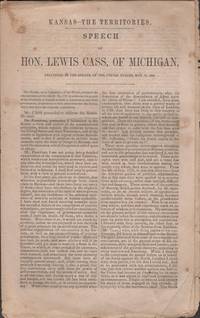
185634806Washington D.C.: Printed at the Office of the Congressional Globe 1856. First Edition. Wraps. Fair. Single sheet folded wraps. 8 pages. Light toning to the paper. Small holes at the fold intersections margins and edges. No loss of print. Light edge wear to the paper with minimal loss of a couple of letters. Speech covers recent violence and Kansas becoming a free State. Fair condition. Printed at the Office of the Congressional Globe unknown
185435390Boston: Phillips Sampson and Company 1854. 1854. Hardcover. Fair. Small octavo. 1 viii 9-256 pages 4 pages advertisements 1. Folding frontispiece map. Blue cloth hardcover with blind stamped covers. Gilt title and decoration on the spine. Folding map has some wrinkling and creases. Cloth hardcover is shelf worn rubbed at the extremities and chipped at the head and base of the spine. Lean to the binding. Light scattered toning and foxing to the contents. Fair. <br /> <br /> Graff 1079. Phillips, Sampson and Company hardcover
1850106404<p>Folio manuscript legal sheets 11 pp. plus docketing on final back sheet. Traces of wax in some margins. Paper is browned and aged some minor creasing at folds margin hole on a couple of pages not affecting text; otherwise very good. This is a very complex legal case about the ownership of two slaves. These manuscript documents are signed by the three Constables deposed as witnesses. The testimony is taken at the law offices of Lysander G. Gordon. It seems that an individual who owed people money was forced to give the slaves to a sheriff and were then sold to William Knox in Southern Tennessee. However it appears that the slaves actually belonged to someone else. These documents try to sort though this mess. </p>
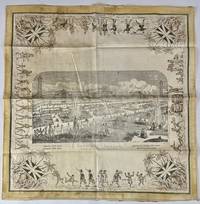
189012893N.p. likely London 1890. Lithograph on silk handkerchief approximately 24 x 24 inches with additional lithographed scene printed around the outer margins in brown and blue ink. Previously matted and framed with resultant edge wear and adhesive staining around margins. Old folds some foxing and staining in image area. Overall good plus condition. A very rare and impactful 19th-century British lithograph-on-lithograph the original a view of London's Crystal Palace with the addition of a satirical scene detailing the history of British colonialist activities in Africa. The overall scene is presented in four linear parts one across each mostly blank margin of the Crystal Palace scene; interestingly the two lithographs overlap each other at a few places along the short edge. The scene seems to begin with the part labeled "African Slave Trade" picturing two slave traders leading a chained procession of African slaves men women and children. The next edge is labeled "The Rescue" and shows three British soldiers including one bagpiper freeing the slaves who are pictured free of their chains and dancing and now detaining the two slave traders in chains. <br /> <br /> The third panel pictures two groups of Africans -- one group running to a rum dealer and another group listening to a man holding a book presumably a missionary preacher. This scene seems to allude to British activities in the West Indies. The final panel labeled "Civilization" is the most varied. It pictures a couple of British railway agents under the banner "Change for Timbuctoo;" a group of African men in Western garb one holding a sign reading "African Times;" an African man riding a bicycle; and a family scene of a man kneeling in front of a seated woman while he kisses her hand and a young man in the background sells matches. How civilized indeed. Each corner of the work is emblazoned with a British lion and the Union Jack amidst a field of African foliage and West Indian palm trees. The scene seems to celebrate the effects of British colonialism while ignoring the country's own history as slaveholders and traffickers the previous century.<br /> <br /> "The border panels of this printed cotton handkerchief caricature the impact of British colonial policy on Africa. It was probably produced at the end of the 19th century at a period when European colonial rule led to increasing social and political intervention in African societies. It illustrates the rescue of a group of slaves by a British military detachment and their subsequent 'westernization' through the introduction of European goods and commodities." This description comes from the online description of the only other example of this scene we can find which resides at the National Maritime Museum NMM at Greenwich London. The NMM example is printed on a blank cotton handkerchief in brown and red and is slightly smaller on one side than our example. Their dating is likely correct if for nothing else because of the depiction of a chain-driven bicycle which became popular in the UK in the 1890s. unknown
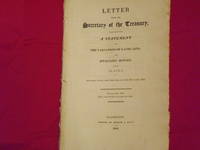
1816100537Pamphlet formate folio disbound first pamphlet 3 leaves printed on recto only second 7pp. third 6 pages and folding chart. Pamphlet extracted from larger volumne chipping along spine and edges not affecting text second papmple completely disbound paper browned and somewhat dry These pamphlets are rare and represent an important source of information on the numbers and values of slaves in early 19th century America. The first title presents the value assigned to slaves in 11 states including New York. The second lists the number and values of slaves in the various counties in the state of Maryland. The final pamphlet presents real estate values and values on dwellings including slaves in the counties of Pennsylvania. The information in these reports was compiled by Alexander James Dallas 1759-1817 who was the Secretary of the Treasury. Dallas born in Kingston Jamaica settled in Pennsylvania and practiced law there. Eventually he would become Secretary of the Treasury in 1814 when the nation was almost bankrupt. He managed to reorganize the department get the country out of debt created a surplus and even helped promote what would become the Second Bank of the United States. ANB. William A. Davis,
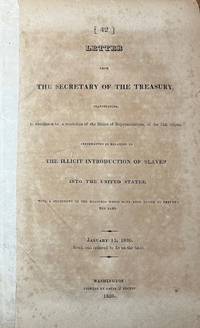
182035023Washington D.C.: Printed by Gales & Seaton 1820. First Edition. Wraps. Fair. Disbound wraps. Approx. 9" x 4". 12 pages. Toning to the paper. First 4 pages have a small edge chip not affecting the print. Wraps spine backed with later tissue paper. Pages 3-6 are loose. Scarce. 10 copies located in OCLC. The Act Prohibiting Importation of Slaves promoted by President Thomas Jefferson was passed in 1807 and took effect in 1808.<br /> <br /> From the 1820 letter submitted by the Treasury Department Spain and individuals were responsible for the illegal importation of Slaves into the United States. Secretary of Treasury William Crawford writes "From information recently received by this Department there is just reason to believe that Sir Gregor MacGregor has taken military possession of Amelia Island Florida in the name of the Spanish Patriots" Continued on the same page "In addition to the circumstances already communicated the disposition which has been manifested by the vessels of Spain engaged in the African Slave Trade to introduce illicitly into that section of the Union the persons who in the prosecution of their traffic have been subjected to their control seems to require the presence of a force sufficient to enforce the due execution of the laws against the introduction of slaves into the United States." The Treasury Department recommends "To guard against the unlawful introduction of slaves and to repress any attempt that may be made by the foreign belligerent force collected in that neighborhood to excite domestic insurrection among the blacks it appears to me to be absolutely necessary that a land and naval force be stationed at St. Mary's." <br /> <br /> Soon after this letter was published Florida was ceded to the United States by Spain in 1821. Florida was a territory until 1845. Printed by Gales & Seaton unknown
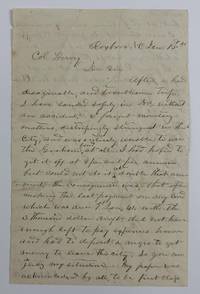
18605563Roxboro N.C.: January 15 1860. Good. 2pp. Wrinkled previously folded. A few minor losses at folds not affecting text. Two half-inch closed tears from edges. Light toning and foxing. After arriving in Roxboro North Carolina in mid-January 1860 planter J.C. Barnett writes to his friend and business partner a Colonel Henry to complain about the tight money situation in the state which has forced him essentially to pawn a slave in order to raise cash: "I found monetary matters distressingly stringent in the City and was entirely unable to use the Graham bond at all. I had hoped to get it off at 8 per cent per annum but could not do it at double that amount the consequence was that after making the last payment on my land which was due 1st Jan 61 with the 3 thousand dollar draft I did not have enough left to pay expenses home and had to deposit a negro to get money to leave the city. So you can judge my situation." Furthermore he has other unpaid debts that he hopes to settle with future cotton sales: "I gave R.H. Williams a draft for 93 dollars also Messrs Lea & Cheatham of Louisville one for 111 dollars and owing to the circumstances just mentioned was unable to meet them. You will do me a favor when you see these gentlemen to explain the reason. When you sell my cotton after paying Mr. Batt and yourself the expenses if there is a remainder please apply it to my Louisville and Williams debt. Also Mr. Gratiot has a claim of an hundred dollars. I will write to these gentlemen and tell to apply to you when you sell my cotton." Interesting detail on economic difficulties in the south just prior to the Civil War. January 15 unknown