111 résultats
198315288Princeton: Princeton University Press 1983. First Edition. Octavo. Cloth boards; dustjacket; 515pp; illus; includes bibliography. Removed from a non-circulating private library with ink ownership markings to front endpaper and accompanying black ink elisions from de-accession. Light rubbing to boards; otherwise bright copy in near fine dustwrapper with unmarked text. Princeton University Press unknown books
1864WRCAM53096Richmond 1864. Broadside 18 x 12 inches. Printed in three columns. Previously folded with a couple small separations along old fold lines. Light toning and foxing. About very good. A very scarce and quite interesting broadside circular printing of the act which allowed slaves and free blacks to be used in certain tasks by the Confederate Army during the Civil War as well as instructions for the conscription and induction of those men into the armed forces. The Confederacy was loath to arm any of its slave population but by 1864 could not spare any further manpower from their infantry to perform menial tasks and the government therefore passed a law allowing slaves to be used "in certain capacities" such as the construction of fortification the production of arms and the transport of materiel. The first column of this broadside comprises a full printing of that law while the remainder sets forth the rules for the impressment of slaves into military service for their care while in service and for the compensation of their owners. <br> <br> A fascinating piece that lays bare the desperation of the Confederacy for labor and supplies in early 1864. Not in Parrish & Willingham. unknown books
183441625Salem MA: W & S.B. Ives 1834. 8 pp. <br /><br />"The society organized January 27 A.D. 1834.--Salem Mass." Waterstained. Bound in original printed wrappers. Front wrapper detached but present. Uncommon. W & S.B. Ives books
1865974Santiago de Cuba 1865. Very good. 10 leaves. Removed from a larger volume and restitched. Minor wear and one small area of worming at edges. Light tanning and foxing. Accomplished in several legible hands. A fantastic set of manuscript records for a slave auction house the General Slave Depository in Santiago de Cuba dating to January 1865. Santiago along with Havana and Cienfuegos was one of three major sites for slave sales on the island during the 19th century. The first leaf of the document provides a statement that the documents were assembled in accordance with the rules established for slave auctions which had been updated and approved at the end of the previous year. The second two documents lay out mortgage agreements and financial obligations between the slave house and the Real Sociedad Economica de Amigos de Pais of the city in which the auction owners acknowledge debts and forthcoming payments on the order of several thousand pesos. Following these are two leaves containing a "Relacion de los esclavos ecsistentes en el deposito de esta Ciudad en el dia de la fecha" that is a list of slaves at the depository on the day of the auction and their owners and renters which perhaps were a part of the collateral for securing the loan. A total of twenty-nine slaves are listed and the leaf that follows certifies that the list is correct according the to the director and the auctioneer of the depository. The final two leaves provide official recognition of the loan from two distinct government offices. All documents are signed by the relevant parties and government officials involved in the agreement. In all the present group of documents provides a detailed assessment of debts and human assets of the slave auction house in Santiago de Cuba in the mid-1860s and is a fascinating and valuable document of the bureaucracy and regulation surrounding the financial realities of selling slaves in Cuba during this period. unknown books
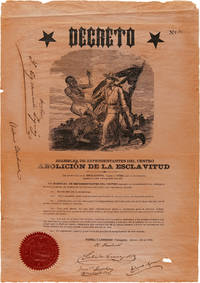
1869WRCAM56566Camagüey Cuba 1869. Pictorial letterpress broadside 18 1/2 x 13 inches. Numbered "54" in manuscript bearing the embossed red seal of the Republica Cubana and signed in ink by Salvador Cisneros y Betancourt Eduardo Agramonte Ignacio Agramonte Loyn áz Francisco Sánchez y Betancourt and Antonio Zambrana. Old horizontal folds minor creasing handful of small edge chips. Small hole in bottom margin just touching one ink signature. Very good condition. A rare and significant pictorial Cuban decree from the provisional rebel government abolishing slavery on the part of the island they controlled issued by the radical faction of the Cuban nationalists fighting against Spanish rule in the first months of the Ten Years' War. <br> <br> This proclamation is illustrated with a dramatic woodcut signed "LFR" depicting an ill-clad but exultant freed slave and a rebel celebrating in front of the Cuban flag. This decree stipulated freedom for all the enslaved people of Cuba in hopes that they would join the revolutionary struggle. The decree also provided for eventual compensation to slaveholders and ordered that freed individuals must serve the revolution either through military service or by continuing with their previous work. Among the important leaders who signed the present document were Salvador Cisneros y Betancourt as president just below the printed text and Ignacio Agramonte y Loynáz as secretary to the left of the engraving. <br> <br> The practical effect of this decree was modest as the rebels only controlled limited territory before their ultimate defeat and their territory was generally under the control of more conservative military commanders but such a proclamation joined a growing chorus of abolitionist sentiment in Cuba which finally realized the end of slavery in 1886. A powerful statement of anti-slavery policy in mid-19th century Cuba with a striking illustration of a jubilant slave celebrating his short-lived freedom. Rare with no copies recorded in OCLC. unknown books
28345Confidant of Missouri pioneer Jonathan Bryan 1759-1846 of the noted St. Charles family whose relatives included their neighbor Daniel Boone. DS 1p 7½" X 12" St. Charles County MO 1847 February 2. Near fine. Acknowledgment that Tuter who signs himself as "Administrator of the Estate of Johnathan Bryan" has had a writ of replevin made out and issued to the St. Charles sheriff Edward C. Cunningham 1809-65 for delivery to an unnamed offender. The writ seeks to recover the following property apparently wrongfully taken from Jonathan Bryan's estate: "one negro man a Slave named Heney one Two horse waggon and one pair of Briches Two Black horses one Lorrel horse with bold face one walnut Cupboard one clock one Bureau one bedstead and bedding one walnut Table one Trunk one Bible." In other words everything but the kitchen sink. Signed at the conclusion by Tater in his definitely untutored hand. Tales of slaves are found in the Bryan family lore such as: "Mrs. Jonathan Bryan a kinswoman of Daniel Boone was working in her yard with a slave woman when a boy slave screamed. She saw an Indian warrior heading for them with a tomahawk in one hand and a gun in the other. The women ran for the house. Just as they were slamming the door they caught the warrior's head and right arm between the door and facing. The slave woman grabbed the hatchet from his hand and killed him with a sharp blow. The women had barely recovered from their fright when the boy shouted again." Could the slave boy in this old family legend by none less than the "Slave named Heney" whose return is demanded in this replevin suit Quite unusual slavery item with an intriguing history. unknown books
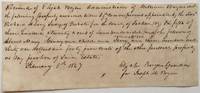
1847266916Jackson County FL 1847. unbound. 1 page 3.5 x 7.5 inches Jackson County Florida February 5 1847 -- a probate court receipt acknowledging that "Elijah Bryon Administrator of William Bryon received the following property awarded to me by the commissioners appointed by the Hon. Richard H. Long Judge of Probate for the County of Jackson one-fifth of three-hundred and twenty acres of land undivided and the following slaves: Mary Ginny and child and Jerry valued at $1500 and three-hundred and thirty one dollars and forty-five cents of the other personal property as my position of said Estate." Signed at the bottom: "Elijah Bryan guardian for Joseph M. Bryan" and docketed on the bacl: "E. Bryan" and "Richard H. Long J.P.C." Richard H. Long 1791 - 1865 was appointed by the Territorial Governor in 1833 to complete the land sale between S. Brown and the Apalachicola Tustenuggee and Hadjo tribes treating the Indians fairly. He was a representative to Florida's first Constitutional Convention and later served as Speaker of the House. During the Civil War he rose to the rank of Colonel of a Florida Regiment and saw much action in the field. His body was recently located in a forgotten Confederate cemetery. Elijah H. Long was known for building a 5200-acre plantation for his mother. The family was well known in Jackson County and evidently all were slave owners. One horizontal fold; uniformly toned. Very good condition.<br/><br/> unknown books
1854CAT0114New York: H. Long 1854. First Edition. 8vo publisher's brown cloth 259 pp. Good Plus. The Vermont-born Chase moved to Tennessee in 1838. He was elected as a member of the Democratic Party to the Twenty-ninth and Thirtieth Congresses serving from 1845-1849 before returning north to New York City to practice law. In this work of fiction which is mostly intended as a diatribe against the hypocrisy of the English he proposes that "The African adopts him-self with greater readiness than the white man." In his view wage slavery in the North and in England was worse than the slavery in the South. An uncommon first edition copy. Some wear and tears to boards some light marginal foxing to contents but still sound and usable good plus condition overall. H. Long unknown books
185519759N. p.: Jan. 4th 1855. Autograph address in ink on an unbound fascicle of 15 folia 30 leaves stitched. These arguments it is believed fairly prove that a man can be at the same time both a slave-holder and a Christian or stated in the abstract that the particular relation of superior & inferior known as slavery is not in itself necessarily sinful." An extensive detailed legal and ethical apology for American slavery arguing that a reciprocal relationship exists between the enslaver and the slave; the speak tentatively argues that Congress does have power to regulate slavery in the territories and had words against the doctrine of Popular Sovereignty. The anonymity of this argument and the popular setting of the lyceum stage perhaps as a student production seems altogether fitting as a reflection of the widespread currency of legalistic equivocation over chattel slavery in America prior to the Civil War. With revisions and interpolations and corrections to the text throughout. Jan. 4th, books
183945020Philadelphia: Printed for the Committee / J. Richards 1839. First Edition. 12mo 19cm.; side-stitched self-wrappers; 12pp. Some foxing faint fold lines else Very Good or better. Extracts taken chiefly from British abolitionist Thomas Fowell Buxton's larger work "The African Slave Trade" in which he argued that the African slave trade could be stamped out by other forms of trade as well as the spread of Christianity. Printed for the Committee / J. Richards unknown books
1840100899Pamphlet leaflet 8vo 4 33-36 pp. Some aging and browning and a small stain at the bottom let margin; otherwise very good plus. Basically this short pamphlet provides "abridged selections" of various slave statutes from states around the country prior to the Civil War .The statutes consistently explain that a slave should be considered a thing not a person and of course has no right to own property. It also outlines various punishments such as 25 lashes for riding a horse without permission 21 lashes if more than six slaves meet together and death for striking a white person 3rd offense. The Anti-Slavery Bugle, books
1826WRCAM40209Philadelphia 1826. 40pp. Original tan wrappers. Wraps a bit creased spine slightly chipped. Contemporary ownership inscription on titlepage. Text a bit tanned. very good. A call for the abolition of the slave trade with sections regarding the involvement of a number of foreign countries in the trade. This copy belonged to the Rev. Leonard Worcester of Peacham Vt. Worcester was a member of the Auxiliary Colonization Society of the State of Vermont a regional subgroup of the American Colonization Society. A nice association copy. SHOEMAKER 23434. paperback books
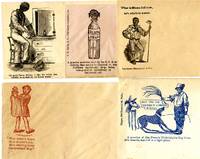
186536346Philadelphia Lancaster PA and elsewhere: Magee Philadelphia Zahm Lancaster and three others 1865. Five postal covers all in Very Good condition:<br/> a. "The latest Contraband of War." A working slave stands confidently: "Whar is Massa Jeff now dat's what's de matter."<br/>Weiss C-BL-16.<br/> b. "Him fader's hope / Him moder's joy / Him darling little / Contraband Boy." A white man holds a little black baby.<br/>Weiss C-BL-11.<br/> c. A medicine bottle labeled "Black Drop" with the head of a Negro at its top: "A popular medicine used by the C.S.A. aristocracy that cannot be obtained in any Northern apothecary shop being com-POUND-ed exclusively on the sacred soil." italics instead of caps in the original. "S.H. Zahm & Co. Publishers Lancaster Pa." <br/>Weiss C-BL-12.<br/> d. A black man polishes boots in a house. Referring to Ben Butler's capture of New Orleans he says "By golly Massa Butler I like dis better dan workin' in de field for ole Sesesh massa." <br/>Weiss C-BL-59.<br/> e. "A member of Jim Francis' Philadelphia Dog Detective Gards has Jeff in a tight place." A black man holding some twigs looks down at a dog with collar labeled "Jeff." An observing donkey says "Jeff has the feelings of a prince of wails." Published by Magee 316 Chestnut Street Philadelphia.<br/>Weiss C-BL-35. Magee [Philadelphia], Zahm [Lancaster], and three others unknown books
186014411New-York John A. Gray Printer 1860. First edition. Some foxing; a couple of small spots of light staining; a very good copy. 16mo original printed self-wrappers 29 pages. In the wake of John Brown's Harpers Ferry raid long-time abolitionist Gerrit Smith who had been one of the covert backers of the raid--the "Secret Six" was evidently so horrified once he realized the scope of the violence the raid unleashed that he had a breakdown and entered an asylum. Smith returned from his insensibility to find that--perhaps not surprisingly--some northern Democrats had published attacks on his links to the raid. Smith responded by suing for libel and this pamphlet reproduces correspondence between his son-in-law Charles D. Miller and the subjects of the suit with extracts from Smith's writings and abolitionist polemics. Sabin 82609; LCP Afro-Americana 9498. John A. Gray, Printer unknown books
15101This rare pamphlet "Act No. XIX of 1929 Passed by the Indian Legislature.An Act to Restrain the Solemnisation of Child Marriages" was a critical step in protecting girls. No other copies in OCLC Worldcat<br/><br/>Child marriage was historically prevalent in India where the International Center for Research on Women reported that 47% of Indian weddings in the early 20th century involved brides under the age of 18. Poverty was a driving factor in child marriage as families in financial straits could improve their economic standing by marrying their daughters to wealthier older men. Yet as other countries began making improvements for women and girls India too recognized the dangers inherent to girls' health and well-being when they were married and became mothers while still in their own childhoods. This pamphlet which is the only known copy according to OCLC Worldcat details the "punishment for male adult below twenty one years of age marrying a child punishment for male adults over twenty one years of age marrying a child and punishment for solemnizing a child marriage." While child marriage does persist in India its rates have gone down and modern India has joined the South Asian Initiative to End Violence Against Children SAIEVAC which adopted a regional action plan to enforce the marriage bans and end child marriage in and beyond its own borders. unknown books
184524737<p>Mary B. Selden was the grandmother of Eleanor Love Selden who married John Augustine Washington III in 1843. She regrets not being able to furnish Washington with the services of one of her slaves as a stacker for the upcoming wheat harvest.</p><p>Still a faithful employee West Ford worked for the Washington family well into the nineteenth century including delivering this letter.</p><p>The letter includes a list of two dozen slaves written in pencil by John Augustine Washington III.</p> <b>SLAVERY. MOUNT VERNON. WEST FORD. MARY BOWLES ARMISTEAD SELDEN.</b>Autograph Letter Signed to John Augustine Washington III hand delivered by West Ford; <b>JOHN AUGUSTINE WASHINGTON III</b>. Autograph List of Slaves. Single folio leaf with autograph address on verso. Alexandria Virginia 1845.<p><b>Complete Transcript</b></p><p><i>My dear Augustine</i></p><p><i> I am very sorry to be unable to render you the service you require. I have a very fine stacker but he is hired by the year to M<u>r</u> Young as I did not expect to have employment enough for him at M<u>t</u>Ida. Another year if you wish it you can have him I receive very small wages for him and as a stacker I have never known any one equal to him.</i></p><p><i>I am very sorry to hear that Nelly is sick. I hope she will be well enough to come up and meet the bridal party on thursday.</i><i> I received a letter from Eliza to day in which she says they will be at M<u>t</u> Ida that day but will bring no company with them. It will give great pleasure to them and to me if M<u>rs</u> Washington</i><i> Nelly and yourself will come up on that day. M<u>rs</u> Lippitt</i><i> will have a room ready for any of the party that will favour her with their company she must by no means be left behind.</i></p><p><i> Most truly and affectionately / yrs</i></p><p><i>M. B. Selden</i></p><p><2></p><p>Address: <i>John A. Washington Esq. / M<u>t</u> Vernon / By West Ford</i></p><p>Docketing by John Augustine Washington III: <i>Mrs. M. B. Selden</i></p><p>List of slaves in pencil by John Augustine Washington III:</p><p><i>Phil</i> b. 1790</p><p><i>Hannah</i> b. 1826</p><p><i>Gabe</i> b. 1820 <i>Eliza</i> b. 1811</p><p><i>Ned</i> b. 1827 <i>Jim</i>Michum b. 1795</p><p><i>Edmund</i> b. 1827 <i>John</i> b. 1833</p><p><i>Betty</i> b. 1833 <i>Mary</i> b. 1819</p><p><i>West</i> <i>Fanny</i> "Belongs to my wife"</p><p><i>Sarah </i> b. 1809 <i>Dennis</i> b. 1838</p><p><i>Hannah</i> <i>Nelly</i> b. 1836</p><p><i>William</i> b. 1830 <i>Jim</i>Starks b. 1805</p><p><i>Joe</i> b. 1832 <i>Sally</i> b. 1827</p><p><i>Ephraim</i> b. 1834 <i>Tom</i> b. 1835 "bound to me till Oct 1856"</p><p><i>West</i> b. 1838</p><p><i>Jesse</i> b. 1785</p><p><b>Historical Background</b></p><p>Farmers in mid-nineteenth-century Virginia typically planted winter wheat in September and October and harvested it in the following June. After wheat had been cut a stacker tied the wheat into bundles and piled the bundles in shocks to dry in the field. After the shocks dried they would be stored in a barn or carefully built stack capped with grass to shed the rain until threshing time. Even after Cyrus McCormick developed his mechanical grain reaper in the 1830s men needed to follow the machine to bundle and stack the wheat. Building a good stack was an important skill and those workers free or enslaved who knew how to do so were very valuable at harvest time.</p><p><b>Mary Bowles Armistead Alexander Selden</b> 1783-1846 was born in Hanover Virginia. She married Charles Alexander Jr. 1772-1812 with whom she had five children including Louisa Elizabeth Fontaine Alexander 1802-1827. After her first husband's death she married Dr. Wilson Cary Selden 1761-1835. She was his third wife and they had three children. By his first wife Dr. Selden was the father of Wilson Cary Selden Jr. 1796-1843. In 1822 Wilson Cary Selden Jr. married Louisa Elizabeth Fontaine Alexander and they became the parents of Eleanor Love Selden 1824-1860 who married John A. Washington III. Thus Mary Bowles Selden was both the grandmother and step-grandmother of Eleanor Nelly Washington. At the time she wrote this letter she was living at Mount Ida a 6000-acre plantation that stretched along two miles of the Potomac River north of Alexandria Virginia and fewer than ten miles from Mount Vernon. Her first husband built the neoclassical mansion of Mount Ida in 1808.</p><p><b>John Augustine Washington III</b> 1821-1861 was born in Blakeley West Virginia the son of John Augustine Washington II and Jane Charlotte Blackburn Washington and graduated from the University of Virginia in 1840. His father inherited George Washington's Mount Vernon estate in 1829 but it passed to his wife at his death in 1832. In 1841 Augustine Washington proposed to manage Mount Vernon for his mother. When she died in 1855 the plantation passed to him. In 1858 after offering the property to both the federal government and to the State of Virginia he sold 200 acres of the Mount Vernon estate including the mansion outbuildings and family tomb to the Mount Vernon Ladies' Association for $200000. Washington married Eleanor Nelly Love Selden 1824-1860 in 1843 and they had seven children. In 1860 he owned 22 slaves. In 1861 Washington joined the Confederate Army as a lieutenant colonel and served as an aide-de-camp to General Robert E. Lee. He was killed while conducting reconnaissance at the Battle of Cheat Mountain in September 1861.</p><p><b>West Ford</b> ca. 1784-1863 was born on the Bushfield Plantation in Westmoreland County Virginia to an enslaved woman owned by George Washington's brother John Augustine Washington. When George Washington visited West Ford was his personal attendant. When John Augustine Washington's widow Hannah died in 1802 she granted Ford his freedom at age 21. Bushrod Washington George Washington's nephew and heir to Mount Vernon freed Ford in 1806 and Ford continued working for the Washington family. According to family oral history Ford's mother Venus told her mistress Hannah Washington that he was George Washington's son. Nearly all historians doubt the claim though one of Washington's nephews certainly could have been the father.</p><p>In 1812 West Ford married Priscella Bell a free woman. Their four children—William Daniel Jane and Julia—were educated on the Mount Vernon Plantation despite laws which restricted the instruction of African Americans. When Bushrod Washington died in 1829 he willed 160 acres of land adjacent to Mount Vernon to West Ford who continued to live on the Mount Vernon estate.</p><p>Over the next several years West Ford was frequently highlighted in the media making his private life a matter of public record. In 1850 two Virginia newspapers—the <i>Alexandria Gazette</i> and the <i>Virginia Advertiser</i>—carried articles describing his prestigious position and authority at Mount Vernon. In 1857 an entry in the Fairfax County Deed Books noted that Ford divided his land among his four children. In 1858 Ford was sketched a second time this time by historian and artist Benson Lossing. In March 1859 <i>Harper's New Monthly Magazine</i> published Lossing's feature on Mount Vernon and included his sketch of Ford. Ford told the reporter of his property on Little Hunting Creek where he planned to retire after the Washington estate was no longer in the Washington family.</p><p>In June 1863 an ailing West Ford was brought back to the Mount Vernon estate by the Mount Vernon Ladies' Association. The association cared for West Ford until his death on July 20 1863.</p><p><b>Condition</b></p><p>Foxing and show through particularly near the signature.</p> books
183612488New York September 1836. Used; Like New/Used; Like New. Folio. 4 pp printed in four columns per page. Tears around edges creased and with significant toning to the upper front half and extensive foxing throughout. <br><br><br />This rare monthly an organ of the American Anti-Slavery Society began in July 1835 and ended with the February 1839 issue. Among other interesting features the present issue prints a "Form of a Petition for the Abolition of Slavery in the District of Columbia. To The Congress of the United States." Not in Lomazow Mott Sabin. OCLC records copies from all the other years but no copies of this issue. <br><br><br />While there was opposition to slavery in the nation's capital the greater forces against slavery came from the outside through newspapers and petitions. Many petitioned Congress to end slavery in the nation's capital and the organizing efforts in the District included the Washington Abolition Society which was organized in 1827. But the opposition to ending slavery and the slave trade in the District was such a contested issue that a gag rule instituted in 1836 prohibited a discussion of slavery on the floor of Congress. Though Abolitionists including John Quincy Adams vehemently opposed the gag rule standard-bearers of slavery in the District fought tirelessly for it. Eventually in 1848 the House of Representative passed a resolution to prohibit the slave trade in the District of Columbia. Although the resolution did not gain enough traction to end the slave trade in the District it played an influential role in the congressional debates over slavery and the slave trade. The Compromise of 1850 admitted California in the Union as a free state; the former Mexican territories were admitted as part slaveholding states and part free soilers states; and the slave trade in the District of Columbia was abolished. The 1850 Compromise provided the necessary momentum for the enactment of the District of Columbia Compensated Emancipation Act of April 16 1862 that abolished slavery in the Nation's Capital. unknown books
18379Used; Like New/Used; Like New. An English tobacco box bearing the kneeling slave iconography of the abolitionist movement dating to the mid-19th Century. Height 4 x width 3.75 x depth 5.5 inches 10 x 9.5 x 14 cm. Oxidation and pitting from age handle is old but may not be original to the box else fine.<br style="">Josiah Wedgewood 1730-1795 a dedicated abolitionist and close friend of Thomas Clarkson designed the "logo" of the kneeling slave for the Society for the Abolition of Slavery in 1787. This was taken up by the American abolitionists and in 1835 Patrick Reason a young black engraver created a version of a kneeling woman that bore the caption "Am I not a Woman and a Sister" This image together with that of the infamous slave ship's hold are without question the most iconic of the anti-slavery movement on both sides of the Atlantic. unknown books
1858660371858. Dividing Prize Money After the Capture of a Slave Ship Slavery. United States. In the Senate of the United States. February 21 1858-Ordered to Be Printed. Mr. Polk Made the Following Adverse Report To Accompany Bill S. C. of C. 108.: The Committee of Claims To Whom was Referred the Opinion of the Court of Claims in the Case of O.H. Berryman and Others Report: The Claimants in this Case are the Officers and Crew of the United States Schooner "On-Ka-Hy-E" drop-head title. Washington DC: S.n. 1858. 13 pp. Octavo 9" x 5-1/2". Disbound light rubbing to extremities some toning and light foxing. $100. 35th Congress 1st Session Senate Rep. Com. No. 33. This speech disputes the distribution of prize money between the Federal government and the crew that captured the slave ship Laurens. unknown books
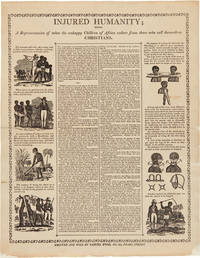
1808WRCAM54959New York: Samuel Wood 1808. Broadside 16 1/2 x 13 inches with main text printed in two center columns flanked on both sides by seven woodcut illustrations with descriptive text. The entire broadside surrounded by an ornamental border. Old folds minor chipping to edges short repaired tears small smudge in right column. Backed on acid-free tissue. Very good. A rare and powerful illustrated broadside describing in text and images the cruelties suffered by Africans in the West Indies slave trade. The main text is largely adapted from a work published in London in 1793 REMARKS ON THE METHODS OF PROCURING SLAVES WITH A SHORT ACCOUNT OF THEIR TREATMENT IN THE WEST- INDIES in support of an abolitionist boycott of West Indian goods with information gleaned from Parliamentary reports. It describes slave auctions and the "scrambles" by which sickly Africans are sold and gives details of the treatment of field and house slaves. The illustrations are horrifying showing slave families being separated at auction and then branded floggings at the hands of black overseers and various restraints to keep the slaves from eating or escaping including head-frames and mouthpieces neck braces weights leg spurs and shackles and yokes. The printer of this broadside Samuel Wood was a noted Quaker- reformist and the illustrations are credited to pioneering New York wood engraver Alexander Anderson. <br> <br> OCLC locates eleven copies and gives a publication date of 1802 though Pomeroy the American Antiquarian Society and Princeton give a date of 1805 to 1808 based on Samuel Wood's address as noted in the imprint. The Gilder Lehrman Institute also holds a copy as does the Rosenbach Museum. Rare and very interesting and a powerful manifestation of the growing abolitionist sentiment in the United States in the early 19th century. POMEROY ALEXANDER ANDERSON 169. HAMILTON EARLY AMERICAN BOOK ILLUSTRATORS AND WOOD ENGRAVERS 252. OCLC 33989651 476101156 945084251. Samuel Wood unknown books
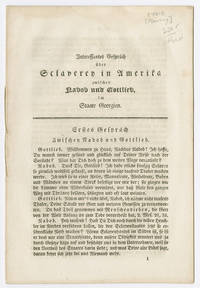
1840WRCAM54016N.p. but Germany 1840. 16pp. text in German. Stitched as issued. Very light dampstaining at top edge. Very good. An imaginary dialogue between a slaveholder and a missionary in Georgia. They debate the rights and wrongs of slavery with the slaveholder gradually crumbling before biblical evidence. A most unusual German tract on the American slavery controversy. unknown books
1850106404<p>Folio manuscript legal sheets 11 pp. plus docketing on final back sheet. Traces of wax in some margins. Paper is browned and aged some minor creasing at folds margin hole on a couple of pages not affecting text; otherwise very good. This is a very complex legal case about the ownership of two slaves. These manuscript documents are signed by the three Constables deposed as witnesses. The testimony is taken at the law offices of Lysander G. Gordon. It seems that an individual who owed people money was forced to give the slaves to a sheriff and were then sold to William Knox in Southern Tennessee. However it appears that the slaves actually belonged to someone else. These documents try to sort though this mess. </p> books
1816100537Pamphlet formate folio disbound first pamphlet 3 leaves printed on recto only second 7pp. third 6 pages and folding chart. Pamphlet extracted from larger volumne chipping along spine and edges not affecting text second papmple completely disbound paper browned and somewhat dry These pamphlets are rare and represent an important source of information on the numbers and values of slaves in early 19th century America. The first title presents the value assigned to slaves in 11 states including New York. The second lists the number and values of slaves in the various counties in the state of Maryland. The final pamphlet presents real estate values and values on dwellings including slaves in the counties of Pennsylvania. The information in these reports was compiled by Alexander James Dallas 1759-1817 who was the Secretary of the Treasury. Dallas born in Kingston Jamaica settled in Pennsylvania and practiced law there. Eventually he would become Secretary of the Treasury in 1814 when the nation was almost bankrupt. He managed to reorganize the department get the country out of debt created a surplus and even helped promote what would become the Second Bank of the United States. ANB. William A. Davis, books
1855CAT0116Peterboro: Self-Published 1855. First Edition. Single sheet folded 10 x 10 inches. Very Good. One of several public letters by Smith to Seward this one discussing the Fugitive Slave Law. Smith by the mid-1850s had grown increasingly frustrated by the abolitionist movement's willingness to compromise. Seward an early figure in the Republican party sought more gradual measures. Smith writes: "Instead of interpreting constitutions and statutes in the light of human rights you interpret human rights in the light of constitutions and statutes. I own that you stand as an antislavery man very far above most of our statesmen. but I would have you stand farther above them." Smith's growing impatience with the compromising nature of the abolitionist movement would later lead him to support the efforts of John Brown and the free-state movement in Kansas. "When most Liberty party leaders agreed to merge with more moderate antislavery factions to form the Free Soil party in 1848 Smith balked at what he regarded as abandonment of the abolitionist commitment to immediate emancipation." - ANB. A very good copy with a light stain to margin else near fine. Six copies in OCLC. Self-Published unknown books
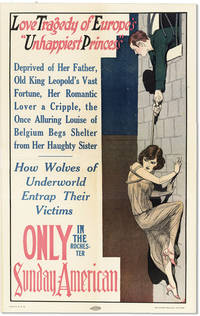
190415411Rochester: Office of the American 1904. Broadside extra lithographed in colors; 18" x 11". Single fold else fine. Colorful graphic depicting Princess Louise escaping from her asylum cell with the help of her illegitimate lover Geza Mattattich. The caption tempts readers with a White Slavery theme suggesting that Princess Louise has been lured to her ruin by a "Wolf of the Underworld." Unlocated. Office of the American unknown books