1 560 résultats
SKU0602368Rowman & Littlefield Publishers 2017-10-06. paperback. Good. 5x0x9. Textbook May Have Highlights Notes and/or Underlining BOOK ONLY-NO ACCESS CODE NO CD Ships with Tracking Rowman & Littlefield Publishers paperback
SKU0649875Rowman & Littlefield Publishers 2017-10-06. paperback. New. 5x0x9. New Textbook Ships with Tracking Rowman & Littlefield Publishers paperback
DADAX1538102692Rowman & Littlefield Publishers 2017-10-06. Second. paperback. New. 5.86x0.79x9.07. Buy with confidence. Excellent Customer Service & Return policy. Rowman & Littlefield Publishers paperback
DADAX1538102684Rowman & Littlefield Publishers 2017-10-06. Second. hardcover. New. 6.21x0.95x9.34. Buy with confidence. Excellent Customer Service & Return policy. Rowman & Littlefield Publishers hardcover
SONG1538102684Rowman & Littlefield Publishers 2017-10-06. Second. hardcover. Used: Good. 6.21x0.95x9.34. Buy with confidence. Excellent Customer Service & Return policy. Rowman & Littlefield Publishers hardcover
184524737<p>Mary B. Selden was the grandmother of Eleanor Love Selden who married John Augustine Washington III in 1843. She regrets not being able to furnish Washington with the services of one of her slaves as a stacker for the upcoming wheat harvest.</p><p>Still a faithful employee West Ford worked for the Washington family well into the nineteenth century including delivering this letter.</p><p>The letter includes a list of two dozen slaves written in pencil by John Augustine Washington III.</p><p><strong>SLAVERY. MOUNT VERNON. WEST FORD. MARY BOWLES ARMISTEAD SELDEN.</strong> Autograph Letter Signed to John Augustine Washington III hand delivered by West Ford; <strong>JOHN AUGUSTINE WASHINGTON III</strong>. Autograph List of Slaves. Single folio leaf with autograph address on verso. Alexandria Virginia 1845.</p><p><strong>Complete Transcript</strong></p><p><em>My dear Augustine</em></p><p><em> I am very sorry to be unable to render you the service you require. I have a very fine stacker but he is hired by the year to M<u>r</u> Young as I did not expect to have employment enough for him at M<u>t</u> Ida. Another year if you wish it you can have him I receive very small wages for him and as a stacker I have never known any one equal to him.</em></p><p><em>I am very sorry to hear that Nelly is sick. I hope she will be well enough to come up and meet the bridal party on thursday.</em><em> I received a letter from Eliza to day in which she says they will be at M<u>t</u> Ida that day but will bring no company with them. It will give great pleasure to them and to me if M<u>rs</u> Washington</em><em> Nelly and yourself will come up on that day. M<u>rs</u> Lippitt</em><em> will have a room ready for any of the party that will favour her with their company she must by no means be left behind.</em></p><p><em> Most truly and affectionately / yrs</em></p><p><em>M. B. Selden</em></p><p><2></p><p>Address: <em>John A. Washington Esq. / M<u>t</u> Vernon / By West Ford</em></p><p>Docketing by John Augustine Washington III: <em>Mrs. M. B. Selden</em></p><p>List of slaves in pencil by John Augustine Washington III:</p><p><em>Phil</em> b. 1790</p><p><em>Hannah</em> b. 1826</p><p><em>Gabe</em> b. 1820 <em>Eliza</em> b. 1811</p><p><em>Ned</em> b. 1827 <em>Jim</em> Michum b. 1795</p><p><em>Edmund</em> b. 1827 <em>John</em> b. 1833</p><p><em>Betty</em> b. 1833 <em>Mary</em> b. 1819</p><p><em>West</em> <em>Fanny</em> "Belongs to my wife"</p><p><em>Sarah </em> b. 1809 <em>Dennis</em> b. 1838</p><p><em>Hannah</em> <em>Nelly</em> b. 1836</p><p><em>William</em> b. 1830 <em>Jim</em> Starks b. 1805</p><p><em>Joe</em> b. 1832 <em>Sally</em> b. 1827</p><p><em>Ephraim</em> b. 1834 <em>Tom</em> b. 1835 "bound to me till Oct 1856"</p><p><em>West</em> b. 1838</p><p><em>Jesse</em> b. 1785</p><p><strong>Historical Background</strong></p><p>Farmers in mid-nineteenth-century Virginia typically planted winter wheat in September and October and harvested it in the following June. After wheat had been cut a stacker tied the wheat into bundles and piled the bundles in shocks to dry in the field. After the shocks dried they would be stored in a barn or carefully built stack capped with grass to shed the rain until threshing time. Even after Cyrus McCormick developed his mechanical grain reaper in the 1830s men needed to follow the machine to bundle and stack the wheat. Building a good stack was an important skill and those workers free or enslaved who knew how to do so were very valuable at harvest time.</p><p><strong>Mary Bowles Armistead Alexander Selden</strong> 1783-1846 was born in Hanover Virginia. She married Charles Alexander Jr. 1772-1812 with whom she had five children including Louisa Elizabeth Fontaine Alexander 1802-1827. After her first husband's death she married Dr. Wilson Cary Selden 1761-1835. She was his third wife and they had three children. By his first wife Dr. Selden was the father of Wilson Cary Selden Jr. 1796-1843. In 1822 Wilson Cary Selden Jr. married Louisa Elizabeth Fontaine Alexander and they became the parents of Eleanor Love Selden 1824-1860 who married John A. Washington III. Thus Mary Bowles Selden was both the grandmother and step-grandmother of Eleanor Nelly Washington. At the time she wrote this letter she was living at Mount Ida a 6000-acre plantation that stretched along two miles of the Potomac River north of Alexandria Virginia and fewer than ten miles from Mount Vernon. Her first husband built the neoclassical mansion of Mount Ida in 1808.</p><p><strong>John Augustine Washington III</strong> 1821-1861 was born in Blakeley West Virginia the son of John Augustine Washington II and Jane Charlotte Blackburn Washington and graduated from the University of Virginia in 1840. His father inherited George Washington's Mount Vernon estate in 1829 but it passed to his wife at his death in 1832. In 1841 Augustine Washington proposed to manage Mount Vernon for his mother. When she died in 1855 the plantation passed to him. In 1858 after offering the property to both the federal government and to the State of Virginia he sold 200 acres of the Mount Vernon estate including the mansion outbuildings and family tomb to the Mount Vernon Ladies' Association for $200000. Washington married Eleanor Nelly Love Selden 1824-1860 in 1843 and they had seven children. In 1860 he owned 22 slaves. In 1861 Washington joined the Confederate Army as a lieutenant colonel and served as an aide-de-camp to General Robert E. Lee. He was killed while conducting reconnaissance at the Battle of Cheat Mountain in September 1861.</p><p><strong>West Ford</strong> ca. 1784-1863 was born on the Bushfield Plantation in Westmoreland County Virginia to an enslaved woman owned by George Washington's brother John Augustine Washington. When George Washington visited West Ford was his personal attendant. When John Augustine Washington's widow Hannah died in 1802 she granted Ford his freedom at age 21. Bushrod Washington George Washington's nephew and heir to Mount Vernon freed Ford in 1806 and Ford continued working for the Washington family. According to family oral history Ford's mother Venus told her mistress Hannah Washington that he was George Washington's son. Nearly all historians doubt the claim though one of Washington's nephews certainly could have been the father.</p><p>In 1812 West Ford married Priscella Bell a free woman. Their four children—William Daniel Jane and Julia—were educated on the Mount Vernon Plantation despite laws which restricted the instruction of African Americans. When Bushrod Washington died in 1829 he willed 160 acres of land adjacent to Mount Vernon to West Ford who continued to live on the Mount Vernon estate.</p><p>Over the next several years West Ford was frequently highlighted in the media making his private life a matter of public record. In 1850 two Virginia newspapers—the <em>Alexandria Gazette</em> and the <em>Virginia Advertiser</em>—carried articles describing his prestigious position and authority at Mount Vernon. In 1857 an entry in the Fairfax County Deed Books noted that Ford divided his land among his four children. In 1858 Ford was sketched a second time this time by historian and artist Benson Lossing. In March 1859 <em>Harper's New Monthly Magazine</em> published Lossing's feature on Mount Vernon and included his sketch of Ford. Ford told the reporter of his property on Little Hunting Creek where he planned to retire after the Washington estate was no longer in the Washington family.</p><p>In June 1863 an ailing West Ford was brought back to the Mount Vernon estate by the Mount Vernon Ladies' Association. The association cared for West Ford until his death on July 20 1863.</p><p><strong>Condition</strong></p><p>Foxing and show through particularly near the signature.</p>
184524737<p>Mary B. Selden was the grandmother of Eleanor Love Selden who married John Augustine Washington III in 1843. She regrets not being able to furnish Washington with the services of one of her slaves as a stacker for the upcoming wheat harvest.</p><p>Still a faithful employee West Ford worked for the Washington family well into the nineteenth century including delivering this letter.</p><p>The letter includes a list of two dozen slaves written in pencil by John Augustine Washington III.</p> <b>SLAVERY. MOUNT VERNON. WEST FORD. MARY BOWLES ARMISTEAD SELDEN.</b>Autograph Letter Signed to John Augustine Washington III hand delivered by West Ford; <b>JOHN AUGUSTINE WASHINGTON III</b>. Autograph List of Slaves. Single folio leaf with autograph address on verso. Alexandria Virginia 1845.<p><b>Complete Transcript</b></p><p><i>My dear Augustine</i></p><p><i> I am very sorry to be unable to render you the service you require. I have a very fine stacker but he is hired by the year to M<u>r</u> Young as I did not expect to have employment enough for him at M<u>t</u>Ida. Another year if you wish it you can have him I receive very small wages for him and as a stacker I have never known any one equal to him.</i></p><p><i>I am very sorry to hear that Nelly is sick. I hope she will be well enough to come up and meet the bridal party on thursday.</i><i> I received a letter from Eliza to day in which she says they will be at M<u>t</u> Ida that day but will bring no company with them. It will give great pleasure to them and to me if M<u>rs</u> Washington</i><i> Nelly and yourself will come up on that day. M<u>rs</u> Lippitt</i><i> will have a room ready for any of the party that will favour her with their company she must by no means be left behind.</i></p><p><i> Most truly and affectionately / yrs</i></p><p><i>M. B. Selden</i></p><p><2></p><p>Address: <i>John A. Washington Esq. / M<u>t</u> Vernon / By West Ford</i></p><p>Docketing by John Augustine Washington III: <i>Mrs. M. B. Selden</i></p><p>List of slaves in pencil by John Augustine Washington III:</p><p><i>Phil</i> b. 1790</p><p><i>Hannah</i> b. 1826</p><p><i>Gabe</i> b. 1820 <i>Eliza</i> b. 1811</p><p><i>Ned</i> b. 1827 <i>Jim</i>Michum b. 1795</p><p><i>Edmund</i> b. 1827 <i>John</i> b. 1833</p><p><i>Betty</i> b. 1833 <i>Mary</i> b. 1819</p><p><i>West</i> <i>Fanny</i> "Belongs to my wife"</p><p><i>Sarah </i> b. 1809 <i>Dennis</i> b. 1838</p><p><i>Hannah</i> <i>Nelly</i> b. 1836</p><p><i>William</i> b. 1830 <i>Jim</i>Starks b. 1805</p><p><i>Joe</i> b. 1832 <i>Sally</i> b. 1827</p><p><i>Ephraim</i> b. 1834 <i>Tom</i> b. 1835 "bound to me till Oct 1856"</p><p><i>West</i> b. 1838</p><p><i>Jesse</i> b. 1785</p><p><b>Historical Background</b></p><p>Farmers in mid-nineteenth-century Virginia typically planted winter wheat in September and October and harvested it in the following June. After wheat had been cut a stacker tied the wheat into bundles and piled the bundles in shocks to dry in the field. After the shocks dried they would be stored in a barn or carefully built stack capped with grass to shed the rain until threshing time. Even after Cyrus McCormick developed his mechanical grain reaper in the 1830s men needed to follow the machine to bundle and stack the wheat. Building a good stack was an important skill and those workers free or enslaved who knew how to do so were very valuable at harvest time.</p><p><b>Mary Bowles Armistead Alexander Selden</b> 1783-1846 was born in Hanover Virginia. She married Charles Alexander Jr. 1772-1812 with whom she had five children including Louisa Elizabeth Fontaine Alexander 1802-1827. After her first husband's death she married Dr. Wilson Cary Selden 1761-1835. She was his third wife and they had three children. By his first wife Dr. Selden was the father of Wilson Cary Selden Jr. 1796-1843. In 1822 Wilson Cary Selden Jr. married Louisa Elizabeth Fontaine Alexander and they became the parents of Eleanor Love Selden 1824-1860 who married John A. Washington III. Thus Mary Bowles Selden was both the grandmother and step-grandmother of Eleanor Nelly Washington. At the time she wrote this letter she was living at Mount Ida a 6000-acre plantation that stretched along two miles of the Potomac River north of Alexandria Virginia and fewer than ten miles from Mount Vernon. Her first husband built the neoclassical mansion of Mount Ida in 1808.</p><p><b>John Augustine Washington III</b> 1821-1861 was born in Blakeley West Virginia the son of John Augustine Washington II and Jane Charlotte Blackburn Washington and graduated from the University of Virginia in 1840. His father inherited George Washington's Mount Vernon estate in 1829 but it passed to his wife at his death in 1832. In 1841 Augustine Washington proposed to manage Mount Vernon for his mother. When she died in 1855 the plantation passed to him. In 1858 after offering the property to both the federal government and to the State of Virginia he sold 200 acres of the Mount Vernon estate including the mansion outbuildings and family tomb to the Mount Vernon Ladies' Association for $200000. Washington married Eleanor Nelly Love Selden 1824-1860 in 1843 and they had seven children. In 1860 he owned 22 slaves. In 1861 Washington joined the Confederate Army as a lieutenant colonel and served as an aide-de-camp to General Robert E. Lee. He was killed while conducting reconnaissance at the Battle of Cheat Mountain in September 1861.</p><p><b>West Ford</b> ca. 1784-1863 was born on the Bushfield Plantation in Westmoreland County Virginia to an enslaved woman owned by George Washington's brother John Augustine Washington. When George Washington visited West Ford was his personal attendant. When John Augustine Washington's widow Hannah died in 1802 she granted Ford his freedom at age 21. Bushrod Washington George Washington's nephew and heir to Mount Vernon freed Ford in 1806 and Ford continued working for the Washington family. According to family oral history Ford's mother Venus told her mistress Hannah Washington that he was George Washington's son. Nearly all historians doubt the claim though one of Washington's nephews certainly could have been the father.</p><p>In 1812 West Ford married Priscella Bell a free woman. Their four children—William Daniel Jane and Julia—were educated on the Mount Vernon Plantation despite laws which restricted the instruction of African Americans. When Bushrod Washington died in 1829 he willed 160 acres of land adjacent to Mount Vernon to West Ford who continued to live on the Mount Vernon estate.</p><p>Over the next several years West Ford was frequently highlighted in the media making his private life a matter of public record. In 1850 two Virginia newspapers—the <i>Alexandria Gazette</i> and the <i>Virginia Advertiser</i>—carried articles describing his prestigious position and authority at Mount Vernon. In 1857 an entry in the Fairfax County Deed Books noted that Ford divided his land among his four children. In 1858 Ford was sketched a second time this time by historian and artist Benson Lossing. In March 1859 <i>Harper's New Monthly Magazine</i> published Lossing's feature on Mount Vernon and included his sketch of Ford. Ford told the reporter of his property on Little Hunting Creek where he planned to retire after the Washington estate was no longer in the Washington family.</p><p>In June 1863 an ailing West Ford was brought back to the Mount Vernon estate by the Mount Vernon Ladies' Association. The association cared for West Ford until his death on July 20 1863.</p><p><b>Condition</b></p><p>Foxing and show through particularly near the signature.</p> books
1954LITT3050MPréface ("Du Bonheur dans l'esclavage") de Jean Paulhan. Sceaux, J.-J. Pauvert, juin 1954. In-8°. 245 pp.
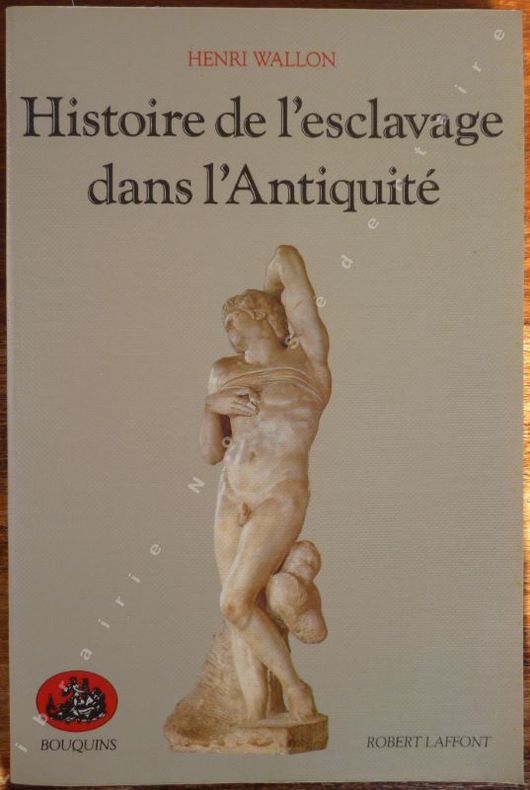
12801Robert Laffont Collection Bouquins, 1988 - Fort violume broché au format In-8, 1101 pages, ensemble un peu fané et en très bon état.
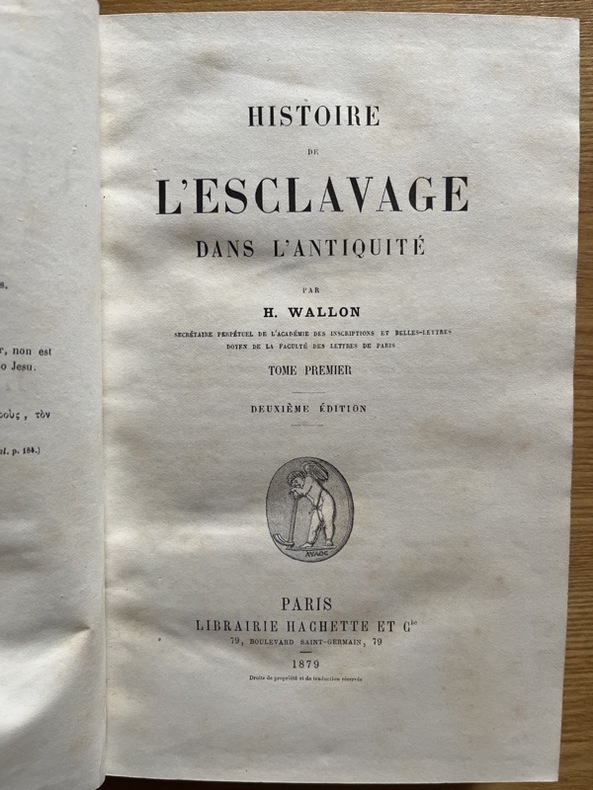
237736Paris, Hachette et Cie, 1879 3 vol. in-8, CLXVII-487 pp., 517 pp. et 559 pp., demi-chagrin vert, dos à nerfs orné de fleurons dorés (reliure de l'époque). Quelques rousseurs.
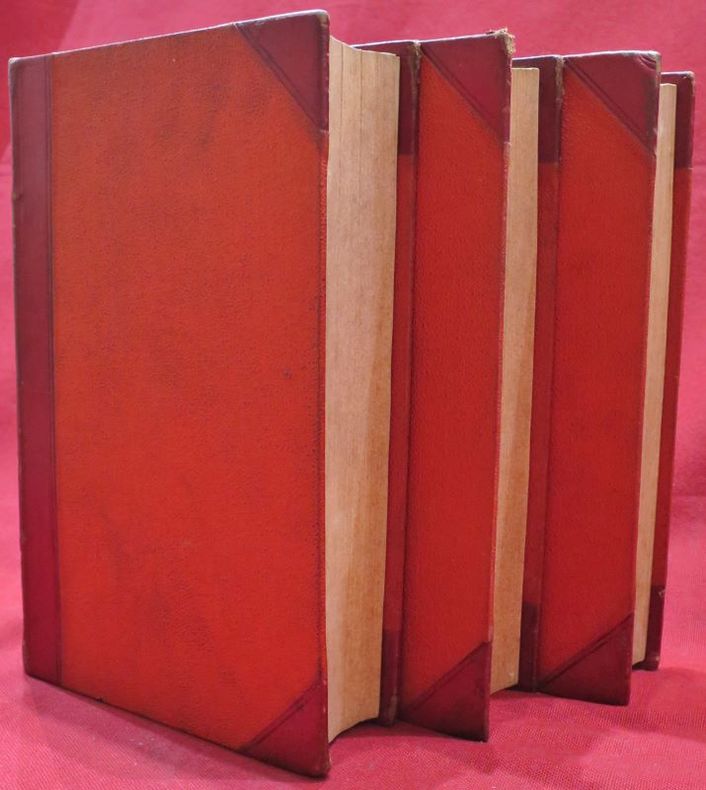
108201Paris, Librairie Hachette et Cie, 1879, 3 volumes in-8 de 220x135 mm environ, tome I : De l'Esclage en Orient et en Grèce : clxvii-487 pages, tome II : De l'Esclavage à Rome depuis les origines jusqu'à l'Epoque des Antonins : 517 pages, 1f. (table), - tome III : De l'Esclavage et du Travail libre sous l'Empire : 559 pages, 2ff. (table, errata), demi reliure à coins cerise, dos à faux-nerfs portant titres et tomaisons dorés, date en queue, gardes vert amande, tranches finement mouchetées. Des rousseurs, mors en partie fendus (tome 1) mais structure solide, petites auréoles et traces brunes sur les plats, des coins dénudés, cuir frotté sur les coiffes, rares passages soulignés. Deuxième Edition.
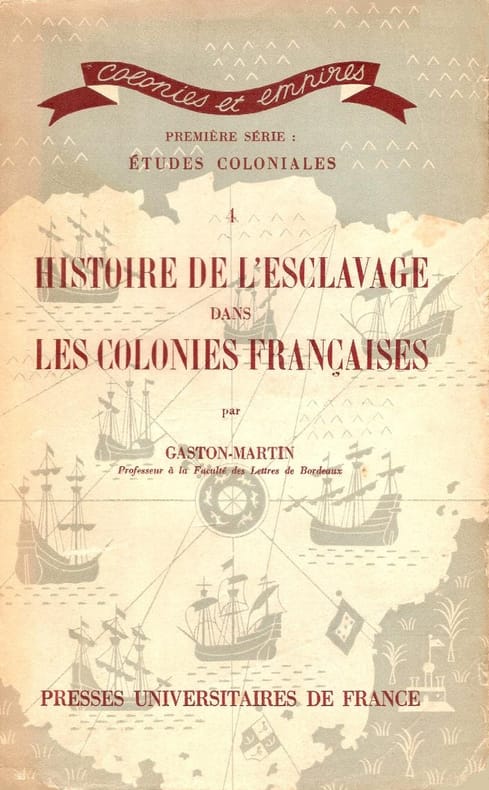
1373100Paris: Presses Universitaires de France, 1948 in-8, 320 pages, bibliographie, index. Broché, bon état. (Collection "Colonies et empires" première série: études coloniales 4).
1948185011948 Paris, PUF (Collection "Colonies et Empires" 1ère Série : Etudes Coloniales), 1948, in 8° broché, 318 pages ; important index in-fine.
194855595PUF, 1948, in-8°, 318 pp, orientation bibliographique, index, broché, couv. illustrée, dos abîmé recollé, état correct (Coll. Colonies et Empires)
1978R160114278LE CERCLE DES BIBLIOPHILES CONTEMPORAINS. 1978. In-12. Cartonnage d'éditeurs. Bon état, Couv. convenable, Dos satisfaisant, Intérieur frais. 249 pages. Nombreuses planches illustrées en noir et blanc.. . . . Classification Dewey : 326-Esclavage
1978203274Couverture rigide. Cartonné. 250 pages. Légères rousseurs.
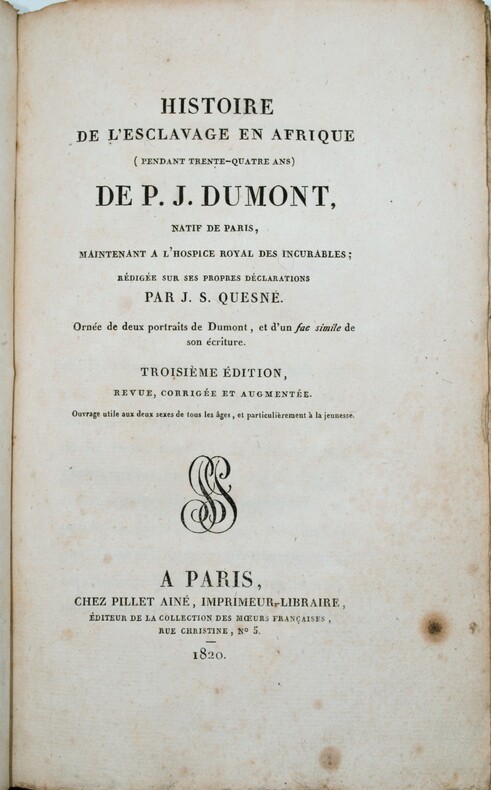
1820PHO-1281Paris, Pillet aine, 1820.In-8, pleine percale bordeaux , 4ffnch.-157pp. , dos lisse avec auteur et titre (postérieure), couverture conservée , illustrée de deux portraits de Pierre Joseph Dumont et d'un fac-similé de son écriture ,dos insolé , mouillure.
51920Paris Chez Pillet Ainé, Imprimeur Libraire 1820 in 8 (24x15,5) 1 volume reliure demi basane fauve de l'époque, dos lisse, pièce de titre de cuir noir, [3] ,157 pages [1], avec 2 portraits de Dumont en frontispice, dont un en pied, et 1 fac-similé hors texte d'écriture de Dumont, petite auréole brune sur un feuillet (pages 153-154). Exemplaire enrichi d'un portrait photographique contrecollé à l'intérieur du premier plat: tirage papier salé: portrait de L. de la Bédollière ? 1873. Pierre Joseph Dumont. Signature manucrite de Quesné au verso du faux-titre. Troisième édition augmentée et corrigée. Bon exemplaire
1376061Paris: Pillet, 1820 in-8, [2]-157-[3] pages, 2 portraits frontispice dessinés et gravés par Ambroise Tardieu, planche hors texte avec fac similé d'un autographe de P. J. Dumont. Demi reliure postérieure chagrin vert, dos à 5 nerfs, fleurons et filets dorés, couv. conservées (la couverture porte l'année 1819), légère mouillure sur qq pages, cachet d'un ancien propriétaire sur la page de titre, bel exemplaire. Dumont, marin dans la marine française, fut fait prisonnier par des pirates Arabes d'Algérie en 1782 et demeura esclave 34 ans.
237863Paris, Pillet Ainé, 1824 in-8, 155 pp., 2 portr., 1 fac-similé, dérelié, tranches marbrées.
1973185133Editions Désormeaux Editions Désormeaux, 1973. 2 volumes In-8 pleine reliure éditeur, plats estampés, titres dorés. La dorure s'efface; 576 + 483 pages. Bon état
1373215Paris: Pagnerre Editeur, 1847 in-8, 486 pages. Demi basane dos à nerfs orné de caisson, coiffes usées, qq. rousseurs, autrement bon état. Edition originale.
19911138611991 Editions Fayard - 1991 - 2 volumes in-8, cartonnages souple illustrés - 1114 + 607 pages
1807144451807 br. sans couvertures (débroché d'un recueil) in-8, 95pp., P. Léopold Collin 1807
2006193285L'Harmattan L'Harmattan, 1998. In-8 broché de 404 pages. Ce tome 1 pose les bases de l'histoire antillaise à travers une perspective endogène (intérieure). Armand Nicolas y étudie la période précolombienne (Arawaks et Caraïbes), la colonisation française, le développement de l'économie de plantation, l'horreur du système esclavagiste et les multiples résistances (le marronnage) qui ont mené à l'abolition de 1848. Bon état