[SLAVERY] - Alpheus CROSBYBiblio.com

239 résultats
186539270Boston: Geo. C. Rand & Avery 1865. 8vo. 8 1/2 x 5 3/4 inches. 16pp. With the author's compliments. Disbound.<br/> <br/> First edition of this powerful and timely address delivered just three months after the end of the American Civil War.<br/> <br/> A respected classicist professor and public intellectual Alpheus Crosby offers a sober and principled argument concerning the reintegration of the Southern states into the Union. Rejecting both harsh retribution and passive leniency Crosby emphasizes the constitutional and moral responsibilities of the federal government in the aftermath of rebellion. Framed by the ideals of Phi Beta Kappa and the liberal education it promotes Crosby's speech calls for a just and sustainable reconstruction policy underscoring the need for national unity grounded in legal equity and civic virtue. A revealing document of Northern intellectual engagement with the dilemmas of Reconstruction at its inception.<br/> <br/> Sabin 17626. Geo. C. Rand & Avery unknown
181935648Milledgeville: S. Grantland 1819. First Edition. Leather bound. Fair. Octavo. iv 463 pages. Polished sheepskin leather binding with red leather title label on the spine. A brown piece of linen tap used at the top and at the bottom of the spine. Covers rubbed. Internal hinges in good condition. Some arithmetic written on the right front flyleaf. "Augusta Wylie King 1929" written in blue pen on the verso of the right front flyleaf. Light toning and foxing to the contents. A few pages have ink splotches. Newspaper clipping stored between pages 342 343 has left stains to the pages. <br /> <br /> Contents include sections on "Free Negroes" and a section on "Slaves". 11 page list of subscriber names by county located in the back. Subscriber names are listed alphabetically by county. List includes the name of Daniel Ross of the Cherokee Nation. Fair.<br /> <br /> Shaw & Shoemaker 47639; Not in Sabin; Derenne Georgia Catalog Vol. I page 366 - "Probably printed in Philadelphia for notice of copyright on Sept. 28 1819 by Mathew Carey & Son as proprietors in Eastern District of Pa. appears on verso of the title page. S. Grantland unknown
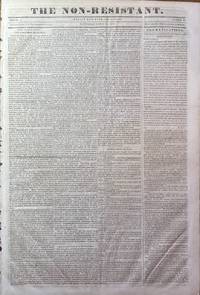
183936794Boston: N. E. Non Resistant Society 1839. Newspaper. Very good. Newspaper. 4 pages. Complete. Approximately 11.75" x 17". Slightly irregular at the blank spine. <br /> <br /> Several articles and letters inside pertaining to "Consequences of War" with Great Britain and other similar pieces. This paper was also an anti-Slavery paper. <br /> <br /> From wikipedia: The New England Non-Resistance Society was an American peace group founded at a special peace convention organized by William Lloyd Garrison in Boston in September 1838.1 Leading up to the convention conservative members of the American Anti-Slavery Society and the American Peace Society expressed discomfort with Garrison's philosophy of "non-resistance" and inclusion of women in public political activities. After conservative attendees opposing Garrison walked out of the convention in protest those remaining formed the New England Non-Resistance Society.citation needed<br /> <br /> The Society condemned the use of force in resisting evil in war for the death penalty or in self-defense renounced allegiance to human government and because of the anti-slavery cause favored non-union with the American South.citation needed The New England Non-Resistance Society was one of the more radical of the many organizations founded by William Lloyd Garrison adopting a Declaration of Sentiments of which he was the principal author pledging themselves to deny the validity of social distinctions based on race nationality or gender"2 refusing obedience to human governments and opposing even individual acts of self-defense.3 In the Society's Declaration of Sentiments Garrison wrote "any person without distinction of sex or color who consents to the principles of this Constitution may become a member and be entitled to speak at its meetings."1 The Society rejected loyalty to any human government; one historian has described the Non-Resistance Society's "basic outlook as that of philosophical anarchism".45. N. E. Non Resistant Society unknown
185740445Boston: John Wilson and Son 1857. Paperback. Small 4to. Self-cover. 12pp. Very good. Outer wrappers only faintly age toned. Clean attractive first edition of this lengthy diatribe against President James Buchanan's handling of the slavery issue in Kansas which they considered weak and ineffective followed by his reply and their response to it. "They fervently hope "that you may yet see that in this respect one false principle if adhered to must prove a principle of weakness and decay -- a sure prelude to the end of all our greatness happiness and glory -- a death-spot in the tree of liberty whose leaves like those of the tree of life are for the healing of the nations." Signed in type at the conclusion by these Connecticut congressmen in order: Nathaniel W. Taylor Theodore D. Woolsey Henry Dutton Charles L. English John H. Brockway Eli W. Blake Benjamin Stilliman Jr. Thomas A. Thacher J.A. Davenport Worthington Hooker Philos Blake Amos Townsend James Brewster Eli Ives S.G. Hubbard John A. Blake William H. Russell A.N. Skinner Charles Robinson Joel Hawes G.A. Calhoun Leonard Bacon H.C. Kingsley Benjamin Stilliman Sr. Charles Ives Josiah W. Gibbs James F. Babcock and Alfred Walker. OCLC cites 20 copies. SABIN 52997. John Wilson and Son paperback
1863101890Letterpress broadside 18 7/8" x 11 3/4" bold black type for highlighted words. Paper evenly toned some wrinkling considerable archival conservation and restoration with archival paper repair; despite the imperfections it is still a decent copy with a nice impression. This appears to fall into the political dirty tricks department in an election between John Brodhead and Henry Bumm for city treasurer in Philadelphia. The broadside is supposed to highlight a letter from John Brodhead to Jefferson Davis in 1860. It has strong racist overtones as Brodhead supposedly requests a position in Nicaragua so he can "help open it up to civilization and Niggers." He goes on to state he is "tired of being a white slave at the North and long for a home in the sunny South." These kinds of political tricks were not uncommon during the Civil War period perhaps that's still true today and the racist overtones would certainly not help one's chances in a Northern election.
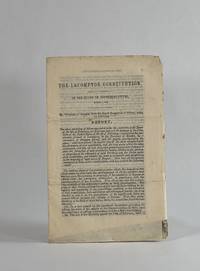
18589866Washington 1858. Unbound. near Very Good binding. Octavo. 16 pp. First edition. Unbound folded sheet forming 8 leaves. Old folds with some closed tears/silverfishing along a couple the creases; staining to the bottom margin of a a few leaves not touching text; otherwise generally a very good copy. <br /> <br /> Circumstances surrounding Kansas's Lecompton Constitution brought the tension surrounding the confluence of statehood and slavery to a new level. A pro-slavery document the Lecompton Constitution and subsequent votes on it were a fraught and dishonest affair complete with subterfuge false choices boycotted votes and more all in service of establishing a pro-slavery constitution in a state that's populace had a clear and before the end demonstrable antislavery majority. This report before the House by Georgia's Alexander Stephens soon to be Vice President of the Confederate State of America defends a December election that was widely boycotted by antislavery voters because the options presented to the electorate both allowed for slavery to persist in Kansas despite the misleading language of the referendum. By August of this same year 1858 a new vote would be held to keep or toss out the Lecompton Constitution. In a vote that demonstrated the antislavery sentiment of Kansas residents the Constitution would be thrown out by a 7 to 1 margin. Leaving space for a constitution to be drafted and ratified prohibiting slavery in Kansas. Krdlicka James F. Colonists Citizens Constitutions: Creating the American Republic. Sabin 91261. unknown
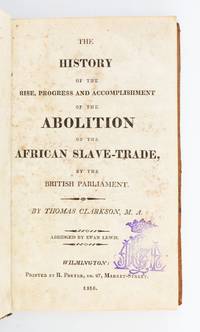
1816ST19567-131<p>Wilmington: Printed by R. Porter 1816. Abridged Edition. 180 x 115 mm. 7 x 4 1/2". 348 pp.Abridged by Evan Lewis. <br />Contemporary tree calf smooth spine with double gilt rules tan leather label with gilt lettering. With one small illustration of a seal in text. Title with crowned monogram stamp in purple ink. Sabin 13486. Calf with significant wear front hinge exposed but the binding very tight; text as expected with varying sometimes noticeable degrees of foxing and browning because of quality of paper.<br /><br />First published in two volumes in 1808 this important work on the history of the slave trade is an "invaluable" resource and "contains much essential autobiographical and other information." DNB The present edition was condensed into one volume in order to "be more generally diffused among the people of the United States" where slavery would not be abolished for another half a century. Thomas Clarkson 1760-1846 was a leading English abolitionist who advocated for an end to slavery world-wide and was an original founder of the Committee for the Abolition of the Slave Trade as well as the pacifist Society for the Promotion of Permanent and Universal Peace.</p> Printed by R. Porter
185633708Philadelphia 1856. 24pp disbound three small binding holes in blank left margin. Two early signatures of Wm. Thompson Shafer on title page. Light spotting throughout. About Good. <br /> <br /> This scarce pamphlet says the "great issue" is whether "Slavery shall be allowed to overspread a territory of greater extent than that of the whole United States" and "whether the policy of our government is to continue to be that of Slavery Extension or Slavery Restriction." All the power of the presidency is "being used to force the withering and blighting scourge of Slavery upon the National domain." Pursuing this tyrannical course our government "shall lend its aid in striking a deathblow to the freedom of speech the liberty of the press and the security for life personal liberty possession and peace." <br /> LCP 4300. OCLC 22829199 4- LCP No. IL U Haverford Detroit Pub. Lib. as of April 2017. unknown
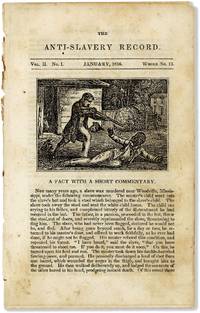
183682919New York: American Anti-Slavery Society 1836. 12mo 19cm. Stitched self-wrappers; pp.1-12. Removed; first and final leaves detached but present; light soil scattered faint foxing; tear to bottom inch of bound edge away from text; complete and Good. Woodcut decoration at head of text a strikingly violent image depicting the murder of a Black man by his enslaver in Woolville Mississippi.<br /> <br /> Single issue of this monthly abolitionist periodical that ran from 1835 to 1837 published by the American Anti-Slavery Society under the direction of Elizur Wright. It was "a small magazine with excellent woodcuts containing principally extracts from other publications" that was "distributed freely without charge" and "found its way into the schools and colleges everywhere" Dumond p.267. Wright stated that in September 1835 the Society published 25000 copies of the Record p.267. BLOCKSON 9174. LCP AFRO-AMERICANA 622. American Anti-Slavery Society unknown
18501210761850. First Edition. SLAVERY SMITH Gerrit. Substance of the Speech Made by Gerrit Smith in the Capitol of the State of New York March 11th and 12th 1850. Albany: Jacob T. Hazen 1850. Octavo period-style half calf gilt marbled boards; pp. 1-3 4-25 26-27 28-30. $1500.First edition of the bold abolitionist's Speech proclaiming the Constitution ""does not allow the three million of our colored countrymen to be held in slavery"" a close friend of Frederick Douglass who ""openly embraced Smith's version of an antislavery interpretation of the Constitution"" delivered the same decade as John Brown's Harpers Ferry raid substantially financed by Smith.Smith a wealthy philanthropist was ""among the most outspoken"" of white abolitionists Jackson Force and Freedom 65. Once linked to William Lloyd Garrison's view of the Constitution as a ""covenant with death"" Smith split from Garrison and became a founder of both the Liberty Party and its successor the Radical Abolitionist Party. He was as well key in forging a close interracial alliance between Frederick Douglass Black abolitionist and physician James McCune Smith and John Brown. The four men shared the goal of achieving ""a 'radical change' in government."" By the early 1850s Douglass ""openly embraced Smith's version of an antislavery interpretation of the Constitution"" Blight 213. To Smith Douglass and figures as Alvan Stewart and Lysander Spooner ""the Constitution empoweredeven requiredCongress to abolish slavery in the southern states by direct legislation As an editor Douglass had always engaged with national politics. Now the federal authority at the base of slavery's stranglehold on America became his intensive focus"" Blight 214; emphasis in original.This very scarce first edition captures the force of Smith's groundbreaking 1850 Speech and clearly demonstrates the breadth of his constitutional argument. Declaring ""law is for the protection of rightsnot for the destruction of rights"" emphasis in original he cites passages in the Declaration and Bill of Rights and addresses the pivotal ""three-fifths"" clause. Smith proclaims the Founding Fathers did not intend ""to make this whole land the slaveholder's hunting ground"" and asserts the Constitution ""does not allow the three million of our colored countrymen to be held in slavery."" He would use his wealth to help establish a Black settlement at North Elba N.Y. which was ""John Brown's permanent residence from 1854 until his death"" Stauffer Black Hearts 3. After Harpers Ferry and Brown's execution Smith faced demands that he be tried as an ""accessory after the fact."" While he ""publicly denied it Smith gave warm encouragement and financial assistance"" to Brown and the Harpers Ferry insurrection. Yet ""guilt over the failure of Brown's raid and fear of possible arrest as a co-conspirator caused Smith to commit himself to the Utica State Lunatic Asylum"" ANB. In time he publicly retreated from his Radical Abolitionist stance and died in 1874. Sabin 82670. A fine copy. hardcover
1856257105Washington D.C.: Globe Office 1856. Signed by Kelsey ordering 2500 and by James Livingston for 100 and another. Old folds. Blind embossed " Platner & Porter Cobngress" staionary. Signed by Kelsey ordering 2500 and by James Livingston for 100 and another. Globe Office unknown
186581012New York: American News Company 1865. First Edition. First printing. Octavo. Sewn printed wrappers; 76pp. Brief closed tear to title page margin; bit of wear at upper fore-corner of text block well away from text else a clean fresh copy in the original printed wraps; Very Good or better. Includes text of letters written to various colleagues in the antislavery ranks including Elizabeth Cady Stanton Charles Sumner and others. The first volume taking in the year 1863 was printed a year earlier. SABIN 82664. American News Company unknown
185426154Washington: Printed at the Congressional Glove Office 1854. First edition. pp. 22. 1 vols. 8vo. Self wrappers unsewn as issued. Some browning and spotting wear along spine and edges but a very good copy. First edition. pp. 22. 1 vols. 8vo. Primarily concerning the issue of slavery in the territories this speech was part of the debates for the Kansas-Nebraska Act. The act initiated by Douglas ultimately repealed the Missouri Compromise allowed the local residents to determine whether the area was free or slave territory allowed for "the doctrine of popular sovereignty of the two territories" and laid the way for a transcontental railroad. The Kansas-Nebraska Act was passed in the Senate on the 3rd of March. Clayton was a lawyer noted agriculturist and long-time member of Congress who was Secretary of State under President Taylor. As Secretary of State he is best remembered for having negotiated the Clayton-Bulwer treaty with Great Britain which provided for a neutral international canal across Central America and "contained pledges which ultimately forced Great Britain to withdraw from large tracts of territory which.it had been occupying on the Isthmus." DAB. Sabin 13576n Printed at the Congressional Glove Office unknown
184837646Washington D.C.: J. & G.S. Gideon printers 1848. First edition. Removed. A very good unopened uncut and intrimmed copy with a mail fold. 14 pp. 8vo. Against Oregon admittance over the slavery issue: "The position I shall assume and attempt to maintain is that Congress has no power to organize what is called a territorial government by ordinance or otherwise; nor has Congress the power to pass laws for the people of the territories of the United States.The speech of the honorable member from Ohio Mr. Root delivered on the 15th of the present month. That speech breathes nothing but hostility to Southern institutions. It was uttered in a tone of defiance and in such language of menace as left the impression that the honorable speaker thought that empty threats were quite sufficient to intimidate what he was pleased to call “Southern chivalry.What does the gentleman from Ohio mean by this haughty and vainglorious boasting Does he think that the South are to be frightened from their duty to their country and themselves by these empty menaces The proposition to exclude slave labor from the territories of the United States is a proposition to degrade the slave States—to render them inferior to the free States."<br /> <br /> John Gayle 1792-1859 "was Alabama's seventh governor and also served as a U.S. congressman state legislator and jurist. Gayle was a fervent champion of states' rights and his advocacy laid the foundation for that movement in Alabama in the 1850s and for the realignment of state political parties." Sarah Woolfolk Wiggins: John Gayle Encyl. of Alabama. Sabin 26798. J. & G.S. Gideon, printers unknown
186035032Washington D.C.: W.H. Moore Printer 1860. First Edition. Wraps. Good. Folded uncut wraps. 16 pages. A single sheet of paper 24" x 19" printed on both sides with 8 folds. Light damp stain and toning to the contents. This speech centers around the debate of allowing Slavery in the western territories. W.H. Moore, Printer unknown
185031527Washington DC: Gideon and Co. Printers 1850. First Edition. Wraps. Good. Wraps. 14 pages 1 page blank. Title printed on page 1. Spine strengthened by archival tape. Page edges creased. Light toning to contents. Gideon and Co., Printers unknown