239 résultats
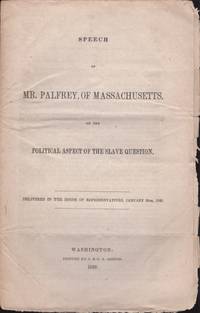
184834435Washington DC: Printed by J. & G. S. Gideon 1848. First Edition. Wraps. Fair. Wraps. Approximately 9.5" x 6". 16 pages. Untrimmed wraps folded with splits and loose pages at the folds. Contents clean. John Gorham Palfrey May 2 1796 – April 26 1881 was an American clergyman and historian who served as a U.S. Representative from Massachusetts. A Unitarian minister he played a leading role in the early history of Harvard Divinity School and he later became involved in politics as a State Representative and U.S. Congressman Wikipedia. Palfrey argued that the existence of slavery was a major political problem that threatened the stability and future of the Union. He believed that slavery was incompatible with the principles of liberty and equality upon which the nation was founded AI generated. Printed by J. & G. S. Gideon unknown
188037129Circa 1880. 1880. Good. - A slip of paper 2-3/8 inches high by 4-3/8 inches wide is inscribed & signed in black ink: "Let us thank God for the Saxon Grit / Robert Collyer". The paper is mounted on a piece of cream-colored card of approximately the same size. The card is unevenly cut & both paper & card are slightly rippled from the mounting. Good. <p>"Saxon Grit" is the title of an 1880 poem by Collyer about the Norman conquest of England in which the phrase recurs in each verse.<p>Robert Collyer 1823-1912 was an English-born American Unitarian clergyman. He became a Methodist minister in England in 1849. Emigrating to The United States in the following year he found employment as a hammer maker in Pennsylvania and soon began preaching on Sundays while still employed at the factory. His earnest rugged simple style of oratory won him great popularity but his advocacy for the antislavery cause then frowned upon by the Methodist authorities aroused opposition. He was tried for heresy and his license was revoked. Continuing as an independent preacher he joined the Unitarian Church in 1859. In 1860 he organized and became pastor of the Unity Church the second Unitarian Church in Chicago. The church grew to become one of the strongest Unitarian churches in the West and Collyer was regarded as one of the foremost pulpit orators in the country. He left Chicago in 1879 and became pastor of the Church of the Messiah now renamed the Community Church in New York City. In 1883 he was a featured speaker at the convention of the American Woman Suffrage Association where he spoke movingly about his deceased wife and their struggles over "the woman question". Circa [1880]. unknown
183519491Boston: James Munroe and Company 1835. First edition. Spine and portions of the rear board sunned and faded; some spotting to the cloth; some foxing and light staining; front hinge just tender; a very good copy. 8vo original embossed purple cloth printed spine label iv 167 1 pages. An important anti-slavery work from the pioneering New England Unitarian. Lib. Company. Afro-Americana 2185; American Imprints 2185. James Munroe and Company, unknown books
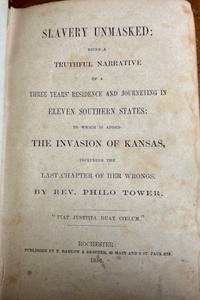
185633823Rochester: E. Darrow & Brother 1856. First Edition. Hardcover. Fair. 12mo. xvi pages 17-432 pages. Lacking the frontispiece. Brown cloth hardcover with faded title on the spine. Cloth binding has several faults including a pronounced lean heavy shelf and edge wear worn and exposed corners and worn and chipped edges of the spine. Light stains on the covers. Moderate toning and foxing to the contents. Text block lightly shaken with some pages in front starting to loosen. Fair condition only. Complete. E. Darrow & Brother hardcover
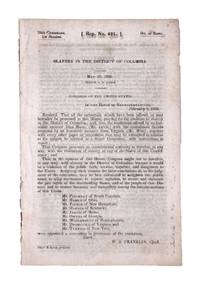
1836346520Washington D.C. 1836. 24th Congress 1st Session House Rep. No. 691. 24pp. 8vo. Disbound. 24th Congress 1st Session House Rep. No. 691. 24pp. 8vo. Many of the early anti-slavery efforts focussed on the abolition of slavery in the District of Columbia as Congress had full control over the laws within the District thus obviating any argument over state's rights. Until "retroceded" back to Virginia in 1846 the city of Alexandria and its notorious slave market was considered part of the District of Columbia making slavery in the District of particular importance. Inundated with petitions calling for the abolition of slavery in the District in 1836 Congress passed the so-called Pinckney Resolution which asserted that Congress "ought not" to consider slavery in the District and created a gag rule whereby all petitions memorials or other resolutions on the subject would be automatically tabled. unknown
1851106835<p>Pamphlet 8vo wrappers 36 pp. Archival tape repair to back of front cover slight edgeware normal aging and browning; otherwise very good. Follows the general tone of a good deal of the abolitionist literature of the period. However while the author acknowledges the critical importance of slavery to America he suggests the issue needs to be debated with "calmness and candor" interestingly he indicates that the climate for these discussions appears to be improving.</p> Charles C. Little and James Brown,
186027124Washington DC: Buell & Blanchard Printers 1860. 1st separate. Not in Dumond. Disbound. VG some soiling. 15 1 pp. Last page with printer imprint/date. 8vo. <br/><br/> Buell & Blanchard, Printers unknown books
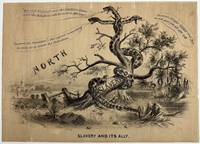
186412816N.p. 1864. Lithograph 14.5 x 20.5 inches. Noticeable toning small areas of light discoloration along top margin short closed tear to left edge minor dust-soiling numerous creases and wrinkles. About very good. A dramatic political cartoon issued during the Civil War and satirizing the dangerous influence of those who argue a compromise on slavery or an easy solution to the war. The work was likely issued in the midst of the 1860 but more likely the 1864 presidential election campaign. The central image of the lithograph involves a three-headed snake -- labeled "The People's Party" and emerging from the American "South" personified by a moss-covered swamp -- which is wrapped around the length of a large tree labeled "Slavery." Each snake vocalizes a different misleading message about the issue of slavery and compromise seemingly aligned with political entities such as the Peace Party and the Copperheads. The messages from each snake head read respectively "Extend Slavery over the Northern States and the Rebellion will be over in 60 days;" "Persevere till after election and then we will give you all you ask;" and "'Support the President' - but oppose everything he may do to crush the Rebellion." This latter message indicates the author of the work supported President Lincoln. The North is personified in the background at left by a depiction of the U.S. Capitol Building. The central image of the lithograph carries echoes of the story of the Book of Genesis with the involvement of a deceptive serpent amid the tree of life.<br /> <br /> The lithograph is signed in the stone at bottom right reading simply "Brooks." Though the work came to us proposing the identify of the artist as Reuben Brooks 1794-1870 we were ultimately unable to confirm this authorship. The lack of an imprint in the lithograph also precludes easy research and identification. In fact the rarity of the lithograph makes it difficult to expound much more about it at all. OCLC reports just a single copy at the Peabody Essex Museum and it is not listed in Weitenkampf or Reilly. Given its rarity and content the present lithograph offers an outstanding opportunity for further research and contextualization. unknown
18271184001827. First Edition. SLAVERY STROUD George M. A Sketch of the Laws Relating to Slavery in the Several States of the United States of America. Philadelphia: Kimber and Sharpless 1827. Octavo original half tan and light brown paper boards uncut. $1350.First edition of Judge Stroud's groundbreaking 1827 work documenting state slave laws and relevant Constitutional provisions held as a key resource for Harriet Beecher Stowe's Uncle Tom's Cabin a cornerstone volume considered by many the best of the ante-bellum studies"" on slavery uncut in original boards.""The ink was hardly dry on the Constitution when the powers of Congress relative to slavery were called into question"" Dumond 153. The Fugitive Slave Act was passed in 1793 and in 1819 Congress began a bitter debate over slavery in the territories that culminated in the 1820 Missouri Act. At this time Philadelphia Judge George Stroud began work on Sketch of the Laws. ""This work the first substantial legal treatise on American slavery is considered by many the best of the ante-bellum studies"" Cohen 9877. His coverage of state slave codes and Constitutional provisions is a cornerstone of the legal literature. Published well before ""the Dred Scott decision Stroud's book had extensive influence upon national legal thinking on the issue of slavery. For example it is believed by some scholars that Harriet Beecher Stowe gained her knowledge of slave laws from Stroud's work"" Johnson Stroud's Slave Laws vi. In legal literature of antislavery one key group is on ""slave codes and their administration. The purpose of these works was to use slave law as data credible data as to the realities of slavery. The first and in many ways the best of these works was George Stroud A Sketch of the Laws"" Cover Justice Accused 149n. Blockson 9965. Sabin 93097. Work 343. Harvard Law Catalogue II:680. Text generally fresh with scattered foxing mild embrowning mild edge-wear rubbing to spine label. A very good copy of a major early work on slavery. hardcover
1836WRCAM52765N.p. likely Augusta 1836. 62pp. Folded sheets stitched. Minor foxing and toning. Very good. Untrimmed. A rare Maine slip-bill document resolving that the citizens from Maine and other states should not interfere with the issue of slavery in slave-holding states. The legislature writes: "Any interference therefore of a State or the inhabitants of a State with the domestic concerns of another State is dangerous as having a direct tendency to create jealousies between the States and thereby weakening the attachment to the Union which is our only security against domestic dissensions and foreign aggressions." <br> <br> This is a somewhat surprising position for the state of Maine to have taken at the time. Maine came into the Union in 1820 as a free state to balance the admission of the slave- owning state of Missouri. Also Maine opposed the admission of the Republic of Texas in 1836 the same year the present document was printed on the basis of Texas' position on slavery. It is curious that they would take two seemingly opposite positions in the same year. Still the legislature printed the resolution and authorized copies to be sent to the four southern slave-owning states mentioned in the title. unknown books
1818568111818. Calhoun signed the Revolutionary War pension claim of Robert Hamilton of Massachusetts who had been a Lieutenant in the Army of the Revolution. Some marginal chiping and tears at the fold affecting the "J" in the signature of J.C. Calhoun. A good copy. Wikipedia: "John Caldwell Calhoun:March 18 1782 - March 31 1850 was an American statesman and political theorist from South Carolina who is best remembered for his strong defense of slavery and for advancing the concept of minority rights in politics which he did in the context of defending Southern values from perceived Northern threats. He began his political career as a nationalist modernizer and proponent of a strong national government and protective tariffs. By the late 1820s his views reversed and he became a leading proponent of states' rights limited government nullification and opposition to high tariffs-he saw Northern acceptance of these policies as the only way to keep the South in the Union. His beliefs and warnings heavily influenced the South's secession from the Union in 1860-61. Calhoun began his political career with election to the House of Representatives. As a prominent leader of the war hawk faction Calhoun strongly supported the War of 1812 to defend American honor against Britain. He then served as Secretary of War under President James Monroe and in his position reorganized and modernized the War Department. In the 1824 presidential election he was the overwhelming choice of the electoral college for Vice President of the United States. He served under John Quincy Adams and continued under Andrew Jackson who defeated Adams in 1828. unknown books
1839106839<p>Pamphlet 8vo original blue wrappers 40 viii 7 1 pp. Very slight edgewear normal aging otherwise excellent condition. The Massachusetts Anti-Slavery Society was founded in 1835 but it appears to be the successor to the New England Anti-Slavery Society founded a few years earlier in 1831. This installment gives a glimpse of the organization's membership and finances. The pamphlet also presents some of the group's resolutions including their strong rejection of the Colonization Society which wanted to send slaves back to Africa. Interestingly the society discusses "the women question" which appears to have been settled by a vote to include women as members.</p> Isaac Knapp,
182532015London: Knight and Bagster 1825. One of several editions issued in 1825. Folio 4pp. Self wraps some marginal soiling and nicks bent at folds a very good copy. Library Company Afro-Americana 4293. OCLC lists just the Library Company copy; not in Dumond or Work. Formed because the 1807 Act to abolish the slave trade had failed to diminish "the prevalence of the very evils which it was one great object of the Abolition to remedy" the Society reviews the stranglehold that West Indian slavery is gaining. Its proceedings examine conditions in each of the West Indian colonies including "the threat of Jamaica to renounce her allegiance" to Britain. Information is also presented concerning Haiti and the effect of that country's upheavals on the British colonies. Knight and Bagster unknown books
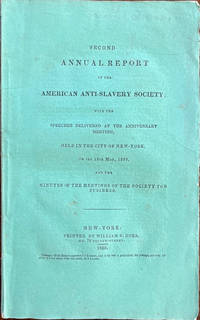
183560564New York: Printed by William S. Dorr No. 70 Fulton Street 1835. 8vo. 87 1 pp. Printed blue-green publisher’s softcovers contents on back cover punch-sewn at gutter margin as issued minor edgewear slight chipping to spine 1 closed tear w/ minor archival repair on inner back cover still VG- copy. First edition of this surprisingly uncommon report of the second meeting of this pioneering American abolitionist society founded by William Lloyd Garrison editor of The Liberator magazine and Arthur Tappan while also featuring contributions by Frederick Douglass and William Wells Brown an African-American freedman. The society was very controversial as by the mid-1830’s slavery was ensconced into the American economy feeding wealth not only to Southern planters but also Northern merchants textile factory owners and shipowners. The first meeting and later misrepresentation had set off violent the violent Farren riots in New York where abolitionists homes and properties were attacked. The 1835 meeting not only agreed on the Society Constitution but also used fundraising to sponsor a great postal campaign to flood the South with Abolitionist literature. White supremacists responded by seizing and destroying the mail and on July 29 1835 3000 people gathered to burn Abolitionist writings and burn three in effigy. The speeches detail the progress of the result of Great Britain freeing 800000 slaves encouraging continued efforts to enroll African-American children and freed slaves into schools and declared that “prejudice which excludes our colored brethren from the rights and privileges of Men the Society lays the axe at the root of slavery. It removes the final bugbear that ‘the Slaves will be worse off when emancipated.’†This also features the extended interview and discussion with Abolitionist former slaveholder James Gillespie Briney 1792-1857 who freed his slaves joined the American Anti-Slavery Society and founded The Philanthropist in Cincinnati OH in 1835 after selling his plantation. Worldcat locates 5 physical copies Cornell DLC NYPL Howard AAS Lib. Printed by William S. Dorr, No. 70 Fulton Street, paperback
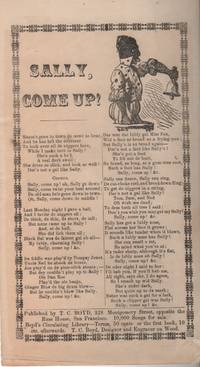
186021436San Francisco: T.C. Boyd ca. 1860. Near fine. Broadside 8.5" by 4.5". Printed from type and wood engraving. Very near fine with trivial crease to edges. <br/><br/>Racist slavery-era broadside printed and designed by one T.C. Boyd featuring a drawing and lyrics to a ballad which begins: "Massa's gone to town de news to hear / And he has left the overseer / To look over all de nrs here / While I make love to Sally!" Boyd notes he had 10000 such sheets for sale at his shop. T.C. Boyd unknown books
186043380San Francisco: T.C. Boyd 1860. Near fine. Racist slavery-era broadside printed and designed by one T.C. . Boyd featuring a drawing and lyrics to a ballad which begins: "Massa's gone to town de news to hear / And he has left the overseer / To look over all de nrs here / While I make love to Sally!" Boyd notes he had 10000 such sheets for sale at his shop. Broadside 8.5" by 4.5". Printed from type and wood engraving. Very near fine with trivial crease to edges. T.C. Boyd unknown
183319436New-Haven: Published and Sold by A. H. Maltby; Boston: Pierce and Parker 1833. Evident first edition. Wrappers quite foxed; some scattered internal foxing and a little light soiling and wear; a good copy. Original printed yellow wrappers stitched 9.5 x 5.75 inches 24 pages untrimmed. From the Congregationalist clergyman and polemicist gradual emancipationist and advocate of colonization see the ANB an attack on Garrison; per the LCP catalog description "Articles reviewed are William Lloyd GarrisonÃs Thoughts on African colonization; James CropperÃs Letter to Thomas Clarkson; and Abolition of Negro slavery published in American quarterly review September 1832." The edition statement would seem to have been more accurately rendered with a comma "second separate edition" as there appears to be no other edition besides this supposed second separate edition published besides the periodical appearance in the Christian Spectator. Lib. Company. Afro-Americana 759; Dumond page 23; Sabin 2671 & 70214; American Imprints 17489. Published and Sold by A. H. Maltby; Boston: Pierce and Parker, unknown books
183736669New York: Collins Keese & Co 1837. First Edition. Hardcover. Poor. Octavo. 4 pages advertisements xxxii 4 blank leaves. Binding in poor condition. Spine missing and repaired with tissue paper. Hinges are glued and cracked. Heavy toning to the preliminary pages. Rest of text has light to moderate foxing and or toning. Contents include the a case relating to Slavery: a motion for a new trial concerning ownership of Slaves owned by the Coxe family on page 5. Scarce. Collins, Keese & Co hardcover
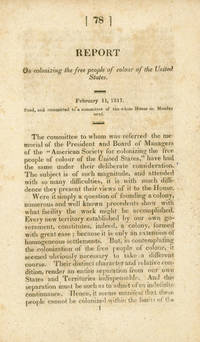
18179350WashingtonCity 1817. First Edition. 5 pp. 1 vols. 8vo. Disbound. Some foxing. First Edition. 5 pp. 1 vols. 8vo. First edition of the government's reply to the request of a group of Virginia planters for a "colony" to essentially rid them of the problem of "free coloured people." In December of 1816 a group of Virginia planters approached the government with a request asking for a location where freed blacks might be sent. In January this "memorial" was presented and in February it was answered with this "Report." This reply discusses location etc. In the end the government officially refused to have anything to do with the plan - thus the American Colonization Society was born. For a detailed account of these events see Dumond Anti-Slavery pp. 126-127. S&S 42738 2 copies unknown books
18179350Washington City 1817. First Edition. 5 pp. 1 vols. 8vo. Disbound. Some foxing. First Edition. 5 pp. 1 vols. 8vo. First edition of the government's reply to the request of a group of Virginia planters for a "colony" to essentially rid them of the problem of "free coloured people." In December of 1816 a group of Virginia planters approached the government with a request asking for a location where freed blacks might be sent. In January this "memorial" was presented and in February it was answered with this "Report." This reply discusses location etc. In the end the government officially refused to have anything to do with the plan - thus the American Colonization Society was born. For a detailed account of these events see Dumond Anti-Slavery pp. 126-127. S&S 42738 2 copies unknown
1842313227Philadelphia: stereotyped by L. Johnson 1842. First edition. 140 pp. 1 vols. 8vo. Original brown ribbed cloth rebacked with original spine laid down titled in gilt. Marginal dampstaining throughout scattered foxing some wear to boards good. First edition. 140 pp. 1 vols. 8vo. First edition of this report of this monumental Supreme Court decision regarding escaped slaves preceding by 15 years and rivaling in importance the Dred Scott case of 1857. "In Prigg the Court identified slavery as a core constitutional commitment with which states could not interfere. In this case the Court struck down northern states' 'personal liberty laws' established to protect alleged fugitive slaves from recapture without due process of law. When the professional 'slave catcher' Edward Prigg tried to remove Margaret Moran an alleged runaway he was unable to meet the burden of proof set out by Pennsylvania's 1826 Personal Liberty Law and failed to obtain the legal certificate permitting him to remove her. When Prigg proceeded to ignore this and removed Moran illegally to Maryland Pennsylvania convicted him of kidnapping. The US Supreme Court however overwhelmingly overturned Prigg's conviction 8-1 and pronounced state laws interfering with the return of alleged runaways a violation of the Fugitive Slave Clause." Beaumont The Civic Constitution 2014 p. 128. Blockson 9905; Dummond p. 140; Sabin 61207 stereotyped by L. Johnson unknown books
1858WRCAM53597Charleston 1858. 16pp. Original printed wrappers. Spine perished held together with brass tacks; light chipping and soiling. Paper lightly and evenly toned. Good. Report submitted to the South Carolina Senate which concludes that slavery is essential to the agricultural production of the South. Additionally the committee felt that the slave trade helped relieve Africa from "the pressure of a redundant population as might be afforded by emigration in the only form in which its benefits can be extended to them." unknown books
1856WRCAM34592Montpelier 1856. 19pp. Self-wrappers. Upper edge gnawed and stained else good. This report from a committee of the Vermont House of Representatives was made in response to events in Kansas resulting from the introduction of slavery into that territory. According to the report Vermonters in Kansas had been harassed and attacked by pro-slavery forces with a situation of lawlessness ensuing. The Vermont House asserts the state's rights to protect its citizens in Kansas and allots a sum of $20000 to alleviate the suffering of afflicted Vermonters. OCLC locates only four copies. Quite scarce. OCLC 34605036. unknown books
1842313227Philadelphia: stereotyped by L. Johnson 1842. First edition. 140 pp. 1 vols. 8vo. Original brown ribbed cloth rebacked with original spine laid down titled in gilt. Marginal dampstaining throughout scattered foxing some wear to boards good. First edition. 140 pp. 1 vols. 8vo. First edition of this report of this monumental Supreme Court decision regarding escaped slaves preceding by 15 years and rivaling in importance the Dred Scott case of 1857. "In Prigg the Court identified slavery as a core constitutional commitment with which states could not interfere. In this case the Court struck down northern states' 'personal liberty laws' established to protect alleged fugitive slaves from recapture without due process of law. When the professional 'slave catcher' Edward Prigg tried to remove Margaret Moran an alleged runaway he was unable to meet the burden of proof set out by Pennsylvania's 1826 Personal Liberty Law and failed to obtain the legal certificate permitting him to remove her. When Prigg proceeded to ignore this and removed Moran illegally to Maryland Pennsylvania convicted him of kidnapping. The US Supreme Court however overwhelmingly overturned Prigg's conviction 8-1 and pronounced state laws interfering with the return of alleged runaways a violation of the Fugitive Slave Clause." Beaumont The Civic Constitution 2014 p. 128. Blockson 9905; Dummond p. 140; Sabin 61207 stereotyped by L. Johnson unknown
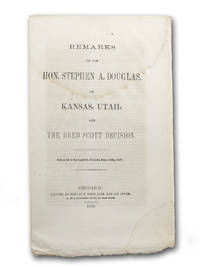
185718536Chicago: Printed at the Daily Times Book and Job Office 1857. First Chicago edition. Light damp-stain to the upper third of the sheet small stain to the lower outer corner; a very good copy. Original self-wrappers 10.25 x 6 inches 15 pages untrimmed. Unopened. Per Byrd "This speech was the first public expression of his views on the Dred Scott decision. In it he accepted the decision and insisted that 'the whole principle of Popular Sovereignty and self-government is sustained and firmly established by the authority of this decision.' " Byrd also notes this pamphlet was intended to lay the groundwork for his 1858 re-election. An edition printed in Springfield and an 8-page edition without an imprint also appeared the same year as well as an edition in German. Flake Mormon Bibliography 2985; Ante-Fire Imprints 250; Byrd 2635. Printed at the Daily Times Book and Job Office, unknown books