2 177 résultats
198960043Gallery. New. 1989. Paperback. 0919777783 . FREE UPGRADE to Courier/Priority Shipping Upon Request IN STOCK AND IMMEDIATELY AVAILABLE FOR SHIPMENT - Flawless copy brand new pristine never opened -- 56 pp. With 20 ills. 8 col. . 29 x 21 cm. Description: "Presents individual commentaries by Canadian artists Steele b. 1947 and Tomczak b. 1952 on stills from 12 videotapes representing both collaborative and independent productions. The artists' 'didactic' treatment of issues involving identity censorship and the nature of mass media is discussed in two critical essays. " -- with a bonus offer-- . Gallery paperback
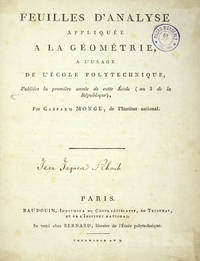
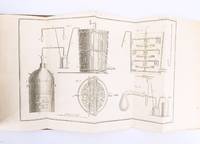
92468Paris Badouin An 9 1801. . Second edition enlarged 4to 142 pp. 3 engraved plates contemporary half calf neatly rebacked a very good example.<br /> mba004 Descriptive geometry is the science of presenting a three dimensional object on a two dimensional plane. Gaspard Monge invented descriptive geometry. His methods allowed for accurate representation of objects including shadows and vanishing points. His methods were so important and revolutionary at the time that they were kept is a military secret. Using his formulae one could simplify the optimisation of 3 dimensional problems dramatically as well as send accurate representations of objects to allies depictions of fortifications were particularly useful at the time being the Napleonic era. This book was first published in 1795 as a series of lectures. The internal scholia indicate that it is a second edition. It includes all 3 projections.<br /><br />Monge was a fervent supporter of the revolution and intellectual rigour. He later led the production of the Description de l'Égypte wherein the accuracy of many of the depictions is testimony to his methods. Current applications of his breakthrough are numerous 3d films use his techniques of representation the calculation of stresses on surfaces and accurate architectural modelling follow from the ideas contained in these his early lectures.<br /> Paris, Badouin, An 9 [1801]. unknown
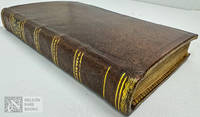
178990025Paris: Rue et Hôtel Serpente 1789. Fine. Opening run of the journal ""Annales de chimie"" vehicle of ""The New Chemistry"" founded and directed by Antoine de Lavoisier Rue et Hôtel Serpente Paris 1789-1792 12.8 x 19.6 cm Relié First edition highly sought after in the 19th century comprising 14 of the first 15 volumes published between 1789 and 1792 of the first series of the celebrated French scientific periodical Annales de chimie. Volume 10 missing. Contemporary full brown calf spines smooth with gilt fillets brown morocco lettering-piece and green morocco numbering-piece blind-ruled border to covers red speckled edges bookplate of P. H. Chavoix to front pastedown of each volume. Volumes 1 and 11 numbered in Roman rather than Arabic numerals. Overall discreet restorations corners rubbed occasional light foxing and browning some worming to bindings not affecting text head and tail of headcaps worn on volumes 7 13 14 and 15. The complete first series of the Annales de chimie published between 1789 and 1815 runs to 96 volumes. From 1793 to 1797 publication was suspended following the arrest of Antoine Lavoisier the journal's treasurer and in Édouard Grimaux's words its ""true director."" The opening run here contains nearly all the issues produced under the direction of and with contributions from the chemists Antoine de Lavoisier and Baron Philippe Frédéric de Dietrich. Both were condemned to the guillotine during the Reign of Terror in 1794 and 1793 respectively. This set is further illustrated with 12 scientific plates including two by the engraver Sellier as well as a map of the county of Bigorre. The majority of the articles and essays are first editions written by distinguished French and foreign chemists and physicists who helped disseminate ""The New Chemistry"": in order of appearance Louis-Bernard Guyton de Morveau Antoine de Lavoisier Gaspard Monge Claude-Louis Berthollet Anne-François Fourcroy Philippe-Frédéric de Dietrich Jean Henri Hassenfratz Pierre-Auguste Adet Jean-Antoine Chaptal Martin Heinrich Klaproth Johann Georg Albrecht Höpfner Christoph Girtanner Johann Christian Wiegleb Jacques-Anselme Dorthes Johann Friedrich Westrumb Armand Seguin Henry Cavendish William Austin Martin van Marum l'abbé René Just Haüy Peter Jacob Hjelm Jan Ingenhousz Isaac Milner Johan Gadolin James Watt Lorenz Florenz Friedrich von Crell Charles Blagden Jean Senebier Jean d'Arcet William Higgins Nicolas-Louis Vauquelin Nicolas Joseph Thiéry de Ménonville Dom Michel Rubin de Celis Jacques Louis Schurer Augustin-François de Silvestre l'abbé Claude Chappe Antoine Augustin Parmentier Nicolas Deyeux Bertrand Pelletier Charles-Augustin Coulomb Joseph Priestley Richard Kirwan Jean André de Luc Jean-François Clouet chevalier Marsilio Landriani Jean-Noël Hallé François Pierre Nicolas Gillet de Laumont Georges-Charles Bartholdi Alexandre Brongniart Jean-Michel Haussmann Henri Reboul François René Curaudau Thomas Henry Jean-Anthyme Margueron Nicolas Leblanc Johann Rudolph Deiman Pieter Nieuwland Pierre de Ribaucourt Pissis fils Jean-Baptiste Van Mons ou encore Louis François Antoine Arbogast. In 1816 the Annales de chimie was retitled Annales de chimie et de physique. In 1913 the journal split into two separate publications Annales de chimie and Annales de physique. The titles have undergone further changes up to the present day. A collection of 14 volumes from the opening run of the prestigious French scientific periodical Annales de chimie containing numerous essays and articles most in first edition published under the editorship of distinguished figures: Antoine de Lavoisier Louis-Bernard Guyton de Morveau Gaspard Monge Claude-Louis Berthollet Anne-François Fourcroy Philippe-Frédéric de Dietrich Jean Henri Hassenfratz and Pierre-Auguste Adet. Rue et Hôtel Serpente unknown
0199541299New. Brand new and still unused unknown
0143020633New. Brand new and still unused unknown
162325379London: William Stansby 1623. Book. Very Good. Hardcover. Folio. Pp. 6 xvi 218. Title in red and black woodcut headpieces and initials and large woodcut textual medallion. Bound in modern quarter calf over marbled boards new endpapers. Faint marginal dampstain to opening leaves light even browning throughout text signature of William Beattie 1795-1875 noted physician and travel writer on title. Overall a very clean attractive copy. Edited by John Selden from a manuscript in the Cotton Library this is the First Edition of Eadmer's most important work the "Historiae Novorum" a chronicle of contemporary events from the time of the Conquest in 1066 to the early 12 th century. STC 7438.2; Sarton II 275. William Stansby Hardcover
46577Hamburg: Gyula Trebitsch Produktion 1981. Manuscript. Hardcover. g to fine. Quarto. 1 19 19 leaves. Original black cloth with gilt lettering on cover and spine. The screenplay is based on the novel "Die Geschwister Oppermann" by Lion Feuchtwanger. Nineteen-page original screenplay in English at front accompanied by nineteen original b/w photographs 9 15/ x 7" pasted to cream heavy stock paper with brief captions. The screenplay was realized and aired as a TV miniseries in 1983.<br /> <br /> Telling the story of the family Oppenheim a dynasty in furniture manufacturing. The name of Feuchtwanger's original novel "Geschwister Oppenheim" was changed to "Geschwister Oppermann" due to the efforts of a German National Socialist with the same name who forced the name change. Therefore the third edition of the novel was published as "Die Geschwister Oppermann." The screenplay starts at the beginning of November of 1931 telling the tragic story of the family Oppermann in the years 1932 and 1933 against the backdrop of the Nazis taking power in Germany. The original photographs vividly represent the historic events including Hitler's arrival in Berlin riots demonstrations police action the election the boycott of Jewish business the Reichtagsbrand and a head shot of Lion Feuchtwanger in 1930 among others.<br /> <br /> Egon Monk 1927–2007 after serving in the German Air Force from 1943–1945 became an actor and joined the Berliner Ensemble as an assistant director. From 1954–1959 he worked for RIAS Berlin and for the NDR North German Broadcast after that. Monk won various Tele play Awards and the German Critics Association Award in 1988. His first realized project of "Senora Carrar's Rifles" by Bertolt Brecht in 1953 was a life television production for the East German Television. Some rubbing and few marks on covers with gilt lettering somewhat faded. Binding in overall good interior in very good photographs in fine condition. Protected in modern mylar. Gyula Trebitsch Produktion hardcover
17941311130103Impr. du Comite de salut public 1794-01-01. Hardcover. Very Good. 4to. Contemporary leather boards rebacked on modern leather spine. 27 cm. Good binding and cover. viii 231 p. lx folded leaves of plates. Lovely copper plates throughout. Generally clean unmarked pages. Collated. Goldsmiths'-Kress no. 16024.5-1. D.S.B. 9: 469-478. Impr. du Comite de salut public hardcover
179456237Paris Comité de Salut Public AN 2 1794. 4to. Contemp. hcalf. Gilt spine. Titlelabel with gilt lettering. A small tear to leather at top of spine and joint. 4VIII231 pp. 4 folded tables and 60 large folded engraved plates. The first few leaves with scattered brownspots. <br/><br/><em>First edition. The plates are identical with those in Panckoucke's Encyclopedie. " Between 1786 and 1788 Monge investigated with Berthollet and Vandermonde the principles of metallurgy and the composition of irons cast metals and steels. This research enabled them to unite previous findings in these areas to obtain precise theoretical knowledge by means of painstaking analyses and to apply this knowledge to the improvement of various techniques." DSB - Poggendorff II184. </em> hardcover
19833459Berkeley : Asian Humanities Press ; Seoul : Po Chin Chai 1983. 1983. Soft cover. Very Good. 135 pp. : chiefly illustrations some in color ; numerous photographs ; 35 cm. ; OCLC: 11766799 ; LC: ND2073.6.Z8 ; a rare collection of action photographs ceramics and calligraphic paintings and lithographs executed by Jung Kwang the Mad Monk ; " The present volume is an attempt to present a partial retrospective of his paintings including the latest work which has expanded into the use of lithographs.In 1980-81 he took an extended trip his first to the U.S. and Europe giving demonstrations of his painting style."--preface ; "Jung Kwang the painter has his artistic roots firmly placed within a style of art that was nourished by the monastic communities of East Asia. Using only the brush and ink monks made their art using rapid and yet disciplined brush strokes. The paintings only took seconds to complete; they could not be retouched or corrected; each was finished when the brush left the paper. As might be imagined this style was particularly favored by the Zen schools. The paintings were used as a test for the state of enlightenment of the painter.Jung Kwang began to separate his art from this traditional school and with that separation came many questions about the value of his work. The controversies of his art continue to the present.Having introduced all sorts of new subjects into his paintings: bulls guardian figures roosters fish and more shocking penises on all the animals and even coming out of the head of Dharma it is little wonder that the traditionalists were horrified."--Introduction ; Jung Kwang's reputation as "The Mad Monk" is here fully represented by the use of color non-traditional brushes and pens even to the shocking photographs of him using his penis as th e brush on a series of paintings! ; he was ordained a monk in the Chongye Buddhist Order at Tong-do Monastery near Pusan in 1962 and practiced meditation under direction of Master Kuha and was later a member of the Chongye National Council as its art consultant but was then expelled in 1983 presumably for his movement away from traditional forms ; nonetheless there are many who would consider the paintings in this book enlightened visual Zen koans of a sublime nature ; SIGNED presentation by Jung Kwang from 1986 on the front ep ; folio bound in color pictorial stiff paper wrappers ; some wear but otherwise VG. Very scarce with only 25 copies known held by libraries worldwide. This online listing contains text in Chinese and Korean fonts <br/> <br/> Berkeley : Asian Humanities Press ; Seoul : Po Chin Chai, 1983. paperback
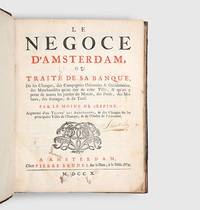
1710135031Amsterdam: Pierre Brunel 1710. Second edition bound as issued with Jacques Mondoteguy's Traité des Arbitrages also published by Pierre Brunel in 1710 but in Paris. Le negoce d'Amsterdam was first published in both Dutch and French in 1694. Jacques le Moine de l'Espine d. 1696 was a merchant dealer in art and maps mathematician and writer on economics who was based in Amsterdam from 1697 onwards. Quarto 221 x 165 mm. Title printed in red and black separate divisional title leaf for Traité des Arbitrages continuously paginated with that gathering Hh having five leaves. Woodcut title page vignettes to both head- and tailpieces initials numerous tables to text. Contemporary calf rebacked preserving the original spine title lettered in gilt to second compartment rest elaborately tooled in gilt raised bands marbled endpapers edges sprinkled red and blue. Early ownership signature "Jouxtel" hand written in ink to front pastedown "Jouxtely" to title page and final page "Jou:tel" to fore edge of book block likely the same hand which has carefully amended the catchword on the final page of Le Moine de L'Espine's work to match the first word of Mondoteguy's title page and neatly corrected a figure on p. 235; engraved bookplate of Jean R. Perrette to front pastedown. Corners restored a few marks to boards lower corner of book block up to p. 170 a little gnawed front free endpaper laid onto following blank occasional marginal dampstain but generally contents crisp a few pen trials to title page and last few blanks natural paper flaw along lower margin of leaf Ff1 resulting in small loss to lower corner not affecting text. Overall a very good copy. Goldsmiths' 4601. hardcover
178544970Paris Moutard 1785. 4to. Extracted from "Mémoires fe Mathematique et de Physique Présentés à l'Academie des Sciences par divers Savans" Tome X. Pp. 511-550 a. 2 folded engraved plates. Clean and fine. <br/><br/><em>First appearance of this importent paper by the "greatest geometer of the century" in which he solves some main problems in coordinate geometry especially he introduced the "distant formula" for three dimensions years before it was used by Lagrange. He laid the foundation of a completely new branch of mathematics known as descriptive geometry. The paper was delivered already in 1771 but not published until 1785. "His first important original work was "Memoire sur les développées les rayons de courbure et différents genres d inflexions des courbes á double courbure" He published an extract from it in June 1769 in the Journal encycyclop´matiques and in October 1770 he finished a more complete version that he read before the Academie des Sciences in August 1771; the latter however was not published until 1785 Mémoires de mathématiques et de physique présentés á ’Academic par divers scavanns. By then some of the most important ideas in the memoir no longer seemed so original because Monge had employed them in other works published in the intervening years. Nevertheless this memoir is of exceptional interest for it presents most of the new conceptions that Monge developed in his later works as well as his very personal method of exposition which combined pure geometry analytic geometry and infinitesimal calculus."DSB. </em> unknown
179825<p><b>LEWIS'S "TO THE READER" EXPLAINS HIS AFRICAN SLAVE CHARACTER HIS "MISANTHROPIC NEGRO"</b></p><p><b>LEWIS Matthew Gregory "Monk". </b><i>The Castle Spectre: A Drama. In Five Acts. First Performed at the Theatre Royal Drury-Lane on Thursday December 14 1797. By M. G. Lewis M. P. Author of The Monk &c. </i> 8vo disbound pp. 103 1 ad. London: Printed for J. Bell 1798. <br /></p><p>First Edition. An extraordinary commercial success although not a universal favorite of the critics. To the critics who objected to his use of black slaves in a Gothic story he defended himself by saying that if he could "have produced the same effect by making my heroine blue blue I should have made her." "As far as Lewis's search for novelty and striking effects is concerned it is interesting to highlight the character of Hassan an African servant.Hassan is in Ormond's service because the earl has cruelly snatched him from his family and hating the white race that he considers responsible for his sufferences the black slave refuses to escape only because he is aware of his master's evil propensity to torture people around him. Lewis exploited this unusual figure to introduce something new and surprising in his play but also to underline the demonic instincts of the villain."-Bertrand Evans <b>Gothic Drama from Walpole to Shelley</b>1947 online. Lewis's <i>To The Reader </i>pp. 100-103 admits borrowing from other authors saying: "To the originality of character I make no pretence.but I shall not so readily give up my claim to novelty when I mention my misanthropic <i>Negro: </i>He has been compared to <i>Zanga </i>but Young's hero differs widely from what I meant in <i>Hassan.Hassan</i> is a man of violent passions and warm feelings whose bosom is filled with the milk of human kindness but that milk is soured by despair.he has lost everything even hope; he has no single object against which he can direct his vengeance and he directs it at large against mankind. He hates all the world.that heart was once feeling and kind." This Lewis's most famous play went into eight printed editions by the following year and a total of eleven by 1803. "A brilliant example of the more thrilling type of melodrama accompanied by music by Michael Kelly.The story tells how Osmond the villain captures Angela.Father Paul is based on Juliet's nurse and on Sheridan's Father Paul."-Nicoll <b>A History of English Drama 1660-1900 </b> vol. III pp. 99-100. The play was particularly indebted to <i>The Castle of Otranto The Mysteries of Udolpho </i>and<i>Die Räuber. </i> Coleridge described it as a "peccant thing of Noise Froth and Impermanence." Despite its lack of originality "it was an excellent vehicle for presenting a series of striking scenes of suspense or spectacle--the sudden appearance of the ghost in an atmosphere prepared by forebodings.Kemble and Mrs. Jordan were by all accounts superb in the leading roles.But the principle reason for its success was the appearance of the ghost in Act IV.Louis F. Peck <b>A Life of Matthew G. Lewis </b>1961 pp. 73-74. Edith Birkhead <b>The Tale of Terror: A Study of the Gothic Romance </b>p. 66. Summers <b>A Gothic Bibliography </b>p. 254. <b>Nicoll </b>III p. 281. No copies have appeared at auction since at least 1975 nor as of this writing are there any online. Minor browning first and last leaves moderately so. 84146 ABAA-VBF<br /></p> J. Bell
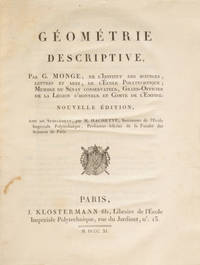
2407SB006<p>Par G. Monge de l'Institut des sciences lettres et arts de l'École Polytechnique; Membre du Sénat conservateur Grand-Officier de la Légion d'honneur et Comte de l'Empire. Nouvelle Édition Avec un Supplément par M. Hachette Instituteur de l'Ecole Impériale Polytechnique Professeur-Adjoint de la Faculté des Sciences de Paris. PARIS J. KLOSTERMANN fils Libraire de l'École Impériale Polytechnique rue du Jardinet n.º 17. M. DCCC. XI. 1811 M. DCCC. XII. 1812.</p>_x000d_<p>De 26x205 cm. Com xii 162 xlviii iv 118 ii xxii págs. Encadernação da época inteira de pele com rótulo laranja e elaborados ferros a ouro na lombada.</p>_x000d_<p>Ilustrado com um total de 35 folhas desdobráveis com 78 figuras muito nítidas. O final da primeira parte da obra contém 24 folhas com 48 figuras com exercícios e desenhos; o suplemento contém 11 folhas desdobráveis das quais quatro são de grandes dimensões perto do tamanho de um A3 com 30 figuras. São apresentadas as formas de desenhar planos figuras geométricas e diversas intersecções.</p>_x000d_<p>Exemplar com desgaste superficial nas pastas.</p>_x000d_<p>Obra muito importante para a história da geometria descritiva disciplina essencial para o desenho técnico a arquitetura e a engenharia.</p>_x000d_<p>Terceira edição muito rara não é catalogada pela BNF. A primeira edição foi publicada em 1798 e a quarta em 1820. Não se conhece a data da segunda edição.</p>_x000d_<p>A obra está estruturada em cinco capítulos que abordam a definição e a forma de projetar pontos linhas e planos; planos tangentes a superfícies curvas propriedades da intersecção de planos com esferas e cilindros linhas cónicas; intersecção entre superfícies curvas e respetivas retas tangentes e aplicações várias da resolução destes problemas.</p>_x000d_<p>Inclui um suplemento escrito pelo discípulo e professor-adjunto de Monge Jean-Nicolas-Pierre Hachette que ampliou o impacto educacional da obra que continuou a ser uma referência fundamental no ensino da geometria aplicada durante várias décadas. O suplemento é registado na folha de rosto principal tem paginação e folha de rosto própria pelo mesmo editor com a data de 1812.</p>_x000d_<p>Gaspard Monge conde de Péluse Beaune 1746 Paris 1818 foi um eminente matemático francês conhecido como o fundador da geometria descritiva uma disciplina que revolucionou o modo de representar objetos tridimensionais em planos bidimensionais.</p>_x000d_<p>Monge demonstrou desde cedo uma aptidão notável para a matemática tendo começado a lecionar física aos 16 anos na escola dos Oratorianos em Lyon. Em 1762 Monge elaborou um plano detalhado da sua cidade natal utilizando métodos inovadores de observação e instrumentos de topografia por ele construídos. Esta habilidade levou-o a ser recomendado para a Escola Militar de Mézières onde desenvolveu uma metodologia geométrica para determinar a colocação de baterias de canhões um trabalho que foi considerado segredo militar. Foi em Mézières que Monge concebeu a sua obra-prima a «Géométrie Descriptive» publicada pela primeira vez em 1799 onde apresenta as bases desta disciplina com base nas suas aulas na École Normale.</p>_x000d_<p>Durante a Revolução Francesa Monge desempenhou um papel crucial participando na criação do sistema métrico e na fundação da École Polytechnique onde foi professor e administrador formando engenheiros que contribuíram para o desenvolvimento da França. Além das suas contribuições matemáticas Monge foi um fervoroso Bonapartista e acompanhou Napoleão nas campanhas em Itália e no Egito onde ajudou a fundar o Instituto do Egito inspirado no Instituto Nacional de França. Contudo após a queda de Napoleão Monge foi despojado dos seus títulos e honras pelos Bourbons passando os seus últimos anos afastado da vida pública mas com um legado duradouro na matemática e na engenharia.</p>_x000d_<p>Jean-Nicolas-Pierre Hachette Mézières 1769 - Paris 1834 foi um matemático e engenheiro francês conhecido por ser um dos principais discípulos de Gaspard Monge. Formado na École Polytechnique onde mais tarde se tornaria professor Hachette contribuiu significativamente para o desenvolvimento e ensino da geometria descritiva. Publicou também obras em mecânica e foi um defensor fervoroso da aplicação prática das ciências matemáticas à engenharia.</p>_x000d_<p>EN 26x20.5 cm. xii 162 xlviii iv 118 ii xxii pages. Contemporary full leather binding with an orange label and elaborate gilt tools on the spine.</p>_x000d_<p>Illustrated with a total of 35 fold-out sheets with 78 very clear engravings. The end of the first part of the book contains 24 sheets with 48 figures with exercises and drawings; the supplement contains 11 fold-out sheets four of which are large about the size of an A3 with 30 figures. Ways of drawing planes geometric figures and various intersections are presented.</p>_x000d_<p>Copy with superficial signs of wear on the boards.</p>_x000d_<p>Very important work for the history of descriptive geometry an essential discipline for technical drawing architecture and engineering.</p>_x000d_<p>Very rare third edition not catalogued by the BNF. The first edition was published in 1798 and the fourth in 1820. The date of the second edition is unknown.</p>_x000d_<p>The book is structured in five chapters that cover the definition and how to project points lines and planes; tangent planes to curved surfaces properties of the intersection of planes with spheres and cylinders conic lines; intersection between curved surfaces and their tangent lines and various applications of solving these problems.</p>_x000d_<p>Includes a supplement written by Monge's disciple and assistant professor Jean-Nicolas-Pierre Hachette which extended the educational impact of the work which continued to be a fundamental reference in the teaching of applied geometry for several decades. The supplement is recorded on the main title page has its own pagination and title page by the same publisher with the date 1812.</p>_x000d_<p>Gaspard Monge Count of Péluse Beaune 1746 - Paris 1818 was an eminent French mathematician known as the founder of descriptive geometry a discipline that revolutionised the way of representing three-dimensional objects on two-dimensional planes.</p>_x000d_<p>Monge showed a remarkable aptitude for maths from an early age and began teaching physics at the age of 16 at the Oratorian school in Lyon. In 1762 Monge drew up a detailed plan of his home town using innovative methods of observation and surveying instruments he had built himself. This skill led him to be recommended to the Military School of Mézières where he developed a geometric methodology to determine the placement of cannon batteries a work that was considered a military secret. It was at Mézières that Monge conceived his masterpiece "Géométrie Descriptive" first published in 1799 where he presents the foundations of this discipline based on his classes at the École Normale.</p>_x000d_<p>During the French Revolution Monge played a crucial role participating in the creation of the metric system and founding the École Polytechnique where he was a professor and administrator training engineers who contributed to the development of France. In addition to his mathematical contributions Monge was a fervent Bonapartist and accompanied Napoleon on his campaigns in Italy and Egypt where he helped found the Institute of Egypt inspired by the National Institute of France. However after the fall of Napoleon Monge was stripped of his titles and honours by the Bourbons and spent his last years away from public life but with a lasting legacy in mathematics and engineering.</p>_x000d_<p>Jean-Nicolas-Pierre Hachette Mézières 1769 - Paris 1834 was a French mathematician and engineer known for being one of Gaspard Monge's main disciples. A graduate of the École Polytechnique where he would later become a professor Hachette contributed significantly to the development and teaching of descriptive geometry. He also published works on mechanics and was a fervent advocate of the practical application of mathematical sciences to engineering.</p>_x000d_<p>Referências/References:<br />Britannica recurso em linhaonline: Gaspard Monge count de Péluse<br />BNF - ark:/12148/cb30962716z FRBNF30962716 primeira edição<br />BNF - ark:/12148/cb309627179 FRBNF30962717 quarta edição</p> M-8-C-55 hardcover
2009SBS-9780754624998ASHGATE 2009. Hardcover. New. ASHGATE hardcover
2009SBS-9780754624998ASHGATE 2009. Hardcover. New. ASHGATE hardcover
179440625Paris: Comité De Salut Public. Very Good with no dust jacket. 1794. First. Vellum. B/ W ; 4to 8.25 x 10.5; 231 plates pages; 60 folding engraved plates; 4 folding tables. 4 viii 231 pages. 4to later vellum-backed boards gilt-lettered spine-label; generally clean and sound. Volume bulging from quantity of prints and fold outs. First edition of a work on " The principles of a gun-founding and manufacture of artillery iron and bronze" Piling 320. French language. Some foldouts protruding from book. . Comité De Salut Public hardcover
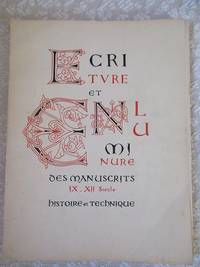
1926010051Sable-Sur-Sarthe / Lophem-Lez-Bruges: Abbaye St-Pierre De Solesmes / Abbaye De Saint-Andre 1926 Writing And Illumination Of Manuscripts From The 9th To The 12th Century - History And Technique. Overall in Very Good Condition with the paper wrap around for the ten portfolios in poor condition. Complete with 14 black & white illustrations and 88 gilt highlighted chromolithograph plates as called for. The First Volume: 83pp 1 with 14 b/w plates and 8 gilt highlighted chromolithograph plates some pages uncut binding and hinges tight. The Second Volume is unbound as issued and contains 10 portfolios each containing several leaves of text along with gilt highlighted chromolithograph plates numbered IX to LXXXVIII - bringing the total number of color plates to eighty-eight. The paper cover that wraps around the portfolios shows edge chips and the spine covering is detached. The plate colours are still bright. NO LABELS INSCRIPTIONS NOR MARKINGS. Text is in French. Abbaye St-Pierre De Solesmes / Abbaye De Saint-Andre paperback
171650002165London: J. Tonson 1716. 1st Edition . Hardcover. Good. 12mo - over 6¾ - 7¾" tall. Original hardcover. Title pages shows date of MDCCXVI 1716. Printed by J. Tonson at Shakespear's Head over-against Catharine - Street in the Strand. Includes lengthly dedication by R. Molesworth 9dated march 16 1716 to the Princess Her Royal Highness Carolina Princess of Wales. Total pages: dedication 46 pp. Poems 156 pp. 4 pages of advertisements. Three-quarter-bound lin leather with marbled paper boards. Spine is missing about 1" at top and 1.75" at bottom. Small 1" tear on one of the advertisement pages and several pages have pencil tic marks which can be erased if desired. An extremely rare copy. <br/> <br/> J. Tonson hardcover
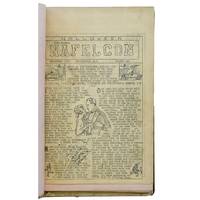
19252071<p>13-3/4 x 9 inches. Unpaginated issues approx. 300pp total. Includes a total of 27 complete issues: Vol. 1 Nos. 1-12 including two different issues of No. 10; Vol. 2 Nos. 1-12; and Vol. 3 Nos. 1-3 plus the first two leaves of No. 5. Bound in dark brown cloth with gilt lettering to front board issues mimeographed on different colored sheets mimeo illustrations throughout. Boards worn rubbed and spotted with fraying to corners; chipping to foot of endpaper and edges of Vol. 2 No. 1; newspaper clippings pasted to inside front cover and front endpaper; light soiling to endpapers; at least one leaf of Vol. 3 No. 5 roughly excised. Occasional pencil marginalia possibly in the hand of Jean Monk himself.</p><p>Bound volume of over two years of this monthly publication of the National Fellowship Club a social group for Washington's lonely hearted. Founded around 1921 as the Lonesome Club of the Wilson Normal Community Center to create social opportunities for the influx of single people over 35 to the city during WWI the group acquired Jean Monk's services as president in 1922. It briefly became the Washington Pastime Club which issued a periodical called The Lonesome Bug before being renamed the National Fellowship Club in 1924.</p><p>The club met every Thursday evening to dance and later other evenings of the week as well. Eventually the Club claimed a membership of between 3000 to 4000."There are multitudes of men and women here far from home and without friends or acquaintances" Monk is quoted as saying in the Evening Star. "This club stands ready to welcome them to invite them to spend a pleasant and profitable evening and to offer them our fellowship and assistance in meeting others who like themselves perhaps are strangers in a strange land." Evening Star Dec. 28 1924</p><p>The newspaper includes information on upcoming dances as well as a section called "Fellowship Funnies" editorials news about other social clubs illustrations of costumes for different themed dances poems short narratives and even the occasional screed by Jean Monk about patriotism the "supreme good" and other topics.</p><p>Rare. We find no record of this or <em>The Lonesome Bug</em> in OCLC or other online records.</p> Jean Monk hardcover
#[52489]Gebonden in 4 half perkamenten banden 479381346379 pag. Geillustreerd met uitslaande plattegrond van de beurs en tabellen. unknown
182721479Paris: Bachelier Succcesseur de Mme. Ve. Courcier 1827. Hardcover. Fine. Fifth edition. 4to. xx188pp. followed by 28 fold-out engraved plates Leather spine of marbled sheep gilt spine titles decorated paper over boards. A fine copy with a trace of foxing to the first couple of pages and light rubbing at edges and hinges<br /> <p><br /> Gaspard Monge was a French mathematician the inventor of descriptive geometry. This edition also contains he Theory of Shadows and Perspective extracted from his paper.<br /> <p>. Bachelier (Succcesseur de Mme. Ve. Courcier) hardcover
1794CAT000515London: G. Woodfall 1794. First Edition. Hardcover Full Leather. Very Good Condition. 3 volumes in contemporary full speckled calf hinges a little rubbed a few corners slightly bumped light occasional age toning internally - a nice set. Old Lawes Agricultural Trust stamps to titles and endpapers list of subscribers in volume one. xix 1 384pp; 372pp; 374pp.<br/><br/>A carefully curated collection of farming wisdom from a variety of sources tips on cultivation cattle bee keeping cheese making etc. Size: 8vo. 3-volume set complete. Quantity Available: 1. Shipped Weight: Under 1 kilo. Category: Farming & Rural Life; Cooking Wine & Dining. Inventory No: CAT000515. G. Woodfall hardcover
66076Luzern Bösch AG 1986. 128 x 905 cm Zustand A. Konzertplakat «Jazz in Willisau» im Hotel Mohren in Willisau. Mit Jon Hendricks George Adams Bill Hardman Walter Davis jun. Stafford James und Cliff Barbaro. 010 Luzern, Bösch AG, 1986 unknown
1805330London: D. N. Shury for J.F. Hughes 1805. First Edition. Very good in later speckled calf with gilt edges and spine marbled endpapers minor browning to a few pages and endpapers but generally clean and tight housed in a marbled slipcase. First edition of Monk Lewis's translation from the German of Zschokke's sensational gothic romance Abällino der grosse Bandit first published in 1793.<br /> <br /> In Coleridge's view this work exhibited the "wonder of effects produced by supernatural power without the means" and the plot follows the adventures of a banished and starving aristocrat who seeks employment as a hired assassin.<br /> <br /> 8vo. viii 340pp. 4 errata and ads. Wolff 4113. NCBEL III 743. Summers pg. 252 noting a few copies contain an 1804 date on the title page this copy with 1805. Thomson Voller and Frank pg. 254. D. N. Shury, for J.F. Hughes unknown