2 653 résultats
720940 photocopied pages incl. wrappers with many illus. stamp on upper wrapper. Small 4to 212 x 155 mm. orig. pictorial wrappers staple-bound. N.p.: 1978.<br /> The extremely rare fifth issue of Commonpress guest-edited by Ulises Carrion and devoted to boxing one of the artist's life-long passions. Based on floating editorship this mail art periodical comprised works contributed by fellow artists that were then photocopied. Carrión solicited projects from Klaus Groh Anna Banana Bill Gaglione Pawel Petasz Robin Crozier Silva Marcondes etc. On the inside of the lower wrapper Carrión writes: "The question now arises: has this anthology Primarily to do with art Or has it to do with box And this question is valid regardless of the plurality of meanings of the word 'box' which lead some participants to take it as meaning 'sport' and some others as 'receptacle'."<br /> A fine copy. Produced in an edition of 300 copies.<br /> ⧠Juan J. Agius ed. Ulises Carrión & The Big Monster 2014 p. 81. Guy Schraenen ed. Dear reader. Don't read. 2016 p. 218. U. Carrión Quant aux Livres 2008 p. 203. unknown books
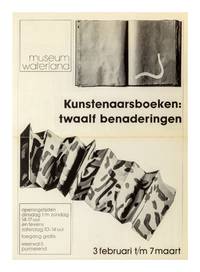
7256Many black & white illus. Two large folded sheets 299 x 212 mm. folded unbound. Purmerend: Museum Waterland 1981.<br /> An uncommon exhibition flyer for a display of bookworks at the Museum Waterland. Co-curated by Ulises Carrion and Agius both included their own works along with those of François Bouillon Axel Heibel Diderick van Kleef Federico Sanguinetti Ben Sleeuwenhoek Ad Gerritsen J. H. Kocman Tom Ockerse Gèza Perneczky and Pawel Petasz. Several examples of each artist's work are pictured. All of the works displayed were drawn from Agius and Carrión's personal collections. This catalogue's text written by Alex A. M. de Vries is in parallel Dutch and English. <br /> De Vries pointedly notes "Two book-artists curated and arranged this exhibition in such a way that you will not see much of the usual mania for conservation which is being practised in most of the musea. This means that you will be able to take the books in your hands.This exhibition proves that artists' books deserve to be shown more often and on large scale. And in an adequate way. The actual treatment like that of conservators in musea who like to take care of books as if they were dealing with radio-active material does not satisfy. A book ought to be in the hand of the reader."<br /> Fine and fresh copy.<br /> ⧠U. Carrión Quant aux Livres 2008 p. 210. unknown books
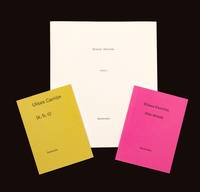
1141115 leaves printed on rectos only. 12mo lime green printed semi-stiff covers stitched. Geneva: Boabooks May 2016.<br /> <br> <br> From the colophon: "a b c presents a linguistic exercise handwritten in green ink on fifteen pages by Ulises Carrión in 1972." Printed and bound by Che Huber and Alexis Dos Santos and designed by Izet Sheshivari. As new. unknown
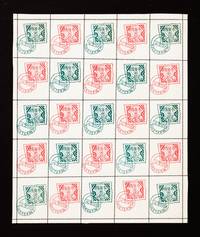
10317Single sheet mounted on black craft paper printed in red & green perforated. Amsterdam: late 1970s.<br /> <br> <br> A compelling specimen of Ulises Carrión’s avid involvement with the Eternal Network: a complete sheet of his “Here & Now†stamps. In excellent condition. unknown
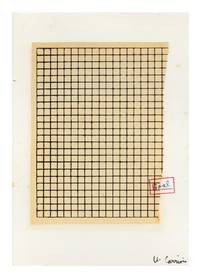
8888Amsterdam: ca. 1979.<br /> <br> <br> An original collage made by Ulises Carrión 1941-89 and gifted to Maurizio Nannucci b. 1939 in support of Zona’s non-profit mission following the Zona Parolo & Suono festival 11-19 June 1979. Near fine; faint foxing. <br /> <br> <br> ⧠See G. Schraenen ed. Dear reader. Don’t read. 2016 pp. 120-23 for similar works by Carrión employing graph paper. unknown
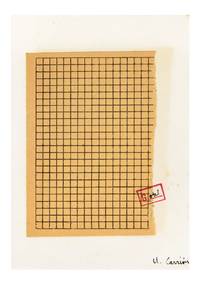
8889Amsterdam: ca. 1979.<br /> <br> <br> An original collage made by Ulises Carrión 1941-89 and gifted to Maurizio Nannucci b. 1939 in support of Zona’s non-profit mission following the Zona Parolo & Suono festival 11-19 June 1979. Near fine; very faint foxing and residue from the glue.<br /> <br> <br> ⧠See G. Schraenen ed. Dear reader. Don’t read. 2016 pp. 120-23 for similar collages by Carrión employing graph paper. unknown
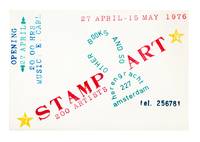
8086Card 150 x 106 mm. with text added by rubber stamp in red blue green and yellow ink. Amsterdam: 1976.<br/> <br/> One of the rarest pieces of ephemera created by Ulises Carrión’s bookstore and exhibition space Other Books and So. In 1975 the year of its founding the space had hosted shows for the Beau Geste Press Jiri Valoch Opal L. Nations and Eric van der Wal. For the present exhibition Carrión invited 200 artists who employed stamps in their work and displayed their pieces on the walls of Other Books and So when it was located at 227 Herengracht.<br/> <br/> In fine condition; nice impressions. From the collection of Guy Schraenen 1941-2018.<br/> <br/> ⧠Juan J. Agius ed. Ulises Carrión & The Big Monster 2014 pp. 38-39 pictured on p. 38 with a photograph of the exhibition. unknown
1089086 1 p. 8vo 225 x 155 mm. orig. printed red semi-stiff wrappers title on spine. Cullompton Devon: Beau Geste Press 1973.<br /> <br> <br> First edition the deluxe version on vibrant multi-colored Strathmore Grandee paper of this scarce and early Carrión 1941-89 bookwork. Arguments was printed in a total edition of 400 copies 200 on Huntsman white cartridge and unsigned and 200 deluxe copies and signed on the verso of the title-page.<br /> <br> <br> Formed in 1970 by Felipe Ehrenberg Martha Hellion David Mayor Chris Welch and Madeleine Gallard the Beau Geste Press was instrumental in Carrión’s growing engagement with artists’ books. The scholar Zanna Gilbert recalls in the Beau Geste Press catalogue p. 405 that in 2017 Ehrenberg “commented that Carrión had never gotten his hands dirty with ink before visiting the Beau Geste Press.†In 1973 the Press published two of his books Arguments Autumn and Looking for Poetry/Tras la PoesÃa Winter.<br /> <br> <br> In the Getty Research Institute exhibition catalogue Artists and Their Books Books and Their Artists 2018 Gilbert describes the present bookwork: “Carrión humorously interrogates the structure and content of books and the literary devices used by authors and playwrights. The titular exchanges in Arguments are indicated only by the names of the participants with no reference to the actual content of their disagreements. The distinctly Anglophone names are arranged in various configurations on each page of the book leaving the reader to wonder about the substance of the disputes. Indeed as the ‘arguments’ play out across the gridded field of the typeset page the book increasingly becomes about the materiality of the text itself with Carrión adding symbols such as the ampersand or violating the names themselves—as when for example ‘Marion’ becomes ‘Mar ion’—resulting in ever more complex exchanges†p. 72.<br /> <br> <br> The book was beautifully typeset by Terry Wright a skilled printer who joined the Press in 1972; laid out by Mayor; and offset-printed by Ehrenberg. Each “Argument†is numbered by hand there are 25 in total with several misnumbered and corrected in this copy nos. 5 22 23 24. Carrión’s book concludes with an unnumbered page on translucent paper with the entreaty: “My name is Ulises / What’s yours â€<br /> <br> <br> A fine copy; spine a trifle sunned.<br /> <br> <br> ⧠Alice Motard ed. Beau Geste Press 2020 No. 48 pp. 186-91 illustrating both versions.<br /> <br> <br> J. J. Agius & R. Ocampo eds. Ulises Carrión: Books & More Catalogue Raisonné 2013 7. unknown
713896 unnumbered pages. Thick 8vo 210 x 150 mm. semi-stiff printed wrappers. Geneva: Editions Héros-Limite 2005.<br/> <br/> The scarce second edition of Ulises Carrión’s famous Arguments 1st ed.: 1973 published by the Beau Geste Press. In the Getty Research Institute exhibition catalogue Artists and Their Books Books and Their Artists 2018 Zanna Gilbert writes about the first edition: “Carrión humorously interrogates the structure and content of books and the literary devices used by authors and playwrights. The titular exchanges in Arguments are indicated only by the names of the participants with no reference to the actual content of their disagreements. The distinctly Anglophone names are arranged in various configurations on each page of the book leaving the reader to wonder about the substance of the disputes.â€<br/> <br/> As new. From an edition of 750 copies.<br/> <br/> ⧠U. Carrión Quant aux Livres 2008 p. 202. unknown
9234Black & white illus. 25 pp. & colophon. 4to black printed softcover title on spine. Amsterdam: Galerie Da Costa 1980.<br /> <br> <br> One of 500 copies a scarce exhibition catalogue with an introduction composed by Carrión 1941-89. The catalogue provides a survey of Galerie Da Costa a publisher of artists’ books and livres d’artistes managed by Juan J. Agius. Agius published two of Carrión’s bookworks: Verzamelde Werken 1980 and Sistemas 1983.<br /> <br> <br> Carrión writes: “This catalogue illustrates the publishing activity developed by Juan Agius from Da Costa Gallery during the last 4 years. Such an activity takes place in a cultural context that is already familiar with the production of books by visual artists but where it has not yet been decided what the defining characteristics of this type of work are.â€<br /> <br> <br> With pictures and bibliographical information on bookworks by François Righi Adriaan Nette Francesc Guitart Manuel Menán Agius Federico Sanguineti François Bouillon Lia Rondelli Ben Sleeuwenhoek Roberto Comini Alessandro Algardi and Jean Zuber.<br /> <br> <br> Near fine copy. Withdrawn stamp of the Stedelijk Museum Amsterdam Library on title-page. unknown
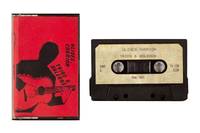
9235Audiocassette tape printed labels on side A & B housed in a plastic case. Orig. red paper pictorial liner. Amsterdam: Time Based Arts 1984.<br /> <br> <br> Rare audiocassette of a Carrión sound work; unrecorded by WorldCat. It was originally recorded in June 1983 and then issued through Time Based Arts the following year.<br /> <br> <br> “Trios & Boleros 1983 was produced as a part of a series by a number of artists writers and composers. The Dutch public broadcasting company VPRO allocated broadcast time to individual unrelated productions under the umbrella title of ‘Art on the Radio the Radio as Art’. No mathematical text analysis here: Ulises narrates the history of the bolero defining the classic form identifying the origins and greatest interpreters. He notes the impact of Cuban and Caribbean music on the genre…<br /> <br> <br> “The lecture is delivered against the musical background provided by these artists whose music filled his home…The program closes with the lyrics ‘Caminemos tal vez veremos después Walk on maybe we’ll meet again.’â€â€“Martha Hawley â€Jacaranda Ulises Carrión and Sound†in Martha Hellion ed. Ulises Carrión: ¿Mundos personales o estrategias culturales 2003 p. 89.<br /> <br> <br> Near fine; one of the cassette labels is partially coming loose.<br /> <br> <br> ⧠G. Schraenen ed. Dear reader. Don’t read. 2016 pp. 128 & 141. unknown
9935Black & white illus. throughout. 16 pp. incl. wrappers. 4to printed wrappers staple-bound. Warsaw: Galeria Remont 1976.<br /> <br> <br> An extremely scarce exhibition catalogue published for Carrión’s first exhibition at Henryk Gajewski’s Galeria Remont. Gajewski b. 1948 the Polish artist and filmmaker founded this contemporary art space in a dormitory student club at the Warsaw University of Technology. The gallery operated from April 1972 to November 1979 hosting performance art exhibitions of photography stamp art and bookworks and many other events.<br /> <br> <br> This catalogue contains the artist’s celebrated manifesto “The New Art of Making Books†which had been published for the first time the previous year in Plural no. 41 in Spanish and Michael Gibbs’s Kontexts nos. 6-7 in English. Galeria Remont became one of Carrión’s most important international connections in the vast network of collaborators he formed. Following this show he curated another exhibition at the Warsaw space — Inne Ksiazki 8-30 May 1977 — and gave lectures and performances there related to mail and stamp art. <br /> <br> <br> Most of the text in the catalogue reproduces Carrión’s characteristic bold script. In a very frank artist’s statement he elucidates his pivot from Mexican literary wünderkind to avant-garde language artist: “After extensively publishing short stories and theater plays in Mexico U. C. began using language outside the mould of what is usually called literature. Since then rather than writing poems ‘in the form of’ an advertisement or a dictionary old literature under new masks he situates dictionaries phone-books ads or any other manifestations of language as autonomous structures. His aim is to reveal the beauty and richness of these structures regardless of their referential content. U. C. is still a writer — and he insists on calling himself such — who writes very little or doesn’t even write at all. This is a radical shift in attitude which enables U. C. to concern himself not only with verbal languages but also with any system of symbols he may come across. He presents such systems either in the form of a book or as a display on a wall.â€<br /> <br> <br> A fine copy but for faint browning to the wrappers.<br /> <br> <br> ⧠Juan J. Agius & Ricardo Ocampo eds. Ulises Carrión: Books & More Catalogue Raisonné 2013 p. 116. unknown
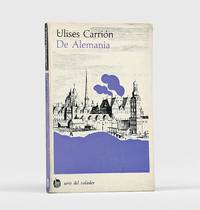
10113159 pp. & one leaf with index & colophon. Small 8vo 180 x 115 mm. orig. printed pictorial softcover spine worn author portrait on lower cover. Guaymas Mexico: JoaquÃn Mortiz August 1970.<br /> <br> <br> First and only edition of Carrión’s second book a collection of six short stories printed in a numbered edition of 3000 copies. In the 1960s Carrión 1941-89 was one of Mexico’s emerging literary talents; a number of his short stories had been published in leading journals and his first play El Gran Espectáculo was performed at the Casa de la Cultura de Tlacotalpan Veracruz to rave reviews. Following his studies in philosophy and letters at the Universidad Nacional Autónoma de México he spent time in France and Germany 1964-65 with the aid of scholarships learning both languages. <br /> <br> <br> Dissatisfaction with the Mexican literary world and local hostility toward the gay community drove Carrión to emigrate to Amsterdam in 1970 where he found a progressive and free-spirited milieu. From then on he conscientiously abandoned literature and fully dedicated his life and work to the visual arts in the form of books films social experiments performances mail art etc. This book represents the artist’s final moment as a traditional/conventional author preceding his conversion to experimental and avant-garde methods of communication.<br /> <br> <br> “In 1970 he published a second six-story collection De Alemania considered a more mature work. Here he has perfected the interior monologue which is the primary manner in which his characters disclose themselves. In some stories the salient characteristic is alienation but in others Carrión employs humor as a catalyst. Since such characteristics are not always mutually exclusive he does achieve a delicate balance between the two.â€â€“Dictionary of Mexican Literature 1992 ed. Eladio Cortés p. 147.<br /> <br> <br> Very good copy internally fine; spine a little creased as with most copies. Housed in a cloth clamshell box. unknown
143753Mexico: Joaquín Mortiz 1970. First edition and only edition number 533 of 3000 copies of Carrión's second book a collection of six short stories employing the interior monologue by "perhaps Mexico's most important conceptual artist" Torre. Uncommon on the market: we were unable to trace any other copies for sale or at auction. Ulises Carrión 1941-1989 wrote De Alemania after his language and literature studies in France and Germany. In 1972 Carrión left Mexico and moved to Amsterdam where he founded the legendary Other Books and So bookstore and event space. He remains best known for his decisive role in defining and conceptualising the artistic genre artists' book through his manifest The New Art of Making Books 1975 "in which he extols the virtues of the book as a three-dimensional medium and convincingly refutes the idea of its being an accidental container of literature: 'A book is not a case of words nor a bag of words nor a bearer of words.' Arguing that if in the 'old art the writer writes texts . in the new art the writer makes books' Carrión urged writers and artists to take advantage of the possibilities that new printing technologies such as the mimeograph had to offer to bypass the market and to form alternate distribution networks by fostering communities of like-minded practitioners" Torre. Octavo. Original pictorial white wrappers printed in purple and black titles to spine and front cover in black and white. Extremities a little rubbed vertical creasing to spine the binding otherwise firm and unfaded slight spotting to top edge internally clean and fresh; a very good copy indeed. Mónica de la Torre "Ulises Carrión's The Poet's Tongue" in BOMB January 2013. unknown
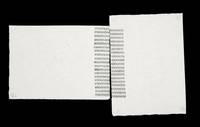
8628Graphite drawings throughout on triangular paper laminated. 6 leaves laminated covers with ms. title signature and date written in blue marker metal spiral-bound. Amsterdam: Self-published 1984.<br /> <br> <br> A unique hand-drawn bookwork by Ulises Carrión 1941-89 unrecorded by Ocampo and Agius in their catalogue raisonné. In the final decade of his life Carrión created a group of geometric and minimalist books about which very little is known. This one depicts two rectangles that are initially nearly touching but as one turns the pages become increasingly distanced while the rectangle on the right shrinks. The book is signed by Carrión in blue marker on the lower cover and dated “’84.†The drawings were rendered on thin paper that has been expertly laminated. We are not certain whether the lamination was the artist’s original intention but it has preserved the book’s leaves well.<br /> <br> <br> This bookwork comes from the collection of Guy Schraenen 1941-2018 the principal chronicler of Carrión’s life and work. It was also part of the display at Dear reader. Don’t read. the first major exhibition on Ulises Carrión curated by Schraenen. Curiously in the exhibition catalogue the date is recorded as 1988.<br /> <br> <br> A unique bookwork drawn by Ulises Carrión in excellent condition. <br /> <br> <br> ⧠G. Schraenen ed. Dear reader. Don’t read. 2016 pp. 84 & 101 pictured but dated “1988â€.<br /> <br> <br> Not in J. J. Agius & R. Ocampo eds. Ulises Carrión: Books & More Catalogue Raisonné 2013. unknown
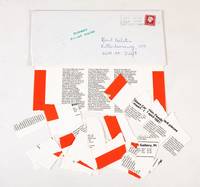
8076Single sheet exhibition invitation torn into ca. two dozen pieces. Amsterdam: Pieter Brattinga Gallery 1981.<br/> <br/> One of Ulises Carrión’s rarest mail art projects with the original mailed envelope sent to the collector Tjeerd Deelstra b. 1937. As the artist intended explained below a small torn portion is not present.<br/> <br/> “In 1981 when the Print Gallery Pieter Brattinga invited Carrión to exhibit his work there Carrión thought of a response project in which he instructed participants to reconstruct in any way they desired the bottom half of an invitation which had been shredded. They were then to sign it and mail it back to the gallery. The lower section of the invitation included a definition of mail art which the artist had torn up and from which he had then removed a small fragment. This way the definition of mail art could never be reconstructed and the instruction given by the artist was impossible to accomplish. The project resulted in 243 responses in all sorts of formats; not only intervened letters but also objects. By making participants reconstruct the invitation the project had a cyclical component that was emphasized by having the word ‘feedback’ in its title. In this way Feedback Pieces takes one step further Carrión’s intentions to reformulate not only the artwork but also the communication system through which it travels.â€â€“Aimé Iglesias Lukin “King Kong Archives: Ulises Carrión on Mail and Art†in Ulises Carrión: The Big Monster 2019 pp. 11-13 pictured.<br/> <br/> Both the envelope and torn-up invitation are in excellent condition.<br/> <br/> ⧠Juan J. Agius ed. Ulises Carrión & The Big Monster 2014 pp. 120-35 pictured. unknown
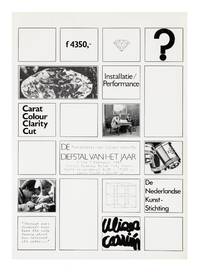
8079Coated paper with black & white illus. Assen Netherlands: 1982.<br/> <br/> The rare promotional poster for one of Ulises Carrión’s experimental public installations; the present copy is in particularly fine condition and has not been folded or creased. Entitled The Robbery of the Year this exhibition was designed by the artist as a test of visitors’ self-restraint. A large diamond was placed on a cushion without any enclosure but with a single spotlight trained on it in an otherwise dark room. Visitors were invited to enter the room while a photographer took pictures of the space and the visitors. An expected theft failed to transpire and near the end of the exhibition the photographer was withdrawn. Soon thereafter the diamond disappeared.<br/> <br/> “De Diefstal van het Jaar was an exhibition of a diamond in which visitors are surreptitiously invited to steal the stone raising interesting questions about viewing and stealing a precious object worthy of public exhibition and evoking images associated with museum heists with subsequent analysis on issues such as the value and ownership of objects on display.â€â€“Guy Schraenen ed. Dear reader. Don’t read. 2016 pp. 44 & 164 pictured.<br/> <br/> On his series of public experiments Carrión is quoted as saying: “In my work I use all kinds of materials objects processes and people as formal elements. The final result is only partially determined in advance and the process that leads to that point is influenced by all the factors mentioned above. It is a game without fixed rules and with no winners or losers.â€â€“Guy Schraenen ed. “We have won! Haven’t we†1992 p. 69.<br/> <br/> In excellent condition. unknown
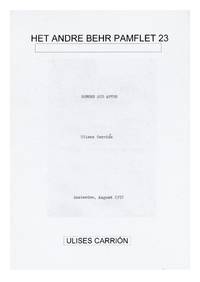
9143Port. on lower wrapper. 13 pp. 8vo printed wrappers staple-bound. Amsterdam: Boekie Woekie 2012.<br /> <br> <br> A facsimile of Before and After an unpublished typescript bookwork composed by Carrión in 1972. As suggested in Raul Marroquin’s note at the end of the publication this work may precede Sonnets.<br /> <br> <br> Fine; staples rusted. WorldCat locates no example in North America. unknown
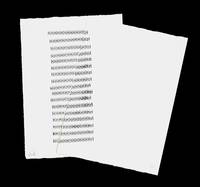
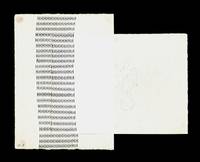
10311Two torn pieces of watermarked paper typewritten text mounted on black craft paper signed. Amsterdam: n.d.<br /> <br> <br> A signed “structure work†by Ulises Carrión. Fine; adhesive bleeding through the corners. Initialed in the bottom left corner of the left sheet. <br /> <br> <br> ⧠G. Schraenen Dear reader. Don’t read. 2015 pp. 110 & 116 pictured. unknown
10312Two torn pieces of watermarked paper typewritten text mounted on black craft paper signed. Amsterdam: n.d.<br /> <br> <br> A signed “structure work†by Ulises Carrión. Fine; adhesive bleeding through the corners. The artist has initialed the bottom left corner of the left sheet.<br /> <br> <br> ⧠G. Schraenen Dear reader. Don’t read. 2015 pp. 110 & 117 pictured. unknown
10313Two torn pieces of watermarked paper typewritten text mounted on black craft paper signed. Amsterdam: n.d.<br /> <br> <br> A signed “structure work†by Ulises Carrión. Fine; adhesive bleeding through the corners. The artist has initialed the bottom left corner of the left sheet.<br /> <br> <br> ⧠G. Schraenen Dear reader. Don’t read. 2015 pp. 110 & 117 pictured. unknown
11413Black & white illus. throughout. 24 leaves printed on rectos only. Small 4to 210 x 152 mm. orig. pictorial wrappers. Amsterdam: Cres Publications & Agora Studio July 1978 but 1979.<br /> <br> <br> First edition of this scarce bookwork. Conceived by Ulises Carrión 1941-89 it was the "July-Special" edition of Cres a bi-monthly publication and produced in an edition of 400 copies. Although it is dated "July 1978" on the upper wrapper a correction slip in this copy states that it is correctly dated July 1979.<br /> <br> <br> "In Alphabetical Order consisted of a set of twenty-four black-and-white photographs of a small wooden index card holder with a label saying 'a-z.' In each photograph some of the cards are placed vertically so that they stand out from the others. They are clearly different each time. The type and size of the card holder suggests that the index cards record personal details. It could be the file of Ulises Carrión's friends although all the friendships are obviously not considered equal nor do they all belong to the same social group or cultural scene. The series showed the wide range of possible categories of a single human group that has been sorted in alphabetical order."-Javier Maderuelo "An Archive Is an Archive Is an Archive Is an Archive" in Guy Schraenen ed. Dear reader. Don't read. 2016 p. 58.<br /> <br> <br> Near fine copy; some minor creasing to the spine internally pristine. Photographs by John Liggins; layout by Thomas Gravemaker. unknown
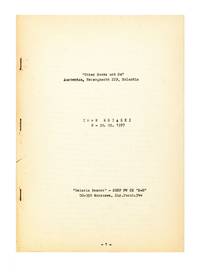
796023 1 leaves mimeographed on rectos only. Small folio 288 x 187 mm. self-bound stapled. Warsaw: Galeria Remont 1977.<br/> <br/> One of Carrión’s rarest exhibition catalogues. The artist curated this show at the Galeria Remont in Warsaw a contemporary art space established by the Polish artist and filmmaker Henryk Gajewski b. 1948 in a dormitory student club at the Warsaw University of Technology. The gallery operated from April 1972 to November 1979 hosting performance art exhibitions of photography stamp art and bookworks and many other events. Carrión had staged an exhibition called Contents at the gallery the previous December. The present exhibition’s title translates as “Other Books.†Gajewski and Carrión contributed essays to the catalogue both in Polish.<br/> <br/> The majority of the catalogue consists of an extensive list of artists engaging with the book form and their bookworks. They include Robert Altman John Armleder Daniel Buren Mirtha Dermisache Peter Downsbrough General Idea Michael Gibbs Klaus Groh Ian Hamilton Finlay Dick Higgins Douglas Huebler Alison Knowles Richard Kostelanetz Joseph Kosuth Anna Kutera George Maciunas Raul Marroquin Maurizio Nannucci Clemente Padin Dieter Roth Ed Ruscha Takako Saito Carolee Schneemann Mieko Shiomi Telfer Stokes Endre Tot Jiri Valoch Wolf Vostell Herman de Vries Lawrence Weiner etc. etc. <br/> <br/> Leaves 16-23 present Carrión’s selections of seminal books along with essays theorizing on bookworks and mail art. Among the bookworks shown we note: Carrión’s Looking for Poetry 1973 General Idea’s Manipulating the Self 1971 Hamilton Finlay’s Honey by the Water 1973 Huebler’s Location Piece 2 1970 Kosuth’s Notebook on Water 1965-66 1970 Maciunas’s Flux Paper Events 1976 Ruscha’s Every Building on the Sunset Strip 1966 Schneemann’s Up to and Including Her Limits 1974 Shiomi’s Spatial Poem 1976 and Weiner’s Various Manners and with Various Things 1976.<br/> <br/> Near fine copy; staples rusted. The pictorial wrappers added to some examples of this catalogue were never bound with the present copy.<br/> <br/> ⧠For more information on the Galeria Remont see the Museum of Modern Art in Warsaw’s website page “Art Prints of the Exchange Gallery†then the section on Gajewski and Galeria Remont. <br/> <br/> U. Carrión Quant aux Livres 2008 p. 209.<br/> <br/> Juan J. Agius & Ricardo Ocampo eds. Ulises Carrión: Books & More Catalogue Raisonné 2013 p. 116. unknown
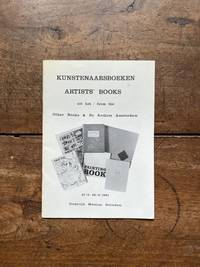
9374Seven black & white illus. 11 pp. Small 4to 210 x 150 mm. pictorial printed wrappers staple-bound. Schiedam Netherlands: Stedelijk Museum Schiedam 1981.<br /> <br> <br> An uncommon exhibition catalogue published by the Stedelijk Museum in Schiedam; the show was curated by Ulises Carrión 1941-89 and the books displayed came from his personal archive the Other Books and So Archive. By 1978 Carrión had closed his intrepid Amsterdam bookstore Other Books and So and converted it into an archive of artists’ books. This is one of a number of exhibitions on artists’ books that the artist organized; others took place in Iceland Poland Denmark and several locations across the Netherlands.<br /> <br> <br> This catalogue features an illuminating interview with Carrión in Dutch and English in which he spells out his criteria for what qualifies as a “bookwork†“an object book†and a “book object.†Describing the conception and production of his own bookworks he says: “When realizing my works I’m strongly influenced by my literary background I think. I’m constantly trying to get rid of it. Sometimes I succeed sometimes not. I try to reduce the book as much as possible to its essence – a sequence of signs. To me sequence implies time it means you cannot perceive a book in one time or moment. The second element is visual by nature – that which you see when you open the book. I try as much as possible to use signs other than literary even other than verbal. That’s why I use photography or rubber stamps. I’m very conscious of the paper. I strive towards an evident unfolding of the book. I don’t mean that the message should be evident but rather the book’s structure how the book fits together. You are free to interpret it as you wish but there must be some sort of recognizable structure. I’m not talking of just a pile of loose sheets.â€<br /> <br> <br> Carrión selected artists’ books by Juan Agius Anna Banana Guglielmo Cavellini Robin Crozier Claudio Goulart Kristjan Gudmundsson Davi Det Hompson Jiri Kolar David Mayor Bruno Munari Maurizio Nannucci Dieter Roth Ed Ruscha Takako Saito Jiri Valoch Lawrence Weiner etc. etc. A full listing of the works is found at the very end.<br /> <br> <br> In near fine condition. Printed in an edition of 350 copies.<br /> <br> <br> ⧠Guy Schraenen ed. Dear reader. Don’t read. 2016 pp. 174 & 214 pictured. unknown
8078Many black & white illus. Two large folded sheets 299 x 212 mm. folded unbound. Purmerend: Museum Waterland 1981.<br/> <br/> An uncommon exhibition flyer for a display of bookworks at the Museum Waterland co-curated by Ulises Carrión and Juan J. Agius. Both featured their own works along with those of François Bouillon Axel Heibel Diderick van Kleef Federico Sanguinetti Ben Sleeuwenhoek Ad Gerritsen J. H. Kocman Tom Ockerse Gèza Perneczky and Pawel Petasz. Several examples of each artist’s work are pictured. All the works displayed were drawn from Agius’s and Carrión’s personal collections. This catalogue’s text written by Alex A. M. de Vries is in parallel Dutch and English. <br/> <br/> De Vries pointedly notes “Two book-artists curated and arranged this exhibition in such a way that you will not see much of the usual mania for conservation which is being practised in most of the musea. This means that you will be able to take the books in your hands…This exhibition proves that artists’ books deserve to be shown more often and on large scale. And in an adequate way. The actual treatment like that of conservators in musea who like to take care of books as if they were dealing with radio-active material does not satisfy. A book ought to be in the hand of the reader.â€<br/> <br/> Fine and fresh copy.<br/> <br/> ⧠U. Carrión Quant aux Livres 2008 p. 210. unknown