BIGNAMI, VespasianoBiblio.com
52 résultats
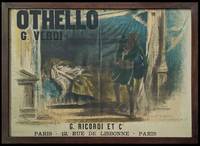
1894verdiothello<p>VERDI'S OTELLO COMES TO PARIS</p><p>Lithograph poster 88 x 65 cm outer dimensions of frame color lithograph framed and glazed plexi. Centerfold very minor toning excellent.</p><p>Very rare color lithograph poster produced in conjunction with the Paris premier of Giuseppe Verdi's opera <em>Otello</em>. Verdi 1813-1901 had retired from opera after <em>Aida</em> in 1871 but his publisher Giulo Ricordi 1840-1912 and the librettist Arrigo Boito 1842-1918 at last convinced him to return with <em>Otello</em> which premiered on 5 February 1887 at the Teatro alla Scala in Milan and proved to be a global success. The Paris production was a French-language version by Camille du Locle 1832-1903 and Boito which opened at the Paris Opéra on 12 October 1894 under the direction of Alexandre Lapissida 1839-1907; Verdi was in attendance.</p><p>The poster designed by Vespasiano Bignami 1841-1929 depicts the climactic scene in Act 4 Act 5 of Shakespeare's play in which Otello rises having just strangled Desdemona in her bed. In Paris the part of Otello was sung by Albert Saléza 1867-1916 and that of Desdemona by Rose Caron 1867-1930. Bignami's composition is not entirely of his own invention but an interpretation preserving the original staging of this scene. At the foot of the poster is the address 12 Rue de Lisbonne of the Paris branch of the Ricordi publishing firm where interested parties could acquire the score of the production.</p><p>Printed at the time as ephemeral advertising the poster is today very rare. We could locate no examples in institutional collections.</p> R. Stabilimento Ricordi-Milano
155521267Venice 1555. 18th-century gold-tooled vellum with the title lettered in gold on the spine and the manuscript title and year of publication in brown ink on the front board. Oblong 4to. With a woodcut of two hands one holding a compass and the other holding a pen 6 charming woodcut initials in text and 85 engraved models of calligraphic text and initials all set within black-lined borders. Rare edition of a famous Italian writing book by Vespasiano Amphiareo Ferrara 1501-Venice 1563 first published as "Un novo modo d'insegnar a scrivere" at Venice in 1548. A new enlarged edition followed in 1554 in two issues after which our edition followed and sixteen more before 1620. Amphiareo belonged to the noble family Albertaccia and had been to all probability a pupil of the famous Tagliente and later he was a writing-master at Venice for some thirty years. He dedicated his writing book to the Doge Francesco Donà. We see for the first time in an Italian writing book a majuscule alphabet based on botanical motives another on trunks of trees heavy gothic letters embodying putti and masks and black strapwork letters obviously linked to contemporary writing books in Germany and Switzerland. The book ends with a section on teaching the cutting of the quill and how to make a clear black ink partly based on Arrighi's instructions. To the second edition Amphiareo added further sections on illuminating in azure and gold and in vermilion in his later editions. The real significance of the writing book is that Amphiareo was dissatisfied with both the chancery and mercatile hands of his time. He therefore devised a mixture of the two styles "like a mystic body" in the Friar's Bastard as he called it which would suit both purposes. He wanted this "invention"' to be generally known and thus "with incredible personal expense" he had his book engraved and printed. After the famous writing masters Tagliente Arrighi and Palatino Amphiareo represented both their tradition and the transition to the revolutionary writing master Cresci of the second half of the 16th century.The title page is slightly browned slight marginal foxing throughout. Otherwise in very good condition.l Casamassima Trattati di Scrittura 1966 p. 90 no. XII and plates XLV-XLVIII first ed.; EDIT 16 CNCE 61646 1 copy; Johnson A.F. A catalogue of Italian writing books of the 16th century in: Signature N.S. 10 1950 p. 36; Medri G. Le opera calligrafiche a stampa II Vesp. Amphiareo da Ferrara in: All' insegna del libro I 1928 pp. 57-58; cf. Becker D.P. The practice of letters 1997 no. 19; Bonacini 49. hardcover