George IIIABAA

29 résultats
177934022London: Printed for the Editor; and sold by J. Bew 1779. First edition. Pp. iii-57. Lacking half-title. 1 vols. 8vo. Red morocco-backed green cloth spine lettered in gilt. Rubbed some light spotting. Bookplate of John Carter Brown ex-library with stamp on title else very good. First edition. Pp. iii-57. Lacking half-title. 1 vols. 8vo. Financing the Revolution. A satire. Often attributed to Richard Tickell as it imitates the tone of Tickell's "Anticipation" published the year before. Purports to contains speeches made in the Houses responding to the King's speech on the war in America and his need for more monies to pay for it. Adams "American Controversy" 79-3a; Sabin 1685 Printed for the Editor; and sold by J. Bew unknown books
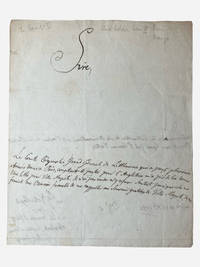
1785003743original letter. WILLIAM V PRINCE OF ORANGE 1748-1806 Stadtholder of the United Provinces. Autograph letter signed in French to GEORGE III King of Great Britain recommending Count Michal Kazimierz Oginski 1730-1800 Grand Hetman of Lithuania. 18 December 1785. Single bifolium written on the first and second pages with integral address panel endorsed "Prince d'Orange to the King" and contemporary docketing. Signed in the formal court style "De Votre Majesté le très humble et très obéissant serviteur G. Pr. d'Orange." Old folds light browning small repair at one fold; otherwise sound. Very good. English translation of the letter: "Sire Count Oginski Grand General of Lithuania who has spent several years in this country and who intends to depart for England in the month of June has had the honour of presenting himself to Your Majesty and most humbly to beg that Your Majesty will be pleased to grant him the continuation of your goodwill and assistance in the plans which he may have the honour to submit to you. I cannot refrain from expressing the profound respect with which I am Of Your Majesty The very humble and very obedient servant W. Prince of Orange. 18 December 1785." A formal letter of introduction from William V to George III on behalf of Count Michal Kazimierz Oginski Grand Hetman of Lithuania commending him to the King's continued favour and assistance as he prepared to travel to England. Oginski was one of the senior military and political figures of the Polish-Lithuanian Commonwealth. A former leader of the Bar Confederation and a persistent opponent of Russian dominance he had been defeated by Russian forces in the early 1770s forced into exile and thereafter remained a politically sensitive figure in eastern European affairs. . Very Good. Soft cover. 1st Edition. 1st Printing. 1785. original letter paperback
178938761London: Logographic Press 1789. George III 1738-1820. Report from the committee appointed to examine the physicians who have attended his majesty during his illness; touching the present state of his majesty's health. 4to. 4-52pp. lacking half-title. London: Logographic Press 1789. 210 x 160 mm. Later half calf marbled boards a bit rubbed. Occasional foxing otherwise very good. Bookplate of Charles W. Pilgrim. <p>Reprint of a parliamentary report issued in January 1789. Few illnesses of historic personages have been followed so closely and documented so well as the insanity of George III king of Great Britain from 1760-1820. The king suffered five separate attacks of mental illness during his long reign the first in 1765 and the last in 1810; the final breakdown which ended only with the king's death resulted in the establishment of the Regency. Of the remaining four attacks the one that incapacitated the king between October 1788-March 1789 is the most interesting not only because of the political turmoil it generated over the regency question but also because of the stimulus it gave to the study of psychiatry. The question of the king's recovery was of such political importance that special committees from each house of Parliament were set up to interrogate the king's doctors about the progress and probable outcome of his illness. These examinations printed in the Parliamentary proceedings and republished in numerous popular editions such as the one we are offering here advanced the cause of psychiatry by educating the public about mental illness and by giving an aura of respectability to the study of insanity.</p> <p>The present report contains testimony from the eight physicians attending the king during his illness taken on January 7-13 1789. The most influential of these physicians was Francis Willis proprietor of a private asylum in Lincolnshire; his optimism about the king's eventual recovery found favor with Prime Minister William Pitt and the Tory government which had been supported by the king. Willis's chief rival was Richard Warren a friend of the leaders of the Whig opposition; his pessimistic views about the king's illness were adopted by those who wished to see the Prince of Wales established as Regent. Guttmacher pp. 1-15. Hunter & Macalpine pp. 509-514. See Norman 890. 38761</p> . Logographic Press unknown books
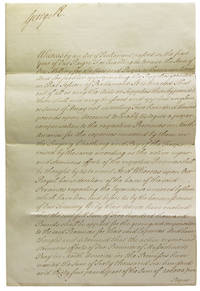
1761319882Great Britain 1761. 2pp. plus integral blank. Docketed on verso "King's Warrant / Province of Massachusetts / Bay £60634 in part / of £200000 Granted for / the North American / Provinces." Signed by George III at the head of the first page countersigned on the second page by William Wildman Barrington James Oswald and Gilbert Elliot. Folio 14 1/4 x 9 1/2 inches. Usual folds. 2pp. plus integral blank. Docketed on verso "King's Warrant / Province of Massachusetts / Bay £60634 in part / of £200000 Granted for / the North American / Provinces." Signed by George III at the head of the first page countersigned on the second page by William Wildman Barrington James Oswald and Gilbert Elliot. Folio 14 1/4 x 9 1/2 inches. Towards the end of the French and Indian War William Pitt started a specie grant program to reward colonies for raising troops thus putting the colonies in competition with each other for a share of an annual 200000 pounds. With specie scarce in the colonies the colonial assemblies were thus incentivized to raise troops to fight against the French. The present document authorizes Henry Fox to make payment to Massachusetts via their colonial agent William Bollan for their share of the annual grant. Although successful the policy was abandoned in favor of direct taxation after 1762 leading to the Sugar Act and most notably the Stamp Act. <br /> <br /> This undated document -- the space for the date being left blank suggesting it to possibly be a draft -- is countersigned by William Wildman Barrington Chancellor of the Exchequer 21 March 1761 to 8 May 1762; Sir Gilbert Elliot third Baron Minto Lord of the Treasury 1761-62 and James Oswald Commissioner of the Treasury 1759-63. The date would therefore appear to be 1761 or early in 1762.<br /> <br /> George III documents relating to North America from the early years of his reign are particularly scarce. unknown