116 résultats
42582printed with the details filled in by hand appointing James Hay Gent to be "Adjutant in Our Perthshire Regiment of Fencible Cavalry commanded by Our Trusty and Wellbeloved Colonel Charles Moray." the top four inches of 1 side oblong folio on vellum with papered seal no place no date circa hardcover
17632with double voucher before Sir John Eardley WILMOT 1709-1792 Chief Justice of the Common Pleas 1766-1771 of 2 dwellings 1 granary 3 gardens and 100 acres in the parish of Titchfield Hants owned by tenant in tail John Paffard fine engraved portrait 8" x 7¼" of George III elaborately engraved border on three sides of the document the vignettes include Neptune ruling the waves and Hercules slaying the Hydra vellum 27¼" x 35¾" Westminster 14th June lacks seal a little creased in some folds On the verso the property is named as 'Paffard's Lee'. Before the trial John Paffard will have conveyed it to his friend John Webb the defendant for a nominal sum. Another friend Henry Cutler sues Webb for possession alleging dispossession by a fictitious Hugh Hunt. Called to warrant Webb's title Paffard in turn calls the court crier Thomas Francis Martin to say untruthfully that Martin had sold the lands to Paffard as a freehold. The process ends with judgment against Webb and Martin and with Cutler in freehold possession. John Paffard has rid himself of all entails and encumbrances on the property and will soon get it back from Cutler. Wilmot a fellow pupil with Dr. Johnson at Lichfield took part in the cases arising from John Wilkes' libels. hardcover
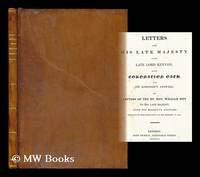
1827181920London : John Murray 1827. First Edition. Hardback. Very good copy in the original full aniline calf. Professionally and period sympathetically re-backed with the title blocked direct in gilt; very impressively finished. Remains particularly well-preserved overall; tight bright clean and strong.; 8vo 8"" - 9"" tall; 45 pages; Physical desc.: viii 2 45 1p.: 1 plate. ; 4o. Notes: Ed. by H. Phillpotts pref. With a half-title preceded by a facsimile. Other names: Phillpotts Henry 1778-1869. Kenyon Lloyd Kenyon Baron. Pitt William 1759-1806. Genre: Letters - 19th century. London : John Murray hardcover
1827619L14London: John Murray 1827. First edition. Leather. Good Only. 11" by 9". None. A selection of letters from George III to two political figures regarding the proposition of Catholic emancipation and his Coronation Oath. He writes to British politician and barrister Lord Kenyon and the then Prime Minister William Pitt. The first edition of this uncommon work. These letters are associated with the political process during the late eighteenth and early nineteenth century regarding the 'Catholic emancipation' or 'relief'. Following the Act of Union between Great Britain and Ireland there was a call to remove many of the restrictions on Roman Catholics introduced by the Act of Uniformity Test Acts and penal laws. During the Act of Union William Pitt the Younger the Prime Minister at the time promised emancipation to accompany the act. However no further steps were taken. This was due to King George III believing that any Catholic emancipation would violate his Coronation Oath. To this work there are correspondences between Pitt and George III regarding this matter. Pitt resigned from his position as Prime Minister when the King's opposition became known. To the main body of this work George writes to Kenyon regarding the standing of the Coronation Oath. He notes to the first letter that 'The following Queries on the present attempt to abolish all distinctions in Religion in Ireland with the intention of favouring the Roman Catholics in that Kingdom.' The King is enquiring to Kenyon as to whether emancipation would affect his Coronation Oath. With an introduction by Henry Phillpotts a well known opponent of Catholic emancipation. One of his well known works is 'A Letter to an English Layman on the Coronation Oath which was issued after this work. This copy is from the Bishop Phillpotts Library in Truro with a bookplate for the library to the front pastedown. The Philpotts library is still an important centre for theological studies. It was first opened in 1871 by Henry Phillpotts. Another prior owner's bookplate to front pastedown 'Henricus Exoniensis'. There are six letters between Kenyon and George III to this volume and five letters between Pitt and the King. With a facsimile letter by George III as the frontispiece. The first edition of this interesting contemporaneous account of British history. In a half calf binding with paper covered boards. Externally sound with slight rubbing to the boards spine and extremities. Loss to the calf at the spine due to a previous library removal. Bookplate to the front pastedown for Bishop Philpotts' Library Truro. Philpotts wrote the introduction to this work. Another bookplate to front pastedown Clero Cornubiensi Henricus Exoniensis. Front hinge is strained but firm. Internally firmly bound. Pages are generally bright with patches of scattered spotting mostly to the page edges. Good Only John Murray hardcover
178897191CB[London?], 1788. 1 Blatt: 53,5 x 75,2 cm. [2 Warenabbildungen]
178924645London 1789. 4 pages including docketing. 1 vols. Folio. The Warrant for accounts due for December 1787 until December 1788 to Sir Charles Gould Judge Advocate General. Folds some light discoloration else very good. 4 pages including docketing. 1 vols. Folio. Sir Charles Gould afterwards Morgan was appointed judge advocate general in 1771. "The manner in which he discharged the duties of this office it is said 'won the favour and exteem of George III in no ordinary degree' "DNB He was also one of the authors of the Oxford poem in 1751 on the death of Frederick Prince of Wales. Gould was knighted in 1779 made a baronet in 1792 and then a privy counvillor in 1802. unknown books
178838765London: Stockdale 1788. <p>George III 1738-1820. Report from the committee appointed to examine the physicians who have attended his Majesty. . . . 8vo. 16pp. London: J. Stockdale 1778 i.e. 1788. 210 x210 x 133 mm. Modern boards. Fine apart from a little spotting.</p> <p> Reprint of a parliamentary report. Few illnesses of historic personages have been followed so closely and documented so well as the insanity of George iii king of Great Britain from 1760-1820. The king suffered five separate attacks of mental illness during his long reign the first in 1765 and the last in 1810; this final breakdown which ended only with the king's death resulted in the establishment of the Regency. Of the remaining four attacks the one that incapacitated the king between October 1788-March 1789 is the most interesting not only because of the political turmoil it generated over the regency question but also because of the stimulus it gave to the study of psychiatry. The question of the king's recovery was of such political importance that special committees from each house of Parliament were set up to interrogate the king's doctors about the progress and probable outcome of his illness. These examinations printed in the Parliamentary proceedings and republished in numerous cheap popular editions advanced the cause of psychiatry by educating the public about mental illness and by giving an aura of respectability to the study of insanity. Guttmacher pp. 1-15. Hunter & Macalpine pp. 509-514. See Norman 889. </p> . Stockdale unknown books
1800D6751early 1800s. Hardcover. Very Good. Full red morocco arms of George III stamped in gilt on boards lettering "Standing Orders" and ornament stamped in gilt on spine a.e.g. inside gilt dentelles; 8vo 5x7 inches; approx. pp. 200 entries beautifully handwritten in black ink with numbered subject headings in the margins and an index at rear. Scuffing along joints and edges of boards; joints a bit tender. Recorded by one or two scribes addressing parliamentary procedures in the 18th century. A lovely reference. <br/><br/> hardcover books
19217Queens House 14 January 1781 52 minutes past 5 P.M.. 2 lines on 1 page 9 x 7 inches in very good condition with an integral blank leaf. King George III reigned 1760-1820. Sir Stanier Porter diplomat and courtier. Frederick North 1732-92 known as Lord North was Prime Minister from 1770-1782 and was largely responsible for the measures which led to the loss of America. unknown
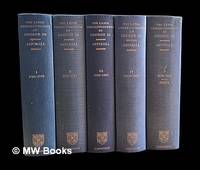
464329London : Cambridge U.P. First Edition. Hardcover. Very good cloth copy. Spine bands and panel edges somewhat bumped and rubbed as with age. Remains well-preserved overall. Physical description; 5 volumes ; 25 cm. Contents; v. 1. December 1783 to January 1793 -- v. 2. February 1793 to December 1797 -- v. 3. January 1798 to December 1801 -- v. 4. January 1802 to December 1807 -- v. 5. January 1808 to December 1810. Subjects; George III King of Great Britain. 1738-1820. Correspondence. Great Britain. History. George III 1760-1820. Sources. Great Britain. Kings and rulers. Correspondence. London : Cambridge U.P hardcover
560232 hand-coloured woodcuts copied from the illustrations in The Universal Magazine for October and November 1761 the first taken as the Archbishop of Canterbury places the Crown on the King's head is lettered with explanations of the crowded scene including at h 'The Dukes of Normandie and Acquitain and other great officers' the second similarly explained shows the King's Champion flanked by the Earl Marshal and Lord High Constable riding up the centre between the long tables watched by the diners and the others present in the galleries printed within a 'Greek Key' border both referring to 22nd September 1761 laid down on two separate album leaves 10" x 7¾" with other items on the versos the two prints no date circa edges worn and border trimmed in places without loss to text or image The original articles of 1761 explain the role at the Dinner of the King's Champion who challenged any one to assert that George III was not their lawful sovereign and the 'Dukes of Normandy and Aquitaine' at the Coronation. The French King had anciently a council of twelve great Peers 6 lay and 6 ecclesiastic. Long after the council ceased to function the ecclesiastics attended at Reims but the lay peerages had became vested in the crown. So the King appointed people to represent his lay peerages. Henry II liked this idea which was last used in 1761 given that in 1801 Great Britain renounced all claims to France and the use of the lilies on her coat of arms. On the versos are 1 a pleasing engraving of Bouverie Hall Chart next Sutton Valence Kent and 2 a number of cuttings including temperance verses and the monument to Captain Charles Colby of the 98th Dragoons killed by a tiger at 'Rawal Pinde' 27th March 1852. unknown
43632printed with the details filled in by hand appointing Colonel James Pringle "to be Major General in our Army in the East Indies only." countersigned by Robert Banks Jenkinson 2nd Earl LIVERPOOL Baron Hawkesbury 1770-1828 Prime Minister 1 side oblong folio on vellum with papered seal and revenue stamp St James's 25th October hardcover
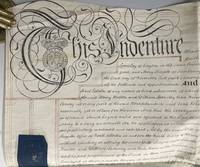
750Light rubbing and soiling. Very good. JJA-750. <p>George III County of York Indenture of Conveyance in the amount of £150 from Dorothy Temple to Henry Haldor and William Spencelay both of York and dated May 21 1776.</p> <br /> <p>Measures approx. 11 x 31.5 inches. Manuscript on vellum sealed and stamped. Docketed to verso.</p> . unknown
1776305122London 1776. Partially printed document on vellum accomplished in manuscript paper seals intact remnant of red wax seal. 11 x 16-1/4 in. Creased and lightly soiled small hole at central crease. Partially printed document on vellum accomplished in manuscript paper seals intact remnant of red wax seal. 11 x 16-1/4 in. Appointing James Lee to Captain of the 30th Regiment of Foot. The appointment comes at the start of the American War of Independence though the 30th Regiment of Foot would not join the fight until 1781. unknown books
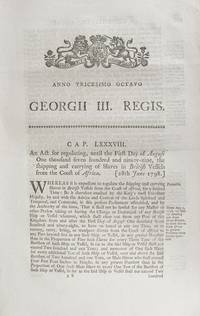
179992483London: Printed by George Eyre and Andrew Strahan 1799-1824. Rare collection of three British Acts related to the regulation and abolition of the British slave trade including: An Act for better regulating the Manner of carrying Slaves in British Vessels from the Coast of Africa 12th July 1799; An Act for regulating.the shipping and carrying of Slaves in British Vessels from the Coast of Africa 28th June 1798; and An Act to Amend and consolidate the Laws relating to the Abolition of the Slave Trade 24th June 1824. Quarto decorative royal emblematic headpieces schedules of muster roles and seizures. Accompanied by a Copy of an Act Passed in 1817 by the Legislature of Antigua For Restricting the Exportation of Slaves to that Island Henry Goulburn 1821 and Copies or Extracts of Correspondence relating to an Expedition to be sent to the River Niger Vernon Smith 1840; both ordered by the House of Commons. In near fine condition. An exceptional piece of history. The anti-slavery movement to abolish the slave trade became popular among the British public following barrister Lord Mansfield's judgement in the Somersett's Case which held that slavery was unsupported by the common law in England and Wales. In 1807 Parliament passed the Slave Trade Act of 1807 which outlawed the slave trade but not slavery itself. Over two decades later in 1833 the Slavery Abolition Act was passed which made the purchase or ownership of slaves illegal within the British Empire and provided monetary compensation for previous slave owners. Printed by George Eyre and Andrew Strahan unknown
42581printed with the details filled in by hand appointing Charles Mingay Gent to be "Ensign to that Company whereof. Esq is Captain in our Twenty Second or the Cheshire Regiment of Foot commanded by our Trusty and Wellbeloved Major General David Dundas." countersigned by the Duke of PORTLAND 1 side oblong folio on vellum with papered seal and revenue stamp Court at St James's 2nd December Along with many other conservative Whigs such as Edmund Burke Portland was deeply uncomfortable with the French Revolution; he broke with Fox over that issue and joined Pitt's government as Secretary of State for the Home Department in 1794. In that role he oversaw the administration of patronage and financial inducements which were often secret to secure the passage of the Act of Union 1800 hardcover
43488saying that "Edward Warburton and William Boulton were at a Quarter Session of the Peace holden at Aylesbury. tried and convicted of Grand Larceny and were sentenced to be transported seven years for the same. We in consideration of some favorable circumstances humbly represented unto Us in their behalf are graciously pleased to extend Our Grace and Mercy unto them and grant them our Pardon for their said Crime on Condition of their enlisting and entering to serve Us as Soldiers in Our Army abroad until duly discharged therefrom." 2 sides folio with papered seal Court at St James 21st January unknown
177934022London: Printed for the Editor; and sold by J. Bew 1779. First edition. Pp. iii-57. Lacking half-title. 1 vols. 8vo. Red morocco-backed green cloth spine lettered in gilt. Rubbed some light spotting. Bookplate of John Carter Brown ex-library with stamp on title else very good. First edition. Pp. iii-57. Lacking half-title. 1 vols. 8vo. A satire. Often attributed to Richard Tickell as it imitates the tone of Tickell's "Anticipation" published the year before. Purports to contains speeches made in the Houses responding to the King's speech on the war in America and his need for more monies to pay for it. Adams "American Controversy" 79-3a; Sabin 1685 Printed for the Editor; and sold by J. Bew unknown
503685May 25 1801. Appointment of "Peter Ogier Gentleman as Clerk in the Office of Our Secretary." Signed by 3 officials and a witness November 24 1801. Printed document completed in a secretarial hand. Full vellum 16" x 15" with 2 blue wax seals and hand-colored portrait of George III folds and slight stains. Rare with seals. 22" x 20". Signed by Authors. F. Soft cover. hardcover
177934022London: Printed for the Editor; and sold by J. Bew 1779. First edition. Pp. iii-57. Lacking half-title. 1 vols. 8vo. Red morocco-backed green cloth spine lettered in gilt. Rubbed some light spotting. Bookplate of John Carter Brown ex-library with stamp on title else very good. First edition. Pp. iii-57. Lacking half-title. 1 vols. 8vo. Financing the Revolution. A satire. Often attributed to Richard Tickell as it imitates the tone of Tickell's "Anticipation" published the year before. Purports to contains speeches made in the Houses responding to the King's speech on the war in America and his need for more monies to pay for it. Adams "American Controversy" 79-3a; Sabin 1685 Printed for the Editor; and sold by J. Bew unknown books
42584appointing "Our Trusty and Wellbeloved Major Thoam Inglis on half pay of our One Hundred and Twenty Sixth Regiment of Foot. to be Lieutenant Colonel." countersigned by Pelham at the foot 1 side oblong folio on vellum with papered seal and revenue stamp Court at St James's 29th April Pelham was Home Secretary from July 1801 to August 1803 under Addington who made him Chancellor of the Duchy of Lancaster in 1803. Pelham went out of office in 1804 and in the next year succeeded to the earldom. hardcover
40960saying that "on receiving the two Boxes yesterday morning I perceived that the one was not intended for my perusal and sent it to the Messenger which gave rise to the mistake of his going to London previous to my dispatching the other Box which I therefore sent by a safe hand at a later hour." 1 side 4to. Windsor 8th February It is unusual to find holograph letters from the monarch. unknown
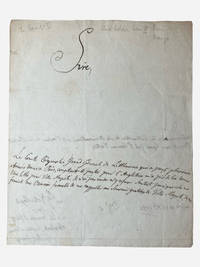
1785003743original letter. WILLIAM V PRINCE OF ORANGE 1748-1806 Stadtholder of the United Provinces. Autograph letter signed in French to GEORGE III King of Great Britain recommending Count Michal Kazimierz Oginski 1730-1800 Grand Hetman of Lithuania. 18 December 1785. Single bifolium written on the first and second pages with integral address panel endorsed "Prince d'Orange to the King" and contemporary docketing. Signed in the formal court style "De Votre Majesté le très humble et très obéissant serviteur G. Pr. d'Orange." Old folds light browning small repair at one fold; otherwise sound. Very good. English translation of the letter: "Sire Count Oginski Grand General of Lithuania who has spent several years in this country and who intends to depart for England in the month of June has had the honour of presenting himself to Your Majesty and most humbly to beg that Your Majesty will be pleased to grant him the continuation of your goodwill and assistance in the plans which he may have the honour to submit to you. I cannot refrain from expressing the profound respect with which I am Of Your Majesty The very humble and very obedient servant W. Prince of Orange. 18 December 1785." A formal letter of introduction from William V to George III on behalf of Count Michal Kazimierz Oginski Grand Hetman of Lithuania commending him to the King's continued favour and assistance as he prepared to travel to England. Oginski was one of the senior military and political figures of the Polish-Lithuanian Commonwealth. A former leader of the Bar Confederation and a persistent opponent of Russian dominance he had been defeated by Russian forces in the early 1770s forced into exile and thereafter remained a politically sensitive figure in eastern European affairs. . Very Good. Soft cover. 1st Edition. 1st Printing. 1785. original letter paperback
42237printed with manuscript details giving "Our Royal Licence authorizjng them to pay two Bills of Exchange for the respective sums of £290 & £473.19.10 the former drawn on themselves the other on Messrs Boyd Benfield & Co drawn at Leghorn." the printed side states that "by these Presents and by the Powers vested in us by the Act passed in the Thirty-fourth Year of Our Reign intitled 'An Act for preventing Money or Effects in the Hands of His Majesty's Subjects belonging to or disposable by Persons resident in France being applied to the Use of the Persons exercising the Powers of Government in France and for preserving the Property thereof'." countersigned by Portland 1 side folio with papered seal Court at St James's 1st April Thomas RAIKES the Elder 1741-1813 was a British merchant particularly trading from London with Russia a banker and newspaper proprietor. Notably he was Governor of the Bank of England during the 1797 currency crisis when the Bank was prohibited by the British Government from paying out in gold. Walter BOYD 1754-1837 was a financier. In March 1793 the firm of Boyd Benfield & Co. was established in London. Boyd as the principal partner contributed £60000 to the common stock. The Bank Restriction Act of 1797 was an Act of Parliament which removed the requirement for the Bank of England to convert banknotes into gold. The period lasted until 1821 when convertibility was restored. The period between these two dates is known as the Restriction period. unknown
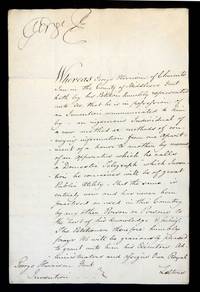
18092120802<i>Folio 4pp. with docket on fourth page "George Harrison Gent. Not stamped. Mr. Solicitor declines at present signing the Bill for this patent. S.G. Wyatt"; </i><i>folded and unbound as issued in very good state of preservation.</i><br /><br />A fascinating document which seems however not after all to have ended in a grant for a patent. George Harrison claims that "he is in possession of an invention communicated to him by an ingenious individual of a new method or methods of conveying information from one apartment of a house to another by means of an apparatus which he calls a "Domestic Telegraph" which invention he conceives will be of great public utility. That the same is entirely new and has never been practised or used in this country by any other person or persons to the best of his knowledge & belief". George Harrison not only does not disclose the name of the inventor he also petitions for the patent to be in his own name. No such patent in Harrison's name is included in Woodcroft's definitive Alphabetical Index. It is possibly that Harrison was trying to be a bit too clever as the award of a patent was conditional on Harrison producing "a particular description of the nature of the said invention and in what manner the same is to be performed".<br /><br />George III's signature here seems in some way to illustrate both his mental illness and his approaching blindness. Little more than a year after signing this document he became dangerously ill and finally accepted the need for the 1811 Regency Act. In 1809 Lord Liverpool was Home Secretary in the Duke of Portland's government.