5 446 résultats
Wear & small closed tears to price clipped DJ. Top corner slightly bumped; SIGNED by author to front endpaper; B&W Photographs; 8vo; 351 pages
Spine faded. Previous owner's info to front pastedown ; Darrow's autobiographical novel, a fictionalized account of his boyhood. Later printing; 8vo 8" - 9" tall; 255 pages
Wear to extremities with fraying to spine ends ; Detailed account of the infamous trial with fold-out maps showing relevant locations ; American Trials; 8vo; 550,xv pages
2008100138817Yale University Press 2008 276 pages 16 2x2 8x23 8cm. 2008. Cartonné jaquette. 276 pages.
2000x-0309071933National Academies Press 2000. Paperback. New. 58 pages. 9.00x6.00x9.00 inches. National Academies Press paperback
8vo., First Edition; ivory cloth, gilt back, a near fine copy in unclipped dustwrapper. SIGNED BY THE AUTHOR ON TITLE.
8vo., First Edition, with portrait frontispiece, title in red and black, and 9 plates; original series binding of red cloth, upper board blocked in blind, gilt back, a very good, bright, clean copy. Sold from an institution with its neat stamp on frontispiece verso and title. Published in the series Notable British Trials.
8vo., First Edition; red cloth, gilt back, small fade-mark on upper board else a very good, bright, clean copy in unclipped dustwrapper. A PRESENTATION COPY FROM THE AUTHOR WITH HER SIGNED HOLOGRAPH INSCRIPTION ON HALF-TITLE.
1990010528University Park Pennsylvania U.S.A.: Pennsylvania State Univ Pr 1990. 509pp. Offers the most detailed and best documented account of the early years of the CIA currently available. It reveals the political and bureaucratic struggles that accompanied the creation of the modern U.S. intelligence community. Clean. Trade Paperback. As New/No Jacket - Wraps. 8vo - over 7¾" - 9¾" tall. Pennsylvania State Univ Pr Paperback
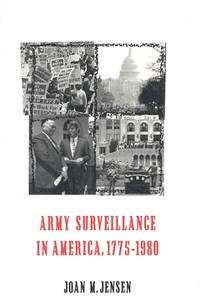
1991012244New Haven Connecticut U.S.A.: Yale Univ Pr 1991. 325pp. a comprehensive history of military surveillance in the United States-traces the evolution of America's internal security policy during the past two hundred years. Joan M. Jensen discusses how the federal government has used the army to intervene in domestic crises and how Americans have protested the violation of civil liberties and applied political pressure to limit military intervention in civil disputes. Light fading to dj spine. Text clean. 1st Printing. Cloth. Near Fine/Very Good. 8vo - over 7¾" - 9¾" tall. Yale Univ Pr Hardcover
Book is in excellent condition with very minor shelf wear to covers only. Binding is solid and square, covers have sharp corners, exterior shows no blemishes, text/interior is clean and free of marking of any kind. Chapters include: The way it was in Alberta, .... in British Columbia, .... in Manitoba, ....in the Yukon, ... In Newfoundland, , ,,, in the NWT territories, .... in the Maritmes, Police transport, The royal Canadian mounted poolice navy, Four legged memebers of the force, Marriage, Sons of freedom, , RCMP musical ride, etc. Inferior economy, As others see us, etc. 215 pages with a few not-so -good b&w illustrations.
New revised and expanded edition, Large 8vo, xvi, 726pp., numerous illustrs., orig. cloth, d.w.
1967018720NY: Harper & Row 1967. 1st ed. Precedes the British edition. Fine in dust jacket with $4.95 price still intact. A QUEEN'S QUORUM title. Short stories featuring Calder and Behrens. The book was dedicated to Jacques Barzun. First Edition. Hard Cover. Fine/Fine. Book. Harper & Row Hardcover
1985019076NY: Mysterious Press 1985. 1st ed. Fine in slipcase w/o dust jacket as issued. LIMITED EDDITION 1 of 250 Numbered EDITIONS this beiing 120 and SIGNED by the author on limitation page. Audley title. "When an American veteran of D-Day dies in Normandy on the 40th anniversary of the invasion the event marks the opening of a chess game between the KGB and British Intelligence. In occasionally bewildering sequence the thread of the story goes from the dead American a suspected Soviet agent to a group of British men who may also be KGB. It is up to Elizabeth Loftus a neophyte in the world of espionage to ferret out the answers with the assistance of her superior David Audley whose own loyalties are suspect because he had investigated these men some 30 years earlier and found nothing suspicious." -- Publishers Weekly. Signed by Author. First Edition. Hard Cover in Slipcase. Fine. Book. Mysterious Press Hardcover
026796465X.Ghardcover. Good. Access codes and supplements are not guaranteed with used items. May be an ex-library book. hardcover
1992047914New York: Hearthstone 1992. Unknown Edition . Hardcover. Very Good-/Very Good -. 8vo - over 7¾" - 9¾" tall. Book is the story of John Wayne Gacy told from the chief of detectives Joseph Kozenczak originally assigned to the investigation. A nice clean copy without any marks or tears. Light edgewear. <br/> <br/> Hearthstone hardcover
0267533136.Ghardcover. Good. Access codes and supplements are not guaranteed with used items. May be an ex-library book. hardcover
Two volumes. pp. 516; 565 + Fifty-one wonderful photogravure plates from the photographs of Dr. Charles L. Mitchell and Francis Frith. Original full red cloth binding., brilliantly decorated in gold. Set against the turbulent historical backdrop of the 1680s, in England's lawless West Country, Lorna Doone is an action-packed tale of romance, revenge and family warfare. Blackmore's sweeping story of love and crime is one of fiction's most respected works. Three young people are caught in a taut emotional triangle - Carver Doone, murderous member of a feared family of aristocratic outlaws; John Ridd, a young farmer dedicated to avenging his father's death; and Lorna Doone, the dark-eyed beauty for whom both men would willingly die. At once independent and vulnerable, Lorna is the Doone "Princess", condemned by the family to marry Carver. But Lorna may not be quite what she seems. Richard Doddridge Blackmore (1825-1900) was born in Longworth, Berkshire, where his father John Blackmore was Curate-in-charge of the parish. Only a few months after his birth his mother died of typhus, his father moved back to his native West Country and young Richard was taken in charge by his aunt. In 1831 John Blackmore married again and Richard went to live with his father and stepmother in Devon. Richard went to school in Tiverton where he excelled in classical studies and later won a scholarship t o Oxford, where he took his degree in 1847. He made his first attempt at writing a novel during a university vacation. After leaving Oxford he entered the law, being called to the Bar in 1852. Ill-health, however, forced him to give up legal work as a full-time occupation and in 1853 he took the post of classics master at Wellesley House Grammar School, Hampton Road, Twickenham. Soon after accepti ng this post, Blackmore moved from London to Hampton Wick, where he lived until he moved to his new home in Teddington. In 1853 he married, and in 1854 published anonymously two volumes of poetry. In September 1857 his uncle died leaving his nephew a sum of money which enabled him to realise a long-held ambition - that of possessing a house in the country with a larger garden. Blackmore selected a plot of land at Teddington and built his new house (completed in 1860). He was to live there for the rest of his life. Gomer House, named after one of his favourite dogs, had extensive grounds. Within them Blackmore developed an 11 acre market garden, specialising in the cultivation of fruit. The grounds were surrounded by high walls. Although an expert in horticulture, he lacked the necessary bu siness sense and his market garden was not a very profitable enterprise. In the late 1860's Blackmore fought the coming of the railway to Teddington, winning claims against his property by the London and South West Railway Company, but being unable to prevent the erection of a station almost directly opposite his house. Some local residents in Teddington apparently regarded Blackmore as unsociable, if not misanthropic. Charles Deayton, a Teddington merchant is recorded as saying to a visitor: "He is not a social man, and seems wedded to his garden in the summer and his book writing in the wint er. That is all I know of him; except that he keeps the most vicious dogs to protect his fruit, and I would advise you to avoid the risk of visiting him." In fact, though of a retiring disposition, Blackmore did have a number of intimate friends whom he met regularly and many friendships with Americans as a result of his wide following in the United States. Blackmore died at Teddington in 1900 after a long and painful illness. He was buried at Teddington Cemetery. His wife had died in 1888. He had no children. **PRICE JUST REDUCED!

431 p. Illustrations. 8vo. Very worn publisher's cloth binding. On July 1, 1874 two little boys were abducted in front of their family's mansion. It was the first kidnapping for ransom in the history of th e United States. And it would be the major event of its kind until the Lindbergh baby kidnapping. The boys were named Charley and Walter Ross; they were 4 and 6 years old. The two men who kidnapped th em had given the boys candy on previous occasions. That day, however, the men told the boys to climb into their buggy and promised to buy them firecrackers. The boys boarded and they drove off into th e city. Charley would never be seen again. As they drove farther away, Charley wanted to go home and began to cry. The men stopped in front of a store and gave Walter 25 cents. He entered the store and started choosing firecrackers, while the men drove away with Charley. The boys' father, Christian K. Ross, thought the boys were playing in a neighbor's yard. But soon a neighbor told him that she saw the boys traveling in a buggy. The father began the search for his son that he would continue until his death. He didn't tell his wife at first, who was recovering from an illness in Atlantic City. Two days later, however, she found out when he began advertising in the newspapers for his sons' return. A stranger found Walter and returned him to his father. Walter related the tale. Two days after that, the father received a crude note, saying that Charley would be released for a sum of money. On July 7, came another note demanding $20,000 and instructing the boy's father how to go about paying the kidnappers. The father tried to follow the instructions as best he could but never contacted the kidnappers. Later that year, police were investigating the kidnapping of a Vanderbilt child and found a ransom note in that case that matched closely the one for Charley Ross. They identified the handwriting as fugitive convict William Mosher's. Mosher was killed during a burglary in Brooklyn, but his partner Joseph Douglas identified Mosher as the kidnapper of Charley Ross. Douglas died insisting that only Mosher had known where Charley was being held. Douglas also said that Charley would be returned safely in a few days. He never was, and the father spent $60,000 in his futile search. Imposters came forward in the years afterward claiming to be the missing boy. Each was disproved. Charley's father died in 1897, his mother in 1912. Walter Ross died in 1943. The Ross mansion was torn down in 1926. The Cliveden Presbyterian Church now stands on the site of the kidnapping. **PRICE JUST REDUCED! PA 28
A clean, unmarked book with a tight binding. Previous owner's name inside. A collection of criminal cases presented by William Roughead, an early practitioner of the "true crime" literary genre.
First edition. NOT a library book. Hardcover. Near fine with light wear to ends of boards. In a very good dust jacket with slight rubbing - protected in a new Brodart Mylar. Book is clean, tight, free of marks. Surprisingly uncommon in this condition.
2006635608Baden-Baden, Nomos, 2006. 621 S. Originalpappband (Buchblock etwas verschoben).
19595674AParis, Le Club français du livre, 1959. 8°. 360 S. Farbig illustriertes Orig.-Leinen.
185413979P., Librairie Nouvelle, 1854, in-12, (vi)-314 pp, reliure demi-toile havane, dos lisse avec fleuron et double filet doré en queue, pièce de titre basane fauve, tranche sup. rouge (rel. de l'époque), qqs rousseurs, bon état
7735Paris, 1860 (5°edition). Format 14x23 cm, demi-reliure cuir bleu, titres et filets dores au dos, 733 pages. Une planche depliante in-fine. Quelques rousseurs dans le texte.Bon etat.