543 résultats
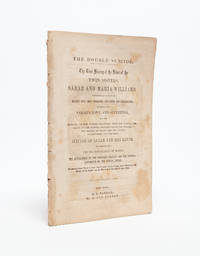
18555437New York: H.H. Randall 1855. First edition. Printed self wraps stitched at spine. Measuring 220 x 140mm and complete in 64 pages. Some rubbing along spine and scattered foxing to preliminary and terminal leaves; toned throughout else clean. A scarce piece sensationalizing the tragic affairs and subsequent suicides of Sarah and Maria Williams OCLC reports fewer than twenty copies with libraries with this being the only example on the market.<br /> <br /> We've been unable to determine whether the tragic story of the Williams twins is in fact historically true. What is clear whether the narrative is fiction or non-fiction is that the damage caused to women and their lives as a result of their social positions and sex had a wide audience and attracted a variety of readers -- some who hoped to judge the parties involved some who sought the experience of empathy and catharsis some with prurient fantasies and some who simply wanted a thrill. According to this story Sarah and Maria Williams were firstborn daughters to a loving and prosperous middle-class New York family and that like any "perfect victims" they combined "sincerity kindness and judgement" with "the bloom of loveliness grace and innocence." Chaste and well behaved in their boarding-school days their lives took a turn at twenty. During their father's extended absence on business Maria began receiving visits from Mr. Knight an insidious but well-recommended brother of an old schoolmate. Seduced by him into a fraudulent marriage Maria is ultimately separated from her family and forced into sex work for his profit.<br /> <br /> Rising eventually to "a high position among those of her kind.as a prostitute of superior grade" Maria operated on her own and refused to return to the Williams household despite Sarah's urgining; being degraded by her old neighbors and parents when she could be respected by her own was too much to bear. Sarah's insistence on maintaining a relationship with her twin and visiting her disreputable home led to her own reputation being cast into doubt. And when Sarah's intended eventually fell for engaged in keeping and ultimately got pregnant Maria all participants in the affair ended their own lives. <br /> <br /> In many ways the sensationalized stories of these twins reveal how no woman is safe and how no woman can rely on her chastity to protect her socially. Though Maria and Sarah were identical and took opposite paths their violent ends wind up being identical and equally scandalous. H.H. Randall unknown
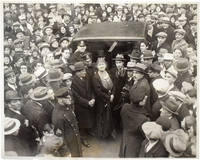
19313299<p>B&w press photograph with snipe on verso. Verso has stamps recent sticker and colored pencil notation as well as evidence of paper removal probably another snipe and light spotting; shallow chip to lower border and tiny loss to lower corner neither affecting body of image. Good.</p><p>Press photograph of legendary speakeasy proprietor Belle Livingston immediately following her release from jail in March 1931 after being incarcerated for 30 days for contempt of court after being arrested for violations of the Volstead Act i.e. Prohibition. In the photograph Livingston stands in the center of a large crowd outside a police car while police officers and a reporter look on. The snipe reads:</p><p>"Crowds Greet Belle after Release from Jail: New York -- Belle Livingston owner of New York's most luxurious night club surrounded by a huge crowd of her admirers immediately after her release from the Harlem jail where she was sentenced to thirty days for contempt of court. La Belle was convicted of defying a federal prohibition injunction at her famous night life rendezvous. N-3-8-31."</p><p>Belle Livingston 1875-1957 was a traveling theater performer who ran her own salon in Paris prior to moving to New York in 1927 at the age of 52 when she tried her hand at speakeasies aimed at the high society crowd. Although her first and second clubs failed quickly due to lack of funds and federal raids her third -- the Fifty-Eighth Street Country Club at 126 E. 58th St.-- was a major hit while it lasted. Her October 1930 opening night drew such guests as Russia's Archduke Leopold John D. Rockefeller the Duke of Manchester and Al Capone. However the establishment was soon raided by federal agents and Livingston who famously tried to escape while wearing red silk pajamas only managed to keep the Country Club open until January 1931. After her release from jail she tried opening speakeasies out West but never managed to make a go of it. Indomitable until the end her gravestone reads "This is the only stone I have left unturned" https://prohibition.themobmuseum.org.</p> International Newsreel Photos, Inc.
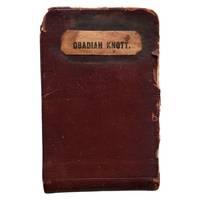
19031953Fall River Massachusetts 1903-1904. About Very Good. 14.5 x 9.5 cm. 120pp. Red limp leather top-bound notebook tan paper label stamped in black to front cover. Holograph text in pencil and ink. Leather edgeworn with several small chips/loss to sides and lower edge; title label stained and toned; faint center crease to rear cover; occasional minor soiling. A year in the beat of Fall River patrolman Obadiah Knott providing a day-by-day account of his activities while on patrol. For the most part these are fairly mundane things: he notes the number of gas lights burning on his route checks that doors are locked and occasionally gets called upon to break up groups of loud drunks. Often people disperse themselves running away when they see him coming; other times he is merely resolving misunderstandings. Nevertheless numerous arrests are reported mostly for larceny and disturbing the peace witnesses corralled warrants given and at one point he notes "On Duty on Wellington St. while small pox patients where sic being carried away" July 20 1903.An uncommon personal record of a policeman's activities while walking his beat. hardcover
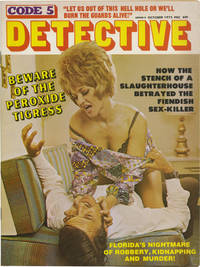
1973160726Freeport New York: G.C. London Publishing 1973. October 1973 issue. Included is a vintage black-and-white photograph used as the magazine's cover image struck in 1976 based on the article "Beware of the Peroxide Tigress." Photograph with a "True Action Detective / Mar 1976" stamp on the verso with manuscript pencil ink and marker annotations on the verso.<br /> <br /> Photograph: 8 x 10 inches. Near Fine with faint creasing on the bottom right corner margin.<br /> <br /> Magazine: 8 x 10.75 inches 65 leaves. Near Fine with two tiny chips at the top of the rear wrapper. G.C. London Publishing unknown
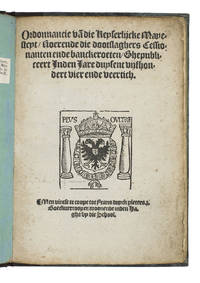
1544ABC_46700The Hague: sold by Frans Duyck Pietersz. colophon: Delft printed by Symon Jansz. 1544. Modern half brown buckram marbled paper sides blue endpapers with an older ca. 1840 front wrapper bound in. 4to. With the woodcut crowned coat of arms of the Holy Roman Emperor Charles V with the order of the Golden Fleece a column on either side and the motto plus oultre on the title-page. Set in 2 sizes of textura gothic type with 2 lombardic initials cast type. First and only edition of a rare ordinance printed in Delft. The ordinance promulgated 19 May 1544 tried to reduce or at least prevent a further rise in crime in Holland and even in other parts of the Holy Roman Empire by addressing the negligence of officers in enforcing the law. It notes that crime rates - from murders to fraud and other smaller incidents - are rising in Holland and across the Holy Roman Empire because officers of the law are failing to do their jobs in the eyes of Holy Roman Emperor Charles V and other lower ranking officials like the stadtholders in the Low Countries. The present ordinance addresses problems concerning the enabling fraudulent behaviour towards creditors of any kind authorities too readily issuing letters permitting deferment of payment resulting in an exorbitant volume of unpaid debts. In total the ordinance contains 40 rules and regulations mainly for officers of the law but also for criminals and others profiting from the lack of law enforcement decreed and published with the intent of bringing down crime rates and reminding officers of their duties. The printer Simon Jansz. in Delft printed the ordinance in two issues the present for Frans Duyck Pietersz. in the Hague and the other with his own imprint Typ. Batava 5796 2 copies.With contemporary marginal annotations and underlining of the text in pen. The second flyleaf is the older front wrapper with an inscription in brown ink on the back: "19 Mei 1544" along with an old catalogue clipping and a few pencilled bibliographical notes. With edges of the leaves slightly frayed slight browning throughout mostly around the edges but overall in good condition.l Petit Pamfletten 1 1882 71; STCN 119453460 2 copies cf. 831527528: Delft issue; Typ. Batava 5797 4 copies cf. 5796: Delft issue; USTC 421160 same 4 copies 1 listed as if it were 2 cf. 421163: Delft issue; not in Knuttel; Kress; Van der Wulp. sold by Frans Duyck Pietersz. (colophon: Delft, printed by Symon Jansz.), hardcover
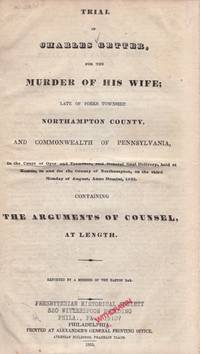
183335550Philadelphia: Printed at Alexander's General Printing Office 1833. First Edition. Hardcover. Good. Octavo. Hardcover. Ex-institutional copy. 72 pages. Original wraps without the outer covers bound in black cloth covered boards with copy of the title pasted down on the front cover. Gilt lettered title on the spine. New tan end sheets front and back. Page 1 is the title page and has two stamps at the bottom: Presbyterian Historical Society Philadelphia and a red withdrawn stamp. Print is small and contents are clean. <br /> <br /> McDade 335 - "Getter convicted of fornication and bastardy was given the option of marrying the girl he had wronged; six weeks later saddled with a wife he did not want he choked her to death.â€. From wikipedia:<br /> <br /> Getter's Island previously known as Abel's Island is a small island in the Delaware River in Easton Pennsylvania in the United States. It is best known as the location of the execution of Charles Getter the last person to be publicly executed in Pennsylvania. History edit Execution of Charles Getter edit The island is named after Charles Getter a farm hand who was hanged on the island in 1833 for the murder of Margaret Lawall a woman he married to avoid prosecution for impregnating her outside of wedlock. Getter's execution was initially scheduled to take place at Center Square in Easton but it was moved to the island - then known as Abel's Island - to accommodate the crowds.<br /> An estimated 15000 to 20000 people some of whom traveled hundreds of miles gathered in the town to view the execution. 12 An initial attempt to hang him failed forcing a second attempt which resulted in his death. A reporter who witnessed the scene was horrified at how little the crowd was affected by the execution and called on lawmakers to take action. 2 Governor George Wolf agreed with the reporter and signed a law banning public execution on April 10 1834. As a result Getter was the last person in Pennsylvania to be publicly executed. 2. Printed at Alexander's General Printing Office hardcover
1967List2964United States 1967. Approximately 108 items: Eighteen packets of carbon-copied documents totaling 114 pages; thirty-nine pages of handwritten notes; twenty-six letters from William Burke to Elwood Hammock; thirteen notes and letters from Elwood Hammock to Arthur Lea; fourteen packets of carbon copies of Burke's letters totaling fifty pages; two newspaper articles about the case; and three copies and one negative of a mugshot. Excellent. The story of Operation Homex an investigation by the FBI into a blackmail ring targeting gay men during the mid-to-late 1960's begins with the arrest of John Aitken by Detective James McDonnell in July of 1965. Police were called to the Grand Central Western Union where Aitken who had been impersonating a police officer while traveling with a 14-year-old boy was attempting to convince the boy's father to wire him $150 to fly him home. Aitken had a prior arrest for child molestation -to avoid doing hard time Aitken told McDonnell that he could tell the NYPD about something much more interesting than the crime he was currently committing.1<br /> <br /> The extortion ring Aitken told the NYPD about had been shaking down dozens of men across the country for almost a decade taking in over $2 million. Corrupt police-and men impersonating police known as "bulls"-used young men and boys known as "chickens" to lure in and blackmail prominent closeted gay men. Their victims included high-ranking military officers doctors professors entertainers and even a sitting Congressman. Over the next two years the investigation headed by the Manhattan District Attorney and the FBI would reveal an operation of unprecedented scope with activities in over a dozen cities.<br /> <br /> The present archive of correspondence is from the collection of Special Agent Arthur B. Lea who was based in Fayetteville North Carolina. The majority of the letters are written by William Joseph Burke an ex-con and ring member who was arrested as part of the first public wave of indictments in February of 1966 to "Bone" or "Bud" a.k.a Elwood "Buddie" Lee Hammock one of the three ringleaders primarily responsible for the whole of the extortion operation. According to a carbon copy of an FBI report included here Hammock was arrested in September of 1966. It would appear that he subsequently began cooperating with the investigation including forwarding Burke's letters to Special Agent Lea.<br /> <br /> Burke discusses the legal case with Hammock candidly and in great detail though using pseudonyms for most of the players. He tells Hammock:<br /> <br /> "Yes the Thumb mentioned your name I assume one of the two contracts he was inflating his ego with may have belonged to you but he was all confused like I told you. He appeared to be sure about one thing and that was that his victims would never show up and take the stand at the trial but when I told him that Murphy the Apple were going to plead guilty his chin dropped he asked me if the Apple was talking ." January 9 1966<br /> <br /> It was incredibly difficult to convince victims to testify a fact which Burke alludes to several times in his letters. One victim Admiral William Church committed suicide rather than even speak to investigators in New York. As Burke himself notes "the laws in the U.S. . tend to encourage Vice Squads etc. to shake down such people" and left them little recourse September 22 1966.<br /> <br /> Hammock's main concern which is shared by Burke is that he would face serious prison time despite his cooperation with the authorities. He tells Lea:<br /> <br /> "Somebody has got to do something for me Art. I've worked hard as hell breaking up this ring now they're going to toss me to the vultures that ain't right Art I aint got no money to hire me a lawyer or nothing - Thats why the Hebe flew away". No Date<br /> <br /> "The Hebe" is Sherman Kaminsky who skipped bail after Church's suicide and disappeared for 11 years his flight is the subject of much ire from both Burke and Hammock. According to Hammock investigators let Kaminsky out of the courtroom at lunchtime and left him alone while he sat on a bench reading the paper and feeding the pigeons. When they came to retrieve him "Boom No Hebe no where in sight" No Date.<br /> <br /> Among the other items included here are two mugshots a photo negative and the complete FBI file of Jimmy Michael Haithcock one of the chickens whose name is included on the aforementioned FBI report. There are many pages of Lea's hastily written notes numerous photocopies of letters from Burke and a substantial stack of call records from Southern Bell Telephone and Telegraph Company. An unusual collection to be sure with much to glean about a fascinating and largely forgotten episode of American history.<br /> <br /> 1 William McGowan "The Chickens and the Bulls" Slate July 11 2012. unknown
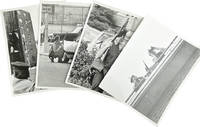
197421567Queens NY 1974. Very Good . Queens NY: 1974. Thirty original press photographs measuring ca. 23.5x18cm. to 28x18cm. or the inverse some with snipe in image or mounted to verso; occasional color pencil annotations to versos one piece of snipe separated else a Very Good collection images all quite sharp.<br /> <br /> Substantial archive of press photographs covering a thirty-hour hostage situation that took place at the South Jamaica Houses in Queens New York. Floyd Steele recently on parole from the Matteawan State Hospital for the Criminally Insane was the tenant of Fred and Peggy Dalton Kinsler living in their apartment with Peggy's five-year-old daughter Avril. Steele had already been convicted twice for manslaughter charges including the 1963 fire arm death of his girl friend. Late on the evening of June 10th 1974 Steele allegedly made an unwanted advance at Peggy threatening the family with a loaded gun when she rebuffed him. Peggy managed to lock herself in a bedroom and used a sheet to climb out of the third story window to alert the police. According to Cecil Mackey a member of the Housing Authority Police and one of the lead negotiators during the following thirty-three hour stand off an early attempt to break open the door to the apartment found Steele pointing the gun at young Avril's head threatening to shoot if they did not shut the door. Mackey and the newly-formed hostage negotiation team developed by Simon Eisdorfer in the wake of the deadly attack on the 1972 Olympics employed the latter's negotiation techniques which according to a 2005 obituary article "deemphasized confrontation focusing instead on saving lives. Studying earlier cases Eisdorfer realized that negotiators could subtly turn a siege into a waiting game that played out in their favor. Police officers could change shifts but the suspects could not and eventually became tired and hungry enough to surrender." Mackey and fellow officer Lt. Francis Bolz followed these protocols addressing Steele as "Mister" chatting about gardenias and slowly managing to gain Steele's trust enough to open the door long enough to provide him and Avril with breakfast and hot coffee. It was by proffering Avril a glass of Kool-Aid that Bolz managed to pull her out of the apartment door and place his body equipped with bullet proof vest between her and Steele. Steele surrendered immediately though it was discovered that his gun was still loaded and Fred Kinsler had been killed by two bullets to the neck and chest. From start to finish the situation lasted thirty-three hours and was later described by Police Commissioner Michael Codd as "an ideal marriage of the community and the professional policeman in action" "New York Daily News" June 13 1974. <br /> <br /> The present collection of photographs attributed to Ted Cunningham Dan Neville and Paul Hosefros were splashed across newspapers across the country. Half of the photographs in the collection depict members of the police force as the situation unfolded including snipers situated on the ground and on a nearby rooftop. A number of images of the small window into the apartment also feature heavily including one in which one can just see the small hand of Avril Kinsler shutting the window upon Steele's instructions. Approximately half of the photographs document the immediate aftermath of Steele's arrest including four close-up shots of him being led by members of the police force; two show Avril being carried away by an unknown policewoman; and three photographs show Peggy Kinsler in a state of shock being wheeled out of the apartment in a gurney after discovering that her husband had been murdered. A substantial and important documentation on the history of police tactics on both the local and the national level. unknown
10760Headed The Camp Little Kimble Nr. Aylesbury Bucks. 5 Feb. 1947. One page 12mo good condition. "Thanks you very much for writing to me about my boo. It is always nice to hear from oone's readers and I am delighted to learn that both you and your husband found an hour's excitement in this otherwise rather dreary world. Your good wishes are appreciated." Norte: Apparently Raymond/Chase/Grant only published "More Deadly than the Male" under the pseudonym "Ambrose Grant" so letters signed so may well be scarce. [Headed] The Camp, Little Kimble, Nr. Aylesbury, Bucks., 5 Feb. 1947. unknown
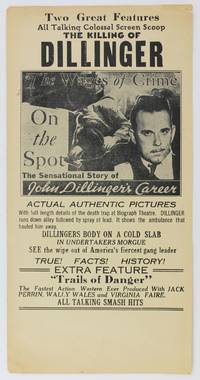
19353203N.p. 1935. Very good. Photographically illustrated film herald 12 x 6 inches. Even toning minor edge wear short closed tear near top edge. A rare small broadside advertising a true crime presentation including real footage related to the shooting death of famed gangster John Dillinger. This "sensational story" most likely a newsreel mixed with a reenactment of Dillinger's assassination promised to show "actual authentic pictures" "the ambulance that hauled him away" and "Dillinger's body on a cold slab in the undertakers morgue." The herald includes a portrait of Dillinger himself. The Dillinger film was paired with an action western from 1930 titled Trails of Danger. An early entry in American true crime and a wonderful display piece. unknown
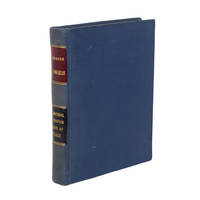
19043207<p>6-5/8 x 5-3/8 inches. 84pp; 524pp; 6411pp; 444pp; 10pp; 1223pp illustrations. Blue cloth with maroon and black spine labels stamped in gilt; original blue or grey wrappers printed in black for each booklet bound in. B&w illustrations. Minor wear to board corners and spine ends; light sunning to some bound-in wrappers; slight scuffing to title page and archivally repaired corner of one leaf in first booklet. Very Good or better overall.</p><p>A bound volume of addresses by William A. Pinkerton on various types of crime as well two booklets on individual criminals by Pinkerton and from the archives of the Pinkerton detective agency. Contains the following in the order bound in:</p><p>- <em>Train Robberies Train Robbers and the "Holdup" Men. Address by William A. Pinkerton. Annual Convention International Association Chiefs of Police. Jamestown VA. 1907. </em>Chicago and New York: Copyrighted by Wm. A. Pinkerton and Robert A. Pinkerton November 1907.</p><p>- <em>Bank "Sneak" Thieves. Paper Read by William A. Pinkerton. Annual Convention International Association Chiefs of Police. Hot Springs Ark. April 11th 1906. </em>Chicago and New York: Copyrighted by William A. and Robert A. Pinkerton Nov. 1906.</p><p>- <em>The "Yeggman": Bank Vault and Safe Burglar of To-Day. Paper Read by William A. Pinkerton. Annual Convention International Association Chiefs of Police. St. Louis MO. June 6th to June 11th 1904. </em>Chicago and New York: William A. Pinkerton and Robert A. Pinkerton August 1904.</p><p>- <em>"Forgery". Paper Read by William A. Pinkerton. Annual Convention International Association Chiefs of Police. Washington D. C. May 22nd 1905. </em>Chicago and New York: William A. Pinkerton and Robert A. Pinkerton August 1905.</p><p>- <em>Timothy Webster Spy of the Rebellion. </em>Chicago and New York: William A. Pinkerton and Robert A. Pinkerton November 1906.</p><p>- <em>Adam Worth Alias "Little Adam." Theft and Recover of Gainsborough's "Duchess of Devonshire."</em> Third Edition. New York Pinkerton's National Detective Agency January 1904.</p><p>Of varying degrees of scarcity in OCLC all uncommon in commerce.</p> [William A. Pinkerton and Robert A. Pinkerton / Pinkerton Detective Agency] hardcover
193457184London: Stanley Paul & Co. Ltd. c. 1934 1940. 8vo. 223 1 pp. Photo frontisp. Green publisher’s cloth white lettering on spine minor rubbing shelfwear w/ d.j. photo cover art minor edgewear small tear to upper right corner some scuffing still VG/VG copy. First Treasure Library edition No. 9 -- listing to this title on back cover of jacket and including Brust I guarded Kings 1940 as no. 7 as well as Pawley’s My Bandit Hosts 1939. Leeson participated in the “Jack the Ripper†investigations was known as “the man who was shot at Sidney Street†penetrated criminal organizations and interacted with Lenin Trotsky Stinie Morrison Anarchists and more. Often without the exceedingly scarce dustjacket these are mis-catalogued as the 1934 first edition but jacket clearly establishes date of publication and also features the Treasure Library 3/6 price. Stanley Paul & Co., Ltd., hardcover
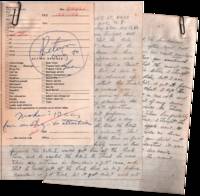
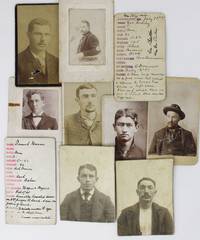
18995150Kansas City Mo 1899. Very good. Ten carte-de-visite photographs 4 x 2.5 inches or slightly smaller on thick cardboard mounts four with partially-printed "rap sheets" on verso completed in manuscript. Occasional edge and surface wear as well as generally light dust-soiling. A nice group. A group of ten fabulous mugshot photographs or studio portraits featuring criminals in the last few years of the 1800s in Kansas City Missouri. Four of the photographs are particularly interesting for the personal and criminal history information recorded on their versos. These photographs are pre-printed with a list of fields to be filled out by the criminal or perhaps the jailer. The combination of fields varies slightly on three of the four cards but generally they all ask for similar information including name; aliases nationality age height weight eye color hair color complexion occupation or "Criminal Occupation" the pertinent crime place of arrest arresting officer date date of arrest and distinguishing marks or "Peculiarities of Build Features Scars Marks etc.". <br /> <br /> One of the mugshots is that of James Carrington Francis 1869-1892. At the bottom of his card is written: "Killed at Pleasanton KS for Pacific Ex Robbery Jan. 23 '92." Francis had indeed taken part in the robbery of the Frisco Express out of St. Louis on the night of November 30 1891. During the robbery two masked men boarded that train as it was leaving St. Louis. They remained in seclusion until they had traveled a few miles and then presented pistols to the heads of the engineer and fireman. They ordered them to stop at the point where two accomplices of the highwaymen were stationed. The engineer and fireman were then ordered from the cab and kept covered while the party proceeded to the express car where the robbers demanded admission but were refused by the messenger. The robbers then set off a stick of dynamite and blew in the side of the car seriously injuring the messenger. They then entered blew open the safe and after taking $10000 made their escape. The Pinkerton Detective Agency and Chief of Detectives Desmond of St. Louis investigated the case and gathered evidence which convinced them that the robbers were Marion Hedgepeth Dink Wilson Adelbert Slye and James Francis.<br /> <br /> The other three men whose photographs are supplemented with personal information include Frank Norris Patrick Raine and George Conley. Oddly enough the crimes of all four men are not stipulated on the present photographs. Norris was a baker by trade with a scar on the palm of his hand and a "knuckle knocked down" who was arrested on October 5 1895. Patrick Raine was a waiter with a forearm tattoo and "2 vax scars on left arm" arrested on January 24 1899. George Conley alias George Baker or George King was a brakeman arrested on July 12 1897. The remaining photographs do not include identifying information save for two with penciled names on the verso and one with a studio stamp from J.V. Dabbs in Fort Scott Kansas but were found with the previous four photographs and would likely reward further research into the Wild West criminal world of late-19th century Kansas. unknown
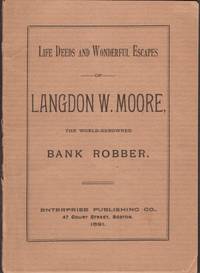
189135019Boston: Enterprise Publishing Co 1891. First Edition. Wraps. Good. Stapled wraps. Approx. 7" x 5". 45 pages. Light brown paper covers with black title bordered in black on the front cover. Spine is chipped Covers detached. Contents clean. Enterprise Publishing Co unknown
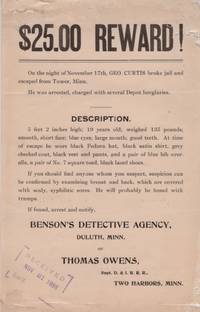
189831956Minnesota: Benson's Detective Agency Duluth; Thomas Owens Two Harbors 1898. Broadside. Good. Broadside. Wanted poster. Approx. 9.5" x 6". Paper is worn upper edge with small edge tears. "Received Nov 21 1898 Ans'd" stamped in purple at the bottom. Small edge chips to the paper on the right margins. Benson's Detective Agency, Duluth; Thomas Owens, Two Harbors unknown
193085251Paris: Privately Printed by Charles Carrington 1930. First Thus. Octavo. 22cm. Publisher's green buckram titled and decorated in dark green to spine and front board. 679pp. Light superficial scuffing to corners and spine ends of the very hard-wearing cloth a little toning and discoloration in places strong and handsome; internally clean with some light cosmetic toning. A very good solid copy.<br /> <br /> The culmination of Proal's career-long fascination with crimes of passion a category which he extended to include suicide and self harm; their motivations their complexities disparities in punishment or treatment and in cataloging their bewildering diversity. Privately Printed by Charles Carrington unknown
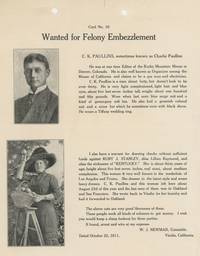
1911List812California 1911. Single sheet measuring 8 ½ x 11 inches. Two vertical folds two holes punched at upper margin very good condition overall. Very Good. An uncommon survival possibly published by the Santa Clara County Sherriff’s Office showing two wanted criminals from 1911 who were travelling together. The first a C.K. Paullins was the editor of the Rocky Mountain Moose and is wanted for embezzlement. The second a Ruby J. Stanley alias Lillian Raymond is known as “Kentucky.†According to the flyer “This woman is very well known in the tenderloin of Los Angeles and Fresno. She dresses in the latest style and wears fancy dresses… These people work all kinds of schemes to make money. I wish you would keep a sharp lookout for these parties… W.J. Newman Constable Visalia California. Dated October 23 1911.â€. unknown
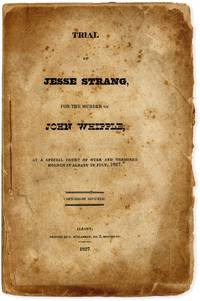
182787802Albany: D. M'Glashan 1827. First and Only Edition. Octavo in 4's. 24cm. Stab bound pages with the title page serving as the front cover and no trace that the pamphlet was ever bound. 35pp. Some mild chipping to edges and extremities most notably the upper right corner toning and soiling to wraps; internally clean but uniformly toned with offsetting from the type throughout edges untrimmed luxuriously wide margins some traces of careless opening in places. Very good by dint of survival and solidity rather than beauty the paper is cheap and the pamphlet was printed to leverage opportunity rather than posterity.<br /> <br /> A notable and at the time highly controversial trial dealing with what was later referred to as "The Murder at Cherry Hill." The prominent New York Van Rensselaer family owned and lived at Cherry Hill Farm in Albany the daughter Elsie was married somewhat unhappily to John Whipple and fell for a younger man she met in a bar by the name of Jesse Strang. The couple fell in love Elsie expressed her deep unhappiness with Whipple; Strang masquerading under the name of Jesse Orton took on a job at the farm and began an affair with Elsie which was maintained by the house staff many of whom were enslaved people of color whose testimonies were heard at the trial passing notes between the two. Elsie chafing somewhat at having to endure her legal husband resolved that he must die to make way for Strang and they would run away together to Canada. <br /> <br /> The first plan was arsenic poisoning which failed. What Elsie lacked in poisoning ability she made up for with murderous intent and she purchased a rifle removed the ammunition from her now somewhat suspicious husband's gun and induced Strang who does not come across as the sharpest tool in the shed to shoot Whipple dead. Strang then attempted to fabricate an alibi which did not hold up and he was arrested. What followed was a widely publicised trial in which both defendants turned on each other Elsie's status as the daughter of prominent landowners was leveraged as protection from any serious punishment and Strang bore the brunt of the law. He had of course further doomed himself by attempting to plant evidence lying under several oaths and generally being one of the less gifted murderers of the early 19th century; he was hanged Elsie went home to Cherry Hill the Van Rensselaer's invested heavily in local collective amnesia and the rest of the US stared somewhat incredulously and gossiped over their breakfast grits. <br /> It was a carnival of awfulness that posed many questions about the societal rights and freedoms of women the privileges of wealth and the integrity of the judicial system. Fairly represented in institutions with 20 examples in US libraries but scarce in commerce and usually in later binding. D. M'Glashan unknown
186727753Ripley Mississippi 1867. Otherwise very good condition. If to be found in your County and them safely keep. to be held to appear at the Court House in The Town of Ripley after the 1st Monday of March 1868. for the charge of murder." A preprinted form with hand written additions.<br /> <br /> There is a David Lumley in the 1845 Mississippi census recording 2 males & 4 females in Tishomingo county. Ancestry dot com<br /> <br /> 8 x 12 1/2" laid paper with blue lines original folds official embossed stamp of the Circuit Court of Tippah County. Some splits at folds. unknown
173327715Namur Belgium 1733. Ephemera. Very good condition. An unusual survival of an 18th century swindle and subsequent execution. The manuscript letter is written by Mme de Douglas to an unknown "Monsieur" from Namur Belgium dated early January 1733. Mme Douglas was the widow of one of two brothers who inherited their fathers' rich estate from the East Indies. Upon the brothers' death in order to prevent the estate being distributed to the daughter of her brother in law she paid a wet nurse and others to falsify testimony implying that the daughter was illegitimate. The daughter was imprisoned but later found to be not guilty and the courts in Holland Belgium indicted Mme Douglas. Ultimately "The verdict was that she be hanged and that her 80 year old father be brought onto the scaffoled in order to watch the execution; and her 300000 florin fortune is not sufficient to save her from her fate." Translation of an article in "Kurz-gefaßter historischer Nachrichten zum Behuf der neuern Europäischen Begebenheiten auf das Jahr 1735" vol. 45 November p. 893.<br /> <br /> Written in unaccomplished French bifold 7 1/4 x 6" 4pp. <br /> Translation from French:<br /> From Namur the 1st of Jan 1733<br /> As I learned a few days ago that you also took possession of all the property of your father-in-law by agreement with your brother-in-law I have the honor to write you these lines to know if your intention to lodge with me was false as you assured me of demonstrating the desire if it were up to you and I assured Monsieur Questand also agreeable that you appeared to me that we could easily arrange for your interests and mine. If you come to Namur it would require us to confer together. I am lodging at the moment with Mr Canon Paradis near St. Aubain I shall await a response to this letter my compliments if you please to Madame your wife and I wish you both all good wishes in this year that we are beginning according to your desires having the honor to be <br /> with a perfect esteem Sir your very humble and very obedient Countess<br /> of Douglas<br /> <br /> In 1717 Veselovsky one of Peter the Great's entourage on his second visit to the Low Countries lodged in Namur 'chez M. le chanoine Paradis.' See Charles Maroy 'Les voyages de Pierre le Grand' L'Expansion Belge 6/4 1913: 209 199-211. <br /> <br /> Further reference to this case is made in a European history published in Nurnberg in 1744 summarizing important events in European history from 1734 to 1744 Ref. below.<br /> <br /> 'How sharply dishonesty is treated in Holland is illustrated by an example in the person of Madame Douglas. There were two Douglas brothers both married who received a rich inheritance from the East Indies. One questioned the legitimacy of the inheritance the other accepted it. The two were so hostile towards each other that guardians had to be appointed. After awhile both brothers died one of whom was survived by a daughter. Because however the other widow wanted the entire fortune for herself and her children she corrupted a wet-nurse and other witnesses who finally testified that the child presumably of the dead brother was illegitimate. The mother of the child was put in jail and the sister-in-law received the entire inheritance. After further investigation the imprisoned woman was found not guilty and the lying of the widow and her false witnesses was exposed. She the widow was prepared to pay 300000 guilders for her life but Madame Douglas ended up having to pay far more. Her 80 year old father was forced to watch the execution of her daughter on the scaffold because he had given his daughter the offending attorney Streich. Nine of the false witnesses were beaten with a broom and seven were branded.' Translation of a passage on pp. 638-639 in Andreas Lazarus von Imhof Des Neu-eröffneten historischen Bilder-Saals Zehender Theil. Nürnberg 1744. unknown
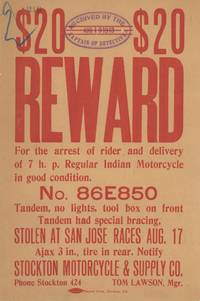
1913List2840Stockton California 1913. Single 6 x 9 inch sheet. Marked with blue crayon at upper left corner otherwise near fine. A wanted poster offering $20 for the return of a stolen Indian motorcycle. Indian motorcycles were an early American motorcycle built by the Hendee Manufacturing Company in Springfield Massachusetts. This particular one was a tandem model stolen from a race ground in San Jose in August of 1913. Motorcycling was then a very new sport with the first motorcycling club the Federation of American Motorcyclists having been formed in New York City not ten years prior. unknown
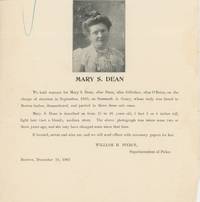
1905List2839Boston Massachusetts 1905. Single 8.5 x 8.5 inch sheet cut from a larger whole; likely missing a portion. Marks at upper left side some folding. Otherwise excellent to near fine. Wanted poster for Mary S. Dean dated December 16 1905. Three months prior a young woman’s torso had been found in a suitcase floating in Boston Harbor. A month later a suitcase containing her limbs was found and she was identified as Susanna Geary. In September Geary had gone to the medical practice on Tremont Street where Dean worked as a nurse and Dean had performed an abortion for her - at the time an illegal procedure in Massachusetts. Geary developed sepsis from the surgery; when she died Dean and three men one a doctor conspired to dismember Geary and dispose of her body in the ocean.1 The doctor was acquitted and the two men pleaded guilty but Mary S. Dean was never found.<br /> <br /> 1 “Says McLeod Made Plans: Crawford Testifies in Suit Case Trial†The Boston Globe November 28 1905. unknown
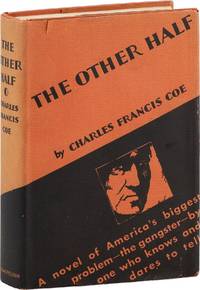
193088102New York: Cosmopolitan 1930. First Edition. First printing. Octavo 19cm. Orange-red cloth titled in black; dustjacket; 309pp. Very Near Fine copy with just a trace of light rubbing to bottom board corners. In the original dustwrapper unclipped priced $1.50 at base of front flap slightly sunned on spine panel with a few tiny nicks to extremities and a short split to upper portion of front flap-fold; still Near Fine most uncommon thus. <br /> <br /> A hard-boiled novel set in the world of New York gangsters focused not so much on a single criminal plot as on the day-to-day machinations of its central figure one Antonio Scarvak head of a small-time rum-running and extortion racket. The New York Times in its 1931 review noted with some pique that Coe's antihero seemed ".an incredibly dull-witted gunman.who moves rather absurdly through the web of murder graft and corruption that makes the background for the novel." Coe a former boxer and federal agent specialized in works that brought to life the criminal underworld with which he was long familiar and his work is unusual in that while it was clearly designed to appeal to the growing audience for lurid hard-boiled crime it kept one foot firmly planted in the realm of social fiction. There are only a few novelists of the period whose work is equally likely to be cited in Hubin's Bibliography of Crime Fiction this title cited on p.88 as in Archibald Hanna's bibliography of American social fiction A Mirror for the Nation no. 728. Uncommon in jacket this is a particularly fresh example. Cosmopolitan unknown
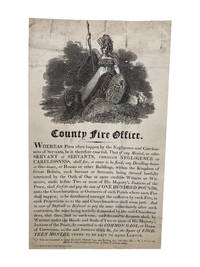
004469London: C. Roworth & Sons Printed broadside n.d. but between 1832 and 1840 approximately 220mm x 370mm in size. Laid down on to paper old tears now closed visible to head light surface soiling cropped by about 20mm another copy I had a few years ago was 245mm x 390mm in size small hole to vignette. The printer was Charles Roworth who traded as C. Roworth & Sons between 1832 and 1840 see BBTI. A notice to menials and servants that if through negligence or carelessness any houses were set on fire they would be subject to a fine of one hundred pounds and in the likely event of them not being able to pay such a fine they would be sent to gaol for eighteen months of hard labour. This notice was to be "affixed in some conspicuous place in view of your servants". First Edition. Unbound. Good. Folio. Broadside. C. Roworth & Sons Paperback
19112021Chicago: Pinkerton's National Detective Agency 1911. Very Good. 11" x 8-1/2". Circular printed recto only. White stock printed in black b&w illustration. Three holes punched to upper portion of leaf slightly affecting text; old folds. Wanted circular for Edward J. Tierney who according to a contemporary newspaper account "is the 'classiest' looking of all the criminals that the police have been asked to look out for" Bridgeport Times and Evening Farmer Feb. 23 1911. Wearing a dress coat in the photo provided for the circular Tierney worked as a traffic clerk for the Western Electric Company in Dallas before disappearing in November 1910. The reader is warned that he "might be found in the Shipping or Traffic Department of some electrical concern or railway office and he may also endeavor to obtain a position as a chauffeur or at some Vaudeville House or Moving Picture Show as he is a competent chauffer and a good singer as well." Oddly the 28-year-old Tierney is never implicated in a crime here nor does an initial review of contemporary newspapers reveal that he was ever charged with one much less convicted. Pinkerton's National Detective Agency unknown