1 463 résultats
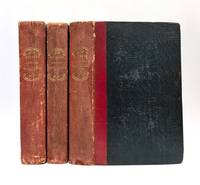
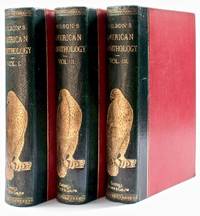
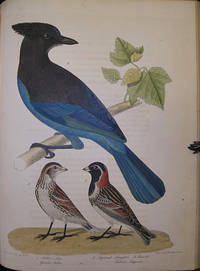
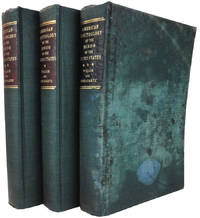
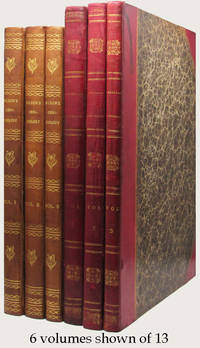
180832275Philadelphia: The Wilson volumes published by Bradford and Inskeep. Printed by Robert Carr; R. & W. Carr; VII-IX by Samuel F. Bradford printed by Thomas H. Palmer; the Bonaparte volumes published by Samuel Augustus Mitchell Vol.I Carey Lea Carey Vols. II and III and Carey & Lea Vol. IV all Printed by William Brown 1808-1812; 1824-1825; 1825-1833. 13 volumes. First Edition of this rare textual and illustrated work that is considered to be the First Outstanding American Ornithology and the First Great American Colour- Plate Book. Volumes I-VI are first issue Volumes VII VIII and IX reissued with the alterations and corrections by Ord made after further ornithological information had been gleaned and First Edition of the Bonaparte volumes with the first volume in rare first state. The nine Wilson volumes beautifully illustrated with 76 superb hand-coloured engraved folio plates by Alexander Lawson J.G. Warnicke G. Murray and Benjamin Tanner from original drawings by Wilson depicting a vast array of American birds. The Bonaparte volumes are illustrated with 27 additional richly hand-coloured folio plates from drawings by Titian Ramsay Peale A. Rider and plate 10 by Audubon and A. Rider Folio 36 x 27 cm. and Folio 38 x 29 & 39 x 32 cm. The Wilson volumes in contemporary mottled calf over marbled paper covered boards the spines gilt decorated within compartments separated by fine gilt tooling two compartments lettered and numbered in gilt some volumes restored at the backs to style and in effort to match the original spine panels though the tooling is slightly different considering the unavailability of the original tools. The four Bonaparte volumes in fine period red morocco over marbled paper covered boards. The spines fully decorated in gilt. vi 158; xii 167; xvi 120; xii 100; xii 122; xx 100; xii 138; xi 162; ccxxiii i 298 4 General Index pp. Complete viii 105; x 95; iv 60; iv 142 pp. Quite a handsome set in pleasing condition the usual spotting in places usually from offsetting from the plates a few expert repairs to old closed tears in the text the plates all quite well preserved with much less spotting or browning than is usually found. One volume with a bit of evidence of old damp at the edges of the prelims. Vol. VI with a bit more spotting or foxing than the others as is usual due to the paper this confined to some of the textual pages An excellent set. The Bonaparte volumes in very handsome bindings as well some of the usual offsetting and browning throughout the volumes as is typical with the paper used. Generally in all volumes the plates are quite clean and the spotting is confined to the text and tissues. The paper used for the text in these sets was prone to foxing and offsetting spotting and splotching but fortunately the paper used for the plates was of a better quality and so as in the copies being offered here the plates are generally quite clean with some minor spotting on occasion and then usually confined to the outer margins. The bindings on the Bonaparte volumes are in original state and offer a very handsome and especially appealing presence. FIRST EDITION OF TWO OF THE MOST IMPORTANT BOOKS IN THE HISTORY OF AMERICAN ORNITHOLOGY AND COLOUR-PLATE PRINTING INCLUDING THE FIRST GREAT WORK ON AMERICAN BIRDS. “The story of Alexander Wilson's spasmodic rise from Scottish peddler and failed poet to the father of Amrican ornithology is a cloyingly American story. Numerous "types" those we recognize from the writings of Benjamin Franklin through the literature of James Fenimore Cooper to the Jacksonian businessman emerge in his journey. It is a journey that takes him from the small town of Paisley in West Scotland to the shores of Delaware where he lands a penniless immigrant over vast tracks of the eastern United States and finally to Philadelphia; here like Franklin he finds renowned associates from Charles Wilson Peale to Thomas Jefferson to Thomas Paine and the international recognition that he had craved since his first poetic jottings as a youth in Scotland. The tragic irony of this American story is its truncation; indeed it is Alexander Wilson's exhaustingly extreme dedication to his ornithological studies and the illnesses contracted during his Leatherstocking-esque roamins through the forests that kill him at the age of forty-seven just as he attains the station in life he so desires. An immigrant who embraced so fully the "American Dream" of constant industry leading to financial and personal reward Wilson achieved his dream but scarcely lived to enjoy it. Perhaps though Wilson did achieve what he truly desired; in 1805 frustrated by attempts to gain help in publishing his ornithology he swore to continue on his own even if it killed him: "I shall at least leave a small beacon to point out where I perished." Ord p. 61. This declaration transcends Americanness; Wilson seemed to fear that in the vast cauldron of humanity he would be subsumed. His Ornithology then which has earned him title of the father of American ornithology seems the work of a talented and driven man whose desires in life were met too well by the American attitudes and mores of the early nineteenth century.†The book is of considerable importance. Vols. VII-IX revised by George Ord were reissued in 1824-1825<br> The Bonaparte volumes were designed as a supplement to Wilson's American Ornithology. Originally intended to be issued inn 3 vols. 1825-1828 it is now considered imperfect without the final 4th volume 1833. Born in 1803 Charles Lucien Jules Laurent Bonaparte 2nd Prince of Canino and Musignano was a French naturalist and ornithologist and a nephew of Napoleon. He emigrated to the United States from France and Italy in 1822 but before leaving Europe he had already discovered a warbler new to science the moustached warbler and on the voyage he collected specimens of a new storm-petrel. On arrival in the United States he presented a paper on this new bird which was later named after Alexander Wilson.<br> On his arrival in America Bonaparte set about studying the ornithology of the United States and updating Wilson's Ornithology. The revised edition was published between 1825 and 1833. His other publications included "Observations on the Nomenclature of Wilson's Ornithology" in the Journal of the Philadelphia Academy and "Synopsis of the Birds of the United States" in the Annals of the Lyceum of New York. In 1824 Bonaparte attempted to get the then unknown John James Audubon accepted by the Academy of Natural Sciences but this was opposed by the ornithologist George Ord who disliked Audubon's dramatic bird poses and considered him to be "a back-country upstart who romanticized his subject matter" according to the Audubon Galleries.<br> At the end of 1826 Bonaparte and his family returned to Europe. He visited Germany where he met Philipp Jakob Cretzschmar and England where he met John Edward Gray at the British Museum and renewed his acquaintance with Audubon. In 1828 the family settled in Rome. In Italy he was the originator of several scientific congresses and lectured and wrote extensively on American and European ornithology and other branches of natural history. Between 1832 and 1841 Bonaparte published his work on the animals of Italy Iconografia della Fauna Italica. He had also published Specchio Comparativo delle Ornithologie di Roma e di Filadelfia Pisa 1827 presenting a comparison between birds of the latitude of Philadelphia and Italian species. He created the genus Zenaida for the mourning dove and its relatives. He was elected a member of the American Antiquarian Society in 1845.<br> In 1840 he became Prince of Canino and Musignano after his father's death and became involved in politics particularly the anti-Austrian party that he joined in 1848. He did not however lose interest in his favourite studies for he organized and presided over several scientific congresses in Italy. He visited Sir William Jardine in southern Scotland and began work on preparing a methodical classification of all the birds in the world visiting museums across Europe to study the collections. In 1854 he became director of the Jardin des Plantes. In 1855 he was made a foreign member of the Royal Swedish Academy of Sciences. He published the first volume of his Conspectus Generum Avium before his death the second volume being edited by Hermann Schlegel.<br> Bonaparte was extremely prolific and is responsible for coining Latin names for a large number of bird species. As of August 2019 in the online list of birds maintained by Frank Gill and David Donsker on behalf of the International Ornithological Committee IOC Bonaparte is credited as the authority for 165 genera 203 species and 262 subspecies. wiki<br><br>Fine Bird Books p.114; Sabin 104598; Nissen IVB 992; Wood p.630; BM Natural History p. 2333 The Wilson volumes published by Bradford and Inskeep. Printed by Robert Carr; R. & W. Carr; VII-IX by Samuel F. Bradford, printe hardcover
1878mon0000051867PORTER AND COATES 1878-01-01. Hardcover. Acceptable. in x in x in. Ex-library book usual markings. Hardback volume 2 only with some damage minor tears or rips to spine and creasing and discolouring to pages due to age. Still very useable. PORTER AND COATES hardcover
1832GT1106London: Whittaker Treacher & Arnot; Stirling & Kenney Edin. 1832. Hardback. Fine. 8vo. 3 volumes octavo set with portrait frontis of the auther Alexander Wilson. Pub. original grey boards with new paper labels to the new grey matching spines. CLEAN TEXT BLOCK AND CLEAN UNCOLOURED ORIGINAL PLATESWith a continuation by Charles Lucian Bonaparte and notes etc. by Sir William Jardine Bart. 408pp;390pp;523pp with 27; 59;76 un-coloured plates and a continuation by Charles Lucian Nonaparte 18 plates. The original plates of both authors were re-engraved by Lizars on a smaller scale and uncoloured in this three volume set. <br/> <br/> Whittaker, Treacher & Arnot; Stirling & Kenney [Edin]. hardcover
32303PHILADELPHIA PORTER AND COATES 1878. THE POPULAR EDITION THREE VOLUMES IN ONE. THICK SMALL QUARTO. pp. 214 390 426. CONTAINS A LONG ESSAY ON THE LIFE OF WILSON. REBOUND USING THE ORIGINAL RED BEVELLED BOARDS AND SPINE NEW ENDPAPERS REPAIRED TITLE PAGE. ILLUSTRATED WITH 103 PLATES ENGRAVED FROM DRAWINGS FROM NATURE FOUR PER PAGE. SOME SLIGHT WEAR TO THE BOARDS AND FOXING TO THE EDGES OF THE PLATE ONLY. CLEAN AND TIGHTLY BOUND. NO DATE BUT CIRCA 1878. VERY SCARCE IN THE UK. PHILADELPHIA, PORTER AND COATES, 1878 hardcover
76860London Paris & New York Cassell Petter & Galpin 1877. CV 408 VII 495 VII 540 s. Frontispiece. 103 håndkolorerte litograferte plansjer. Pene samt. grønne skinnbd. med 5 opph. bind. Rik ryggdekor i gull. Topp gullsnitt. Forsatspapir og tittelbl. og snittet litt gulplettet ellers et rent og pent sett. . <br/><br/><em>Cont. green half morocco with 5 raised bands. Spine richly gilt. Top edge gilt. Frontispiece. 103 hand-coloured lithographed plates. </em> hardcover
1832654304Whittaker Treacher & Arnot 1832. First Edition. Leather Binding. Very Good. First Jardine Edition with illustrative notes and life of Wilson by Sir William Jardine. In Three Volumes. Illustrated with an engraved portrait frontispiece of Wilson in first volume and 97 hand-coloured engraved plates by W. H. Lizars after Wilson and others. Each 6 x 9 in. cvii 408; 390; 523pp. including index. Uniformly bound in quarter red morocco over green cloth boards with gilt stamped titles and decorative device on spines. Overall a nice set with wear to the corners and rubbing along the edges; usual foxing to the frontispiece else a Very Good set. Internally clean and all the plates are fresh and bright with just a faint traces of offsetting to the facing pages; binding are tight and all hinges/boards intact. Anker 534; Sabin 104598 ref. the American Edition // Considered the first major scientific work published in the United States 1808-1814 and the most important publication on American ornithology before Audubon. Whittaker, Treacher, & Arnot unknown
028279Philadelphia: Porter & Coates. Hardcover. Good. 4to - over 9¾" - 12" tall. Popular Edition. Green boards. Previous owner's ink stamp on second page. Light wear to boards. No date present. Text and illustrations very good side tear on page 39 of volume I pressed plant removed along spine of page 209 volume II. Expedited or International shipping may cost more heavy book. <br/> <br/> Porter & Coates hardcover
9925Philadelphia: Porter & Coates 1871. Faint damp staining to the top and right edges of some of the pages in the Bonaparte Supplement which does not affect the images corner torn to one tissue guard; a near fine set in the original publishers binding. Pp. Text: iii-cxxxii 214; iii-viii 9-390; vi-viii xvi 9-426; Plates: title page 2 pp index of plates 76 plates; title page of Bonaparte Supplement 1 pp index of plates 27 plates for a total of 103 hand-colored lithographed plates featuring nearly 400 figures of birds most by Alexander Lawson after Wilson and Rider. Publisher's original half brown morocco over marbled boards spine with five raised bands and titles in gilt all edges gilt yellow endpapers lg. 8vo text large folio 15 by 17-1/2 inches plate volumes. This is the rare Philadelphia Edition which was printed on much larger paper than earlier editions. Owner signature of George L. Ledyard dated 1873 on endpapers of plate volumes. Philadelphia: Porter & Coates, [1871]. hardcover
1831mon0000122441Edinburgh Constable 1831-01-01. Hardcover. Good. in x in x in. 1836 Four volumes1-4 in acceptable condition from constable pocket editions on dark green cloth - vol I has splits down side spine seams & Vol II is missing part of spine cover whilst vol III & IV are intact but all slightly loose bindings Edinburgh Constable hardcover
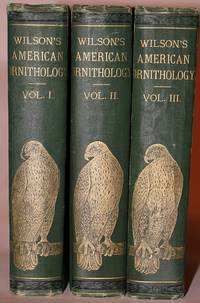
1877BB1704London Paris & New York: Cassell Petter & Galpin Chatto & Windus 1877. First Edition thus from 1808. Half-Morocco. Fine. A superb 3-volume British edition of this classic American bird book the “first major scientific work published in the United States†Burtt and Davis p. 333 here in its final state with notes and Life of Wilson by Sir William Jardine and with the largest number of plates. Demy 8vo 211 x 140mm: cv14088Cassell catalogue; vii14951; vii1540pp with tissue-guarded engraved portrait frontispiece of Wilson in shooting attire and 103 chromolithographed plates featuring Lizar's attractive re-engravings of Wilson's originals. Publisher's dark green morocco-backed red cloth spines richly gilt with hawk vignette top edge gilt black coated end papers. Pages and plates virtually pristine light foxing to opening leaves of each volume; label blacked out on fly leaves. Nissen 996 Chatto & Windus imprint. Anker 533. Sitwell p. 155-57. Reese 3 "the first American work to use color plates to convey scientific information and the first real combination of text and color illustration produced in the United States." Anker 533 and 534. Originally published in nine folio volumes with 76 hand-colored engravings between 1808 and 1814 in a subscribed edition of 400 copies then updated and expanded after Wilson's death by the French naturalist Charles Lucien Bonaparte 2nd Prince of Canino and Musignano. Wilson was almost entirely eclipsed in popular awareness by John James Audubon and his Birds of America 1827–1838 but Wilson not Audubon is the true founder of American ornithology and this work is the foundational account of North American birds. This edition reprints Wilson's original text and Bonaparte's "continuation" and includes Jardine's later notes see Zimmer I pp. 64-65 which Neville Wood quoted in Allibone III 2765-2766 calls "by far the best edition." Matching entirely in format binding pages and plates the Chatto & Windus edition of 1876 see Sitwell. Indeed sets have appeared in commerce with the Chatto & Windus imprint to Volume I and that of Cassell Peter & Galpin to Volumes II and III. The publishing firm Cassell was founded in 1848 by John Cassell and taken over by Thomas Dixon Galpin and George William Petter in 1855 when it began trading as Cassell Petter & Galpin. The imprint did not become Cassell Petter Galpin & Company until 1878 with the arrival of a new partner Robert Turner. Petter resigned in 1883 and from 1888 the company was known simply as Cassell & Co. N. B. With few exceptions always identified we only stock books in exceptional condition carefully preserved in archival removable mylar sleeves. All orders are packaged with care and posted promptly. Satisfaction guaranteed. Fine Editions Ltd is a member of the Independent Online Booksellers Association and we subscribe to its codes of ethics. Cassell Petter & Galpin [Chatto & Windus] unknown
033923New York: Collins & Co. Hardcover. Fair/No Jacket. 1828-1829. Three text volumes ONLY and LACKING the PLATE VOLUME. Volume I is in modern library type of binding though with no library markings. Volumes II and III remain in contemporary bindings though spines are darkened chipped and brittle and appear to have been exposed to smoke and/or heat. There is no smoky odor however. All volumes show moderate to heaving foxing though all text remains clear and legible. Covers of II and III are loosened and/or detached but present. <br/> <br/> Collins & Co. hardcover
18284341Philadelphia: Bradford and Inskeep; Samuel Augustus Mitchell 1828. FIRST EDITIONS. I. Contemporary half red roan over marbled boards gilt spine; some wear to extremities offsetting from plates. Ex-libris David Bixler and Lee Lawrence Stopple with their bookplates. II. Contemporary half red roan over marbled boards gilt spine; some wear to extremities offsetting from plates. Ex-libris David Bixler and Lee Lawrence Stopple with their bookplates. I. First edition of "the first truly great American ornithology . . . absolutely basic as a collector's item" Bennett. Wilson's Ornithology was an artistic scientific and commercial undertaking of magisterial proportions. His plates depict 320 figures of 262 species including 39 that were entirely new and 23 that were for the first time described sufficiently to distinguish them from European species with which they had been confused. <br /> II. First edition with the rare first issue of Volume 1. The work was subsequently purchased by Carey Lea and Carey and published under their aegis. Intended as a supplement to Wilson's American Ornithology Bonaparte describes 60 birds supposedly not treated in the original work. Bradford and Inskeep; Samuel Augustus Mitchell unknown
187123726Philadelphia. Porter & Coates 1871. Hardcover. sm4to 25.5cm in 3 volumes cxxxii214 & 390 & viiixvi9-426pp. original green cloth leather spine labels gilt titles the upper cover of volume three is heavily damp stained and slight dished affecting the first few pages 3/4 the set would otherwise be fine sgc. - Contains a biography of Alexander Wilson and then detailed information of each species. Philadelphia. Porter & Coates hardcover
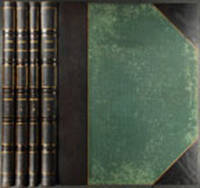
183335614Philadelphia: Samuel Augustus Mitchell vol I; Carey Lea & Carey vols II & III; Carey & Lea vol IV 1833. 4 volumes folio. 15 x 12 inches. 27 hand-colored engraved plates by Alexander Lawson 11 after Titian R. Peale 15 after A. Rider and 1 after J.J. Audubon and A. Rider. Vol. 4 uncut. Some foxing browning and offsetting as ususal. Contemporary half red morocco and marbled paper covered boards rebacked.<br/> <br/>First edition first issue of this important American ornithological work: the first book appearance of any engraving after John James Audubon.<br/> <br/>Bonaparte's important continuation of Wilson's American Ornithology describes 60 birds not in the original work. "A love for the same department of natural science and a desire to complete the vast enterprise so far advanced by Wilson's labors has induced us to undertake the present work" Bonaparte writes in the preface "in order to illustrate what premature death prevented him from accomplishing as well as the discoveries subsequently made in the feathered tribes of these States." "The work which had been performed by Wilson's hands alone now gave employment to several individuals. Titian R. the fourth son of Charles Wilson Peale not only collected many of the birds figured while on the Long expedition which were credited to Thomas Say who originally described them in footnotes scattered through the report; or in a subsequent private trip to Florida during the winter and spring of 1825 under the patronage of Bonaparte; but also drew the figures engraved for the first and two plates for the fourth and last volume. A German emigrant by the name of Alexander Rider of whom little is known beyond that he was a miniature painter in 1813 and a portrait and historical painter in 1818 was responsible for the remainder of the drawings with the exception of the two figures of plate 4 of volume I." Frank L. Burns On Alexander Wilson. That plate the Great Crow Blackbird is notable as being the first book appearance of any engraving after John James Audubon. Perhaps the most influential artist involved with the work however was Bonaparte's master engraver Alexander Lawson arguably the most talented ornithological engraver in America at that time. Multiple issues of the first edition of Wilson's continuation have been identified. This fine set is comprised of the rare first issue of vol. 1 with the Mitchell imprint and containing an early issue of plate 6 in that volume with the Latin name given as Pyrrhula Erythrina; see Ellis/Mengel; and with first issues of volumes two through four published by Carey Lea & Carey or Carey & Lea and printed by William Brown. Carey & Lea would reissue the first volume with their own imprint after purchasing the rights to the publication from Mitchell in 1828 and all the volumes would be reprinted by T.K. and P.G. Collins with their imprint replacing that of William Brown for Carey & Lea with unchanged dates on the titles but actually printed in about 1835.<br/> <br/>Anker 47; Bennett 16; Coues 1:609; Ellis/Mengel 312a-b; Fine Bird Books 1990 p. 78; Nissen IVB 116; Sabin 6264; Wood 247; Zimmer p.64. Samuel Augustus Mitchell [vol I]; Carey, Lea & Carey [vols II & III]; Carey & Lea [vol IV] unknown books
183334816Philadelphia: Samuel Augustus Mitchell vol I; Carey Lea & Carey vols II & III; Carey & Lea vol IV 1833. Four volumes small folio 15 x 12 inches vols. 2 and 4 and 14 1/2 x 11 1/4 inches vols. 1 and 3. 27 hand-colored engraved plates by Alexander Lawson 11 after Titian R. Peale 15 after A. Rider and 1 after J.J. Audubon and A. Rider. Foxing to the text particularly in vols. 3 and 4 though the plates clean throughout. Vols. 2 and 4 uncut. Publisher's half red morocco and marbled paper covered boards<br/> <br/>First edition first issue of this important American ornithological work with the plates beautifully hand colored.<br/> <br/>Bonaparte's important continuation of Wilson's American Ornithology describes 60 birds not in the original work. "A love for the same department of natural science and a desire to complete the vast enterprise so far advanced by Wilson's labors has induced us to undertake the present work" Bonaparte writes in the preface "in order to illustrate what premature death prevented him from accomplishing as well as the discoveries subsequently made in the feathered tribes of these States." "The work which had been performed by Wilson's hands alone now gave employment to several individuals. Titian R. the fourth son of Charles Wilson Peale not only collected many of the birds figured while on the Long expedition which were credited to Thomas Say who originally described them in footnotes scattered through the report; or in a subsequent private trip to Florida during the winter and spring of 1825 under the patronage of Bonaparte; but also drew the figures engraved for the first and two plates for the fourth and last volume. A German emigrant by the name of Alexander Rider of whom little is known beyond that he was a miniature painter in 1813 and a portrait and historical painter in 1818 was responsible for the remainder of the drawings with the exception of the two figures of plate 4 of volume I." Frank L. Burns On Alexander Wilson. That plate the Great Crow Blackbird is notable as being the first book appearance of any engraving after John James Audubon. Perhaps the most influential artist involved with the work however was Bonaparte's master engraver Alexander Lawson arguably the most talented ornithological engraver in America at that time. Three issues of the first edition of Wilson's continuation have been identified. This set is comprised of the rare first issue of vol. 1 with the Mitchell imprint and containing the first issue of plate 6 in that volume see Ellis/Mengel and with first issues of volumes two through four published by Carey & Lea and printed by William Brown. Carey & Lea later reissued the first volume with their own imprint after purchasing the rights to the publication from Mitchell in 1828. The third issue includes volumes reprinted by T.K. and P.G. Collins with their imprint replacing that of William Brown for Carey & Lea with unchanged dates on the titles but actually printed in about 1835 after the completion of the final volume.<br/> <br/>Anker 47; Bennett 16; Coues 1:609; Ellis/Mengel 312a-b; Fine Bird Books 1990 p. 78; Nissen IVB 116; Sabin 6264; Wood 247; Zimmer p.64. Samuel Augustus Mitchell [vol I]; Carey, Lea & Carey [vols II & III]; Carey & Lea [vol IV] unknown books
183322742Philadelphia: Samuel Augustus Mitchell vol I; Carey Lea & Carey vols II & III; Carey & Lea vol IV 1833. 4 volumes folio. 15 x 12 inches. 27 hand-colored engraved plates by Alexander Lawson 11 after Titian R. Peale 15 after A. Rider and 1 after J.J. Audubon and A. Rider. Extra-illustrated with 5 uncoloured engraved plates in vol. IV. Usual paper toning in vol. IV minor offsetting in vols. II-IV short repaired tear to an uncoloured plate in vol. IV. 19th-century black half morocco over green cloth-covered boards the spine in six compartments with raised bands lettered in the second and fourth the compartments bordered in gilt with double fillets marbled endpapers top edge gilt.<br/> <br/>Provenance: Juliette Clary inscribed by Bonaparte on the vol. I title "Offert par l'auteur a sa Cousine Juliette"<br/> <br/>A very fine set of the first edition first issue of this important American ornithological work inscribed by Prince Bonaparte to his cousin and with additional uncoloured states of the plates in volume four.<br/> <br/>Bonaparte's important continuation of Wilson's American Ornithology describes 60 birds not in the original work. "A love for the same department of natural science and a desire to complete the vast enterprise so far advanced by Wilson's labors has induced us to undertake the present work" Bonaparte writes in the preface "in order to illustrate what premature death prevented him from accomplishing as well as the discoveries subsequently made in the feathered tribes of these States." "The work which had been performed by Wilson's hands alone now gave employment to several individuals. Titian R. the fourth son of Charles Wilson Peale not only collected many of the birds figured while on the Long expedition which were credited to Thomas Say who originally described them in footnotes scattered through the report; or in a subsequent private trip to Florida during the winter and spring of 1825 under the patronage of Bonaparte; but also drew the figures engraved for the first and two plates for the fourth and last volume. A German emigrant by the name of Alexander Rider of whom little is known beyond that he was a miniature painter in 1813 and a portrait and historical painter in 1818 was responsible for the remainder of the drawings with the exception of the two figures of plate 4 of volume I." Frank L. Burns On Alexander Wilson. That plate the Great Crow Blackbird is notable as being the first book appearance of any engraving after John James Audubon. Perhaps the most influential artist involved with the work however was Bonaparte's master engraver Alexander Lawson arguably the most talented ornithological engraver in America at that time. Three issues of the first edition of Wilson's continuation have been identified. This fine set is comprised of the rare first issue of vol. 1 with the Mitchell imprint and containing the first issue of plate 6 in that volume see Ellis/Mengel and with first issues of volumes two through four published by Carey & Lea and printed by William Brown. Carey & Lea later reissued the first volume with their own imprint after purchasing the rights to the publication from Mitchell in 1828. The third issue includes volumes reprinted by T.K. and P.G. Collins with their imprint replacing that of William Brown for Carey & Lea with unchanged dates on the titles but actually printed in about 1835 after the completion of the final volume. We are aware of the existence of only one other inscribed set of Bonaparte's Ornithology to have appeared on the market in the last 30 years inscribed to the Count Charles de Chatillon.<br/> <br/>Anker 47; Bennett 16; Coues 1:609; Ellis/Mengel 312a-b; Fine Bird Books 1990 p. 78; Nissen IVB 116; Sabin 6264; Wood 247; Zimmer p.64. Samuel Augustus Mitchell [vol I]; Carey, Lea & Carey [vols II & III]; Carey & Lea [vol IV] unknown books
188065419Philadelphia PA: Porter & Coates 1880. Popular edition" first published Philadelphia 1828. Thick 4to 27 cm. Three volumes bound as one: 2 v-vi ix-cxxxii xvi 1-214; 2 v-viii 9-390; 2 vii-viii 9-426 pp. 27 plates each illustrating multiple species. A good solid copy. Original gilt and black-stamped rust cloth rear board discolored spine ends frayed. 11247. <br/><br/> Porter & Coates hardcover books
1877000182New York: J. W. Bouton 1877. Cloth. Very Good. 8vo. 3 volumes "Bouton Edition" of Wilson/Bonaparte work a combination of the earlier works of each ornithologist. This 1877 edition features chromolithographic versions of Lizars engravings. 103 chromolithographs in all. VG condition. <br /><br /> J. W. Bouton hardcover books
187125433Philadelphia: Porter & Coates 1871. Text only: 3 volumes octavo 10 3/16 x 6 5/8 inches. Small format errata slip at the start of the 'introduction' in vol.I. Occasional illustrations. Lacks the section title to Bonaparte. Contemporary brown half morocco over dark maroon morocco-grained cloth-covered boards spines in six compartments with raised bands lettered in gilt in the second and fourth compartments the others with simple repeat decoration in blind gilt edges.<br/> <br/>The revised text to this late edition of Wilson and Bonaparte's important work without the two folio volumes of plates.<br/> <br/>Alexander Wilson was the first ornithologist to undertake a systematic study of the birds of America. Wilson who was born in Scotland turned to the study of American ornithology full time in 1802 under the tutelage of William Bartram. At the time of the appearance of the first part of his grand work in 1807 no similar study in any branch of natural science had yet been undertaken in America and only one colour-plate book of any scope had been published in the infant nation Birch's Views of Philadelphia. Between 1808 and 1813 Wilson managed after overcoming innumerable difficulties to travel over much of the United States collecting material whilst also managing his ambitious publication. He died in 1813 exhausted by his task and the final parts of the first edition of his work were eventually seen through the press by his friend George Ord. Ord went on to issue a well-regarded reprint published in 1828-1829. After the defeat of Napoleon various members of the Bonaparte family took refuge in America including his nephew Prince Charles Lucien Bonaparte. The young Bonaparte proved to be an ornithological prodigy and undertook the writing of a supplement to Wilson which was completed in 1833. Frank L. Burns in his bibliography of Wilson writing of the present edition notes that it is "a reprint of Ord's fine 1828-29 edition with the interpolation of Baird's Catalogue of North American Birds reprinted from the 8vo edition of 1858 and the addition of Bonaparte's work."<br/> <br/>Cf. Anker 533; Frank L. Burns "Alexander Wilson. Part VII: Biographies Portraits and a Bibliography of the Various Editions of his Works" copy 'q' in The Wilson Bulletin Vol. XXI No. 4 December 1909 pp.184-5; Nissen IVB 997; cf. Wood p.631. Porter & Coates unknown books
73540Torino Reale Accademia delle Scienza di Torino 1840. Large 4to 28.8 x 22.0 cm. 72 pp. Marbled wrappers. = An important contribution to the systematics of reptiles and amphibians by the vertebrate zoologist Charles Lucien Jules Laurent Bonaparte 1804-1857 or Carolo Luciano Bonaparte a nephew of Emperor Napoleon. Bonaparte describes 94 species in 63 genera 61 subfamilies 32 families and ten orders including synonyms named varieties localities and distribution etc. Many new names are included. Published in the academy's Memorie. A very good clean copy. Rare. Adler I pp. 29-30. unknown
1360253386.Ghardcover. Good. Access codes and supplements are not guaranteed with used items. May be an ex-library book. hardcover
0282322922.Gpaperback. Good. Access codes and supplements are not guaranteed with used items. May be an ex-library book. paperback
0666242771.Ghardcover. Good. Access codes and supplements are not guaranteed with used items. May be an ex-library book. hardcover
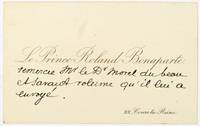
53808Paris ohne Datum. 1 Seite quer-16°. Roland-Napoléon Bonaparte Principe de Canino e Musignano 1858-1924 französischer Anthropologe und Naturforscher; schuf das größte Herbarium der Welt das er der Société de Géographie stiftete. - Dank für ein Buchgeschenk. "Le Prince Roland Bonaparte / remercie Mr le Dr Morel du beau et savant volume qu'il lui a envoyé." Roland Bonaparte war der Vater der Psychoanalytikerin Marie Bonaparte. unknown
41567739like new. unknown