708 résultats
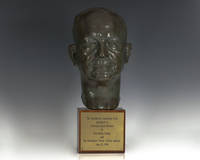
122916The Eisenhower Leadership Prize presented to the 69th United States Secretary of the Treasury Lloyd Millard Bentsen on June 15 1994 with an archive of speeches and dinner programs from the Eisenhower Leadership Prize Presentation Ceremony and the Fall 1994 issue of Dateline produced by The Eisenhower World Affairs Institute featuring a photograph of Bentsen receiving the award on the front page. Presented by Gettysburg College and The Eisenhower World Affairs Institute the prize features a bronze bust of Eisenhower by renowned sculptor Nison A. Tregor with a bronze presentation plaque. From the collection of Lloyd Millard Bentsen. In fine condition. A unique piece of Americana with noted provenance. Lloyd Millard Bentsen who ran as the Democratic Party nominee for vice president in 1988 on the Michael Dukakis ticket and served as the the 69th United States Secretary of the Treasury under President Bill Clinton. As a primary architect of the Clinton economic plan Bentsen contributed to a $500 billion reduction in the deficit launching the longest period of economic growth since World War II. More than 5 million new jobs were created during his tenure as Secretary. Bentsen was awarded the Presidential Medal of Freedom in 1999. unknown books
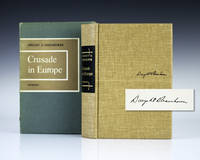
1948140940010New York: Doubleday & Company Inc 1948. First Edition. Near Fine. First edition limited issue. One of 1426 numbered copies signed by Dwight D. Eisenhower in bottom margin of page facing copyright page his famous D-Day "Order of the Day." xiv 2 559 pp. with plates and maps. Original tan buckram spine blocked in black and lettered in gilt top edge gilt cartographic endpapers. A Near Fine copy with front hinge paste down paper starting but hinge itself holding well in mylar housed in Very Good slipcase with some wear and evidence of tape repair. A signed copy of the WWII memoirs of General and eventual President Dwight D. Eisenhower. Doubleday & Company, Inc unknown books
19681093551968. Black and white photograph of Presidents Dwight D. Eisenhower Herbert Hoover and Harry S. Truman signed by each below the photograph. In fine condition. The entire piece measures 12 inches by 12 inches. Rare and desirable. unknown books
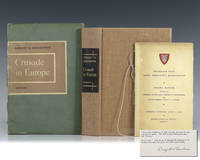
1948123942Garden City NY: Doubleday & Company 1948. Signed limited first edition of General Eisenhower's wartime memoirs. Thick octavo original cloth cartographic <span class="glossaryQtip qTip">endpapers</span> top edge gilt original acetate. One of 1426 numbered copies signed by Dwight D. Eisenhower this is number 836. With a rare original dinner program from the Michigan Post Army Ordinance Association Spring Dinner held in honor of Eisenhower and Major General Everett S. Hughes held on June 3 1946 at the Book-Cadillac Hotel in Detroit laid in. Both Eisenhower and Hughes spoke at the dinner and the program includes brief biographies of both Army Generals. Fine in the original acetate jacket and in the original slipcase which is in very good condition. A nice example with noted provenance. Five-star General Dwight D. Eisenhower was arguably the single most important military figure of World War II. For many historians his memoirs of this eventful period of U.S. history have become the single most important record of the war. Crusade in Europe tells the complete story of the war as Eisenhower planned and lived it. Through his eyes the enormous scope and drama of the war-strategy battles moments of fateful decision-become fully illuminated in all their fateful glory. "Eisenhower gives the reader true insight into the most difficult part of a commander's life" New York Times. Doubleday & Company hardcover books
1948LLV2319Garden City NY:: Doubleday 1948. 1948. Thick 8vo. 4 xiv 2 559 1 pp. 16 photographic plates selected by Edward Steichen 38 maps 6 in color. Tannish-beige black- and gilt-stamped linen cloth with "Dwight D. Eisenhower" stamped on the upper cover top-edge gilt original acetate jacket. Slip-case not included. SIGNED by DWIGHT D. EISENHOWER WITH AN ADDITIONAL PERSONAL TYPED LETTER SIGNED by EISENHOWER. Fine. Limited edition of 1426 numbered copies of which this is # 737. Signed on the facsimile of the D-Day orders letter addressed to the "Soldiers Sailors and Airmen of the Allied Expeditionary Force!" / Includes a typewritten letter signed by Eisenhower on his personal letterhead: "Dear Mr. Bond: To the thanks you have undoubtedly already received for your generous contribution during the recent campaign I wish to add my own. "Since November 4th my thoughts have turned often to those whose faith and support - and financial contributions - helped to make victory possible. In the task of bringing the message of our Crusade to all of our fellow Americans we would have failed without their much-needed help. "That is why I am particularly glad of this opportunity to express my gratitude to you and to ask for your continued support. "Sincerely Dwight D Eisenhower" / This edition includes the powerful letter Eisenhower drafted for D-Day and representing thus a key turning point in World War II. The letter opens with these lines: "You are about to embark upon the Great Crusade toward which we have striven these many months. The eyes of the world are upon you. The hopes and prayers of liberty-loving people everywhere march with you. . ." He ends elegantly "Good Luck! And let us all beseech the blessing of Al-mighty God upon this great and noble undertaking." / "This stands head and shoulders above the other records of fighting men in its simplicity clarity and the illumination it throws on the basic human relations of the men at top. In his Normandy to the Baltic Montgomery wrote: - ‘We are still too close to attempt a critical analysis of the campaign.’ The same could be said of this book but in spite of that General Eisenhower manages to convey a sense of objective surveying of the forging of victory over the Germans. This is the real inside story of the war in Europe not in terms of jealousy and backbiting and gossip mongering but in terms of its planning its diplomacy its action and its victorious ending. More than that it is revealing of the greatness the modesty the statesmanship of one of America’s truly great men. This is more than a soldier’s story. It is the story of America’s contribution to victory of the splendid cooperation of the allies of campaigns in Africa Sicily Italy France and Germany." - Kirkus Reviews. Doubleday, 1948. hardcover books
19511604641951. Commemorating the American fallen A compelling album apparently made by the family of a fallen serviceman and therefore unique commemorating Eisenhower's presentation of the Roll of Honor to St Paul's Cathedral. The roll lists the 28000 American soldiers stationed in Britain who gave their lives in the Second World War. The album includes large-format photographs of the military procession to the ceremony; attendees entering the cathedral including Churchill Mountbatten Attlee the Queen Mother and Princess Elizabeth Eisenhower and Curtis LeMay; photographs of the service including the congregation singing hymns and the sermon by the Archbishop of Canterbury; and Eisenhower leaving the Cathedral. The ceremony was held on Independence Day. Eisenhower delivered a message: "Each name inscribed in this book is a story of personal tragedy and a grieving family; a story repeated endlessly in white crosses girdling the globe. The Americans whose names here appear were part of the price that free men have been forced a second time to pay in this century to defend human liberty and rights". The album includes a copy of a page from the roll listing names from Hiltabidle to Hitchings - presumably the album was made by the family of someone listed there. We could trace no other similar album. In 1958 the American Memorial Chapel was completed in a part of the cathedral that a bomb had hit in 1940. The roll now resides there and a page is turned each day to show different names. Landscape quarto album 318 x 419 mm. Four letterpress leaves partly printed in gilt comprising title excerpt from the Archbishop of Canterbury's address Eisenhower's introduction to the Roll of Honour and copy of page from roll all with acetate covers. Tan leatherette front cover lettered in blind "Commemoration Service - St. Paul's Cathedral - July 4. 1951." cord-bound cord recently renewed 33 heavy card leaves with 28 mounted black and white silver gelatin press photographs 203 x 254 cm most captioned by hand. Binding neatly restored and consolidated the photographs in sharp unblemished condition slight discolouration around letterpress leaves. In very good condition. hardcover
194820089Garden City NY: Doubleday & Company 1948. Signed limited first edition of General Eisenhower's wartime memoirs. Thick octavo original cloth cartographic <span class="glossaryQtip qTip">endpapers</span> top edge gilt original acetate. Signed by Dwight D. Eisenhower number 299 of 1426 copies. Fine in the original acetate which is in fine condition. Original slipcase in near fine condition with light rubbing. A very sharp example. Five-star General Dwight D. Eisenhower was arguably the single most important military figure of World War II. For many historians his memoirs of this eventful period of U.S. history have become the single most important record of the war. Crusade in Europe tells the complete story of the war as Eisenhower planned and lived it. Through his eyes the enormous scope and drama of the war-strategy battles moments of fateful decision-become fully illuminated in all their fateful glory. "Eisenhower gives the reader true insight into the most difficult part of a commander's life" New York Times. Doubleday & Company hardcover books
194813691CRUSADE IN EUROPE Doubleday 1948 first edition t.p.e.'s in gold-gilt fore edge and bottom edge uncut fine in original acetate dust-wrapper in vg slip-case. One of 1426 copies specially bound and SIGNED by the author. Illustrated. Doubleday unknown
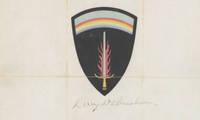
19452570830/10/1945. <p>During World War II Ike received requests for him to send one of his sleeve patches as a souvenir. He never seems to have had one on hand but instead sent a printed color facsimile patch with a description of its meaning below the image and which he signed above the description. The description makes clear that the sword on the insignia “represents avenging justice by which the enemy power will be broken in Nazi-dominated Europeâ€. The black background represents Nazi oppression and the rainbow above is emblematic of hope.</p><p>Miss Martha Wiedermann was one of those who wrote asking for a patch. Eisenhower responded by sending her this <strong>printed color facsimile patch</strong> <strong>signed</strong> above the description. The envelope is still present postmarked October 30 1945 just after hostilities ceased. Affixed to a light board.</p><p>This is just the second Eisenhower sleeve patch we have carried in all these years. The other Ike had sent to his brother.</p><p><img class=""alignnone wp-image-24670 size-post-window"" src=""https://cdn.raabcollection.com/wp-content/uploads/20231204145810/Folder-site-9-1600x1327.jpg"" alt="""" width=""1600"" height=""1327"" /></p> unknown
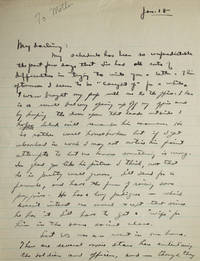
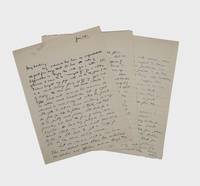
19421013441942. ALL WOMEN . . . IN THIS REGION . . . WANT . . . TO GET CLOSE TO THE FRONT" A charming letter at a vital time in Eisenhower's career: in the midst of planning the attack that would lead to the defeat of Germany here refered to casually as getting "absorbed in work." We're also let in on another side of Eisenhower's responsibilities: entertaining the entertainers. He bears this somewhat wearily but nonetheless we're left with a valuable record of the spirit and dedication of not just the entertainers but all women working on or near the front line. "Last eve was an event in our house. There are several movie stars here entertaining the soldiers and officers . . . . Last eve the troupe gave a performance for the officers of AFHQ but I would not go. Afterwards I sent them an invitation . . . to come up for an after performance supper. They did. There were: Kay Francis Martha Ray Carole Landis and Mitzi Mayfair. I was a bit fearful of how movie people would act & what they'd expect--but it all went off perfectly naturally & no embarrassment. . . . They work hard giving from 2 to 3 shows per day 6 days per week. Moreover they reflect an attitude that seems to be characteristic of all women British & American in this region. They want to get close to the front. The women seem to be more casual with respect to danger than do sic the men. These particular ones want to get up as close as possible to do their stuff--as do the Red Cross the WAACs the ATS etc etc. I suppose there are 50-75 American women in this city & every one tells me that their constant cry is 'Let me get up where there is action.' Many of my officers are quite willing to take cushy jobs far from the sound of bombs & bullets. . . . "No woman can . . . take your place. Don't worry about me . . . . I'm in love with you & with no one else." This last tempted fate written just months before Eisenhower met his long-term mistress Kay Summersby. "Last eve was an event in our house. There are several movie stars here entertaining the soldiers and officers . . . . Last eve the troupe gave a performance for the officers of AFHQ but I would not go. Afterwards I sent them an invitation . . . to come up for an after performance supper. They did. There were: Kay Francis Martha Ray Carole Landis and Mitzi Mayfair. I was a bit fearful of how movie people would act & what they'd expect--but it all went off perfectly naturally & no embarrassment. . . . They work hard giving from 2 to 3 shows per day 6 days per week. Moreover they reflect an attitude that seems to be characteristic of all women British & American in this region. They want to get close to the front. The women seem to be more casual with respect to danger than do sic the men. These particular ones want to get up as close as possible to do their stuff--as do the Red Cross the WAACs the ATS etc etc. I suppose there are 50-75 American women in this city & every one tells me that their constant cry is 'Let me get up where there is action.' Many of my officers are quite willing to take cushy jobs far from the sound of bombs & bullets. . . . "No woman can . . . take your place. Don't worry about me . . . . I'm in love with you & with no one else." This last tempted fate written just months before Eisenhower met his long-term mistress Kay Summersby. unknown books
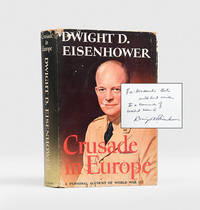
1952184948Garden City NY: Doubleday & Company Inc. 1952. A credit to the Armed Forces of the United States Inscribed by Eisenhower on the half-title to a decorated Japanese-American serviceman "For: Masaichi Goto with best wishes to a comrade of World War II. Dwight D. Eisenhower". The mass internment by the United States of 120000 Japanese-Americans in camps during the Second World War is recognized as a blight on the nation's history. Nonetheless an estimated 33000 Japanese-Americans served in the US military in the conflict. Goto 1911-1988 was born in Hawaii and served in the 100th Infantry Battalion a Japanese-American unit formed by Franklin D. Roosevelt. Goto served as staff sergeant in the battalion's medical department and fought in Italy and France. In April 1944 he was awarded the Silver Star. His citation declared how he "with utter disregard for his own personal safety left the comparative security of his shelter to go to the aid of a wounded comrade. Though the enemy shells were falling dangerously close to him Staff Sergeant Goto stayed in the exposed area and gave first-aid to three more severely wounded soldiers. Staff Sergeant Goto's courage coolness and bravery under fire was exemplary and a credit to the Armed Forces of the United States". Eisenhower's memoirs "a classic of military writing" ANB were first published in 1948. Eisenhower's diaries show he inscribed this book as President on 14 March 1958 at the request of John Anthony Burns Hawaii's Territorial delegate in Congress. Octavo. With 16 plates 4 double-page maps 38 full-page maps in text. Original brown cloth spine lettered in gilt on black ground facsimile signature in black to front cover map endpapers fore edge untrimmed. With dust jacket. Extremities a little rubbed; price-clipped jacket worn with neat repair on verso: a very good copy in good jacket. hardcover
141596/1/46. <p>Dwight D. Eisenhower became a member of the National Executive Board of the Boy Scouts of America in 1948 but had been a staunch supporter of Scouting ever since his son was a Scout in the 1930s. He would say that “The Boy Scout movement merits the unstinted support of every American who wants to make his country and his world a better place in which to live. Its emphasis on community service and tolerance and world friendship promotes a speedier attainment of the enduring peace among men for which we all strive. By developing among its members both a spirit of sturdiness self-reliance and a realization of the need for cooperative effort in every major enterprise the movement is a prime force in preparing tomorrow’s men for their duty to themselves their country and their world.â€</p><p>Charles D. Hart was a Philadelphia physician best known for the important contributions he made to the Boy Scouts over the course of four decades. In 1946 Hart was Honorary President of the Philadelphia Council of the Boy Scouts of America.</p><p><strong>Typed letter signed</strong> on his War Department Chief of Staff letterhead January 6 1946 to Dr. Hart responding to Hart’s request for a comment about the Boy Scouts. <em>“Thank you for your letter my photograph and a letter for the Boy Scouts of the Philadelphia Council. I am always glad to endorse the Boy Scouts who have done so much for American youth and for the entire nation. I have just sent a statement expressing my high opinion of the Scouts to the national headquarters. A copy of the statement is attached. Please assure the officials and boys of the Philadelphia Council of my continued interest in their success…â€</em></p><p>This is a wonderful sentiment evocative of the many contributions the Boy Scouts have made and Ike’s belief in them.</p> unknown
19481309030Doubleday 1948. Limited Edition. Hardcover. Very Good/No Jacket. Doubleday & Company Inc. Garden City 1948. Hardcover. First Edition. First Edition preceding the trade edition. Illustrated with drawings and photographs. One of 1426 deluxe numbered copies SIGNED by the author on the facsimile page of the D-Day Order to send the troops to storm the beaches of Normandy which begins: "You are about to embark upon the Great Crusade toward which we have striven these many months. The eyes of the world are upon you." Fine in original acetate and a Near Fine slipcase. Housed in an additional custom-made slipcase. Doubleday hardcover
JD30941first edition. Garden City Doubleday 1948 first edition dust jacket. Hardcover. <br/><br/> With publisher's slipcase TEG it precedes the trade edition this is No. 322 of 1426 copies Signed by Eisenhower map endpapers includes six color maps and 38 b&w maps also includes six photographic illustrations selected by Edward Steichen as well as Eisenhower's famous D-Day order to his troops about to storm the beaches at Normandy. Fine beautiful copy in like jacket in a very good slipcase. hardcover books
19481309030Doubleday 1948. Limited Edition. Hardcover. Very Good/No Jacket. Doubleday & Company Inc. Garden City 1948. Hardcover. First Edition. First Edition preceding the trade edition. Illustrated with drawings and photographs. One of 1426 deluxe numbered copies SIGNED by the author on the facsimile page of the D-Day Order to send the troops to storm the beaches of Normandy which begins: "You are about to embark upon the Great Crusade toward which we have striven these many months. The eyes of the world are upon you." Fine in original acetate and a Near Fine slipcase. Housed in an additional custom-made slipcase. Doubleday hardcover books
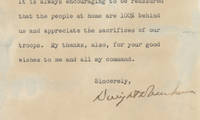
344736/4/45. <blockquote><p>“It is always encouraging to be reassured that the people at home are 100% behind us and appreciate the sacrifices of our troops.â€</p></blockquote><p>General Dwight D. Eisenhower the Supreme Commander of the Allied Expeditionary Force in Europe orchestrated the defeat of Germany’s Third Reich during World War II. He could only have done so with the support of the American people for which he was eternally grateful and of his courageous soldiers many of whom were killed in action.</p><p>April 1945 saw the war in Europe in its final weeks with intense fighting and many significant events. These included the continuing bloody Allied invasion of Germany and the Battle of Berlin and Soviet advance into that city. As Allied forces in the West closed in they liberated concentration camps like Bergen-Belsen. April was also marked by the execution of Benito Mussolini suicide of Adolf Hitler and on April 12 the death of President Franklin D. Roosevelt. On May 8 V-E Day the war in Europe would come to an end.</p><p>While his role as a military leader was crucial to the war’s outcome Eisenhower was equally important in the documentation of Nazi brutality and the truth of the Holocaust. This was an important aspect of April 1945 for him. On April 4 the Third United States Army liberated the Ohrdruf camp. That camp was an extension of the Buchenwald Concentration Camp. On the day of liberation the SS members of Ohrdruf evacuated many of the prisoners on death marches. As U.S. troops arrived they found scenes of mass murder while also coming into contact with the camp’s surviving prisoners. The living prisoners were starving emaciated and desperately needed medical attention. Eisenhower along with Generals George Patton and Omar Bradley visited the Ohrdruf concentration camp personally on April 12 1945. While driving towards the camp the smell of decaying flesh was present and dead bodies littered the streets. Eisenhower was “never so angry in my life†stating that the “English language didn’t even have words that could describe†what he saw. Eisenhower wrote to Winston Churchill following his time at Ohrdruf stating that “everything you read in the paper does not adequately describe what has really happened here.†Thus in April 1945 Eisenhower was profoundly impacted by the horrors that he witnessed and demanded that newspaper editors representative groups German civilians and Allied soldiers bear witness.</p><p><strong>Typed letter signed</strong> on his Supreme Headquarters Allied Expeditionary Force letterhead Germany April 6 1945 just two days after the taking of Ohrdruf and six days before his famous visit there to Mrs. Mamie Metz thanking her and the American people for their support of the army in the field and appreciation of its sacrifices. <em>“Many thanks for your interesting letter. It is always encouraging to be reassured that the people at home are 100% behind us and appreciate the sacrifices of our troops. My thanks also for your good wishes to me and all my command.â€</em></p><p>An important statement showing Eisenhower’s feelings about the American people’s sustaining and backing the army and gratitude for the sacrifices of the soldiers issued right near the end of World War II in Europe.</p><p>Some trimming and evidence of past mounting on verso.</p><p><img class=""alignnone wp-image-25018 size-post-window"" src=""https://cdn.raabcollection.com/wp-content/uploads/20231204144051/Folder-site-11-1600x1327.jpg"" alt="""" width=""1600"" height=""1327"" /></p> unknown
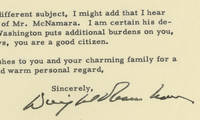
19602101927/12/1960. <p>“I doubt if you realize just how much you have helped me carry on the official work of government…â€</p><p>In the waning days of 1960 Eisenhower prepared to leave office and hand the presidency to John F. Kennedy. Henry Ford II was a close confidant of Eisenhower’s and during his presidency provided Ike with important assistance. So as he said farewell to the presidency Ike wanted to tender to Ford his heart-felt thank you.</p><p>On three occasions Ford lent one of his senior executives Leo Beebe to the U.S. government to supervise the resettlement of refugees and manage similar projects. Beebe became executive vice chairman of Eisenhower’s Committee for Hungarian Refugees in 1956 a need that resulted from the Hungarian Revolution and subsequent flight from the country of many refugees. In addition to his committee work during 1956-1957 while working out of Camp Kilmer in northern New Jersey Beebe oversaw the relocation and resettlement of 35000 Hungarian refugees in the United States eventually finding them permanent residences in this country. In 1959-1960 Beebe organized the U.S. Center for Cuban Refugees in Miami Florida to help with the mass influx of Cuban refugees that fled Castro’s Cuba in 1960 and beyond. Ford backed the refugee aid effort all the way and it was of incalculable importance.</p><p>In 1960 Robert McNamara was President of the Ford Motor Company. Kennedy the President-elect sought to name McNamara Secretary of Defense. Ford agreed to spare McNamara yet another example of his largess.</p><p>Ford Motor Co. required its top executives to use private aircraft for business and personal travel. We see in this letter that he also served Eisenhower by providing private jet transportation to and from meetings.</p><p><strong>Typed letter signed</strong> on White House letterhead Washington December 27 1960 to Henry Ford II. <em>“As the end of my Administration approaches I want once again to express to you and through you to your associates the appreciation I personally feel and which is shared by the members of the White House staff who normally travel with me of the many courtesies that have been extended to us not only during 1960 but through all the years here. I doubt if you realize just how much you have helped me carry on the official work of government by making transportation available to the key personnel who must be with me but are necessarily scattered during any one of the so-called ‘work-vacation’ trips I have taken. I assure you however that without your cooperation it would have been exceedingly difficult for me to carry out my responsibilities and still get some periods of relaxation. I shall be lastingly grateful to you and your officials in the various places we have visited with some regularity and at some length.</em></p><p><em>“On a totally different subject I might add that I hear good reports of Mr. McNamara. I am certain his departure for Washington puts additional burdens on you but as always you are a good citizen.</em></p><p><em>“With best wishes to you and your charming family for a fine 1961 and warm personal regard Sincerely Dwight D. Eisenhower.â€</em></p><p>This letter is the first valedictory of Eisenhower’s we can recall seeing and it remained in the Ford family until 2020. It has never before been offered for sale.</p><p><img class=""alignnone wp-image-25018 size-post-window"" src=""https://cdn.raabcollection.com/wp-content/uploads/20231204144051/Folder-site-11-1600x1327.jpg"" alt="""" width=""1600"" height=""1327"" /></p> unknown
2221848<p>"Ike" 3 pages to wife Mamie no date but ca. 1944. 9" x 6". Fine.</p><p>Eisenhower pens a heartfelt letter to Mamie while in the depths of war: "The Russian fight continues to stir me to the depths of my soul. They're hitting so hard that no one can fail to admire them. I hope they kill a million Huns -- even more! And I wish we could be hammering at the d--- Germans this instant just as hard and on as big a scale as the Russians."</p><p>Dwight D. Eisenhower 1890-1969 was the 34th President of the United States from 1953 until 1961. He was a five-star general in the United State Army during World War II and served as Supreme Commander of the Allied Forces in Europe.</p> unknown books
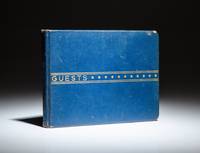
195110813Boston: Samuel Ward Stationery 1951. Guest Book. Full leather. Very good. The Guest Book from President Harry Truman's "Air Force One" featuring signatures from President Harry S. Truman General Dwight D. Eisenhower Representative John F. Kennedy Indian Prime Minister Jawaharlal Nehru and his assistant Indira Nehru Ga. Octavo 125pp. Full blue leather title stamped in gilt on cover. Housed in custom blue leather clamshell title on cover over red morocco label. This book is from the private collection of the pilot Colonel Chester C. Moomaw. Includes ephemera from Colonel Moomaw. The plane used for these trips was a Lockheed Constellation under the designation of SAM 8608. Notable flights include: Wake Island 1950 Independence MO 1949 New Delhi 1949 Berlin 1949 Little White House in Key West 1950 and Santiago 1950. An exceptional piece includes the signatures of three US Presidents as well as various US Cabinet secretaries chairmen of the Joint Chiefs of Staff Prime Ministers of India and numerous other dignitaries. Signed by the following dignitaries with their contemporary title:<br/> <br/>Harry Truman President of the United States<br/>Dwight D. Eisenhower President of Columbia University<br/>John F. Kennedy House Representative<br/> <br/>Jawaharlal Nehru Prime Minister of India<br/>Indira Nehru Gandhi Assistant to Prime Minister of India<br/> <br/>George C. Marshall Secretary of Defense<br/>Dean Acheson Secretary of State<br/>Dean Rusk Assistant Secretary of State<br/> <br/>Omar Bradley Chairman of the Joint Chiefs of Staff<br/>Hap Arnold General of the Air Force<br/>Andrew Goodpaster General of the Army<br/>Matthew Ridgway General of the Army<br/>Forrest Sherman Chief of Naval Operations<br/>Frank Pace Secretary of the Army<br/>Stuart Symington Secretary of the Air Force<br/>Louis A. Johnson Secretary of Defense<br/>J. Lawton Collins Chief of Staff Army<br/> <br/>James Fulbright Senator<br/>Warren Magnuson Senator<br/>Stephen T. Early White House Press Secretary<br/>Averell Harriman Special Assistant to the President<br/>Hoyt Vandenberg Chief of Staff Air Force<br/>Margaret Truman Daughter of President Truman<br/>Stephen J. Springarn Administrative Assistant to the President<br/>Clark M. Clifford White House Counsel<br/>Vannevar Bush Engineer<br/>Arthur Vandenberg Senator-President Pro Tempore<br/>Charles W. Sawyer Secretary of Commerce<br/>Gabriel Gonzalez Videla President of Chile<br/>Bernard Baruch Presidential Adviser. Samuel Ward Stationery unknown books
1948190523Garden City NY: Doubleday & Company Inc. 1948. His signed wartime memoir First edition signed limited issue number 1198 of 1426 copies signed by Eisenhower under his D-Day message to the troops here preserving both the slipcase and original acetate both often missing. Crusade in Europe made Eisenhower a rich man "becoming one of the most widely translated and sold books of all time. It is often compared to Grant's memoirs as a classic of military writing" ANB. Octavo. Original light brown buckram over bevelled boards spine lettered in gilt on black ground facsimile signature to front cover in black top edge gilt others untrimmed. With acetate jacket and original printed card slipcase. With 16 black and white plates from photographs selected by Edward Steichen 4 double-page maps and 38 full-page maps to the text map endpapers. A fine copy slipcase worn but holding. hardcover
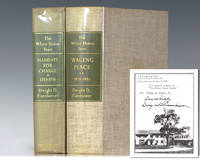
1963133263Garden City NY: Doubleday and Company 1963-65. Signed limited first editions of Eisenhower's memoirs each one of 1500 copies. Thick Octavo two volumes original tan cloth with green morocco spine labels lettered in gilt cartographic endpapers. One of 1500 numbered copies signed by the author. Association copy Waging Peace is an Advance presentation copy inscribed by Eisenhower to Secretary of Defense Thomas S. Gates Jr. "Devotedly Dwight D. Eisenhower" on an Eisenhower Farm Gettysburg Pennsylvania bookplate. The recipient Thomas S. Gates is mentioned numerous times in both of these volumes. "To replace Neil McElroy as Secretary of Defense I prevailed on Secretary of the Navy Tom Gates to delay his return to private life. He first took the post of Deputy Secretary for the duration of Mr. McElroy's term and then in December assumed the post of Secretary of Defense. During his term as Secretary he had the satisfaction of seeing the Polaris developed by the Navy under his leadership make its first successful firings and join America's growing arsenal." p. 254 The White House Years: Waging Peace 1956-1961. Fine in the original acetate dust jackets. An exceptional association. This is the story of President Eisenhowers first administration. Dwight D. Eisenhower one of the major figures of the twentieth century writes an account of the events as he saw them leading up to a sweeping mandate and then pursues the theme of change in the years 1953-1956 Doubleday and Company hardcover
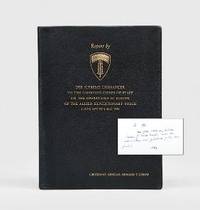
1946190508Washington DC: US Government Printing Office 1946. Presented to his "oldest and best friend" a key commander at D-Day First edition presentation copy specially bound for Leonard T. Gerow and inscribed by Eisenhower on the initial blank "To 'Gee' one of the outstanding battle leaders of World War II with the admiration and gratitude of his old friend Ike". Gerow 1888-1972 was in command of the V Corps at Omaha Beach on D-Day and became the first American general to enter Paris after its liberation in 1944. "Gerow was his oldest and best friend in the theater and V Corps headquarters would provide a haven in moments of anxiety more than once" Eisenhower p. 176. The careers of the two men were closely intertwined. "Eisenhower and Gerow were opposites. Gerow trim and meticulous was a chronic worrier. Eisenhower hale and robust had a gregarious and confident manner. But the two men shared similar thinking and tastes and had similar prewar professional reputations as staff officers. In the summer of 1916 Eisenhower and Gerow had first served together in the 19th Regiment based at San Antonio. In 1926 they had been classmates at the Leavenworth Command and General Staff School. They had formed a two-man study group in Eisenhower's tiny attic" Eisenhower pp. 176-7. It was Gerow that introduced Eisenhower to his future wife Mamie. Gerow originally headed the War Plans Division until the role was reassigned to Eisenhower due to Gerow's failure to foresee Pearl Harbour. Eisenhower was gracious to Gerow acknowledging it was only fortune that led to his taking the position; afterwards Eisenhower's career was to inevitably eclipse that of his old friend but Gerow still rose to a highly respected position eventually leading the Fifteenth and Second Armies. The book prints Eisenhower's official report of his role leading the Allied liberation of western Europe and the defeat of Nazi Germany. Eisenhower had copies bound for presentation to close family and military leaders the Eisenhower library have his brother's copy in the same binding; we could trace no other example on the market. Folio. Original black morocco front cover lettered in gilt silk endpapers. Housed in a custom black cloth solander box. With 11 colour maps of European battle theatres. Spine and front inner hinge neatly repaired light rubbing and wear at extremities. A very good copy. David Eisenhower Eisenhower at War 1986. hardcover
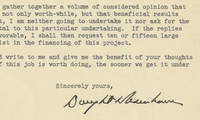
18122102918/12/1948. <blockquote><p>The Founding Letter of the Renowned Eisenhower Center for the Conservation of Human Resources</p></blockquote><p><strong>Yet during the war rejections and discharges of men for mental defects reached a total of more than two million.</strong></p><p><strong>This type of problem would affect industry as well and Ike sought to establish an entity to research causes and solutions</strong></p><p>In December 1948 Eisenhower was called to Washington where he met with Averill Harriman Omar Bradley and Harry Truman. The leadership of the military had not settled on a plan to counter the rising Soviet threat and wanted Ike's opinion on fighting force preparedness. He remained in Washington for these meetings in the first two weeks of December. The immediate threat was Russia and a possible attack. The long term threat was to create a more efficient military. He had been assured that such a job should it require long hours would be compatible with his new job at Columbia University and so he made that real.</p><p>Eisenhower gave thought and consideration on how to present the needs and issues and introduce the concept and program director. This letter/presentation is a product of that and in it Eisenhower also speculates on the role played by education and poverty and ponders whether “industry trade unions the school the church do to help reduce the volume of lossâ€. The recipient was Henry Ford II president of the Ford Motor Company who was one of America’s top industry leaders and well as a personal acquaintance who would become a friend.</p><p>The letter is at its essence how to learn from the failures of fighting force recruitment and support during World War II apply it to the next combat and see how far that lesson could be taken to workplace life and the reintegration.</p><p><strong>Typed letter signed</strong> on his Columbia University letterhead New York December 18 1948 to Ford. <em>“It seems to me that the time has come when the wastage of American resources must be combated along all fronts. There are numbers of organizations directing their efforts toward conservation of natural resources including the soil. Our future prosperity is going to depend directly upon the success of their achievements. There is another sector of the conservation problem however that deserves immediate attention and that so far has not been made the subject of widespread intelligent attack. It is the wastage of manpower through mental and emotional failures.</em></p><p><em>“My own attention was drawn forcibly to the matter during the war particularly in the late months of 1944 when the country found that its ability to supply replacements for the battleline was badly strained. Units had to fight under truly desperate handicaps by reason of lack of manpower. Yet during the war rejections and discharges of men for mental defects reached a total of more than two million. One of the numerous reasons that finally decided me to come to Columbia was the hope of assisting in finding some kind of an answer to this national problem. Obviously in the event of great emergency our manpower will be in limited supply but the basic problem is far broader in scope. Manpower losses of this kind imply tremendous costs and inefficiencies for our economy.</em></p><p><em>“This I believe is a particularly propitious time to begin a down-to-earth study of the matter. There exist today the rejection records of the two million men lost in World War II. Most of them are still alive and they provide therefore a great body of factual information for any group that can organize itself sufficiently well to dig out and correlate the facts. In addition there is available in business corporations an important body of personnel information bearing on civilian maladjustments which invites exploration and evaluation.</em></p><p><em>“It would seem particularly important to find out whether there are common causative factors responsible for these human failures. Numerous questions immediately suggest themselves. Among these are: 1. Are these men generally from the undereducated groups 2. Are they generally urban or rural in origin 3. How do these men spend their leisure time 4 Are they underfed or otherwise definitely underprivileged 5. Do they show a long history of emotional instability or do these defects come out only under fear or other stress 6. What has happened to them Are they now a charge upon society or are they leading useful lives </em><em>7. How accurate were our war-time yardsticks for measuring ""mental deficiency"" 8 What can industry trade unions the school the church do to help reduce the volume of loss Dozens of other questions suggest themselves but the foregoing will indicate some of the specific points I have in mind.</em></p><p><em>“Shortly after coming to Columbia University I detailed a very able young professor Eli Ginzberg to prepare a memorandum which would show the capacity and qualifications of this institution for undertaking a significant study in this area. His report is attached. Although the study of human resources is so important that it would warrant continuing support I have thought it best to propose a limit of five years on this investigation. My thought is that regardless of continuing scientific research into the various aspects of the question we need to develop at an early date helpful practical methods that will contribute much more than past procedures to the efficient utilization of human resources.</em></p><p><em>“The Columbia Deans commented on the enclosed proposal and they were unanimously of the belief that the investigation should be undertaken. Now I am particularly anxious to get the opinions of men who are experienced in business labor agriculture finance the church etc. and I should therefore like to have your reactions to the above suggestions which are amplified in the accompanying memorandum. </em><em>It might be that a large percentage of mentally ineffective manpower is inescapable and is a natural result of our particular civilization. This I do not believe and certainly I will not accept such a conclusion until we have done our best to prove or disprove the case</em></p><p><em>“However until I can gather together a volume of considered opinion that the proposed task is not only worth-while but that beneficial results should flow out of it I am neither going to undertake it nor ask for the financial support vital to this particular undertaking. If the replies are predominantly favorable I shall then request ten or fifteen large organizations to assist in the financing of this project. I wish that you would write to me and give me the benefit of your thoughts on this proposal. If this job is worth doing the sooner we get it under way the better.â€</em></p><p><strong>It comes with the retained response from Ford and the copy of the report sent by Eisenhower to Ford being Ford's copy.</strong></p><p>A few of these letters were sent out and the response was positive so these words heralded the establishment at Columbia of a project originally called The Conservation of Human Resources and later renamed The Eisenhower Center for the Conservation of Human Resources. Dr. Ginzberg ran the project while Eisenhower invigorated it with energy and direction until he left Columbia to run for president. The work provided for a three-pronged approach: 1 a study of inadequacy and maladjustment in civilian and military life 2 a study of the factors contributing to the development of talent and superior performance and 3 changing patterns of work in a dynamic economy. Over the years it has published numerous works a few of which are “The Ineffective Soldier: Lessons for Management and the Nation†“The Changing U.S. Labor Market†“The New Suburbanization: Challenge To The Central City†and “The physician and the poorâ€. The Center remains active today.</p> unknown
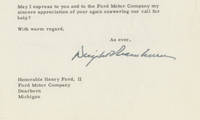
16012121416/01/1961. <blockquote><p>Ike wrote that asked “for help in dealing with this crisis your company at once furnished…the same team - Mr. Leo C. Beebe and Mr. Charles A. Pink - who did so much to make a success of our work…for the Hungarian refugees four years ago.â€</p></blockquote><p>In the wake of the Cuban Revolution in 1959 a Cuban exodus began as the new government allied itself with the Soviet Union and began to introduce communism. Tens of thousands of Cubans left Cuba starting in late 1959 and picking up in 1960 and the United States became the country of first asylum as the Cuban refugees sought and found political refuge here. For the first time the United States Government found it necessary to develop a program to help refugees from another nation in this hemisphere.</p><p>In the forefront of this effort was President Dwight D. Eisenhower who was in the waning days of his administration. In November 1960 Eisenhower directed Tracy S. Voorhees a former Undersecretary of the Army to act as the President's Personal Representative for Cuban Refugees to look into the Cuban refugee situation. To do this and deal with the broader challenges the refugees presented Voorhees reached out for assistance to Henry Ford II of the Ford Motor Company who had been of great help on a similar occasion in the past. In 1956 Ford lent one of his senior executives Leo Beebe to the U.S. government to supervise the resettlement in the U.S. of refugees fleeing Hungary after the failure of the revolution there. Beebe became executive vice chairman of Eisenhower’s Committee for Hungarian Refugees. In addition to his committee work during 1956-1957 while working out of Camp Kilmer in northern New Jersey Beebe and his aide Charles A. Pink a Ford staff member oversaw the relocation and resettlement of 35000 Hungarian refugees in the United States eventually finding them permanent residences in this country.</p><p>In 1960 Ford came through again and provided the services of the experienced Beebe and Pink for the Cuban refugee effort. The Cuban Refugee Emergency Center was established in Miami and became the focal point of refugee registration assistance relief and resettlement as well as coordination of government and independent agencies’ programs. Federal funding provided for the center’s operations record keeping publications coordination of agencies and research on different aspects of the refugee situation as well as for programs. The latter included financial assistance educational loans health care adult education and re-training resettlement and care of unaccompanied children.</p><p>To understand the scope of the effort in the first two years after the Cuban Revolution over 50000 Cubans fled and established new homes in the United States.</p><p><strong>Typed letter signed</strong> on White House letterhead Washington January 16 1961 to Henry Ford II thanking him for again lending a much-needed hand in this critical venture. This letter was written a mere four days before Ike left office and was succeeded by John F. Kennedy. <em>“Tracy Voorhees my representative for the Cuban refugee problem has told me that in response to his request to the Ford Motor Company for help in dealing with this crisis your company at once furnished to him the same team - Mr. Leo C. Beebe and Mr. Charles A. Pink - who did so much to make a success of our work at Camp Kilmer for the Hungarian refugees four years ago.</em></p><p><em>“With their unique experience gained at Kilmer these men have been largely responsible for setting up our Cuban Refugee Emergency Center in Miami and making its work a success. May I express to you and to the Ford Motor Company my</em><br /><em>sincere appreciation of your again answering our call for helpâ€</em></p><p>This letter remained in the Ford family until recently and it has never before been offered for sale.</p> unknown
1942376490N.p. 1942. 3pp. on three ruled sheets. Small closed tear to top edge of first page small open tear to left edge of final page; else Fine. 3pp. on three ruled sheets. A charming letter at a vital time in Eisenhower's career: in the midst of planning the attack that would lead to the defeat of Germany here refered to casually as getting "absorbed in work." We're also let in on another side of Eisenhower's responsibilities: entertaining the entertainers. He bears this somewhat wearily but nonetheless we're left with a valuable record of the spirit and dedication of not just the entertainers but all women working on or near the front line. <br /> <br /> "Last eve was an event in our house. There are several movie stars here entertaining the soldiers and officers . . . . Last eve the troupe gave a performance for the officers of AFHQ but I would not go. Afterwards I sent them an invitation . . . to come up for an after performance supper. They did. There were: Kay Francis Martha Ray Carole Landis and Mitzi Mayfair. I was a bit fearful of how movie people would act & what they'd expect--but it all went off perfectly naturally & no embarrassment. . . . They work hard giving from 2 to 3 shows per day 6 days per week. Moreover they reflect an attitude that seems to be characteristic of all women British & American in this region. They want to get close to the front. The women seem to be more casual with respect to danger than do sic the men. These particular ones want to get up as close as possible to do their stuff-as do the Red Cross the WAACs the ATS etc etc. I suppose there are 50-75 American women in this city & every one tells me that their constant cry is 'Let me get up where there is action.' Many of my officers are quite willing to take cushy jobs far from the sound of bombs & bullets. . . . <br /> "No woman can . . . take your place. Don't worry about me . . . . I'm in love with you & with no one else." This last tempted fate written just months before Eisenhower met his long-term mistress Kay Summersby. unknown