2 100 résultats
New Turkish Paperback. Oblong large 8vo. (20 x 24 cm). In Turkish. 144 p., b/w photos. Dört mevsim Istanbul. [Album of photograhs].
New Turkish Paperback. Oblong large 8vo. (22 x 25 cm). In Turkish. 142, [2] p., b/w photos. Beyoglu 1930: Selahattin Giz'in fotograflariyla 1930'larda Beyoglu. Text by Ali Ozdamar. Preface by Demir Özlü.
New English Paperback. Pbo. Demy 8vo. (21 x 14 cm). In Turkish. 277 p. Ali Emiri'nin Osmanli tarih ve Edebiyat mecmuasi. A study on Ali Emiri's 'Osmanli Tarih ve Edebiyat Mecmuasi' (Ottoman History and Literature Journal). OTTOMANIA Periodicals Reference Scholar.
1843GIT00e4cParis Didier 1843. 2vol in-8 broché 577 551pp. Quelques rousseurs.
New Turkish Original bdg. HC. 4to. (28 x 21 cm). In Turkish. 223 p., color and b/w ills. Bize belediye baksin: Belediye hizmetlerinin karikatürlerle 100 yili, (1872-1972).
New New English Original binding with original dust wrapper. 4to. (35 x 24 cm). 223 p. B/w and color ills. This book does not only aim at reminding us once more of Istanbul's past glory days, but also draws our attention to the point that at this moment of time, Istanbul is again a world city where many people from various language backgrounds can be found crowding its streets day and night. The impressions of famous Western travelers of years gone by, share the book's pages with the interpretations of contemporary ¿stanbul written by Sefa Kaplan. ISTANBUL Constantinople Travel Memoirs Ottoman culture Social life Description.
New English Paperback. Pbo. Roy. 8vo. (24 x 17 cm). In Turkish. 530, [5] p. A historical study on transport in Istanbul. Dünden bugüne Istanbul'da ulasim.
Fine Turkish In modern clothes. 4to. (33 x 24 cm). In English and Turkish. 2 volumes set: (xvii, [3], 357 p.; [8], 447 p.), b/w and color plates. Sedad Hakki Eldem was a Turkish Architect. One of the pioneers of nationalized modern architecture in Turkey. He was born in Constantinople (1908). He graduated from the Academy of Fine Arts (department of Architecture). Between 1931 and 1932 he travelled to France, England and Germany with a scholarship of the academy. In 1932 he opened his own office, also started teaching at the Academy of Fine Arts and continued until retirement in 1978. In 1934 he worked for the National Architecture Seminar in Turkey which was a complete disaster for him because of the discussions between modern architecture and traditional architecture. In 1938 he designed the Turkish Pavilion in New York Exhibition. Sedad Hakki Eldem represented Turkish Republic at International Union of Architects in Lausanne (1948) after Second World War. Also in the same year Sedad Hakki worked with his colleague Emin Onat on the project of Istanbul Palace of Justice. He worked on proportions and architectural organizations of Ottoman domestic houses, 18th and 19th century palaces and mansions. He was known as a role model and pioneer to reinterpret the Classical Ottoman Patterns in modern architecture. He was a part of Former Artifacts Maintain Council (Eski Eserleri Muhafaza Encümeni) between 1941 and 1945 and also a part of Supreme Council of Antiquities and Monument Real Estate (Gayrimenkul Eski Eserler ve Anitlar Yüksek Kurulu) between 1962 and 1978. His thought was about nationalizing the Modern Architecture. He basically thought that International Style in architecture should not applied everywhere. Some things should be changed in the design by considering the national and domestic texture. He has won the international Aga Khan Award for Architecture in 1986 with the project of Zeyrek Social Security Facilities. Sedad Hakki Eldem's architecture has basically 4 main periods. The first of them, between 1928 and 1934, is known by the instability of his work. After that, the second period is popular with modern trials on Ottoman architectural organization. The time frame of this period spans from 1934 until 1952. The third period of his architecture has lost its Ottoman influence, it looks more modernized between 1952 and 1962. The last part of Eldem's Architecture known for his double approach on projects.This final period started in 1962, and lasted until his death in 1988. (Source: Wikipedia). Extremely rare.
Very Good Turkish Paperback. Folio. (34 x 24 cm). In Turkish. 2 volumes set: (70 p.; 64 p.). Eldem was a Turkish architect and one of the pioneers of nationalized modern architecture in Turkey. He was born in Istanbul (1908). He graduated from the Academy of Fine Arts (Department of Architecture). Between 1931 and 1932 he traveled to France, England, and Germany with a scholarship from the academy. In 1932 he opened his own office, also started teaching at the Academy of Fine Arts, and continued until retirement in 1978. In 1934 he worked for the National Architecture Seminar in Turkey which was a complete disaster for him because of the discussions between modern architecture and traditional architecture. In 1938 he designed the Turkish Pavilion in New York Exhibition. Sedad Hakki Eldem represented the Turkish Republic at the International Union of Architects in Lozan (1948) after Second World War. Also in the same year, Sedad Hakki worked with his colleague Emin Onat on the project of Istanbul Palace of Justice. He worked on proportions and architectural organizations of Ottoman domestic houses, 18th and 19th-century palaces, and mansions. He was known as a role model and pioneer to reinterpret the Classical Ottoman Patterns in modern architecture. He was a part of the Former Artifacts Maintain Council (Eski Eserleri Muhafaza Encümeni) between 1941 and 1945 and also a part of the Supreme Council of Antiquities and Monument Real Estate (Gayrimenkul Eski Eserler ve Anitlar Yüksek Kurulu) between 1962 and 1978. His thought was about nationalizing Modern Architecture. He basically thought that International Style in architecture should not be applied everywhere. Some things should be changed in the design by considering the national and domestic texture. He has won the international Aga Khan Award for Architecture in 1986 with the project of Zeyrek Social Security Facilities. Sedad Hakki Eldem's architecture has basically 4 main periods. The first of them, between 1928 and 1934, is known for the instability of his work. After that, the second period is popular with modern trials on Ottoman architectural organization. The time frame of this period spans from 1934 until 1952. The third period of his architecture has lost its Ottoman influence, it looks more modernized between 1952 and 1962. The last part of Eldem's Architecture known for his double approach to projects. This final period started in 1962 and lasted until his death in 1988. (Wikipedia).
Very Good French Paperback. 4to. (34 x 24 cm). In French and Turkish. 112, [1] p., b/w plts. Le Yali de Köçeoglu à Bebek sur le Bosphore.= Köçeoglu Yalisi, Bebek, Bogaziçi.
New Turkish Paperback. Folio. (34 x 24 cm). In Turkish. [16], 178 p., 150 plans and photos. Sa'dabad. [REPRINT EDITION of 1977].
New English Paperback. Pbo. 4to. (30 x 24 cm). In Turkish. 210 p., color and b/w ills. Sedad Hakki Eldem 1: Gençlik yillari. He was born in Istanbul in 1908. He graduated from Academy of Fine Arts, department of Architecture. Between 1931 and 1932 he travelled France, England and Germany with scholarship of the academy. In 1932 he opened his own office, also started teaching at the Academy of Fine Arts and continued until retirement at 1978. In 1934 he worked for National Architecture Seminar in Turkey which was a complete disaster for him because of the discussions between modern architecture and traditional architecture. In 1938 he designed the Turkish Pavilion in New York Exhibition. Sedad Hakki Eldem represented Turkish Republic at International Union of Architects in Lozan (1948) after Second World War. Also in the same year Sedad Hakki worked with his colleague Emin Onat on the project of Istanbul Palace of Justice. He worked on proportions and architectural organizations of Ottoman domestic houses, 18th and 19th century palaces and mansions. He known as a role model and pioneer to reinterpret the Classical Ottoman Patterns in modern architecture. He was a part of Former Artifacts Maintain Council (Eski Eserleri Muhafaza Encümeni) between 1941 and 1945 and also a part of Supreme Council of Antiquities and Monument Real Estate. Between 1928 and 1934 defined as preparation years for Sedad Hakki Eldem. At these years the architect worked at Istanbul, Paris and Berlin but there is no built project or something. The only structure that has been built in that period is temporary Turkish pavilion in Budapest Exhibition in 1931. This structure give us so little clues about his searching in architecture. Whereas Sedad Hakki was tried almost every approach popular in these years, also tried to combine them even if they are all contradicted. He even give parts to different architectural elements in one design. For example, one of his trials in Paris, embassy project has Auguste Perret impressions in details, its planimetry has traditional middle "sofa" and "Eyvan" types of components that usually belong to Turkish Architecture. Also the architect inspired by a sheme that peculiar to Iran-Middle East, named "Cihar-bag". At the same time he examined the style of Art Deco, Le Corbusier, Hoffmann, Olbrich, Tessenow and Webb. Despite all of these and his instability of style, he never abandon his researches about traditional and domestic Ottoman civil architecture. He made use of all styles as much as they compromise with traditional architecture. The styles that do not overlap with domestic architecture, are disappeared. TURKISH ARCHITECTURE Biography Istanbul History art Turkish intelligentsia Memoirs.
New English Paperback. Pbo. 4to. (30 x 24 cm). In Turkish. 322, [2] p., color and b/w ills. Sedad Hakki Eldem 2: Retrospektif. Sedad Hakki Eldem's architecture has basically 4 main period. First of them is known by instability of his works, it was between 1928 and 1934. After that, second period is popular with modern trials on Ottoman architectural organization the time period of this part starts with 1934, until 1952. Third period of his architecture has lost its Ottoman influence, it looks like more modernized between 1952 and 1962. Last part of Eldem's Architecture known with his double approach on projects. Time period of that leading years started at 1962 until his death at 1988. TURKISH ARCHITECTURE Biography Istanbul History art Turkish intelligentsia Memoirs.
Fine English Original bdg. 4to. (34 x 25 cm). In English and Turkish. [432] p., color and b/w ills. Works of Turkish architecture.= Türk mimari eserleri.
Fine Fine English Paperback. Pbo. Dust wrapper. 4to. (34 x 24 cm). In Turkish. 128 p., 236 numerous color and b/w plts. Topkapi Sarayi. Bir mimari arastirma. Very fine copy. First and Only Edition. A comprehensive architectural study on Topkapi Palace of Istanbul. ARCHITECTURE Turkish and Islamic arts Topkapi Ottoman culture Palace Constantinople - Istanbul - Konstantinopel.
19791130631979 Alarko Egitim Tesisleri - 1979 - 2 volumes in-4, cartonnage avec titre et nom de l'auteur en doré sur le 1er plat et le dos - 343 p. + 398 p. - Très riche iconographie hors texte et pleine page en N&B - Ouvrage bilingue turc / anglais
Fine English Original bdg. HC. 4to. (33 x 25 cm). In English and Turkish. 318 p., color ills. Sile and Sile cloth from past to present.= Geçmisten günümüze Sile ve sile bezi.
New New English Original bdg. Dust wrapper. 4to. (33 x 25 cm). In English and Turkish. 318 p., color ills. Sile and Sile cloth from past to present.= Geçmisten günümüze Sile ve sile bezi.
As New English Paperback. Pbo. Mint. 4to. (28 x 22 cm). Color photos. 159 p. Photographed by Douchan Novakoviç. Süryaniler. Translator: Ersel Topraltepe.
Very Good French A small original albumen print photograph by Sebah & Joaillier mounted on paper. Size: 6,5x8 cm. Rare albumen print photograph mounted on a grey album paper taken by Sebah & Joaillier photograph studio of Constantinople, showing Syrian women and men in their traditional clothes. In 1857 photographer Pascal J. Sébah opened a studio in Constantinople, today Istanbul, Turkey. Photographing city views, daily activities, and ancient ruins in the surrounding area, Sébah sold many of his prints to visiting tourists, a prosperous and common market for other contemporary photographers, such as the well-known Abdullah Frères. Tourists would select a range of prints from professional photo studies in the countries they visited and compile a travel album of their journey. In 1888, two years after Pascal J. Sébah passed away, his 16-year-old son Jean (Johannes) became involved in the studio work. Jean started a partnership with another photographer from Istanbul, the Frenchman Policarpe Joaillier, which became a great success. Jean worked both on assignments for the studio and as an individual photographer, which can be determined from the signatures on the works: some prints were signed "Sébah & Joaillier," and others have the signature "J.P. Sébah" The studio flourished and Sébah & Joaillier were named as the official photographers of the Ottoman Empire by the Turkish sultan. In the early 1900s, Joaillier returned to Paris and Sébah continued his work in Constantinople. After different partnerships, the studio was taken over by Ismail Insel and renamed "Foto Sabah" [i.e. Photo Morning].
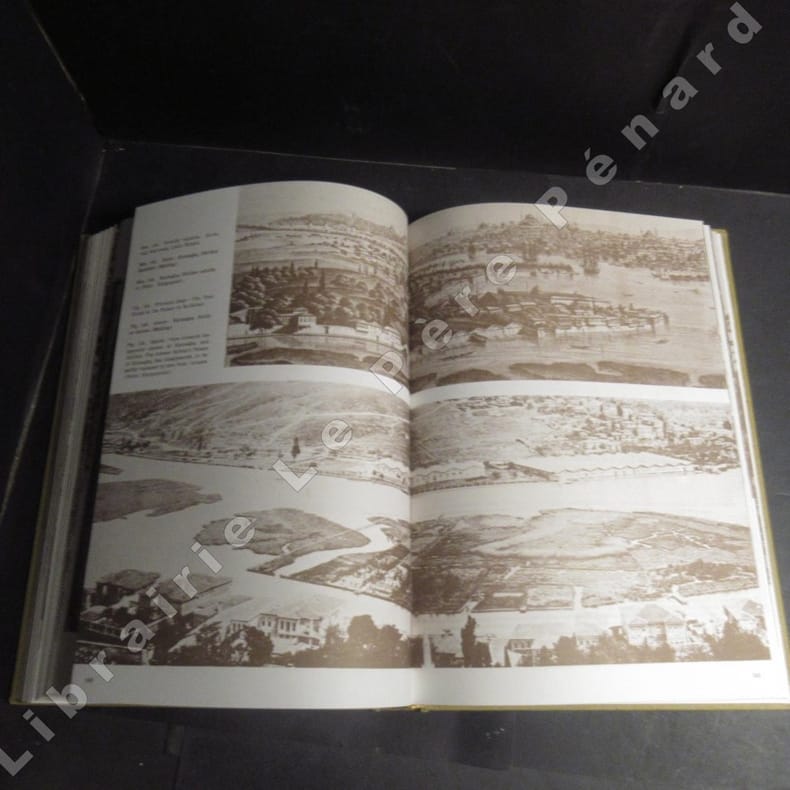
Very Good French Original albumen print photograph by Sebah & Joaillier mounted on cardboard. Size: 25,5x33 cm; photographic size: 21,5x26 cm. Rare albumen print photographs double-sided printed mounted on green cardboard taken by Sebah & Joaillier photograph studio of Constantinople, showing the Bosphorus, view of Therapia Bay and Pier with the Asian and European coasts of the strait. In 1857 photographer Pascal J. Sébah opened a studio in Constantinople, today Istanbul, Turkey. Photographing city views, daily activities, and ancient ruins in the surrounding area, Sébah sold many of his prints to visiting tourists, a prosperous and common market for other contemporary photographers, such as the well-known Abdullah Frères. Tourists would select a range of prints from professional photo studies in the countries they visited and compile a travel album of their journey. In 1888, two years after Pascal J. Sébah passed away, his 16-year old son Jean (Johannes) became involved in the studio work. Jean started a partnership with another photographer from Istanbul, the Frenchman Policarpe Joaillier, which became a great success. Jean worked both on assignments for the studio and as an individual photographer, which can be determined from the signatures on the works: some prints were signed "Sébah & Joaillier," others have the signature "J.P. Sébah" The studio flourished and Sébah & Joaillier were named as the official photographers of the Ottoman Empire by the Turkish sultan. In the early 1900s Joaillier returned to Paris and Sébah continued his work in Constantinople. After different partnerships, the studio was taken over by Ismail Insel and renamed "Foto Sabah" [i.e. Photo Morning].
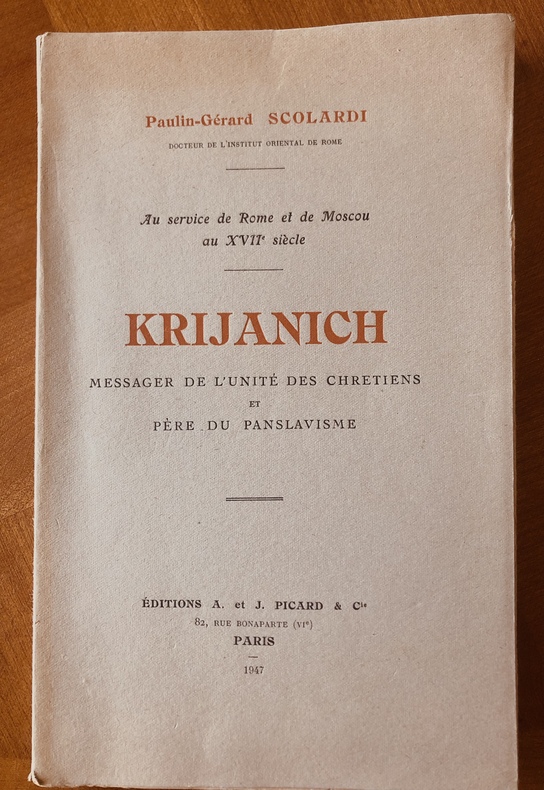
1947290PREMIÈRE ÉDITION. In -8 broché, (22,5 X 14 cm) ,261 p. Éditions A. et J. Picard & Cie, Paris, 1947.
Swashbuckling novel of the Fall of Constantinople 1453.".the rich,barbaric scenes of Moslem pageantry,the fascinating enterprises of wily Venetian merchants,the terrifying death throes of lovely and decadent Constantinople."302p. Book
Very Good English Original decorative bdg. Large Roy. 8vo. In English. 3 portrait pages, [152] p. B/w ills. The first half-century. The story of The English High School for Boys from 1905 to 1955. The wolf and crescent 1955. English High School For Boys - Istanbul.
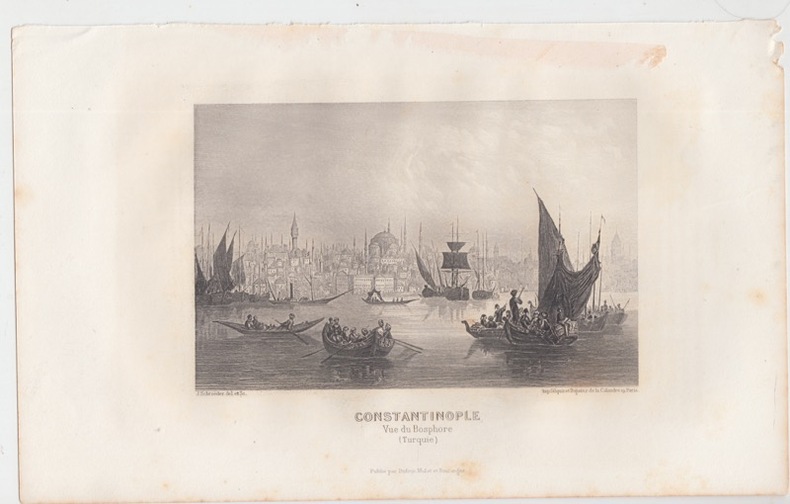
26217Paris . Dufour , Mulat et Boulanger éditeur / Imprimerie Gilquin et Dupain . Vers 1858 - Eau forte 27,5 x 18 cm [ 15,5 x 10,5 cm de Gravure ] - Vers 1858 - SCHROEDER J. [ DESSIN et GRAVURE ]