2 100 résultats
Very Good English Original bdg. HC. No dust jacket. Cr. 8vo. (20 x 14 cm). In Turkish. 296 p., ills. Urban history of Istanbul (Constantinople) with legends. Tarih ve efsaneleri ile Istanbul.
Very Good English Paperback. Pbo. 4to. (28 x 20 cm). In French. 224, [1] p., with original b/w photographs. Typewritten copy of author. Le monde de mon enfance, (1911-1929). [= Author work and editor's copy of 'Une enfance Juive a Istanbul, 1911-1929'.]
New English Paperback. Pbo. Roy. 8vo. (24 x 17 cm). In French. 218, [1] p. Une enfance Juive a Istanbul, 1911-1929.
Very Good French Paperback. Crr. 8vo. (20 x 14 cm). In French. 79 p., b/w plates. Oublier Byzance pour l'Anadolie.
As New English Original creme leather bdg. with special design. A Byzantine saint gilt under the window of front cover. Mint. 4to. (30 x 24 cm). In English and Turkish. [8], 282 p., 186 numerous color figures. Tatlarin: Wall paintings of churches no. I and no. II.= I ve II no'lu kiliselerin duvar resimleri. Tatlarin underground city, which was one of the most important underground cities of the Cappadocia region, could only be discovered in 1975 because its original entrance had collapsed and had gone underground to be opened to the visits of tourists in 1991. The toilet in it demonstrates that toilets were being used in Anatolia around 3000 years ago. There are many food storage areas and churches within it. It is believed to have been used as a center for religious or military purposes judging by the large size of its rooms. Only two floors of the Tatlarin underground city which has spread over a pretty large area can be visited currently, however works continue to open the other floors to visits as well. Although there is a large number of churches around and within the Tatlarin underground city which is near the Acýgöl district of the Nevþehir province a major part of them have collapsed due to natural causes. This book includes wall paintings of two of those churches, No. 1 and 2.
Fine Fine English Original bdg. Dust wrapper. 4to. (29 x 21 cm). In Turkish. 2 volumes set ([viii], 233 p.; [vi], 223 p.), full page color ills. Catalogue of icons in Hagia Sophia Museum. A heavy set. Ikonalar. Ayasofya Müzesi'ndeki ikonalar katalogu. 2 volumes set.
Fine English Paperback. Pbo. Oblong 4to. (21 x 30 cm). In Turkish. [4], 298 p., b/w ills. Kurulusundan 1933 reformuna fotograflarla Darülfünun Tip Fakultesi. Corporate history with old photographs of Istanbul University Medicine Faculty (Darülfünun Tip Fakültesi).
Fine Greek, Modern (post 1453) Paperback. Roy. 8vo. (23 x 16 cm). In modern Greek. 50, 16 p. O Astir tis Omonoias: Pankosmio diarkes symvoulio. The Castle of Omonoias: World council period. Rare. Just one copy in Veria Library. Printed in Istanbul. For early Ottoman Turkish edition (1909) see: Müsalemet-i umûmiye için cihan divan-i daimisi and Özege: 14938. First Greek Edition.
0332218546.Gpaperback. Good. Access codes and supplements are not guaranteed with used items. May be an ex-library book. paperback
0332229742.Ghardcover. Good. Access codes and supplements are not guaranteed with used items. May be an ex-library book. hardcover
New English Paperback. Pbo. Small 4to. (25 x 22,5 cm). In Turkish. 228 p., fully b/w and color ills. 500 copies were printed. Hamza Rüstem ve ogullari. Fotograf mesleginde bir yüz yil. A very comprehensive illustrated study on Turkish photographer, Hamza Rüstem, (1872-1971), who was born in Crete. Beside him, Rahmizâde Bahaeddin Bey (Bahaettin Rahmi Bediz, Rahmi Bediz after the 1934 - Law on Family Names in Turkey) was a Cretan Turk who is generally agreed by historians to be the first Turkish photographer by profession. He was a first photographer of archaeologist Evans' Knossos excavations. He started his career in Hanya, Crete in 1895, and went on to open photography studios in Izmir in 1910, in Istanbul in 1915 where he acquired his fame, and in Ankara after 1935 where, aside from his private business, he worked as the Chief of Photography Department in Turkish Historical Society. The thousands of photographs (especially portraits) he took during his career (Crete, Izmir, Istanbul, Ankara) have immense historical value. Before Hamza Rüstem was a photographer was trading some goods near English camp in Crete. Bediz discovered him in Crete as a trader, and he hand his photograph studio to Hamza Rüstem on in Constantinople, Istanbul after Second Constitution, 1909. Bediz was a first Muslim photographer who opened a studio in Ottoman geography according photographic literature. This book includes many postcards which photographed by Bediz, biography of Hamza Rüstem and sons and corporate history of his studio.
New New English Original bdg. Dust wrapper. In special slip-case. 4to. (34 x 24 cm). In Turkish. [ix], 224 p., color ills. Basbakanlik Osmanli Arsivi'ndeki belge türleri, padisah el yazilari ve belge restorasyonu.
New English Original bdg. HC. Oblong folio. (39 x 33 cm). In English and Turkish. Color photos. 119, [4] p. The Haliç Shipyard faces.= Haliç Tersanesi sakinleri.
0366681567.Ghardcover. Good. Access codes and supplements are not guaranteed with used items. May be an ex-library book. hardcover
0366681559.Gpaperback. Good. Access codes and supplements are not guaranteed with used items. May be an ex-library book. paperback
New English Paperback. Pbo. Roy. 8vo. (24 x 17 cm). In French. 124 p. Ills. Remerciements Introduction À propos des mots I - Le luth et l'Empire : une histoire du lavta dans l'Empire ottoman 1. Le Luth d'Istanbul 2. Tanburi Cemil Bey, Une Filiation II - À l'ombre de la République 3. La Radio d'Istanbul, le Chaînon Manquant ? 4. Istanbul Aujourd'hui III - Tribulations autour de la Mer Egée5. Le Lavta en Grèce 6. Une Affaire de Luthiers 7. Quelque chose se Passe : Notes sur le Devenir du Lavta IV - Jeux et enjeux 8. Accents Ottomans ? 9. Le Geste Musical : Une Etude du Jeu de Plectre 10. Les Secrets d'un Instrument 11. Les Devenirs du Lavta : Questions de Style En guise de conclusion. Ressources Table des illustrations Table des matières.
New English Paperback. Pbo. 4to. (28 x 23 cm). In Turkish. 311 p. B/w photos. Artamonoff: Bizans Istanbul'u imgeleri, 1930-1947. Edited by Günder Varinlioglu. Artamonoff [Nicolas V.]: Picturing Byzantine Istanbul, 1930-1947. Nicholas V. Artamonoff left behind a photographic puzzle of over one thousand images. He was a student and engineer, who, while studying and living at Robert College in Istanbul, gained an appreciation for the city's history and culture. With his Rollei camera, he captured Byzantine remains, ntering nooks and crannies of fortifications and cisterns. He strolled through the city in the footsteps of architectural historians and archaeologists who explored and uncovered Byzantine Istanbul. his interests were broad: they ranged from imposing churches to the smallest details of architectural sculpture, from bustling marketplaces to the diligent work of lone craftsmen. The abundance of subjects es the Nicholas V. Artamonoff Collection rich and engaging, providing a glimpse into the diverse urban environment in which he lived, and into the versatile photographer he was.
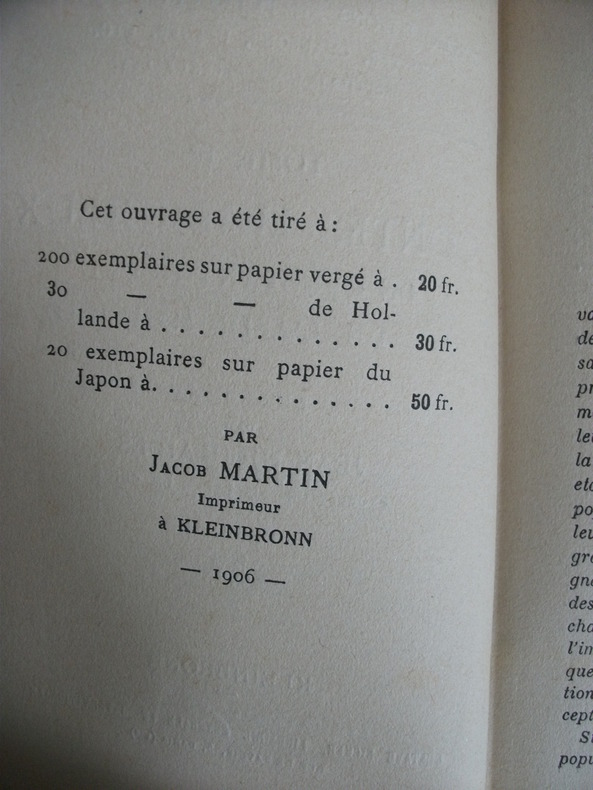
5558Recueillis par Jean NICOLAIDES professeur au lycée de Chios.In 12 reliure éditeur pleine toile marron titre doré au dos et sur le premier plat(avec un petit décor de fleur)faux-titre,titre,XXVIII,217 pages,non rogné,Kleinbronn librairie dépositaire Gustave Ficker Librairie internationale 1906 un des exemplaire sur papier vergé(tiré à seulement 200 exemplaire).Contributions au folklore érotique recueillis aux sources orales.Tome 1er.Rare
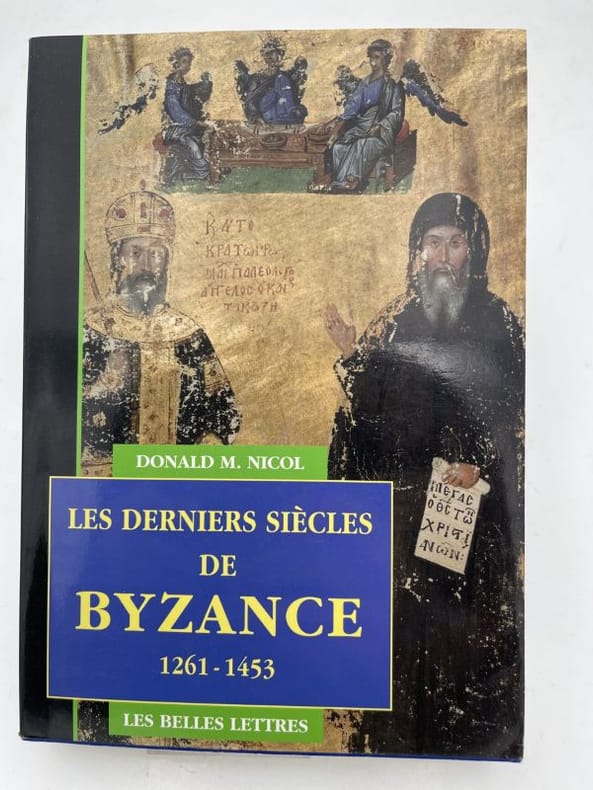
2005191827Les Belles Lettres Les Belles Lettres, 2005. In-8 broché (21,5 x 15,3 cm) de 530 pages. Sous jaquette illustrée. Collection "Histoire". Traduit de l'anglais par Hugues Defrance. Cet ouvrage constitue une synthèse de référence sur l'agonie lumineuse de l'Empire byzantin, de la reconquête de Constantinople par Michel Paléologue jusqu'à la chute finale face aux Ottomans. Donald M. Nicol y analyse avec précision les luttes intestines des grandes familles, la pression constante des puissances occidentales et l'essor de la puissance turque, tout en soulignant la vitalité culturelle et religieuse de cette période. L'appareil critique comprend des arbres généalogiques, des cartes détaillées et une bibliographie exhaustive. Devenu un classique de l'historiographie byzantine, ce titre sous sa jaquette d'origine est particulièrement recherché par les collectionneurs et les passionnés de l'Orient médiéval. Très bon état
89992Paris, Les Belles Lettres, 2005. 15 x 22, 530 pp., broché, couverture à rabats, très bon état.
New English Paperback. Demy 8vo. (21 x 14 cm). In English. 240 p. Rumi therapy: From age of knowledge to age of wisdom. Mankind is rediscovering Rumi. His universal teachings are just as relevant as they were when he wrote them... All of us have much to learn from 13th century poet and scholar. Doctor Nevzat Tarhan explains how the wisdom inherent in Rumi's work, the Masnavi, can be the cure we need for our souls and our psychological wellbeing. Tarhan explains that we must take living wisdom of Rumi as a guide as we navigate our daily lives. He read the Masnavi as a work that treats our hearts and pysches in a manner that is a work that is now accepted by modern psychology. Tarhan's interpretive methods enable us to raise our awareness and see the truth within ourselves. "Rumi will be the one who will show us the way as we transition from the information age to the age of wisdom. He affects the codes within our spiritual programming, activating tenderness within us.".
Very Good Turkish Original TLS by Nevzat Tandogan. 27,5x18 cm. In Turkish. 1 p. Punching holes on right side folded traces. A fine paper. Dated 30/6/1936. Seven lines. Letter/document sent to H[asan] Resit Tankut, (1891-1980), who was a Turkish historian and statesman when Tankut was a director of TDK (Türk Dil Kurumu [i.e. Turkish Language Society]). The letter says his thanks for Tankut's book titled 'Introduction to Turkish Linguistic Union' that he sent to Tandogan. Tandogan was the fourth mayor and governor of Ankara serving between 1929 and 1946. He committed suicide upon a political scandal he was involved in. Abdullah Nevzat Tandogan was born into a wealthy family in 1894 in Istanbul, then Ottoman Empire. His father was from Sarajevo and his mother from Belgrade. He completed his education at Istanbul Law School, today Istanbul University Faculty of Law. After the Surname Law was enacted in Turkey in 1934, he adopted the family name Tandogan. He was married and had two children. During World War I, he served as an intelligence officer in the Ottoman Army in Istanbul. In the later years of the war, he began a career as a school teacher in Istanbul. In 1918, he entered police service. After serving at leading posts in various police departments, he quit. He became Governor of Malatya in 1925 before he entered politics from the Republican People's Party) (CHP) and was elected into the Grand National Assembly as deputy of Konya in the 1927 general election. On November 4, 1929, he resigned from his parliamentary seat to take office as Governor of Ankara. Serving also as the acting city mayor, he was uninterrupted 17 years long in this position. Tandogan was a civil servant and politician of the single-party era (1923-1945). The political philosophy of the era was understood so as "the government has the authority to determine and to do what is useful and best for the country, knowing better than everyone, especially the folk". Tandogan's political attitude is described best with his words he said to a young man as "We constitute Communism in this country if it is necessary". Tandogan had a dissenting opinion to the 1929 Jansen Plan by German architect and urban planner Hermann Jansen(1869-1945). The plan proposed the integration of green belts and areas within the rapid-growing new capital of the newly established Republic for promoting a healthy urban environment. The realization of Ankara's master plan as different from the Jansen Plan is his practice. In 1945, a murder occurred in Ankara, which became known as the "Ankara Murder" (Turkish: Ankara Cinayeti). Tandogan was accused of intentionally and deliberately covering the murder case, in which Hasmet Orbay, the son of the then Chief of the General Staff Kâzim Orbay, was involved. Tandogan was summoned to court to testify after the case was discussed in a question time in the parliament. It was believed that calling a high-ranked civil servant or politician to the witness stand in a court trial was unthinkable during the single-party era before 1945. The next day, on July 9, 1946, Nevzat Tandogan committed suicide by shooting himself at home with a firearm. The main square in Ankara, which hosted many political party rallies and protests, was named in his honor. In 2012, the city council of the metropolitan municipality changed the square's initial name from "Nevzat Tandogan Square" to "Tandogan Square". A public park in Batikent neighborhood of Yenimahalle, Ankara as well as a street in Kavaklidere neighborhood of Çankaya, Ankara is also named after him.
Very Good Turkish Original TLS by Nevzat Tandogan. Oblong: 16,5x20 cm. In Turkish. 1 p. Punching holes on right side folded traces. Dated 9/V/1939. Six lines. Tandogan was the fourth mayor and governor of Ankara serving between 1929 and 1946. He committed suicide upon a political scandal he was involved in. Abdullah Nevzat Tandogan was born into a wealthy family in 1894 in Istanbul, then Ottoman Empire. His father was from Sarajevo and his mother from Belgrade. He completed his education at Istanbul Law School, today Istanbul University Faculty of Law. After the Surname Law was enacted in Turkey in 1934, he adopted the family name Tandogan. He was married and had two children. During World War I, he served as an intelligence officer in the Ottoman Army in Istanbul. In the later years of the war, he began a career as a school teacher in Istanbul. In 1918, he entered police service. After serving at leading posts in various police departments, he quit. He became Governor of Malatya in 1925 before he entered politics from the Republican People's Party) (CHP) and was elected into the Grand National Assembly as deputy of Konya in the 1927 general election. On November 4, 1929, he resigned from his parliamentary seat to take office as Governor of Ankara. Serving also as the acting city mayor, he was uninterrupted 17 years long in this position. Tandogan was a civil servant and politician of the single-party era (1923-1945). The political philosophy of the era was understood so as "the government has the authority to determine and to do what is useful and best for the country, knowing better than everyone, especially the folk". Tandogan's political attitude is described best with his words he said to a young man as "We constitute Communism in this country if it is necessary". Tandogan had a dissenting opinion to the 1929 Jansen Plan by German architect and urban planner Hermann Jansen(1869-1945). The plan proposed the integration of green belts and areas within the rapid-growing new capital of the newly established Republic for promoting a healthy urban environment. The realization of Ankara's master plan as different from the Jansen Plan is his practice. In 1945, a murder occurred in Ankara, which became known as the "Ankara Murder" (Turkish: Ankara Cinayeti). Tandogan was accused of intentionally and deliberately covering the murder case, in which Hasmet Orbay, the son of the then Chief of the General Staff Kâzim Orbay, was involved. Tandogan was summoned to court to testify after the case was discussed in a question time in the parliament. It was believed that calling a high-ranked civil servant or politician to the witness stand in a court trial was unthinkable during the single-party era before 1945. The next day, on July 9, 1946, Nevzat Tandogan committed suicide by shooting himself at home with a firearm. The main square in Ankara, which hosted many political party rallies and protests, was named in his honor. In 2012, the city council of the metropolitan municipality changed the square's initial name from "Nevzat Tandogan Square" to "Tandogan Square". A public park in Batikent neighborhood of Yenimahalle, Ankara as well as a street in Kavaklidere neighborhood of Çankaya, Ankara is also named after him.
New Turkish Original bdg. HC. 4to. (30 x 21 cm). In Turkish. [x], 210 p., color and b/w ills., Ottoman documents. Osmanli Üsküdar'inda toplumsal hayat (18. asir Üsküdar'da müslim-gayrimüslim iliskileri). Social life in the Ottoman Scutari: Muslim and non-Muslim relations in Scutari in the 18th century.
Very Good French Original two photos (stereoscope and gelatin silver prints). 9x18 cm, 19x25 cm. Rare two photographs of early 20th century Constantinople, "Cimetiere Turc" and "Une Rue a Stamboul" [i.e. Eyup Cemetery and a street (probably from Kandilli)], taken and printed by "Verlag der Neuen Photogr. Gesellschaft A. G., Steglitz-Berlin in 1905. The Neue Photographische Gesellschaft (NPG) was the first and for many years the biggest factory for real photographic bromide printing and the production of real photograph postcards. Arthur Schwarz (1862-1944) founded the company in 1894 in Berlin-Schöneberg, and there were later subsidiary companies in various cities including London, New York, Paris, Vienna, Brussels, and Milan. The company closed in 1921, although the NPG trademark and the postcard department were acquired by E. A. Schwerdtfeger, located first in Berlin and then in Dresden. That business closed with the outbreak of the Second World War. About 1906, the NPG was one of the postcard manufacturers that formed the Verein Photographischer Reproduktions-Anstalten GmbH (P.R.A.) (Association of Institutions of Photographic Reproductions) with headquarters in Berlin and directed by Arthur Schwartz. By 1907, the P.R.A. represented thirteen German and four Austrian publishing companies with the aim to have guaranteed minimum prices and fixed terms and conditions to avoid ruinous competition.