2 100 résultats
Very Good French Scarce color lithographed tourist map of Syria and Lebanon, showing international boundaries, transportation, archaeological, historical, and military ruins, water features, distances between places and populated places. Relief is shown by hachures, bathymetric tints, and spot heights. Includes 28 attractive drawings in red of tourist sites in Syria and Lebanon: Damas, Palmyre, Afqa, Hama, Homs, Meyrouba, Saida, Beit ed-Dins, Djebail, Led Cedres, Krak des Chevaliers, Massiaf, Antioche, Deir Smane, El Goilla, Aleppo, etc. "Relief is shown by contours and spot heights. Includes 28 drawings of tourist sites in Syria and Lebanon, listing the city. "7 -49". On lower right margin.'". Free French Forces was the government-in-exile led by Charles de Gaulle during the Second World War, and its military forces, that continued to fight against the Axis powers as an Allied nation, following the Fall of France. Set up in London in June 1940, it organized and supported the Resistance in Occupied France, and established a foothold within several French colonies in Africa. Original color lithograph map of Syria and Lebanon. 57x72 cm., on sheet 63x84 cm. In French. Scale: 1:1.000.000. Edition of May 1942.
20186Tournai, Casterman, 1868 Relie, demi veau rouge a 4 nerfs et a l'impression dore sur le dos, pages de garde marbrees, page de titre original, 175 x 270mm., 417pp.
Fine English Paperback. Pbo. 12mo. (16 x 10 cm). In French. 127, [20] p. 20 p. b/w plates. Vos vacances en Turquie.
History textbook from Rome to the end of Byzantium for 2nd. year Greek high school students. 367p. illus. [Only ONE copy found in WorldCat] Book
Original letter penned and signed by Layard after the Bulgarian uprising in the Balkans. The letter measures 7 x 9 inches dated February 23, 1878 while he was HBM Ambassador in Constantinople. The letter provides a reference for a James Long, MA who was a humanitarian. Long was about to go to Bazandjik on the Danube in Bulgaria which had recently been occupied by the Russians during the Russo-Turkish War. Together with the letter is an original portrait photograph of Layard measuring 8 x 10 inches as well as a contemporary bigraphical sketch from the 1880's. Letters from Layard while abroad are rare. Manuscript
949571Librairie Honore Champion, Editeur Paris 1974 In-8 ( 185 X 115 mm ) de XVI-126 pages, broché sous couverture imprimée . Intérieur frais. Bon exemplaire.
Useful Reference for Classical, Byzantine, Oriental and African Literature and History. ; The Penguin companion to world literature; 360 pages
New English Paperback. 4to. (29 x 24 cm). In English and Turkish. 69, [3] p., color ills. Innocent surrogates: Photographs of Lale Tara.= Masum suretler: Lale Tara fotograflari. Curated by Engin Özendes. Edited by Esin Eskinat. Lale Tara's new exhibition Innocent Surrogates in which the artist creates stories with no time or place out of silent surrogates which she uses as symbols. With her new series, Lale Tara invites the spectator "into a different world to view a story about alternative reality, hope, and disillusion conceived in imaginary time and space." Continuing the theme of the exhibitions Canli/Live, Hello Earth Goodbye, and Doppelgaenger (RUI), in this show Lale Tara adds yet another story to those she has created about surrogates she brings a new perspective to the theme of "mother and child" often treated in Renaissance painting.
Fine Fine English Original bdg. Dust wrapper. Oblong small 4to. (26 x 26 cm). In English. Color ills. Living in Istanbul. Photos by Jerome Darblay. Preface by: Kenize Mourad.
Remainder mark to bottom of textblock. Minor shelfwear. DJ has creasing along top edge now in plastic sleeve. ; Harvard Historical Studies, V. 88; 390 pages; At the age of twenty-two, Andronicus II became sole ruler of Byzantium. His father, Michael VIII, had been a dashing figure--a good soldier, brilliant diplomat, and the liberator of Constantinople from its fifty-seven-year Latin occupation. By contrast Andronicus seemed colorless and ineffectual. His problems were immense--partly as a result of his father's policies--and his reign proved to be a series of frustrations and disasters. For forty-six years he fought to preserve the empire against constant encroachments. When he was finally deposed in 1328 by his grandson and co-emperor, Andronicus III, almost all of Asia Minor had been lost to the Turks, Westerners had taken over the defense of the Aegean, and the Catalan army he had invited to help him fight the Turks remained to fight the emperor. In this penetrating account of Andronicus' foreign policy, Angeliki E. Laiou focuses on Byzantium's relations with the Latin West, the far-reaching domestic implications of the hostility of western Europe, and the critical decision that faced Andronicus: whether to follow his father's lead and allow Byzantium to become a European state or to keep it an Eastern, orthodox power. The author, who argues that foreign policy cannot be understood without examining the domestic factors that influence, indeed create, it, devotes a large part of her study to domestic developments in Byzantium during Andronicus' reign-the decline of the power of the central government; the spread of semi-independent regional authorities; the state of finances, of the army, of the church. She concludes that, contrary to common opinion, Andronicus II sincerely desired the union of the Greek and Latin churches, when, in the last years of his reign, he realized that the political situation made such a union necessary. Maintaining also that the conquest of Asia Minor by the Turks was not a foregone conclusion when Andronicus II came to the throne, she discusses at length the errors of policy and the manifold circumstances which combined to precipitate that loss.
90577A Paris, chez Treuttel et Wütz, Libraires, A Strasbourg, même Maison de Commerce, 1824/ Londres, Chez Treuttel, Würtz Treuttel Fils, et Richter, 1827, 2 textes reliés dans un volume in-8 de 130x210 mm environ, (1) un portrait de l'auteur en frontispice, dessiné d'après nature et sur pierre par C. Carbonnier, Lith. de G. Engelmann, viij-440-80 pages, (1) f., cartonnage moderne. Avec un envoi de l'auteur sur la première garde du premier texte. Des rousseurs et petites mouillures claires dans les marges du premier texte, sinon bon état.
Fine English Sark mektuplari., Lady Montegü [Lady Montagu], translation and annotion: Ahmet Refik [Altinay], Hilmi kitabhanesi, Ist., 1933. Paperback. Pbo. Foolscap 8vo. (18 x 12 cm). Fine. First Turkish edition of 'Letters of Lady Montagu'. 144 p. Montagu's Turkish letters were to prove an inspiration to later generations of European women travellers to the Orient. In particular, Montagu staked a claim to the particular authority of women's writing, due to their ability to access private homes and female-only spaces where men were not permitted. The title of her published letters refers to "Sources that Have Been Inaccessible to Other Travellers". The letters themselves frequently draw attention to the fact that they present a different (and, Montagu asserts, more accurate) description than that provided by previous (male) travellers: "You will perhaps be surpriz'd at an Account so different from what you have been entertaind with by the common Voyage-writers who are very fond of speaking of what they don't know." Montagu provides an intimate description of the women's bathhouse, in which she derides male descriptions of the bathhouse as a site for unnatural sexual practices, instead insisting that it was ¿the Women¿s coffee house, where all the news of the Town is told, Scandal invented, etc¿. However, Montagu's detailed descriptions of nude Oriental beauties provided inspiration for male artists such as Ingres, who restored the explicitly erotic content that Montagu had denied. In general, Montagu consistently derides the quality of European travel literature of the 18th century as nothing more than "trite observations.superficial.[of] boys who only remember the best wine or the prettyest women." Montagu's Turkish letters were frequently cited by imperial women travellers, more than a century after her journey. Such writers cited Montagu's assertion that women travellers could gain an intimate view of Turkish life that was not available to their male counterparts. However, they also added corrections or elaborations to her observations. Julia Pardoe, in describing her own visit to a bathhouse, wrote "I should be unjust if I did not declare that I saw none of that unnecessary and wanton exposure described by Lady Mary Montagu. Either the fair Ambassadress was present at a peculiar ceremony, or the Turkish ladies have become more delicate and fastidious in the ideas of propriety." Emmeline Lott, who wrote a book about her experience working as a governess for the son of Ishamel Pasha, claimed that Montagu's aristocratic rank meant that she had seen only the most attractive elements of Oriental life: ".her handsome train, Lady Ambassadress as she was, swept but across the splendid carpeted floors of these noble Saloons of Audience, all of which had been, as is invariably the custom, well ¿swept and garnished¿ for her reception.
Very Good English In original cloth. HC. Small Roy. 8vo. (23 x 15 cm). In English. 224 p., 35 photographic ills. in 24 plates. Lady Dorothy Mills who started her Istanbul journey with a wrong train, noticed this in Budapest and got off the train in Romania border, after all succeeds to got on the Sofia Express. She became very happy when she arrived to Istanbul. However the pouring rain, her wet aching feet, cold wind of Bosphorus, seeing her dreams about the city were not real made her unhappy and she did not love Istanbul. Afterwards Istanbul, with its mosques especially Hagia Sophia (St. Sophia), its Grand Bazaar, Bosphorus and with its all other beauty impressed Doroty Mills. The writer continues her journey visiting Ankara, South Anatolia, Syria, Jerusalem, Tel-Aviv, Jordan and Iraq, wrote her observations about historical, geographical, cultural and social qualities of countries, qualities and traditions of nations of the countries that she travelled as a diary with a riveting style.
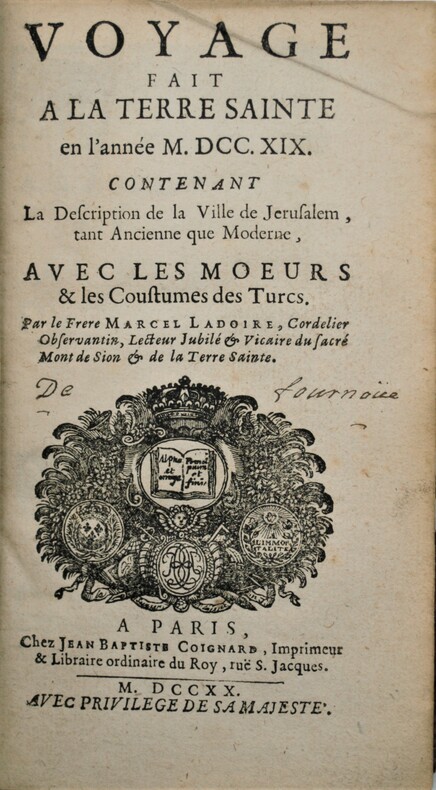
1720PHO-9761720, à Paris chez Jean Baptiste Coignard , In-12,7ffnch - 398pp- relié plein veau brun, dos à nerfs orné, pièce de titre (petit manque) , tranches mouchetées , coiffes arasées , coins usés(Reliure de l'époque).
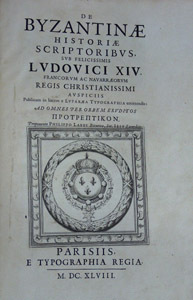
1648HI246Parisiis, e typographia regia -curante Sebastiano Cramoisy- 1648. Folio, 1f, 59, 12, 220,, 161, 191, 1f. En-tetes, initiales decorees, pages de titre, culs-de-lampe, grandes vignettes graves sur cuivre. Textes grec et latin. Rel. plein veau contemp., ecusson de cardinal au milieu des plats, roulette doree, ex-libris grave, dos a nerfs decore, exemplaire propre, non-lave.
96662Paris, Librairie Archéologique de de Victor Didron, 1861, 1 volume in-folio de 320x250 mm environ, 240 pages + 3 planches (dont 2 double page), broché sous couverture illustrée, feuillets non coupés. Manque de papier sur le coin supérieur de la page de faux-titre, quelques rousseurs, couverture insolée avec dos fendillé, sinon bon état.
0666906203.Gpaperback. Good. Access codes and supplements are not guaranteed with used items. May be an ex-library book. paperback
52179N° 4 - Première année - octobre-décembre 1926 - Paris. Rédaction et administration : 45, boulevard Beaumarchais (IIIe) - revue illustrée - hors-texte - in-4 boché
1981BN110682Dumbarton Oaks Center for Byzantine Studie 1981. 1981. Hardcover. Nicholas I. Patriarch of Constantinople : Miscellaneous Writings <br/><br/>Nicholas I. Patriarch of Constantinople : Miscellaneous Writings Dumbarton Oaks Center for Byzantine Studie hardcover
Fine Fine Turkish Yayincisinin özgün sömizli cildinde. 4to. (32 x 24 cm). In Turkish. 176 p. 25 adet büyük boy katlanir harita. Halkali sulari.", KÂZIM ÇEÇEN, ISKI / Istanbul Büyüksehir Belediyesi, Ist., 1991. -- Osmanli medeniyeti Istanbul Halkali Bizans Su kültürü Mimari Sehircilik.
Fine English Paperback. Pbo. Roy. 8vo. (24 x 17 cm). In Turkish. 88 p., b/w and color ills. Istanbul Teknik Üniversitesi'nin kisa tarihçesi. Short history of Technical University of Istanbul.
Fine English Paperback. Roy. 8vo. (24 x 17 cm). In Turkish and abstract in English. [xx], 292, [1] sayfa, 2 folding maps, numerous b/w plts. First Edition. Istanbul'da Osmanli devrindeki su tesisleri.= [Water intakes, water plants in Istanbul during the Ottoman period]. OTTOMANIA Water supply systems Ottoman culture Constantinople - Istanbul Byzantium Urbanization City planning.
Fine Fine English Original bdg. Dust wrapper. 4to. (30 x 21 cm). In English. 217, [1] p., color and b/w ills., 9 folding plans and maps. Sinan's water supply system in Istanbul. e.; Tugra of Sultan Suleiman the Magnificent.; Sinan's Tomb and Its Inscription.; The civilization of Water and Greenery: Recep Tayyip Erdogan Mayor of Greater Istanbul Municipality.; Water And Art: D. Veysel Eroglu.; Director General Istanbul Water and Sewage Disposal Administration.; preface. Water Supply System of Istanbul in the Late Roman and Byzantine Period. Raman and Byzantine Period 1.2. Documents on the Byzantine Period.; The Period of Suleiman the Magnificent and the Water Demand of Istanbul. 2.1 A General View of the Period of Suleiman the Magnificent 2.2.The Population of Istanbul at the Time of Suleiman the Magnificent and the Water Demand of the City 2.3. The Ottoman Water Supply Systems Built in Istanbul Before the Kirkcesme System 2.4. Sinan's Life 2.5. Sources of Information on the Construction of the Kirkcesme System 2.5.1. Architect Sinan and the Search for A Solution to the Water shortage in Istanbul at the Time of Suleiman the Magnificent 2.5.12 The Description of the Construction of the Kirkcesme Water System by Architect Sinan in Tezkiretü'l-Bünyan 2.5.2. Destruction of the Kirkcesme Water Supply by the Flood of 1563 2.5.3. Aqueducts Demolished by Floods (Topkapi Museum Archives E. 12005) 2.5.4. The Cost of the Kirkcesme System. III. The Kirkcesme Water Supply System Outside the City and the Water Supply Line 3.1. The Water Supply Line of the Kirkçesme System and the Related Documents 3.1.1. The East Branch of the Kirkcesme Water Supply Line. 3.1.2. The West Branch of the Kirkçesme Water Supply Line 3.1.3. Bashavuz (Mainpool) 3.1.4. The Water Supply Line from Bashavuz to Güzelcekemer Aqueduct 3.1.5. Cebecikoy Branch 3.1.6. The Water Supply Line from the Güzelcekemer (Gozlüce-Gonince) Aqueduct to the Egrikapi Distribution Chamber 3.2. Additional Lines of the Kirkcesme System 3.3. Monumental Aqueducts 3.3.1. The Uzunkemer Aqueduct 3.3.2. The Kovukkemer or Kirkkemer Aqueduct 3.3.3. The Maglova or Muallak "Suspended" Aqueduct 3.3.4. The Gozlücekemer or Güzelcekemer Aqueduct 3.4. Dams of the Kirkcesme System 3.4.1. Topuz Dam (Karanlik Dam, Komürcü Dam, Osmanli Dam) 3.4.2. The Büyük Dam (Belgrade Dam, Big Belgrade Dam) 3.4.3. The Kirazli Dam 3.4.4. The Ayvad Dam 3.4.5. The Cebecikoy Dam (Ahmed HI Dam) IV. The City Network and Fountains of the Kirkcesme Waters 4.1. General Information 4.2. City Distribution Network 4.2.1. Galleries4.2.2. The Service Regions of Kirkcesme 4.2.3. Main Distribution Chambers . 4.2.31. Savaklar (Egrikapi) Distribution Chamber 4.2.32. The Tezgahcilar Distribution Chamber 4.2.33. The Eyüp, Azaplar, Sulukule, Hagia Sophia Distribution Chambers 4.3. Documents Referring to the Distribution of the City Waters 4.3.1. The Distribution Book of the Kirkcesme and Kagithane Waters of Istanbul . Written by Architect Sinan in 976 H. (A.D. 1568-69) 4.3.2. The 1127 H. (A.D. 1715) Distribution Scheme of the Kutce§me Waters of Istanbul.
Very Good English Paperback. Pbo. Roy. 8vo. (24 x 17 cm). In Turkish and abstract in English. [iv], 91 p., 19 folding plates. Süleymaniye suyollari.