Talbot Rice DavidLivre Rare Book
2 100 résultats
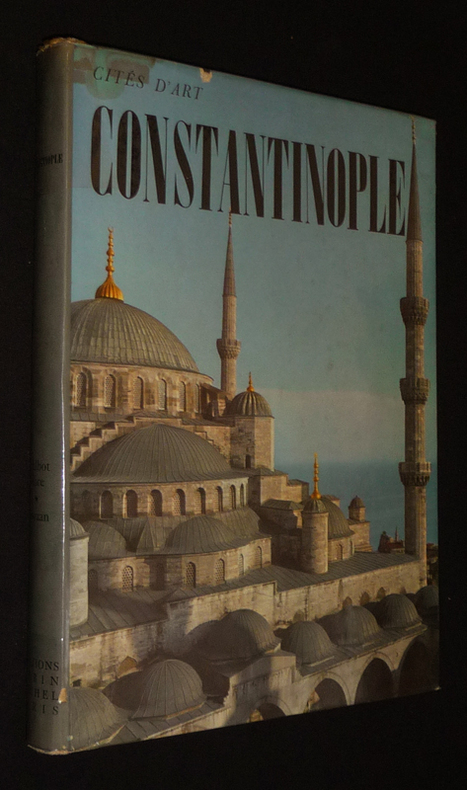
1965mz810Albin Michel Cités d'art Cartonné avec jaquette 1965 In-4 (21 x 28 cm), cartonné avec jaquette, 213 pages ; mouillure sur l'envers de la jaquette (visible au dos en tête et sur l'envers), petites déchirures sur le bord supérieur de la jaquette, assez bon état général. Livraison a domicile (La Poste) ou en Mondial Relay sur simple demande.
47013La Boite à Documents.1990.In-8,couv.souple ill.en couleurs.466 p. TBE.
198985652Genève Athènes, Centre orthodoxe du patriarcat oecuménique , E. Tzaferis 1989 In-folio. Reliure pleine toile toile grenat, jaquette illustrée en couleurs, étui carton illustrée, 374 pp., 463 reproductions, plans et figures en couleurs. Emboîtage défectueux, sinon très bon.
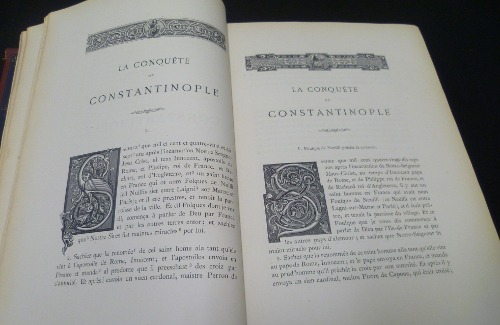
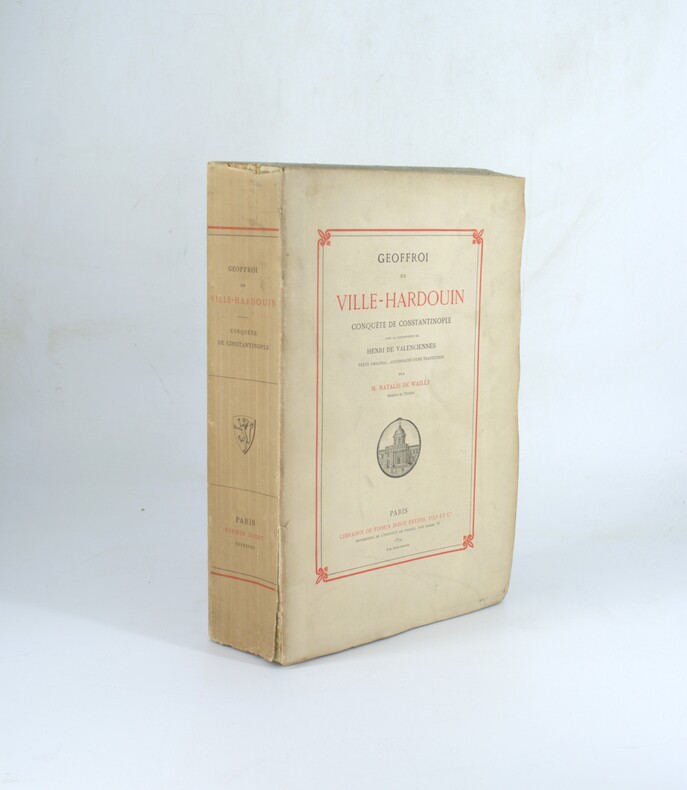
1874pl1959Librairie Firmin-Didot et Cie Relié 1874 Grand in-8 (18.5x28 cm), demi-maroquin rouge à coins, auteur et titre dorés au dos à nerfs orné de dorures, tête dorée, 2e édition, (XXIV)-616-23 pages, une gravure couleurs en frontispice, texte original accompagné d'une traduction par Natalis de Wailly, préface de l'auteur, bandeaux et lettrines en début d'ouvrage, quelques illustrations noir et blanc hors-texte ; coiffes et coins frottés, nerfs un peu frottés, intérieur frais, bon état. Livraison a domicile (La Poste) ou en Mondial Relay sur simple demande.
1874PHO-2270Paris, Firmin Didot, 1874. In-4° de xxiv, 616 pp. Frontispice en couleur et 1 carte dépliante. Brochage éditeur. Tirage de luxe à 220 exemplaires sur papier à la forme, celui-ci n° 122. Petite déchirure au dernier plat, petite fente et léger
16709Paris, Librairie de Firmin-Didot et Cie, 1882. In-4 ; demi-chagrin rouge, dos à 4 nerfs, plat avec l'écusson du Lycée Henri IV ; faux-titre, fronstipice couleurs et page de titre imprimée en noir et rouge - XXIV pp (préface, notice sur la présente édition, note explicative de la carte, observations sur les culs-de-lampe et autres ornements), 616 pp.
3835In 8 demi-cuir vert,titre doré,filets à froid,faux-titre, frontispice illustré et gravé(massacre des Janissaires) titre,374 pages,une carte dépliante en couleurs (Basse-Egypte et Syrie)Charles Noblet 1856.Une mouillure angle inférieur droit en marge jusqu’à la page 93,rousseurs habituelles.Le frontispice et la page de titre ont été placés par erreur,par le relieur,après la page 16(?)
4388Paris, Imprimerie d'Adolphe Blondeau, 1854, deuxième édition revue et corrigée par Charles Hertz, reliure demi-basane vert foncé , dos lisse, titre et faux-nerfs dorés, 13,5x21,5 cm, 378 pages.
18589835Paris Typographie De Gaittet et Cie 1858 In-8 Fort 374 pp, 5è édition revue et corrigée par Charles Hertz. Un portrait en frontispice et une carte dépliante gravés. Coupures et manques de papier au dos, brochage fragile ; ensemble du brochage passé et frotté. Rousseurs éparses, faible mouillure.
185613674P., Henri et Charles Noblet, , 1856, in-8°, 374 pp, un portrait de l'auteur en frontispice, une gravure et une carte dépliante hors texte, reliure demi-chagrin vert, dos lisse à faux nerfs filetés et soulignés à froid, titres dorés (rel. de l'époque), qqs rousseurs, bon état (Lorentz IV, 615)
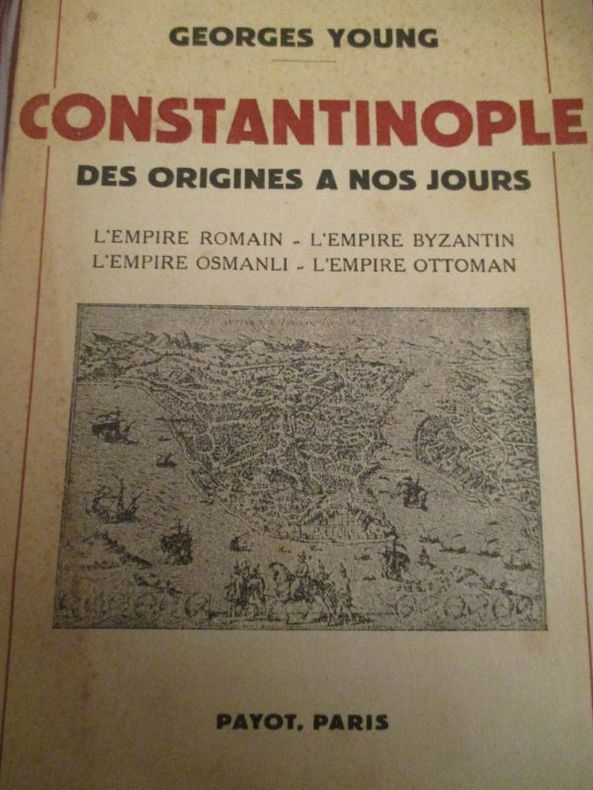
4104Broché - 14x22.5 - 391 pp - 1934 - éditions PAYOT, Paris. avec un plan de CONSTANTINOPLE.Traduit de l'anglais par M. DARD et M. TENINE.collection " bibliothèque historique".
2406payot 1948 in 8 broché 323 pages 1 plan
Fine English Paperback. 12mo. (17 x 11 cm). In French. [8], 37, [5] p. Conclusions des reunions de la mission du 23 au 26 Juin, 1913. 2 stamps of 'Bibliotheque des Aug. de l'assomp., Kadi-Keuy'.
Paris, Librairie de Firmin-Didot et Cie, 1882. In-4 ; demi-chagrin rouge, dos à 4 nerfs, plat avec l'écusson du Lycée Henri IV ; faux-titre, fronstipice couleurs et page de titre imprimée en noir et rouge - XXIV pp (préface, notice sur la présente édition, note explicative de la carte, observations sur les culs-de-lampe et autres ornements), 616 pp. Texte original avec la traduction en regard. Edition ornée de lettres intiales et de bordures empruntées aux manuscrits du XIIe et du XIIIe siècle et accompagné d'une carte géographique dépliante en noir et blanc sur fond vert, dressée par Auguste Longnon et gravée par Erhard (en fin d'ouvrage). Planches hors-texte, culs-de-lampe. Bel exemplaire (sans rousseurs).
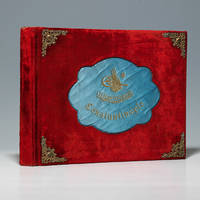
18901031341890. PHOTOCHROM ZURICH. Constantinople. Zürich: Photochrom Zürich circa 1890. Oblong folio 16 by 12 inches 30 photochrom images each measuring approximately 9 by 6-1/2 inches and mounted on heavy cardstock; original red velvet blue silk gilt-lettered title centerpiece on front cover brass cornerpieces. $4500.Rare photographic album of Constantinople circa 1890 by the renowned studio of Photochrom Zürich with 30 beautiful mounted vintage photochrom color prints offering exceptional views of majestic mosques palaces and plazas as well as the people of this great city in magnificent velvet binding with brass furniture.This splendid souvenir album of Constantinople contains exquisite color photographic prints of images taken at the turn of the 20th century produced by the revolutionary photochrom process. Photochrom also called the Aäc process is ""a very successful form of color photolithography developed in the late 19th century by the Swiss firm of Orell Füssli and used mainly for topographical views; photochroms have almost the appearance of color photographs but through a glass will show a delicate ink pattern which was achieved by a combination of photographic and manual work on grained i.e. lithographic stones being a forerunner therefore of modern screenless offset lithography"" Gascoigne 206. In this process black and white photographic negatives were directly transferred onto lithographic printing plates to produce color prints. These photographs are a high point in late 19th-century photography when albums such as these captivated a world newly spellbound ""by photography's capacity to 'take them there' and bring them directly in contact with the long ago and far away"" Parr & Badger I:18. Each image captioned with a four-digit number followed by ""P.Z."" for Photochrom Zürich and then the title of the scene in French. A few instances of marginal spotting to mounts; photochrom prints clean and fine with vivid colors. Binding splendid. An about-fine copy of this lovely album. unknown
Fictional account of Constantine, and the conversion to Christianity after the Battle of Milvian Bridge. Book
Folio 89p., illus. Purnell Library of Knowledge series Hardcover Very good condition
Facsimile of the edition first published by Methuen, London 1926) 310p. index. Name of previous owner on ffep. else as new. Book
New English Paperback. Pbo. Roy. 8vo. (24 x 17 cm). In French. [2], 317, [1] p., 8 color plts. Constantinople - Istanbul en 1852. Texte presente et annote par Jacques Hure.
6 pages. Average wear. A sound copy. Sheet music
Remainder mark to bottom of textblock. Minor shelfwear. DJ has creasing along top edge now in plastic sleeve. ; Harvard Historical Studies, V. 88; 390 pages; At the age of twenty-two, Andronicus II became sole ruler of Byzantium. His father, Michael VIII, had been a dashing figure--a good soldier, brilliant diplomat, and the liberator of Constantinople from its fifty-seven-year Latin occupation. By contrast Andronicus seemed colorless and ineffectual. His problems were immense--partly as a result of his father's policies--and his reign proved to be a series of frustrations and disasters. For forty-six years he fought to preserve the empire against constant encroachments. When he was finally deposed in 1328 by his grandson and co-emperor, Andronicus III, almost all of Asia Minor had been lost to the Turks, Westerners had taken over the defense of the Aegean, and the Catalan army he had invited to help him fight the Turks remained to fight the emperor. In this penetrating account of Andronicus' foreign policy, Angeliki E. Laiou focuses on Byzantium's relations with the Latin West, the far-reaching domestic implications of the hostility of western Europe, and the critical decision that faced Andronicus: whether to follow his father's lead and allow Byzantium to become a European state or to keep it an Eastern, orthodox power. The author, who argues that foreign policy cannot be understood without examining the domestic factors that influence, indeed create, it, devotes a large part of her study to domestic developments in Byzantium during Andronicus' reign-the decline of the power of the central government; the spread of semi-independent regional authorities; the state of finances, of the army, of the church. She concludes that, contrary to common opinion, Andronicus II sincerely desired the union of the Greek and Latin churches, when, in the last years of his reign, he realized that the political situation made such a union necessary. Maintaining also that the conquest of Asia Minor by the Turks was not a foregone conclusion when Andronicus II came to the throne, she discusses at length the errors of policy and the manifold circumstances which combined to precipitate that loss.
New English Paperback. Pbo. 4to. (29 x 24 cm). In English. 331 p., b/w and color ills. Constantinople and the orientalists. Since the publication of our earlier study; 'Orientalism and Turkey', we have been exploring the ramifications of Orientalism in the Ottoman capital of Istanbul itself, or as it was generally known in the nineteenth and early twentieth century: Constantinople. The present study, documented by both visual and written records, including memories, reveals not only the ways in which Istanbul was perceived and portrayed by European artists in the nineteenth century, but it also tries to represent the contemporary city as it truly lived and breathed. In the present work, the reader will discover the identity of Western artists whose works pictorially limned the Ottoman capital, their favorite subjects ¿the harem, the bath, the coffeehouse, and the slave market- and the nature of their interpretation of these subjects.
Very Good English Paperback. Pbo. 4to. (29 x 24 cm). In English. 331 p., b/w and color ills. Constantinople and the orientalists. Since the publication of our earlier study; 'Orientalism and Turkey', we have been exploring the ramifications of Orientalism in the Ottoman capital of Istanbul itself, or as it was generally known in the nineteenth and early twentieth century: Constantinople. The present study, documented by both visual and written records, including memories, reveals not only the ways in which Istanbul was perceived and portrayed by European artists in the nineteenth century, but it also tries to represent the contemporary city as it truly lived and breathed. In the present work, the reader will discover the identity of Western artists whose works pictorially limned the Ottoman capital, their favorite subjects ¿the harem, the bath, the coffeehouse, and the slave market- and the nature of their interpretation of these subjects.
New New English Original bdg. Dust wrapper. 4to. (29 x 24 cm). In English. 331 p., b/w and color ills. Constantinople and the orientalists. Since the publication of our earlier study; 'Orientalism and Turkey', we have been exploring the ramifications of Orientalism in the Ottoman capital of Istanbul itself, or as it was generally known in the nineteenth and early twentieth century: Constantinople. The present study, documented by both visual and written records, including memories, reveals not only the ways in which Istanbul was perceived and portrayed by European artists in the nineteenth century, but it also tries to represent the contemporary city as it truly lived and breathed. In the present work, the reader will discover the identity of Western artists whose works pictorially limned the Ottoman capital, their favorite subjects ¿the harem, the bath, the coffeehouse, and the slave market- and the nature of their interpretation of these subjects.
Fine English Paperback. 4to. (30 x 21 cm). In English. 49, [1] p., 16 numerous b/w plates, 1 folded map. Constantinople during the era of Mohammed the Conqueror, 1453-1481 (Maps, explanations, indices).