Szczypiorski, AndrzejAntiquariat.de

345 résultats
1988005831Zürich, Diogenes, 1988. 268 S.; 6. Aufl.; allenfalls angelesen, sauberes Expl. Leinen 18,8 cm Tadelloser Schutzumschlag Tadellos
8vo., First Edition thus, page-edges very slightly browning; original black cloth, backstrip lettered in silver, a near fine copy in price-clipped dustwrapper. Bright copy of the book that forms the basis of Roman Polanski's Oscar-winning feature film (2002) starring Adrien Brody. SCARCE IN THIS CONDITION.
in-16 broché, couverture illustrée Bon état. [LP-7]
192621554Paris, Marcelle Lesage, 1926 ; in-16, broché ; 72, [1] pp., couverture gris clair rempliée, titre en rouge dans un triple encadrement noir et rouge.
980Paris, Plon - 1927 - In-8 ° broché - Avant-Propos I à VII - 282 pages; Etat moyen
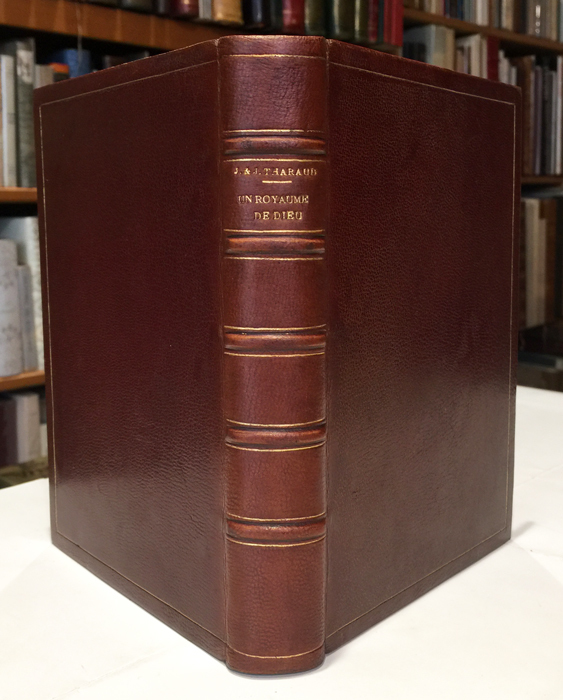
193321864Paris, Plon, collection Byblis, 1933 ; in-8, chagrin maroquiné prune, dos à nerfs soulignés de filets à froid et dorés, titre doré, filet doré d'encadrement des plats, double filet doré d'intérieur, tête dorée, non rogné, couverture imprimée en orange et noir et dos conservés (rel. de l'époque) ; 208 pp., [4] ff. les 2 derniers blancs, 12 compositions hors-texte en couleurs, avec serpentes, de Manuel Orazi, y compris le frontispice.
Paris, Plon - 1927 - In-8 ° broché - Avant-Propos I à VII - 282 pages; Etat moyen
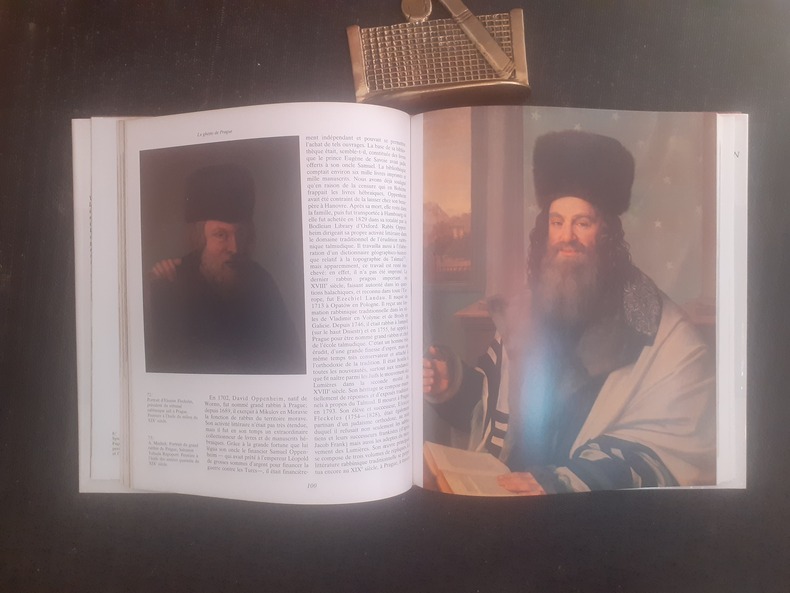
1983617256The State Jewish Museum in Prague, Prag 1983. 23,8 x 17 cm. White, illustrated original booklet, outside stained a bit. (52) pages with introduction by Markéta Petrásová, texts, short biographies and b/w illustrations, many full-page. Inside clean copy in good condition.
194032897Litzmannstadt [um 1940], (Buchhandlung S. Seipelt). Gefaltete Karte. 99 x 68 cm. Wenige Bruchstellen an den Falzen. Gering gebräunt. Guter Zustand.
Mm 160x240 Brossura editoriale con sovraccoperta illustrata a colori, 491 pagine con alcune tavole in nero fuori testo. Opera in ottime condizioni. SPEDIZIONE IN 24 ORE DALLA CONFERMA DELL'ORDINE.
Milano, Mondadori, 1971, 16mo brossura con copetina illustrata a colori, pp. 677 (Oscar) .
196235362juMünchen, Kindler, 1962. Leinen, mit Schrift-Deckelprägung, ca. DinA 5, 780 Seiten, 1 sw-Skizze im Anhang, farbig illustrierter Originalumschlag / Schutzumschlag / OU (randrissig, berieben und bestoßen), Einband mit geringen Gebrauchsspuren, Rücken an den Enden mit leichten Gebrauchsspuren, gering berieben und bestoßen, Schnitt und Seiten papierbedingt gebräunt, Kuli-Namen und Datum auf dem Titelblatt, abgesehen vom Umschlag insgesamt gut erhalten / insgesamt guter Zustand [4 Warenabbildungen]
Over 200 pages. Abundantly illustrated in black and white. Includes contributions from: Ruta Sakowska, Marek Edelman, Jan Karski, Franz Blattler, and Maria Kann. Clean and bright with negligible wear. Unmarked but for Warsaw Ghetto ink stamp dated 1998 upon title page. A premium copy. Book
QWA-17271Aurore Editions d'Art, 1990, in-4 rel. toile (23,5 x 28), 232 p., traduit par Françoise et Karel Tabery, illustrations en n. et en coul., jaquette, très bon état.
198317088München ; Wien : Hanser 1983. XXXIII, 179 S. : 180 S. Abb. ; 31 cm, mit Schutzumschlag Gewebe, gebundene Ausgabe, Leinen, Exemplar in gutem Erhaltungszustand, Neupreis in DM: 168,--
19961057209München: Kindler Verlag, 1996. 213 Seiten; sehr zahlr. Illustrationen (Fotografie); 30,5 cm; fadengeh. Orig.-Pappband mit illustr. OUmschlag.
19841045854Frankfurt: Zweitausendeins, 1984. XXXIII, 179 S. Originalbroschur.
199316023München, Kindler, 1993. Pappeinband, Schutzumschlag, 4°, Querformat, ganzseitige, fotografische s/w-Abbildungen, 116 Abbildungen; -sehr gutes Exemplar.
A clean, unmarked book with a tight binding. Previous owner's name inside. Full beige cloth boards with gilt and black drawing on cover. Previous owner's name inside. 7 3/8"w x 11"h. 82 pages. Color illustrations. Circa 1962.
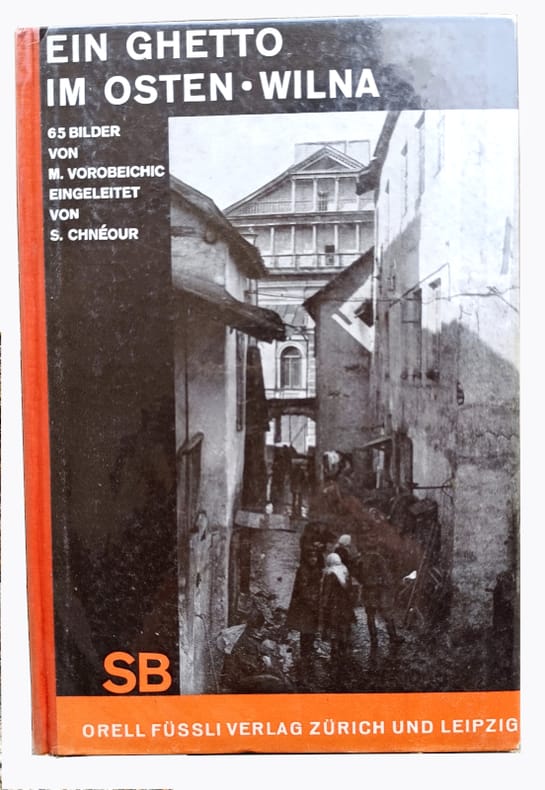
1931ec43Orell Füssli Verlag Cartonnage 1931 DOCUMENT PHOTOGRAPHIQUE RECHERCHÉ SUR LE GHETTO DE VILNIUS DONT LA POPULATION QUI QUASIMENT ENTIÈREMENT EXTERMINÉE PAR L'ALLEMAGNE NAZI. Livre de photographies de 1931, In-8 (3 cm sur 19,4 cm), couvertures illustrées, dos toile orange, 7 pages d'introduction en allemand, suivi de 64 planches (certaines planches comportent plusieurs photographies) de photographies hors-texte. Le livre à pour quatrième de couverture, la couverture en yiddish puis la traduction du texte d'introduction de 7 pages en yiddish également, le livre peut donc être pris dans les deux sens ; bel exemplaire. Livraison a domicile (La Poste) ou en Mondial Relay sur simple demande.
198471930Berlin, Edit.Hentrich Frölich&Kaufmann, 1984. Origi.Broschur, 8°, 64 Abbildungen. Reprint Ausgabe von 1931.
1945STAN0099Praha, Delnicke Nakladatelstvi 1945. 22x15cm. 80 unpaginierte lose Seiten, 27 ganzseitige photogr. Abb., in ill. OUmschlag. Umschlag gering randrissig u. rückseitig etwas stockfleckig, sonst sehr gut erhalten. Die erste Bilddokumentation aus dem befreiten KZ Theresienstadt. Von großer Seltenheit.
197357092Mailand, Mondadori, 1973. Storia degli Ebrei di Roma 395 S. (22x17 cm) Pappband mit Umschlag / gebundene Ausgabe
Le Scie. Prima edizione.<BR>Traduzione di Giacometta Cantatore Limentani.<BR>In 8°; pp. 395 con 49 illustrazioni fuori testo; cartonato editoriale con titoli oro al dorso e sovraccoperta illustrata; cucito.<BR>CONDIZIONI PIù CHE DISCRETE (segnaliamo la consueta forte ingiallitura delle pagine dovuta alla qualità della carta e lieve sentore di umido).
1946MMRM1658Varsovie:: American Joint Distribution Committee 1946. 1946. 8vo. 264 4 pp. 11 black and white photographic plates 50 tables charts index. Original printed wrappers; scotch tape along spine front and rear covers age-darkened first 3 pages including half title and last three blank end-papers are loose. Main body of work remains bound and in good condition. Loose pages have some slight area of extremities missing. Some fading and foxing to pages. Thus wrappers poor but text good to good plus. First edition. SEMINAL WORK IN MEDICAL CLINICAL RESEARCH & A CRITICAL ARTIFACT OF THE WARSAW GHETTO AND HOLOCAUST. Copies of the book are uncommon in part because of the fragile nature of the paper used to publish the report. In the immediate aftermath of World War II paper ink and binding facilities in Europe were scarce. The published report was done with economy in mind and with a rushed sense of needing to reveal to the world what happened. / Six articles report on the clinical research by 28 Jewish physicians and a student intern the 1946 book only records the names of 21 physicians and the student – subsequent research in the 1960s revealed the additional names who conducted the studies on adults and children at the two Jewish hospitals in the Ghetto. Abbreviated biographies of the physicians can be found in The Uses of Adversity: Studies of Starvation in the Warsaw Ghetto by Leonard Tushnet published in 1966. The physicians hoped to study these patients to somehow benefit humanity perhaps in the spirit of the Jewish concept of tikkun olam - to repair the world. The studies were conducted in secret since any scientific research in the Ghetto was prohibited by the Nazi overseers. It is also quite possible that many if not all the clinical physicians believed that granting children and others the status of being a patient would protect them by preventing their transport out of the ghetto to death camps. Theories also suggest that the physicians wanted to preserve a record of the atrocities being committed as well as advance medical research. The studies remain the most comprehensive research of the effects and progression of starvation in part because any contemporary studies would largely be blunted by existing ethical guidelines for informed consent and subject welfare. Contemporary debates about the ethical wisdom of conducting these studies remains contentious. / The Warsaw Ghetto occupied approximately 1.3 square miles 3.4km2 and its population was as much as 500000 men women and children. The Ghetto was a staging area for transporting Polish and Eastern European Jews to the death camps and a locale for starving to death Jews prior to transport. The average daily caloric intake of a resident of the Ghetto was 600 to 800 calories of low-protein food for adults. This amount was calculated by Adolf Eichmann to starve-to-death most of the residents in approximately nine months. The physicians performing the research were no exception to the plan. All were starving as they performed their studies. Equipment for clinical research was smuggled into the hospitals. / Each article in the book is devoted to specific results of these studies. Chapter V offers autopsy results on 710 patients; 492 died of starvation and 218 died of complications of secondary conditions. Chapter VI offers clinical observations of one-hundred adults who died from starvation. Chapter VII offers clinical observations of 40 children who died of starvation. Chapter VIII examines the effects of starvation on the cardiovascular system in adults and children. Chapter IX discusses changes in peripheral blood and bone marrow. Ophthalmic responses to starvation are discussed in Chapter X. Only one doctor engaged in the research Emil Apfelbaum survived the war. He arranged to have the studies smuggled out of the Ghetto to a Polish professor of medicine who released the reports after the liberation of Warsaw. After the war Apfelbaum edited the report for publication by the Joint Distribution Committee. He died a week before the book was published. / Research was performed at the two hospitals in the Ghetto from late February to July 22 1942. On July 22 the hospitals were closed and any patients unable to be transported were summarily executed regardless of age. The attending and clinical physicians were fully aware of the fate awaiting transported patients and in many instances they performed euthanasia on elderly and child patients who were scheduled for transport. Some of the physicians committed suicide rather than face transport. Other physicians accompanied their patients to the death camps providing whatever aid they could. / The studies were smuggled out of the ghetto in a manner befitting a Ken Follet thriller. A Jewish physician Henryk Fenigstein played a crucial role. "Before the war Henryk was a stamp collector. In fact he had one of the largest collections of Polish stamps in the country. One day two SS members arrived at the hospital and told Henryk to come with them to Gestapo headquarters. Of course he was terrified. Jews taken to Gestapo headquarters did not return. On arrival he was taken to the office of a senior officer who told him that he himself was an avid stamp collector. He took out a list and handed it to Henryk. He wondered if Henryk had these stamps and if not if he knew where to procure them. Henryk told him that he had many of the stamps including some of the very rare ones. He told him that he thought he could procure the rest. In order to do this he would need a pass to get out of the ghetto for a few hours each week. And of course the SS officer was welcome to those that he had. The officer agreed and even gave Henryk his phone number in case he needed any help. Thus Henryk Fenigstein a key member of the study team was able to leave the ghetto" 2005 lecture Myron Winick. During such an outing Fenigstein arranged for the smuggling of the reports. A pregnant woman reportedly was used to hide the documents and transport them out of the ghetto. / The supervising physician of the project Israel Milejkowski wrote in his Introduction to the studies that each author refused to allow the Nazis to destroy their work and that through the research and the publication of that research "Nous avons termine nos Recherches et nous les conserverons bien comme c'etait Ton desir. Les paroles immortelles que Tu a jetees "Non omnius Moriar" doivent etre en premier lieu appliquees a Toi! Gloire eternelle a Ta Memoire !" / The research as well as results from the Minnesota Semi-Starvation studies of 1944-1945 continues to benefit the millions of persons facing starvation each year. The participants in the Minnesota study lost an average of 25% of pre-test body weight and the final phase of the study included recovery techniques and methods. The Warsaw studies measured effects until death. This artifact of scientific integrity individual bravery and resistance to oppression is a rare opportunity to truly own a small piece of history illuminating the courage of physicians determined to use their craft to help the world and advance the memory of atrocities. American Joint Distribution Committee, 1946. unknown books