Sample, JoeMareMagnum

345 résultats
80 pages. Songs include: Ashes to Ashes; Born in Trouble; Born to be Bad; I'll Love You; The Last Child; Mother's Eyes; Phoenix; The Road Less Traveled; Strike Two. "These title alone evoke a vivid picture of inner-city life, made more tangible by Sample's achingly beautiful musical visions." - from page 5. Clean and unmarked with light wear. A quality copy. Book
80 pages. Features: The Credit Spy Can Ruin You; Canada, Too, Does Her Bloody Bit in Vietnam; Great one-page colour Aislin caricature of Mohn Munro contemplating the legalization of pot/marijuana; One page Volvo car ad with snowy road photo; Joe and Jarusewich have not seen each other for forty years; How Women in Power Keep Other Women Powerless; Water - The Sellout That Could Spell the End of Canada; A Glimpse of Nines to Come - photo-illustrated article on Gordie Howe and his sons; Why Settle for One World When Turkey Offers Two?; Your Guide to the Medicare Maze; Architect Ray (Raymond) Moriyama - A Designing Man with Seduction On His Mind; Snow, Saunas and Swimsuits - article with with six nice colour photos of bikini-clad young ladies in sauna and snow; Car Races That Don't Kill - cars on the ice track at Young's Point, Ontario - with photo of driver Chris Cossette; Toshiba TV ad features illustration of young lady carrying radio with strap over her shoulder - predecessor to the ghetto blaster?; Article on NFB (National Film Board) and its rumoured demise; Review of book 'The Poverty Wall' by Ian Adams; News fight between CTV and CBC; How Bureaucrats Deal With Such Rebels as Riel and David Ward. Somewhat above-average wear with five-inch opening to mid-portion of cover fold and short opening to fore-edge of front cover. A sound vintage copy. Book
Over 200 pages. Abundantly illustrated in black and white. Includes contributions from: Ruta Sakowska, Marek Edelman, Jan Karski, Franz Blattler, and Maria Kann. Clean and bright with negligible wear. Unmarked but for Warsaw Ghetto ink stamp dated 1998 upon title page. A premium copy. Book
1988BN258021Frankfurt am Main : S. Fischer 1988. 1988. Hinaus aus dem Ghetto : Juden in Frankfurt am Main ; 1800 - 1950 ; Begleitbuch zur ständigen Ausstellung des Jüdischen Museums der Stadt Frankfurt am Main. Rachel Heuberger ; Helga Krohn <br/><br/>Hinaus aus dem Ghetto : Juden in Frankfurt am Main ; 1800 - 1950 ; Begleitbuch zur ständigen Ausstellung des Jüdischen Museums der Stadt Frankfurt am Main. Rachel Heuberger ; Helga Krohn Ghetto / FFM - Heuberger Rachel und Helga Krohn Frankfurt am Main : S. Fischer unknown
Firenze, Libreria Bodoniana (Via Panzani, 5), 1875, in-24, br. editoriale cilestrina con copertina posteriore fittizia, pp. 48. Almanacco dal tono beffardo (evidente fin dalla presentazione a firma d'un tale "Scelmò-Ben-Cimicì, che indica "Moscé Birbichim" come autore delle "canzoni" a seguire) che raccoglie testi già presenti nella memoria popolare fiorentina come antisemiti, ma con registro più irridente che insolente; Lo "Sposalizio" è una satira delle nozze ebraiche pubblicata per la 1a volta nel 1752 (si ricorda che il ghetto di Firenze, a ridosso del Mercato Vecchio, fu istituito da Cosimo I nel 1571 ed aperto nel 1835, per esser poi abbattuto nell'opera di risanamento di Firenze capitale); gli altri testi ebbero qualche edizione ottocentesca, sia a Lucca (F.Bertini), che a Bologna e Firenze (Salani); ultima versione dello "Sposalizio", ma con registro ben diverso è la commedia (una sorta di Acqua cheta" in versione yiddish) che Moshe David Cassuto e figli sotto lo pseudonimo di Bené Kedem, ne hanno tratto, valorizzando il tema popolare coll'uso del bagitto, dialetto usato dagli ebrei toscani. Molto raro.
1st edition. Original Paper wrappers, 8vo, 206 pages. Includes illustrations & facsimiles. 21 cm. In Yiddish. Title translates as, "The Ghetto in Flames: An Anthology." Early report, from the year following the Warsaw Ghetto Uprising, with reporting on the revolt. SUBJECT(S): Jews -- Poland -- Warsaw. World War, 1939-1945 -- Jews. Geographic: Poland -- History -- Occupation, 1939-1945. Warsaw (Poland) -- History -- Warsaw Ghetto Uprising, 1943. OCLC: 1227410408. Clean and fresh. Very good. Important. (HOLO2-98-26A-+)
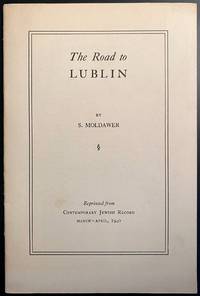
194043325New York: American Jewish Committee 1940. 1st separate edition. Original paper wrappers. 8vo pages 119-133 14 pages total. “Reprinted from Contemporary Jewish Record March-April 1940.†Includes photo of “Armbands which Nazis are compelling the Jews to wear.†Moldawer’s story originally appeared in The Forward N.Y.C. Jan. 2-5 1940 in Yiddish. <br> Moldawer a Polish Jew who had resided in Germany had been caught by the outbreak of the war in Hamburg on his way to the United States. Together with other Jews holding U.S. visas and steamship tickets on the Hamburg-America Line-which had suspended operations-he was deported to Lublin via Prague. Moldawer used his U.S. visa and left Poland in December 1939 and was able to issue this report which became important at the time for understanding what was happening to the Jews in Poland and is often cited in later analysis. <br> <br> “During the Holocaust 99% of the Jews from Lublin District in the General Governorate of German-occupied Poland were murdered along with thousands of Jews who had been deported to Lublin from elsewhere. There were three extermination camps in Lublin District Sobibor Belzec and Majdanek.<br> The ghettoization of the Jews for the purpose of persecution terror and exploitation in the Nazi German controlled towns began immediately after the invasion of Poland….The number of major urban ghettos established in the General-Government in 1939–40 including those of Kraków and Warsaw reached one hundred before the end of the year. In the Lublin area the situation initially differed. Instead of their urban concentration some 10000 Polish Jews had been expelled from Lublin in early March 1940 to the rural towns where ghettos were not set up based solely on Globocnik's opposition to the Jewish people living near his staff headquarters. The remaining 40000 Jews of Lublin were forced into the Lublin Ghetto in May 1940†Wikipedia. <br> SUBJECTS: Nazi concentration camps. World War 1939-1945 -- Jews. Concentration Camps Camps de concentration nazis. Guerre mondiale 1939-1945 -- Juifs. Majdanek Concentration camp. OCLC: 39753405. Touch of edgewear to rear wrapper Very Good Condition Overall. B HOLO2-162-15-AX-BB. New York: American Jewish Committee unknown
194613981Lodzsh: Tsentraler Yidisher Historisher Komisye baym Tsentral-Komitet fun Poylishe Yidn 1946. 1st edition. Later cloth with original dramatic photgraphic cover mounted on front 8vo 70 1 pages 1 l. includes facsimiles. 21 cm. Poems. "Oysgabes fun Der Tsentraler Yidisher Historisher Komisye baym Tsentral-Komitet fun Poylishe Yidn. Serye yidishe literatur 1." <br> A committee dedicated to recording the fate of Polish Jews published this book length poem by Simkhah Szajewics. Written in the Lodz Ghetto it appeared immediately after the war in 1946; Szajewicz perished in a concentration camp in 1944" from the permanent exhibit at the National Yiddish Book Center which houses their copy in their Rare Book Collection. <br> The book actually includes two long poems: "Lekh-lekha" and "Friling 702 " as well as letters and other related material. <br> See David Roskies interesting reflection on this work and it's stunning photographic cover at jtsa.edu/torah/go-forth-the-grammar-of-remembrance. <br> For more about the author-poet see Chava rosenfarb's essay on Shayevitch in Tablet Magazine at tabletmag.com/sections/arts-letters/articles/the-last-poet-of-lodz. SUBJECTS: Jews -- Persecutions -- Poland -- Lódz. Holocaust Jewish 1939-1945 -- Poetry. Jews -- Correspondence. Expertly rebound in attractive black cloth with the original photographic front cover mounted on the front. Very Good Condition. B HOLO2-110-36-CCALX-'emm H-40-10. Lodzsh: Tsentraler Yidisher Historisher Komisye baym Tsentral-Komitet fun Poylishe Yidn unknown
Good Solid condition.; 8vo; 387 pages; In Yiddish. Not in Robinson & Friedman nor Wolff. Jewish partisan's memoirs of resistance against the Nazis in Poland. Illustrated with many photographs throughout. Inscribed by Kaczerginski in year of publication. Kaczerginski (19081954) was a Yiddish writer and cultural activist. Born in Vilna to a poor family and educated at that citys Talmud Torah, Shmerke (Pol., Szmerke) Kaczerginski lost both his parents during World War I. As a youth, he was involved with outlawed Communist groups and was arrested several times, serving a lengthy prison term. In the 1930s, two of his revolutionary poems became popular in Poland. He wrote short stories with a radical bent and was a correspondent and reporter for literary publications, including the semilegal leftist press in Poland and the New York Communist daily Morgn-frayhayt. Kaczerginski played a key role in shaping the writers and artists group Yung-Vilne; he organized its evening events and was the de facto publisher of its three miscellanies between 1934 and 1936. During the period of Soviet control over Lithuania in 19401941, he was even more active in the field of Yiddish culture, but at the same time experienced his first disappointments with the attitude of the Soviet regime toward Jewish culture. During the first period of Nazi occupation, Kaczerginski wandered through villages and towns posing as a deaf mute; after many difficulties, he ended up in the Vilna ghetto. Kaczerginski was very involved in the ghettos cultural activities. As a leader of its youth club, he wrote its Yugnt-himen (Youth Hymn), a song that immediately became popular. In 1943, he wrote the song Shtiler, shtiler in memory of the mass murders committed at Ponar. Set to music that Aleksander Volkoviski (later known as Aleksander Tamir) had submitted to a contest organized by the ghetto, the song was first heard at an evening performance there and over the years became one of the best-known songs of the Holocaust. With Avrom Sutzkever and others, Kaczerginski became part of a group of forced laborers whom the Germans designated to sort Jewish cultural treasures at YIVO and other locations. Known as the Papir-brigade (Paper Brigade), the groups members risked their lives to hide the most significant items, smuggling them back into the ghetto or entrusting them to non-Jewish acquaintances. Kaczerginski was a member of the Fareynikte Partizaner Organizatsye (United Partisans Organization; FPO), and, since YIVOs building was located outside the ghetto walls, he took part in smuggling weapons into the ghetto. In September 1943, Kaczerginski, along with Avrom and Freydke Sutzkever and other members of the FPO, escaped from the Vilna ghetto as part of an organized group of fighters just before its liquidation. They joined a Soviet partisan unit in the Naroch Forests, where Kaczerginski fought as a partisan until liberation in July 1944. Kaczerginskis books describe the destruction of Vilna, the partisan struggle, and his own experiences during the Holocaust period: Khurbn Vilne (The Destruction of Vilna; 1947), Partizaner geyen (Partisans on the Move; 1947), and Ikh bin geven a partizan (I Was a Partisan; 1952) (YIVO, 2010). Wear to cover and edges, very good condition. (HOLO2-87-3A)
193321864Paris, Plon, collection Byblis, 1933 ; in-8, chagrin maroquiné prune, dos à nerfs soulignés de filets à froid et dorés, titre doré, filet doré d'encadrement des plats, double filet doré d'intérieur, tête dorée, non rogné, couverture imprimée en orange et noir et dos conservés (rel. de l'époque) ; 208 pp., [4] ff. les 2 derniers blancs, 12 compositions hors-texte en couleurs, avec serpentes, de Manuel Orazi, y compris le frontispice.
30 pages. Illustrated in black and white. Features: Exploring the Fundamentals in Fundamentalist Columbus, IN; Designing for Change - Innovative Design that Expresses the Changing Christian Community; Unity Temple - a Masterpiece on the way to Restoration; The Sandburg Village Church; A New Church in the Ghetto; and more. Moderate wear. Unmarked. Binding intact. A sound copy. Magazine
96 pages. Features: Stupendous prairie grain harvest - with photo of Alta Atcheson of Saskatchewan; Farmer Fred C. Langmaier of Zehner, Saskatchewan; Photo of Pierre Trudeau yachting in the Mediterranean; Peter Lebensold and his 'The Five Cent Review'; Fortress of Louisbourg; Nice color-photo as for the Mercedes-Benz 280s; Color Quantas ad features photo of Koala under blanket in first class seat; Racial Revolt - why the summer was quiet; Photo of burned-out Newark ghetto two years later; photo of fire and riot in Hartford; Ramson for kidnapped U.S. Ambassador C. Burke Elbrick in Rio; Mary Jo Kopechne inquest delayed; Feature article on the passing of Ho Chi Minh - with photos; Can the hijackers be halted? - already 46 aircraft hijacked this year; Coup in Libya - King Idris is overthrown; Albert Speer - Hitler's personal architect; Isle of Wight music concert - great two-page photo-illustrated article of hippies, Bob Dylan and Marsha Hunt; John O'Brien and Shintaro Okada study Tay-Sachs disease; Charles Templeton is featured in ad for Progress wool fashions for men; Harvey Matusow and the Guerrilla war against computers; James and Diane Pike become lost in the desert near Qumran; Wheat Price War; Restoration of Novgorod Kremlin - article with three pages of color photos of Soviet architecture; Passing of Rocky Marciano, David Karnofsky, Right Reverenc James A. Pike, Josh White, Erika Mann, Drew Pearson, Norman Washington Manley, Betty Gram Swing and Arthur Upham Pope; The Track of the Quarck; One-page illustrated Cominco ad; Toyota Crown ad; and more. Average wear. Unmarked. A sound vintage copy. Book
1909JUDA1745aWien, Braumüller 1909. gr.-8°, XII, 314 S., 1 Bl., OBrosch., Rücken gebräunt, sonst sehr gutes Exemplar (= Quellen u. Forschungen zur Geschichte der Juden in Deutsch-Österreich. II. Band).
281 pages. Extensive footnotes. Fourth printing of the 1961 first edition. "In my own time, governments have taken the place of people. They have also taken the place of God... I have written chiefly of one government in this book - that of the new Jewish state of Israel... I am a Jew. I come of a long, never-broken line of Jews... They did well by the world... What happened to this fine heritage when the Jews finally fashioned a government of their own in Israel; what happened to Jews when they became Jewish politicians, what happened to a piety, a sense of honor, and a brotherly love that 2,500 years of anti-semitism were unable to disturb in the Jewish soul? My answers are in this book." - from Preface. Staining to front endpaper, otherwise contents clean and unmarked. Binding intact. A sound reading copy. Book
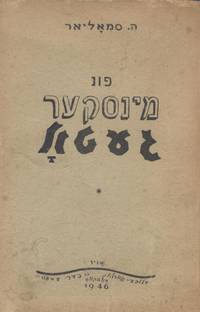
194630905Moskve: Melukhe-farlag "Der Emes 1946. 1st edition. Original Printed Boards Small 8vo 167 pages. In Yiddish. Title translates as "From the Minsk Ghetto." Title also in Russian: Minskoe getto.<br> In 1941 a group of Jews among them the Polish Jew Hersh Smolar; 1905–1993 the author organized a resistance movement in the ghetto in close connection with the Minsk Communist underground led by Isay Kazinets 1910–1942 and Masha Bruskina 1924–1941. Members of the resistance organized acts of sabotage and working together with the Judenrat led by Il’ia Mushkin diverted the production of the ghetto’s workshops and factories to the partisans. An underground printing press issued the leaflet Vestnik rodiny Homeland’s Messenger. <br> The resistance enabled thousands of Jews to escape to the forests where they founded seven partisan brigades one of which in September 1943 organized the assassination of the governor-general of Belorussia Wilhelm Kube. <br> Approximately 10000 Minsk Jews succeeded in escaping from the ghetto a proportion without parallel in Holocaust history. At liberation 13 Jews had survived the ghetto and about 5000 Jewish partisans and their families returned from the forests. <br> In 1945 the first memorial to Jewish victims in Minsk—and the only one in the USSR with a Yiddish inscription explicitly mentioning the Jewishness of the victims—was erected†Bemporad YIVO Encyclopedia of Jews in Eastern Europe. <br> SUBJECTS : Jews -- Persecutions -- Belarus -- Minsk. Holocaust Jewish 1939-1945 -- Belarus -- Minsk -- Personal narratives. World War 1939-1945 -- Jewish resistance -- Belarus -- Minsk. Named Person: Smolar Hersh 1905- Geographic: Minsk Belarus -- Ethnic relations. <br> OCLC: 12284925. Small stain to title page Jewish institutional stamp on final page rear of title page and text block edges no other markings spine neatly rebacked new endpapers Good condition. B YID-17-15-ALBXGGCCOE. Moskve: Melukhe-farlag "Der Emes unknown
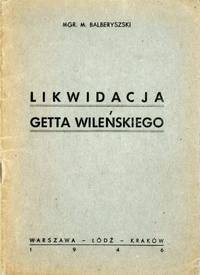
194643329Warszawa; Lódz: Zaklady Graficzne WINW: Centralna Zydowska Komisja Historyczna 1946. 1st Edition. Original Paper Wrappers 8vo 40 pages. 21 cm. In Polish. Title translates as "The Liquidation of the Vilna Ghetto." Includes bibliographical references. <br> Personal eyewitness account by Mendel Balberyszski 1894–1966 a prominent Vilna Jewish leader and later Holocaust survivor detailing life in the Vilna Ghetto and its destruction under German occupation. Balberyszski served on the Advisory Council of the “small ghetto†opposing Judenrat collaborationist policies. He survived both the liquidation of the ghetto and the Holocaust. <br> Balberyszski a Lithuanian-Polish Jewish politician and journalist was prewar editor at Vilna’s Der Tog and active in the Folkspartei and later the Polish Democratic Party. After the war he emigrated to Melbourne where he became a leading communal figure. His memoir was later republished in English as Stronger than Iron: The Destruction of Vilna Jewry 1941–1945 2010.<br> Pages 38-40 detail a list of 35 titles issued 1945–46 by the Historical Commission documenting early postwar Jewish testimony efforts.<br> SUBJECTS : Holocaust Jewish 1939-1945 Lithuania Vilnius. Jewish ghettos Lithuania Vilnius. World War 19391945 Lithuania Vilnius Atrocities. Jews Lithuania Vilnius. OCLC: 13911170. Very Good Condition overall. B H2-3-5-VLGGAMPCCFE-XBB. Warszawa; Lódz: Zaklady Graficzne WINW: Centralna Zydowska Komisja Historyczna unknown
1909JUDA1745Wien, Leipzig, Braumüller 1909. gr.-8°, XII, 314 S., 1 Bl. Vlgsanz., neuer Pappband unter Verwendung des aufkasch. Orig. Umschlags und Rückens, sowie der miteingebund. Orig. Umschlagrückseite, OU. am Seitenrand stark braun- u. wasserfleck. Buchrückseite mit einigen Rasurstellen, Schnitt schwach stockfleck. (= Quellen u. Forschungen zur Geschichte der Juden in Deutsch-Österreich. II. Band). [3 Warenabbildungen]
Original boards. 8vo; 53, 75 pages; Some text in English, some in Yiddish. Nice book Co-sponsored by the Emma Lazarus Federation, the Furrier Joint Council of N. Y. & the Joint Board of the Fur Dressers & Dyers Unions. Bumps to edges. Very Good Condition. (HOLO2-127-6)
1st edition. Original stiff paper wrappers. 4to. 11 sheets of illustrations, 33 cm. In Hebrew, English, and Yiddish, with a Hebrew introduction. Title translates to Children in the Ghetto. An assortment of illustrations from the Warsaw Ghetto. SUBJECTS: Jewish children -- Poland -- Warsaw -- History -- 20th century -- Pictorial works. The US Holocaust Museum keeps their copy in their Rare Book Collection. OCLC lists 12 copies worldwide (OCLC: 54613924) . Very light edge wear to stiff wrappers. Very Good Condition. (YID-41-44)
Cloth; 8vo. 320 pages. First edition. Illustrated with photographic plates. Frontispiece map of Warsaw ghetto; other maps throughout text. Includes bibliographical references and index. The author's gripping account of the fall of Poland to Hitler's Nazis, and his life under Nazi occupation, the Warsaw Ghetto Uprising, the Concentration Camps, and on his death march when he was rescued by liberating American troops. Holocaust, Jewish (1939-1945) -- Poland -- Personal narratives. Jews -- Persecutions -- Poland. Poland -- Ethnic relations. Very good condition in good dust jacket. (H-35-11)
Cloth, 8vo, 689 pages. 21 cm. In Yiddish. Includes frontis portrait Fiction. In Yiddish. Soviet Yiddish Novel of the Warsaw Ghetto Uprising. SUBJECT(S): Yiddish literature. Photo endpapers. Light dampstains to paper, Good Condition. (H-40)
1st edition. Original Cloth with dust jacket, 8vo, 689 pages. 21 cm. In Yiddish. Includes frontis portrait Fiction. In Yiddish. Soviet Yiddish Novel of the Warsaw Ghetto Uprising. SUBJECT(S): Yiddish literature. Photo endpapers. Some faint old dampstains, otherwise Very Good Condition in Good Jacket with two stickers removed (H-40-20)
8vo; 719 pages; 1st Yiddish. edition. Original cloth in illustrated dust jackets. "The epic of the Jews in Warsaw. A collection of reports and biographical sketches of the fallen. " In Yiddish. Robinson & Friedman # 2003 Vol II serves as a biographical dictionary of the fighters. This first Yiddish edition of Volume I is an expansion and revision of the two Hebrew editions published in 1946 & 1947. The English title page is not an accurate translation of the Yiddish title. The correct translation would be: "Destruction and uprising of the Jews in Warsaw: Reports and biographical sketches." An important work in its most desireable edition. Dust jacket for Vol I has small label on base of spine with clear tape; Very Good Condition in about Very Good- Jacket. Beautiful set. (H-43-5A)
Wrappers; 8vo. 23 pages. Holocaust, Jewish (1939-1945) -- Poland -- Warsaw. Jews -- Poland -- Warsaw. World War, 1939-1945 -- Jewish resistance -- Poland -- Warsaw. Warsaw (Poland) -- History -- Warsaw Ghetto Uprising, 1943. Pages brown. Some marks in pen and soil on cover; otherwise, good condition. (H-35-8)
Cloth, 8vo, 200 pages. Includes illustrations, facsimiles, fold-out map, portraits, etc. 22 cm. In Hebrew. Memoir of Warsaw Ghetto Uprising. SUBJECT(S): World War, 1939-1945 -- Underground movements -- Jews. Geographic: Warsaw (Poland) -- History -- Warsaw Ghetto Uprising, 1943. Very Good Condition. (H-40-7)