Vishniac, RomanAntiquariat.de

345 résultats
19841045854Frankfurt: Zweitausendeins, 1984. XXXIII, 179 S. Originalbroschur.
8833Maren Sell & Cie In-8, broché, 207 pages, les plats ont été un peu malmenés et l'ensemble est en belle condition, couvert par nos soins ;
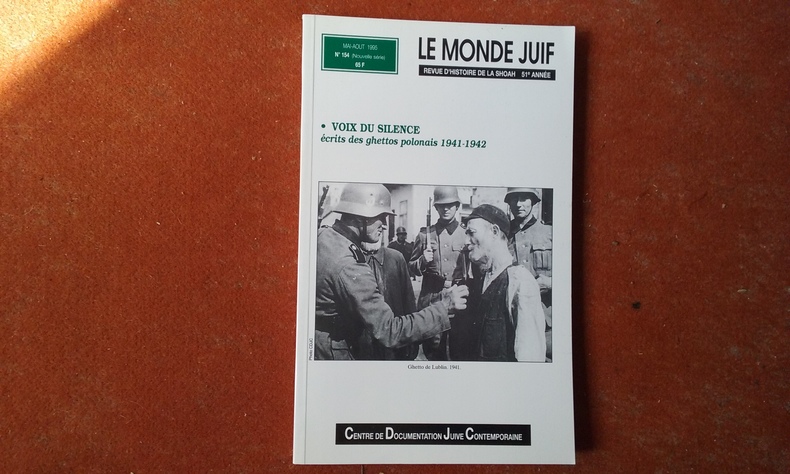
QWA-7496Centre de Documentation Juive Contemporaine, 1995, in-8 br., 210 p., N° 154 (mai-août 1995) de la revue "Le monde juif", carte, état de neuf.
1963106585AB(Bonn, 1963). 8°. 104 S. Original-Karton. (=Schriftenreihe der Bundeszentrale für Heimatdienst; 32).
19855361CBGütersloh, Gütersloher Verlagshaus Mohn (= Gütersloher Taschenbücher Siebenstern Band 1084), 1985. 8°, 140 S., illustr. original Kartonage (Paperback), Taschenbuch Erstausgabe sehr schönes, sauberes Exemplar (Li2 - A)
1371406Warszawa (Varsovie): Wydawnictwo Ministerstwa Obrony Narodowej, 1959 in-8, 508 p., nombreuses ill. dans le texte, plan dépliant, index des noms. Broché, exemplaire et couverture défraichis. Texte polonais. Sur le Ghetto de Varsovie.
8vo., First Edition; cloth, a fine copy in unclipped dustwrapper. First edition in English of this remarkable memoir by a suruvivor of the Uprising
Original boards. 8vo; 53, 75 pages; Some text in English, some in Yiddish. Nice book Co-sponsored by the Emma Lazarus Federation, the Furrier Joint Council of N. Y. & the Joint Board of the Fur Dressers & Dyers Unions. Bumps to edges. Very Good Condition. (HOLO2-127-6)
4to., First Edition, with very numerous full-page photographs throughout; oatmeal Holland, backstrip lettered in black, black endpapers, a near fine copy in unclipped dustwrapper, the latter very lightly chafed at extremities. Comprehensive photographic survey with over 240 contemporary images of WWII destruction. Very scarce, especially in this condition.
20141143627Wien : Picus-Verl., 2014. 61 S. ; 19 cm, Hardcover.
8vo., First Edition, with portrait frontispiece and plates; black cloth, gilt back, a very good, bright, clean copy. Enser, p.180.
199316023München, Kindler, 1993. Pappeinband, Schutzumschlag, 4°, Querformat, ganzseitige, fotografische s/w-Abbildungen, 116 Abbildungen; -sehr gutes Exemplar.
200922652Stuttgart, Klett-Cotta, 2009. 8°, 287 Seiten. mit zahlreichen, teils farbigen Abbildungen und Photos auf Tafeln. Orig.Pappband mit OSU.
2264o.J.; Neue Kritik, 1994; Frankfurt/Main
JUDA2214o.J. BLUMENTAL, Nachman (Ed.) Yizkor Baranow. A Memorial to the Jewish Community of Baranow. Jerusalem, Yad Vashem 1964. gr.-8°, XVI S., engl. Text, 236 hebräischer Text mit zahlr. Abb., OLn. m. hebr. Rückentit., leichte Gebrauchsspuren. / BAUMINGER, Arieh. L. Les Justes. Jerusalem, Yad Vashem (1969). gr.-8°, 102 (statt 104) S., letztes Bl. fehlt (herausgeriss.), OBrosch., lichtspurig, abgegriff., Umschlag vorne tlw. vom Textblock gelöst. / Der HOLOCAUST. Jerusalem, Yad Vashem 1979. 79 S., stark illustriert, OBrosch.
1st edition. Original stiff paper wrappers. 4to. 11 sheets of illustrations, 33 cm. In Hebrew, English, and Yiddish, with a Hebrew introduction. Title translates to Children in the Ghetto. An assortment of illustrations from the Warsaw Ghetto. SUBJECTS: Jewish children -- Poland -- Warsaw -- History -- 20th century -- Pictorial works. The US Holocaust Museum keeps their copy in their Rare Book Collection. OCLC lists 12 copies worldwide (OCLC: 54613924) . Very light edge wear to stiff wrappers. Very Good Condition. (YID-41-44)
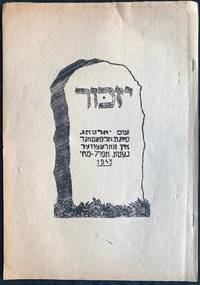
194443395Shvayts Switzerland: Undzer Vort Poale Tziyon Left 1944. May 1944. 1st edition. Original stapled printed paper cover 4to 2 25 pages. <br> In Yiddish. Title translates as "In Memoriam. On the Anniversary of the Uprising in the Warsaw Ghetto April-May 1943.<br> First Anniversary of the Warsaw Ghetto uprising published in Europe during the Holocaust by Jewish "Poale Tziyon Left" members in Switzerland. The organization's name which means "Workers of Zion" is sometimes also romanized as "Poale Zion" or "Poaley Syjon." <br> <br> The imprint "Undzer Vort" "Our Word" was a Left Poale Tziyon publisher in Switzerland which also published a mimeograph newspaper titled "Undzer Vort" OCLC: 232675203 during this same period. A fully underground version of the paper was also published in Nazi-Occupied Belgium see below.<br> <br> Indeed Poale Tsiyon Left was an important part of Jewish resistance throughout Europe most notably during the Warsaw Ghetto Uprising which this publication commemorates. <br> <br> "The Holocaust-era Jewish resistance group ZOB was formed from a coalition including Hashomer Hatzair Dror Bnei Akiva the Jewish Bund various Jewish Communist groups and both factions of Poale Zion. Poale Zion was also active in the Anti-Fascist Bloc.<br> Several notable Jewish resistance fighters during the Holocaust particularly those involved in the Warsaw Ghetto Uprising were members of Poale Zion. They include:<br> <br> Adolf Berman Warsaw ZOB fighter; Secretary of Zegota Poale Zion Left<br> Hersz Berlinski member of Warsaw ZOB Command Poale Zion Left<br> Yochanan Morgenstern member of Warsaw ZOB Command Poale Zion Right<br> Emanuel Ringelblum member of Warsaw ZOB; chronicler of the Warsaw Ghetto Poale Zion Left" Wikipedia.<br> <br> The booklet opens with the moving story of the start of the uprising:<br> <br> "It has been a year since the glorious uprising of the Jews in the Warsaw ghetto.<br> April 19 1943 - barely a few tens of thousands of Jews left in Warsaw after about half a million of their brothers and sisters were exterminated in the most gruesome way they rose up with organized resistance against the renewed attempts.that they too like the previous ones would be led out like sheep to the slaughter.<br> Forty thousand Jews weapons in hand opposed an enemy tenfold a hundred hundred times outnumbered.Women men and children the high class and the humble.<br> From the beginning they all knew without exception that they would be defeated that the outcome was not in doubt and that the enemy intended nothing but destruction for all of them.<br> But no Nazi expected to fall on such a battlefield.<br> And his was the biggest slap in the face which the proud Nazis.so hated when it was received from these these trampled down these unrefined these scorned these despised Jewish 'untermenchen'" Translated from the opening paragraphs on page 1.<br> <br> The publication later continues with a damnation of the "democracies" who did so little and a holding up of the comrades of Poale Tziyon who are doing so much fighting on all fronts:<br> <br> "The 'world democracies' didn't do anything.to save the Jewish victims and to stop the misery train they issued platonic statements about punishing the 'crimes' after the massacre. The warnings have so far helped little.<br> The.Sacrifices keep growing.The world that is fighting 'for justice' and that is busy with courts after the massacre has not found any means to rescue the few escaped heroes in the ghetto for a whole year.<br> This long eulogy is for dozens and hundreds of comrades who fell as loyal children of the nation and fighters for its working class on the fronts in the distant.north in the camps of France and Belgium. who went from one end of the world to the other - at their wounds and from hundreds of thousands of others - comrades of the Poale-Tziyon movement." page 24. <br> <br> Poale Zion.was a movement of Marxist-Zionist Jewish workers founded in various cities of Poland Europe and the Russian Empire at about the turn of the 20th century after the Bund rejected Zionism in 1901.<br> Poale Zion was torn between left-wing and right-wing factions in 1919-1920; the organization formally split at the Poale Zion fifth world congress in Vienna in 1920 following a similar division that occurred in the Second International.<br> The right wing was less Marxist and more nationalist and favoured a more moderate socialist program and supported the International Working Union of Socialist Parties to continue the work of the Second International essentially becoming a social democratic party. The left-wing faction did not consider the Second International radical enough and some accused its members of betraying Borochov's revolutionary principles although Borochov had begun to modify his ideology as early as 1914 and publicly identified as a social democrat the year before his death.<br> Poale Zion Left which supported the Bolshevik revolution continued to be sympathetic to Marxism and Communism and attended the second and third congresses of the Communist International in a consultative capacity. They lobbied for membership but their attempts were unsuccessful as the internationalist communist movement under Lenin and Trotsky was opposed to Zionist nationalism. The Comintern advised individual members of Left Poale Zion to join their national Communist parties as individuals; at their 1922 Danzig conference these terms were rejected by the party. The Comintern declared it an enemy of the workers' movement.<br> Poale Zion Left opposed the decision by Poale Zion to rejoin the World Zionist Organization viewing it as essentially bourgeois in character and viewed the Histadrut as reformist and non-socialist. Aside from differing attitudes towards Zionism and Stalinism the two wings of Poale Zion parted ways over Yiddish and Yiddish culture.<br> The Left was more supportive of the latter similar to the members of the Jewish Bund while the Right bloc identified strongly with the emerging modern Hebrew movement in the early 20th century.<br> In Poland for a brief period following World War I both factions of Poale Zion were reported as legal and functioning political parties. The Polish Left party was the largest Left Poale Zion party in the world. It worked closely with the Bund in developing Yiddish schools in Poland and supporting secular Yiddish culture although they had political differences e.g. the Bund was more supportive of the Polish Socialist Party than LPZ.<br> As part of the large-scale ban on Jewish political parties in post-World War II Poland by the Communist leadership both Poale Zion groups were disbanded in February 1950" Wikipedia.<br> <br> Interestingly the image on the front cover this distinctive gravestone with "Yizkor" in a specific heavy font was a frequent image for memorials to the victims of pogroms as well as the Shoah in particular for memorials to the Warsaw Ghetto Uprising. A few examples include:<br> • Hashin & Ben Gurion Yizkor tsum ondenken di gefalene vekhter un arbeiter in Erets Yisroel New York Poale Zion Palestine Committee 1917. Internal illustrated title page<br> • Hurbn Proskurov New York: Proskurover Relief Organization 1924. See image on JHU's online Yizkor Book Exhibit at www.library.jhu.edu/news/2025/06/yizkor-books-traveling-homelands-and-portable-memorials And from another memorial to the first anniversary of the Warsaw Ghetto Uprising:<br> • Tsum Yortog Funm Oyfshtand in Varshever Geto April-May 1943. Ramat Gan: Defus "liga" 1944. OCLC: 63647084. See Nr. 35 in our catalog 215 at danwymanbooks.cdn.bibliopolis.com/images/upload/catalog-215.pdf <br> <br> "Undzer Vort" also published similar underground Poale Tziyon Left newspapers and other materials in Nazi-occupied countries such as Belgium: <br> "'Linke Poale Zion' Left-wing Workers of Zion was a Zionist-Socialist party in Belgium and one of the initiators of the Jewish Defense Committee of Belgium. This committee managed to save about 3000 children and several thousand Jewish adults from the clutches of the Nazis.<br> With his party comrades Abusz Werber ensured the editing publication and distribution of 28 issues of a secret underground newspaper in Yiddish"Unzer Wort" Undzer Vort Our Word which appeared until the Liberation in September 1944 and even after" Werber The Word of Abusz Werber 2017. Note how the Yiddish documents on the cover of the book are similar to our Undzer Vort publication from Switzerland: https://m.media-/images/I/71sWHrhxgoL._SL1360_.jpg. <br> <br> SUBJECTS: Holocaust Jewish 1939-1945 -- Poland -- Warsaw -- Illustrations. <br> OCLC: 233365664. OCLC locates only 1 copy worldwide NLI.<br> <br> Final leaf in facsimile. Paper toning as expected but strong. About Very Good Condition thus. Rare and important. B Holo2-163-28-XX. Shvayts [Switzerland]: Undzer Vort [Poale Tziyon Left] unknown
trad. di Anna Linda Callow e Rosella Carpinella Guarnieri n. 393 in 16°, bross. edit. con bandelle, timbro di appartenenza
20003131013Berlin: Wichern-Verlag 2000. 298 Seiten. 8° (17,5-22,5 cm). Illustrierte Orig.-Broschur. [Softcover / Paperback].
194613981Lodzsh: Tsentraler Yidisher Historisher Komisye baym Tsentral-Komitet fun Poylishe Yidn 1946. 1st edition. Later cloth with original dramatic photgraphic cover mounted on front 8vo 70 1 pages 1 l. includes facsimiles. 21 cm. Poems. "Oysgabes fun Der Tsentraler Yidisher Historisher Komisye baym Tsentral-Komitet fun Poylishe Yidn. Serye yidishe literatur 1." <br> A committee dedicated to recording the fate of Polish Jews published this book length poem by Simkhah Szajewics. Written in the Lodz Ghetto it appeared immediately after the war in 1946; Szajewicz perished in a concentration camp in 1944" from the permanent exhibit at the National Yiddish Book Center which houses their copy in their Rare Book Collection. <br> The book actually includes two long poems: "Lekh-lekha" and "Friling 702 " as well as letters and other related material. <br> See David Roskies interesting reflection on this work and it's stunning photographic cover at jtsa.edu/torah/go-forth-the-grammar-of-remembrance. <br> For more about the author-poet see Chava rosenfarb's essay on Shayevitch in Tablet Magazine at tabletmag.com/sections/arts-letters/articles/the-last-poet-of-lodz. SUBJECTS: Jews -- Persecutions -- Poland -- Lódz. Holocaust Jewish 1939-1945 -- Poetry. Jews -- Correspondence. Expertly rebound in attractive black cloth with the original photographic front cover mounted on the front. Very Good Condition. B HOLO2-110-36-CCALX-'emm H-40-10. Lodzsh: Tsentraler Yidisher Historisher Komisye baym Tsentral-Komitet fun Poylishe Yidn unknown