5 325 résultats
Fotos von Barbara von Haeften, Hilde von Mertz, u.v.a.
Mit zahlreichen Abbildungen.
Mit Abbildungen.
Photo-Illustr.
Reichlich in Schwarzweiß illustriert.
Mit zahlreichen Abbildungen.
Mit zahlreichen S/w Abbildungen.
Mit einigen S/W Fotos.
Mit 52 Abbildungen und 1 Lagerskizze.
Reichlich in Schwarzweiß illustriert.
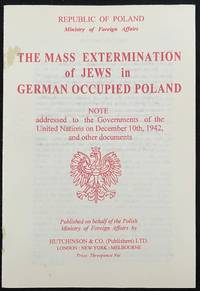
194343453London New York; Published on Behalf of the Polish Ministry of Foreign Affairs by Hutchinson & Co 1943. 1st edition. Original illustrated red and white paper wrappers. 8vo. 16 pages. 22 cm. National Government Publication. Printed in red and black ink. Includes a note by Polish Foreign Minister Edward Raczynski and speeches by Deputy Prime Minister Stanislaw Mikolajczyk.<br> The official 16-page diplomatic publication from December 1942 by the Polish Government-in-Exile in London marking a turning point in international understanding of the Nazi destruction of the Jews of Europe. <br> Jan Karski a courier for the Polish Underground had smuggled microfilmed evidence and intelligence out of occupied Poland to London. This raw intelligence gathered from his time secretly inside the Warsaw Ghetto and the Izbica transit camp formed the core of the facts published in the booklet.<br> <br> "In October 1942 at the height of the destruction of Polish Jewry Jan Karski born Jan Kozielewski was ordered to clandestinely go to the West and deliver a report on the situation of occupied Poland to the Polish government-in-exile in London. The situation of the Jews in Poland was to be one section of that report. Since the government in exile was concerned with the internal politics of Poland's underground parties Karski held meetings with the different factions including the Jewish Zionist and the Jewish Socialist Bund movements. <br> Thus shortly before his departure Karski met with two Jewish leaders who asked him to inform the world's statesmen of the desperate plight of Polish Jewry and of the hopelessness of their situation. Their message was: 'Our entire people will be destroyed.'<br> The Jewish leaders' appeals touched Karski and he decided to see things with his own eyes in order to make his report. With great risk to his life he was smuggled into the Warsaw ghetto and into a camp in the Lublin area. The horrors he witnessed marked him deeply and propelled him to become not only the messenger of the Polish underground but to concentrate on giving voice to the suffering of the dying Jews.<br> In November 1942 Karski reached London delivered the report to the Polish government-in-exile and set out to meet Winston Churchill other politicians journalists and public figures. Upon completing his mission Karski went on to the United States where he met with President Roosevelt and other dignitaries and tried in vain to stir up public opinion against the massacre of the Jews. In 1944 while in the United States Karski wrote a book on the Polish Underground Story of a Secret State with a long chapter on the Jewish Holocaust in Poland.<br> After the war Karski stayed in the United States where he was later appointed Professor at Georgetown University Washington DC.<br> On 2 June 1982 Yad Vashem recognized Jan Karski as Righteous Among the Nations" Yad Vashem. <br> <br> Leading Holocaust scholar Lucy Dawidowicz cites the booklet in her now classic work "The Holocaust and the Historians" Harvard 1983 p. 167; the report could not be more explicit in its description of the horrors nor in its plea for help: <br> "The new methods of mass slaughter applied during the last few months confirm the fact that the German authorities aim with systematic deliberation at the total extermination of the Jewish population of Poland and of the many thousands of Jews whom the German authorities have departed to Poland from Western and Central European countries and from the German Reich itself. The Polish Government considers it their duty to bring to the knowledge of the Governments of all civilised countries the following fully authenticated information received from Poland during recent weeks which indicates all too plainly the new methods of extermination adopted by the German authorities." <br> The report elaborates: "The actual process of deportation was carried out with appalling brutality. At the appointed hour on each day the German police cordoned off a block of houses selected for clearance entered the back yard and fired their guns at random as a signal for all to leave their homes and assemble in the yard. Anyone attempting to escape or to hide was killed on the spot. No attempt was made by the Germans to keep families together. Wives were torn from their husbands and children from their parents. Those who appeared frail or infirm were carried straight to the Jewish cemetery to be killed and buried there. <br> On the average 50-100 people were disposed of in this way daily. After the contingent was assembled the people were packed forcibly into cattle trucks to the number of 120 in each truck which had room for forty. The trucks were then locked and sealed. The Jews were suffocating for lack of air. The floors of the trucks were covered with quicklime and chlorine. As far as is known the trains were dispatched to three localities - Treblinka Belzec and Sobibor to what the reports describe as 'Extermination camps.' <br> The very method of transport was deliberately calculated to cause the largest possible number of casualties among the condemned Jews. It is reported that on arrival in camp the survivors were stripped naked and killed by various means including poison gas and electrocution. The dead were interred in mass graves dug by machinery." <br> <br> Read more about the singular importance of this publication at <br> en.wikipedia.org/wiki/The_Mass_Extermination_of_Jews_in_German_Occupied_Poland# . <br> In 2020 Polish Postal authorities chose this very publication to illustrate their official first day cover honoring righteous Poles who had saved Jews during the Holocaust see illustration. <br> <br> Subjects: World War 1939-1945 - Jews - Poland. World War 1939-1945 - Poland - Atrocities. Holocaust Jewish 1939-1945 - Poland. Jews - Poland. OCLC: 234118765. <br> Touch of staining at staples without the rust almost always seen in other surviving copies. Very Good condition. A copy with rust stains sold in 2018 at auction for over £6000. Rare and very important. BHOLO2-97-48-MMXRLADFACC. London, New York; Published on Behalf of the Polish Ministry of Foreign Affairs by Hutchinson & Co unknown
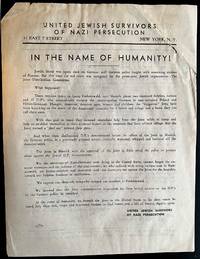
194743409New York The Organization No Date 1947. 1st edition. Double-sided English-Yiddish leaflet 2 pages. The Yiddish header translates roughly as "An Announcement To the Jewish Public"<br> Bilingual American Flyer condemning the Joint the American Joint Distribution Committee AJDC for not doing more to help the Jewish DPs and its "hiding" behind the German police when DP's demonstrated for more action on DP resettlement.<br> The issuing organization the United Jewish Survivors of Nazi Persecution/Farband fun Geveyzene Yidishe Katsetler un Partizaner was the first survivor network founded in the US. Their Yiddish name translates as "The Association of Former Jewish Concentration Camp Inmates and Partisans." The word "Katsetler" in their name is a contraction of "kontsentratsyonslager-er" using the letters K and Z "ka" and "tset" and thus short for "kontsetratsyonslager" a concentration camp inmate or survivor sometimes also noted as a "katsetnik." <br> <br> The flyer announces:<br> <br> "Jewish blood was again shed on German soil! German police fought with remaining victims of Nazism. But this time the sad event was instigated by the prominent Jewish organization-The Joint Distribution Committee.<br> <br> What happened<br> <br> There remains today in Camp Foehrenwald near Munich about two thousand helpless forlorn and ill D.P's who miraculously escaped the extermination furnaces in nazi-occupied Poland and Hitler-Germany. Hungry desperate destitute men women and children the 'forgotten' Jews have been knocking at the doors of the democratic countries for a haven and refuge and a home they can call their own.<br> <br> With this goal in mind they demand immediate help from the Joint while in camp and help to establish themselves in their eventual homes in the countries that have offered refuge. But the Joint turned a 'deaf ear' toward their pleas.<br> <br> And when these disillusioned D.P.'s demonstrated before the offices of the Joint in Munich the German police in a previously planned attack critically wounded whipped and battered off the demonstrators.<br> <br> The Joint in Munich with the approval of the Joint in Paris asked the police to protect them against the Jewish D.P. demonstrators.<br> <br> We the survivors of Nazi-Germany now living in the United States cannot forget the extreme torments and the inferno of the nazi-torture; we who suffered with many victims now in Foch- renwald are horror-stricken and dismayed and our hearts cry out against the Joint for the brutality toward our helpless brethern in misfortune.<br> <br> We express our deep-felt sympathy toward our brothers in Foehrenwald.<br> <br> demand that the Joint representatives responsible for these brutal attacks on the D.P.'s by the German police be punished.<br> <br> In the name of humanity we beseech the Jews in the United States to let their voices be heard help these sick tragic and frustrated victims to find homes and a life of human dignity again" From the English side of the flyer.<br> <br> <br> After World War II Munich served as a major center for Jewish Holocaust survivors the "Sh'erit ha-Pletah" who were living in DP camps. The "Joint" was the primary welfare organization providing aid clothing and food to these camps. While the Joint was a vital lifeline its Munich headquarters at Siebertstrasse 3 sometimes became the focal point for frustration regarding the pace of aid distribution or more frequently the slow pace of emigration to Palestine Aliyah and broader often frustrating postwar conditions.<br> Following the 1947 Exodus ship incident where Jewish refugees were returned to Germany by the British Jewish DPs felt trapped and staged intense demonstrations including protests at the offices of international organizations like the Joint to highlight their despair.<br> These demonstrations were part of a broader effort by survivors to assert their agency and demand rights during their time in Munich 1945-1951. For more on tensions between Munich's Jewish DPs and the Joint see www.juedisches-museum-muenchen.de/en/exhibitions/munich-displaced-online/moehlstrasse. <br> <br> Scholar David Slucki notes about the publishers of this leaflet that "Within months of arriving in the United States in 1946 Jewish Holocaust survivors began to organize themselves to help with the process of resettlement. The small band of socialists who established the Farband fun Geveyzene Yidishe Katsetler un Partizaner United Jewish Survivors of Nazi Persecution this group initiated a dual process of identity formation and memorialization of the Holocaust. <br> The first survivor network founded in the United States the Katsetler Farband this group developed a memorial culture that included commemorations and publications replete with its own rituals and calendar. Moreover the organization was part of a broader process of defining what experiences constituted the Holocaust and who was to be considered a survivor. Ultimately they were among a host of survivor networks in the United States to lay the foundation for Holocaust memorialization" Slucki D. 2017. A Community of Suffering: Jewish Holocaust Survivor Networks in Postwar America. Jewish Social Studies 222 116-145. https://muse.jhu.edu/article/649094<br> <br> We could locate no copies in OCLC-Worldcat Archive Grid nor using a google search. <br> <br> Touch of edgewear one diagonal fold paper generally bright and strong about Very Good- Condition. Holo2-163-28A. New York, The Organization, No Date unknown
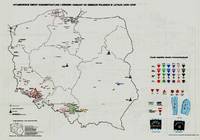
197941929Warszawa Warsaw: Pan´stw. Wydawn. Naukowe 1979. 1st Edition. Original black printed portfolio 8vo. Portfolio of seven large folding maps on on 4 sheets of heavy paper 3 are double sided 1 is singled sided. Primarily black and white with some color. Text in Polish. <br> Title translates to “Nazi camps in Poland 1939 - 1945. An Encyclopaedic Reference Book: Maps." Collection of 7 maps each 84 cm x 60 cm 33 x 24 inches produced by Jan Laskowski at the Main Commission for the Investigation of Nazi Crimes in Poland. The maps comprise Volume II of the work; Volume I is a heavily illustrated 676-page book of the same title which we offer separately. <br> The Seven maps all present are: <br> - Map 1 Single Sided: Hitlerowskie obozy na ziemiach polskich w latach 1939 - 1945. “Nazi camps in Poland in the years 1939 - 1945â€. Showing: concentration and extermination camps sub-camps of concentration camps extermination centers POW camps more important sub-camps working divisions commandos and temporary POW camps penal labor camps major labor camps prisons transit camps & ghettos. <br> - Map 2A: Getta na ziemiach polskich w okresie okupacji hitlerowskiej w latach 1939 - 1945 “Ghettos in Poland during the Nazi occupation in 1939 - 1945â€. <br> - Map 2B: Hitlerowskie obozy przejsciowe na ziemiach polskich w latach 1939 - 1945 “Nazi transit camps in Poland in 1939-1945â€. <br> - Map 3A: Hitlerowskie wiezienia i areszty na ziemiach polskich w latach 1939 - 1945 “Nazi prisons and arrests in Poland in 1939 - 1945â€. <br> - Map 3B: Hitlerowskie obozy pracy na ziemiach polskich w latach 1939 - 1945 “Nazi labor camps in Poland in the years 1939 - 1945â€. <br> - Map 4A: Hitlerowskie obozy jenieckie na ziemiach polskich w latach 1939 - 1945 “Nazi POW camps in Poland in 1939 - 1945â€. <br> - Map 4B: Hitlerowskie obozy koncentracyjne i osrodki zaglady na ziemiach polskich w latach 1939 - 1945 “Nazi concentration camps and extermination centers in Poland in 1939 - 1945â€. <br> Maps 2A & 2B have been described as a “Terrifying pair of maps showing the locations of German POW and internment camps in Poland during World War II highlighting the widespread locations of these establishments. In some parts of the map the information becomes so dense that three inset maps are shown. This map was designed by Jan Laskowski and printed in 1979 as part of a work on the Nazi extermination machine produced by PWN Warsaw a state-owned research-focused publishing house in Poland.<br> The map on the front is particularly interesting for its depiction of symbols used to classify internees in German camps. The uppermost of these depictions shows the combinations that can be made for different types of prisoners of different levels of importance. The armbands that would have been worn by these prisoners is shown as well as the prison uniforms. Other details are also shown. <br> The map lists hundreds of sites run by Nazi operators throughout the country. These include concentration camps death camps transitional camps and ghettos. The map is divided according to Poland's voivodeships with a key in the lower left. Names of cities too long to spell are also provided in the lower left. <br> This map was produced during a point in Poland's history during which it was actively revisiting the period during the Second World War. Leading social scientists devoted their time to trying to gather all the living as well as the recorded history of the events of the Holocaust and related atrocities before this information vanished. Leading these efforts particularly during the 1960s and 1970s was the Glówna Komisja Scigania Zbrodni przeciwko Narodowi Polskiemu known as the Chief Commission for the Prosecution of Crimes against the Polish Nation. They were active in publishing maps both for domestic educational purposes and for international remembrance and diplomatic efforts regarding the Holocaust. Jan Laskowski was a leading cartographer who produced a number of maps in this field. <br> These maps were produced as part of a series of maps that purported to combine to form an atlas of all of Hitler's crimes in Poland. Many of the large wall maps produced during this period could only show a fraction of the crimes or only the atrocities committed in one region. Thus a series of maps was needed to show all the points necessary which this present work contributes to. <br> Polish Reinterpretations of the Holocaust: Studying the effects of German occupation in Poland is a delicate subject. While it is certain that Poland suffered at least as badly as any other European nation during the Second World War reinterpretations of the Holocaust in the country have also been used to satisfy nationalistic tendencies. It has become evident to Western observers in the last several years that there is a strong nationalist movement in Poland that seeks to place blame for the Holocaust solely on the shoulders of non-Polish actors a movement originally fostered under Soviet rule. This movement has gone so far as to limit freedom of speech criminalizing with a three-year sentence the suggestion that Poland or its citizens in any form participated in the murders committed by Nazis. As such the term ‘Polish concentration camps’ has been deemed unacceptable with the government-approved term being ‘concentration camps on Polish territory.’ <br> All lines of evidence show that this map 2A & 2B was produced using the most accurate and impartial historical sources. The language on the map is simple naming only ‘Hitler's Atrocities’ and there is no evidence of a clear anti-German bias. However it is impossible to separate this map one of the most important productions of the remembrance movement during this period from the social situation in which it was produced. Maps like these can easily be converted into propaganda instruments and today's Polish leaders most of whom grew up during Soviet occupation will have formed their understanding of the Holocaust through maps like these. <br> Soviet Censorship: While the content of the map appears to have been produced free from bias the map still had to go through Soviet censorship. Mentioning prisoner of war camps in which primarily Soviet troops were interned would have been a prerequisite condition upon which the publication of the map rested. Further the lack of mention of any Soviet killings or camps requires no explanation….The map unlike many later maps makes no differentiation between the populations who suffered at the various camps. This represents the Soviet agenda that all nations suffered fought and won equally which sought to limit divisions in this post-identity state†Ruderman 2022. <br> SUBJECTS: World War 1939-1945 -- Prisoners and prisons German. -- Concentration camps -- Poland. Guerre mondiale 1939-1945 -- Prisonniers et prisons des Allemands. -- Camps d'internement -- Pologne. Obozy koncentracyjne -- Polska -- 1900-1945. OCLC: 830885973. <br> Light shelf wear to portfolio as expected. All maps in pristine condition with normal folds as issued. Very Good Condition. Complete and dramatic BR5 holo2-147-19-'cc. Warszawa (Warsaw): Pan´stw. Wydawn. Naukowe unknown