(Holocaust: Yellow Star; Tunisia)Biblio.com
1 440 résultats
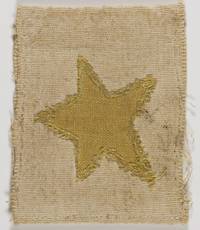
194353630Tunisia 1943. Nearly Fine. Five-pointed yellow cloth star sewn onto plain beige cloth 7.3 by 9 cm. Yellow dye somewhat faded else in fine state of preservation.<br /> <br /> Specimen of the yellow star imposed on the Jewish population of Tunisia in March 1943 as a mark of the slave laboror. Tunisia was the only Islamic country to come under Nazi rule at first indirectly through the Vichy regime in France between 1940 and its liberation by Allied forces on May 7 1943. In response to the Allied invasion of Algeria and Morocco German and Italian forces invaded Tunisia on November 9 1942. By the end of November the Germans took the first anti-Jewish move by arresting four of the community leaders including Moïse Borgel the president of the Jewish congregation. "In addition to the governor-general's sympathetic attitude -- and in some degree to the pro-Jewish attitude of Bey Sidi Mohammed al-Mounsaf -- the Italians also in practice interfered with the application of the anti-Jewish laws" E.H. The dignitaries were released after a week following the intervention of the mayor of Tunis and the Italian consul. Because of objections by the Italians the edict to wear the star does not appear to have been generally enforced with rigor and was only formally imposed in two cities Sfax and Tunis. While 5000 Jews had originally been put on forced labor in thirty locations and camps along the front line "at the time of the collapse and surrenter in early May 1943 only sixteen hundred Jews were employed on forced labor" E.H. Given the relatively small labor force and the lack of zeal in imposing the anti-Jewish ordinances it is clear why so few of these yellow badges have survived. References: I. Gutman ed. Encyclopedia of the Holocaust vol. 4 pp. 1521-23. unknown
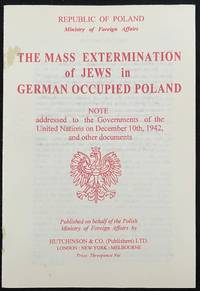
194343453London New York; Published on Behalf of the Polish Ministry of Foreign Affairs by Hutchinson & Co 1943. 1st edition. Original illustrated red and white paper wrappers. 8vo. 16 pages. 22 cm. National Government Publication. Printed in red and black ink. Includes a note by Polish Foreign Minister Edward Raczynski and speeches by Deputy Prime Minister Stanislaw Mikolajczyk.<br> The official 16-page diplomatic publication from December 1942 by the Polish Government-in-Exile in London marking a turning point in international understanding of the Nazi destruction of the Jews of Europe. <br> Jan Karski a courier for the Polish Underground had smuggled microfilmed evidence and intelligence out of occupied Poland to London. This raw intelligence gathered from his time secretly inside the Warsaw Ghetto and the Izbica transit camp formed the core of the facts published in the booklet.<br> <br> "In October 1942 at the height of the destruction of Polish Jewry Jan Karski born Jan Kozielewski was ordered to clandestinely go to the West and deliver a report on the situation of occupied Poland to the Polish government-in-exile in London. The situation of the Jews in Poland was to be one section of that report. Since the government in exile was concerned with the internal politics of Poland's underground parties Karski held meetings with the different factions including the Jewish Zionist and the Jewish Socialist Bund movements. <br> Thus shortly before his departure Karski met with two Jewish leaders who asked him to inform the world's statesmen of the desperate plight of Polish Jewry and of the hopelessness of their situation. Their message was: 'Our entire people will be destroyed.'<br> The Jewish leaders' appeals touched Karski and he decided to see things with his own eyes in order to make his report. With great risk to his life he was smuggled into the Warsaw ghetto and into a camp in the Lublin area. The horrors he witnessed marked him deeply and propelled him to become not only the messenger of the Polish underground but to concentrate on giving voice to the suffering of the dying Jews.<br> In November 1942 Karski reached London delivered the report to the Polish government-in-exile and set out to meet Winston Churchill other politicians journalists and public figures. Upon completing his mission Karski went on to the United States where he met with President Roosevelt and other dignitaries and tried in vain to stir up public opinion against the massacre of the Jews. In 1944 while in the United States Karski wrote a book on the Polish Underground Story of a Secret State with a long chapter on the Jewish Holocaust in Poland.<br> After the war Karski stayed in the United States where he was later appointed Professor at Georgetown University Washington DC.<br> On 2 June 1982 Yad Vashem recognized Jan Karski as Righteous Among the Nations" Yad Vashem. <br> <br> Leading Holocaust scholar Lucy Dawidowicz cites the booklet in her now classic work "The Holocaust and the Historians" Harvard 1983 p. 167; the report could not be more explicit in its description of the horrors nor in its plea for help: <br> "The new methods of mass slaughter applied during the last few months confirm the fact that the German authorities aim with systematic deliberation at the total extermination of the Jewish population of Poland and of the many thousands of Jews whom the German authorities have departed to Poland from Western and Central European countries and from the German Reich itself. The Polish Government considers it their duty to bring to the knowledge of the Governments of all civilised countries the following fully authenticated information received from Poland during recent weeks which indicates all too plainly the new methods of extermination adopted by the German authorities." <br> The report elaborates: "The actual process of deportation was carried out with appalling brutality. At the appointed hour on each day the German police cordoned off a block of houses selected for clearance entered the back yard and fired their guns at random as a signal for all to leave their homes and assemble in the yard. Anyone attempting to escape or to hide was killed on the spot. No attempt was made by the Germans to keep families together. Wives were torn from their husbands and children from their parents. Those who appeared frail or infirm were carried straight to the Jewish cemetery to be killed and buried there. <br> On the average 50-100 people were disposed of in this way daily. After the contingent was assembled the people were packed forcibly into cattle trucks to the number of 120 in each truck which had room for forty. The trucks were then locked and sealed. The Jews were suffocating for lack of air. The floors of the trucks were covered with quicklime and chlorine. As far as is known the trains were dispatched to three localities - Treblinka Belzec and Sobibor to what the reports describe as 'Extermination camps.' <br> The very method of transport was deliberately calculated to cause the largest possible number of casualties among the condemned Jews. It is reported that on arrival in camp the survivors were stripped naked and killed by various means including poison gas and electrocution. The dead were interred in mass graves dug by machinery." <br> <br> Read more about the singular importance of this publication at <br> en.wikipedia.org/wiki/The_Mass_Extermination_of_Jews_in_German_Occupied_Poland# . <br> In 2020 Polish Postal authorities chose this very publication to illustrate their official first day cover honoring righteous Poles who had saved Jews during the Holocaust see illustration. <br> <br> Subjects: World War 1939-1945 - Jews - Poland. World War 1939-1945 - Poland - Atrocities. Holocaust Jewish 1939-1945 - Poland. Jews - Poland. OCLC: 234118765. <br> Touch of staining at staples without the rust almost always seen in other surviving copies. Very Good condition. A copy with rust stains sold in 2018 at auction for over £6000. Rare and very important. BHOLO2-97-48-MMXRLADFACC. London, New York; Published on Behalf of the Polish Ministry of Foreign Affairs by Hutchinson & Co unknown
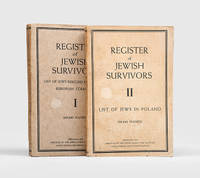
1945193462Jerusalem: Published by the Jewish Agency for Palestine / Search Bureau for Missing Relatives 1945. The search for the living First edition of the first major attempt to reunite Jewish families after the Holocaust listing 118000 survivors and their locations. Almost immediately after the war localized lists were published recording survivors from particular camps ghettos and countries. The Jewish Agency for Palestine established the Search Bureau for Missing Relatives to draw these efforts into a comprehensive register. The introduction notes it was published to "facilitate the re-establishment of contact between the remnants of Jewry in Europe and their relations in the Land of Israel and overseas. The Register contains the names of 60000 Jews of various countries saved from the camps and the ghettos who have been registered wherever they were were found following the liberation of Europe from Nazi servitude". It nevertheless cautions readers not to give up hope if a name is absent given the difficulty of compilation amid the chaos of postwar Europe. Lists also appeared in the weekly bulletin Lakarov Ulerahok while search requests were broadcast on Kol Yerushalayim in Jerusalem. Despite the suggestion of "forthcoming volumes" no further were produced. During its years of operation 1945 to 2002 the Bureau handled more than a million enquiries. The volumes are scarce on the market with most surviving copies held institutionally. They remain important reference works for those tracing relatives. 2 vols octavo. Original brown wrappers lettered in black. Contemporary Hebrew library stamps to title page of the Search Bureau for Missing Relatives; residue of removed labels to front covers. A little toned with minor wear remnants of the paper ties as issued to title pages wrappers of vol. I a little loose with some gatherings shaken. A good set of a fragile publication. unknown
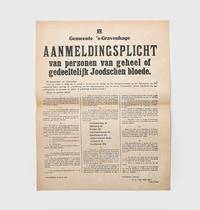
1941167943The Hague: City Legislative Board 31 January 1941. Laying the groundwork for the Holocaust in the Netherlands A significant step in the implementation of the Holocaust in the Netherlands - a broadside ordering all Jews in The Hague to register with the authorities. The broadside was issued in the name of The Hague mayor Cornelis Lodewijk van der Bilt on the order of the Reich Commissariat for the Occupied Dutch Territories. Similar orders were made by municipal bodies across the Netherlands. Headed in Dutch "Obligation to register persons of wholly or partly Jewish blood" it states that anyone with one Jewish grandparent must register by 21 February 1941. Each person will be issued with a certificate which must be shown to authorities on request. Those who do not register are liable to a five-year prison term and confiscation of assets. The move was part of an ongoing campaign against the Jews in the Netherlands that began shortly after the Nazi invasion in May 1940. Registration was with the mayor's office - the poster attests to the co-operation forced or otherwise of existing political structures. Almost all Dutch Jews did comply with the order. Deportations from the Netherlands began in Summer 1942 and was effectively completed by September 1944; less than a quarter of Dutch Jewry who fled the country or hid with supporters survived the Holocaust "The Netherlands" Holocaust Encyclopedia accessible online. Poster 280 x 229 mm printed in black verso blank. A couple of minor creases else very good. unknown
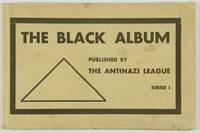
194054535Tel Aviv: The Antinazi League/ The Anti-Nazi League 1940. First edition. Softcover. g- to vg. Oblong 32mo. 8 text leaves 10 postcards. Unpaginated. Illustrated tan wrappers with black lettering on the covers. The work is a collection of 10 illustrated Anti-Nazi postcards issued by the Anti-Nazi League in Tel Aviv. <br /> <br /> This scarce collection of postcards contains some of the earliest photo-documentations visual depictions and statements on Nazi atrocities and oppression during the Holocaust some of which interestingly utilize photomontage techniques. Scenes depict hangings murders forced labor starvation displacement and cremations of Nazi victims. The text captions underneath each of the images are in English. Most of the text of the printed pages is bilingual including covers foreword publisher's statements and publication information in both Hebrew and English. There are two printed lists of images one in Hebrew and one in French. Each of the postcards have a perforated edge where they attach to the album. Only the first card is still attached. The rest are loose but unused. Each of the postcards measure approx. 5.4x4".<br /> <br /> As stated by the publisher the organization had "been established in Palestine with the object of promoting the foundation of a mass organization for propaganda against Nazism and racial hatred". They further state that the "publishing of the Black Album and sending the cards contained therein to friends all over the world are first steps to making the public participate in our struggle for truth against Nazi barbarism."<br /> <br /> Wrappers age toned with some staining and water spots to the English cover. Corners lightly rubbed. Interior with light foxing to the first text leaf.<br /> <br /> Other than some expected age toning the cards themselves and images are clean and in very good shape overall. 4 postcards #3-6 have been detached from the perforated edge but are present. Complete with all cards present. Wrappers in good- interior in very good- condition overall. Quite scarce. Hebrew title: ×”××œ×‘×•× ×”×©×—×•×¨. The Antinazi League/ The Anti-Nazi League unknown
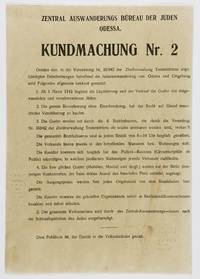
194251752Odessa: Zentral Auswanderungs Büreau 1942. Original document. Loose leaf. Very good condition. Quarto. Original loose leaf with black lettering. Announcement based on ordinance no. 35/942 of the civil government of Transnistria relating to the emigration of Jews in Odessa and surrounding areas. <br /> <br /> The text printed biligually in German and Ukrainian is organized into five statements. The annoucement concerns the liquidation and sale of goods of emigrated or vanished Jews beginning on March 1 1942 with the whole population without limitations given the right to buy these items based on oral agreements. Furthermore the announcement regulates details and procedures of the sale and at the end announces that after the sale proceeds will by handed to the Jews by the Central Emigration Office.<br /> <br /> "The rapid development of Odessa began after the Russian conquest 1789. Its Jewish population also grew quickly and in the late nineteenth and early twentieth centuries it was the most important Jewish literary community after Warsaw. In 1926 there were 153194 Jews in Odessa 36.4 percent of the total population and by 1939 their numbers reached 180000." Encyclopedia of the Holocaust Vol. 3 page 1080.<br /> <br /> When Romanians and Germans laid siege to the city on August 5 1941 many Jews in Odessa managed to leave and eighty to ninety thousand Jews remained in the city. Odessa fell on October 16 and the German Einsatzkommando 11b and the Romanian intelligence service immediately slaughtered over eight thousand residents mainly Jews and Odessa was established as the capital of the Transnistria region. On October 22 the Romanian military headquarters were blown up killing sixty-six officers and the military governor. In reprisal the Romanian ruler Ion Antonescu ordered devastating retaliation including the arrest of one member of each Jewish family. By October 1941 some 40000 Jews were assembled in the ghetto of the nearby city of Slobodka and their valuables confiscated. Deportations of some 20000 Jews began in January of 1942. When Odessa was liberated on April 10 1944 authorities reported that about 99000 Jews had been killed. Odessa again became an important Jewish center with 102000 Jews living there according to a 1959 census.<br /> <br /> Considering the context of "Kundmachung Nr. 2 the Odessa massacre of October 22-24 1941 and the murder of Jews living between the rivers Dniester and Bug during the Romanian and German occupation this succinct notice including its misspellings and mistakes in the German language is a chilling mirror image of the attitude shown by the occupying powers towards the Jews. Approximately 30000 Jews were killed in Odessa and more than 100000 in Transnistria. <br /> <br /> The text is printed in German on one side and Ukrainian on the verso. Minor wear and smudging. Protected in modern mylar. Zentral Auswanderungs Büreau unknown
199136935Pittsburgh PA: Pittsburgh. New. 1991. Paperback. FREE UPGRADE to Courier/Priority Shipping Upon Request IN STOCK AND IMMEDIATELY AVAILABLE FOR SHIPMENT - FLAWLESS COPY BRAND NEW PRISTINE NEVER OPENED 13 pages; 4 black and white illustrations. -- with a bonus offer-- . Pittsburgh paperback
199838769Bloomington Indiana U.S.A.: Indiana Univ Pr. New. 1998. Paperback. 0253211875 . FREE UPGRADE to Courier/Priority Shipping Upon Request IN STOCK AND IMMEDIATELY AVAILABLE FOR SHIPMENT - FLAWLESS COPY BRAND NEW PRISTINE NEVER OPENED -- with a bonus offer-- . Indiana Univ Pr paperback
199829144Bloomington Indiana U.S.A.: Indiana Univ Pr. New. 1998. Paperback. 025320884X . FREE UPGRADE to Courier/Priority Shipping Upon Request - IN STOCK AND IMMEDIATELY AVAILABLE FOR SHIPMENT - FLAWLESS COPY BRAND NEW PRISTINE NEVER OPENED -- with a bonus offer-- . Indiana Univ Pr paperback
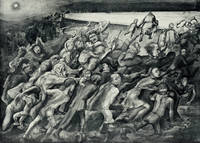
194434835Tel Aviv: Haaretz Printing House 1944. First Edition with annotations in Hebrew. Illustrated with 17 full-page Zinco engravings created by Zincographies Ltd. Oblong folio 34 x 25 cm publisher's original linen backed boards the upper cover printed in Hebrew. 4 text and 17 plates pp. A very good copy well preserved with minor evidence of age or use. RARE EARLY ILLUSTRATED WORK ON THE HORRORS OF THE HOLOCAUST. The evocative illustrations include Jews being rounded up for transport to the camps a depiction of the "death wagons" used for transport the rebellion in the ghetto partisans Treblinka the "monster" Nazi the Underground resistence and more. The album of illustrations was prepared and published during the most intense years of the Holocaust.<br> Lea Grundig 1906 – 1977 was a German painter and graphic artist. In the mid-1930s her work reflected themes of the new Nazi age with her cycles "Harzburger Front" "Unterm Hakenkreuz" 1936 "Der Jude ist schuld!" 1935–38 "Krieg droht!"1935–37 "Im Tal des Todes" 1942/43 and "Ghetto".<br> In 1935 a ban was imposed on exhibits of her work and in May 1936 she was arrested. Later in 1936 she traveled to Switzerland but she then returned to her home city and it was in Dresden that in May 1938 she was again arrested. In March 1939 she was found guilty of "Preparing to commit High Treason" »Vorbereitung zum Hochverrat« as a result of her Communist activities and/or her Jewish provenance and was sentenced to four months imprisonment. She served her sentence which in the event lasted till November/December 1939 in a prison in Dresden. However on her release she was granted an emigration permit. She emigrated to Bratislava then the capital of the still notionally independent Slovak Republic Slovakia. In 1940 she reached a refugee camp in Slovakia from where she moved as an exile to Palestine. Here she survived in a British internment camp at Atlit till 1942. On release she remained till the end of 1948 in Palestine living successively in Haifa and Tel Aviv. She was again able to show her work legally: exhibitions of her work took place not just in Palestine where she was living but also in the USA France South Africa and Great Britain. Haaretz Printing House hardcover
1943BRzz1310Berlin, Decker 1934-1943. 4°. je Band ca 800 S. Schwarze HLnBde mit Rückenpräg., Vorsatz u. Titelbll. gestempelt "Staatsanwaltschaft Wr. Neustadt" Nahezu vollständige Folge des von 1933-1945 erschienenen amtlichen NS-Rechtsorgans.
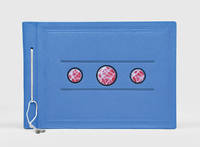
19671824721967. Auschwitz memorialized - a record of "the first fully 'international' event" at the former camp A commemorative album for the opening of the memorial at Auschwitz on 16 April 1967 an important stage in its transition to an international memorial site. Situated at the western end of the railway lines that cross the camp the memorial remains a central part of the Auschwitz complex. The large granite memorial was designed by the Italian architects Andrea and Pietro Cascella. Approximately 200000 people attended the unveiling including Polish state officials the East German and Italian foreign ministers and prisoner organisations. The first two photographs show the memorial the third the crowd bound in by the barbed wire and the fourth the Polish prime minister Józef Cyrankiewicz laying a tribute. The remainder show the attendees eating lunch food stalls and chefs preparing the food. Given this the album was presumably produced for the organizers of the catering. "Abstract in form and vague in its message the monument and the events surrounding its unveiling in April 1967 certainly furthered the memorial site's growing international character and testified to the waning relevance of a traditional Polish-national commemorative idiom at Auschwitz. At the same time however the Birkenau monument failed to specify or acknowledge explicitly the suffering and death of Jews as Auschwitz and therefore took its place in the continuum of commemorative marginalization of the Shoah at the site" Huener pp. 145-6. The memorial does not mention the Jews specifically nor did Cyrankiewicz in his remarks at the event as he wished to continue to present the camp as a specifically Polish tragedy. Nonetheless the unveiling "drew tremendous attention from abroad and can therefore be understood as the first fully 'international' event held at the State Museum at Auschwitz. The highly publicized April ceremonies. reached the wider European public and through the presence of countless journalists the world" Huener p. 146. Oblong quarto 36 x 25 cm containing 28 silver gelatin prints ranging from 17 x 12 to 17 x 23 cm mounted on 21 leaves of thick black card string-tied within blue cloth covers. Fore edge of first leaf a little chipped otherwise binding and contents in excellent condition. Jonathan Huener Auschwitz Poland and the Politics of Commemoration 1945-1979 2003. hardcover
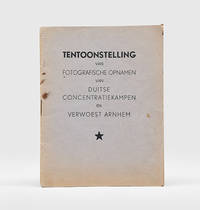
1945174825Amsterdam: United States Information Service 1945. Nazi crimes publicly revealed First edition first printing of the catalogue of one of the earliest Holocaust exhibitions held in the Netherlands soon after the war. The exhibition and catalogue were funded by the United States Information Service which supported exhibitions of photographs across Europe to show what had been done by the Nazis and build support for the coming war crimes trials. It includes one of the defining images of the Holocaust - the future Nobel laureate Elie Wiesel among other prisoners on the barracks at Buchenwald. Sextodecimo. With 25 half-tone photographs. Original grey wrappers printed in black. Short split at head of spine and 50 mm split at foot a little soiling to wrappers wrappers and contents slightly toned. A very good copy. unknown
1945STAN0099Praha, Delnicke Nakladatelstvi 1945. 22x15cm. 80 unpaginierte lose Seiten, 27 ganzseitige photogr. Abb., in ill. OUmschlag. Umschlag gering randrissig u. rückseitig etwas stockfleckig, sonst sehr gut erhalten. Die erste Bilddokumentation aus dem befreiten KZ Theresienstadt. Von großer Seltenheit.
19451874311945-46. A photograph album compiled by an American soldier serving in Austria immediately after the Second World War containing several photographs documenting the Holocaust. The album is divided into three sections labelled "commercial photographs" "'captured' photographs" and "personal photographs". The Holocaust images are in the "commercial" section and show piles of corpses concentration camp prisoners both naked and in striped uniforms and views of the camps and crematoria. Other commercial photographs depict combat scenes entertainment and bombed-out cities. The "'Captured' photographs" - it is unsure what the compiler means by this - also appear to be commercially produced. The "personal photographs" were all captured by the compiler and individually captioned. They depict the American soldier - identified only as "me" - while posted in Pupping Austria. The images include portraits of himself and his named comrades views of the Pupping Prisoner-of-War camp local buildings and landscapes and excursions to nearby Linz. The photographs are dated from November 1945 to June 1946. Oblong folio 370 x 290 mm embossed boards with gilt design on front new string ties containing 137 photographs of varying sizes on 15 card leaves remaining leaves unused. Covers very lightly rubbed and soiled some leaves a little chipped all photographs present. In very good condition. hardcover
194547189Krakow: Spóldzielnia Wydawnicza "Czytelnik" Czytelnik Publishing Cooperative 1945. First edition. Softcover. g to von-. Octavo 8 1/4 x 6". 93pp. 13 leaves of double sided photographic plates interleaved and unpaginated. Illustrated tan red and black wrappers with black lettering on the front cover. Photographic b/w frontispiece. Spóldzielnia Wydawnicza "Czytelnik."<br /> <br /> Possibly an earlier publication on lower quality paper compare to a slightly smaller publication by the "Library of the Union of Polish Patriots in the USSR" Biblioteczka Zwiazku Patriotów Polskich w ZSRR with the same text in different layout. That publication issued on higher quality paper and with twenty-eight photogravures three more than in this publication with twelve photographs appearing in both publications though in lesser quality here.<br /> <br /> Court Proceedings of the Polish-Soviet Special Criminal Court established in Lublin in August 1944 in order to investigate the crimes committed by the Germans in the Majdanek extermination camp. Despite the importance of this document it must be mentioned that the Commission made erroneous assumptions regarding the duration of the camp and the number of people killed at Majdanek. The Publishing cooperative "Czytelnik" was established behind Soviet front lines in 1944. It became the first post-World War II. publisher in Poland.<br /> <br /> The total numbers of the victims is still controversial: In this report 1.5 million victims of different nationalities were counted however according to the latest researches there were 79000 victims 59000 of whom were Jews See: Kranz T.: "Bookkeeping of Death and Prisoner Mortality at Majdanek." pp. 81-110. In: Silberklang D. Ed.: Yad Vashem Studies. Vol. 35:1. Jerusalem 2007.<br /> <br /> Illustrated with 25 pages of b/w photographic reproductions including a frontispiece on 13 double-sided interleaved plates altogether thirty-two photographs depicting members of the Commission Nazi guards now prisoners who used to run the camp and survivors alike testifying before the Commission. Also includes views of the actual concentration camp piles of suitcases Zyklon B poison gas pellets gas chambers ovens and survivors amid corpses.<br /> <br /> Wrappers with some chipping rubbing creasing and/or closed tears to extremities. Small stain on the back cover and side edge of book block. Verso of frontispiece with a vertical crease. Some pages throughout with some light age toning or small water spots. Overall text and images clear and vibrant. Wrappers in good interior in very good- condition overall. One of two editions of this work published in Moscow and Krakow in 1945. It is not certain which was released first. Each has different wrappers size pagination and publishers. Spóldzielnia Wydawnicza "Czytelnik" (Czytelnik Publishing Cooperative) unknown
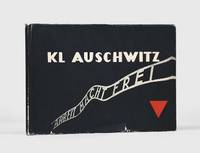
1960190277Krakow: International Auschwitz Committee 1960s. First edition first printing very scarce and even more so in the dust jacket. Offered "in memory of those murdered a warning to those living" the book charts the history of Auschwitz from its founding to its liberation and the trial of camp operators. It is extensively and graphically illustrated with photographs. The text is in English French and German throughout. The publishers the International Auschwitz Committee was founded by survivors in 1952 to preserve the memory of the camp counter anti-Semitism and maintain links between former inmates between nations and across the Iron Curtain. Oblong quarto. Original grey cloth front cover lettered in blind. With dust jacket. Jacket a little rubbed and chipped at extremities without price as issued; a fine copy in very good jacket. hardcover
193358726ABBerlin-Schöneberg, NS-Druck und Verlag, (1933). 8° (21x15), 165 S., 1 Bl. mit 13 fotograf Aufnahmen auf Tafeln (fortlaufend in der Paginierung; 191 S. mit 16 fotograf Aufnahmen auf Tafeln und 19 Porträtaufnahmen mit Kurzbiographien im Schlußkapitel 'Jüdischer Bolschewismus in Deutschland', einheitl rote Olnbde mit TitelPrägung, 1. Aufl. die Rücken aufgehellt, an den Rückenenden berieben und mit Schatten/Abrieb von entfernten Etiketten, sonst sauber und gut,
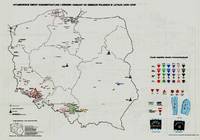
197941929Warszawa Warsaw: Pan´stw. Wydawn. Naukowe 1979. 1st Edition. Original black printed portfolio 8vo. Portfolio of seven large folding maps on on 4 sheets of heavy paper 3 are double sided 1 is singled sided. Primarily black and white with some color. Text in Polish. <br> Title translates to “Nazi camps in Poland 1939 - 1945. An Encyclopaedic Reference Book: Maps." Collection of 7 maps each 84 cm x 60 cm 33 x 24 inches produced by Jan Laskowski at the Main Commission for the Investigation of Nazi Crimes in Poland. The maps comprise Volume II of the work; Volume I is a heavily illustrated 676-page book of the same title which we offer separately. <br> The Seven maps all present are: <br> - Map 1 Single Sided: Hitlerowskie obozy na ziemiach polskich w latach 1939 - 1945. “Nazi camps in Poland in the years 1939 - 1945â€. Showing: concentration and extermination camps sub-camps of concentration camps extermination centers POW camps more important sub-camps working divisions commandos and temporary POW camps penal labor camps major labor camps prisons transit camps & ghettos. <br> - Map 2A: Getta na ziemiach polskich w okresie okupacji hitlerowskiej w latach 1939 - 1945 “Ghettos in Poland during the Nazi occupation in 1939 - 1945â€. <br> - Map 2B: Hitlerowskie obozy przejsciowe na ziemiach polskich w latach 1939 - 1945 “Nazi transit camps in Poland in 1939-1945â€. <br> - Map 3A: Hitlerowskie wiezienia i areszty na ziemiach polskich w latach 1939 - 1945 “Nazi prisons and arrests in Poland in 1939 - 1945â€. <br> - Map 3B: Hitlerowskie obozy pracy na ziemiach polskich w latach 1939 - 1945 “Nazi labor camps in Poland in the years 1939 - 1945â€. <br> - Map 4A: Hitlerowskie obozy jenieckie na ziemiach polskich w latach 1939 - 1945 “Nazi POW camps in Poland in 1939 - 1945â€. <br> - Map 4B: Hitlerowskie obozy koncentracyjne i osrodki zaglady na ziemiach polskich w latach 1939 - 1945 “Nazi concentration camps and extermination centers in Poland in 1939 - 1945â€. <br> Maps 2A & 2B have been described as a “Terrifying pair of maps showing the locations of German POW and internment camps in Poland during World War II highlighting the widespread locations of these establishments. In some parts of the map the information becomes so dense that three inset maps are shown. This map was designed by Jan Laskowski and printed in 1979 as part of a work on the Nazi extermination machine produced by PWN Warsaw a state-owned research-focused publishing house in Poland.<br> The map on the front is particularly interesting for its depiction of symbols used to classify internees in German camps. The uppermost of these depictions shows the combinations that can be made for different types of prisoners of different levels of importance. The armbands that would have been worn by these prisoners is shown as well as the prison uniforms. Other details are also shown. <br> The map lists hundreds of sites run by Nazi operators throughout the country. These include concentration camps death camps transitional camps and ghettos. The map is divided according to Poland's voivodeships with a key in the lower left. Names of cities too long to spell are also provided in the lower left. <br> This map was produced during a point in Poland's history during which it was actively revisiting the period during the Second World War. Leading social scientists devoted their time to trying to gather all the living as well as the recorded history of the events of the Holocaust and related atrocities before this information vanished. Leading these efforts particularly during the 1960s and 1970s was the Glówna Komisja Scigania Zbrodni przeciwko Narodowi Polskiemu known as the Chief Commission for the Prosecution of Crimes against the Polish Nation. They were active in publishing maps both for domestic educational purposes and for international remembrance and diplomatic efforts regarding the Holocaust. Jan Laskowski was a leading cartographer who produced a number of maps in this field. <br> These maps were produced as part of a series of maps that purported to combine to form an atlas of all of Hitler's crimes in Poland. Many of the large wall maps produced during this period could only show a fraction of the crimes or only the atrocities committed in one region. Thus a series of maps was needed to show all the points necessary which this present work contributes to. <br> Polish Reinterpretations of the Holocaust: Studying the effects of German occupation in Poland is a delicate subject. While it is certain that Poland suffered at least as badly as any other European nation during the Second World War reinterpretations of the Holocaust in the country have also been used to satisfy nationalistic tendencies. It has become evident to Western observers in the last several years that there is a strong nationalist movement in Poland that seeks to place blame for the Holocaust solely on the shoulders of non-Polish actors a movement originally fostered under Soviet rule. This movement has gone so far as to limit freedom of speech criminalizing with a three-year sentence the suggestion that Poland or its citizens in any form participated in the murders committed by Nazis. As such the term ‘Polish concentration camps’ has been deemed unacceptable with the government-approved term being ‘concentration camps on Polish territory.’ <br> All lines of evidence show that this map 2A & 2B was produced using the most accurate and impartial historical sources. The language on the map is simple naming only ‘Hitler's Atrocities’ and there is no evidence of a clear anti-German bias. However it is impossible to separate this map one of the most important productions of the remembrance movement during this period from the social situation in which it was produced. Maps like these can easily be converted into propaganda instruments and today's Polish leaders most of whom grew up during Soviet occupation will have formed their understanding of the Holocaust through maps like these. <br> Soviet Censorship: While the content of the map appears to have been produced free from bias the map still had to go through Soviet censorship. Mentioning prisoner of war camps in which primarily Soviet troops were interned would have been a prerequisite condition upon which the publication of the map rested. Further the lack of mention of any Soviet killings or camps requires no explanation….The map unlike many later maps makes no differentiation between the populations who suffered at the various camps. This represents the Soviet agenda that all nations suffered fought and won equally which sought to limit divisions in this post-identity state†Ruderman 2022. <br> SUBJECTS: World War 1939-1945 -- Prisoners and prisons German. -- Concentration camps -- Poland. Guerre mondiale 1939-1945 -- Prisonniers et prisons des Allemands. -- Camps d'internement -- Pologne. Obozy koncentracyjne -- Polska -- 1900-1945. OCLC: 830885973. <br> Light shelf wear to portfolio as expected. All maps in pristine condition with normal folds as issued. Very Good Condition. Complete and dramatic BR5 holo2-147-19-'cc. Warszawa (Warsaw): Pan´stw. Wydawn. Naukowe unknown
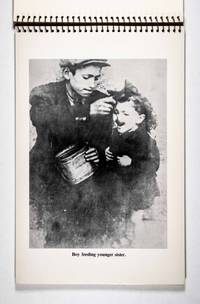
198347653Los Angeles: American Congress of Jews from Poland and Survivors of Concentration Camps 1983. First edition. Softcover. g to vg. Oblong Quarto. 4 55 leaves incl. 49 photographic plates. Original white stiff spiral-bound wraps with black lettering and publisher's device on cover. Catalog of the photo-exhibition "The Tragedy of the Jewish Child Under the Nazis" by the Holocaust Documentation Committee in Los Angeles. <br /> <br /> The exhibition is structure into six categories: Children orphaned and Starving 7; Child Labor Exploited 9; Struggle to Survive Physically and Mentally Warsaw Ghetto Scenes; 17 The Final Destination; 10 Child Partisans 3; After Liberation 3. The exhibition was curated in consideration of the younger viewers therefore omitted those pictures which in their stark and gruesome reality might harm the impressive minds of children Benjamin Grey. Introduction by Dr. Judah Pilch "Lest we forget." Illustrated with forty-five full page b/w photographs documenting the suffering of Jewish children during the Holocaust. Cover with very light soiling and rubbed. Last two plates with some wear along bottom edge not affecting images. American Congress of Jews from Poland and Survivors of Concentration Camps unknown
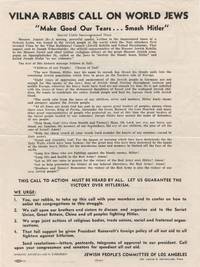
1941204434Los Angeles: Jewish People's Committee of Los Angeles 1941. Folded once horizontally fine. Broadsheet printed on both sides of single leaf 9-1/4 X 12-1/4 inches. Rare bilingual broadsheet appeal to the Jewish community printed in English and Yiddish and quoting the statement from the Vilna Rabbinical Council sent to the world August 26 1941 via Moscow begging for help after the nazi invasion and praising the Russian Red Army and "our redeemer Joseph Stalin." This sheet is slightly larger than one printed by the Daily Worker in New York of which OCLC locates only a single copy. The summer of 1941 saw the mass executions of Lithuanian Jews by German einsatzkommano forces. This appeal emerged in the midst of the horror and months before the U.S. entry into the war. Jewish People's Committee of Los Angeles unknown books
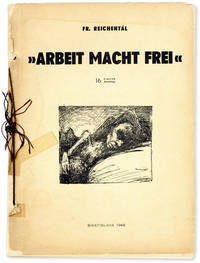
194652694Bratislava: Central Union of Jewish Communities of Slovakia 1946. First Edition. Bratislava: Central Union of Jewish Communities of Slovakia 1946. First Edition. Trade issue. One of a stated 5000 copies; this copy inscribed by the artist on title page: "To my friends Rossi and Mikloš Foltari / F. Reichental" undated but apparently contemporary with publication. Quarto 36cm; cord-bound printed card wrappers; 2 preliminary leaves; 16 unnumbered leaves of plates on coated paper printed recto-only; printed colophon leaf and blank terminal leaf 20ll complete. Covers somewhat worn; two small marginal tape-repairs to front cover with is partially detached from cord binding; internal text leaves somewhat age-toned; plates clean and unfaded. Very Good. <br/>Preface printed in both Slovak and English by Vojtech Winterstein. <br/><br/>Album of drawings depicting the daily lives of prisoners in Nazi concentration camps rendered in Reichentál's singular Expressionist style. Well known and highly-regarded as an avant-gardist through the Twenties and Thirties Reichentál exhibited widely in Germany and Eastern Europe until 1939 when German troops occupied Slovakia forcing the mass exodus of the native Jewish population. Though Reichentál himself was able to evade capture by the Nazis many of his family members died in the camps. He returned to Czechoslovakia after the war finally emigrating to the U.S. in 1950 where he continued to exhibit new work until his death in 1971. Despite the rather generous stated printing of 5000 copies plus 1000 copies of a signed numbered edition this album is notably scarce with only about 15 holdings worldwide noted in WorldCat KVK and COPAC of which ten are in North America. Central Union of Jewish Communities of Slovakia unknown books
1945009117Greiling bei Bad Tölz, Selbstverlag des Verfassers, 1945. 15 Blatt (die letzten beiden unbedruckt); 12 Blatt (das letzte unbedruckt) lose eingelegt in einen unbedruckten Papierumschlag. Mit eigenhändiger Widmung des Autors: "In Herzlichkeit der Redaktion zugeeignet. Deutschland im Jahre 1945. Hermann Noell. Tölz, Oberbayern, Städtisches Krankenhaus." "An Ketten und Zwangsjacken, bei Wasser und Brot, bei schlechtestem Fressen, ständig den gemeinsten Tod vor Augen, zerschlagen, zerquält und zersehnt, an Leib und Seele elend, krank und wund, hoffnungslos, hungrig und müde, weiblos und staatenlos erklärt, verbrachte ich 12 Jahre mein elendes Leben in deutschen Konzentrationslagern, in Strafbunkern und Strafkompagnien, in nationalsozialistischen Höllen jeder Art" (aus der Einleitung zum ersten Band). Die hier vorliegende Publikation enthält, jeweils mit Titelblatt und Einleitung, 11 bzw. 8 Gedichte auf einseitig bedruckten, nicht numerierten und - wohl für eine vorgesehene Kordelheftung - gelochten Blättern. Über den Verfasser war für uns nichts zu ermitteln (u.a. nicht in Kosch: Deutsches Literaturlexikon). Die Bayerische Staatsbibliothek besitzt je ein Exemplar der beiden hier vorliegenden Privatdrucke, die Universitäts- und Staatsbibliothek Hamburg eine sonst nicht nachweisbare Veröffentlichung "Nie vergessen. Erlebnis-Gedichte aus dem Konzentrationslager" (Bad Homburg 1947, 43 Seiten - diese Publikation nicht in der Deutschen Bibliographie 1945-1950). 2 Blatt mit kleinen Rostspuren einer Büroklammer, sonst schönes, gut erhaltenes Exemplar mit nur leichten Gebrauchsspuren. Selten.
1941STLB0099Prag, Als Manuskript gedruckt 1941. Gr.-4°. Tit., 19 S., obrosch. Viktor Ullmann (geb. 1. Januar 1898 in Teschen (Cieszyn), Österreich-Ungarn; ermordet 18. Oktober 1944 in Auschwitz-Birkenau). Ullmann lebte von 1933 bis zu seiner Deportation nach Theresienstadt (8. September 1942) in Prag. Hier schuf er den größten Teil seiner erhaltenen Werke, 15 von ihnen erschienen ?im Eigenverlage? in den Jahren 1939 ? 1942. - Mit einer Beigabe: Schultz, Ingo: Viktor Ullmann. Jude, Anthroposoph, "Entarteter" Musiker. (In: Flensburger Hefte, 1991; Ss. 5-26.)
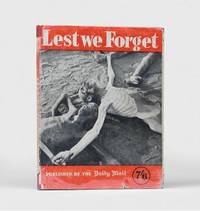
1945190283London: Associated Newspapers Ltd. 1945. First edition first impression rarely encountered in the jacket of one of the earliest full expositions of the Holocaust aimed at a general audience published by Britain's Daily Mail newspaper. The book gathers first-hand accounts and photographs from the liberation of the Nazi camps in the West showing corpses and surviving inmates as well as captured camp operatives. Quarto. Original red cloth front cover lettered and with barbed wire design in black. With the dust jacket illustrated with photograph of Holocaust victims. Light bumping and rubbing at extremities jacket chipped and creased reinforced with tape on verso protective acetate sleeve taped directly to jacket; a very good copy in sound jacket. hardcover