KIEFER, AnselmLivre Rare Book
175 résultats
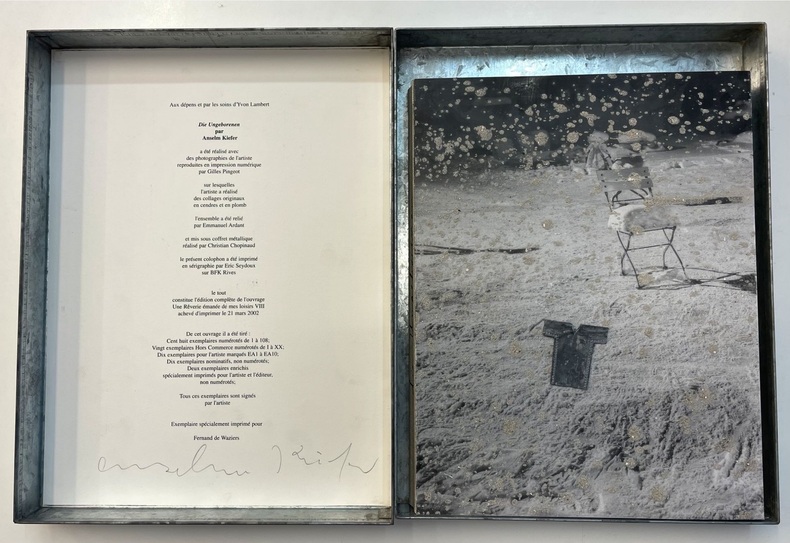
20022124Paris, Yvon Lambert, Coll. « Une rêverie émanée de mes loisirs, VIII », 2002. Un vol. in-4 (30,5 x 23 cm), broché, couverture illustrée, dos toilé titré, boîte d’acier brossé de l'éditeur. ÉDITION ORIGINALE. Collages de cendres et de plomb sur 18 photographies numériques par Anselm Kiefer. Chaque exemplaire composé à la main est sensiblement différent l’un de l’autre. Tirage à 150 exemplaires (N° 48/108 justifié et signé au crayon par l'artiste. Note : Les livres ne se contentent pas d'accompagner la création d'Anselm Kiefer, comme une production secondaire ou un commentaire. Ils y occupent une place centrale en constituant à la fois un lieu d'entrecroisement pour ses autres réalisations (installations et performances, sculptures et gravures, etc.), le creuset d'œuvres à venir ou l'aboutissement de réalisations antérieures. En tant que tels, ils sont un élément essentiel de son travail, un des plus significatifs et des plus fascinants. Bibliographie : Arasse, Anselm Kiefer, p. 47 ; […], Anselm Kiefer. L’alchimie du livre, BNF, 2015. Exemplaire bien signé à l’état de neuf, aucun défaut, les collages de cet exemplaire nominatif sont particulièrement soignés. — (ENGLISH DESCRIPTION) DIE UNGEBORENEN. (Paris, Yvon Lambert 2002). Anselm Kiefer's photographic book / multiple 'Die Ungeborenen': the complete illustrated portfolio of eighteen digital prints with ash and lead collage. Self-wrappered leporello with grey cloth spine, preserved in the original metal box prepared by Christian Chopinaud, with the colophon leaf mounted to the interior of the lid (as issued). Anselm Kiefer's photographic book / multiple 'Die Ungeborenen'. Edition: 150 ex. numbered and signed in pencil by Anselm Kiefer (with a further 20 hors commerce numbered I-XX, ten artist copies numbered 48/108 and signed with pencil by the artist, ten unnumbered nominatives copies, and ten copies from an édition de tête). Justification sheet is pasted to interior of lid. 305 x 230 mm. Printer: Eric Seydoux, Paris (Colophon) Fabricator: Emmanuel Ardant, Paris, Christian Chopinaud (Fabricator of Metal Case). - About the work: 'Die Ungeborenen' (The Unborn) has been a motif in Kiefer's work since the 1970s. Encompassing all of the artist's oeuvre, from painting to sculpture to books (as here), Kiefer has explored the idea of potential in all its forms: potential, i.e. unborn, people, ideas and creative possibilities. To this end, Kiefer has explored a vast mythos including German folklore, philosophy, literature, Jewish myth, Lilith, the first woman, characterised by patriarchy as a demoness and so on. As so often in Kiefer's work, he makes use of lead and ash in this book, applying them directly to his photographs. 'It’s the other aspect of the unborn, the desire of not wanting to be born. Cry of the prophets, the revolt of Job. It would have been better if you had never been born! Everything happens as if it would have been preferable to not be born. The retrograde movement of creation. Theodicy, the accident of creation, God’s regret to have fathered this ungrateful being, this outlaw, who does not abide to the contract.' (Anselm Kiefer). - About the artist: Anselm Kiefer (born in 1945) has established himself as one of the most important post-war German artists. In his works, paintings, sculptures, and installations Kiefer draws from German culture, making more or less explicit references to recent history, literature, philosophy and art. Kiefer’s Die Ungeborenen combines figurative motives with an abstract background. The artist uses narrative elements—the dresses, numbers, and branches—to evocate the demon Lilith, a figure from Jewish folklore, who was believed to kidnap newborn children. The dresses without bodies, and the adjacent numbers, are also a reminder of the Holocaust. In his work, Kiefer frequently offers a reading of recent history through mythological or classic figures, in this case Lilith. He uses the abstraction of the background not per se, but to demonstrate the universality of his approach; the unborn and the ones who lost their lives are like stars in the infinite sky, countless, yet always on our mind. (Literature: Daniel Arasse, Anselm Kiefer (New York: Harry N. Abrams, Inc., 2001), 16-17, 19, ill). More pictures on request.
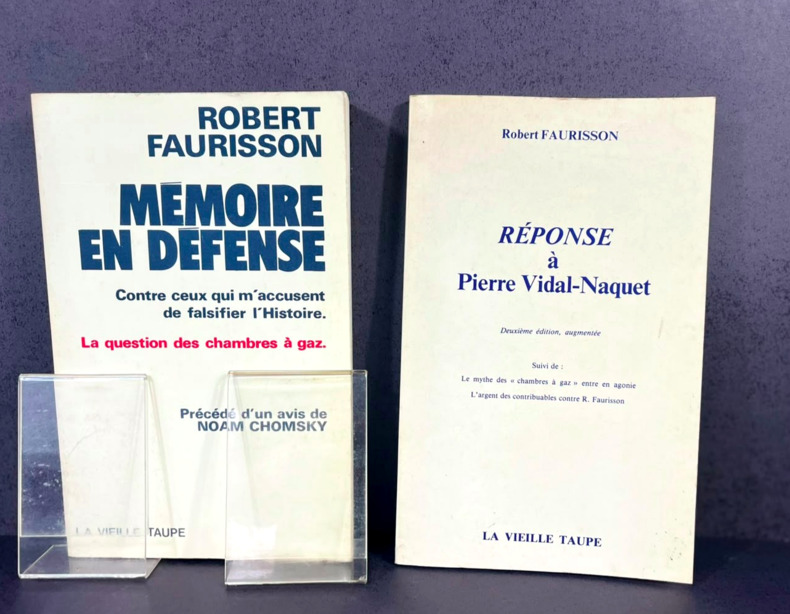
1980QZI-24Premier livre : Mémoire en défense contre ceux qui m'accusent de falsifier l'Histoire. La question des chambres à gaz. Paris, La vieille taupe, 1980. Édition originale. Préfacé par Noam Chomsky. In-8 broché, 14 x 22 cm, (xxiii) 275 + 3 pp. Intérieur propre, légers jaunissements par endroits. Avertissement au lecteur, Le professeur de médecine Johann Kremer devant le typhus à Auschwitz en 1942, Pièces annexes. Second livre : Réponse à Pierre Vidal-Nacquet, suivi de : Le mythe des chambres à gaz entre en agonie et L'argent des contribuables contre R. Faurisson. Paris, La vieille taupe, 1982. Deuxième édition, augmentée, définitive. In-8 broché, 14 x 22,5 cm, 95 pp. Légères rousseurs aux 2 premières pages, sinon intérieur propre. Portrait d'un historiocrate par Pierre Guillaume (éditeur), Note du Professeur Faurisson, Réponse à un historien de papier, etc. Ce livre répond à l'article "Un Eichmann de papier" paru en 1980.
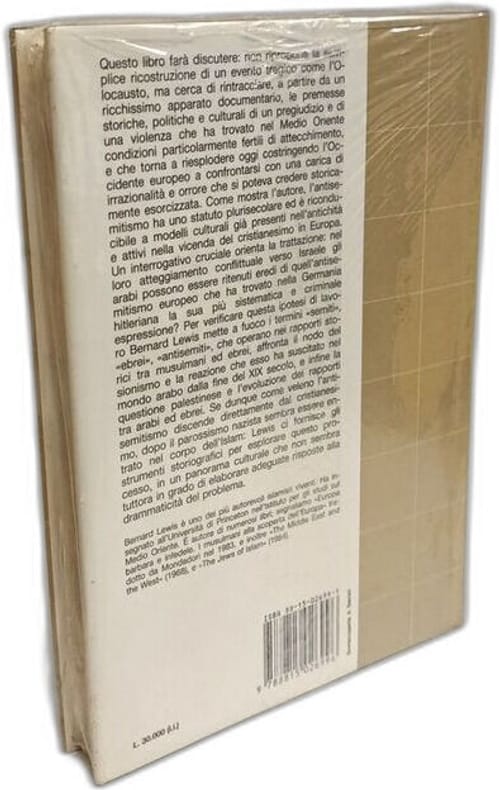
1990100137504Il Mulino 1990 294 pages in8. 1990. Cartonné jaquette. 294 pages.
122725Imprimerie Artistique en couleurs, Lyon - 1946 - In-folio, chemise broché avec papier cristal, couverture illustrée, feuillets détachés, dans une chemise cartonnée, dans un emboitage gris neutre - 78 planches illustrées hors-texte en N&B - Exemplaire numéroté sur Vélin pur fil Lafuma, Ex N°274/1200.
L11112Moscou. Éditions militaires du Commissariat du Peuple à la Défense, 1944. In-12 agrafé de 28 pages. Texte du Communiqué de la Commission extraordinaire Polono-Soviétique pour l'étude des massacres commis dans le camp d'extermination de Majdanek, près de Lublin (Pologne). Dos recollé, extrêmement rare !
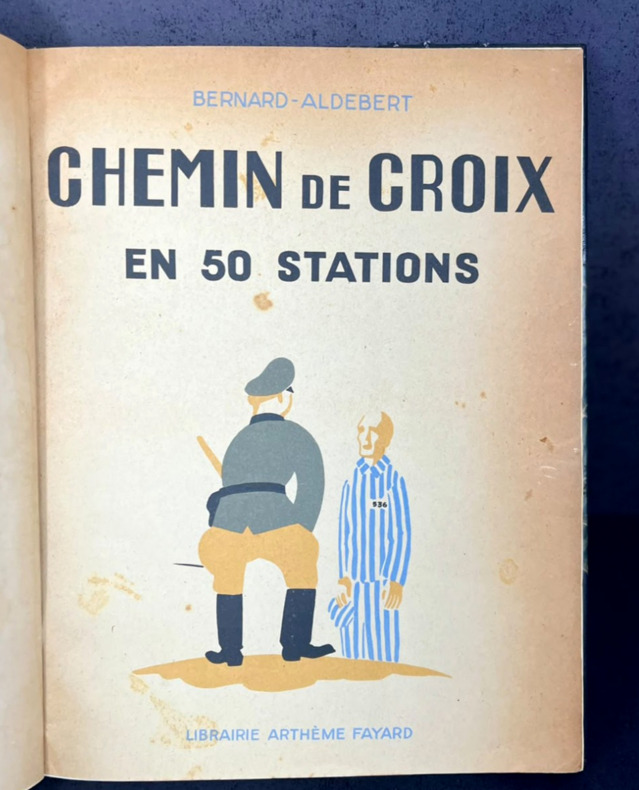
1946563Paris, Arthème Fayard, 1946. Édition originale. Grand album de 22 x 28 cm, 112 (2) pp. Relié demi-cuir noir à coins, dos à 5 nerfs ornés de pointillés et traits dorés, nom d'auteur et titre en doré. Plats marbrés. Couverture originale conservée. Tranchefile. Ouvrage illustré d'une cinquantaine de dessins en noir et blanc de l'auteur. Cet ouvrage est un puissant récit autobiographique illustré de l'artiste français Jean Bernard-Aldebert (connu sous le nom de Bernard-Aldebert, 1909-1974), relatant sa captivité dans cinq camps de concentration nazis différents entre 1944 et 1945. Après avoir bâti une carrière d'illustrateur, de caricaturiste et de satiriste, l'artiste voit son destin basculer tragiquement en novembre 1943. Pour avoir caricaturé Hitler sous les traits d'un chimpanzé dans le numéro du 1er août de l'hebdomadaire humoristique français *Ric et Rac*, Bernard-Aldebert est arrêté par la Gestapo. Il est ensuite transféré en janvier 1944 au camp d'internement de Royallieu-Compiègne, puis successivement à Buchenwald, Mauthausen, Gusen I et enfin Gusen II, où il demeure jusqu'à sa libération le 5 mai 1945. Le texte et les illustrations de l'auteur dévoilent les horreurs subies par les prisonniers dans ces camps : travaux forcés brutaux, famine, tortures sadiques et violences diverses. Si Bernard-Aldebert était surtout connu pour des caricatures au style léger et de charme, les images présentées ici versent dans un tout autre registre. Elles rappellent son style habituel, mais se révèlent bien plus dépouillées, sombres et austères, comme un reflet des émotions des personnages qui y apparaissent. Le texte est accompagné, presque systématiquement sur la page en regard, d'une reproduction en noir et blanc d'un dessin original de l'artiste, pour un total de 50 images. Celles-ci sont issues d'une série de croquis dessinés par Bernard-Aldebert peu après sa libération ; ils offrent, encore aujourd'hui, un témoignage visuel et émotionnel inestimable.
L11110Lodz. Commission Centrale d'Histoire Juive, 1946. Plaquette in-8 agrafée de 40 pages. M. Balberyszski était un juif lituanien, survivant de l'Holocauste. Ce livre est le récit de la vie et de l'organisation du Petit Ghetto depuis sa formation jusqu'à sa liquidation, c'est aussi le seul témoignage historique du sort de la population juive de Vilna depuis le jour de l'arrivée des Allemands, jusqu'à la libération des 84 Juifs survivants par l'armée soviétique. Préface de J. Kermisz. Catalogue des publications du centre. Textes en polonais. E.O.
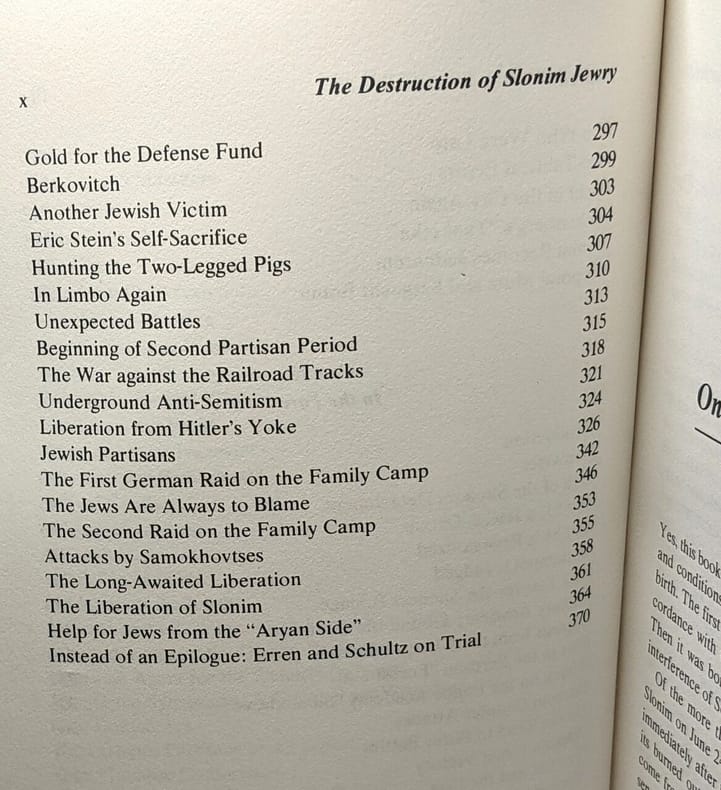
1990100133188Unites States Holocaust 1990 in8. 1990. Broché.
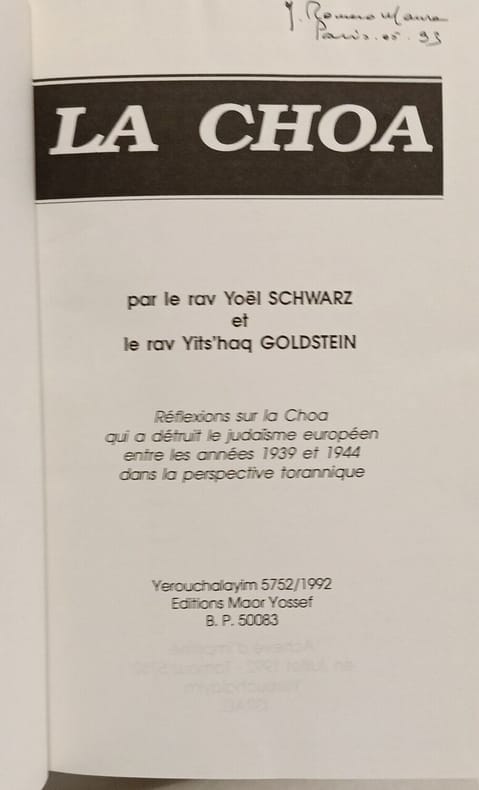
1992100147339Editions Maor Yossef 1992 in8. 1992. Cartonné. Le livre 'Shoah: A Jewish Perspective on Tragedy in the Continent' est une collaboration des rabbins Yoel Schwartz et Yitzchak Goldstein qui aborde la Shoah d'un point de vue théologique juif. L'ouvrage initialement publié en hébreu en Israël traite de ce sujet difficile du XXe siècle et a gagné un large respect dans les milieux religieux israéliens
1991100133181Bloomsbury Publishing PLC 1991 320 pages 14x2 8x21 6cm. 1991. Cartonné jaquette. 320 pages.
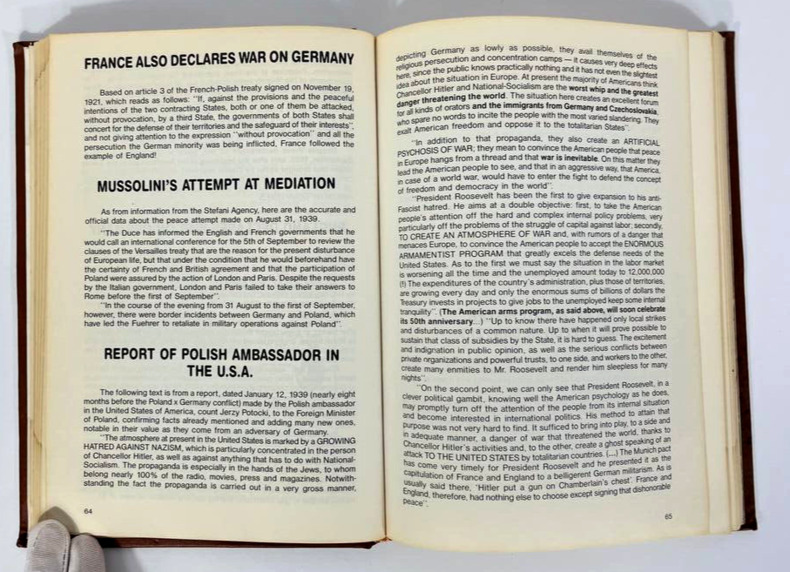
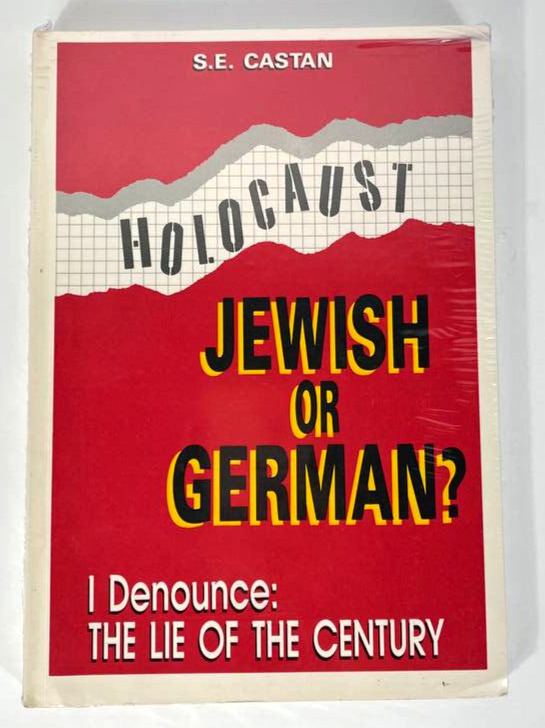
19880188Porto Alegre, Revisão, 1988. In-8, 233 x 166 mm, 320 pp. First English edition. Translated from Portuguese by Murilo Alves Lopes and Sandra Beatriz Zagonel. Brown hardcover with author's name and book title on the front plate and the spine, original colored softcover inside with flaps. Dedication, thank-you list and table of contents at the beginning. Translator's note and preface opening the book, epilogue and list of source at the end. Widely illustrated with pictures and maps. Tables and many quotes along the way. This is the English edition of S. E. Castan's Holocausto: Judeu ou Alemão? published in 1987. This book puts forward "another version of the World War Two history" told by Germans themselves (Overture, p. 11) and gives another account than the orthodox Nuremberg judgment narrative. It went through multiple editions in Brazil, becoming a library success before Castan's publisher was trialed for "racism." Though the Brazilian law prohibits expressions of racism and offense to religious cults, it does not forbid from doubting the Nuremberg narrative and official version of the World War Two, which this book does. Both original Portuguese and translated English copies have become increasingly rare. Includes a reference to the Leuchter report, another staple of revisionism, which was also translated and published in Portuguese by Revisão (Acabou o gás: o fim de um mito) in 1989. The gaúcho Siegfried Ellwanger Castan (1928-2010) started working in a factory at 12 years old. He became an industrialist, dealing with iron and steel as a branch office organizer, then created production plans for the first "galvanized water pipes, soldered by induction, the first cold-drawn steel bars and the first rolled steel for special profiles that were imported into Brazil until then. He also invented support plates for rails... [and] sold the stock control of his organization a few years ago to devote himself mostly to researches about the second World War" (front flap).
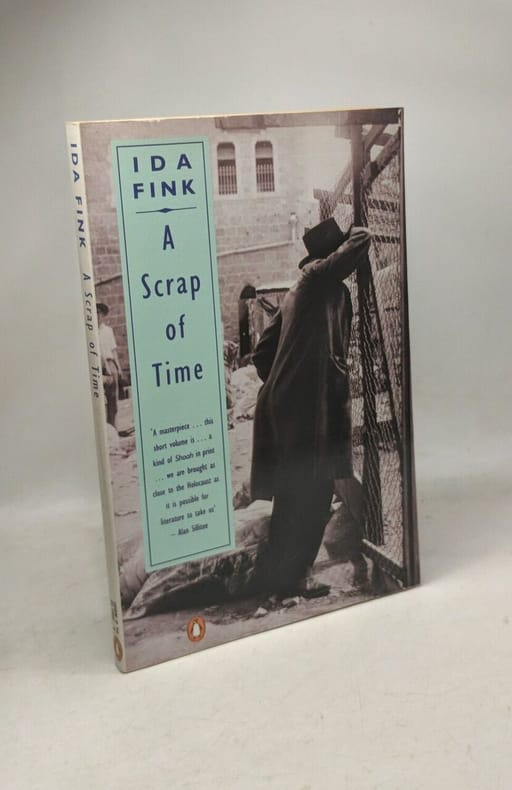
1990100133787Penguin 1990 144 pages 12 8x1x19 6cm. 1990. Broché. 144 pages.
PHO524M1960, Editions Polonia, Varsovie. ENVOI. In-4, relié, toilé éditeur sous jaquette illustrée, 266pp. Imprimé en héliogravure. Jaquette fatiguée. Intérieur bon. Exemplaire satisfaisant de ce témoignage accablant. INSCRIBED BOOK. In-4, clothbinding, dust jacket, 266pp. Worn dust jacket. Interior good. Satisfying copy.
1993T113022Augsburg, 1993 265pp., 21cm., Doctoral Dissertation (Inaugural-Dissertation (Inaugural-Dissertation zur Erlangung des Doktorgrades der Philosophischen Fakultäten der Universität Augsburg), softcover, stamp at verso of title page, text is clean and bright, T113022
195222631KRAKOW Comité International d'Auschwitz 1952 -in-8 broché un volume, broché noir in-octavo à litalienne Editeur (27 x 19,2 cm), dos muet(spine without title), 1ère de couverture avec titre imprimé en blanc, reproduction de la frise au dessus de la porte d'entrée du camp : "ARBEIT MAGHT FREI"(le travail rend libre) en blanc avec en bas à droite un triangle rouge, texte en français, anglais et allemand, orné de trés nombreuses photographies in et hors-texte en noir, 96 pages, sans date (1952)KRAKOW Comité International d'Auschwitz (CIA) Editeur,
2013S92807Antwerpen, Ludion 2013 239pp. with illustrations in colour (work from the Belgian artist Jan Vanriet), 29cm., editor's illustrated hardcover, bilingual: English-Dutch, very good condition, [Contains contemporary art by Jan Vanriet, inspired by the Holocaust. This book is published on the occasion of the exhibition in the Museum Kazerne Dossin, Mechelen, from 28 November 2013 until 30 March 2014], S92807
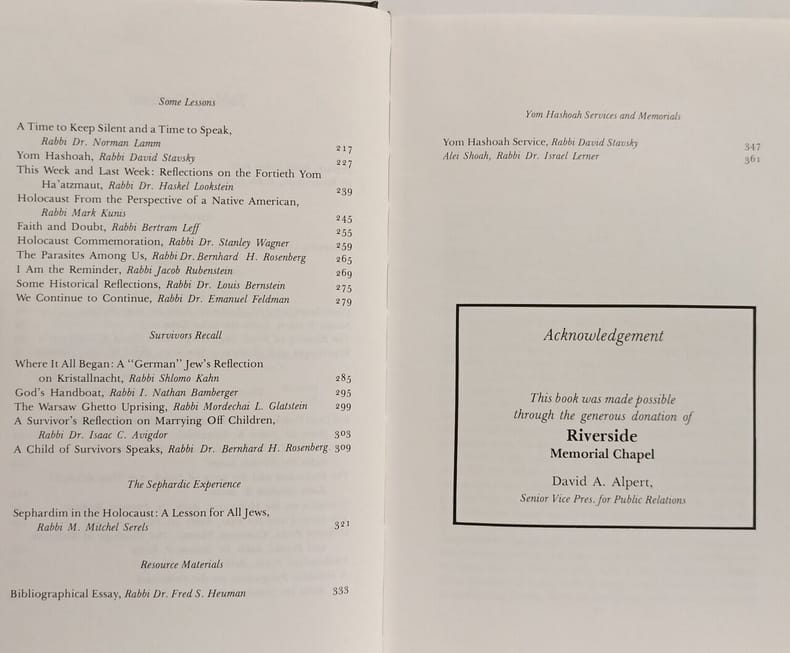
1991100147078Ktav Pub & Distributors Inc 1991 16 2x2 8x23 4cm. 1991. Cartonné jaquette. Il s'agit d'une anthologie académique publiée en 1991 éditée par le rabbin Dr. Bernhard H. Rosenberg avec Fred Heuman comme co-éditeur qui rassemble des réflexions théologiques et halakhiques sur l'Holocauste. L'ouvrage aborde le défi de la réflexion théologique après la Shoah un domaine qui a été relativement peu exploré dans la génération suivant les événements en raison du choc et des priorités de reconstruction communautaire
L15847Varsovie. Ksuazka i Wiedza, 1968. In-12 br. Plaquette de 92 pages publiée à l'occasion de l'anniversaire des 25 ans du soulèvement du ghetto de Varsovie en 1943. Texte en polonais. Année de l'E.O.
L14606New York. Museum of Jewish Heritage, 2008. In-4 br. Texte en anglais. Plusieurs contributions. Importante iconographie sur la Résistance juive durant la seconde guerre mondiale.
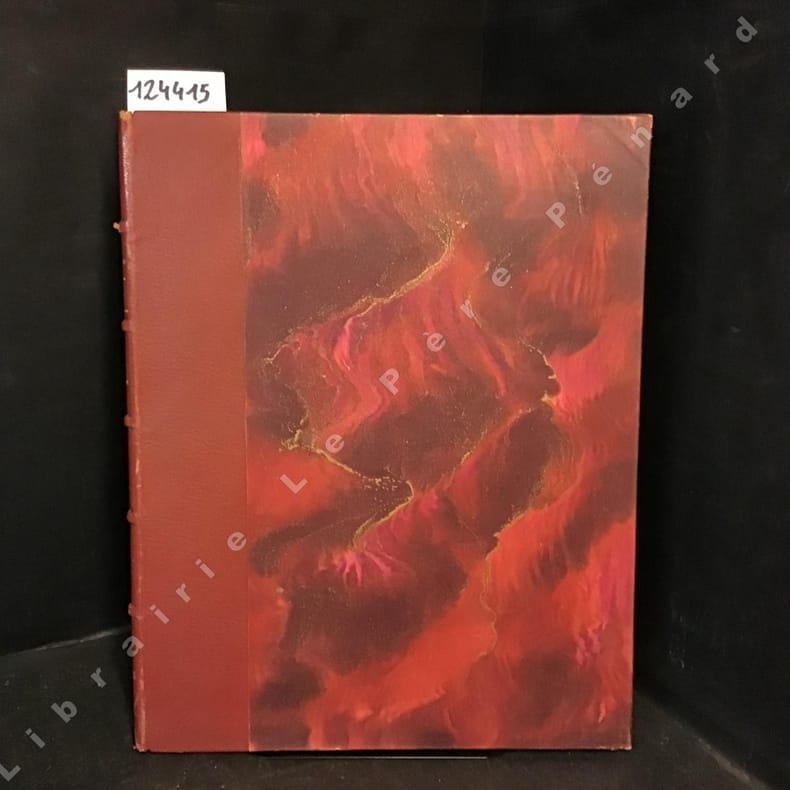
19411244151941 A Lyon, éditions non renseignées, Imprimerie Giraud-Rivoire - 1941 - In-4, reliure demi cuir rouge, dos à 5 nerfs avec titre en doré, couverture par Chapelet d'origine conservée - Héliogravure en contrecollé de M. Lescuyer - Couverture et deux hors-texte en couleurs de Chapelet 54 pages + 14 pages de la revue "L'illustration" - Nombreuses illustrations en N&B dans l'ouvrage
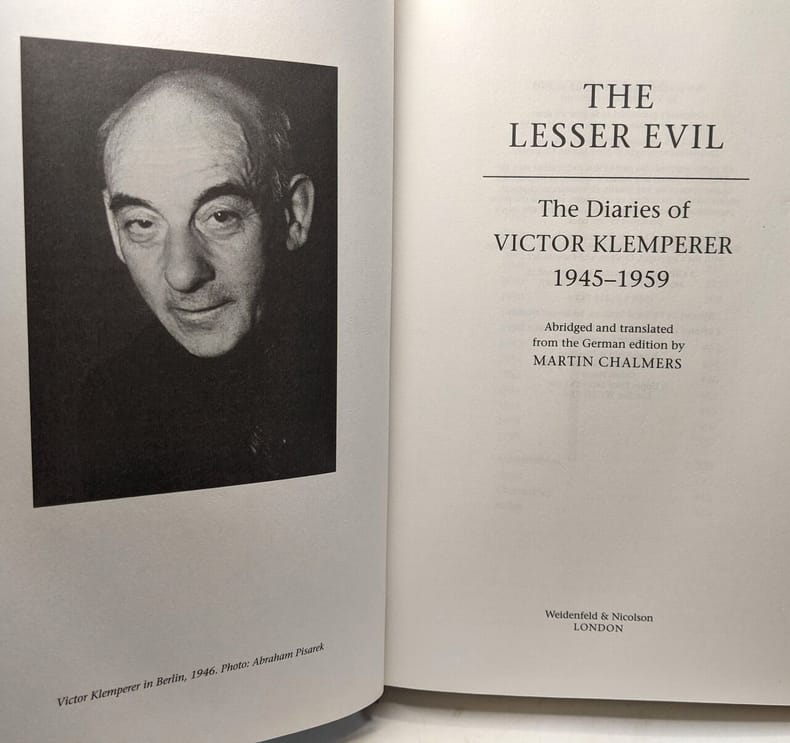
2004100126997Weidenfeld & Nicolson History 2004 500 pages 16 76x5 59x23 62cm. 2004. Cartonné jaquette. 500 pages.
20172202017 - cartonné - Apostolicum, Pallottine Fathers Publishing House - Gdzie Foundation - 2017 - In-8 (24 x 17 cm) cartonné - XXXIV + 253 pages - ISBN : 9788379190690 - Ouvrage en anglais (Text in english)
19880253Porto Alegre, Revisão, 1988. In-8, 228 x 160 mm, 320 pp. First English edition. Translated from Portuguese by Murilo Alves Lopes and Sandra Beatriz Zagonel. Original editor's colored softcover with flaps. Dedication, thank-you list and table of contents at the beginning. Translator's note and preface opening the book, epilogue and list of source at the end. Widely illustrated with pictures and maps. Tables and many quotes along the way. Please note: this book is still under wrappers and like new. The three last pictures on the ad have been taken from another copy of the same book (which I cracked open to take these pictures). This is the English edition of S. E. Castan's Holocausto: Judeu ou Alemão? published in 1987. The book puts forward "another version of the World War Two history" told by Germans themselves (Overture, p. 11) and gives another account than the orthodox Nuremberg judgment narrative. It went through multiple editions in Brazil, becoming a library success before Castan's publisher was trialed for "racism." Though the Brazilian law prohibits expressions of racism and offense to religious cults, it does not forbid from doubting the Nuremberg narrative and official version of the World War Two, which this book does. Both original Portuguese and translated English copies have become increasingly rare. Includes a reference to the Leuchter report, another staple of revisionism, which was also translated and published in Portuguese by Revisão (Acabou o gás: o fim de um mito) in 1989. A polemical title and a rare copy. The gaúcho Siegfried Ellwanger Castan (1928-2010) started working in a factory at 12 years old. He became an industrialist, dealing with iron and steel as a branch office organizer, then created production plans for the first "galvanized water pipes, soldered by induction, the first cold-drawn steel bars and the first rolled steel for special profiles that were imported into Brazil until then. He also invented support plates for rails... [and] sold the stock control of his organization a few years ago to devote himself mostly to researches about the second World War" (front flap).
1919011786Brussel 1919 N.V. Ons Vaderland Soft cover