Charles-Edouard MailhotBiblio.com

326 résultats
0484244248.Ghardcover. Good. Access codes and supplements are not guaranteed with used items. May be an ex-library book. hardcover
0656873027.Ghardcover. Good. Access codes and supplements are not guaranteed with used items. May be an ex-library book. hardcover
1527604373.Gpaperback. Good. Access codes and supplements are not guaranteed with used items. May be an ex-library book. paperback
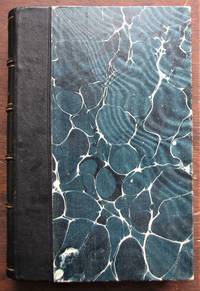
1925R3278Québec: L'Imprimerie d'Arthabaska Inc. Imprimeur 1925 RARE. Nombreuses photographies en n.& b. hors-texte; frontispice de l'auteur. Quart de reliure de cuir noir avec quatre faux nerfs au dos dorés au filet; titrage doré au dos; roulette à froid sur la longueur du cuir; plats marbrés; tranches jaspées. Couverture rigide. Très bon. L'Imprimerie d'Arthabaska, Inc. Imprimeur hardcover
1019989920.Ghardcover. Good. Access codes and supplements are not guaranteed with used items. May be an ex-library book. hardcover
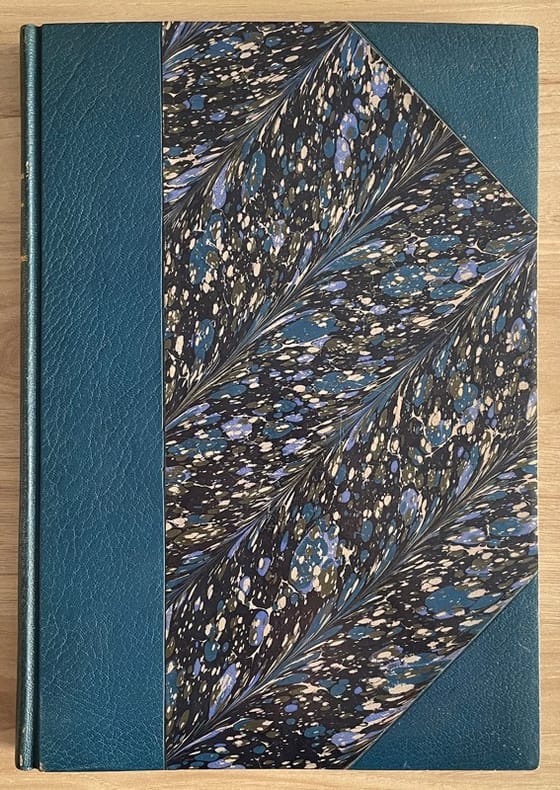
1887727Paris : Librairie des bibliophiles (impr. Jouaust et Sigaux), 1887 In-4, 335 x 230 : (2 ff.), XIV, (1 f.), 191 pp., couverture illustrée Demi-maroquin bleu-roi à la bradel, à large coins, dos lisse, couverture et dos conservés (Carayon).
190628019Paris, 1906, in-8, 51 et (1) pages, exemplaire broché, sous couverture muette, Annexe des Procès-verbaux des séances du comité international des poids et mesures de la session de 1905. Cette annexe signée par Benoit et Guillaume, directeur et directeur-adjoint de l'institut nationale des Poids et Mesures s'inscrit dans un tournant de l'histoire de la métrologie. Ayant pour objet l'étude de la détermination des coefficients de dilatation, les résultats présentés dans l'annexe furent fondamentaux et atteignirent une précision inégalée pour l'époque. Les méthodes mises au point et menées par les deux savants sont encore, à quelques variantes près, celles que nous utilisons aujourd'hui. L'ouvrage nous renvoie ainsi aux origines de la métrologie moderne. L'ouvrage condense un ensemble de données géométriques et thématiques sur les objets tri-dimensionnels qui composent nos paysages urbains et naturels. Des recherches sur la permanence des fils et sur les appareils utiles à la détermination géodésique rythment par ailleurs l'ensemble de l'ouvrage. Demeurant le fruit de longues recherches, les conclusions recueillies dans cet ouvrage participèrent à constituer la renommée de l'institution nationale des poids et mesure. 15 figures en noirs illustrent le texte. Parfait exemplaire, intact. 51 et (1) pages
185090068Goupil Vibert & Cie | Paris 1850 | 34.5 x 46.5 cm | Reliure de l'éditeur
242991Paris, Eugène Figuière & cie, s.d. (1913) in-12, [4]-248 pp., avec des illustrations dans le texte, demi-percaline violette à la Bradel, couv. cons.
195621750Paris, éditions de Minuit, 1956. In-8 oblong de 192 pages, cartonnage d'éditeur illustré, dos de toile, titre en long.
20819Arthabaska L'Imprimerie d'Arthabaska
SLIVCN-9782882410214Bernard Campiche (10/1990)
84486Yvonand, Campiche 1990, 210x120mm, 309pages, broché. Couverture à rabats. Très bel exemplaire.
1527721108.Gpaperback. Good. Access codes and supplements are not guaranteed with used items. May be an ex-library book. paperback
1104139502.Gpaperback. Good. Access codes and supplements are not guaranteed with used items. May be an ex-library book. paperback
1341050556.Ghardcover. Good. Access codes and supplements are not guaranteed with used items. May be an ex-library book. hardcover
0266750885.Ghardcover. Good. Access codes and supplements are not guaranteed with used items. May be an ex-library book. hardcover
2024BN203544LGDJ 2024. 2024. Softcover. Le statut des baux commerciaux: Textes et commentaires - Modèles d'actes <br/><br/>Le statut des baux commerciaux: Textes et commentaires - Modèles d'actes Brault Charles-Edouard; Barbier Jehan-Denis LGDJ paperback
2017BN179227LARCIER 2017. 2017. Softcover. Le notaire et son client : de conseiller à confident de 7 à 77 ans <br/><br/>Le notaire et son client : de conseiller à confident de 7 à 77 ans Baugniet Nathalie; Bertouille Dominique; Frésart Charles-Edouard de; Frésart Michel de; Collectif LARCIER paperback
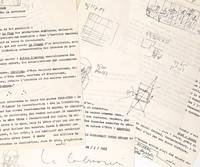
19513031Paris: np 1951. first edition. folder. Very Good. UNIQUE ANNOTATED TYPESCRIPT SIGNED WITH TWO FULL PAGES OF LE CORBUSIER DRAWINGS PRESENTING ONE OF HIS MOST FAMOUS AND INFLUENTIAL PHILOSOPHICAL ACHIEVEMENTS. Born in 1887 Le Corbusier found himself situated between two competing historical and architectural moments: an intricate history of grandiose Gothic and Renaissance style and the sleek efficient creation of the Second Industrial Revolution. In his canonical 1923 Towards an Architecture Le Corbusier argued that modernity must be matched with architectural innovation. Functionality took a core place in Le Corubusier’s thinking. Houses were to be understood as machines for living said Le Corbusier famously and machines were to be governed by the economies in which they existed. From this conviction came Le Corbusier’s famous villas his massive housing blocks in the suburbs of Paris and perhaps most importantly a fathering of modern architecture as defined by an emphasis on function simplicity and new material Towards an Architecture.<br /> <br /> In 1942 Le Corbusier was asked to create a universal measurement for construction materials. What Le Corbusier deemed necessary was not only the creation of a new unit but the arduous task of unifying metric and Anglo-Saxon systems integrating the inch and the centimeter into one intuitive scale. Although an ambitious project this unification coined Modulor existed within the ethos of Le Corbusier’s New Architecture. As Le Corbusier identified it the importance of an architect was in their giving of “a physical order which we feel to be in accordance with that of the world.†This order was not only in aesthetic sleekness but in an ethos of design that mirrored the social moral and political reality surrounding the architect. Therefore units of measurement —as enablers of creation—were to reflect modern efficiency with new universal standards Towards an Architecture.<br /> <br /> It was not immediately clear what should be the basis for the new standardized units. Metric and Anglo-Saxon systems after all are based on different ‘orders’—a meter defined by the speed of light a law of science; a foot defined by the proportions of the human body. Le Corbusier framed this tension in this rare manuscript: “the human body exists on one side and the mathematicians on the other.â€<br /> <br /> Le Corbusier struggled with the concept of the Modulor over many years and the present text dated by Le Corbusier 28/1/1951 represents a more mature and developed presentation of his theories. It reads as a manifesto-like preamble to the Modulor’s ambitions in the postwar world: to “harmonize the flow of worldwide production†to systematize standardization without deadening compromise and to reduce the friction of incompatible systems metric versus foot–inch. Le Corbusier presents the Modulor as a human-scale “gamut†of measurements—explicitly compared to the musician’s scale—grounding chosen dimensions in bodily proportion and number. He invokes the golden ratio and the Fibonacci series as ordering principles and includes the well-known endorsement attributed to Einstein “a scale of proportions that makes the bad difficult and the good easy†framing the Modulor as a tool of order rigor and harmony applicable from the architect’s drafting table to the engineer’s office and the building site.<br /> <br /> The two full drawing sheets marked with figure callouts e.g. “Fig. 35…†“Fig. 65…†“Fig. 100…†and geometric/proportional constructions including a right-angle scheme marked “90°†and φ symbols reinforce the document’s working character: argument paired with visual proof capturing Le Corbusier’s drive to make proportion not merely theoretical but operational.<br /> <br /> Although we haven’t been able to find this exact text published anywhere the present typescript closely aligns—often in phrasing and argumentative sequence—with Le Corbusier’s published presentation of the Modulor and can be read as a self-contained “preamble†distilled from that larger project. However the dated and signed terminal leaf 28 January 1951 and the presence of working ink annotations and separate diagram leaves with figure callouts suggest an independent studio or promotional iteration rather than a simple excised page from a printed book documenting the Modulor as an evolving actively circulated tool.<br /> <br /> The Modulor proved enduringly influential as a conceptual and pedagogical framework for proportion—reinforced by its use in Le Corbusier’s own buildings and its broad afterlife in architectural discourse—even as it never achieved its founder’s ambition of becoming a universally adopted international standard of measurement.<br /> <br /> Paris: January 28 1951. Text in French. 6 leaves each approx. 8.25 × 10.75 in.; with writing or drawings on rectos only including 4 typed leaves with ink annotations and small drawings; 2 leaves of original drawings; last typed leaf signed and dated. In excellent condition with only very light toning and minor handling wear consistent with working material. English translation available upon request.<br /> <br /> A UNIQUE FIRST-HAND ACCOUNT WITH NUMEROUS DRAWINGS PRESENTING ONE OF LE CORBUSIER'S CORE PHILOSOPHIES. np unknown
20112-2296547877Editions L'Harmattan 2011. Paperback. New. 358 pages. French language. 9.37x6.06x1.34 inches. Editions L'Harmattan paperback
2009127170Fondation Le Corbusier, Paris, 2009. 22 S. ; 29,5 x 16 cm ; broschiert.
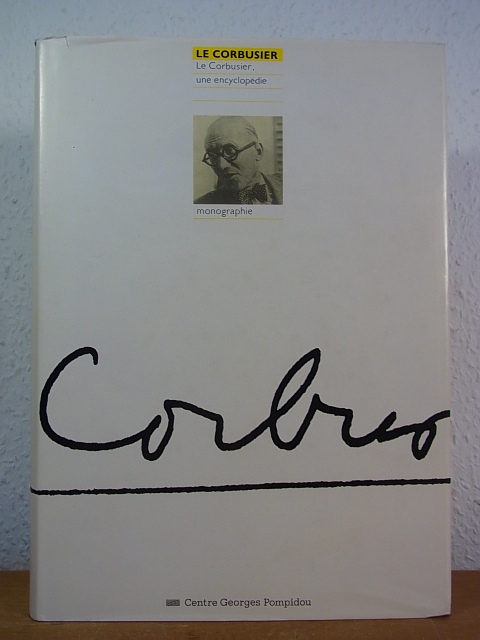
1987126968Éditions du Centre Georges Pompidou, Paris, 1987. 497 S. ; 30,5 x 22 cm ; Leinen.
1987127092Musée des beaux-arts, La Chaux-de-Fonds, 1987. 80 S. ; 22 x 22 cm ; kart. ;
1987127128Caisse Nationale des Monuments Historiques et des Sites, Paris, 1987. 245 S. ; 26 x 24 cm ; kart. ;