1 219 résultats
ORD-8097Préface de François Mauriac. 140 gravures. Paris. Flammarion. 1944. Gd in-8 (185 x 250mm) broché, couverture blanche imprimée en noir et en bleu, blanc, rouge, photo des chars place de l'Étoile, 96 pages. Nombreuses photos de H. de SEGONZAC, Presse-Libération, Robert DOISNEAU, CARTIER-BRESSON, JAHAN, etc. Couverture un peu épidermée, bon état intérieur.
2010202601535Paris, Éditions de la Martinière, 2010 ; in-folio, 362 pp., cartonnage imprimé d'éditeur. Nombreuses illustrations en noir et blanc et en couleurs.
34412Paris, sans date (1945), in 8°, reliure à spirale illustrée de l'éditeur, 1 feuillet d'Avant-propos (en français et en anglais) suivi de 36 feuillets de photographies (généralement, 2 phtographies par feuillet), chacun accompagné de sa serpente légendée en anglais et français.
1974LFA-126740017N° 3 - 1974 : 292 pages, format 210 x 295 mm, illustrée, brochée couverture couleurs, bon état
194524120P., Comité Parisien de la Libération, Imprimerie Draeger, novembre 1945, in-4°, 105 pp, 34 photos reproduites en héliogravure provenant des studios L.A.P.I., Louis Sylvestre, France-Presse, ensemble de textes : tracts, proclamations, messages, appels, etc. promulgués par le C.P.L. de 1943 à 1945, broché, bon état
200803226Saint-Mandé, Comité libération, vers 1944 - 1945 ; petit in-4, cartonnage de l'éditeur. L'ombre et la lumière - rousseurs.
1984LFA-126729981Tome Onzième (Année 1984) : 96 pages, format 140 x 210 mm, illustré, broché, bon état
2008169215北京.Beijing.: 星球地图出版社.Xing qiu di tu chu ban she. May2008. Two large coloured maps printed on double sided on a single sheet folded issued shortly after the devastating 2008 Wenchuan Earthquake which was occurred on 12 May 2008. Small tears along folds mended by both non-acidic tape and cello tape some creasing generally good. Text in Chinese. Sheet measures 84.9 x 119.7cm. <br> <br>Map of Sichuan Province: scale 1: 1100000 inset map lower right corner showing the provincial capital city Chengdu a statistical chart lower section listing counties within Sichuan Province their population and territory size. <br> <br>Map of Wenchuan County and Its Vicinity: 1: 300000 various colour representing altitude differences inset map showing the position Wenchuan County within Sichuan Province a mileage chart listing the distance between Wenchuan County to nearby cities. A brief introduction of Wenchuan on left section accompanying the images of the rescue forces. The Great Wenchuan Earthquake was the biggest earthquake in Chinese history with a casualty over 69000 people. . 星球地图出版社.[Xing qiu di tu chu ban she]. unknown
194428582tiffauges 1944 une photographie originale en noir, format total : 9 x 6,5 cm, 1944, PHOTOGRAPHIE ORIGINALE : DÉFILÉ DES RESISTANTS DE TIFFAUGES A LA LIBÉRATION EN 1944 ( PHOTO TRÉS ANIMÉE)
77190Paris Citroën 1915-1916. In two volumes. Oblong folio 31.5 x 43.7 cm. 71 original photographs 22.0 x 28.5-35.5 cm mounted on grey cardboard with printed captions 60; 11. Uniform full mottled calf. Boards with double gilt-rolled ornamental borders and gilt title. = A very rare set both volumes dealing with the Parisian factory founded by André-Gustave Citroën 1878-1935 renowned for its technologically advanced cars but also for its contributions to the French war industry during WWI and in particular the contributions women made as factory workers in the mass production of artillery shells. The first volume is entirely devoted to this subject showing the female munitions-workers at work. André Citroën played an essential part in French women's emancipation: once the women had left their traditional singular role as homemakers replacing the men who fought in the trenches there was no looking back and after the war their participation in the country's workforce became permanent. "World War I radically changed women's role in society as they stepped into the boots of men gone to fight for their countries. In cities across Europe women took on traditionally 'male' jobs - waiting on tables delivering the mail teaching in boys' schools or handling cash as bank clerks. 'Women rapidly became indispensable not only in the nursing and welfare services but in offices and factories and agriculture changing the whole balance of society in the process' says historian Michael Howard. As soon as war broke out in 1914 France's prime minister Rene Viviani called on women to 'replace in the workplace those who are on the battlefield'. . From 1915 onwards Europe's industry - devoted to the war effort - relied massively on the female workforce as did that of the United States from 1917. 'Without women victory will tarry' warned Britain's soon-to-be prime minister David Lloyd George in 1915. Some 400000 women were toiling in France's war factories by 1918 - a quarter of the workforce - handling some 2500 shells per exhausting 11-hour shifts" AFP. The second volume records the building and operational start of the factory itself. It shows the evolution of the works starting with a photo of the still-vacant lot save for gardens and sheds followed chronologically by views of all building developments including one with the famous Eiffel Tower in the distance. Groundwork started in March 1915 and by the 28 September the largely female workforce had already become fully active. The final photo shows the official ceremonial opening of the factory on 24 June 1916 revealing decorations given by General Gilinski on behalf of the Russian emperor. "As soon as war was declared in August 1914 André Citroën was mobilized as a lieutenant then as captain in the 2nd Grenoble Artillery Regiment. On the eastern front he was able to witness France's lack of artillery and ammunition to counter the German forces. Following the death of his brother Bernard on the front André Citroën was determined not only to do his duty but also to repel the enemy as far as possible. In January 1915 he proposed to General Louis Baquet director of artillery at the Ministry of War which was sorely lacking in ammunition to apply Fordism in a factory built in three months and capable of producing 5000 to 10000 artillery shells of Type 75 per day. Thanks to his savings those of his right-hand man Georges-Marie Haardt and especially financing from a rich diamond dealer of Armenian origin Atanik Eknayan who had already saved his fragile Mors 12 car business Citroën erected a huge ultramodern factory on 15 hectares of vacant land and vegetable gardens on the Quai de Javel. With some 13000 workers the factory produced 23 million shells at a rate of 10000 per day an unprecedented rate at the time. 'You have to produce quickly well and economically to put the products manufactured within the reach of the greatest possible number of consumers he said. The pace the factories imposed on workers was tiring and as a result André Citroën was sometimes considered a despot. Nevertheless he was one of the first manufacturers concerned about the well-being of his workers and avoided imposing repetitive tasks. André Citroën's ammunition business quickly gained a reputation and became a model of organization efficiency and social responsibility. Major personalities both civil and military visited the factory. Between 1917 and 1918 the government also charged Citroën with reorganizing supplies for the armaments industry the military postal services and with the distribution of bread ration tickets in the Paris region. When the war was over André Citroën decided to convert his factory on the Quai de Javel into a car manufacturing plan" taken from French Wikipedia. Boards a bit rubbed; a skilful repair to one joint one photograph with a brown spot in the top left corner; otherwise in an excellent state. hardcover
197148779Bloomington IN: Bloomington Women's Liberation Front 1971. First Edition. Five quarto issues 28cm; mimeographed sheets printed in colors and stapled at upper left corner; ca.8-12pp per issue. Light wear to extremities else very Near Fine. A nearly complete run lacking only the first one or possibly two issues of this ephemeral Indiana women's underground publication. OCLC cataloging incorrectly states that publication "began and ceased with Oct 13 1971" and noting physical holdings at 4 locations. Bloomington Women's Liberation Front unknown
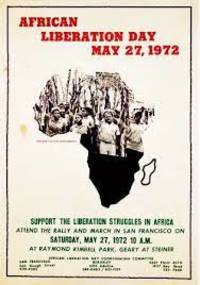
1972182121972. African Liberation Day handbill. African Liberation Day Coordinating Committee: San Francisco 1972. Measures 8.5 x 11 inches. Bold red text reads "African Liberation Day May 27 1972" with black and white photo of Freedom Fighters in Mozambique fit into the shape of the African continent. Green text below the image reads in part "Support the Liberation Struggles in Africa Attend the Rally and March in San Francisco." African Liberation Day was first recognized in 1972 after Owusu Sadaukai visited the liberated zones of Mozambique and witnessed the struggle to build a nation there. He identified international solidarity as a pressing need within the African Diaspora. In his letter urging a national day of solidarity for African Liberation Sadaukai identified the objectives as raising awareness for the conditions in Southern African educating African Americans on the shared struggle between nations and organizing a national protest again U.S foreign policy in Southern Africa. Toning to top edge of handbill. In very good condition. unknown
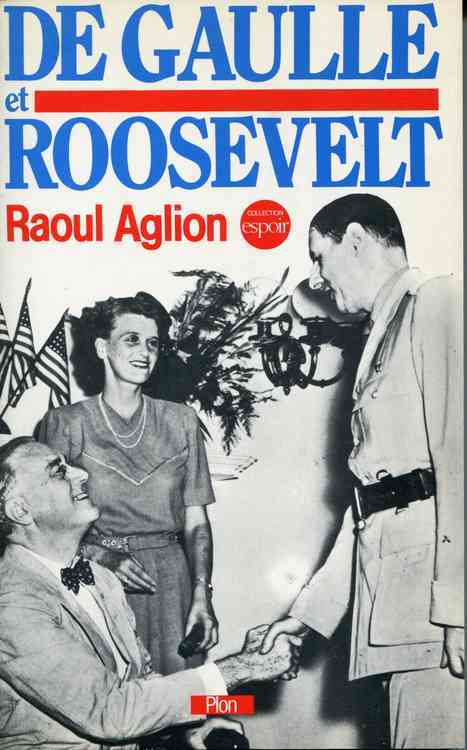
11474,Paris, Plon 1984, 294 pp., 1 vol. in 8 br. illustrations hors-texte, biblio, index
1967100145526Beograd 1967 in8. 1967. Cartonné.
1980117969L'Harmattan 1980 L'Harmattan, 438p, 1980, in-8 broché. Plis de lecture au dos, couverture légérement cornée sinon bon état général.
Editions R.S.T, 1966 . In-4 relié cartonnage éditeur sous jaquette illustrée. 197 pages. Belle iconographie. Très bon état.
1979238513Philadelphia: Task Force on Gay Liberation American Library Association 1979. Two 8.5x11 inch sheets printed both sides with information about publications stapled top-left corner horizontal fold-crease for mailing otherwise very good on orange stock. Task Force on Gay Liberation, American Library Association unknown books
3022Autrement 1994
in 12, broché, 251 pages Bel exemplaire, non coupe. [TX-20]
194821009Strasbourg Dernières Nouvelles de Strasbourg 1948 -in-4 demi-basane un volume, reliure demi-basane rouge grand in-quarto à coins (half binding sheepskin in-4 with corners), dos à nerfs (spine with raised band), reliure non-signée (mais de part la provenance : René GUNTZ maitre relieur à Strasbourg), décoré or et à froid(gilt and blind-stamping decoration), titre frappé or (gilt title), entre-nerfs à fers spéciaux (constitués d'un petit rond central entouré de six ronds du même calibre) "or", filets à froid de part et d'autre des nerfs se rejoignant en pointe, plats décorés à froid, mors et coins ornés d'un filet à froid, papier crème imitation cuir aux plats, tête lisse dorée, gouttière et tranche de queue non-rognées, dos et couverture illustrée en couleurs par Ernest SCHMITT conservée, justification du tirage : exemplaire numéroté, tirage limité à 660 exemplaires sur vergé d'Arches (limited edition - 660 copies were printed), un des 500 exemplaires sur papier Alpha Navarre numérotés de 61 à 560(N°322), orné d'un frontispice " photo du Général LECLERC", saluant les troupes devant le Palais du Rhin. Splendide témoignage, groupant aussi bien un exposé du Général de LANGLADE, un récit d'Alfred BETZ et une préface de Robert HEITZ, ainsi qu'une carte en diptyque des opérations + l'ensemble des affiches des généraux DE LATTRE, DE GAULLE, LECLERC, du Maire de Strasbourg ainsi que l'acte de capitulation + Nombreuses photos in et hors-texte N & B, et couleur sépia, dos légèrement frotté, 88 pages, 1948 Strasbourg Dernières Nouvelles de Strasbourg Editeur,
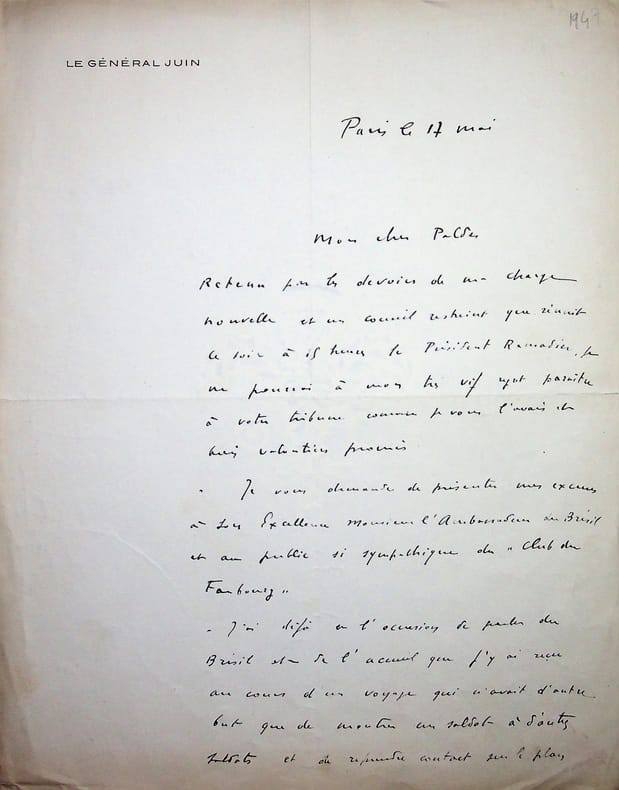
020647Alphonse Juin (1888-1967), général, maréchal de France en 1952, un des grands chefs de la Libération. L.A.S., Paris, 17 mai 1947, 2p in-4. A l'écrivain, militant socialiste puis communiste, fondateur du Club du Faubourg, Léo Poldès (1891-1970). « Retenu par les devoirs de [sa] charge nouvelle » - il vient d'être nommé résident général de la France au Maroc -, il ne pourra être là, avec le « président [du conseil] Ramadier », malgré sa promesse, en présence de l'ambassadeur du Brésil, Luiz Martins de Souzas Dantas (1876-1954). Suit alors un beau témoignage de son expérience avec le Brésil. Belle lettre, peu commun. [500]
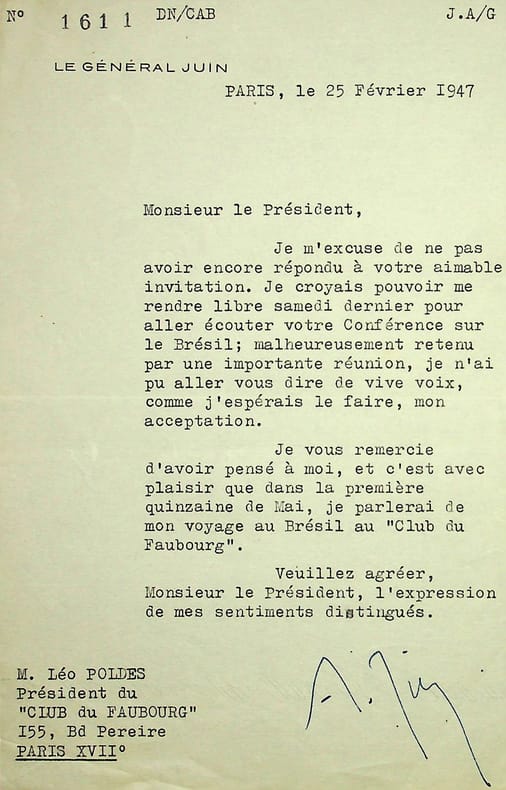
020648Alphonse Juin (1888-1967), général, maréchal de France en 1952, un des grands chefs de la Libération. L.S., 25 février 1947, 1p in-8. A l'écrivain, militant socialiste puis communiste, fondateur du Club du Faubourg, Léo Poldès (1891-1970). Il répond tardivement à son invitation qu'il décline. Une conférence sur le Brésil devait avoir lieu le samedi. Peu commun. [500]
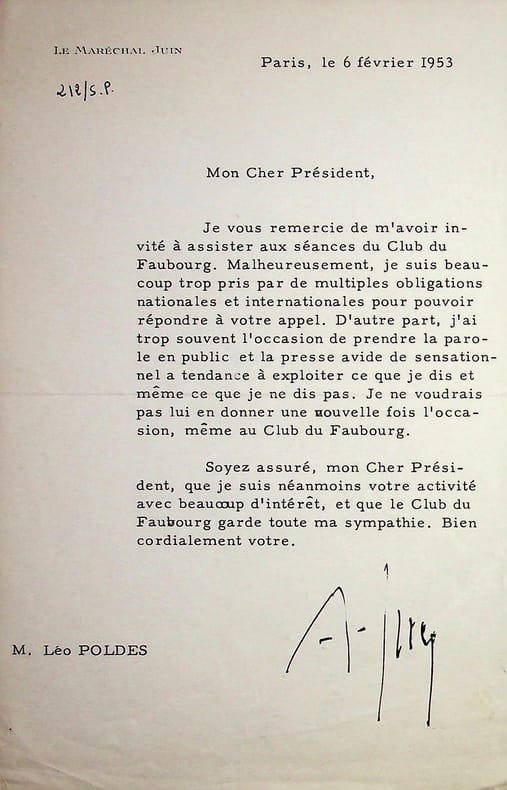
020649Alphonse Juin (1888-1967), général, maréchal de France en 1952, un des grands chefs de la Libération. L.S., 6 février 1953, 1p in-8. A l'écrivain, militant socialiste puis communiste, fondateur du Club du Faubourg, Léo Poldès (1891-1970). Ses « obligations nationales et internationales » l'empêchent de pouvoir assister aux séances du Club. Peu commun. [500]
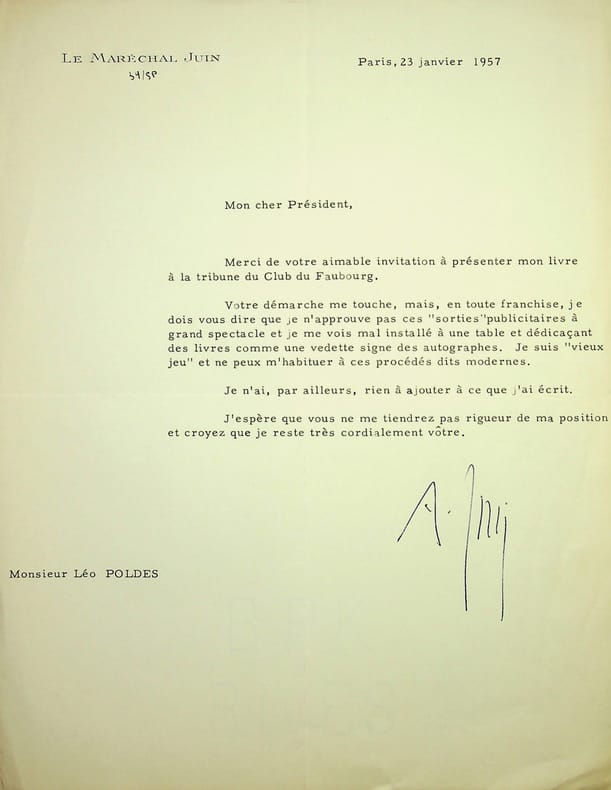
020650Alphonse Juin (1888-1967), général, maréchal de France en 1952, un des grands chefs de la Libération. L.S., 23 janvier 1957, 1p in-4. A l'écrivain, militant socialiste puis communiste, fondateur du Club du Faubourg, Léo Poldès (1891-1970). Il refuse de présenter son livre, certainement Le Maghreb en feu, car il « n'approuve pas ces sortie publicitaires à grand spectacle », se voit « mal installé à une table et dédicaçant des livres comme une vedette signe des autographes » et il n'y a « rien à ajouter » à ce qu'il a écrit. Peu commun. [500]
057022Alger Université Paul Valéry Montpellier III / Centre d'Histoire Militaire et d'Etudes de Défense Nationale 1997 in 8 (23,5x15,5) 1 volume broché, 94 pages, et annexes non paginés. Sous la direction du Professeur Jean Charles Jauffret. Très bel exemplaire ( Photographies sur demande / We can send pictures of this book on simple request )