PROHIBITIONBiblio.com
108 résultats
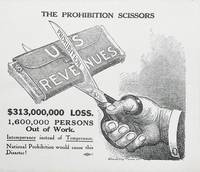
1916190622Newark New Jersey: Bowers 1916. A handbill opposing the introduction of prohibition illustrating it as greatly cutting American revenues leading to "$313000000 loss. 1600000 persons out of work" and therefore "intemperance instead of temperance" - "national prohibition would cause this disaster". Newspapers reported the design placed on billboards and arriving in the mail in early 1916. 178 x 211 mm. Very light central crease and spot at head else in fine condition. hardcover
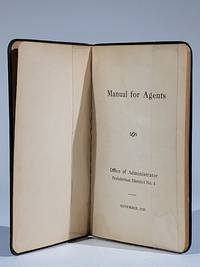
1925965Pittsburgh: Office of Administrator Prohibition District No. 4 1925. Cloth over flexible boards. Sixteenmo. ii 53 pages. Near fine. Bound in black cloth over flexible boards with no exterior titles. A few faint spots to lower board. Binding sound. A rare manual issued by Prohibition District No. 4 Pittsburgh as a pocket guide to help its Revenue and Prohibition agents build strong cases as they enforced the Volstead Act in the field. The contents are distilled ha from Treasury Department Regulations 12 and 60 and aimed at avoiding procedural mistakes during investigations sting operations and arrests. Think Eliot Ness making sure his "i"s are dotted and "t"s are crossed so the bootleggers don't walk on a technicality. Office of Administrator, Prohibition District No. 4 unknown
Abundant black and white illustrations and reproductions of photos. Features: 'Twixt Sunset and Sunrise - Mining Engineer William Bartle relates a story from Mexico where, outside the large cities "no foreigner's life is worth a farthing"; The Cannibal Islands - Part II - photo-illustrated article by Clifford Collinson who has lived in the Solomon Islands for several years and, in this instalment, visits the little-known atolls of Ong-Tong-Java, with nice photos; The Disappearance of Annie Mooney - A thirty-year-old mystery is solved in a strange and unlooked-for manner - was she kidnapped by the Chinese all those years ago?; The Most Wonderful School in the World - A remarkable "sun-cure" establishment at Aigle in the Swiss mountains where children - recently hopeless cripples - learn their lessons and romp in deep snow clad only in loin-cloths and boots! - with photos; Obyada, Bad Indian - story related by a member of the Royal North-West Mounted police about a troublesome individual near Red Deer, Alberta; The Rum-Runner - the story of a sea captain's first smuggling voyage, as told in St. Pierre, headquarters of a fleet of ships engaged in the liquor-running business; Soliman the Seer - the mysterious fortune-teller of the Pyraid of Cheops; The Children of the Wilderness (Conclusion) - Juliet Bredon's photo-illustrated travels in little known Mongolia; A Wildfowling Adventure - a nasty little adventure on the Solway Firth; Fishing for Crocodiles - using a special hook and line; On Patrol - a quaint little experience related by a flying officer of the Royal Air Force; The MIssing Links - An Indian magician discovers a thief when the police had failed; Round the World With a Lasso - former Texas Ranger Captain George Ash tours the world giving exhibitions and training troops in the use of the lasso - article with photos; The Strangest Mutiny on Record - The Schooner Pedro Varela; Six Hundred Thousand Francs - One of the most audacious jewel robberies ever perpetrated (in Paris); and more. 88 pages plus 16 pages of nostalgic ads. Clean and unmarked with light wear. A quality copy of this excellent vintage issue. Book
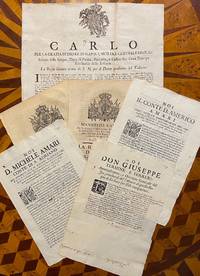
17641067Sicily Naples and Turin 1764. Very good. Together 6 items: 1 broadside 46 x 34.5 cm 5 bandi folio sheets each folded once various sizes various wear some signatures clipped others supplied in manuscript assorted manuscript annotations extracted from bindings. Small but very interesting collection of Bandi on the prohibition of tobacco all scarce none are found in OCLC / FirstSearch. As there was no centralized government in Italy the restrictions on Tobacco was a quagmire of regional taxation restriction and monopolization as is attested by the bandi in the present collection. Increasing tobacco consumption in the Italian penensula merited the establishment of fiscal laws by various States. The present items illustrate the expansion of tobacco culture and the disjointed governmental responses from Sicily Naples and Turin:<br /> <br /> 1. Broadside: Carlo . La Regia Giunta eretta da S.M. per il Dritto proibitivo del Tabacco 3 May 1758.<br /> 2. Noi il Conte d' Americo Amari . del gius proibitivo del Tabacco 23 January 1746 2 pp.<br /> 3. Noi d' Michele Amari conte de S. Adriano . del Jus prohibendi del Tabacco 23 January 1740 2 pp.<br /> 4. Noi Don Giuseppe Termine e Ferreri . del Jus prohibendi del Tabacco 30 November 1733 1 p. <br /> 5. Manifesto Camerale per la vendita. de distribuzione del Tabacco nel Luogo di Refrancore 14 May 1762 3 pp. with Tariffs. <br /> 6. 5. Manifesto Camerale che ristabilisce la vendita e distribuzione del Tabacco nel Luogo di Rochetta Belbo 13 February 1764 3 pp. with Tariffs. unknown
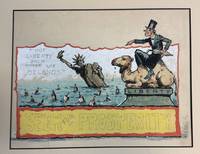
193341184n.p. 1933. 8" x 12". Original color painting on Abacco illustration board matted and framed behind glass. Vibrant colors with some pencil sketch lines showing through. Unsigned and uninitialed. Corners chipped a closed crack in lower left corner. On verso of board is the name of the type of board and available dimensions "Paints Brush and Color Corporation" with distributors listed as E.H. & A.C. Friedrichs Co. of New York The Hirshberg Company of Baltimore and Henry M. Taws of Philadelphia. Very Good. <br /> <br /> Ours is the only copy located after diligent investigation. The camel which Thomas Nast chose as the symbol of the Prohibition Party has replaced the Statue of Liberty on the pedestal. Camels don't drink very often; when they do they only drink water. <br /> This item was likely painted between 1931 and 1933. The official Beer for Prosperity Campaign was organized May 1931 in New York City. Edward H. Schulze was director of the organization and announced that he would support all political candidates in favor of legalizing beer. The slogan spread over the next year and a half. Posters for this campaign in 1932 advertised that legalizing beer would bring two trillion dollars in new revenue in four years because "millions of dollars made from bootleg Beer now finances all kinds of crimes kidnappings etc." Another campaign poster advertised purchases of "Beer for Prosperity" Stamps to "Help Elect to Congress Men Who Will Vote 'Yes.'" Beer for Prosperity Campaign. n.d. In John J. Raskob papers. Manuscripts and Archives Hagley Museum and Library #m473_20100624_005; "Beer For Prosperity Campaign Inc. Will Back Pierce's Congressional Candidacy" The Rutland Daily Herald 23 August 1932 p.7. <br /> We do not know who painted this imaginative item. E.H. & A.C. Friedrichs Company was founded in 1868 and is still in business today under the modern name of Fredrix. The Hirshberg Company originated in 1845 as Hirshberg Hollander & Company and remained in business under a few different Hirshberg names until approximately the early 1960s. Henry B. Taws opened in Philadelphia around 1897 and remained in business until at least 1931. unknown
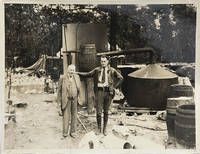
1932181780East Hartford CT & Palm Beach County FL: 1932-c.1933. A collection of photographs documenting the seizure of illegal moonshine stills in Connecticut and Florida during Prohibition and following its repeal. The photographs are from the library of Ralph A. Johnson a revenue agent for the Bureau of Prohibition and its successor the Bureau of Alcohol Tax Unit. Moonshining flourished under Prohibition and even after its repeal its cheapness - and to some its taste - ensured it continued. Across the New England countryside farms housed industrial-sized moonshine operations. The first nine images show an immense moonshine still with vats and equipment inside a Connecticut barn raided by the Bureau of Prohibition on 14 July 1932. Johnson is shown standing next to an unidentified well-dressed man perhaps the moonshiner. The remaining five images depict a large still in Florida seized by the Alcohol Tax Unit in 1933 showing large copper stills connected to barrels above cooking fires glass carboys for the product and barrels with stove-in tops. Taken by Ernest Kirbell signed in the negative a crime photographer with the Connecticut State Police Department these images document the continued profitability of moonshining after Prohibition's repeal. Recent blue leatherette album front cover lettered in silver enclosing 14 silver gelatin photographs preserved in archival sleeves 5 measuring 216 × 279 mm with photographer's signature in negative sequence numbered in blank margin at upper fore edge; 8 measuring 203 × 254 mm; 1 measuring 89 × 140 mm. Sepia toning to photographs minor creasing and edgewear at extremities. In very good condition. hardcover
[4], 5-254, [2], 8 [ads], pages. This portion of Carr's life story begins after his experience as a submariner in WWI. He serves as an officer of the Mercantile Marine and experiences incredible adventures and hardships before deciding to move his young family from England to New Brunswick. Times are tough in his new land. He describes the local poverty and exposes the awful social problems of rural New Brunswick, as well as his dramatic adventures at work, with a local trapper and as a member of the C.P.R. police. In short, Carr was a man's man and this book is full of manly adventures. Later in life, Carr [1895-1959] became very concerned about what he viewed as plans for world government and wrote Pawns in the Game and Red Fog Over America, books which sold by the hundreds of thousand. The present work is vital in understanding the background and motivations of this fascinating man. Above-average wear to publisher's black cloth. Binding intact. Gift greetings upon front free endpaper. Spine leaning. Dust jacket not included. Not pretty but a worthy reading copy. Book
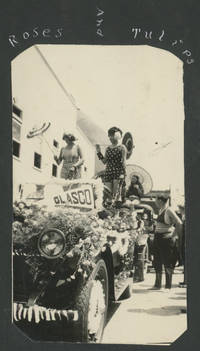
1920List1317Southern California 1920. Limp leatherette album oblong 4to measuring 10 x 7 inches with seventy photographs most measuring 4 x 2 ½ inches. Wear to binding photographs with excellent contrast very good to near fine overall. Near Fine. An energetic album of photographs belonging to one Eddie Jones a fun-loving banjo player from Santa Ana mostly composed of photographs of musicians performing at small parties and functions during the prohibition era. Jones was apparently quite active on the local scene and the album is mostly made up of candid photographs of musicians all captioned some humorously. Many of the photographs show small bands playing guitars many of them playing with slides likely due to the popularity of Hawaiian music at the time. Also included are many photographs of parades in and around Los Angeles as well as photographs of the 1925 Santa Barbara Earthquake showing damaged buildings. Two photographs feature a glass of rye others show agricultural scenes. Newspaper clippings in the back center on the Santa Ana and it’s possible that Jones - who was the common name mentioned in these clippings - was also a farmer from the Santa Ana area when he wasn’t playing music. One photograph shows San Diego a couple show a bullfight in Tijuana. Overall an evocative and well preserved piece of California Prohibition-era history. unknown