127 195 résultats
167275039s. d. [1672-1674] | 24 x 34 cm | relié
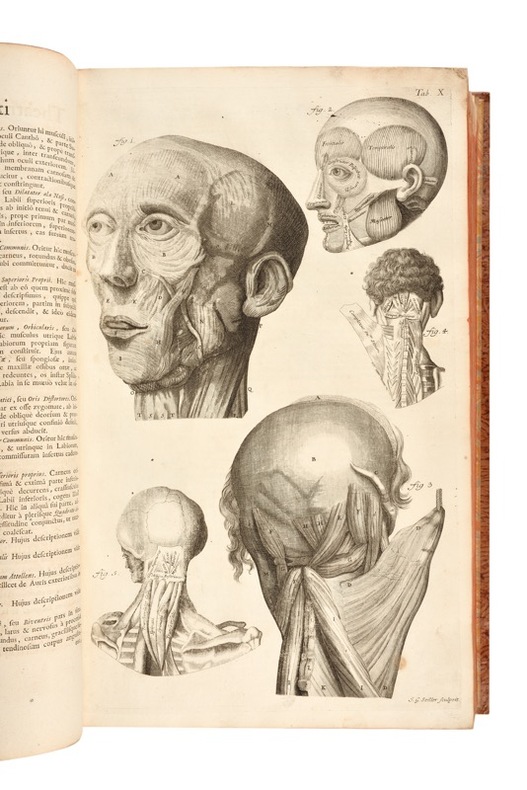
171721598Genevae, Cramer et Perachon, 1717 ; 2 tomes in-folio (428 mm), demi-veau fauve du temps, dos à nerfs décoré de filets dorés, titre doré, pièce de tomaison foncée (plats refaits, gardes renouvelées) ; [20], 434 pp., [1 bl.] f. ; [4], 452 ; [12], XVI, 34, [10] pp. et en tout: portrait de Jean Jacques Manget gravé par Seiller, d’après B. Guillibaud, en frontispice, grande vignette répétée aux 3 titres, figurant une scène de dissection, gravée par Seiller et 136 planches anatomiques hors-texte ( 110 + 5 extra-ordinaires + 21 Eustache) gravées par Seiller, Gottfried Pfauntz, J.d. Hartman, Andréas Geyer et Augusta Vind.
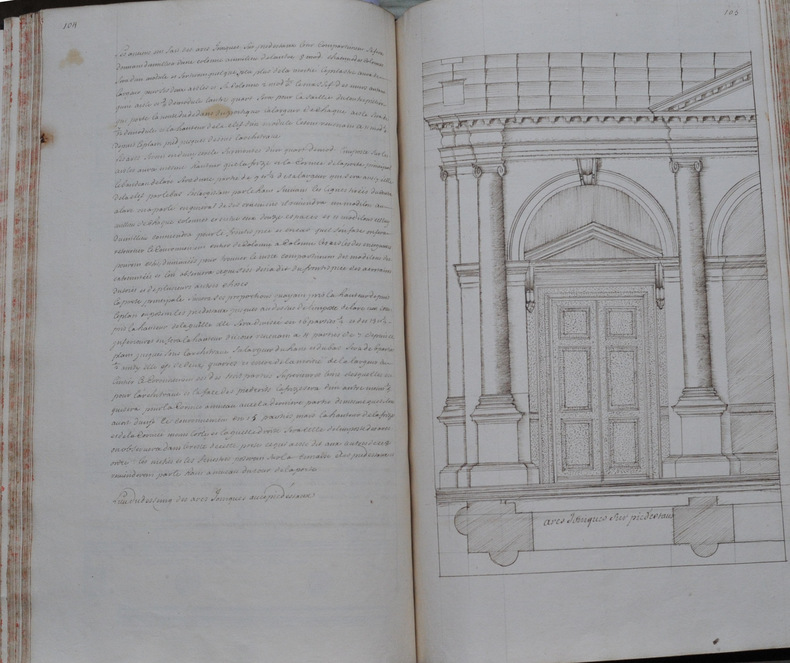
46404668SUPERBE ET PRÉCIEUX MANUSCRIT soigneusement calligraphié d’une traduction inédite du traité d’architecture de Vincent Scamozzi. Il s’agit du principal traité d’architecture classique de cette époque, en 35 chapitres et une conclusion. Ce livre est connu en français depuis 1685 grâce à la traduction d’Aviler sous le titre Les cinq ordres de l’architecture ou Le sixième livre d’architecture de Vincent Scamozzi. La traduction diffère parfois assez fortement de celle de d’Aviler. D’Aviler précise dans une introduction à l’édition de 1685 qu’il a pris des libertés vis à vis du texte original afin d’en restituer au mieux le sens général. La version de Lefebvre de Chassenay est peut-être plus fidèle à l’originale italienne. Le manuscrit est orné de 38 planches hors-texte dessinées à la plume reproduisant les planches des éditions tant italiennes que françaises (les illustrations de l’originale italienne ayant été réemployées pour la traduction française).Un article de Louis Thuillier donne quelques précisions sur Théodore Lefebvre de Chassenay dans Le Marteau Pilon 1995-96 : “Un des personnages clefs de la métallurgie nivernaise entre 1690 et 1715 : cet ingénieur devenu “écrivain général de la Marine” était aussi un inventeur, et on assure que Trésaguet était son prête-nom (il aurait entrepris la fourniture des ancres sous le nom de Trésaguet)” Lefebvre de Chassenay avait inventé une machine pour les ancres vers 1710. Il exploitait la fonderie de Thiot et le fourneau de Sardolles en société avec Prisye de Limoux. À Toulon il était associé avec un sieur Renou dans une entreprise pour ouvrages de la Marine. Il est mort à Toulon en 1721. Sa fille unique, Dorothée Lefebvre avait épousé en 1714, François Bouys.Voir aussi Jacques Gay. Les promoteurs du progrès technique pour la fabrication des ancres en Nivernais autour des années 1700 in Innovations métallurgiques 1996.Sur la garde on trouve l’ex-libris manuscrit de Lefebvre de Chassenay, ainsi que celle de son gendre Bouys. La signature de Bouys se trouve aussi sur la première page du manuscrit.
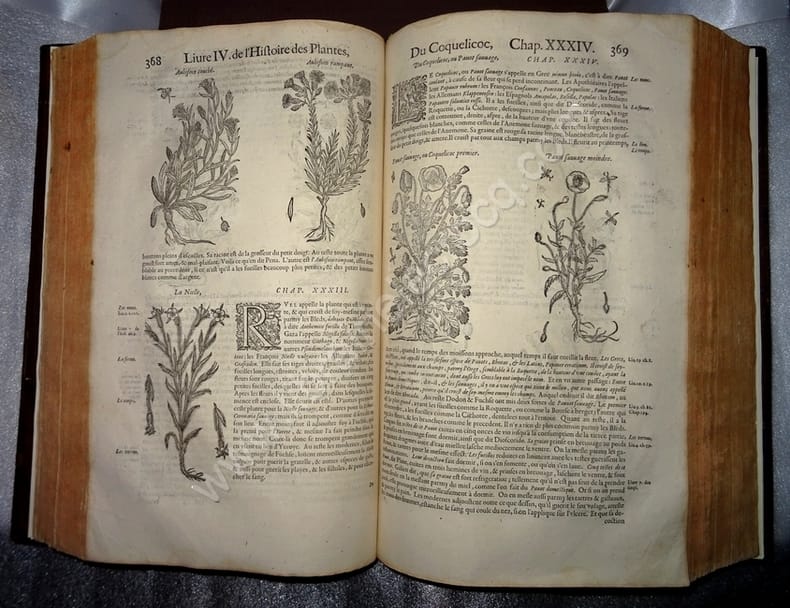
15584,Lyon, Guillaume Rouille 1615, (1)ff., 960pp., (18)ff. + (59)ff., 758pp., (15)ff. pp., 2 vol. in folio reliés : Sortie latine de la Bibliotheque de Me Jacques Dalechamps puis faite Françoise par Me Jean Des Moulins, Medecins très-fameux de leur Siecle, ou sont pourtraites et descriptes infinies plantes par les noms propres de diverses Nations, leurs especes, forme, origine, saison, temperament naturel et vertus convenables a la Medecine, avec un indice contenu au commencement du second tome tres utile et tres necessaire pour monstrer les proprietez des Simples, et donner guerison a toutes les parties du corps humain. Ensemble les tables des noms en diverses langues . Pleine basane brune, dos à 6 nerfs ornés de fleurons dorés, pièces de titre et de tomaison en maroquin rouge et vert, tranches rouges (les dos sont récents mais ont été refaits dans l'esprit de la reliure originale), légères traces d'humidité anciennes marginales en haut de l'ouvrage, restauration à la page de titre du tome 2 avec manque partielle de la marque d'imprimeur, page de titre du tome 1 remontée. Cet ouvrage célèbre est illustré de 2731 gravures sur bois, d'un beau tirage, il est divisé en 18 livres : Description et portraits de tous les Arbres qui croissent aux forêts sans être plantés; de tous les Arbrisseaux qui croissent de leur bon gré parmi les haies et buissons; des Arbres qui croissent dans les vergers; des Blés et Légumes, et autres Herbes croissant pêle mêle avec les blés; des Herbes potagères et autres qui croissent dans les jardins; des Plantes qui portent des Ombelles; des Plantes qui sont recommandées à raison de leurs belles fleurs; des Plantes odorantes; des Plantes bulbeuses; des Plantes purgatives; des Plantes vénéneuses. Première édition française la plus complète (l'édition latine fut publiée en 1586). Bel exemplaire bien complet.
161641713A Bourdeaus, Par Gilbert Vernoy, 1616. In-8 de (8)-250 pp., 2 feuillets (bl.), vélin souple (reliure de l'époque).
194087015Pour les amis de Charles Pathé | Paris 1940 | 16 x 25 cm | relié
175166681chez Jacques Rollin chez Charles Antoine Jombert | à Paris 1751 | 20.50 x 26.50 cm | relié
In-4°, (2), (8), 168, legatura in pergamena rigida, molteplici illustrazioni nel testo, buona copia, prima edizione. Il nome del gesuita Girolamo Saccheri viene comunemente, quando non esclusivamente, associato alla nascita delle geometrie non euclidee di cui è considerato giustamente il precursore. Tra i matematici che si impegnarono nella dimostrazione del quinto postulato di Euclide, Saccheri non cercò di sostituire il quinto postulato con un asserto simile, ma seguì un procedimento logico diverso dagli altri, ipotizzando la sua negazione, sicuro di pervenire ad un assurdo. In realtà, inconsapevolmente, creò a livello elementare due nuove geometrie in seguito definite Geometrie non Euclidee proprio perché in esse si negava la validità del quinto postulato. Fondamentale per lui fu l'incontro con Tommaso Ceva, (1648-1737), matematico e poeta, fratello del più famoso Giovanni Ceva, e con Vincenzo Viviani (1622-1703), matematico che lavorò con Galileo e Torricelli. Saccheri ebbe corrispondenza con tutte e tre queste grandi figure. Molto accurata anche la Neo-statica, del 1708, di argomento fisico che tratta di oggetti in quiete o soggetti a forze in equilibrio. Riccardi II, 405, Sommevogel VIII, 106 In-4 °, (2), (8), 168, hard vellum binding, multiple woodcuts in the text, faircopy, first edition. The name of the Jesuit Girolamo Saccheri is commonly, if not exclusively, associated with the birth of non-Euclidean geometries of which he is rightly considered the precursor. Among the mathematicians who engaged in the demonstration of Euclid's fifth postulate, Saccheri did not try to replace it with a similar assertion, but following a logical procedure different from the others, assuming its denial, sure to arrive to an absurdity. In reality, unknowingly, he created at an elementary level two new geometries which were later called non-Euclidean geometries precisely because they denied the validity of the fifth postulate. Fundamental for him was the meeting with Tommaso Ceva, (1648-1737), mathematician and poet, brother of the more famous Giovanni Ceva, and with Vincenzo Viviani (1622-1703), mathematician who worked with Galileo and Torricelli. Saccheri corresponded with all three of these great figures. Also very accurate is the Neo-statica, written in 1708, on a physics topic which deals with objects at rest or subject to forces in balance. Riccardi II, 405, Sommevogel VIII, 106
1 vol. in-8 reliure de l'époque demi-basane marron, G. Jacques, Paris, s.d. [ 1905-1906 ], 475 pp.. Rappel du titre complet : Le Système historique de Renan (5 Parties - Complet) [ Edition originale - Livre dédicacé par l'auteur à Vilfredo Pareto et signé par Pareto ] I : Introduction ; II : Renan, historien du Judaïsme ; III : Renan, historien du Christianisme ; IV : Les Premiers Temps apostoliques Exceptionnel exemplaire de l'édition originale, dédicacée par Georges Sorel "A mon ami V. Pareto, Cordial Souvenir". L'exemplaire porte également la signature autographe de Vilfredo Pareto, sur la couverture conservée du premier fascicule. L'amitié du philosophe et sociologue français Georges Sorel (1847-1922) et de l'économiste et sociologue italien Vilfredo Pareto (1848-1923) remontait à l'année 1896 ; elle se maintiendra jusqu'au décès de Georges Sorel, malgré leurs fortes divergences philosophiques. Dans son célèbre "Traité de Sociologie", Vilfredo Pareto citera cet ouvrage en indiquant : "Tout ce livre est à lire et à étudier attentivement". L'ouvrage, en bon état (qq. lég. frott. en dos, très bon état par ailleurs) est enrichi de quelques annotations du professeur G.-H. Bousquet. Le professeur Georges-Henri Bousquet (1900-1978), était un juriste (docteur en droit en 1923 avec une thèse sur "L'évolution sociale en Hollande 1914-1922"), qui devint un spécialiste de questions économiques, proche de Pareto et Schumpeter, ainsi qu'un islamisant de l'école de Goldziher et Snouck-Hugronje. Il fut en particulier professeur aux facultés d'Alger puis de Bordeaux. Proche de son maître en sociologie Vilfredo Pareto, il en servit fortement la pensée, en l'éditant et en le vulgarisant. G.-H. Bousquet entretint une correspondance avec Pareto et le visita notamment une huitaine de jours dans sa villa de Céligny (Suisse), vers Pâques 1923. G.-H. Bousquet revint à Céligny après la mort de Paréto, à l'automne de cette même année. C'est probablement à l'une de ces deux occasions qu'il obtint ce souvenir. Outre Pareto, G.-.H. Bousquet connut personnellement d'aussi grands noms de la pensée économique que Joseph Schumpeter (rencontré dès 1923 à Vienne puis fréquenté pendant plusieurs mois à Harvard, lors d'un séjour financé par la fondation Rockfeller en 1933-1934), Irving Fisher ou Albert Aupetit, le disciple de Léon Walras. Le nom du Professeur Bousquet est cité plusieurs fois par Schumpeter dans sa monumentale Histoire de l’Analyse Economique. (Voir A. de Benoist, Georges Sorel, Une bibliographie, A22) Français
1773019039London: Printed for the author 1773. Second edition "corrected and enlarged". Folio pp iv ii 716 with an engraved frontispiece 60 engraved plates plates 66 - 80 in the appendix i.e. LACKING five plates in the appendix some age-toning internally the odd blemish here and there the frontispiece with two earlier minor repairs a partly unpressed copy which has resulted in a horizontal crease to the last sixty pages or so see illustration and a slight depression to earlier ones bound in a recent half calf with very slight signs of use with marbled endpapers. Plate 31 is bound slightly out of order and plate 59 has a small ink scribble in the margin and has the plate number corrected in ink. Blanche Henrey 805 mentioning a portrait as well as an allegorical frontispiece; the portrait is not present in our copy. Sir John Hill was an English composer actor author and botanist. He contributed to contemporary periodicals and engaged in literary battles with poets playwrights and scientists. A controversial figure John Hill's often provocative and scurrilous writings involved him in many quarrels both in the field of science and that of literature. Nevertheless his general approval of Linnaeus resulted in many of Hill's publications using the Linnean system for the first time. Second edition. Full Leather. Good. Printed for the author Hardcover
017976Taurini: Ex Regio Typographeo Three volumes 1837 - 1843. A partial set of one of the rarest of Mediterranean floras. Illustrated with 96 very fine engraved plates including 3 bis plates - XXXIII LXXVII LXXXVIII a double-page engraved map of Sardinia rather foxed quarto pp xii 606; 562. ii plates volume 96 plates of 114 remarkably clean internally contemporary half calf and cloth the spines with raised bands and black morocco labels slightly rubbed and scuffed a little wear at the corners. The engravings are by by L. Fea S. Botta H. Mil and A. Nizza after drawings by M. Lisa and J.C. Heyland; there is a presentation inscription in Latin in the first volume from the author to Sir Charles James Fox Bunbury. Lacking the final volume which was not published until 1857. The fact that the plates volume is here labelled Volume III suggests that Bunbury received these from the author in 1843 and the final volume was never presented. The author was a botanist at Cagliari then at Turin where he subsequently became Director of the Botanical Gardens. His primary investigations were on the flora of Sardinia of which this work is the first and still the most complete and detailed account. Sir Charles Bunbury was a keen botanist and geologist with a particular interest in paleobotany. He collected plant specimens on expeditions to South America in 1833 and South Africa in 1838. He also accompanied his great friend Sir Charles Lyell the geologist on an expedition to Madeira. He was elected a Fellow of the Royal Society in 1851. From Bunbury the set moved to the Leipzig collector and antiquary Oswald Weigel with his small stamp. Also in each volume is the later bookplate of Kenneth Lazenby a founding member of the Alpine Garden Society. The map is an addition to the published work and is equally rare - "Carta della Sardegna annessa alla 1a parte del viaggio in cetta Isola del Colonello A. della Marmora. 2da Edizione. Carte de la Sardaigne annexee a la 1e´re partie du voyage en cette Ile par le Colonel A. de la Marmora.". Although lacking the later volume this set remains very attractive due to its condition provenance and the additional map. First Edition. Half-Leather. Very Good. Ex Regio Typographeo Hardcover
2056Toulouse, Douladoure, 1853, un volume in 8 relié en demi-basane bordeaux, dos orné de filets dorés (reliure de l'époque), (dos légèrement passé), 164pp., 2 planches dépliantes
1965mon0000121503PROGRESS PUB. 1965-01-01. Hardcover. Good. 2.5000 in x 8.5000 in x 5.9000 in. No DJ. Mild shelf wear and fading to both volumes. Former owner's name on inside cover otherwise pages clean. Cup mark on volume one's cover. PROGRESS PUB. hardcover
174657440ABNürnberg, Beim Verfasser gedruckt bei Johann Josef Fleischmann., 1746-1761. Klein-4°. Mit 3 gestochenen, kolorierten Vortiteln, einem gestochenen Porträt, 284 (davon 4 gefalteteten) kolorierten gestochenen Tafeln. Lederbände der Zeit mit 2 verschiedenfarbigen goldgeprägten Rückenschildern und reicher floraler Rückenvergoldung. 4 Bände. [3 Warenabbildungen]
1734D4425Paris: Par La Compagnie des Libraires 1734. Hardcover. Very Good. Three volumes comprising Vol. III parts I to III of Memoires de lAcadémie Royale des Sciences depuis 1666 jusquà 1699. Paris: Par La Compagnie des Libraires 1733-1734. Part I: 231pp.; Part II: 294pp.; Part III: 215pp. 97 engraved folding plates depicting animals and skeletal diagrams. Engraved portrait frontispiece of Claude Perrault in first volume. Contemporary French calf spines gilt edges red; some occasional browning; repairs to joints some rubbing. Unidentified armorial bookplate to front pastedown beneath monogrammed bookplate D.P. with chipmunk and two mice. A later reduced format edition of Perraults Memoires of 1671-1676 Perraults study of this nature was first published in 1669 with the results of investigations of five animals and later expanded with studies of over forty animals. Prior to 1670 most descriptions of animals paid little attention to their internal structure and there were very few images in natural history encyclopedias that depicted skeletons or muscles. That changed with the establishment of the Académie des Sciences in Paris in 1666 by Jean-Baptiste Colbert with the approval of King Louis XIV. The Academy functioned with neither statutes nor regulations until 1699. At that time the Academy used the term mathématique to encompass the fields that are now called astronomy mathematics and physics and the term physique to encompass the fields that are now called anatomy botany zoology and chemistry. In January 1699 Louis reorganized the Academy giving it first regulations. The effect was to give the King more control over their activities in exchange for becoming an official institution under his protection with the new name Académie Royale des Sciences. One of the original academicians the physician Claude Perrault organized regular sessions at which participants could dissect deceased animals from Louis XIVs royal menagerie and record all they observed. Lions chameleons bears gazelles wolves ostriches crocodiles monkeys eagles tigers porcupines and salamanders among some were all laid open by the academics scalpels. These superb folding plates record in great detail the pioneering work at the Academy. These three volumes in three parts focus on the transformative and foundational years of the French Royal Academy of Sciences and Claude Perraults efforts which had made comparative anatomy a vital tool for the classifying naturalist. <br/><br/> Par La Compagnie des Libraires hardcover books
1734D4425Paris: Par La Compagnie des Libraires 1734. Hardcover. Very Good. Three volumes comprising Vol. III parts I to III of Memoires de lAcadémie Royale des Sciences depuis 1666 jusquà 1699. Paris: Par La Compagnie des Libraires 1733-1734. Part I: 231pp.; Part II: 294pp.; Part III: 215pp. 97 engraved folding plates depicting animals and skeletal diagrams. Engraved portrait frontispiece of Claude Perrault in first volume. Contemporary French calf spines gilt edges red; some occasional browning; repairs to joints some rubbing. Unidentified armorial bookplate to front pastedown beneath monogrammed bookplate D.P. with chipmunk and two mice. A later reduced format edition of Perraults Memoires of 1671-1676 Perraults study of this nature was first published in 1669 with the results of investigations of five animals and later expanded with studies of over forty animals. Prior to 1670 most descriptions of animals paid little attention to their internal structure and there were very few images in natural history encyclopedias that depicted skeletons or muscles. That changed with the establishment of the Académie des Sciences in Paris in 1666 by Jean-Baptiste Colbert with the approval of King Louis XIV. The Academy functioned with neither statutes nor regulations until 1699. At that time the Academy used the term mathématique to encompass the fields that are now called astronomy mathematics and physics and the term physique to encompass the fields that are now called anatomy botany zoology and chemistry. In January 1699 Louis reorganized the Academy giving it first regulations. The effect was to give the King more control over their activities in exchange for becoming an official institution under his protection with the new name Académie Royale des Sciences. One of the original academicians the physician Claude Perrault organized regular sessions at which participants could dissect deceased animals from Louis XIVs royal menagerie and record all they observed. Lions chameleons bears gazelles wolves ostriches crocodiles monkeys eagles tigers porcupines and salamanders among some were all laid open by the academics scalpels. These superb folding plates record in great detail the pioneering work at the Academy. These three volumes in three parts focus on the transformative and foundational years of the French Royal Academy of Sciences and Claude Perraults efforts which had made comparative anatomy a vital tool for the classifying naturalist. <br/><br/> Par La Compagnie des Libraires hardcover
174014160Paris: de L’Imprimerie Royale 1740. Complete with errata’s and original blank leaves two of three finely engraved frontispieces chapter vignettes ornamental head and tail pieces and 82 folding plates. Full mottled calf rebacked the corners a bit worn. Interior is lightly toned with some browning on the preliminaries and last leaves. Generally this is an excellent set. First editions of these three volumes from a series published by the Academy of Sciences. It is a summary of the activities and inventions that have been made and contains the most important discoveries of the time. These periodicals which were at the forefront of scientific development during the Enlightenment contain works produced by an elite class of French scientist for the years 1722 1731 and 1740. Each volume provided an overview of advancements in math and science for each year and the writings therein shaped the world’s understanding of physics mathematics astronomy anatomy and other fields of science. They further provide invaluable historical data such as meteorological and astrological records for each year. <br /> <br /> The memoirs for 1722 include data recorded on both a lunar and solar eclipse as well as other astronomical observations by Jacques Cassini 1677-1756 best know for completing his fathers work on determining the meridian of Paris. The distinguished astronomer provided further research on lunar eclipses in the memoirs of 1731 where he is in great company alongside distinguished mathematicians Alexis-Claude Clairaut 1713-1765 Pierre Bouguer 1698-1758 known for his work in physics photometry and hydrography and the foremost proponent of the Newtonian movement in France Pierre de Maupertuis 1698-1759. Of special note in the 1731 memoirs is Maupertuis’s ballistic arithmetic which was used to try to better understand the movement of the earth and its gravity. Too an article by Clairaut on new formulas for finding the center of gravity. These articles contributed greatly to a better understanding of the earth’s shape and the mechanics of its rotation particularly Bouguer’s essay on the tendency of objects set in motion to move in a curvilinear fashion. The 1740 edition contains Cassini De Thury’s De la Maridienne de Paris. which was an important step in the process of mapping the shape of the earth. Cassini 1714-1784 representing the third generation of the distinguished family of astronomers was the first to question <br /> <br /> <br /> Picard’s measurements which had been used to map the Maridian of Paris. Clairaut’s essay on integral calculus in the same volume which established the existence of an integrating factor for linear differential equations was an important step in the history of mathematics and Mairan’s treatise on reflection and refraction of light and the human eye was essential to the advancement of optics. Mairan 1678-1771 would set the foundation for optical theory with this treatise. de L’Imprimerie Royale unknown
187640369Paris, Baillière et fils, 1876. Grand in-8 de XII pp. V-XI pp. 196 pp., photographie collée en frontispice et 9 planches de photographies avec 144 figures, demi-basane noire, dos orné à nerfs, super-libris en maroquin rouge sur le plat supérieur (reliure de l'époque).
188984140London 1889 | 28.70 x 38.40 cm | une photographie encollée sur carton
8681P., Imprimerie royale, 1694 (LA HIRE), 1692 (observatons physiques et mathématiques envoyées des INDES et de la CHINE), 1694 (Observations faites à la CHINE), un volume in 4 (20cm x 26cm) relié en plein veau marbré, dos orné de fers dorés (fleurs de lys), ARMES DE LOUIS XIV sur les plats, tranches rouges (reliure de l'époque), 8pp., 202pp. (mal chiffrés 302), figures dans le texte (LA HIRE) ; (3), 113pp. (observations physiques et mathématiques envoyées des INDES et de la CHINE ; 20pp. (observations faites à la CHINE)
In -4°, 1 cb, pp. (26), 280; piena pergamena coeva con titolo manoscritto al dorso. Prima e unica edizione di questo cospicuo lavoro del bolognese Pietro Mengoli (1626-86), noto soprattutto per le sue ricerche nel campo dell’analisi matematica: l’“Anno”, frutto di due anni di osservazioni sulla Meridiana di San Petronio, propone dei metodi di correzione al Calendario gregoriano. Il presente lavoro è scritto in un volgare molto limpido e comprensibile, contrariamente alla maggior parte della prosa dello scienziato, scritta in un latino considerato molto contorto, che non giovò alla popolarità dei suoi scritti matematici, rivalutati solo di recente. The first and only edition of this huge work of Pietro Mengoli, a scientist from Bologna mostly known because of his researches on mathematical analisys field: the “Anno” suggests some corrections to the Gregorian calendar.
8535P., Ruault, 1777, un volume in 8 relié en pleine basane, dos orné de fers dorés, tranches rouges (reliure de l'époque), brunissures dans les marges des deux derniers feuillets, manque de papier d'origine dans la marge du dernier feuillet), notes manuscrites de l'époque dans les marges de quelques feuillets, 32pp., 216pp., 2 PLANCHES
179962602Kiøbenhavn, Thiele, 1781 - 1799. 4to. Uniformly bound, uncut, in recent blue boards. Stamp to title-page in vol. 1 (Det Kongelige Danske Videnskabernes Selskab). Washed. A very nice and clean copy. XII, 640, (20) pp. 19 plates VIII, (4), 603, (13) pp. + 17 plates XII, 576, (1) pp. + 18 plates XII, 621 pp. + 7 plates XII, 670 pp. + 10 plates.
1803172548Modena u. Verona, 1782-1803. 4°. M. 122 gef. Kpfr.-Taf., 8 gef. Tab. u. zahlr. Textkpfrn. Hldrbde. d. Zt. m. Rsch. u. Rsign. Einbde. leicht berieben u. bestoßen. Rücken teils m. leichten Läsuren, einige m. Rsign. Jeweils 5 Bde. uniform geb. St. a. bzw. verso Tit. Etwas gebräunt, insgesamt wohlerhalten.
65584, De Stijl,, 1919-1920 De Stijl, November 1919 - November 1920, 12 parts with 14 plates(annexI-XIV) Vantongerloo, Archipenko, Mondriaan, Rietveld, oud and Picasso and others.