2 903 résultats
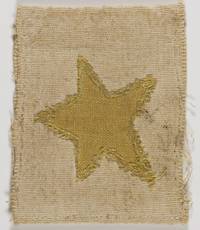
186524356.99<p>"<i>June 18. Reached Front Royal & met there the famous & very handsome rebel spy Belle Boyd who gave to me the rebel flag waving which she led the attack upon Kenly in May.</i>"</p><p>The "stars and bars" circular canton pattern with eleven-stars was used for First National flags from July 2 1861 when Tennessee and North Carolina joined the Confederacy until November 28 1861 when stars were added for Missouri and Kentucky. The other side of this rare two-pattern configuration is a tribute to the "Bonnie blue flag that bears the single star" the unofficial first Confederate flag.</p><p>Frederic d'Hauteville's small autograph note has been loosely stitched to the flag: "<i>Confederate flag. Taken by F.S.G d<i>'</i>H. and given by him to E.S.F. in 1862. To be given to Freddie d'Hauteville when he is fifteen.</i>" His first wife Elizabeth Stuyvesant Fish died in 1863. Freddy his son by his second wife was born in 1873 thus dating his note about the second gifting of the flag to between 1873 and 1888. The flag remained in his family preserved in perfect condition until 2015 when contents from their Swiss castle were sold clearing the way for the property to be sold; it is now on the market for $60 million dollars.</p> <b>ELEVEN-STAR "FIRST NATIONAL" FLAG WITH SINGLE STAR "BONNIE BLUE" FIRST UNOFFICIAL CONFEDEDERATE FLAG VERSO.</b>Belle Boyd the "Siren of the Shenandoah" gave the flag to Captain Frederic Sears Grand d'Hauteville on June 18 1862 telling him that it was the flag she waived to urge on Confederate troops at the Battle of Front Royal a month earlier. D'Hauteville's 25-page autograph manuscript war memoir with his account of the gift of the flag quoted above is included. See below for complete transcript. With additional photographs and manuscripts. Homemade perhaps even by Boyd or a family member and used only briefly before being given to d'Hauteville the flag has been perfectly preserved retaining the short ribbons along its hoist and showing no tears holes fraying loss or staining. Over 5 x 3 feet. <p><b>Historical Background</b></p><p>D'Hauteville had joined General Nathaniel P. Banks' staff before Banks advanced south up the Shenandoah valley the Shenandoah river flows north into the Potomac at Harper's Ferry so you go "up" the valley to the south and "down" the valley to the north to Strasburg maneuvering against Confederate General Thomas J. "Stonewall" Jackson's army.</p><p>Belle Boyd had moved to Front Royal to stay with relatives when her hometown of Martinsburg West Virginia had been occupied by Union troops in March 1862. Shortly after her eighteenth birthday Boyd hid in a local hotel in Front Royal where she overheard General James Shields and his officers discussing orders to transfer his division to the Union army along the Rappahannock River in eastern Virginia. Boyd reportedly rode fifteen miles on horseback through Union lines to tell Confederate Colonel Turner Ashby of the reduced Union presence in Front Royal. When approximately 3000 of Jackson's men attacked the Union force occupying Front Royal on May 23 Boyd ran to meet Jackson's men as they advanced and urged them onward. The Union garrison approximately 1000 strong under the command of Colonel John R. Kenly of the Union 1st Maryland Volunteer Infantry was routed. Kenly was wounded and he and nearly 700 of his men were captured. Jackson later sent Boyd a note of gratitude for her role.</p><p><b>Robert Gould Shaw </b>1837-1863 another officer in Banks' command confirmed d'Hauteville's account. In a letter to his mother Shaw wrote "Perhaps you have seen some accounts of a young lady at Front Royal named Belle Boyd. There was quite a long and ridiculous letter about her copied into the 'Evening Post' the other day. I have seen her several times but never had any conversation with her. Other men who have talked with her tell me that she never asked for any information about our army or gave them the slightest reason to suppose her a spy; and they were probably as capable of judging as the correspondent who wrote about her. She gave Fred. D'Hauteville a very pretty Secession flag which she said she carried when she went out to meet Jackson's troops coming into Front Royal." Shaw went on to command an African-American regiment the 54th Massachusetts Volunteer Infantry which obtained fame in the Second Battle of Fort Wagner at Charleston Harbor on July 18 1863. Shaw died with many of his men that day and was immortalized in a memorial by Augustus Saint-Gaudens in Boston and in the 1989 film <i>Glory</i>.</p><p>That both d'Hauteville and Shaw believed Boyd's account that she waved this flag to encourage the Confederate attack demonstrates her ability to manipulate both men and narratives. In her own entertaining and exaggerated memoir Boyd later wrote "As I neared our line I waved my bonnet to our soldiers to intimate that they should press forward." Another key witness Henry Kyd Douglas 1838-1903 a member of Jackson's staff later recalled in his memoir seeing "the figure of a woman in white glide swiftly out of town" and that Boyd "seemed when I saw her to heed neither weeds nor fences but waved a bonnet as she came on." Whether she actually waived her bonnet or this flag or perhaps both at different moments during the battle that day she clearly gave it to d'Hauteville to curry favor and that apparently worked. Rather than being prosecuted for her role in aiding the Confederates in what was a disaster for the Union she was celebrated for her charm. Before being banished to England Boyd was arrested six or seven times and always managed with the help of gentlemanly Union officers to avoid the most serious consequences. Her seemingly innocuous flirtations apparently provided her with her greatest source of influence.</p><p><b>Isabella Marie "Belle" Boyd </b>1844-1900 was one of the most famous and notorious Confederate spies. After her father enlisted in the Confederate army Boyd became an espionage agent at the age of seventeen aiding the Confederate forces in the Shenandoah Valley. Forced from her home in Martinsburg West Virginia when Union troops occupied it she moved in with relatives in Front Royal Virginia. During the spring 1862 Valley Campaign she was a courier and provided valuable information to General Thomas J. "Stonewall" Jackson. General Jackson reportedly made her a captain and honorary aide-de-camp on his staff. On one occasion she wooed a Northern soldier to whom she was "indebted for some very remarkable effusions some withered flowers and last but not least for a great deal of very important information. I must avow the flowers and the poetry were comparatively valueless in my eyes." Boyd continued in her melodramatic style "I allowed but one thought to keep possession of my mind—the thought that I was doing all a woman could do for her country's cause."</p><p>After being betrayed by a lover she was arrested on July 29 1862 and spent a month in the Old Capitol Prison in Washington D.C. Exchanged a month later she lived with relatives in the South for a time. She was again arrested in June 1863 while on a visit to her birthplace of Martinsburg. Suffering from typhoid fever she was released on December 1 1863 and banished to the South. While attempting to sail to England on May 8 1864 she was arrested again as a Confederate courier. With the help of Lieutenant Sam Hardinge a Union naval officer she escaped to Canada and then to England where she and Hardinge married in August 1864. While in England Boyd had a stage career and published a highly fictionalized two-volume work entitled <i>Belle Boyd in Camp and Prison</i> 1867. She died in Wisconsin while touring the western United States telling her story.</p><p><b>Frederick or Frédéric Sears Grand d'Hauteville</b> 1838-1918 was born in Boston Massachusetts to a Swiss nobleman and American mother who returned to the United States while pregnant. Their marital conflict led to a contentious custody battle over Frederick in 1840 in a Philadelphia court which his mother won. D'Hauteville graduated from Harvard University in 1859. He was appointed volunteer aide-de-camp to General Nathaniel Banks in December 1861 and served at the Battle of Winchester in March 1862. Commissioned captain on June 30 1862 he served on General Samuel Crawford's staff including action at Cedar Mountain in August. At the Battle of Antietam in September his commanding general was wounded in the leg while talking to him and a few minutes later d'Hauteville himself was struck by a musket ball that was deflected by his boot but still seriously bruised his leg but. By December he returned to General Banks' staff in the Department of the Gulf. He resigned his commission on March 1 1863. He married Elizabeth Fish daughter of Hamilton Fish of New York in 1863 but she died the following year. In 1872 he married Susan Watts Macomb 1849-1928 with whom he had three children. She was the grand-daughter of Major General Alexander Macomb 1782-1841 general-in-chief of the U.S. Army from 1828 to 1841.</p><p><b>Additional Items</b></p><p>Five additional brief notes including one on letterhead marked "Newport" are loose in the notebook. Most were written by d'Hauteville and two are initialed "F d'H." This lot also includes cartes-de-visite of d'Hauteville and his commander Major General Nathaniel P. Banks and an albumen image of four officers who attended d'Hauteville's alma mater Harvard University and served with d'Hauteville in the Shenandoah Valley in 1862 from left to right Major James Savage Jr. 1832-1862 killed at Cedar Mountain; Captain Robert Gould Shaw 1837-1863 killed at Fort Wagner; Major Robert Morris Copeland 1830-1874; Captain Henry S. Russell 1838-1905.</p><p><b>Provenance</b></p><p>These materials descended in the d'Hauteville family until sold in September 2015.</p><p>The d'Hautevilles kept a home in Newport Rhode Island but they also lived much of the time at his family's palatial estate overlooking Lake Geneva in Switzerland. Approximately 1600 items from the family's estate were sold. Having been cleaned out the 30-room d'Hauteville chateau built in 1760 and its 64-acre estate is now on the market.</p><p><b>More Historic Background</b></p><p>Learning that Confederates had captured Front Royal Banks retreated north to Winchester. There he tried to slow Stonewall Jackson's pursuit leading to another lopsided Confederate victory on May 25. Fearing that Washington D.C. was exposed President Abraham Lincoln ordered General John C. Fremont's forces in western Virginia and General Irvin McDowell's forces in Fredericksburg to converge and trap Jackson. The Confederates demonstrated against Harper's Ferry on May 29 and 30 but General James Shields leading the only division McDowell actually sent recaptured Front Royal on May 30.</p><p>Over the next week as Jackson retreated the opposing cavalries met in several small skirmishes. In battles on June 8 and 9 at Cross Keys and Port Republic Jackson repulsed Fremont's and Shields' armies and stopped their pursuit. After initially considering a counterattack in the valley Jackson instead joined General Robert E. Lee at Richmond opposing General George B. McClellan's Army of the Potomac. Although Jackson's daring actions had threatened Washington D.C. and relieved pressure on Richmond Union armies resumed their occupation of Winchester and Front Royal.</p><p><b>Civil War Memoir of Frederick Sears Grand d'Hauteville </b>included with the flag.</p><p>The notebook is bound in black leather stamped in blind and gilt with marbled endpapers and lined pages. Titled in manuscript "The War of Secession 1861" this memoir was written between 1887 and d'Hauteville's death clearly compiled from notes or a diary made during the conflict. The gilt decoration is still bright and the leather and pages still fresh.</p><p>D'Hauteville's Memoir includes fascinating accounts of and commentary on the Battles of Winchester Cedar Mountain and Antietam. At Cedar Mountain D'Hauteville was particularly moved by the losses of the 2d Regiment of Massachusetts Volunteers "one of the best in the whole Union Army… officered almost entirely by young men belonging to the leading families in the City of Boston. All of them were my friends & very dear friends. Their loss was enormous but they went to their deaths with sublime courage. There was no flinching there."</p><p><b>Complete Transcript of Civil War Memoir of Frederick Sears Grand d'Hauteville </b></p><p><i>The War of Secession 1861.</i></p><p><2> <i>I enlisted as "private" in the Fourth Battalion of Massachusetts State Infantry Militia at Boston Harbor Fort Independence in May 1861 & remained there for garrison duty and drill for one month. Afterwards drilled with the Battalion in Boston during the summer and autumn of that year.</i></p><p><i> Reported to Major General N P Banks commanding Fifth Corps Army of the Potomac at Darnstown Maryland about November 20 1861 as volunteer Aid de Camp without pay. Was appointed volunteer Captain & A.D.C. on General Banks Staff on December 5 1861. See General Orders no 70 Head Quarters Banks Division.</i></p><p><i> Was very busy learning duties during all the time that the division remained in Autumn field quarters at Darnestown and during the winter months at Frederick City.</i> <3></p><p><i>Darnestown Md. Headquarters of the Fifth Corps Army of the Potomac Banks Division November 1861.</i></p><p><i>Major General N. P. Banks Major General Commanding.</i></p><p><i>Major R Morris Copeland Asst. Adjt. Genl.</i></p><p><i>Major D. D. Perkins USA Chief Inspector.</i></p><p><i>Colonel S B Holabird Chief Quartermaster.</i></p><p><i>Colonel E S Beckwith Chief Commissary.</i></p><p><i>Captain Aberd U.S.A. Chief Engineer.</i></p><p><i>Captain C S Best Chief of Artillery.</i></p><p><i>Colonel John S Clark A.D.C.</i></p><p><i>Captain Schreiber German A.D.C.</i></p><p><i>Captain Schiffler German A.D.C. not speaking English</i></p><p><i>Captain Munther German A.D.C. not speaking English</i></p><p><i>Captain Strothers extra A.D.C. Old magazine writer Porter Crayon</i></p><p><i>Captain F. d'Hauteville Volunteer A.D.C.</i></p><p><i>Dr. King Medical Director </i></p><p> <4></p><p><i> The Division left Darnestown for Frederick City Md on December 4 1861 arriving there on December 6<u>th</u>. Quarters were assigned to me in the law office of Colonel Bradley T. Johnson of the Confederate Army. All law books and papers were carefully looked after by me. Friends made during the winter at Frederick City: General Shriver & family & Colonel Maudsley & family.</i></p><p><i> The advance of the Army of the Shenandoah into Virginia began on February 26<u>th</u> Head Quarters Staff left Frederick City on February 27 reached Harper's Ferry on that day & crossed to Virginia by pontoon bridge. Visit from General McClellan & staff on February 28<u>th</u> Comte de Paris & Duc de Chartes ADC accompanied by the Prince de Joinville.</i></p><p><i> From Harpers Ferry marched to Winchester by Charlestown. Winchester occupied March 10. </i>Confederate General Thomas J. "Stonewall"<i> Jackson retiring down the Valley of </i><5> <i>of the Shenandoah.</i></p><p><i> March 22. First battle of Winchester or Kernstown in which General Jackson was defeated by General Shield's Division. General Shields wounded.</i></p><p><i> The pursuit of Jackson by General Banks entire Army Corps began on the following day by main road passing Cedar Creek. First camp at Strasburg.</i></p><p><i>April 1st advanced from Strasburg to Woodstock. Artillery duel Cothran Battery. Bridge at the narrow pass saved then on to Edenburg. Bridge burned by enemy. Rebuilt next day by Pennsylvania men. Very heavy storm.</i></p><p><i>April 17th Pursuit of Jackson resumed reached Mt Jackson General Shields Division leading. Next day to Newmarket frequent Artillery duels & rear guard & advanced guard skirmishes & picket firing. Lovely country.</i></p><p><i>April 25. Moved on to near Harrisburg</i> Harrisonburg. <6></p><p><i>May 5. Started on return towards Strasburg after many reports of impending battle with Jacskon who report said had been largely reinforced. Strasburg May 13.</i></p><p><i> <b>May 23. Colonel Kenly attacked & overwhelmed at Front Royal. The first news was received by <u>me</u> at Head Quarters at 4. P.M. General Banks was absent but Captain Brown of the 2d Mass was with me at the time.</b></i></p><p><i> May 24. Retreat commenced towards Winchester by Middletown Newtown & Kernstown.</i></p><p><i> May 25. Battle of Winchester. See General Banks Official Report. United States War of the Rebellion Series I Volume XII. Part 1 pages 550</i><i> 552 606</i><i>Personal notice of myself. In this battle my attention was called to the very gallant conduct of a Confederate General Officer in leading his men alone on horseback over the Hill on the Federal right to what appeared</i> <7> <i>certain death. </i><i>After the conclusion of the war I asked General Richard Taylor whose Brigade fought on the Confederate side if he could tell me the name of that gallant Officer. He replied very modestly that it was himself and that it gained for him the rank of Major General.</i></p><p><i> Banks defeated & much demoralized Army retreated in disorder to Williamsport & remained there until June 10.</i></p><p><i> On June 10 the army largely reinforced recrossed the Potomac & marched towards Winchester through Falling Waters and Bunker Hill.</i></p><p><i> <b>June 18. Reached Front Royal & met there the famous & very handsome rebel spy Belle Boyd who gave to me the rebel flag waving which she led the attack upon Kenly in May.</b></i></p><p><i> July 6. Advance again passing through Chester Gap Luray Amissville Little Washington</i> <8> <i>Sperryville Gaines Cross Roads to Fairfax Culpepper August 4<u>th</u>. </i></p><p><i> Although ordered several weeks previously by the War Department to report to General Crawford for assignment as Ass<u>t</u> Adj<u>t</u> Gen<u>l</u>to his Brigade General Banks short of Staff Officers could not spare me and he ordered me to remain with him until the Army reached Culpeper and it was not until August 4 that I was detached from his Staff.</i></p><p><i>Advanced towards Cedar Mountain on August 8 and crossed the Creek.</i></p><p><i> August 9 1862 Battle of Cedar Mountain. See Official Reports War of the Rebellion Series 1. Volume XII. Part II. Page 149 150.</i><i> Personal notice</i></p><p><i> During the battle my blankets strapped behind my saddle were pierced by one ball making more than a dozen holes.</i></p><p><9></p><p> <i>The battle of Cedar Mountain was one of the most sanguinary of modern times having in view the numbers engaged and the losses sustained. It should never have been fought. The Commander of the Corps </i>Banks<i> was a political General without military experience or training & the plan of the battle was thoroughly bad. Nothing but disaster could have been the result & there was no co-operation from beginning to end. The right flank of the attacking Brigade General Crawford was exposed to the fire of a largely superior force. No reconnaissance of the ground was made during all the morning previous to the enemy's advance while the troops were lying idle under arms & there were no reserves. Any advantage which the Union Army might have temporarily gained was therefore lost in advance before the battle began as it could not be held. </i></p><p><10></p><p><i>General Banks was afterwards charged by General Pope the Commander in Chief with disobedience of orders in forcing the battle. This accusation was unjust and was clearly an afterthought on the part of General Pope. As the Assistant Adjutant General of the advanced Brigade these written orders were shown to me by General Banks and no question whatever arose in the minds of everyone who saw them in regard to their purpose & intent. They were worded as follows & taken down in writing when they were given: "If the enemy advances attack him instantly & be reinforced from here." Culpepper. The enemy certainly forced the attack to which General Banks replied with disastrous results. The explicit orders were strictly obeyed but the disposition for the attack & the general management of the battle could not have been worse. </i></p><p><11></p><p> <b><i>General Pope afterwards claimed that General Banks should have attacked only with his "skirmishers" & wait to be reinforced on the following day. The written orders cannot be twisted into such a construction as this. An instant attack against any advance of the enemy was ordered early in the morning in writing and it was naturally inferred that the necessary orders for reinforcements were arranged for <u>then</u>.</i></b></p><p><b><i> The 2d Regiment of Massachusetts Volunteers one of the best in the whole Union Army in General Gordon's Brigade was officered almost entirely by young men belonging to the leading families in the City of Boston. All of them were my friends & very dear friends. Their loss was enormous but they went to their deaths with sublime courage. There was no flinching there.</i></b></p><p><i> The retreat began on August 11<u>th</u> & the</i> <12> <i>Brigade reduced in numbers by exactly one half reached Culpepper on August 12.</i></p><p><i> August 18. fell back towards the Rappahannock.</i></p><p><i> August 19. Brandy Station & Beverley ford. Sharp skirmish across the river & very heavy rain.</i></p><p><i> August 20. Sulpher Springs. Very heavy shelling from Confederate batteries. Next day to Bealton Station by Fayetteville then Catletts. August 28. Kettle run. First day of second battle of Manassas.</i></p><p><i> August 30. Broad run.</i></p><p><i> August 31. Burned by urgent orders all wagons including ammunition. Attack expected at any moment by overwhelming forces. It did not come. Passed through Brentsville & forded the Occoquan to Bull Run & Centreville.</i></p><p><i> September 1<u>st</u> Battle of Chantilly. Generals Kearny & Stevens killed. The Brigade was on the extreme right of the</i> <13> <i>line & was not actually engaged.</i></p><p><i> September 2. on towards Alexandria.</i></p><p><i>September 3d camped near Fort Albany</i></p><p><i>September 4<u>th</u> Crossed the Potomac & encamped just outside of Washington on the Rockville turnpike.</i></p><p><i>September 5. Rockville.</i></p><p><i>September 9. Advanced along the Rockville Road & encamped near Middlebrook. The 124 125 & 128 Pennsylvania Regiments new were assigned to Crawford's Brigade.</i></p><p><i>September 10. Encamped near Damascus.</i></p><p><i>September 12 General Crawford in command of Division.</i></p><p><i>September 13 Crossed the Monocacy and encamped just outside Frederick City.</i></p><p><i>September 15 Battle of South Mountain Brigade acted as reserve & was not engaged. General Reno killed.</i> <14></p><p><i>September 16. Advanced during the day. Crossed the Antietam and encamped in fields just across the stream. Heavy rain at night.</i></p><p><i>September 17. Under arms at 5. AM and advanced. Was very promptly met by very heavy firing from both Artillery & infantry. The battle in our immediate front had its ups & downs all day long & the Regiments became very much broken up & formations lost. General Crawford was with the old Regiments & I was with the new ones from Pennsylvania. About noon when we were together under very heavy fire & close to the enemy General Crawford was wounded in the leg & a few minutes later a musket ball struck the calf of my leg but my heavy top boots stopped its entrance.</i> <15> <i>The leg however was very much bruised. Shortly before this <b>General Williams temporarily in command of the Corps General Mansfield having been killed early in the Battle gave an order for the Commanding Officer of a small Brigade which did not belong to his Command to charge the woods from which we had just been driven back.</b></i></p><p><b><i> I took the order under a very heavy fire but the Commanding Officer very properly questioned the authority.</i></b></p><p><b><i> To obey it would have been the destruction of his Brigade without the slightest chance for success.</i></b></p><p><i> Colonel Wilder Dwight of the 2d Massachusetts & a very dear friend was killed at Antietam.</i></p><p><b><i> From the eighth of August when we marched from Culpepper en route for Cedar Mountain until the battle of</i> </b><16><b> <i>Antietam on September 17<u>th</u> I had slept for four nights only under any kind of shelter. The weather had been very wet & officers & men slept on the grass without shelter tents. Everyone was starved during Pope's retreat as all supplies were cut off & our principal ration was the growing green corn. I remember very well picking up a piece of "hard tack" dropped in the mud by a soldier & eating it ravenously. The horses from want of fodder could hardly stand. </i></b><i>The result was a very severe attack of diarrhea which I could not shake off for many weeks.</i></p><p><i> For the official reports of General Crawford's Division at the Battle of Antietam see No 107 167 page 484 Official Records War of the Rebellion. Series 1. Vol XIX Part I Personal record.</i></p><p><17></p><p><i>After Antietam General Crawford's wound obliged him temporarily to relinquish his command & he ordered me to report to General Banks who was then in command of the Defences of Washington to help me to recover from an attack of jaundice which the acute diarrhea had promptly brought on. General Banks assigned me to the task of passing upon all applications for furlough for the whole army around Washington. My offices were on the whole of the ground floor in the historic building which had served as Head Quarters for the General in Chief since the beginning of the war. It was a very arduous & responsible duty as the orders from General Halleck were very positive. No leaves of absence were to be given except upon Surgeons certificate that there was danger to life or permanent disability.</i></p><p><i> I remained in Washington on duty for about a month. My dear Mother</i> <18> <i>my Grandmother & Mr Amory paid me a visit of a few days.</i></p><p><i> In the early part of October General Banks invited me to go with him as one of the Assistant Adjutant Generals in his Staff on a proposed expedition South by sea no one knew where. I accepted promptly as General Banks paid me the compliment of asking me first before any other officer to join his staff. The expedition was being fitted out in New York & the Head Quarters of the Command were located there. About October 15 General Banks paid an official visit to Boston and I went with him. My dear Mother was then far from well but upon the advice of Dr Warren I went back to New York as it was feared that by remaining with her & missing</i> <19> <i>the Expedition the worry & anxiety of my remaining near her would very likely do her more harm than good. On the evening of November 29 Mr Frank Davis brought me a telegram from Boston telling me that my dear Mother was dying and that all hope was gone. I was able to catch the night train & reached her bedside very early in the morning.</i></p><p><i> My darling mother was then unconcious & at half past nine on November 30 1862 she passed away.</i></p><p><i> About December 10 I returned to New York. General Banks Expedition having sailed I was ordered to report to General Andrews who was in charge of a number of regiments to be dispatched later on.</i></p><p><i> While with him I had charge of sanitary inspection duty among other things & I found that there was much irregularity which required correction.</i></p><p><i> On January 5<u>th</u> I was ordered by</i> <20> <i>General Andrews to report at once to General Banks & I sailed for New Orleans by way of Havana. I remained at New Orleans for about six weeks with nothing to do but office work & on occasion uneventful expedition up the Mississippi to Baton Rouge & elsewhere.</i></p><p><i> My resignation was offered on March 1st & accepted as my Mothers death & the consequent urgency of winding up her estate & other matters called me home.</i></p><p><i> I shall never cease to regret as long as I live that I did not remain in the Army until the end of the war.</i></p><p><21></p><p><i>Details.</i></p><p><i>Private Fourth Battalion Massachusetts State Militia May 1861.</i></p><p><i>Volunteer Aid de Camp to Major General N. P. Banks Commanding Division Army of the Potomac Darnestown November 1861. Rank of Captain Volunteer December 5 861 Frederick City M<u>d</u></i></p><p><i>Head Quarters Department of the Shenandoah February to July 1861.</i></p><p><i>Captain & Assistant Adjutant General N P Banks Commanding Department of Washington September 1862.</i></p><p><22></p><p><i>Assigned to duty with "Banks Expedition" as Assistant Adjutant General with others November 1862. Sailed for New Orleans Department of the Gulf January 5 1862</i></p><p><i>Resigned alas! March 1 1863.</i></p><p><i> During all my services with General Banks from Frederick City to Culpepper I always acted as his personal Aid de Camp. All his private & official papers & dispatches came under my notice & I occupied not only a very interesting but also a very responsible position on his Staff.</i></p><p><i> During the retreat of General Banks</i> <23> <i>Corps from Strasburg to the Potomac in the temporary absence of the Assistant Adjutant General Major R. Morris Copeland practically all the duties were performed by me & I think to the entire satisfaction of the Commanding General. Proof of this is forthcoming in the double offer of Generals Crawford & Gordon to accept the regular position of Assistant Adjutant General upon their Staff. Both of these Generals had recently been appointed to the command of Brigades in General Banks Army Corps & both were present during the retreat.</i></p><p><i> During all the spring months I alone in all the Army Corps was entrusted with the Government Cyphers. During General Pope's retreat I was one day sent for by Generals Pope & Banks to</i> <24> <i>put into cypher a very important dispatch to General McDowell with whom direct communication had been cut off by the enemy.</i></p><p><i> I was obliged to reply that during the severest part of the Battle of Cedar Mountain when I was in the greatest danger of being killed or captured at any moment I had felt it my duty to destroy the cypher which I tore up into a hundred or more very small pieces & swallowed some of them. My action was approved. I then offered to carry the orders unwritten myself to General McDowell if I could find him and take my chances.</i></p><p><i> My offer was accepted but while</i> <25> <i>the instructions were being prepared the advance of General McDowells Corps came in sight & I was relieved from a duty which would have put me in the greatest danger of capture or otherwise.</i></p> books
186524356.99<p>"<em>June 18. Reached Front Royal & met there the famous & very handsome rebel spy Belle Boyd who gave to me the rebel flag waving which she led the attack upon Kenly in May.</em>"</p><p>The "stars and bars" circular canton pattern with eleven-stars was used for First National flags from July 2 1861 when Tennessee and North Carolina joined the Confederacy until November 28 1861 when stars were added for Missouri and Kentucky. The other side of this rare two-pattern configuration is a tribute to the "Bonnie blue flag that bears the single star" the unofficial first Confederate flag.</p><p>Frederic d'Hauteville's small autograph note has been loosely stitched to the flag: "<em>Confederate flag. Taken by F.S.G d<em>'</em>H. and given by him to E.S.F. in 1862. To be given to Freddie d'Hauteville when he is fifteen.</em>" His first wife Elizabeth Stuyvesant Fish died in 1863. Freddy his son by his second wife was born in 1873 thus dating his note about the second gifting of the flag to between 1873 and 1888. The flag remained in his family preserved in perfect condition until 2015 when contents from their Swiss castle were sold clearing the way for the property to be sold; it is now on the market for $60 million dollars.</p><p><strong>ELEVEN-STAR "FIRST NATIONAL" FLAG WITH SINGLE STAR "BONNIE BLUE" FIRST UNOFFICIAL CONFEDEDERATE FLAG VERSO.</strong> Belle Boyd the "Siren of the Shenandoah" gave the flag to Captain Frederic Sears Grand d'Hauteville on June 18 1862 telling him that it was the flag she waived to urge on Confederate troops at the Battle of Front Royal a month earlier. D'Hauteville's 25-page autograph manuscript war memoir with his account of the gift of the flag quoted above is included. See below for complete transcript. With additional photographs and manuscripts. Homemade perhaps even by Boyd or a family member and used only briefly before being given to d'Hauteville the flag has been perfectly preserved retaining the short ribbons along its hoist and showing no tears holes fraying loss or staining. Over 5 x 3 feet.</p><p><strong>Historical Background</strong></p><p>D'Hauteville had joined General Nathaniel P. Banks' staff before Banks advanced south up the Shenandoah valley the Shenandoah river flows north into the Potomac at Harper's Ferry so you go "up" the valley to the south and "down" the valley to the north to Strasburg maneuvering against Confederate General Thomas J. "Stonewall" Jackson's army.</p><p>Belle Boyd had moved to Front Royal to stay with relatives when her hometown of Martinsburg West Virginia had been occupied by Union troops in March 1862. Shortly after her eighteenth birthday Boyd hid in a local hotel in Front Royal where she overheard General James Shields and his officers discussing orders to transfer his division to the Union army along the Rappahannock River in eastern Virginia. Boyd reportedly rode fifteen miles on horseback through Union lines to tell Confederate Colonel Turner Ashby of the reduced Union presence in Front Royal. When approximately 3000 of Jackson's men attacked the Union force occupying Front Royal on May 23 Boyd ran to meet Jackson's men as they advanced and urged them onward. The Union garrison approximately 1000 strong under the command of Colonel John R. Kenly of the Union 1st Maryland Volunteer Infantry was routed. Kenly was wounded and he and nearly 700 of his men were captured. Jackson later sent Boyd a note of gratitude for her role.</p><p><strong>Robert Gould Shaw </strong>1837-1863 another officer in Banks' command confirmed d'Hauteville's account. In a letter to his mother Shaw wrote "Perhaps you have seen some accounts of a young lady at Front Royal named Belle Boyd. There was quite a long and ridiculous letter about her copied into the 'Evening Post' the other day. I have seen her several times but never had any conversation with her. Other men who have talked with her tell me that she never asked for any information about our army or gave them the slightest reason to suppose her a spy; and they were probably as capable of judging as the correspondent who wrote about her. She gave Fred. D'Hauteville a very pretty Secession flag which she said she carried when she went out to meet Jackson's troops coming into Front Royal." Shaw went on to command an African-American regiment the 54th Massachusetts Volunteer Infantry which obtained fame in the Second Battle of Fort Wagner at Charleston Harbor on July 18 1863. Shaw died with many of his men that day and was immortalized in a memorial by Augustus Saint-Gaudens in Boston and in the 1989 film <em>Glory</em>.</p><p>That both d'Hauteville and Shaw believed Boyd's account that she waved this flag to encourage the Confederate attack demonstrates her ability to manipulate both men and narratives. In her own entertaining and exaggerated memoir Boyd later wrote "As I neared our line I waved my bonnet to our soldiers to intimate that they should press forward." Another key witness Henry Kyd Douglas 1838-1903 a member of Jackson's staff later recalled in his memoir seeing "the figure of a woman in white glide swiftly out of town" and that Boyd "seemed when I saw her to heed neither weeds nor fences but waved a bonnet as she came on." Whether she actually waived her bonnet or this flag or perhaps both at different moments during the battle that day she clearly gave it to d'Hauteville to curry favor and that apparently worked. Rather than being prosecuted for her role in aiding the Confederates in what was a disaster for the Union she was celebrated for her charm. Before being banished to England Boyd was arrested six or seven times and always managed with the help of gentlemanly Union officers to avoid the most serious consequences. Her seemingly innocuous flirtations apparently provided her with her greatest source of influence.</p><p><strong>Isabella Marie "Belle" Boyd </strong>1844-1900 was one of the most famous and notorious Confederate spies. After her father enlisted in the Confederate army Boyd became an espionage agent at the age of seventeen aiding the Confederate forces in the Shenandoah Valley. Forced from her home in Martinsburg West Virginia when Union troops occupied it she moved in with relatives in Front Royal Virginia. During the spring 1862 Valley Campaign she was a courier and provided valuable information to General Thomas J. "Stonewall" Jackson. General Jackson reportedly made her a captain and honorary aide-de-camp on his staff. On one occasion she wooed a Northern soldier to whom she was "indebted for some very remarkable effusions some withered flowers and last but not least for a great deal of very important information. I must avow the flowers and the poetry were comparatively valueless in my eyes." Boyd continued in her melodramatic style "I allowed but one thought to keep possession of my mind—the thought that I was doing all a woman could do for her country's cause."</p><p>After being betrayed by a lover she was arrested on July 29 1862 and spent a month in the Old Capitol Prison in Washington D.C. Exchanged a month later she lived with relatives in the South for a time. She was again arrested in June 1863 while on a visit to her birthplace of Martinsburg. Suffering from typhoid fever she was released on December 1 1863 and banished to the South. While attempting to sail to England on May 8 1864 she was arrested again as a Confederate courier. With the help of Lieutenant Sam Hardinge a Union naval officer she escaped to Canada and then to England where she and Hardinge married in August 1864. While in England Boyd had a stage career and published a highly fictionalized two-volume work entitled <em>Belle Boyd in Camp and Prison</em> 1867. She died in Wisconsin while touring the western United States telling her story.</p><p><strong>Frederick or Frédéric Sears Grand d'Hauteville</strong> 1838-1918 was born in Boston Massachusetts to a Swiss nobleman and American mother who returned to the United States while pregnant. Their marital conflict led to a contentious custody battle over Frederick in 1840 in a Philadelphia court which his mother won. D'Hauteville graduated from Harvard University in 1859. He was appointed volunteer aide-de-camp to General Nathaniel Banks in December 1861 and served at the Battle of Winchester in March 1862. Commissioned captain on June 30 1862 he served on General Samuel Crawford's staff including action at Cedar Mountain in August. At the Battle of Antietam in September his commanding general was wounded in the leg while talking to him and a few minutes later d'Hauteville himself was struck by a musket ball that was deflected by his boot but still seriously bruised his leg but. By December he returned to General Banks' staff in the Department of the Gulf. He resigned his commission on March 1 1863. He married Elizabeth Fish daughter of Hamilton Fish of New York in 1863 but she died the following year. In 1872 he married Susan Watts Macomb 1849-1928 with whom he had three children. She was the grand-daughter of Major General Alexander Macomb 1782-1841 general-in-chief of the U.S. Army from 1828 to 1841.</p><p><strong>Additional Items</strong></p><p>Five additional brief notes including one on letterhead marked "Newport" are loose in the notebook. Most were written by d'Hauteville and two are initialed "F d'H." This lot also includes cartes-de-visite of d'Hauteville and his commander Major General Nathaniel P. Banks and an albumen image of four officers who attended d'Hauteville's alma mater Harvard University and served with d'Hauteville in the Shenandoah Valley in 1862 from left to right Major James Savage Jr. 1832-1862 killed at Cedar Mountain; Captain Robert Gould Shaw 1837-1863 killed at Fort Wagner; Major Robert Morris Copeland 1830-1874; Captain Henry S. Russell 1838-1905.</p><p><strong>Provenance</strong></p><p>These materials descended in the d'Hauteville family until sold in September 2015.</p><p>The d'Hautevilles kept a home in Newport Rhode Island but they also lived much of the time at his family's palatial estate overlooking Lake Geneva in Switzerland. Approximately 1600 items from the family's estate were sold. Having been cleaned out the 30-room d'Hauteville chateau built in 1760 and its 64-acre estate were bouhgt by Pepperdine University in 2019.</p><p><strong>More Historic Background</strong></p><p>Learning that Confederates had captured Front Royal Banks retreated north to Winchester. There he tried to slow Stonewall Jackson's pursuit leading to another lopsided Confederate victory on May 25. Fearing that Washington D.C. was exposed President Abraham Lincoln ordered General John C. Fremont's forces in western Virginia and General Irvin McDowell's forces in Fredericksburg to converge and trap Jackson. The Confederates demonstrated against Harper's Ferry on May 29 and 30 but General James Shields leading the only division McDowell actually sent recaptured Front Royal on May 30.</p><p>Over the next week as Jackson retreated the opposing cavalries met in several small skirmishes. In battles on June 8 and 9 at Cross Keys and Port Republic Jackson repulsed Fremont's and Shields' armies and stopped their pursuit. After initially considering a counterattack in the valley Jackson instead joined General Robert E. Lee at Richmond opposing General George B. McClellan's Army of the Potomac. Although Jackson's daring actions had threatened Washington D.C. and relieved pressure on Richmond Union armies resumed their occupation of Winchester and Front Royal.</p><p><strong>Civil War Memoir of Frederick Sears Grand d'Hauteville </strong>included with the flag.</p><p>The notebook is bound in black leather stamped in blind and gilt with marbled endpapers and lined pages. Titled in manuscript "The War of Secession 1861" this memoir was written between 1887 and d'Hauteville's death clearly compiled from notes or a diary made during the conflict. The gilt decoration is still bright and the leather and pages still fresh.</p><p>D'Hauteville's Memoir includes fascinating accounts of and commentary on the Battles of Winchester Cedar Mountain and Antietam. At Cedar Mountain D'Hauteville was particularly moved by the losses of the 2d Regiment of Massachusetts Volunteers "one of the best in the whole Union Army… officered almost entirely by young men belonging to the leading families in the City of Boston. All of them were my friends & very dear friends. Their loss was enormous but they went to their deaths with sublime courage. There was no flinching there."</p><p><strong>Complete Transcript of Civil War Memoir of Frederick Sears Grand d'Hauteville </strong></p><p><em>The War of Secession 1861.</em></p><p><2> <em>I enlisted as "private" in the Fourth Battalion of Massachusetts State Infantry Militia at Boston Harbor Fort Independence in May 1861 & remained there for garrison duty and drill for one month. Afterwards drilled with the Battalion in Boston during the summer and autumn of that year.</em></p><p><em> Reported to Major General N P Banks commanding Fifth Corps Army of the Potomac at Darnstown Maryland about November 20 1861 as volunteer Aid de Camp without pay. Was appointed volunteer Captain & A.D.C. on General Banks Staff on December 5 1861. See General Orders no 70 Head Quarters Banks Division.</em></p><p><em> Was very busy learning duties during all the time that the division remained in Autumn field quarters at Darnestown and during the winter months at Frederick City.</em> <3></p><p><em>Darnestown Md. Headquarters of the Fifth Corps Army of the Potomac Banks Division November 1861.</em></p><p><em>Major General N. P. Banks Major General Commanding.</em></p><p><em>Major R Morris Copeland Asst. Adjt. Genl.</em></p><p><em>Major D. D. Perkins USA Chief Inspector.</em></p><p><em>Colonel S B Holabird Chief Quartermaster.</em></p><p><em>Colonel E S Beckwith Chief Commissary.</em></p><p><em>Captain Aberd U.S.A. Chief Engineer.</em></p><p><em>Captain C S Best Chief of Artillery.</em></p><p><em>Colonel John S Clark A.D.C.</em></p><p><em>Captain Schreiber German A.D.C.</em></p><p><em>Captain Schiffler German A.D.C. not speaking English</em></p><p><em>Captain Munther German A.D.C. not speaking English</em></p><p><em>Captain Strothers extra A.D.C. Old magazine writer Porter Crayon</em></p><p><em>Captain F. d'Hauteville Volunteer A.D.C.</em></p><p><em>Dr. King Medical Director </em></p><p><4></p><p><em> The Division left Darnestown for Frederick City Md on December 4 1861 arriving there on December 6<u>th</u>. Quarters were assigned to me in the law office of Colonel Bradley T. Johnson of the Confederate Army. All law books and papers were carefully looked after by me. Friends made during the winter at Frederick City: General Shriver & family & Colonel Maudsley & family.</em></p><p><em> The advance of the Army of the Shenandoah into Virginia began on February 26<u>th</u> Head Quarters Staff left Frederick City on February 27 reached Harper's Ferry on that day & crossed to Virginia by pontoon bridge. Visit from General McClellan & staff on February 28<u>th</u> Comte de Paris & Duc de Chartes ADC accompanied by the Prince de Joinville.</em></p><p><em> From Harpers Ferry marched to Winchester by Charlestown. Winchester occupied March 10. </em>Confederate General Thomas J. "Stonewall"<em> Jackson retiring down the Valley of </em><5> <em>of the Shenandoah.</em></p><p><em> March 22. First battle of Winchester or Kernstown in which General Jackson was defeated by General Shield's Division. General Shields wounded.</em></p><p><em> The pursuit of Jackson by General Banks entire Army Corps began on the following day by main road passing Cedar Creek. First camp at Strasburg.</em></p><p><em>April 1st advanced from Strasburg to Woodstock. Artillery duel Cothran Battery. Bridge at the narrow pass saved then on to Edenburg. Bridge burned by enemy. Rebuilt next day by Pennsylvania men. Very heavy storm.</em></p><p><em>April 17th Pursuit of Jackson resumed reached Mt Jackson General Shields Division leading. Next day to Newmarket frequent Artillery duels & rear guard & advanced guard skirmishes & picket firing. Lovely country.</em></p><p><em>April 25. Moved on to near Harrisburg</em> Harrisonburg. <6></p><p><em>May 5. Started on return towards Strasburg after many reports of impending battle with Jacskon who report said had been largely reinforced. Strasburg May 13.</em></p><p><em> <strong>May 23. Colonel Kenly attacked & overwhelmed at Front Royal. The first news was received by <u>me</u> at Head Quarters at 4. P.M. General Banks was absent but Captain Brown of the 2d Mass was with me at the time.</strong></em></p><p><em> May 24. Retreat commenced towards Winchester by Middletown Newtown & Kernstown.</em></p><p><em> May 25. Battle of Winchester. See General Banks Official Report. United States War of the Rebellion Series I Volume XII. Part 1 pages 550</em><em> 552 606</em><em> Personal notice of myself. In this battle my attention was called to the very gallant conduct of a Confederate General Officer in leading his men alone on horseback over the Hill on the Federal right to what appeared</em> <7> <em>certain death. </em><em>After the conclusion of the war I asked General Richard Taylor whose Brigade fought on the Confederate side if he could tell me the name of that gallant Officer. He replied very modestly that it was himself and that it gained for him the rank of Major General.</em></p><p><em> Banks defeated & much demoralized Army retreated in disorder to Williamsport & remained there until June 10.</em></p><p><em> On June 10 the army largely reinforced recrossed the Potomac & marched towards Winchester through Falling Waters and Bunker Hill.</em></p><p><em> <strong>June 18. Reached Front Royal & met there the famous & very handsome rebel spy Belle Boyd who gave to me the rebel flag waving which she led the attack upon Kenly in May.</strong></em></p><p><em> July 6. Advance again passing through Chester Gap Luray Amissville Little Washington</em> <8> <em>Sperryville Gaines Cross Roads to Fairfax Culpepper August 4<u>th</u>. </em></p><p><em> Although ordered several weeks previously by the War Department to report to General Crawford for assignment as Ass<u>t</u> Adj<u>t</u> Gen<u>l</u> to his Brigade General Banks short of Staff Officers could not spare me and he ordered me to remain with him until the Army reached Culpeper and it was not until August 4 that I was detached from his Staff.</em></p><p><em>Advanced towards Cedar Mountain on August 8 and crossed the Creek.</em></p><p><em> August 9 1862 Battle of Cedar Mountain. See Official Reports War of the Rebellion Series 1. Volume XII. Part II. Page 149 150.</em><em> Personal notice</em></p><p><em> During the battle my blankets strapped behind my saddle were pierced by one ball making more than a dozen holes.</em></p><p><9></p><p><em>The battle of Cedar Mountain was one of the most sanguinary of modern times having in view the numbers engaged and the losses sustained. It should never have been fought. The Commander of the Corps </em>Banks<em> was a political General without military experience or training & the plan of the battle was thoroughly bad. Nothing but disaster could have been the result & there was no co-operation from beginning to end. The right flank of the attacking Brigade General Crawford was exposed to the fire of a largely superior force. No reconnaissance of the ground was made during all the morning previous to the enemy's advance while the troops were lying idle under arms & there were no reserves. Any advantage which the Union Army might have temporarily gained was therefore lost in advance before the battle began as it could not be held. </em></p><p><10></p><p><em>General Banks was afterwards charged by General Pope the Commander in Chief with disobedience of orders in forcing the battle. This accusation was unjust and was clearly an afterthought on the part of General Pope. As the Assistant Adjutant General of the advanced Brigade these written orders were shown to me by General Banks and no question whatever arose in the minds of everyone who saw them in regard to their purpose & intent. They were worded as follows & taken down in writing when they were given: "If the enemy advances attack him instantly & be reinforced from here." Culpepper. The enemy certainly forced the attack to which General Banks replied with disastrous results. The explicit orders were strictly obeyed but the disposition for the attack & the general management of the battle could not have been worse. </em></p><p><11></p><p><strong><em>General Pope afterwards claimed that General Banks should have attacked only with his "skirmishers" & wait to be reinforced on the following day. The written orders cannot be twisted into such a construction as this. An instant attack against any advance of the enemy was ordered early in the morning in writing and it was naturally inferred that the necessary orders for reinforcements were arranged for <u>then</u>.</em></strong></p><p><strong><em> The 2d Regiment of Massachusetts Volunteers one of the best in the whole Union Army in General Gordon's Brigade was officered almost entirely by young men belonging to the leading families in the City of Boston. All of them were my friends & very dear friends. Their loss was enormous but they went to their deaths with sublime courage. There was no flinching there.</em></strong></p><p><em> The retreat began on August 11<u>th</u> & the</em> <12> <em>Brigade reduced in numbers by exactly one half reached Culpepper on August 12.</em></p><p><em> August 18. fell back towards the Rappahannock.</em></p><p><em> August 19. Brandy Station & Beverley ford. Sharp skirmish across the river & very heavy rain.</em></p><p><em> August 20. Sulpher Springs. Very heavy shelling from Confederate batteries. Next day to Bealton Station by Fayetteville then Catletts. August 28. Kettle run. First day of second battle of Manassas.</em></p><p><em> August 30. Broad run.</em></p><p><em> August 31. Burned by urgent orders all wagons including ammunition. Attack expected at any moment by overwhelming forces. It did not come. Passed through Brentsville & forded the Occoquan to Bull Run & Centreville.</em></p><p><em> September 1<u>st</u> Battle of Chantilly. Generals Kearny & Stevens killed. The Brigade was on the extreme right of the</em> <13> <em>line & was not actually engaged.</em></p><p><em> September 2. on towards Alexandria.</em></p><p><em>September 3d camped near Fort Albany</em></p><p><em>September 4<u>th</u> Crossed the Potomac & encamped just outside of Washington on the Rockville turnpike.</em></p><p><em>September 5. Rockville.</em></p><p><em>September 9. Advanced along the Rockville Road & encamped near Middlebrook. The 124 125 & 128 Pennsylvania Regiments new were assigned to Crawford's Brigade.</em></p><p><em>September 10. Encamped near Damascus.</em></p><p><em>September 12 General Crawford in command of Division.</em></p><p><em>September 13 Crossed the Monocacy and encamped just outside Frederick City.</em></p><p><em>September 15 Battle of South Mountain Brigade acted as reserve & was not engaged. General Reno killed.</em> <14></p><p><em>September 16. Advanced during the day. Crossed the Antietam and encamped in fields just across the stream. Heavy rain at night.</em></p><p><em>September 17. Under arms at 5. AM and advanced. Was very promptly met by very heavy firing from both Artillery & infantry. The battle in our immediate front had its ups & downs all day long & the Regiments became very much broken up & formations lost. General Crawford was with the old Regiments & I was with the new ones from Pennsylvania. About noon when we were together under very heavy fire & close to the enemy General Crawford was wounded in the leg & a few minutes later a musket ball struck the calf of my leg but my heavy top boots stopped its entrance.</em> <15> <em>The leg however was very much bruised. Shortly before this <strong>General Williams temporarily in command of the Corps General Mansfield having been killed early in the Battle gave an order for the Commanding Officer of a small Brigade which did not belong to his Command to charge the woods from which we had just been driven back.</strong></em></p><p><strong><em> I took the order under a very heavy fire but the Commanding Officer very properly questioned the authority.</em></strong></p><p><strong><em> To obey it would have been the destruction of his Brigade without the slightest chance for success.</em></strong></p><p><em> Colonel Wilder Dwight of the 2d Massachusetts & a very dear friend was killed at Antietam.</em></p><p><strong><em> From the eighth of August when we marched from Culpepper en route for Cedar Mountain until the battle of</em> </strong><16><strong> <em>Antietam on September 17<u>th</u> I had slept for four nights only under any kind of shelter. The weather had been very wet & officers & men slept on the grass without shelter tents. Everyone was starved during Pope's retreat as all supplies were cut off & our principal ration was the growing green corn. I remember very well picking up a piece of "hard tack" dropped in the mud by a soldier & eating it ravenously. The horses from want of fodder could hardly stand. </em></strong><em>The result was a very severe attack of diarrhea which I could not shake off for many weeks.</em></p><p><em> For the official reports of General Crawford's Division at the Battle of Antietam see No 107 167 page 484 Official Records War of the Rebellion. Series 1. Vol XIX Part I Personal record.</em></p><p><17></p><p><em>After Antietam General Crawford's wound obliged him temporarily to relinquish his command & he ordered me to report to General Banks who was then in command of the Defences of Washington to help me to recover from an attack of jaundice which the acute diarrhea had promptly brought on. General Banks assigned me to the task of passing upon all applications for furlough for the whole army around Washington. My offices were on the whole of the ground floor in the historic building which had served as Head Quarters for the General in Chief since the beginning of the war. It was a very arduous & responsible duty as the orders from General Halleck were very positive. No leaves of absence were to be given except upon Surgeons certificate that there was danger to life or permanent disability.</em></p><p><em> I remained in Washington on duty for about a month. My dear Mother</em> <18> <em>my Grandmother & Mr Amory paid me a visit of a few days.</em></p><p><em> In the early part of October General Banks invited me to go with him as one of the Assistant Adjutant Generals in his Staff on a proposed expedition South by sea no one knew where. I accepted promptly as General Banks paid me the compliment of asking me first before any other officer to join his staff. The expedition was being fitted out in New York & the Head Quarters of the Command were located there. About October 15 General Banks paid an official visit to Boston and I went with him. My dear Mother was then far from well but upon the advice of Dr Warren I went back to New York as it was feared that by remaining with her & missing</em> <19> <em>the Expedition the worry & anxiety of my remaining near her would very likely do her more harm than good. On the evening of November 29 Mr Frank Davis brought me a telegram from Boston telling me that my dear Mother was dying and that all hope was gone. I was able to catch the night train & reached her bedside very early in the morning.</em></p><p><em> My darling mother was then unconcious & at half past nine on November 30 1862 she passed away.</em></p><p><em> About December 10 I returned to New York. General Banks Expedition having sailed I was ordered to report to General Andrews who was in charge of a number of regiments to be dispatched later on.</em></p><p><em> While with him I had charge of sanitary inspection duty among other things & I found that there was much irregularity which required correction.</em></p><p><em> On January 5<u>th</u> I was ordered by</em> <20> <em>General Andrews to report at once to General Banks & I sailed for New Orleans by way of Havana. I remained at New Orleans for about six weeks with nothing to do but office work & on occasion uneventful expedition up the Mississippi to Baton Rouge & elsewhere.</em></p><p><em> My resignation was offered on March 1st & accepted as my Mothers death & the consequent urgency of winding up her estate & other matters called me home.</em></p><p><em> I shall never cease to regret as long as I live that I did not remain in the Army until the end of the war.</em></p><p><21></p><p><em>Details.</em></p><p><em>Private Fourth Battalion Massachusetts State Militia May 1861.</em></p><p><em>Volunteer Aid de Camp to Major General N. P. Banks Commanding Division Army of the Potomac Darnestown November 1861. Rank of Captain Volunteer December 5 861 Frederick City M<u>d</u></em></p><p><em>Head Quarters Department of the Shenandoah February to July 1861.</em></p><p><em>Captain & Assistant Adjutant General N P Banks Commanding Department of Washington September 1862.</em></p><p><22></p><p><em>Assigned to duty with "Banks Expedition" as Assistant Adjutant General with others November 1862. Sailed for New Orleans Department of the Gulf January 5 1862</em></p><p><em>Resigned alas! March 1 1863.</em></p><p><em> During all my services with General Banks from Frederick City to Culpepper I always acted as his personal Aid de Camp. All his private & official papers & dispatches came under my notice & I occupied not only a very interesting but also a very responsible position on his Staff.</em></p><p><em> During the retreat of General Banks</em> <23> <em>Corps from Strasburg to the Potomac in the temporary absence of the Assistant Adjutant General Major R. Morris Copeland practically all the duties were performed by me & I think to the entire satisfaction of the Commanding General. Proof of this is forthcoming in the double offer of Generals Crawford & Gordon to accept the regular position of Assistant Adjutant General upon their Staff. Both of these Generals had recently been appointed to the command of Brigades in General Banks Army Corps & both were present during the retreat.</em></p><p><em> During all the spring months I alone in all the Army Corps was entrusted with the Government Cyphers. During General Pope's retreat I was one day sent for by Generals Pope & Banks to</em> <24> <em>put into cypher a very important dispatch to General McDowell with whom direct communication had been cut off by the enemy.</em></p><p><em> I was obliged to reply that during the severest part of the Battle of Cedar Mountain when I was in the greatest danger of being killed or captured at any moment I had felt it my duty to destroy the cypher which I tore up into a hundred or more very small pieces & swallowed some of them. My action was approved. I then offered to carry the orders unwritten myself to General McDowell if I could find him and take my chances.</em></p><p><em> My offer was accepted but while</em> <25> <em>the instructions were being prepared the advance of General McDowells Corps came in sight & I was relieved from a duty which would have put me in the greatest danger of capture or otherwise.</em></p>
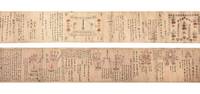
9137Numerous fine paintings & diagrams throughout using blue green red gray yellow much gold silver & flesh-colored pigments. Siddham script in several places. Two scrolls 185 x 17660 mm.; 175 x 9210 mm. each with gold-speckled inner endpapers at front dark blue paper on outsides. At the end of the first scroll a note states these texts were first written in 1192 KenkyÅ« 建久 3 & copied on an auspicious day in the 12th month of Genna 元和 5 this part of Genna 5 corresponds to 1620; the second scroll is also dated at end “the 12th month of Genna 5.â€<br /> <BR> <BR> These two scrolls are related to a kind of Daoist-influenced star worship that was associated with esoteric Buddhism. This practice became popular within the Japanese aristocracy in the medieval period. It drew on several strands of thought imported from China that were synthesized in Japanese religious practice. Buddhism as it appeared when imported to China from India and Central Asia in the first millennium CE carried with it astronomical and astrological knowledge including an identification of the planets and their association with the calendar e.g. the association between the planets and the days of the week still apparent in the modern Japanese names for them. In China this knowledge became influenced by Daoism exemplified for example by the worship of the stars of the Big Dipper Ch.: beidou J.: hokuto 北斗. In medieval Japan star worship under the auspices of esoteric Shingon and Tendai Buddhism became popular and highly ritualized. One star-related ritual expressed the worship of an individual’s birth and year stars. During these rituals offerings were made to a star or a constellation to obtain fortune or longevity. Such rituals are described in these two scrolls.<br /> <BR> <BR> Mandala dhÄraṇī and mudrÄ were important features of ritualized star worship and the three of them are present in the first scroll. There is a fine series of 158 flesh-toned paintings of mudrÄ gestures of the hand depicted and labeled. MudrÄ were hand and arm gestures made during the course of ritual practice or depicted in images of buddhas bodhisttvas tantric deities and other Buddhist images. With the development of Mahayana and Vajrayana iconography the number of mudrÄ proliferated and reaching the hundreds. DhÄraṇī were incantations and are presented as lists of syllables written in the Indic Siddham script. There is also a diagram a mandala depicting the Big Dipper the legends reference the earthly branches each listed as either yin or yang.<br /> <BR> <BR> The second scroll includes among other things a list of the Seven Planets sun moon and the planets of the solar system minus Neptune and Pluto and associated Buddhist deities stars in the constellation of the Big Dipper and years in the sexagenary calendrical cycle. Through this list an individual’s personal star can be determined. Further into the scroll the layout of the altar featuring e.g. silver coins food offerings and candles and the conduct of the rituals for various kinds of worship are described and illustrated in a series of scenes. Ritual objects like mandalas with Siddham characters are depicted as well. The instructions for the conduct of these rituals include the performance of combinations of mudrÄ and dhÄraṇī associated with the mystery of the body and the mystery of speech respectively.<br /> <BR> <BR> In addition to the importance of the Big Dipper the Daoist influence on these scrolls is evident in its mention of deities such as the Dongyue emperor and Huang Shigong.<br /> <BR> <BR> Very good preserved in a modern box. Some worming carefully repaired. unknown
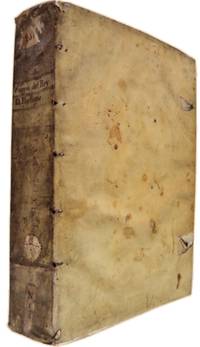
1504JC024<p>Hijo dÂ’el Emperador Don Carlos Quinto Maximo desde España à sus tierras de la baxa Alemaña: con la description de todos los Estados de Brabante y Flandres. Escrito en quatro libros por Iuan Christoual Caluete de Estrella. Con Gracia y Priuilegio de la Imperial Majestad para todos sus Reynos Estados y Seõrios por quinze Años. En Anuers en casa de Martin Nucio. Año de M. D. L I I. 1552.</p>_x000d_<p>In fólio de 27x19 cm. Com 8 335 19 folios.</p>_x000d_<p>Encadernação da época em pergaminho flexÃvel com o tÃtulo manuscrito na lombada e com vestÃgios de fechos de atilho nas pastas com 6 fragmentos de um manuscrito do séc. XVI reforçando a lombada do miolo.</p>_x000d_<p>Ilustrado com as armas de Carlos V em xilogravura na página de rosto uma outra xilogravura de página inteira no verso do último fólio preliminar contendo um arco triunfal erigido em Gand para a entrada de Filipe a marca de impressor de Nutius no final e dezenas de iniciais decoradas em 4 séries.</p>_x000d_<p>Exemplar com uma nota manuscrita marginal inicial e ocasionais notas e marcas posteriores maioritariamente a lápis. Com um leve pico de traça na margem interior do pé de cerca de 40 folhas que não afecta o texto e ligeiras manchas de água marginais nas últimas e primeiras três folhas mas ainda em muito bom estado. Capa quase solta do miolo alguns rasgões e manchas perdeu os dois pares de atilhos e as páginas finais com rasgos.</p>_x000d_<p>Primeira edição no original espanhol de um relato de uma testemunha ocular das viagens do PrincÃpe Filipe futuro Filipe II de Espanha e Iº de Portugal aos PaÃses Baixos através de Itália e dos Estados alemães com o objetivo de o preparar para as obrigações que teria de enfrentar quando sucedesse aos tÃtulos do seu pai o Sacro Imperador Romano Carlos V que também foi rei Carlos I de Espanha.</p>_x000d_<p>Obra publicada nos últimos anos do reinado do Imperador Carlos V. Encontram-se referências a D. João II e à presença de Portugal em Antuérpia e na Flandres nos fólios 318; 235 e 302.</p>_x000d_<p>A obra enquadra-se na passagem de poderes abdicação e cedência do Imperador. Nos últimos anos da sua função Imperial ocorreram os seguintes factos:</p>_x000d_<p>Em 1548 o documento proposto por Carlos V - o Interin de Augsburgo - não foi aceite pelos Protestantes nem pelo Papa A cidade de Magdeburgo centro da resistência protestante é banida do Império. Em 1552 MaurÃcio da Saxónia responsável pela aplicação do decreto armou-se secretamente e surpreendeu o Imperador. Derrota de Carlos V em Innsbruck. O Imperador e os PrÃncipes protestantes assinam o Tratado de Nassau. 1552-1556 Guerra entre Carlos V e Henrique II de França que tinha ocupado Metz Toul e Verdun. Em 1553. MaurÃcio da Saxónia derrota Alberto marquês de Brandenburgo-Culmach em Sievershausen mas foi ferido mortalmente. Em 1554 Assinatura do Tratado de Crépy. 1555. Supressão violenta de uma revolta anti calvinista em Genebra. A cidade tornou-se um centro de refúgio para protestantes ingleses e franceses e um ponto de radiação da doutrina calvinista. 1555 Assinatura da Paz de Augsburgo pela qual se reconhece aos protestantes a liberdade de culto e de propriedade. Os prÃncipes territoriais e as cidades livres que à data tinham aceite a confissão de Augsburgo passaram a ter liberdade de culto o direito de introduzirem a Reforma nos seus territórios jus reformandi e direitos iguais aos dos estados católicos. 1556. Carlos V assina a Paz com Henrique II de França. Abdicação de Carlos V. em Bruxelas com efeito em 1558. Carlos V abdica a favor do seu filho Filipe II a soberania dos PaÃses Baixos Castela Leão Aragão e a Catalunha Navarra Nápoles Sardenha SicÃlia o Ducado de Milão e as Ãndias. A função imperial e as possessões dos Habsburgos foram entregues ao seu irmão Fernando I. Carlos viveu no mosteiro de Yuste tendo ali morrido em 1558.</p>_x000d_<p>O humanista aragonês Juan Cristóbal Calvete de Estrella ca. 1510/20-1593 pertenceu à corte espanhola de Carlos V que o nomeou tutor do prÃncipe Filipe 1527-1598 em 1541. Acompanhou Filipe nestas viagens pelo que o seu livro constitui uma fonte primária essencial tanto para a vida e personalidade do futuro rei Filipe II que viria a trazer a Espanha a sua idade de ouro e o seu maior poder e riqueza como para os primórdios das suas relações com os PaÃses Baixos que viriam a revoltar-se contra o rei e provocar a queda do poder de Espanha e a desenvolver a sua própria idade de ouro como Estado independente. Calvete de Estrella permaneceu em Antuérpia quando Filipe regressou a Espanha tendo aà mandado imprimir o seu livro. Trata-se de um excelente trabalho de produção de livros que antecipa o papel que Antuérpia viria a desempenhar como principal centro de impressão e edição da Europa.</p>_x000d_<p>EN In folio. 27x19 cm. 8 335 19 folios.</p>_x000d_<p>Contemporary lexible parchment binding with handwritten title on the spine and traces of latches on the boards and with 6 fragments of a 16th century manuscript reinforcing the spine of the bookblock.</p>_x000d_<p>Illustrated with the coat of arms of Charles V in woodcut on the title page another full-page woodcut on the back of the last preliminary folio containing a triumphal arch erected in Ghent for Philip"s entry the printer"s mark of Nutius at the end and dozens of decorated initials in 4 series.</p>_x000d_<p>Copy with an initial marginal handwritten note and occasional later notes and marks mostly in pencil. With a slight moth hole on the inner margin of the foot of about 40 leaves which does not affect the texto area and slight marginal water stains on the last and first three leaves but still in very good condition. Cover almost detached from the bookblock some tears and stains signs of two pairs of latches and the final pages with tears.</p>_x000d_<p>First edition in the original Spanish of an eyewitness account of the travels of Prince Philip the future King Philip II of Spain and I of Portugal to the Low Countries through Italy and the German states with the aim of preparing him for the obligations he would have to face when he succeeded the titles of his father the Holy Roman Emperor Charles V who was also King Charles I of Spain.</p>_x000d_<p>Published in the last years of the reign of Emperor Charles V. References to King João II and Portugal"s presence in Antwerp and Flanders can be found on folios 318; 235 and 302.</p>_x000d_<p>This work fits in with the transfer of powers abdication and transfer of Emperor Charles V. In the last years of his Imperial function the following events occurred:</p>_x000d_<p>In 1548 the document proposed by the Emperor - the Interin of Augsburg - and it was not accepted by Protestants nor by the Pope. The city of Magdeburg the centre of the Protestant resistance is banished from the Empire. In 1552 Maurice of Saxony responsible for implementing the decree armed secretly and surprised the Emperor. Defeat of Charles V in Innsbruck. The Emperor and the Protestant Princes sign the Treaty of Nassau. In the years 1552-1556 there was a war between Charles V and Henry II of France who had occupied Metz Toul and Verdun. In 1553 Maurice of Saxony defeated Albert Marquis of Brandenburg-Culmach in Sievershausen but was mortally wounded. In 1554 there was a signature of the Treaty of Crépy. In 1555 occurs the violent suppression of anti Calvinist revolt in Geneva. The city has become a refuge center for English and French Protestants and a radiation point of the Calvinist doctrine. In 1555 was signed the Peace of Augsburg which recognizes the Protestants freedom of worship and property. The territorial princes and free cities that had accepted the Augsburg Confession had now freedom of worship the right to introduce the Reformation in their territory jus reformandi and equal rights of Catholic states. In 1556 Charles V signed the Peace with Henry II of France. In the same year occurred the the abdication of Charles V in Brussels effective in 1558. Charles V abdicated in favour of his son Philip II the sovereignty of the Netherlands Castile Leon Aragon and Catalonia Navarre Naples Sardinia Sicily the Duchy of Milan and the Indies. The imperial role and the possessions of the Habsburgs were delivered to his brother Ferdinand I. Charles lived his last years in the monastery of Yuste in Spain and died there in 1558.</p>_x000d_<p>The Aragon humanist scholar Juan Cristóbal Calvete de Estrella ca. 1510/20-1593 served in the Spanish court of Charles V who appointed him tutor to Prince Philip 1527-1598 in 1541. He accompanied Philip on these travels so that his book forms an essential primary source for both the life and personality of the future King Philip II who was to bring Spain its golden age and its greatest power and wealth and for the early beginnings of his relations with the Netherlands which was to revolt against the King bring about Spain"s fall from power and develop its own golden age as an independent state. Calvete de Estrella remained in Antwerp when Philip returned to Spain having his book printed there. It is an excellent piece of book production anticipating the role Antwerp was to play as Europe"s leading centre of printing and publishing.</p>_x000d_<p>Referências/References:</p>_x000d_<p><em>Adams C264; <br />Belg. Typ. 539;<br /></em><em>Iberian books 2403;<br /></em><em>Landwehr Splendid ceremonies 14;<br /></em><em>Palau 40491.</em></p> M-17-B-19 hardcover
1552H8IABU6I693ZAntwerp: Martinus Nutius I 1552. Near contemporary limp vellum sewn on 5 double tanned leather supports cut flush with the bookblock but with later alum-tawed thongs laced through the vellum cover with 6 fragments of a 16th-century manuscript reinforcing the spine of the bookblock blind- and later gold-tooled spine with a neatly lettered title in caps and small caps reading down the spine and a later one in caps and lowercase across the spine headbands in yellow and green old paper labels with letterpress and manuscript shelfmarks. Small folio 27 x 19.5 cm. With a woodcut architectural cartouche on the title-page the arms of the Holy Roman Emperor and King of Spain Charles V with columns strapwork and allegorical figures representing stability and fairness a full-page woodcut triumphal arch erected in Ghent for Philips entry with letterpress title and key to elements A-N Nutiuss woodcut device at the end a strapwork cartouche with a crane feeding a worm to its young dozens of woodcut decorated initials 4 series and a vine-leaf ornament Vervliet 170. Set in roman and italic types many and the vine-leaf by François Guyot in Antwerp. First and only early edition in the original Spanish of an eyewitness account of the future King Philip II of Spain's travels from Spain through Italy and the German states to the Low Countries from 1548 to 1550 or 1551 intended as preparation for the duties he would face when he succeeded to in the event only some of the titles of his father the Holy Roman Emperor Charles V who was also King Charles I of Spain. The Aragon humanist scholar Juan Cristóbal Calvete de Estrella ca. 1510/20-1593 served in the Spanish court of Charles V who appointed him tutor to Prince Philip 1527-1598 in 1541. He accompanied Philip on these travels so that his book forms an essential primary source for both the life and personality of the future King Philip II who was to bring Spain its golden age and its greatest power and wealth and for the early beginnings of his relations with the Netherlands which was to revolt against the King bring about Spain's fall from power and develop its own golden age as an independent state. Calvete de Estrella remained in Antwerp when Philip returned to Spain having his book printed there. It is an excellent piece of book production anticipating the role Antwerp was to play as Europe's leading centre of printing and publishing.With an early marginal manuscript note and occasional later mostly pencil notes and marks. With a small worm trail in the inner foot margin of about 40 leaves not approaching the text and faint marginal water stains in the last and first three leaves but still in very good condition. The cover has nearly come loose from the bookblock has some tears and stains has lost its 2 pair of ties and the endpapers are tattered.l Adams C264; Belg. Typ. 539; Iberian books 2403; Heredia 7039; Landwehr Splendid ceremonies 14; Netherlandish books 6408; Palau 40491; Peeters-Fontainas Meridionaux 170; Ruggieri 913; Salvá 3758; USTC 440071; not in Bibl. Belg. Martinus Nutius I, hardcover
star-wars-1977-internatio<span data-mce-fragment="1">The fantastic and highly collectible 1st printing of the Star Wars 1 Sheet Style A poster! Iconic artwork by Tom Jung.</span><br data-mce-fragment="1"><br data-mce-fragment="1"><span data-mce-fragment="1">Due to the immense popularity of the movie there were four different printings of this 'style A' one-sheet poster in 1977. The first printing offered here has the original NSS number of 77-21-0 while the next three printings have the 77-21 NSS number. The first printing is naturally the most collectible.</span> unknown
1932160793New York: Abbott-Dunning 1932. Draft script for the Broadway premiere of the 1932 play. Working copy belonging to playwrights Ben Hecht and Charles MacArthur with their annotations in manuscript pencil throughout. <br /> <br /> An early theatrical effort by legendary playwrights authors and creative collaborators Hecht and MacArthur preceded by "The Front Page" 1928 and "The Great Magoo" 1932.<br /> <br /> Based on "Napoleon of Broadway" an unproduced play by Charles B. Millholland about an egomaniacal theatrical producer based on real-life impresario David Belasco as he attempts to win back his former protégé now working as a Hollywood actress. The play made its Broadway premiere on December 29 1932 at the Broadhurst Theatre running for 152 performances. Adapted for film by Howard Hawks two years later starring John Barrymore and Carole Lombard. <br /> <br /> Set in New York. <br /> <br /> Blue titled wrappers with credits for playwrights Hecht MacArthur and Millholland on the front wrapper. Title page present dated December 29 1932 with credits for playwrights Hecht MacArthur and Millholland director George Abbott and others. 112 leaves with last page of text numbered 3-29. Mimeograph duplication rectos only. Title page lightly dampstained else Pages Near Fine wrapper Good moderately dampstained and edgeworn bound with two gold brads. Abbott-Dunning unknown
19685519McGraw Hill Book Company 1968. First Edition First Printing. Hardcover. Near fine/very good . SIGNED BY PAUL MCCARTNEY - McGraw Hill Book Company 1968. Hardcover in pictorial dust jacket. Stated First Edition First Printing not a book club edition. 8vo with 357 pages with several black and white photos at the center of the book. "Hunter Davies had the great fortune to be with the Beatles for around 2 years researching with their cooperation this book. This gave him fantastic insights and access but of course being 'authorised' he had to be a little careful about what he wrote.No-one interested in how The Beatles grew up and what made them what they were should be without this book." This copy is HAND-SIGNED by Paul McCartney in blue marker diagonally across the yellow fep.; McCartney's signature is consistent with those made during the mid 1960's to mid 1970's. BOOK CONDITION Near Fine with light overall rubbing to covers light soiling to endpapers including around McCartney's signature and overopening at page 175 where the signature for the group of black and white photographs at thebook's center meet the subsequest signature with text; in a Near Fine dust jacket with rubbing wear and a few small closed tears to edges price of 6.95 to upper corner of front flap and no mention of a book club edition to lower corner of front flap. SIGNED COPY. McGraw Hill Book Company hardcover
194353630Tunisia 1943. Nearly Fine. Five-pointed yellow cloth star sewn onto plain beige cloth 7.3 by 9 cm. Yellow dye somewhat faded else in fine state of preservation.<br /> <br /> Specimen of the yellow star imposed on the Jewish population of Tunisia in March 1943 as a mark of the slave laboror. Tunisia was the only Islamic country to come under Nazi rule at first indirectly through the Vichy regime in France between 1940 and its liberation by Allied forces on May 7 1943. In response to the Allied invasion of Algeria and Morocco German and Italian forces invaded Tunisia on November 9 1942. By the end of November the Germans took the first anti-Jewish move by arresting four of the community leaders including Moïse Borgel the president of the Jewish congregation. "In addition to the governor-general's sympathetic attitude -- and in some degree to the pro-Jewish attitude of Bey Sidi Mohammed al-Mounsaf -- the Italians also in practice interfered with the application of the anti-Jewish laws" E.H. The dignitaries were released after a week following the intervention of the mayor of Tunis and the Italian consul. Because of objections by the Italians the edict to wear the star does not appear to have been generally enforced with rigor and was only formally imposed in two cities Sfax and Tunis. While 5000 Jews had originally been put on forced labor in thirty locations and camps along the front line "at the time of the collapse and surrenter in early May 1943 only sixteen hundred Jews were employed on forced labor" E.H. Given the relatively small labor force and the lack of zeal in imposing the anti-Jewish ordinances it is clear why so few of these yellow badges have survived. References: I. Gutman ed. Encyclopedia of the Holocaust vol. 4 pp. 1521-23. unknown
3490New. DESCRIPTION: Outtake: Red Star The Breaker 2012. Limited Edition Archival inkjet print 10 x 10" image on 12 x 12" paper. Edition of 50 signed and numbered by the artist. CONDITION: FINE/NEW. SIGNED. unknown
1954146173Burbank CA: Walt Disney Productions 1954. Final Shooting Script for the 1954 film with blue yellow and green revisions throughout. <br/><br/>Based on the 1870 novel "Twenty Thousand Leagues Under the Sea" by Jules Verne. Walt Disney's "20000 Leagues Under the Sea" was one of the most expensive and ambitious productions of its time. A 200 foot submarine a 225 pound diving suit a specially built soundstage with a 90 x 165 foot tank and a giant squid which weighed two tons and required a crew of 28 to operate were just some of the monumental challenges of the production. Disney's first CinemaScope motion picture "20000 Leagues Under the Sea" was a resounding success and went on to be considered one of greatest live-action adventure movies ever made.<br/><br/>In 1868 off the coast of San Francisco Professor Aronnax Paul Lukas his assistant Conseil Peter Lorre and master harpooner Ned Land Kirk Douglas set sail upon a armed frigate to investigate a spate of sinkings rumored to be caused by a sea monster. After months of searching the "monster" is spotted sinking a merchant vessel and the frigate attacks only to be sunk themselves. Adrift in the ocean the three come upon a strange metal vessel and realize the "monster" is a "submerging boat." The trio are captured by Captain Nemo James Mason and taken aboard the submarine the Nautilus and journey on a voyage of adventure and discovery under the sea.<br/><br/>Nominated for three Academy Awards winning two for Art Direction and Special Effects.<br/><br/>Shot on location in California Jamaica and the Bahamas. <br/><br/>Blue titled wrappers with affixed Walt Disney Productions label as called for with Disney scripts from this era noted as FINAL SHOOTING SCRIPT on the front wrapper with credits for screenwriter Earl Felton. Title page present with credits for screenwriter Earl Felton. 146 leaves with last page of text numbered 141. Mimeographed rectos only with blue yellow and green revision pages throughout dated variously between 1/30/54 and 3/1/54. Pages Near Fine plus wrapper Near Fine bound internally with three gold brads. Walt Disney Productions unknown books
166560N.p.: N.p. 1972. Early Draft script for the 1974 film file copy belonging to director Sam Peckinpah. Dated July 8 1972 over a year before production commenced and notably featuring the original ending with Bennie getting away-in true Peckinpah fashion the director would later rewrite the ending to show Bennie dying in a shootout. With Peckinpah's brief annotations in manuscript ink on the title page and two leaves of the script. <br /> <br /> Warren Oates stars as Bennie a bartender who travels through the Mexican underworld accompanied by his sex worker girlfriend to collect the bounty on the head of a gigolo. The only Peckinpah film not re-cut by the studio.<br /> <br /> Shot on location in Mexico. <br /> <br /> Yellow titled wrappers. Title page present dated July 8 1972 with credits for Peckinpah and screenwriter Gordon Dawson. 128 leaves with last page of text numbered 126. Xerographic duplication rectos only. Pages Near Fine wrapper Very Good plus bound with two gold brads.<br /> <br /> Ebert II. Nilsen Warped and Faded. Rosenbaum 1000. Twilight Time 497. N.p. unknown
1983791983. Very good. Ps. Sensational original presentation color photograph 16" X 20" of Carrie Fisher as Princess Leia in her slave costume. Boldly inscribed by Fisher in black ink to her psychiatrist Dr. Arnold Klein "For my own crazy. Who loves you darling Guess again. Princess Leia. Opiates for sure." With the original hologram sticker "Officially Licensed Star Wars Photograph" in the lower left corner. 2 dozen surface scratches else very good. Framed. If you like this sort of thing this is the sort of thing you'll like. My take Carrie's Leia is one of the 2 late 1970s world-wide magnetic babe fantasies see page 19 in this catalog for the other but needless to say we don't number our pages. And speaking of babes when we do employment interviews at Biblioctopus we give the women a bite-sized Snickers. If they take the wrapper off before eating it we make them catalogers. If they eat it with the wrapper still on they get hired for Security. unknown books
OTASG001Comiskey Park Chicago: Major League Baseball 1983 July 5 1983. 4pp. Original printed wrappers printed yellow red and blue. Signed by Roger Maris in blue sharpie to front cover signed by virtually every participating former player on or near their photo. Approximately 100 signatures including: Hank Greenberg Joe and Dom DiMaggio Bob Feller Larry Doby Don Larsen Lefty Gomez Frank Robinson Brooks Robinson Al Kaline Bob Lemon Charlie Gehringer Joe Cronin Bobby Doerr Roger Maris signed twice Earl Weaver Leo Durocher Buck Leonard Ernie Banks Lou Brock Carl Hubbell Willie McCovey Pee Wee Reese Willie Mays Johnny Mize Stan Musial Enos Slaughter Duke Snider Warren Spahn Willie Stargell Bobby Thomson Travis Jackson Ralph Kiner and Joe Torre. Some light wear to the extremities several creases otherwise very good. . First Edition. Original Wraps. Near Fine. Comiskey Park, Chicago: Major League Baseball, 1983 (July 5, 1983). paperback books
157917643Lutetiae, apud Marnerum Patissorum typographum Regius, in officina Roberti Stéphani, 1579 ; deux parties avec titre propre reliées en un volume in-8, veau marbré, dos à nerfs décoré et doré avec le chiffre de Mathieu Molé, armes de Mathieu Molé au centre des plats ; (12)-136 pp. , (6) p. , (1) f. blanc ; 292, (12) pp.volume in-8, veau marbré, dos à nerfs décoré et doré avec le chiffre de Mathieu Molé, armes de Mathieu Molé au centre des plats ; (12)-136 pp. , (6) p. , (1) f. blanc ; 292, (12) pp.
197716625JNew York 1977. Measuring 8 by 10 inches. Signed in blue ink: Best wishes Alec Guinness. Former ownership stamp and writing on verso in fine condition. When Guinness read the script for Star Wars was reluctant to do the film but Lucas badly wanted a major star and he offered Guinness $150000 plus 2% of profits and Guinness agreed and became Obi-Wan Kenobi and later was nominated for the Best Supporting Actor Academy Award. Guinness had made a stipulation his character would die before the end of the movie so he would not have to appear in the inevitable sequels which he actually did briefly appear in! Guinness was shocked by the huge success of Star Wars and the financial windfall it gave him. He would occasionally sign photographs from Stars War but they are not common. unknown
158636N.p.: N.p. 1971. Vintage two-color poster for an unseen performance by punk icons the Stooges queer hippie theatre troupe the Cockettes all-girl rock group The GTOs and John Mendelsohn's short-lived rock band Super Star held at the Hollywood Palladium on July 16 1971. The show would ultimately be canceled after The Stooges formally broke up on July 9 1971.<br /> <br /> A preview of The Cockettes' satirical 1971 film "Tricia's Wedding" was also to have been shown. The film featured The Cockettes reenacting President Nixon's daughter Tricia's wedding to Edward Cox interspersed with a number of humorous scenes including Eartha Kitt spiking the punch bowl with LSD.<br /> <br /> Even before it was canceled it's hard to imagine how this concert would have come together given the clashing styles of the acts. Founded in 1969 in San Francisco the Cockettes were a performance art group that performed improvised musical numbers in elaborate genderbending costumes and had become a sensation among the West Coast arts and culture scene. The GTOs were a satirical rock band formed in Los Angeles with ties to Captain Beefheart and Frank Zappa who would produce the band's only album Permanent Damage 1969. And the Stooges were simply the Stooges.<br /> <br /> 11.25 x 26 inches. About Near Fine. N.p. unknown
1970011169Paris Maeght 1970 In-2 En feuilles, couverture illustrée Edition originale Dédicacé par l'illustrateur
158698N.p.: N.p. 1972. Early Draft script for the 1974 film dated July 8 1972 over a year before production commenced. Script notably features the original ending with Bennie getting away-in true Peckinpah fashion Peckinpah would later rewrite the ending to show Bennie dying in a shootout. Annotations in manuscript ink and pencil on fifteen pages largely regarding spelling and grammatical corrections.<br /> <br /> Warren Oates stars as Bennie a bartender who travels through the Mexican underworld accompanied by his sex worker girlfriend to collect the bounty on the head of a gigolo. The only Peckinpah film not re-cut by the studio.<br /> <br /> Shot on location in Mexico. <br /> <br /> Yellow titled wrappers. Title page present dated 7/8/72 with credits for screenwriters Gordon Dawson and Sam Peckinpah. 128 leaves with last page of text numbered 126. Mimeograph duplication rectos only. Pages Near Fine wrapper Near Fine bound with two gold brads.<br /> <br /> Ebert II. Nilsen Warped and Faded. Rosenbaum 1000. Twilight Time 497. N.p. unknown
196932779Holywood: Desilu Studios unpublished Circa 1969-1971. A reel of original black and white 16mm film containing a film print of the full footage of the blooper reels Roddenberry had assembled following seasons one and two of STAR TREK September 8 1966 to March 29 1968. Roughly fifteen minutes of black and white footage from film originally rescued from the cutting-room floor at Deslu Studios. On a contemporary 12.5 inch film spool and in a film can from the same period. The digital print is made from the actual film provided and is on modern "thumb-drive" media. Request for conversion to DVD. The celluloid film appears to be very well preserved there is no odor of acetate or evidence of brittleness associated with degraded film the actual projected images range from scene to scene but are as in virtually all known examples generally of fairly low quality. The history of the their creation and early distribution explains this. A VERY ENJOYABLE AND YET ALSO AN IMPORTANT HISTORICAL ITEM FROM THE MOST FAMOUS TELEVISION SCIENCE FICTION SERIES OF ALL TIME. STAR TREK has lived on to be a cultural phenomenon with an almost 60 year life comprised of twelve television series twelve major motion pictures and a countless array of books graphic novels parodies and various merchandise. In the history of modern Science Fiction only STAR WARS rivals its popularity.<br> The STAR TREK bloopers were also the first generally viewed or distributed films of their kind. In the decades since bloopers have become big business spawning a popular television series and commonly shown at the end of movies such as the Marvel film series and Dreamworks productions. But prior to STAR TREK unusable footage such as this was in virtually all cases simply discarded.<br> The making of the STAR TREK Blooper Reels began as a labor of love. Series creator Gene Roddenberry hand-assembled the first original reel from film scraps rescued from the cutting room floor of things such as goof-ups horseplay practical jokes etc. This first reel was made to show to the cast production staff and other studio personal at a 1966 Desilu Christmas party. It was a hit and he had a few copies made to give as gifts to the studio execs. At the conclusion of season one he created a second reel using film from reel one combined with additional new footage from the episodes produced after Christmas. Copies of this reel were also produced again as gifts to studio execs. Another reel was made using clips from season two.<br> STAR TREK was canceled in 1968 but knowing it had a broad base of mostly well educated fans the studio heavily promoted it for syndication. These afternoon "reruns" quickly gave the series a second life. Roddenberry began as early as 1969 going to colleges to give public speaking appearances and occasionally brought along his copies of the popular "bloopers". These appearances eventually led to the early S.T. conventions where Roddenberry would speak and often show his film reels. Eventually as the conventions grew in popularity copies were made from Roddenberry's copies for wider distribution. And occasionally copies of those copies were made to sell to the devoted fans. While the original broadcast episodes of the series were protected by copyright the editing room scraps were not. The conventions could show these as they pleased; and in fact the series owners by this time Paramount/Gulf Western encouraged it as free advertising for the franchise; they would later try to clamp down on this but the genie was already out of the bottle.<br> The distribution reels being made from Roddenberry's already well-loved and often-shown originals is what accounts for the generally poor audio and video to be found on the film. Fan complaints about the viewing quality go back as far as the early 1970s. No official effort to restore or market the bloopers has ever been made though parts of them showed up on unauthorized VHS anthologies in the 1980s and later on unauthorized DVDs.<br> The reel of film offered here contains the full season one reel combined with the full reel from season two making for just over 15 minutes of viewing pleasure. It is also an uncommon example as it was produced in black and white. The bloopers themselves provide a rare behind-the-scenes glimpse not only into STAR TREK but into the television industry of the era. They show us a typically good-natured group of fun and creative people who seem to be genuinely enjoying their work. Many of the scenes are physical mishaps such as tripping falling dropping things or walking into doors that happens a lot. Others are line flubs and slips of the tongue and many more are the cast of actors just goofing around horse-playing or pulling gags on one and other. Much of the activity is clearly from a different era and would be considered highly "workplace inappropriate" by today's standards! [Desilu Studios, unpublished] unknown
1798321399Northampton Massachusetts: By Andrew Wright for Daniel Wright and Company 1798. First edition. 300pp. with music printed from moveable type throughout. 8vo. Contemporary sheep red morocco lettering piece. Worn at edge splits starting at joints. Front endpaper renewed chips at edges of title repaired tear to dedication leaf. First edition. 300pp. with music printed from moveable type throughout. 8vo. First edition containing early American secular music including patriotic and anti-slavery songs with tunes. Noted as containing the first American book publication of the tune to the Anacreontic song which would become the basis for the Star Spangled Banner. This appears under the title "Adams and Liberty" which is written to the tune of the Anacreontic song. Star-Spangled Books B8; Evans 33294; Sabin 1163; Dichter and Shapiro pp. 34; Lowens 139 By Andrew Wright for Daniel Wright and Company unknown
183849473Paris, Bachelier, 1838 a. 1840. 4to. No wrappers. In: ""Comptes Rendus Hebdomadaires des Séances de L'Academie des Sciences"", Tome 7, No 19 and Tome 10, No 17/18. With title-ages to vol. 7 and 10. Pp. (769-) 803 a. pp. (671-) 717. (Entire issues offered). Bessel's papers: pp. 785-793 a. pp. 703-710. Stamp on both titlepages. The second titlepage with a fes brownspots, otherwise clean and fine.
183849473Paris Bachelier 1838 a. 1840. 4to. No wrappers. In: "Comptes Rendus Hebdomadaires des Séances de L'Academie des Sciences" Tome 7 No 19 and Tome 10 No 17/18. With title-ages to vol. 7 and 10. Pp. 769- 803 a. pp. 671- 717. Entire issues offered. Bessel's papers: pp. 785-793 a. pp. 703-710. Stamp on both titlepages. The second titlepage with a fes brownspots otherwise clean and fine. <br/><br/><em>First appearance of a milestone paper in astronomy giving the solution of the great problem of distances in the universe which had baffled astronomers ever since the time of Copernicus announcing the FIRST SUCCESSFUL DISPLACEMENT OR PARALLAX OF A FIXED STAR and hence deducing the FIRST RELIABLE DISTANCE OF THE EARTH TO A FIXED STAR. The parallax observed corresponded to ab. 600.000 times that of the earth from the sun. On these grounds Bessel calculated the distance to about 11 light years and this was confirmed by fresh investigations by Bessel in 1839-40 the second paper offered. In 1842-43 it was also confirmed by C.A.F. Peters at Pulkowa. It is the first published instance of the fathom-line thrown into celestial space.Bessel communicated his observations in Comptes Rendus in a letter to Humboldt the offered paper dated Nov. 5 1838 in "Monthly Notices" in letter to J. Herschel and in "Astronomische Nachrichten" Vol. 16 No 365-66 pp. 65-96 1838 where a more detail account was published.Ther paper "Bestimmung der Entfernung des 61sten Stern des Schwans" in "Astronomische Nachrichten" is dated at the end: Altona 1838 Dec. 13.Bessel's investigation was hailed by John Herschel when Bessel was awarded the R.A.S. gold medal "The greatest and most glorious triumph which practical astronomy has ever witnessed". "For determining the parallax of 61 Cygni Bessel selected two comparison stars of magnitude 9-10 at distances of roughly eight and twelve minutes of arc. 61 Cygni is a physical double star whose components differ in brightness by less than one magnitude. The distance of sixteen seconds of arc between the components favored the accuracy of the determination of the parallax because pointing could be carried out with two star images. After observing for eighteen months by the fall of 1838 Bessel had enough measurements for the determination of a reliable parallax. He found that p = 0.314 with a mean error of ±:0.020. This work was published in the Astronomische Nachrichten 1838 the first time the distance of a star became known. Bessel’s value for the parallax shows excellent agreement with the results obtained by extensive modern photographical parallax determinations." DSB.Parkinson "Breakthroughs" 1838 A. - Shapley & Howarth "A Source Book in Astronomy" pp. 216 ff. </em> unknown
20211-1119488877Wiley-Blackwell 2021. Hardcover. New. 2nd edition. 7081 pages. 18.25x12.00x10.00 inches. Wiley-Blackwell hardcover
160904N.p.: N.p. 1977. Early First Draft script for the seminal 1980 film here under the working title "California Girls." Copy belonging to uncredited crew member Jim Brown no relation to the actor we suspect with his name in manuscript ink on the title page. <br /> <br /> A bleak seminal coming-of-age drama about four teenage girls grappling with their families drugs and relationships in Los Angeles in the late 1970s. Adrian Lyne's directorial debut.<br /> <br /> Shot on location in San Fernando Hollywood and Los Angeles California. <br /> <br /> Blue untitled wrappers. Title page present dated Nov. 28 1977 noted as First Draft with credits for screenwriter Gerald Ayres. 138 leaves with last page of text numbered 137. Xerographiic duplication with the exception of the title page which is a carbon typescript copy rectos onl. Pages Near Fine wrapper Very Good plus bound with two gold brads.<br /> <br /> McPadden Heavy Metal Movies. McPadden Teen Movie Hell. N.p. unknown