Kircher AthanasiusMareMagnum

948 résultats
Folio (320 x 215mm). (16) ll, including frontispiece, 618 pp, (14) ll. Engraved frontispiece, title in red and black with large engraved vignette, numerous engraved illustrations including large-format ones, and numerous woodcut illustrations, headpieces and initials, with final blank. Contemporary vellum, manuscript title on spine. Somewhat browned and with a small defect in the engraved title-page, but still in good condition, binding slightly bowed.
2 403 cc. di cui 10 bianche ; 520 cc. (tutte numerate a fascicoli da 1 a 10), carte scritte solo al recto di ogni foglio, salvo alcune pagine con chiose e correzioni, unica mano, ben leggibile, legatura in mezza pelle piatti in cartonato marmorizzato, scritte incise e dorate al dorso: A-M Mesmerismo / autografo. Alle carte di guardia anteriori di entrambi i volumi timbro ad inchiostro di possesso che legge A. FUSARA / Biblioteca Hermetica con segnatura, al verso delle stesse: etichetta di possesso del Conte Paolo Vimercati Sozzi Autografo dell?opera come segnalato al dorso e confermato dalla nota manoscritta in calce al frontespizio che cos? legge: Avviso al tipografo: si trasportino a pi? di pagina tutte quelle indicazioni in cui vien citata la pagina [?], nonch? le note relative ai richiami per la paginazione presenti in tutto il testo. Il manoscritto ? stato pubblicato nel 1856 dalla Tipografia Mazzoleni di Bergamo, in due volumi, l?unico esemplare di questa pubblicazione ? stata rinvenuta nella Biblioteca Universitaria di Pavia censito nel Sistema Bibliotecario Nazionale, che scioglie anche la sigla con il nome dell?autore: Monicelli Antonio.Ottimo e decisamente interessante questo manoscritto autografo sulla teoria del mesmerismo che nacque e si svilupp? tra la fine del secolo XVIII e l?inizio del secolo XX, dopo le pubblicazioni delle teorie di Franz Anton Mesmer. Questo esemplare di questa rarissima opera acquista un aspetto pi? interessante in quanto autografo dello stesso autore, nonch? per la nobile provenienza.
In-24 gr. (mm. 128x75), p. pergamena coeva, titolo ms. al dorso, tagli rossi, 10 cc.nn., 201 pp. num., 3 cc.nn., compresa la bella antiporta allegorica inc. in rame. Importante opera dell’erudito gesuita tedesco (1601-1680), dedicata ai fenomeni magnetici rilevati in natura. "Seconda edizione" (la prima in-4 fu pubblicata a Roma, lo stesso anno), rara. Cfr. Brunet,III,667 - Caillet,II,5781: “Kircher tente de démontrer un grand nombre de phénomènes par le Magnétisme” - De Backer,I, p. 429: “L’auteur assure que la nature n’a aucun secret que ne puisse pénétrer l’observateur attentif, et pose en principe que l’attraction et la répulsion peuvent servir à expliquer les phénomènes les plus obscurs de la physique. Il explique, d’après cette hypothèse, la production des minéraux, des pierres précieuses, des plantes, et les affections et les antipathies qu’on remarque dans les animaux”. Pagine ingiallite per la qualità della carta, altrimenti esemplare ben conservato.
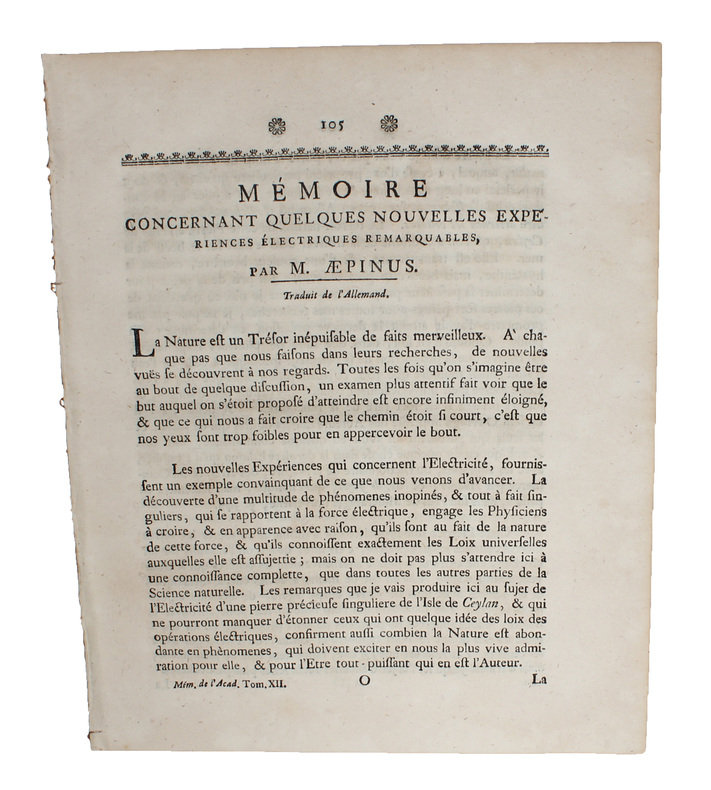
175846557Berlin, Haude et Spener, 1758. 4to. No wrappers, as issued in ""Mémoires de l'Academie Royale des Sciences et Belles-Lettres"", 1756, tome XII. Pp. 105-121. With titlepage to the volume, printed in red/blac and with engraved titlevignette. Also having the parttitlepage. Titlepage with 2 small wormtracts.
175846557Berlin Haude et Spener 1758. 4to. No wrappers as issued in "Mémoires de l'Academie Royale des Sciences et Belles-Lettres" 1756 tome XII. Pp. 105-121. With titlepage to the volume printed in red/blac and with engraved titlevignette. Also having the parttitlepage. Titlepage with 2 small wormtracts. <br/><br/><em>First appearance of a milestone paper in the history of electricity as Aepinus here found that a heated tourmaline attracted and repelled light bodies. He decided that the effect was electrical and that its ends was carrying charges of opposite sign much as soft iron is magnetized by a lodestone. This paper is a forerunner of his "Tentamen Theoriae electricitatis et magnetismi" - published 1759 and one of the most original and important books in the history of electricity. It is the first reasoned fruitful exposition of electrical phenomena based on action-at-a-distance."Aepinus’ first reseraches on the thermoelectric properties of this stone Tourmalin which was then of extreme rarity were fundamental. He recognized the electrical nature of the attractive power of a warmed tourmaline and attempted not altogether successfully to reduce its apparent capriciousness to rule. He was particularly struck by the formal similarity between the tourmaline and the magnet in regard to polarity which inspired him to reconsider the possibility then occasionally discussed that electricity and magnetism were basically analogous. This thought became the This thought became the theme for his masterwork Tentamen theoriae electricitatis et magnetismi 1759."DSB."Aepinus is known in the history of electricity for his attempt to develop the one fluid theory of Franklin. His theory was for a while generally adopted but was gradually displaced by the two fluid theory in consequence chiefly of the necessity of ascribing to uncharged matter repulsions of the same force as those which were ascribed to electrical charges. His theory exhibits interesting similarities to the present theory of the constitution of matter"Magie "A Source Book in Physics" pp.406-8.Ronalds p. 4. </em> unknown
182919876Paris: Mme. Levi 1829. FIRST AND ONLY EDITION. Uniformly bound in calf-backed marbled boards spine labels; a brilliant copy. First and only edition. A complete collection of this journal which published monthly for the four years between 1826 and 1829. Devoted to the practice of magnetism in France. The periodical brings together various articles on medical and other experimentation with animal magnetism the latest trends and research testimonials and even letters from readers. Articles by practitioners such as Deleuze Comte and d’Aulnay reveal the scope of use of animal magnetism in medical and other practices. <br /> <br /> Hundreds of publications were printed following Mesmer’s initial introduction of the practice in 1784. L’Hermès was an important guidepost to the use and efficacy of animal magnetism and how it affected medicine in general as well as specific illnesses nearly fifty years later. It is quite rare to find a complete set. Mme. Levi unknown
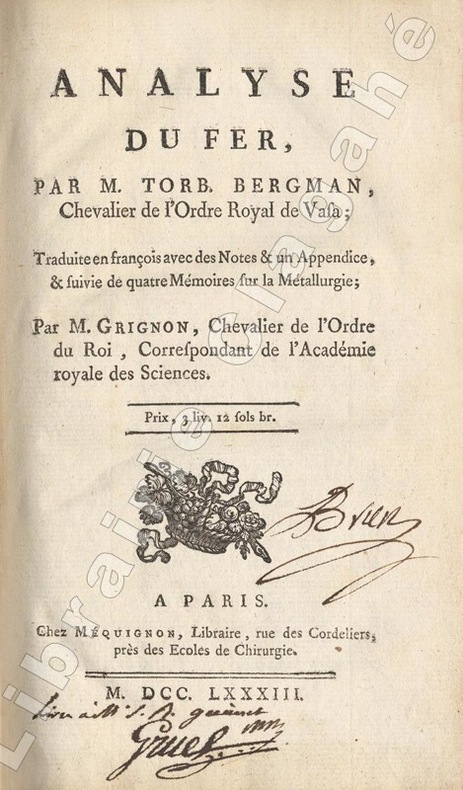
17536Paris, Méquignon, 1783 ; in-8, veau fauve marbré, dos lisse décoré et doré, pièce de titre grenat, tranches rouges (rel. de l'époque) ; (2) ff. le premier blanc et titre, XVI, 286 pp.
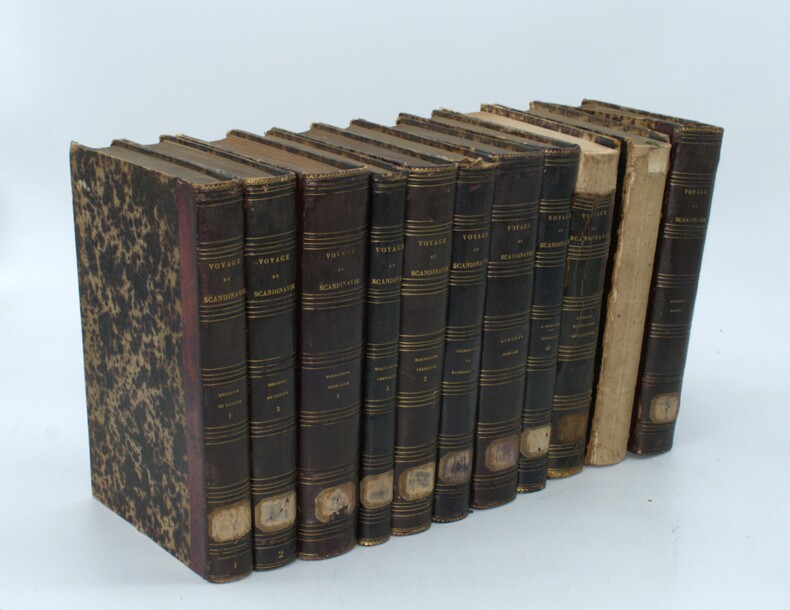
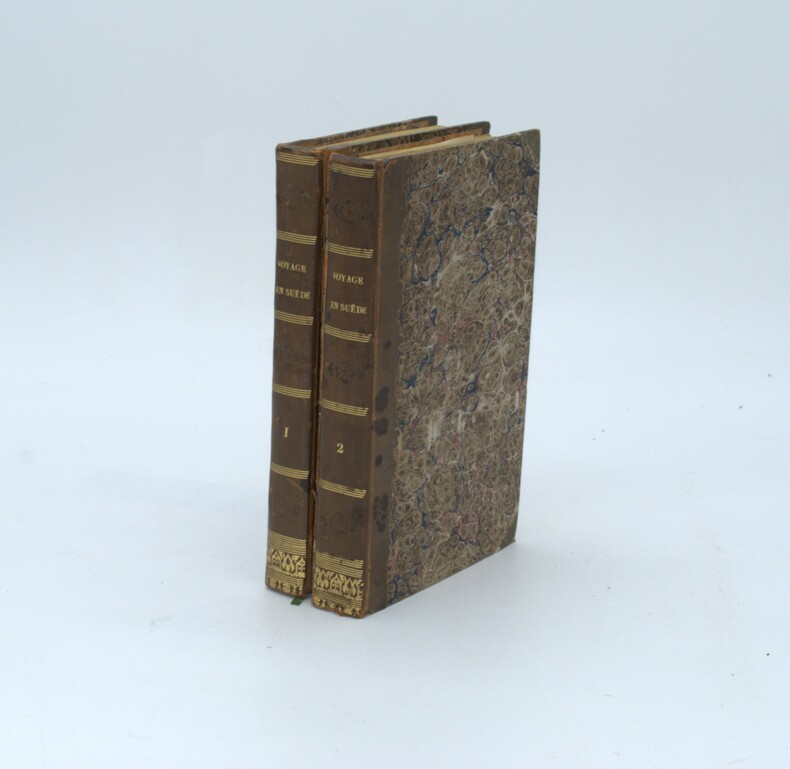
1843PHO-1524Paris, Arthus Bertrand, s.d. (1842-1845). 11 volumes grand in-8 (18, 13 volumes de texte et 5 atlas), relié demi veau aubergine, dos lisse avec titre et tomaison, étiquette au dos, supra libri effacés aux plats, coins usés, dos avec manque (géologie, minéralogie), dos manquant (histoire de la Scandinavie), - Relation du voyage par X. Marmier, 2 vol. (374 pp., 1 pl. ; 458 pp.) - Magnétisme terrestre par V. Lottin, A. Bravais : 3 vol. (563 pp. plus errata ; 448 pp. ; 297 pp. plus table générale détaillée des planches.) - Aurores boréales par V. Lottin, A. Bravais 1 vol. (566 pp., avec 42 figures in texte.) - Géologie, par E. Robert, 2 vol. en 1, (4), 210 pp. ; (4), 308 pp.) - Géologie, Minéralogie par J. Durocher, 1 vol. (482 pp.) - Astronomie et Hydrographie, par V. Lottin, A. Bravais… 1 vol. (531 pp.) - Littérature scandinave, par X. Marmier : 1 vol. (557 pp.) - Histoire de la Scandinavie, par X. Marmier, 1 volume (515 pp.)
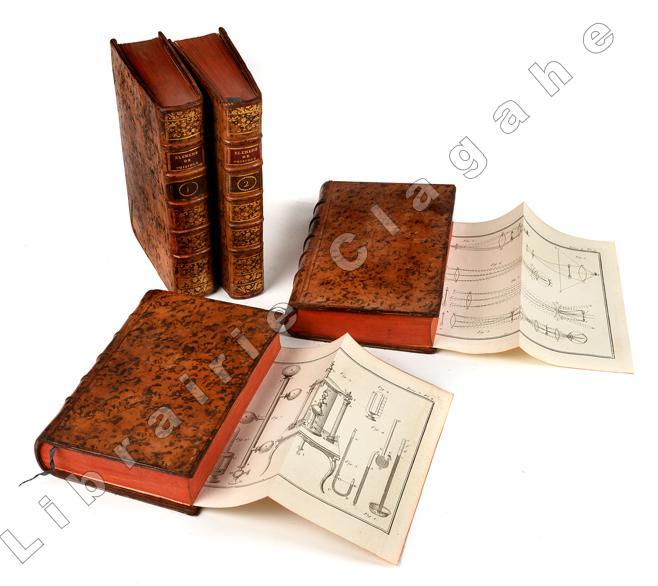
178720311Paris, Griffier, 1787 ; 4 tomes in-8 (195 mm), veau marbré, dos à nerfs décoré et doré, pièce de titre rouge, tranches rouges (reliure de l’époque) ; XXXII, 635, [1 bl.] pp, 7 pl. dépl. ; 565, [1 bl.] pp., 10 pl. dépl. ; 576 pp., 4 pl. dépl. ; 622 pp, 4 pl. dépl. soit en tout 25 planches dépliantes gravées sur cuivre et portrait gravé par Coron d’après Naudin en frontispice.
186441709(London, Taylor and Francis, 1864). No wrappers, as extracted from""Proceedings of the Royal Society"". From November 19, 1863, to December 22, 1864, inclusive."", Vol. XIII. Pp 531-536.
186441709London Taylor and Francis 1864. No wrappers as extracted from"Proceedings of the Royal Society". From November 19 1863 to December 22 1864 inclusive." Vol. XIII. Pp 531-536. <br/><br/><em>First printing of the first announcement of Maxwell unification of light-waves electricity and magnetism the most importent of the papers relating to his electromagnetic theory in which he brought electro-magnetical phenomena on a clear mathematical form. The present paper is an abstract of the larger paper which was read to the Royal Academy in 1864 but only issued the year later 1865 in "Philosophical Transactions of the Royal Society" where it was printed in full and as an abstract in "Philosophical Magazine" 1865."A generation later Einstein's work on relativity was founded directly oupon Maxwell's electromagnetic theory; it was this that led him to equate Faraday with Galileo and Maxwell with Newton." PMM No 355 but only the paper from 1865. - Dibner. Heralds of Science No 68 1865 paper. </em> unknown
2 voll. legati in uno in 8°, elegante legatura ottocentesca in mz pelle con nerv. e fregi in oro, timbrino alla sguardia, fioriture alle primme cc pp 2, 298; 2, 340. nella prima parte vi è una storia del magnetismo e si espongono fenomeni come guarigioni di malattie e sonnambulismo, nella seconda parte vi è una bibliografia sul magnetismo dai primi trattati del '500 fino alle opere piu recenti. " Ouvrage indispensable dans une biblioteque magnetique" Caillet, 2933. Buon esemplare.
1845MED2607MBroché, 608 pages ( INCOMPLET : la table alphabétique s arrête à la lettre M ), l état général est bon pour une livre datant de 1845, il y a des brunissements et de légères déchirures et frottements notables mais le livre reste tout à fait lisible. Éditions Germer Baillière.
[Figurato Occultismo-Tabacco] (cm.17) bella piena pergamena originale con nervi.-- cc. 15 nn., pp. 609 (1). con 23 illustrazioni nel testo. Due parti in un volume, la seconda parte ha un titolo f.t. Dedica al Pollart consigliere del Re. Le belle tavole in xilografia rappresentano personaggi che mostrano i vari modi di tenere in mano la bacchetta magica, igrometri e barometri, schemi astrologici, camera oscura, esperienze sul magnetismo. Le incisioni, siglate " P.L.S. ", sono di Pierre le Sueur. Edizione originale di grande rarità che ebbe molte ristampe. L' opera, oltre che rabdomanzia e divinazione, contiene varie analogie con elettricità e magnetismo, sulle quali pone la sua attenzione il catalogo Wheeler Gift. A p. 318 si discute l' elettricità del pesce " Torpedo ". Inoltre contiene un interessante capitolo sul tabacco e sul fumo, a p. 397 una curiosa incisione rappresenta una persiana che fuma il " Narguilè ". Esemplare bellissimo nitido e marginoso con xilografie in ottima tiratura. * Caillet 10984; * Ronalds 507; * Cat. Wheeler Gift 206; * Stanislas de Guaita " Bibliotheque Occulte " n° 2186; * Thorndike VIII 498; * Mottelay " History of Electricity and Magnetism " 145; * Dorbon-Ainet n° 5040 con lunga nota. Il Nuc non registra nessuna copia in America.[f56] Libro
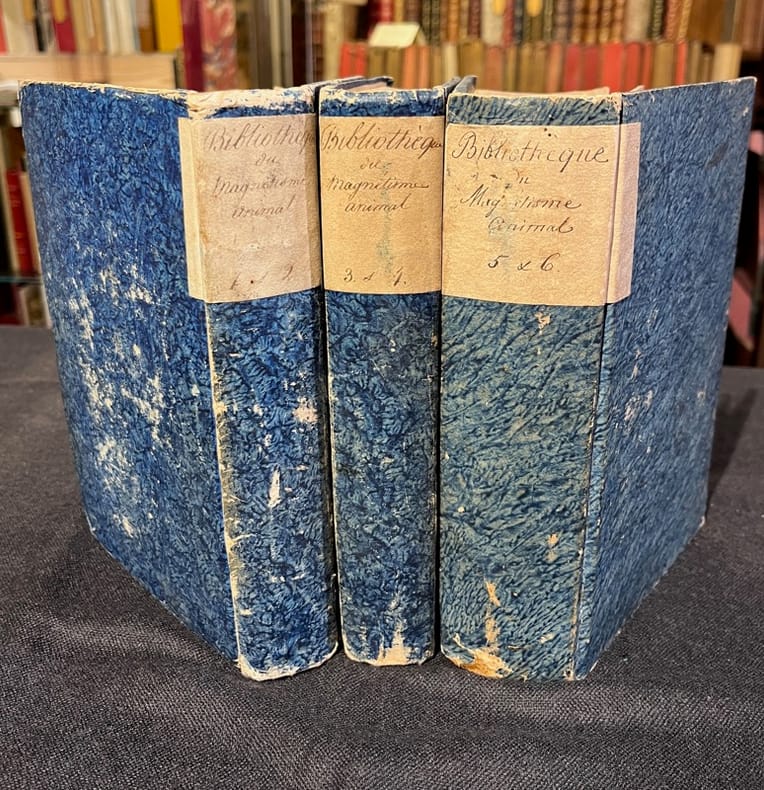
20931A Paris, chez Treutel et Wurtz [puis] J. G. Dentu, 1817 - 1819. 7 tomes reliés en 3 volumes, plein cartonnage de papier à la colle bleu, dos lissse, étiquette de titre manuscrite.
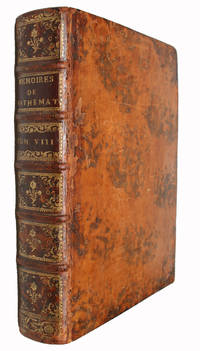
178044929Paris, Moutard, Panckoucke, 1780. 4to. Contemp. full sprinckled calf with 5 raised bands on spine. Richly gilt compartments, title-and tomelabels with gilt lettering. ""Mémoires fe Mathematique et de Physique, Présentés à l'Academie des Sciences par divers Savans"", Tome VIII. XXIV,624 pp., 8 engraved plates a. 52 folded tables. (Entire volume offered). Van Swinden's work: pp. 1-576, 3 folded engraved plates and 52 folded tables.
178044929Paris Moutard Panckoucke 1780. 4to. Contemp. full sprinckled calf with 5 raised bands on spine. Richly gilt compartments title-and tomelabels with gilt lettering. "Mémoires fe Mathematique et de Physique Présentés à l'Academie des Sciences par divers Savans" Tome VIII. XXIV624 pp. 8 engraved plates a. 52 folded tables. Entire volume offered. Van Swinden's work: pp. 1-576 3 folded engraved plates and 52 folded tables. <br/><br/><em>First edition of Van Swinden's large work on magnetism and the function of the compass and the variability of magnetic needles. It also explained the diurnal variation of the earth's magnetic force.In 1767 van Swinden obtained the chair of philosophy logic and metaphysics at Franekar University. He studied all the popular scientific topics of the period especially magnetism electricity meteorolgy and chemistry and corresponded with many leading scientists including Bonnet Euler Deluc J. C. Wilcke Bertholon and Lalande. His Tentamen de magnete 1772 dealt with his mathematical theory of magnetism and in 1777 he and Coulomb shared the gold medal of the Paris Academy of Sciences for a very detailed prize essay on magnetism Recherches sur les aiguilles aimantées. the essay offered.Poggendorff II 1057 </em> hardcover
1834PHO-1353Paris, Arthus Bertrand, 1834. 2 volumes in-8, (4)pp., 399pp.; ( 4), 416pp. , demi-veau havane, dos lisse avec titre, tranches jaunes ,complet des 10 planches qui ont été reliées en fin de tome II, second plat du tome II détachée , sinon bon état.
In 4° (23,8×19 cm); (16), XLVIII, (12), 193, 192, (14) pp. e 32 tavv. f.t. ripiegate e una tabella. 2 parti in un volume. Bella legatura coeva in tutta pergamena rigida con titolo parlato al dorso. First edition, good copy. Frontespizio in rosso e nero. Prima edizione in ottime condizioni di conservazione di questa raccolta illustrata di esperimenti relativi alla misurazione di umidità, pressione atmosferica, la struttura del ghiaccio, caldo e freddo, capillarità, ottica, il movimento del suono, il magnete, ecc. Esemplare con leggerissima ed uniforme brunitura dovuta alla tipica qualità della carta utilizzata a Leida ma non fastidiosa e meno intense che nelle altre copie conosciute e nel complesso bellissimo esemplare. Opera di estrema importanza per la storia della fisica moderna. Qui è presente anche la prima descrizione del pirometro (Pyrometer chiamato così da Musschenbroek), uno strumento per misurare la dilatazione dei corpi solidi quando esposti al calore. Pieter van Musschenbroek (1692-1761), professore di fisica a Leida, fu un grande ammiratore di Newton e Desaguliers. Iniziatore della fisica sperimentale in Olanda, il suo insegnamento fu particolarmente apprezzato per la qualità dei suoi esperimenti. L’eccellenza delle sue lezioni aiutò a mantenere la reputazione che l’Università di Leida aveva acquisito sotto Boerhaave e Gravesande, continuando ad attrarre studenti provenienti da tutta Europa, tra i quali Jean Antoine Nollet che divenne poi il primo professore di fisica sperimentale presso l’Università di Parigi. Il suo nome rimane legato all’invenzione della così detta “bottiglia di Leida” che ebbe un’importanza cruciale sulle ricerche riguardanti l’elettricità. La bottiglia di Leida costituisce la forma più antica di condensatore. Fu utilizzata per condurre molti dei primi esperimenti sull’elettricità durante la seconda metà del XVIII secolo. In questo libro, l’autore, raccoglie e presenta con commenti, integrazioni e spiegazioni diversi esperimenti fisici portati avanti nell’Accademia del Cimento. Il tutto è preceduto da un discorso sulla storia e i fondamenti della fisica sperimentale. L’opera contiene anche la prima traduzione in latino dell’opera del Magalotti “Saggi di naturali esperienze”, fatta dallo stesso Petrus van Musschenbroek che aggiunse ad essa le sue “Oratio de methodo instituendi experimenta physica” i “Commentarii” (o “Additamenta”) e “Nova Experimenta” che contengono importantissime aggiunte e nuove esperienze pratiche mai prima provate. Tra gli esperimenti effettuati molti “deal with the mechanics of rigid bodies, air pressure, heat, cohesion, capillarity, phosphorescence, magnetism, and electricity. Many of these experiments have become classics in elementary instruction. One of the better-known apparatuses is the pyrometer (the name was given by Musschenbroek) first described in the Tentamina of 1731…” (Dict. of Scientific Biogr., vol. 9, pp. 594-6). Prima non comune edizione in ottime condizioni di conservazione. Rare. A good copy. Bibl.: Wellcome Vol. 4 p. 23; Graesse IV, 637 e VI, 218; Wheeler Gift Cat. 276.
9321A Londres, et se trouve à Paris, chez Cailleau, 1785. In-12 de 86 pages, cartonnage de papier marbré, étiquette de titre verticale en maroquin noir. Reliure XXe.
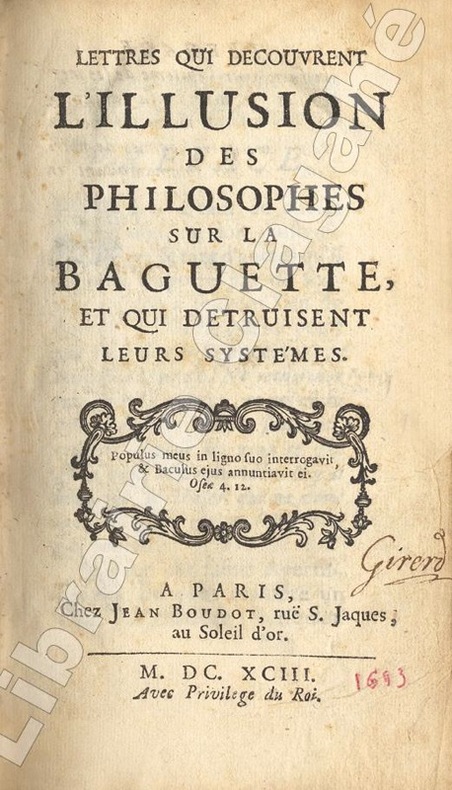
169317622Paris, Boudot, 1693 ; in-12, veau havane, dos à nerfs décoré et doré, roulette sur les coupes (reliure de l'époque) ; (34), 309 pp. , (1) f. blanc, 2 figures hors-texte et 1 in-texte gravées sur cuivre.
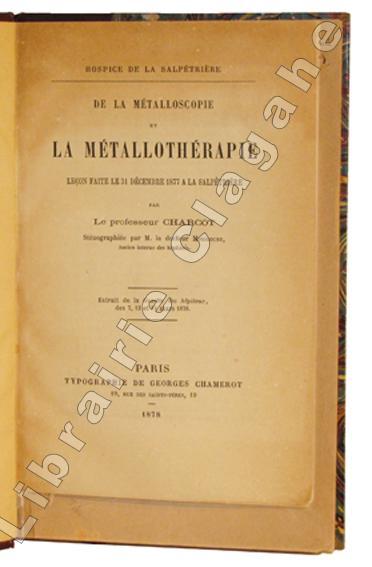
182221) Charcot : Hospice de la Salpêtrière. De la métalloscopie et la métallothérapie. Leçon faite le 31 décembre 1877 à la Salpêtrière par le professeur Charcot. Sténographié par M. le docteur Moricourt. Paris, Chamerot, 1878, 20 pp.2) La métallothérapie dans le service de M. le professeur Verneuil à l’hôpital Lariboisière, par le docteur Burq. Paris, 1877, 30 pp. E.A.S. au docteur Decrane de Moulins.3) Second rapport fait à la Société de Biologie sur la métalloscopie et la métallothérapie du docteur Burq, au nom d’une commission composée de M.M. Charcot, Louys et Dumontpallier, rapporteur (10 août 1878) ; XXXII pp.4) Des origines de la métallothérapie. Part qui doit être faite au magnétisme animal dans sa découverte. Le Burquisme et le Perkinisme, par le Dr V. Burq. Paris, Delahaye et Lecrosnier, 1882, 142, (2) pp. (rousseurs dans ce 4e ouvrage).
18380056141838 Paris, Desessart et Cie, 1838. Deux tomes reliés en un volume in-8 (209 X138 mm) demi-chagrin noir, dos à nerfs surlignés de filets à froid, titre doré (Reliure de l'époque). Tome I : Frontispice, (2) ff. de faux-titre et titre, 327 pages - Tome II : 325 pages, (1) f. de table. L'exemplaire a été relié sans les feuillets de faux-titre et de titre du tome II ni sans le feuillet (pages 39/40) de faux-titre du chapitre IV du tome II "Cuncta supergilio mota". Deux infimes trous de la taille d'une tête d'épingle dans le compartiment inférieur et en bas du mors supérieur, pointes de rousseurs à la gravure ajoutée, trace de colle sur la partie gauche de la page de titre (morceau collé de la gravure), mouillure claire au faux-titre, mention manuscrite à l'encre brune « acheté à Médan - 1862 » en tête du faux-titre, mention à l'encre brune de la même main (ex-libris ?) biffée au verso du faux-titre, trace de cachet encré (ex-libris) effacé en marge latérale de la page de titre.
In-8°; pp. (6), 89, un piccolo legno al frontespizio, un capolettera e una testatina incisi su legno. LEgatura in iena pergamena coeva rigida con tagli in rosso.
180315508Paris, Imprimerie Delonce et Lesueur, an XII, 1803 ; 2 tomes in-8 ; plein veau marbré havane glacé, dos à faux-nerfs torsadés dorés, dos décorés d'un entrelacs de feuillage, fleurons au soleil, étoiles, etc., pièces de titre et de tomaison bronze, tranches mouchetées de rouge (reliure de l'époque) ; (6), XXXIV, 426 ; (4), III, (1 bl.), 447 pp., et en tout 24 planches dépliantes gravées, représentant 157 figures.