813 résultats
DISPONIBILITÀ GARANTITA AL 99%; SPEDIZIONE ENTRO 12 ORE DALL'ORDINE. COME NUOVO, LIEVISSIMI SEGNI DEL TEMPO. RISTAMPA ANASTATICA A TIRATURA LIMITATA. NOSTRO ESEMPLARE N. 0877 DI 2999. Scheda bibliografica Titolo: Ptolemaei Tabulae Cosmographicae Curatore: Bortolami Sante Autore: Claudio Ptolomeo Edizione: Novara, 2001 Editore: Istituto Geografico De Agostini Volumi: 2 Introduzioni: Traduttori: Fabio Orpianesi, Nada Tomain Coordinatore: Alberto Rocci ISBN: 8439591330, 9788439591337 Lunghezza: 400 pagine Facsimile opera 1486 - Studio e Traduzione Soggetti: Carte Geografiche, Tolomeo, Scienza, Cielo, Cosmo, Cosmologia, Tavole, Terra, Centro, Sferica, Pitagora, Parmenide, Anassimandro, Democrito, Platone, Timeo, Rotazione Terrestre, Astronomia, Almagesto, Geografia Matematica, Divulgazione Scientifica, Scienze, Incunaboli, Ristampe anastatiche, Riproduzioni, Libri Rari, Edizioni di Lusso, Edizioni Pregiate, Fuori catalogo, Libri Vintage, Scienze, Rivoluzione astronomica, Mappe, Geographic Maps, Ptolemy, Science, Sky, Cosmos, Cosmology, Tables, Earth, Center, Spherical, Pythagoras, Parmenides, Anaximander, Democritus, Plato, Timaeus, Earth Rotation, Astronomy, Almagest, Mathematical Geography, Scientific Disclosure, Science, Incunabula, Anastatic reprints, Reproductions, Rare books, Luxury, Precious editions, Out of print books, sciences, Astronomical revolution, Maps Descrizione: 40x29 cm., splendida legatura pergamenata, in cofanetto da biblioteca, in seta, con scritte e disegno impressi in oro alle facciate, carte n.n., circa 200, comprese le stupende carta geografiche e i capi-lettera, su carta speciale, testo in latino su 2 colonne; pagg. X, 307 in italiano, quasi tutte con testo su 2 colonne, sempre su carta speciale, edizione di grande pregio, in tiratura limitata, numerata e garantita da apposito certificato notarile e documento stampato su pergamena in apposita busta, esemplare n. 0877/2999, ad personam, in stato di nuovo. Allegata certificazione notarile sull'autenticità della firma. Note: Il volume è una riproduzione facsimile dell'opera Ptolomaei Tabulae Cosmographicae stampata da J. Roger nel 1486 nella città tedesca di Ulma con pagine ricavata da altri incunaboli in migliori condizioni. Per produrlo è stata scelta una carta che, per le sue speciali caratteristiche, si avvicina molto a quella usata dall'incunabolo originale. Per riprodurre anche fedelmente la tinta della carta originale è stato introdotto un colore in più in fase di stampa. Le sbiaditure che compaiono in alcune parti dell'opera sono presenti anche sull'incunabolo originale. " La presente edizione è in 2 volumi con coperta in carta Pergamenata Marina e fregi impressi in oro. Il cofanetto è in tela, realizzato a mano con impressioni in color oro. Il facsimile in latino è realizzato con speciale carta Corolla Bianca di Fedrigoni, stampato a 5 colori per riprodurre la tinta originale della carta e rilegato con antica tecnica artigianale. Tutto il procedimento di braghettatura è rigorosamente manuale".
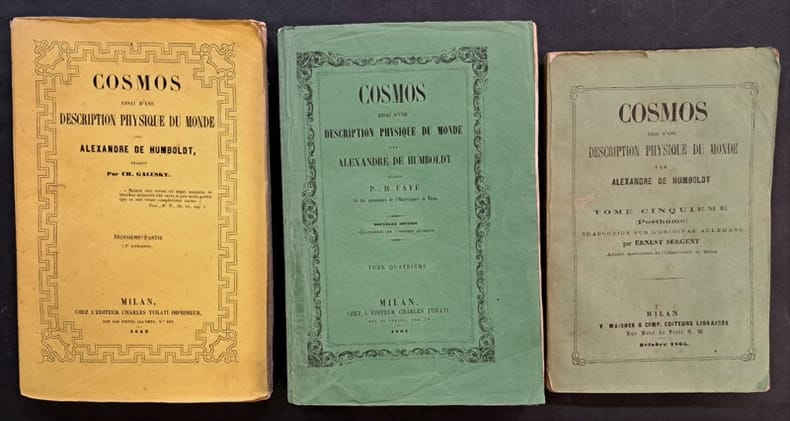
1865127421Milan, chez Charles Turati, Maisner & Comp. 1865 5 tomes en 6 volumes. In-8 22 x 14,5 cm. Brochés, couvertures d’origine, XIX-435-XIII-459-589 p. en continu 2 vol-616-VI-132 pp., Couvertures froissées, rousseurs marginales.
5 vol. in-8, pp. XII, 155; VIII, 164; VIII, 156, VIII, 184; leg. dell'epoca in cartonato marmorizzato. Illustrato con 10 interessanti tavole astronomiche inc. in rame, ripieg. f.t. Prima edizione, completa di questo notevole trattato di astronomia e cosmografia dello Scanelli, nobile canonico e studioso (nato a Forlì nel 1723), costituito da una serie di cento lettere asai interessanti, di cui le prime dieci erano già state stampate nel 1772 col titolo ''Saggio cosmologico'' a seguito di una discussione sulle comete, in riferimento alla cometa del 1669. Bell'esemplare, intonso.. Riccardi, II, 430: «...ben esteso trattato di Astronomia e di Cosmografia, che presenta molta utilità per la storia di queste scienze»..
In 4° antico (cm. 21,9×18,2); pp. [6], 558 + 3 TAVOLE in rame fuori testo, cioè l’antiporta (il Cristo risorto (“egò eimì tò A kai to Oméga”) tra cherubini sovrasta globi terrestri in 7 fasi, dalla “fondazione” (“katabolè”) del cosmo alla formazione dei continenti, alla fiammeggiante eruzione vulcanica generale fino al “compimento” (“tetélestai”), cioè alla trasformazione della terra in Sole + 2 tavole ripiegate (le Americhe con la California staccata dal continente, come si credette fino al 1706, a causa di un romanzo popolare spagnolo del 1510; un Rio delle Amazzoni da Nord verso Sud; e il vecchio mondo; con sistemi orografici sommari, ipotesi sulla profondità dei mari, i Poli incogniti e un continente a sud est dell’Indonesia) e con 16 FIGURE in 12 incisioni perlopiù a piena pagina (tra cui una con un mare contornato da monti e un’isola, e una che mostra diverse profondità del mare). Solida e genuina cartonatura coeva con legacci originali passanti alle cerniere, titolo manoscritto e due antiche etichette con cifra e sigle al dorso. La seconda parte “Libri duo posteriores de CONFLAGRATIONE MUNDI et FUTURO RERUM STATU“ ha un proprio occhiello a carta Y. Archaeologiae philosophicae” (che è una storia delle civiltà e delle filosofie e poi una cosmogonia) ha due propri occhielli alle carte ss2 e lll3. Frontespizio in rosso e nero con vignetta incisa al frontespizio (candela entro nicchia e paesaggio con agricoltori “Aliis inserviendo consumor”). Piccole macchie e alone al margine basso del frontespizio, se no fresco e immacolato ad ampi margini, nelle sue barbe. In fine 4 pagine di appendice sui Bramini indiani. Edizione completa del capolavoro di Thomas BURNET (Croft 1635 - Londra 1715), celebre teologo e cosmologo inglese. Il primo volume fu pubblicato nel 1681 in latino e nel 1684 in inglese, con il titolo di Sacred Theory of the Earth. Spiega i fenomeni geologici interpretando la Bibbia e cercando di armonizzarla con teorie emergenti, come quelle di Cartesio, Locke ecc.; in 4 libri (A. 1. De Diluvio, & Dissolutione Terrae. 2. De Tellure Primigenia & de Paradiso. B. De Conflagratione Mundi et de Futuro Rerum Statu. 3. De Conflagratione. 4. De Novis Coelis & Nova Terra ac de Beato Seculo sive de Mundo Renovato & Rerum omnium Consummatione) + Archaeologiae philosophicae” (1. storia delle civiltà e delle filosofie e 2. cosmogonia). Intrattenne una corrispondenza con Leibniz; nel 1680 inviò il manoscritto di quest’opera a Newton, che apprezzò l’interpretazione non letterale dei sei giorni della creazione e suggerì un impulso divino a un moto accelerato del globo fino all’attuale velocità di rotazione; e qualche obbiezione (R. S. Westfall, Newton. Vol. 1. P. 407). Alcune ipotesi (per es. la terra liscia solidificata emergente da un caos uniforme, cava e piena d’acqua, la Caduta dell’Uomo considerata come simbolica, spunti millenaristici ecc.) apparvero inaccettabili ai teologi suoi contemporanei e fu messa all’Indice dei Libri Proibiti nel 1739 (cfr. Mirella Pasini, Thomas Burnet. Una storia del mondo tra ragione, mito e rivelazione. Firenze, La Nuova Italia, 1981). Influenzò Coleridge. La catena montuosa della Luna “Dorsa Burnet” prese il nome da lui. Opera molto curiosa e particolarmente ricercata.
Davies, Paul (autore)Cannillo, Tullio (traduttore) Una fortuna cosmica : la vita nell'universo: coincidenza o progetto divino. Milano, Mondadori 2007, 367 p. : ill. ; 23 cm. Ottimo (Fine) . <br> <br> rigida <br> 367<br> 9788804571674
Ediz. originale. In-4°; pp. xxxii, 232, il testo è entro cornice a doppio filetto. Legatura coeva in cartonato colorato, tagli spruzzati in rosso.. Piccolo timbro di collezione al frontespizio. Giuseppe Lavini (1721-1793) canonico e letterato, espone in questa originale opera in versi il sistema di Newton relativo all’attrazione dei corpi e in particolar modo dei corpi celesti. L’opera si compone di una dedica a Vittorio Amedeo di Savoia, alcune lettere, la prefazione, 60 sonetti e le Annotazioni ai sonetti, che essendo in prosa contengono più estese spiegazioni scientifiche di geologia, cosmologia, geometria, vulcanologia ecc, e riferimenti ai maggiori scienziati tra cui Kircher, Keplero, Galilei. Chiude “l’Indice de capiversi de’ sonetti e di quello che trattano”, e “l’Indice delle materie notabili e degli autori citati”
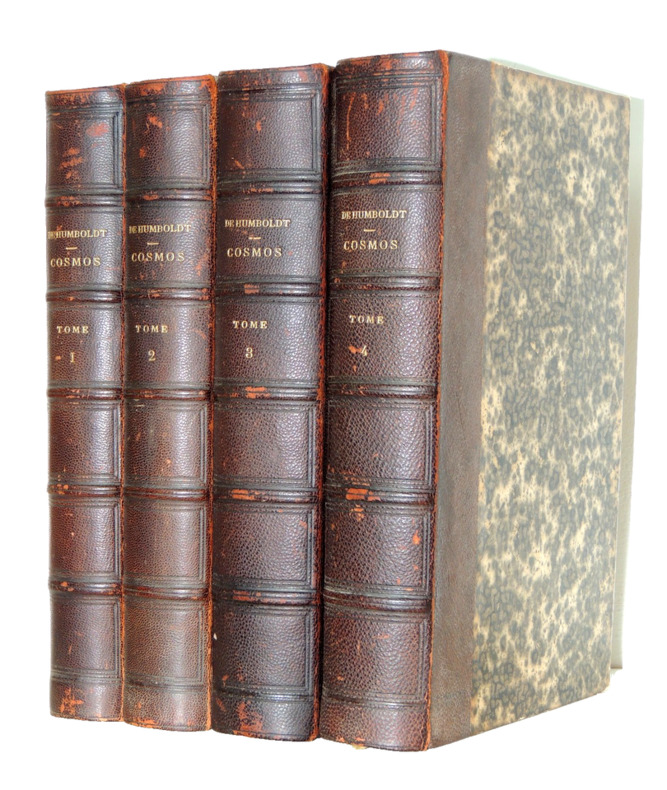
1855CZC-13717Préface : "j'offre à mes compatriotes, au déclin de ma vie, un ouvrage dont les premiers aperçus ont occupé mon esprit depuis un demi-siècle . souvent je l'ai abandonné, doutant de la possibilité de réaliser une entreprise trop téméraire: toujours et imprudemment peut-être, j'y suis revenu et j'ai persisté dans mon premier dessein, j'offre le cosmos, qui est une description physique du monde. les unités de mesure, adoptées dans cet ouvrage sont les unités légales en France . volume spécialement destiné à compléter la partie uranologique du cosmos " Vol. I : Introduction. Le ciel. La Terre. Vie organique. Vol. II : 1re partie : Reflet du monde extérieur dans l'imagination de l'homme - 2e partie : Essai historique sur le développement progressif de l'idée de l'univers. Vol. III (en 2 tomes) : Partie uranologique de la description physique du Monde. Traduit par H. Faye, et Ch. Galusky ( IV), complet en 4 volumes fort in8, demi cuir, 22x14cm, frottements, bel état intérieur, qq rousseurs éparses, 580, 806, 764 et 801pp. Rare Paris, Gide et Baudry 1855-1859
1855CZC-13717Préface : "j'offre à mes compatriotes, au déclin de ma vie, un ouvrage dont les premiers aperçus ont occupé mon esprit depuis un demi-siècle . souvent je l'ai abandonné, doutant de la possibilité de réaliser une entreprise trop téméraire: toujours et imprudemment peut-être, j'y suis revenu et j'ai persisté dans mon premier dessein, j'offre le cosmos, qui est une description physique du monde. les unités de mesure, adoptées dans cet ouvrage sont les unités légales en France . volume spécialement destiné à compléter la partie uranologique du cosmos " Vol. I : Introduction. Le ciel. La Terre. Vie organique. Vol. II : 1re partie : Reflet du monde extérieur dans l'imagination de l'homme - 2e partie : Essai historique sur le développement progressif de l'idée de l'univers. Vol. III (en 2 tomes) : Partie uranologique de la description physique du Monde. Traduit par H. Faye, et Ch. Galusky ( IV), complet en 4 volumes fort in8, demi cuir, 22x14cm, frottements, bel état intérieur, qq rousseurs éparses, 580, 806, 764 et 801pp. Rare Paris, Gide et Baudry 1855-1859
173450434Dresden et Leipzig, Frederik Hekelius, 1734. Folio. Contemp. full mottled calf. Upper half of spine rebacked. Raised bands. Lower part of spine gilt. A crack to leather at lower part of fronthinge, cover not loose. Engraved portrait. (16),452 pp. and 28 engraved plates on 26 sheets. A dampstain in upper part of inner margins throughout, otherwise clean and wide-margined. The plates with some browning.
173450434Dresden et Leipzig Frederik Hekelius 1734. Folio. Contemp. full mottled calf. Upper half of spine rebacked. Raised bands. Lower part of spine gilt. A crack to leather at lower part of fronthinge cover not loose. Engraved portrait. 16452 pp. and 28 engraved plates on 26 sheets. A dampstain in upper part of inner margins throughout otherwise clean and wide-margined. The plates with some browning. <br/><br/><em>Scarce first edition of Swedenborg's main scientific work. The volume also form part one of his "Opera Philosophica et Mineralia"."In his Principia rerum naturalium Leipzig 1734 probably conceived as a counterpart to Newton’s Principia he sought a comprehensive physical explanation of the world based on mathematical and mechanical principles. While remaining faithful to the general principles of Cartesian natural philosophy which he had learned while studying at Uppsala Swedenborg elaborated upon them. According to his cosmogony the physical reality has developed from the mathematical point which was an entity between infinite and finite. Through a vortical movement implanted on the point a series of material particles developed the "first finiata "the second finita"and so on that eventually led to the cosmos in its present state. In contrast to Descartes Swedenborg believed that the planets had developed from the chaotic solar mass through expansion of its surrounding shell which finally joined to form a belt along the equatorial plane of the sun. It then exploded forming the planets and the satellites. Although the basic construction of Swedenborg’s thought heralded the later planetary theories of Buffon Kant and Laplace there is nothing to indicate that it exerted any direct influence on posterity." DSB.In 1738 Swedenborg's magnum opus was placed on the "Index Librorum Prohibitorum". </em> hardcover
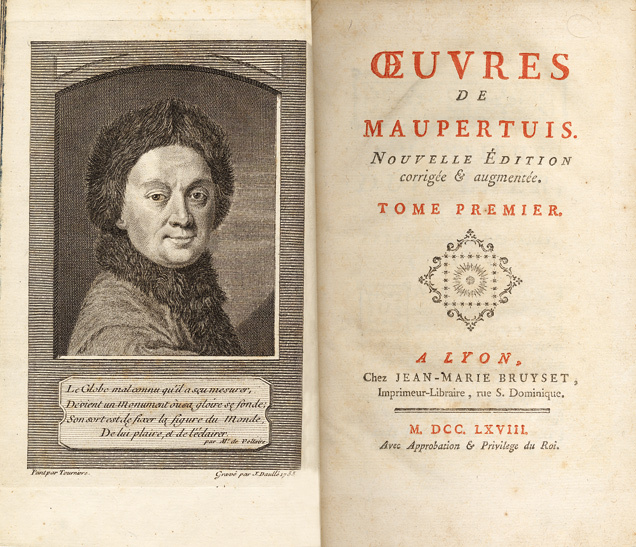
176815501Lyon, Jean-Marie Bruyset, 1768 ; 4 tomes in-8 ; veau fauve marbré, dos à faux-nerfs, décorés et dorés, pièces de titre et de tomaison grenat, filet doré sur les coupes, tranches marbrées (rel. de l'époque) ; (4) faux-titre et titre en rouge et noir à chaque tome ; XXXVI, 309, (3) pp. ; IV, 431 pp., (1 bl.), (1) f. blanc ; IV, 468, (4) pp. ; VIII, (12), 346, (4) pp., nombreuses figures ; portrait en frontispice gravé par J. Daullé d'après Tournière et carte hors-texte de l'arc méridien mesuré au cercle polaire au Tome 3.
In -folio, due voll. legati assieme; pp. (68), 504, (4); (40), 334, (2). Legatura in piena pelle alle armi di Felipe Ramirez Nuñez de Guzmán de Medina, nervi e titolo al dorso. Questa di Basilea del ’32 è considerata l’ultima e migliore edizione nel Cinquecento in latino delle Genealogie [...] che si deve all’umanista strasburghese Jakob Moltzer. Notevoli le illustrazioni genealogiche a piena pagina in quest’opera che, in vita, diede fama a Boccaccio, i cui lavori in volgare erano considerati una produzione minore. Rilegato con i Saturnalia e il commentario al Somnium Scipionis, le due maggiori opere di Macrobio nell’edizione di Camerario. Numerose illustrazioni nel testo fra cui l’incisione del planisfero macrobiano, diviso in zone climatiche, che costituì per circa un millennio il modello geografico terrestre: nella prima riproduzione a stampa di questa mappa, del 1483, le linee climatiche erano dritte, qui per la prima volta sono curve e rimandano a un modello di terra sferica e non piatta. This Basilea 1532’s edition is considered the last and the best latin edition in XVI century of “Genealogie”: it’s due to austrian scholar Jakob Moltzer. The full page genealogic illustrations are remarkable; this work gave a reputation to Boccaccio while he was still alive, and whose works in volgare were then considered a less important production. Bound with the “Saturnalia” and commentary to “Somnium Scipionis”, the most important Macrobio’s works in Camerario edition. Many illustrations in text: between them the macrobian world map, divided in climatical areas, that was for about 1000 years the geografic Earth pattern: in the first printed reproduction of this map, from 1483, the climatical lines were straight, while here they are bent and they suggest a spheric Earth model.
5 voll. Folio. viii pp. (incl. frontespizio inciso) + 596 + 607–638; + 252 (ultima carta bianca); + 244 + 84 + 184 (ultima carta bianca); + viii + 340 (ultima carta bianca) + 348 + xx (ultima carta bianca); + viii + 552 + xii + 60 + 244; + xii + 624 (ultima carta bianca) + 124 (ultima carta bianca) + 60 + 20 + 24 pp. Numerosi legni e diagrammi nel testo. Legatura in pelle coeva, dorso dorato. Bruniture omogenee della carta. The evidence of the attempts to leave the Aristotelianism for the modern method and an important proof of the Galileian revolution.Clavius's work includes in addition to commentary on arithmetic and algebra one on Euclid, Teodosio and Sacrobosco; his contribution to the study of trigonometry and astronomy; his work on the calendar. Clavius has been for mathematics in Renaissence a real turning point: “Probably the man who did the most of all the German scholars of the 16th century to extend the knowledge of mathematics… was Cristopher Clavius, a Jesuit, who passed the later years of his life in Rome. He was an excellent teacher… His Algebra appeared in 1608 and was one of the best textbooks on the subject that had been written up to that time… (he was) engaged in the reform of the calendar…” (Smith). Opera Mathematica in his third volume contains the Sphaera in his last editorial, to which Clavius worked during 1610 and which was printed in 1611. Shortly thereafter, in February 1612, Clavius was dying after a period of illness. In March 1610 following his comments on the telescope, Galileo published in Sidereus Nuncius his latest astronomical discoveries. These findings, perhaps only for a lucky snap of dates, are among the topics covered in the review of Sphaera, where Clavius shows to recognize the meaning. Clavius and the Jesuits in those years had to go back to seriously consider the observations of Galileo, and had to acquire the telescope also to repeat the observations and then verify their accuracy. Clavius led directly the observations (especially on the phases of Venus and the moons of Jupiter, but also on the lunar spots) along with a group of young Jesuit mathematicians and astronomers, first of all Grienberger, thus removing, towards the end of his life and following a long friendship with Galileo, his skepticism about the Copernican theory. Galileo himself in a letter to Madame Christina of Lorraine in 1615 wrote that “altri matematici, i quali mossi da gli ultimi miei scoprimenti, hanno confessato essere necessario mutare la già concepita costituzione del mondo, non potendo in conto alcuno più sussistere”. Galilei continues that one of them was just Clavius, and the reference is certainly to the pitch of the Opera Mathematica Tomo III, p. 75, where as the result of the list of Galileo's discoveries, the Jesuit ends “Quae cum ita sint, videant Astronomi quo pacto orbes coelestes constituendi sint ut haec phaenomena possint salvari”. It 's an extraordinary moment in the history of cosmology and Church, which has marked the highlight of the heliocentric theory, which no major scientists, mathematicians and astronomers of the Society of Jesus, thought no more be able to object. As D'Elia notes (pp. 14-15): "The confirmation from him on the discoveries of the astronomer from Pisa and on the copernican interpretation he deduced, had definitive influence and perhaps even dominate, to ensure the discoveries the almost universal acceptance in the intellectual world, even if the disappearance of the old professor and that of several of his closest disciples could not prevent the ecclesiastical Authority’s precept of 1616 and the condemnation of 1633 ". Clavius had even got that Galileo was received at the Roman College, and was himself to "explain" to Cardinal Bellarmine scientific discoveries of Galilei. So while the academic and obviously ecclesiastical circles did not leave officially by the Aristotelian position, a scientist of them, for evidence and intellectual honesty, was preparing the way for the acceptance of Galileo's discoveries, and could do so given the authority of his position, achieved mainly thanks to its capital contribution asked by Gregory XIII to reform the Julian calendar, which led to the drafting of the Gregorian Calendar. Christoph Clavius (Bamberg 1538-1612) Jesuit and mathematician, astronomer, he entered the Jesuit College in Rome in '55 and then went to Coimbra, where he studied mathematics and science; back to Rome to study theology, he remained as a professor for fortyfive years. He became a pivotal figure for the general mathematical and scientific renewal that had in the Compagnia di Gesù a driving force, entering into the main controversies of the time, from the squaring of the circle to the comparison between the Ptolemaic and Copernican theories. He was the master, among other things, of Matteo Ricci, who with the help of his students, translated many works of Clavius in China, including the six books of Euclid's Elements (1574), which had several editions and updates; a work who had an enormous influence, providing a compendium of knowledge on geometry. His other important works were the Commentaries on Sphaera di Sacrobosco, a treatise on spheres’ geometry and astronomy, and work on the astrolabe. He determined the subsequent development of algebra. De Backer & Sommervogel, 2, cols. 1222–3 (with details of contents). DSB, 3, pp. 311–2. D’Elia, Pasquale, Galileo in Cina, Roma, Università Gregoriana, 1947. Jardine, Nicholas. "The Forging of Modern Realism: Clavius and Kepler against the Sceptics." Studies in History and Philosophy of Science 10 (1979): 141-73. Lattis, James M. Between Copernicus and Galileo: Christoph Clavius and the Collapse of Ptolemaic Cosmology. Chicago: University of Chicago Press, 1994 Proceedings of the Symposium on Christoph Clavius (1538–1612), July 21, 2005, University of Notre Dame, Edited by Dennis Snow. D. E. Mungello, Curious land. Jesuit accomodation and the Origins of Sinology, 1985, p. 26. Eberhard Knobloch, Christoph Clavius – Ein astronom zwischen Antike und Kopernikus”, in Cvortrage des ersten Symposions des Bamberger Arbeitskreises Antike Naturwissenschaft und ihre Rezeption, 113-40, Wiesbaden, 1990.