773 résultats
Original Publishers Cloth. 8vo. Xxvii, 285 p. Ages. [1] leaf of plates. Illus. 24 cm. Series: International studies of the Committee on International Relations, University of Notre Dame. Contents: Introduction. ; Philip E. Mosely's contribution to the comparative study of family /; Margaret Mead. ; Philip E. Mosely and his work, analyses of Mosley. ; Philip E. Mosely /; Leonard B. Schapiro --; Mosely on the zadruga /; Stavro Skendi. ; Philip E. Mosely and his work, Mosely on the family, especially the zadruga. ; The peasant family : the zadruga, or, communal joint-family in the Balkans and its recent evolution ; ; Adaptation for survival : the Varzic zadruga ; ; The distribution of the zadruga within southeastern Europe ; ; The Russian family, old style and new /; Philip E. Mosely. ; Philip E. Mosely and his work, the published work of Philip E. Mosely. ; Bibliography of books and articles. ; Historical and sociological studies of the zadruga. ; Some medieval evidence on the Servian zadruga : a preliminary analysis of the chrysobulls of Decani /; Eugene A. Hammel --; The zadruga and the contemporary family in Yugoslavia /; Olivera Buric --; The Romanian communal village : an alternative to the zadruga /; Daniel Chirot. ; The zadruga, past and present : some illustrations. ; A zadruga in Bileca Rudine /; Wayne Vucinich --; The Tomasevic extended family on the peninsula of Peljesac /; Jozo Tomasvich --; The democratice spirit of the Poljica commune /; Ante Kadic --; Time and form : contemporary Macedonian households and the zadruga controversy /; David B. Rheubottom --; The cultural ecology of Albanian extended family households in Yugoslav Macedonia /; C. J. Grossmith --; The last big zadrugas : Albanian extended families in the Kosovo Region /; Vera St. Erlich --; The zadruga community : a phase in the volution of property and family in an Agrarian Milieu /; Emile Sicard. Nice, clean copy in very good condition. (SEF39-13)
DJ spine sunned. ; We often think of classical Greek society as a model of rationality and order. Yet as Walter Burkert demonstrates in these influential essays on the history of Greek religion, there were archaic, savage forces surging beneath the outwardly calm face of classical Greece, whose potentially violent and destructive energies, Burkert argues, were harnessed to constructive ends through the interlinked uses of myth and ritual. For example, in a much-cited essay on the Athenian religious festival of the Arrephoria, Burkert uncovers deep connections between this strange nocturnal ritual, in which two virgin girls carried sacred offerings into a cave and later returned with something given to them there, and tribal puberty initiations by linking the festival with the myth of the daughters of Kekrops. Other chapters explore the origins of tragedy in blood sacrifice; the role of myth in the ritual of the new fire on Lemnos; the ties between violence, the Athenian courts, and the annual purification of the divine image; and how failed political propaganda entered the realm of myth at the time of the Persian Wars. ; 0.63 x 9.32 x 6.3 Inches; 152 pages
Vortrag, gehalten an den Mentorenabend der Carl Friedrich von Siemens Stiftung in München-Nymphenburg am 21. November 1983. Mentor des Abends was Professor Dr. Phil. Christian Meier, Ordinarius für Alte Geschichte, Ludwig-Maximilians-Universität München; Carl Friedrich Von Siemens Stiftung - Themen XL; 63 pages
Dustjacket has edgewear with light chipping and 1 small closed tears. Scholars' bookplate to inner cover else Fine. ; 272 pages; Sacrifice--ranging from the sacrifice of virgins to circumcision to giving up what is most valued--is essential to all religions. Could there be a natural, even biological, reason for these practices? Something that might explain why religions of so many different cultures share so many rituals and concepts? In this extraordinary book, one of the world's leading authorities on ancient religions explores the possibility of natural religion--a religious sense and practice naturally proceeding from biological imperatives. Because they lack later refinements, the earliest religions from the Near East, Israel, Greece, and Rome may tell us a great deal about the basic properties and dynamics of religion, and it is to these cultures that Walter Burkert looks for answers. His book takes us on an intellectual adventure that begins some 5,000 years ago and plunges us into a fascinating world of divine signs and omens, offerings and sacrifices, rituals and beliefs unmitigated by modern science and sophistication. Tracing parallels between animal behavior and human religious activity, Burkert suggests natural foundations for sacrifices and rituals of escape, for the concept of guilt and punishment, for the practice of gift exchange and the notion of a cosmic hierarchy, and for the development of a system of signs for negotiating with an uncertain environment. Again and again, he returns to the present to remind us that, for all our worldliness, we are not so far removed from the first Homo religiosus.
Scholar's bookplate to ffep (G. P. Goold). Foxing/dustsoiling to top of textblock. Laminate lifting in places from DJ. A couple of tears and yellowing to DJ. ; Die Religionen Der Menschheit ; Bd. 15; 508 pages
Foxing/dustsoiling to top of textblock. Scholar's bookplate to inner cover (G. P. Goold). ; Religionsgeschichtliche Versuche Und Vorarbeiten Bd. XXXII; 356 pages
Upper corners a bit bumped. Lower corners slightly edgeworn. Minor darkening to boards. Very minor bumping along top edges. ; 545 pages
Inner hinges are broken and crudely repaired with brown tape. Bumping to last pages with creasing through upper corners. Upper corners bumped. ; Very heavy. ; University De Paris, Faculte Et Sciences Humaines; 4to 11" - 13" tall; 694 pages
2 vols Rebound in 1/4 leather boards with green boards and gitl lettering. Spine cover has pieces missing along lower section and some tears and chipping to leather spine. Scholars' bookplate to inner cover (Slater & Dunbabin) along with additional bookplate. A few tears along joints of spine cover. ; 2 books bound in 1 volume. Bruchmann (1893) 226 pp; Carter (1902) 154 pp ; Ausführliches Lexikon Der Griechischen Und Römischen Mythologie: Supplement; 226 pages
Dustjacket is protected in mylar. Light soiling to textblock. The first 20 pages are creased but with no loss to text else VG. Adhesives stain to front free-page. ; 256 pages; Julian is called by Christians "The Apostate" because they believe he converted from Christianity to Paganism. He himself, as attested to in private letters between him and the Rhetorician Libanius, had Christianity forced on him as a child by his cousin Constantius II, who was a zealot Christian and would have not tolerated a pagan relative, but Julian had never really accepted any religion until his reading of the Homeric poems, some of the most important texts for the Greek religion. After this conversion to Hellenism he devoted his life to protecting and restoring the fame and security of this more ancient tradition as well as other religious traditions such as Judaism from Christian persecution. After gaining the purple, Julian started a religious reformation of the state, which, in his intentions, was to give back its lost strength to the Roman State. He supported the restoration of the old Roman faith, based on polytheism. Julian reduced the influence of Christian bishops in public offices. The lands taken by the Church were to be returned to their original owners, and the bishops lost the privilege to travel for free, at expenses of the State.
General shelfwear. ; Thesis in Dutch. ; 293 pages
Sunning to part of rear board and spine. Very faint shelfwear. ; Oversized. ; Deutsches Archäologisches Institut; 4to 11" - 13" tall; 56 pages
V1: small chip to fore-edge of front wrap. Very minor shelfwear else fine. Pages unopened. V2: portfolio of maps. Portfolio cover has some edgewear but maps are fine. ; V1: TEXTE: A-Q pages of plates/planches at rear. V2: ATLAS: maps are present and complete. ; Collection Latomus Volume 129. 2 Volume Set COMPLETE; 363 pages
192985493Librairie Bloud & Gay, coll. « Bibliothèque Catholique des Sciences Religieuses » 1929 In-12. Broché, couverture imprimée, 200 pp.
Very minor shelwfear to book. DJ has 1 tiny tear. ; Edinburgh Leventis Studies 5; 448 pages; The Greek gods are still very much present in modern consciousness. Although Apollo and Dionysos, Artemis and Aphrodite, Zeus and Hermes are household names, it is much less clear what these divinities meant and stood for in ancient Greece. In fact, they have been very much neglected in modern scholarship. This book brings together a team of international scholars with the aim of remedying this situation and generating new approaches to the nature and development of the Greek gods in the period from Homer until Late Antiquity. The book looks at individual gods, but also asks to what extent cult, myth and literary genre determine the nature of a divinity. How do the Greek gods function in a polytheistic pantheon and what is their connection to the heroes? What is the influence of philosophy? What does archaeology tell us about the gods? In what way do the gods in Late Antiquity differ from those in classical Greece? This book presents a synchronic and diachronic view of the gods as they functioned in Greek culture until the triumph of Christianity.
Tear to cloth at base of spine (~2cm) . Bottom corners are bumped. DJ has tears and chipping but intact. ; Nuovi Saggi, 21; 409 pages
Scholars' bookplate to ffep. Very light edgewear. Pages slightly toned. ; Albae Vigiliae Neue Folge, Heft VII; 120 pages
Foxing to textblock and endpapers. Faint creasing to front wrap. ; 5.5 X 0.2 X 0.2 inches; 206 pages
Scholar's small bookplate to ffep (R. E. Fantham). Faint creasing to first few pages. Very light soiling to textblock. DJ has light creasing along top edge with creasing to DJ front flap. ; This collection of essays examines the tradition associated with the ancient Cynics. The contributors to this volume - classicists, comparatists and philosophers - draw on a variety of methodologies to explore the ethical, social and cultural practices inspired by the Cynics. ; Hellenistic Culture and Society; 8vo 8" - 9" tall; 465 pages
Book is fine. DJ has very light shelfwear. ; This collection of essays examines the tradition associated with the ancient Cynics. The contributors to this volume - classicists, comparatists and philosophers - draw on a variety of methodologies to explore the ethical, social and cultural practices inspired by the Cynics. ; Hellenistic Culture and Society; 8vo 8" - 9" tall; 465 pages
Minor shelfwear to boards. Ex-library copy with usual stamps, call numbers and pocket. ; Contents: Previous Work on the Hymn-Cycles; The subject-matter of the Hymn-Cycles; The Goal of the Departed Spirit and the Identity of the Saviour; The Manuscripts; The Reconstruction of the Text; Some Remarks on Authorship and Style; Versification; The Texts: List of Fragments; Huwidagman; Angad Rosnan; The Unidentified Fragments; Additional Note on the Manuscripts. ; London Oriental Series Volume 3; 199 pages; Includes 4 photographic plates of the manuscripts at end.
Scholar's blindstamp to ffep and bookplate to inner cover (Robert Brown). Staining to top of spine. Some tears to wraps especially at base of spine. Some creasing to wraps. Light pencil marginalia. ; Les Grands Penseurs; 348 pages
This book provides an exploration of the Oracle of Apollo at Delphi, where the god Apollo was believed to speak to inquirers through his priestesses. In particular, it examines Athens' use of the oracle c. 500-300 BC. Demonstrating the importance of communication with the gods, and doing their will, in classical Athenian society, Hugh Bowden concludes that ancient Athens was not a secular Westernized democracy as we understand the term today. ; 8.4 X 5.4 X 0.6 inches; 206 pages
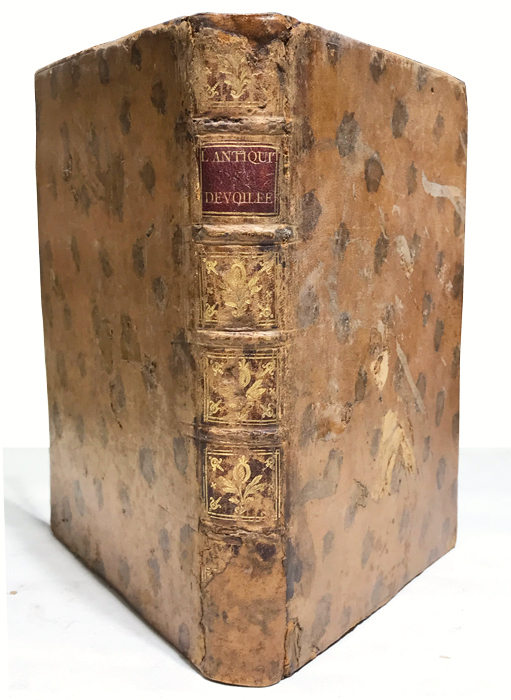
17663142Amsterdam, Marc Michel Rey, 1766 ; in-4 ; plein veau fauche tacheté, dos à nerfs décoré, pièce de titre bordeaux, tranches rouges cirées (reliure de l'époque) ; VIII pp., 412 pp.
Foxing/dustsoiling to top of textblocks with faint foxing passim. Scholar's bookplate to inner covers (G. P. Goold). Faint soiling to boards. ; Reprint of 1879-82 edition ; Roman History Series 4 Vols In 2; Vol. 1/4/2022; 9.3 X 6.8 X 3.5 inches; 1616 pages