773 résultats
xvi + 385pp., in the series "Studien und Texte zu Antike und Christentum. Studies and Texts in Antiquity and Christianity" vol.3, text in English, 23cm., softcover, previous owner's name on first title page, else in very good condition, R101117
Ex-library copy with usual stamps, call numbers and pocket. Corners are bumped. ; Contents: Pictures of pre-Roman religion; Orpheus in Italy; The Etruscan influence on Roman beliefs; Breaking through the maze; Modern problems in the eyes of an Augustan poet; The road to Christmas. ; 150 pages
Some light creasing to DJ. ; In this sumptuously illustrated book, Joan Breton Connelly gives us the first comprehensive cultural history of priestesses in the ancient Greek world. Connelly presents the fullest and most vivid picture yet of how priestesses lived and worked, from the most famous and sacred of them--the Delphic Oracle and the priestess of Athena Polias--to basket bearers and handmaidens. Along the way, she challenges long-held beliefs to show that priestesses played far more significant public roles in ancient Greece than previously acknowledged. Connelly builds this history through a pioneering examination of archaeological evidence in the broader context of literary sources, inscriptions, sculpture, and vase painting. Ranging from southern Italy to Asia Minor, and from the late Bronze Age to the fifth century A. D. , she brings the priestesses to life--their social origins, how they progressed through many sacred roles on the path to priesthood, and even how they dressed. She sheds light on the rituals they performed, the political power they wielded, their systems of patronage and compensation, and how they were honored, including in death. Connelly shows that understanding the complexity of priestesses' lives requires us to look past the simple lines we draw today between public and private, sacred and secular. The remarkable picture that emerges reveals that women in religious office were not as secluded and marginalized as we have thought--that religious office was one arena in ancient Greece where women enjoyed privileges and authority comparable to that of men. Connelly concludes by examining women's roles in early Christianity, taking on the larger issue of the exclusion of women from the Christian priesthood. This paperback edition includes additional maps and a glossary for student use.; 10.1 X 7.4 X 1.3 inches; 415 pages
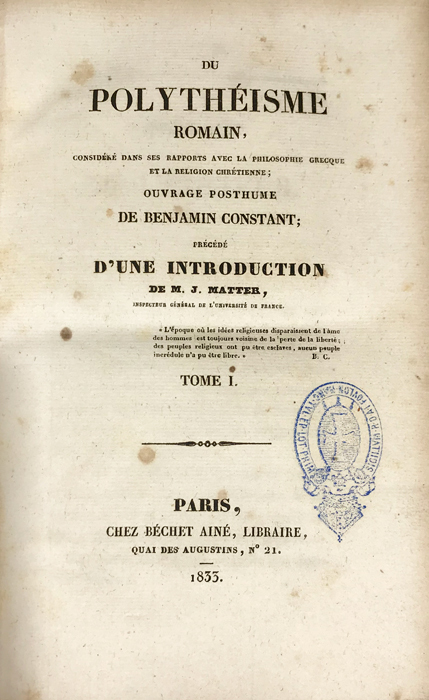
18333556Paris, Béchet Ainé, 1833 ; deux tomes reliés en un volume in-8, demie-basane fauve, dos à nerfs décorés, grandes pièces de titre et tomaison rouges (reliure de l’époque) ; (2) ff., LIX pp., 283 et 384 pp. ; précieuse table alphabétique et analytique.
3663P. Lethielleux, Editeur, 1938, broché , 14x23 cm, 346 pages.
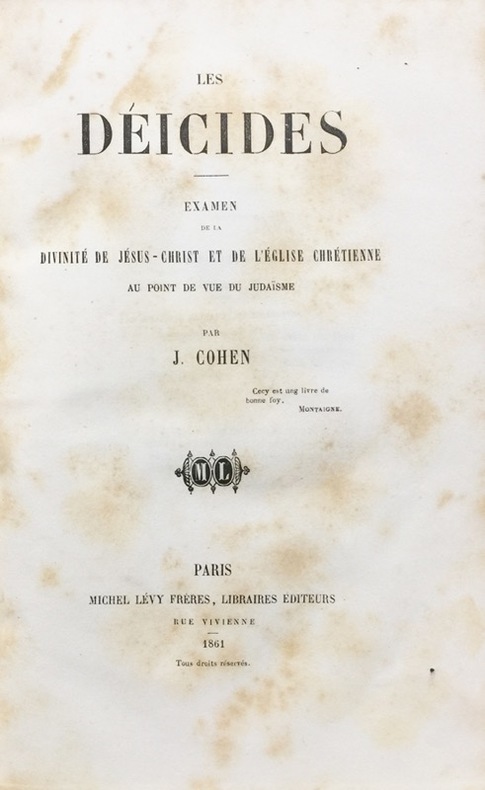
18615184Paris, Michel Lévy Frères, 1861 ; in-8 ; demi-chagrin vert sapin, dos à nerfs, caissons décorés et dorés, titre doré (reliure de l'époque) ; (4), 399 pp.
In verbindung mit Franz Babinger, Leo Baeck, Heinrich Hackmann, F.E.A.Krause, Karl H. Meyer, Friedrich Pfister, Günther Roeder, Albert Schott, Franz Rolf Schroeder, Erich Seeberg, Otto strauss. Dargestellt von Carl Clemen. with 135 illustrations, mostly photographic, in the text; bound in publ. cloth; cloth sl. marked, minimal wear to extremities, tears to the edges of the opening and closing few pages. *This distinguished collection of essays on world religions and their ancient origins includes studies of Babylonian, Ancient Egyptian, Indian, Ancient Greek, Roman, Celtic, Germanic, Buddhist, Jewish, Islamic and early Christian beliefs.
Ex-library copy with usual stamps, call numbers and pocket. Spine and part of wraps are taped. Highlighting to about 10 pages. Fair to good condition. ; 246 pages; Traces the development of the theme of "Descent into the Underworld," or what the Greeks called "Catabasis," from the Near East through its long career in Greek and Roman literature and cult as a background of Vergil's cumulative and innovative version of the "Descent of Aeneas" in the Sixth Book of the Aeneid and to pinpoint more fully than hitherto Vergil's originality in his use of the theme.
Hard bump to 1 corner. Small corrections in pen to about 8 pages by R. E. Fantham. Light shelfwear to DJ. ; This book explores an aspect of how Romans thought about themselves. Its subject is 'divine qualities': qualities like Concord, Faith, Hope, Clemency, Fortune, Freedom, Piety, and Victory, which received public cult in Rome in the Republican period. Anna Clark draws on a wide range of evidence (literature, drama, coins, architecture, inscriptions and graffiti) to show that these qualities were not simply given cult because they were intrinsically important to 'Romans'. They rather became 'Roman' through claims, counter-claims, appropriations and explorations of them by different individuals. The resources brought into existence by cult (temples, altars, coin images, statues, passwords, votive inscriptions) were visible and accessible to a broad range of people. Divine qualities were relevant to a broader social spectrum than is usually recognized, and this has important consequences for our understanding of Roman society. ; Oxford Classical Monographs; 380 pages
Light scratches to rear panel with minor edgewear to wraps. Light soiling to ffep. ; Text is Greek with short abstracts in English. ; 200 pages
Very light shelfwear. ; Sammlung Vandenhoeck; 295 pages
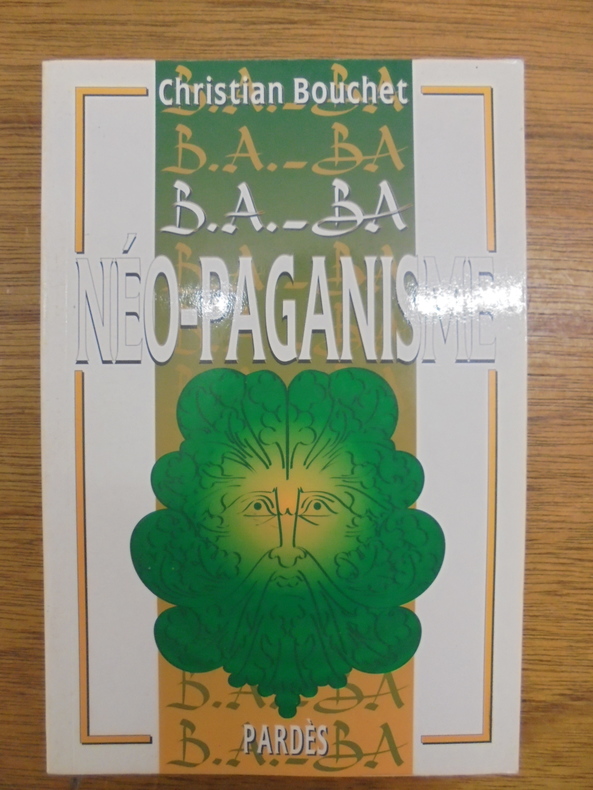
2003REL1102MPardès, 2003.Broché, 127pp. In-12°
1784140108à Paris, chez Laporte, Imprimeur-Libraire, M. DCC. LXXXIV 1784 In-16 15 x 7,5 cm. Reliure de l’époque veau havane marbré, dos lisse orné de fers dorés, pièce de titre maroquin grenat, VI-427 pp. Exemplaire en bon état.
Epic and tragedy, from Homer's Achilles and Euripides' Pentheus to Marlowe's Tamburlaine and Milton's Satan, are filled with characters challenging and warring against the gods. Nowhere is the theme of theomachy more frequently and powerfully represented, however, than in the poetry of early imperial Rome, from Ovid's Metamorphoses at the beginning of the first century AD to Statius' Thebaid near its end. This book -- the first full-length study of human-divine conflict in Roman literature -- asks why the war against god was so important to the poets of the time and how this understudied period of literary history influenced a larger tradition in Western literature. Drawing on a variety of contexts -- politics, religion, philosophy, and aesthetics -- Pramit Chaudhuri argues for the fundamental importance of battles between humans and gods in representing the Roman world. A cast of tyrants, emperors, rebels, iconoclasts, philosophers, and ambitious poets brings to life some of the most extraordinary artistic products of classical antiquity. Based on close readings of the major extant epics and selected tragedies, the book replaces a traditionally Aeneid-centric view of imperial epic with a richer dialogue between Greek and Roman texts, contemporary authors, and diverse genres. The renewed sense of a tradition reveals how the conflicts these works represent constitute a distinctive theology informed by other discourses yet peculiar to epic and tragedy. Beginning with the Greek background and ending with a look ahead to developments in the Renaissance, this book charts the history of a theme that would find its richest expression in a time when men became gods and impiety threatened the very order of the world. ; 416 pages
Creasing to upper corner of front wrap. Laminate lifting along lower edge. Crease to spine. Minor shelfwear. ; L’histoire de Délos à l’époque classique est indissociable de celle d’Athènes : depuis la fondation de la Ligue de Délos en 478, les Athéniens sont les administrateurs du sanctuaire d’Apollon délien et, si la cité de Délos se maintient au cours des Ve et IVe siècles, ce n’est que dans l’orbite d’Athènes qu’elle peut exister. L’histoire de Délos classique se laisse essentiellement appréhender par les inscriptions et plus particulièrement les actes administratifs athéniens du sanctuaire d’Apollon délien. Convergeant avec les sources littéraires et archéologiques, ces textes épigraphiques permettent de définir précisément le statut de l’île de Délos, mais également de mettre en évidence la progressive élaboration, par l’autorité athénienne, d’un système administratif, financier et économique qui, parallèlement à la construction idéologique et religieuse élaborée par Athènes dans le cadre de sa politique impérialiste, rend compte des innovations introduites en Égée au cours de la période classique. ; Bibliothèque Des Écoles Française D'Athènes Et De Rome. BEFAR 331; 588 pages
Light Fading to letters on spine. Top corner is lightly bumped. ; Genius, appears in major Latin and vernacular works of the late Middle Ages. Originally a spirit or god that survived in Roman religion for at least seven centuries, its history and significance - religious, philosophical, and literary - have not previously been examined in detail; 0.79 x 9.23 x 6.23 Inches; 201 pages
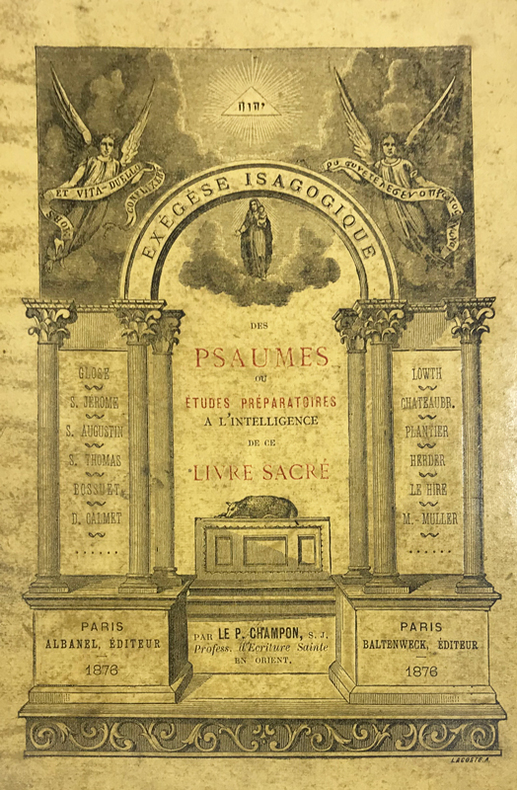
18763786Paris, Albanel et Baltenweck (Le Puy en Velay, Imp. Freydier), 1876 ; in-8, broché ; XXXIV pp., 491 pp., (1) f. d'errata et couverture jaune illustrée.
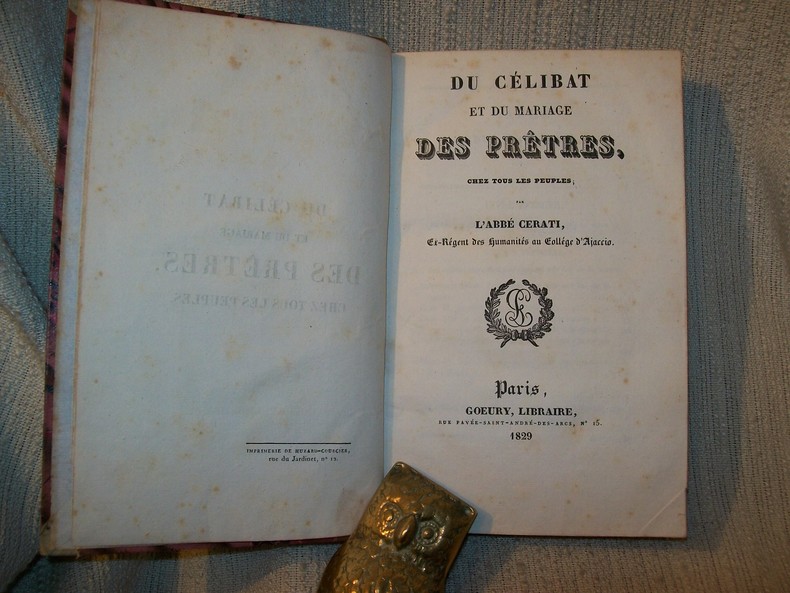
1829GITc181Paris Goeury 1829. In-8 VIII (table) XLVIII (introduction) 423pp. Demi basane havane à petits coins de vélin ivoire, dos lisse orné de filets dorés, tranches jonquille, reliure de l'époque. Quelques pâles rousseurs par endroits. Bel exemplaire.
Bound in black cloth lettered in gilt. Fraying to top of spine. Slight rubbing to boards. Inscribed by author on ffep. ; Fascinating study that looks at the remains of the temple structures and their possible uses with reconstructions. ; 49 pages; Signed by Author
Bound in black cloth lettered in gilt. Minor Fraying to spine ends. Slight rubbing to boards. Blank front free and back free endpapers have been torn out leaving remains and exposed webbing. Still presentable and sound copy. ; Fascinating study that looks at the remains of the temple structures and their possible uses with reconstructions. ; 49 pages
Book has minor shelfwear and rubbing. ; Reprint of 1911. Chapters Include: Rome and the Etruscans; Rome and Greece: The Religion Of Superstition And The Decline Of Faith; Religion Of The Early Empire; Constantine And Christianity; Julian called the Apostate: Twilight of the Gods; Augustine And The City Of God; Benedict And The Ostrogoths; Gregory And The Lombards: The Preparation For The Holy Roman Empire. ; 270 pages
Scholars' bookplate to inner cover (Slater & Dunbabin). Slight creasing to wraps. One small tear to wraps (1 cm). ; Studi Ellenistici VII; 230 pages
Faint shelfwear. ; Excavations of the Athenian Agora Picture Book No. 19; 8.2 X 5.1 X 0.1 inches; 32 pages
New Turkish Paperback. Roy. 8vo. (21 x 14 cm). In Turkish. 352 p. Emevîler'in sonuna kadar Islam cografyasinda Mecusîler. The Mazdaism in the Islamic geography until fall of the Umayyads.
55705N° 10 - Mai 1958 - En dépôt à la Société d'Edition "Les Belles Lettres" - in-8 broché - 252 pages