VALERY (Paul).Livre Rare Book
OperaBiblio.com
Amphitryão Ou Jupiter e Alcmena
1390249239.Gpaperback. Good. Access codes and supplements are not guaranteed with used items. May be an ex-library book. paperback
Bonita · États-Unis53,12 $US≈ 44,94 €
21 719 résultats
193191946Paris Chez l'auteur 1931 1 vol. broché petit in-4, broché, non coupé, 50 pp. Édition originale de ce drame lyrique créé en juin 1931 à l'Opéra Garnier, en tirage à part de la revue Commerce (printemps 1931, n°XXVII). Un des 40 exemplaires numérotés sur Hollande, seul tirage avec 10 Japon, enrichi d'un envoi autographe signé de l'auteur à son ami "G. Jean Aubry, (qui me prêta sa belle voix), bien amicalement". Couverture bleue un peu brunie en bordure comme souvent, sinon très bel exemplaire [Karaïskakis & Chapon, 176].
1390249239.Gpaperback. Good. Access codes and supplements are not guaranteed with used items. May be an ex-library book. paperback
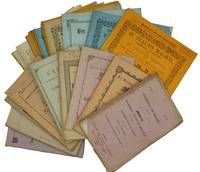
AQ25079vs.: vs. c. 1820s-1930s 12mo 8vo and quarto. The majority preserved within original publisher's wrappers. An extensive archive of theatrical publications and ephemera emanating from the recently dispersed library of Howth Castle County Dublin seat of the Gaisford-St. Lawrence family comprised of theatre programmes and libretti representing productions spanning from the late 1820s up to the 1930s both domestic and Continental in origin. The 94 individual publications comprehend: Eight playscripts and libretti printed in Paris between including an 1828 edition of Théaulon and Choquart's comic vaudeville Monsieur Jovial ou l'huissier-chansonnier 1827 and an 1882 issue of Charles Gounod's five-act opera Faust set to a French libretto by Jules Barbier and Michel Carré from Carré's play Faust et Marguerite. 15 Italian productions variously printed at Rome Milan Florence and Naples in the latter half of the nineteenth century including an 1848 Neapolitan edition of Verdi's four-act opera Nabucodonosor composed to an Italian libretto by Temistocle Solera first performed at La Scala in Milan 9th March 1842; and a programme to accompany the first performance of Verdi's Attila at La Fenice in Venice 17th March 1846. An Italian language edition printed at Barcelona in 1845 of Jacopo Ferretti's libretto Eran due or son tre 1834. 70 theatre programmes operas and Italian-language libretti printed in London spanning the century between the 1830s and 1930s including: 15 issued in the 1870s as a part of 'Davidson's Musical Opera-Books' series published in conjunction with performances at 'London's Italian Opera Houses' of productions of inter alia Rossini's The Barber of Seville Bizet's Carmen and Mozart's Don Giovanni and The Magic Flute each with a parallel English translation and 'the music of the principal airs'. The first appearance in print of the libretti for five Gilbert and Sullivan productions: Patience 1881 Princess Ida 1884 The Mikado 1885 The Yeomen of the Guard 1888 and Utopia 1893. A magazine-programme for a run of performances at the Shaftesbury Theatre in 1926 of J. M. Barrie's Peter Pan; or the Boy Who Wouldn't Grow Up 1904 - a production with which Barrie was directly involved - with Dorothy Dickson in the lead role. A run of 12 programmes for the 1925/26 1926/27 seasons at the The Old Vic including 11 productions of Shakespeare's plays all notably featuring leading Shakespearean actor Baliol Holloway d. 1967. Notable members of the Gaisford-St. Lawrence family included Thomas Gaisford 1789-1855 English classical scholar sometime curator of the Bodliean Library Regius Professor of Greek at Oxford and Dean of Christ Church. Gaisford’s eldest son Thomas Gaisford of Offington Sussex 1816-1898 British Army officer married in 1859 as his second of three wives Lady Emily St Lawrence d. 1868 eldest daughter of the third Earl of Howth. Their eldest surviving son Royal Navy officer Julian Charles Gaisford-St Lawrence 1862-1932 succeeded in 1909 his uncle the fourth and last Earl of Howth and came to reside at Howth Castle in Co. Dublin. A rare opportunity to acquire an ephemeral archive which not only exemplifies the theatrical passions of a single family across least three generations but documents the evolution of nineteenth century stage production charts the popular progress of Italian-language libretti in both Britain and on the Continent and exhibits the situation of English theatre prior to the post-war dominance of television and film. . [vs.], [c. 1820s-1930s] unknown
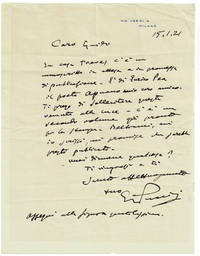
1921100261<p>Milano January 15 1921. 1921. Very good. - Over 60 words penned in Italian on 10-1/2 inch high by 8-1/4 inch wide cream "Via Verdi 4 Milano" stationery. Puccini writes to the publishers Fratelli Treves on behalf of his friend the writer Enrico Pea. He addresses Guido Treves the nephew of the firm's founder Emilio Treves who took over the company upon Emilio's death in 1916. Guido Treves ran the company with his wife Antonietta. Puccini writes that there is a manuscript awaiting publication at Treves' house. It is from his dear friend the Apuan region poet Enrico Pea. He asks that publication be expedited as there is a second volume ready for print. Puccini states that he wrote to Beltrami Giovanni Beltrami the managing director at Fratelli Treves who promised that it would be published soon. Signed "tuo yours G. Puccini" followed by his regards to Guido's wife. Folded horizontally and vertically for mailing the letter is slightly creased at the corners with a couple of minuscule chips to the edges. Once mounted there are remnants of archival tape along the top edge of the verso.</p><p>Giacomo Puccini often enjoyed a table at the Antico Caffe di Simo in Lucca with his friend Enrico Pea.</p><p>The book being discussed by Puccini is without doubt the first volume in Pea's "Trilogia del Moscardino" simply titled "Moscardino" published by Fratelli Treves in 1922. The book was translated into English by Ezra Pound. It was reviewed in the January 1 2005 edition of the New York Review of Books: "A small masterpiece Pea's lyrical autobiographical novel paints a fiery and intimate portrait of an old man through the brushstrokes of his grandson. The passions and tensions between the old eccentric and his brothers play themselves out in mythical sketches before a vivid backdrop of the hills of Lunigiana. Moscardino the first novella of his tetralogy Il romanzo di Moscardino is anarchic and haunting. Pound conducts Pea's vernacular song allowing images to flow from the land the flesh and beyond."</p><p>Little needs to be said about the life of the great Italian opera composer Giacomo Puccini 1858-1924 who composed several of the best known Italian operas. His works include "Manon Lescaut" "La Boheme" "Madama Butterfly" and "Turandot" among many other works.</p><p>The Italian poet novelist playwright and theatre impressario Enrico Pea 1881-1958 produced literary works that are said to be divided into two periods. The first being that of "Moscardino" and the second beginning with "Il Figlioccia" which takes on a softer delicate modulated style.</p> Milano, January 15, 1921.
No marks or inscriptions. A lovely clean very tight copy with bright unmarked boards and no bumping to corners. Dust jacket not price clipped or marked or torn or creased with signs of storage and minor indentation. 96pp. The reality of ballet dance, how to become a dancer, practical advice and the Royal Ballet School.
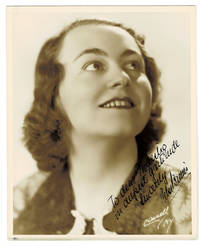
100159<p>New York Canell . Very good. - An original 10 inch high by 8-1/8 inch wide sepia toned gelatin silver photograph of the opera contralto Else Brems. The portrait depicts Else Brems from the shoulders up looking up with a soulful smile. The photographer's credit "Canell NY" is printed in white at lower right of the image. The contralto has inscribed the photograph to Enrico Rosati diagonally at bottom right "To dear Maestro with deepest gratitude / Sincerely / Else Brems". The top left corner is slightly creased and the bottom edge of the border is darkened. Else near fine.</p><p>The Danish opera contralto Else Brems 1908-1995 is remembered the world over for her interpretations of Carmen. She first performed in Copenhagen at the age of 20 and her success propelled her to study with the American opera singer Sara Cahier who was herself famous for her performances of Carmen. She went on to appear as Carmen with the Royal Danish Theatre at the age of 22. Following a highly acclaimed private concert in Chicago she went to study in New York under Enrico Rosati the great voice teacher of Benniamino Gigli Giacomo Lauri-Volpi and Mario Lanza. She went on to perform the role hundreds of times and also performed the role of Bess in Gershwin's "Porgy and Bess" during the Second World War. Following the liberation of Denmark she sang the role of Elisabeth in the patriotic "Elvehoj". She performed many other roles while at Copenhagen's Royal Theatre and elsewhere.</p> New York, Canell,
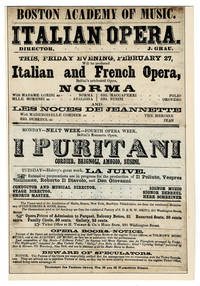
1863100670<p>Boston: Transcript Job Printing Office 1863. 1863. Very good. - An original 10-3/8 inch high by 6-5/8 inch wide broadsheet announcement for the Grau Italian Opera Company's performances of "Norma" "Les Noces de Jeannette" "La Traviata" and "Lucrezia Borgia" with a 2-7/8 inch high by 6-5/8 inch wide tipped-on overlay advertising the following week's performances of "I Puritani" and a performance of "Oratorio and Sacred Concert" several featuring the Opera Soprano Madame Lorini in the title roles. The broadsheet advertises the Friday February 27 performances of "Norma" and "Les Noces de Jeannette" and the following Saturday & Sunday's performances of "La Traviata" and "Lucrezia Borgia" with the Following week's Monday performance of "I Puritani" and the Tuesday performance of "La Juive" printed on the recto of the overlay tipped on over the Saturday program with that Sunday's "Oratorio and Sacred Concert" advertised on the verso of the overlay. The Broadside is dated "Sunday Evening March 1 1863 under the announcements of "La Traviata" and "Lucrezia Borgia". There is some minor foxing and darkening and the broadsheet is mounted from the verso onto slightly larger heavy cream paper. Very good.</p><p>The Brau Italian Opera Company began a six week engagement at the Boston Academy of Music on February 9th. This was the last time that what became "The Boston Theatre" was called "The Academy of Music". Among the singers were Madame Lorini Mlle Morensi Signor Maccaferri Signor Susini Mademoiselle Cordier Signor Dubreul etc.</p><p>The November 15 1862 New York Herald review of an earlier performance of "Norma" at the Academy of Music possibly the Brooklyn Academy of Music in that case highly praises the quality of the Soprano's voice "It follows as a matter of course from what we have just stated that Madame Lorini's debut last night was a success. She had sung but a few passages when the audience recognized the beautiful quality of her voice--pure round and fresh--and though not as powerful as one would wish to hear in Norma still with volume sufficient to give a perfect interpretation of the music of the part. Her method is excellent and exhibits evidence of her Italian training."</p> [Boston]: Transcript Job Printing Office, 1863.
Quattro volumi composti. Brossura in cartoncino flessibile. Copertina con alette illustrata. Pagine in buonissimo stato. Lingue presenti greco e italiano, con testo tradotto a fronte. Introduzione e note di Pierluciano Guardigli. Traduzione di Lela Mazzone. Numero pagine 560 USATO
0666279748.Gpaperback. Good. Access codes and supplements are not guaranteed with used items. May be an ex-library book. paperback
19812142710Turnhout: Brepols / Leuven: University Press 1981. CCXLVII, 455 Seiten. Mit 3 gefalteten Beilagen (schematische Übersichten) in Leinentasche auf dem hinteren Innendeckel. Gr.-8° (25,5 x 16 cm). Orig.-Leinenband mit vergoldeter Titelprägung auf Rücken und Deckel. Original gilted cloth.
Tascabile, in parte intonso, degli anni '20 del '900 in stato discreto, bella coperta illustrata in cartoncino semimorbido, lievi bruniture, tracce di fioritura sparsa, bordo poco sfregato, tagli lievemente ambrati con barbe, pagine in buono stato. Presenta antiporta con illustrazione bicroma, rossa e nera, ritratto di Anatole France, bella testatina in rosso. Fa parte della collana Medaglie. Numero pagine 56 USATO
Prima edizione di questo volume con prefazione di Geno Pampaloni. Sovraccoperta con illustrato "il ritorno del figliol prodigo" di Rembrandt. A pagina 12 e 63 presente nota scitta a matita. Altri segni a matita nelle pp. 68, 70, 76. Presente mancanza nelle ultime tre pagine. Sovraccoperta con margini leggermente stanchi. Pagine ben salde e lievemente ingiallite. Numero pagine 296. USATO
In 4° grande; (16) pp. Frontespizio inciso. Qualche macchiolina di foxing e brunitura. Qualche angolo piegato ma per il resto in buono stato di conservazione. Ben visibile la battitura della lastra. Rara fantasia per pianoforte del compositore Adamo Vieri dedicata al grande compositore catanese Vincenzo Bellini ed alla sua opera La Sonnambula. Raro.
br. Su un lontanissimo pianeta coperto di ghiaccio, Breq sta per recuperare l'oggetto di cui è in cerca da tempo - un prezioso manufatto costruito dall'inconoscibile e temutissima specie aliena Presger -, quando si imbatte in un corpo semiassiderato nella neve: è Seivarden Vendaai, una persona che Breq credeva morta da mille anni. Perché Breq non è ciò che sembra: diciannove anni, tre mesi e una settimana prima di quel giorno era la "Justice of Toren", una gigantesca astronave da trasporto truppe in orbita attorno al pianeta Shis'urna insieme alle sorelle "Sword" e "Mercy". Come tutte le navi dell'impero Radchaai, la "Justice" è un'intelligenza artificiale che controlla ancelle umane. Ma ora la "Justice" è stata distrutta e della sua coscienza pensante è rimasto solo un frammento: Breq. Chi l'ha devastata ha portato via tutto ciò che le era più caro; solo due cose le rimangono: un fragile corpo umano nel quale sta imparando a nascondersi e un'inesauribile sete di vendetta. Il suo obiettivo è Anaander Mianaai, Lord del Radch, la creatura semi-immortale che da tremila anni detiene il potere assoluto sull'impero grazie alle sue migliaia di corpi interconnessi. La trilogia "Ancillary" disegna un universo originale e ricco di particolari spiazzanti, tanto complesso quanto coerente: un sistema nel quale le intelligenze artificiali si appassionano alla musica polifonica e sono ossessionate dal tè, mentre le differenze di genere non hanno senso. Ann Leckie esplora le sottigliezze psicologiche, i pregiudizi razziali, le passioni politiche e religiose dei suoi personaggi. Ma soprattutto fa ciò che da sempre fa la fantascienza: accompagnare il lettore, tra gigantesche battaglie interplanetarie e viaggi spaziali, alla scoperta di nuovi mondi, dove nessuno è mai giunto prima. Contiene anche i racconti "Il lento veleno della notte" e "Lei comanda e io obbedisco".
17492o.J. Amerikanische Opernsängerin. 1930 Europa-Tournee, 1935 Salzburg, Australien, Südamerika, 1954 erste farbige Sängerin an der Metropolitan Opera New York. 1897 Philadelphia - 1993 Portland. Fast Halbfigur singend. Bleistiftzeichnung von Benedikt Fred Dolbin um 1940 ?, nicht signiert. Ca. 170 x 150 mm.
29o.J. Bariton. Wagnersänger. Mailand, Moskau, Berlin, Frankfurt, Zürich, München. 1859 Lissabon - 1921 Berlin. Ganze Figur in Kostüm. Photogravure bei Eckstein. 300 X 205 mm.
BUONE CONDIZIONI
OTTIME CONDIZIONI
18 cm, brossura editoriale; pp. 64
In-16 (Cm 19,5 x 13,5), pp. 72, brossura editoriale. Due millimetrici strappetti al margine interno, leggermente allentato. BUONO
Coperta imbrunita e segnata da fattore tempo, legatura allentata alle pagine iniziali, tagli e pagine con imbrunitura e con punti di crescente fioritura, libretto completamente fruibile, numero pagine 71; da segnalare: annotazione numerica al piatto anteriore USATO
<p>20 cm, brossura editoriale, titolo in rosso e nero, dorso rifatto; p. 73. Timbri del maestro Guido Spagnoli ai piatti</p>
In-16 (Cm 18 x 13), pp. 64, br. ed. Rare e leggere ingialliture sparse.Leggero alone alla br. post. Ordinari segni del tempo. BUONO
18 cm, brossura; pp. 64. Date di prima esecuzione e biografiche degli autori, ben manoscritte al frontespizio
30 cm, cartone edit. con dorso in tela; pp. 160; spartito