LEHMANN (Maurice), MASCHWITZ (Eric). BRUNELLESCHI (Umberto).Livre Rare Book
21 663 résultats
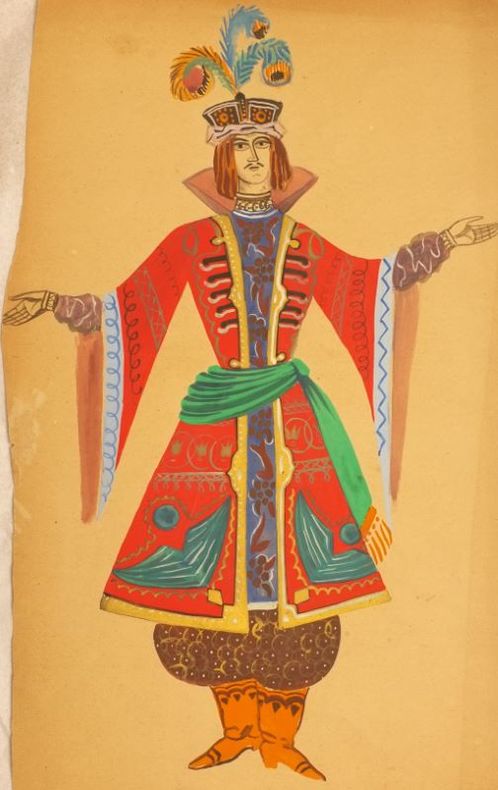
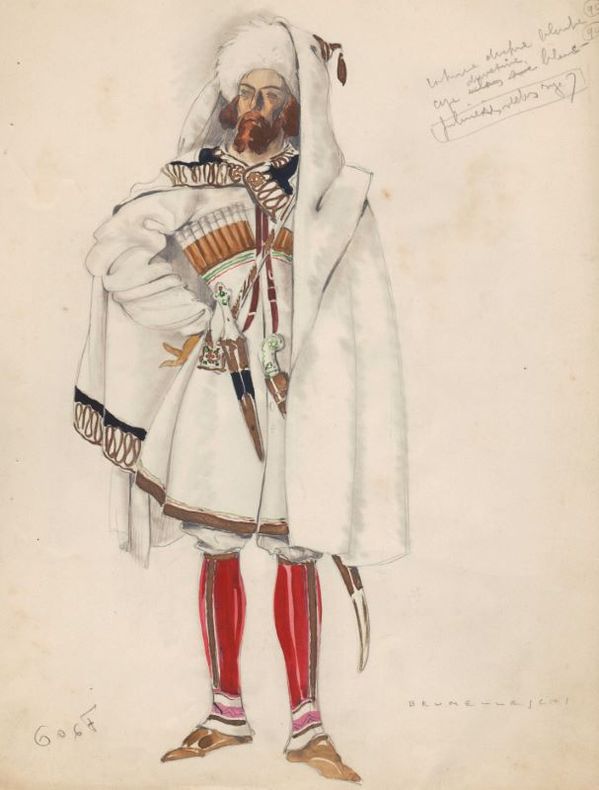
1938193831938 22 aquarelles pour le spectacle-opérette de Mogador, sur papier cartonné beige, 21 signées en bas à droite, 4 datées (1938), rehauts d'or et de blanc, mine de plomb, feuilles de 32 x 25 environ, dessins de 30 x 15 cm. environ.
160463098Arnhem, Johan Jansen (Jan Jansz), (1603-)1604. Fol. Mit einem Kupferportrait Dürers (monogr. ?DM?) u. zahlr. tlw. ganzs. bzw. gefalt. Holzschnitten (davon 2 m. mont. Einschlagstreifen) von Albrecht Dürer. 2; 90 (das letzte weiß); 131 (davon 4 gefalt.; das letzte weiß); 26 (davon 10 gefalt.) nn. Bll., Etw. späterer orangegefärbter Pgmt.-Bd. m. durchzogenen Bünden u. am Vorderdeckel den Initialen ?HVZ? sowie der Jahreszahl ?1674?.
"Opera divisa in quattro volumi, rarissima a trovarsi completa: Libro primo, detto la Qualità delle comedie. Per dichiarare, quale sia la lecita a' buoni christiani, e quale la illecita; e per distinguere la modesta dalla oscena, secondo la dottrina di s. Tomaso, e d'altri theologi per sicurezza della coscienza. In-4°, XV, (6cc), 172pp (i.e. 272), legatura in pelle coeva, nervature e titolo al dorso in oro, Firenze, Bonardi 1655; Libro secondo, detto La solutione de' nodi. Per isciogliere molte difficoltà, e per risoluere molti casi di coscienza intorno alle comedie poco modeste; e per mostrare, che non è mai lecita la loro permissione ... Opera di un theologo religioso, stampata ad instanza del sig. Odomenigico Lelonotti da Fanano. Si aggiunge al fine vna Censura d'autori antichi, e moderni intorno a' compositori, compositioni, lettione, e recitamento di poca honestà. Et di più il Giuditio, che si può fare di quelle comedie, che si rappresentano tal'hora con titolo di honesta ricreatione da persone ascritte in vna osseruante congregatione. In-4°, (20cc), 158pp (i.e.258); 135pp+1, legatura in pelle coeva, nervature e titolo in oro al dorso, Firenze, Bonardi, 1649; Libro terzo, detto L’instanza, per supplicare a' signori superiori, che si moderi christianamente il theatro dall'oscenità, e da ogni altro eccesso nel recitare, secondo la dottrina di S. Tomaso, e d'altri theologi antichi e moderni. Opera d'vn religioso theologo, stampata per soddisfattione del sig. Odomenigico Lelonotti da Fanano. ... Vi sono due indici, vno de' capi, e punti, l'altro delle materie. In-4°, (16cc), 377pp, (16cc), legatura in pelle coeva, nervature e titolo in oro al dorso, Firenze Bonardi, 1652; Libro detto L'ammonitioni a' recitanti, per auuisare ogni christiano à moderarsi da gli eccessi nel recitare. Sono diuise in tre breui trattati, cioè il primo intorno à recitanti. Il secondo intorno al comico Beltrame, & al suo libro. Il terzo intorno à ciarlatani. Opera d'vn theologo religioso da Fanano, stampata ad istanza del sig. Odomenigico Lelonotti. Con aggiunta all'vltimo d'vn'Hipomnistico, ouero Discorso ammonitorio, diretto in forma di preghiera a' musici comedianti mercenarij, & ad ogn'altro musico aiutante al theatrale, e poco modesto recitamento. Con due indici, vno dell'ammonitioni, e l'altro delle cose notabili. In-4°, (16cc), 566pp, (2cc), legatura in pergamena con titolo manoscritto al dorso, Firenze, Bonardi 1652. Il gesuita Ottonelli (Odomenigico Lelonotti da Fanano) fu, insieme a Giovanni Paolo Oliva e Paolo Segneri, uno dei critici del teatro più celebri nelle fila della Compagnia di Gesù e in particolare la sua critica è importante per tracciare l’evoluzione del rapporto fra teatro professionale e religione (Zampelli, 2006). Sicuramente sono i libri di teatro, soprattutto Della Christiana moderatione del theatro, a raccontarci molto di Ottonelli. Dagli aneddoti autobiografici sepolti in queste pagine dense possiamo ricostruire l'attività di Ottonelli per i cinque anni cruciali che precedettero il suo arrivo a Firenze nel 1640. Dipingono un quadro sorprendente. Ottonelli si presenta non come un teologo o uno scrittore, ma come un uomo d'azione, un guerrigliero impegnato nella lotta contro il teatro e soprattutto contro il ruolo delle donne in esso. Ottonelli sapeva che in Inghilterra le attrici erano proibite (anche se occasionalmente sul palco apparivano donne di compagnie continentali e la regina e le sue dame si esibivano in maschere di corte). Ottonelli conosceva la pratica inglese e la raccomandava per l'Italia, anche se sapeva che gli attori italiani erano assolutamente contrari. Le donne erano essenziali per l'economia del teatro popolare, e Ottonelli spiega perché. Vendevano i biglietti e permettevano di dare un'occhiata al viso o al petto per qualche soldo. Durante le rappresentazioni vendevano merce: ""mercantie, profumeria, saponetti, moschardini, o simili coserelle"". Cantavano, eseguivano acrobazie e si scambiavano mance, una pratica redditizia. Le brave attrici portavano clienti sia alle commedie che ai giochi d'azzardo. I regali poi venivano inviati dietro le quinte. E’ l’opera di Ottonelli la più attenta cronaca della nascita del teatro italiano, una miniera di notizie e fatti che, anche se narrati con vis polemica, sono l’unico documento di prima mano del periodo d’oro delle compagnie teatrali italiane; addirittura egli si sofferma sulle figure minori dell’intrattenimento, come ciarlatani, musici ambulanti, venditori e imbonitori, vagabondi scaltri e giocolieri. A work which extremely rare to find complete. Jesuit Ottonelli (Odomenigico Lelonotti da Fanano) was, together with Giovanni Paolo Oliva and Paolo Segneri, one of the most famous theater critics in the ranks of the Society of Jesus and in particular his criticism is important for tracing the evolution of the relationship between theater professional and religion (Zampelli, 2006). In fact it is the books on theater, especially Della Christiana moderatione del theatro, that tell us much about Ottonelli. From the autobiographical anecdotes buried in these dense pages we can reconstruct Ottonelli’s activities for the five crucial years preceding his arrival in Florence in 1640. They paint a surprising picture. Ottonelli comes across not as a theologian or writer, but as a man of action, a guerrilla engaged in combat against the theater and especially against the role of women in it. Ottonelli knew that in England actresses were prohibited (though women from continental troupes occasionally appeared on stage and the Queen and her ladies performed in court masques). Ottonelli knew of the English practice and recommended it for Italy, though he knew that Italian actors were dead set against it. Women were essential to the economics of the popular theater, and Ottonelli explains why. They sold the tickets and threw in a glimpse of face or bosom for good measure. They peddled merchandise during performances: “mercantie, profumeria, saponetti, moschardini, o simili coserelle.” They sang, performed acrobatics, and passed a cup for tips, a lucrative practice. Good actresses brought in clients both to the plays and to games of chance. Gifts were sent backstage. Ottonelli's work is the most careful chronicle of the birth of the Italian theater, a mine of news and facts which, even if narrated with a polemic face, are the only first-hand document of the golden period of the Italian theater companies; he even dwells on the minor figures of entertainment, such as charlatans, traveling musicians, vendors and barkers, crafty vagrants and jugglers."
In-folio (mm 298 195). Carte [250], con la prima bianca; [52]. Collazione: a-G8 H10 i-U8 x10 A8 B12 C-I8; AA-DD8 EE FF10. Spazio delle iniziali vuoto con suggerimento di lettere. Carattero romani (R 94) su 55 righe. Copia con ampie ma leggere macchie di umidità alle pagine iniziali, alcune più marginali alla fine. Legatura in pelle coeva su tavole di legno, con motivi arabeschi impressi sui piatti, dorso con titolo manoscritto su carta; con difetti. Ex-dono del XVI secolo sulla pagina del titolo, alcune glosse dalla stessa mano nel testo.
In 2°, (16) cc. (inclusi i due frontespizi), 489 (1) pp., (14) cc., doppio frontespizio in latino e italiano, entrambi con vignette tipografiche, con 79 tavole fuori testo, bianche al verso di cui 69 a piena pagina e 10 piu' volte ripiegate, legatura coeva in mezza pergamena e carta decorata con angoli.
1491915<p>Terviso or Venice: Michael Manzolus 1491. First Edition with the commentary of Acron and Pomponius Porphyrio. Bound in modern marbled gilt calf. A very large and clean copy with marginal indexing on a few signatures in red others in brown ink. A very Large copy of a very very rare edition of Horace https://data.cerl.org/istc/ih00451000 GW 13457; Goff H451; BMC V 315 IB. 21815; Bod-inc H-203; CIBN H-275. Located copies:The Walters Art Museum Bancroft Library Yale Free Library of Philadelphia Princeton Univ. Brown University Pauline Fore Moffitt Library University of California General Library. The unique charm of Horace's lyric poetry arises from his combination of the metre and style of the distant past—the world of the Archaic Greek lyric poets—with descriptions of his personal experience and the important moments of Roman life. He creates an intermediate space between the real world and the world of his imagination populated with fauns nymphs and other divinities.<br />He denounces corrupt morals praises the integrity of the people of Italy and shows a ruler who carries on his shoulders the burden of power. Other Augustan themes that appear in Horace's lyric verse include the idea of the universal character and eternity of Roman political dominion and the affirmation of the continuity of the republican tradition with the Augustan principate. At some stage Augustus offered Horace the post of his private secretary but the poet declined on the plea of ill health. Not withstanding Augustus did not resent his refusal and indeed their relationship became closer.<br />"Horace's success as a poet can be measured partly by how difficult he is to imitate and translate and by how many admirers have sought to do both. Readers in the Middle Ages looked to Horace as a moralist and as a literary critic and appreciated the Satires and Epistles more than the more difficult Odes. The enthusiasm of the Italian Renaissance poets Petrarch 14th century Landinio and Politian late 15th century for the Odes encouraged the popularity of Horace's lyric. Horace was one of Montaigne's 16th century favorite poets. The themes and poetics of both the lyrics and the satires greatly influenced Ben Jonson late 16th early 17th century Robert Herrick Andrew Marvell Milton and Dryden 17th century. The Odescontinued to be springboards for much of both public and private 17th-century English lyrics. Pope was the leading Horatian poet writing in English during the 18th century the Age of Augustanism especially imitating Horace's hexameter poetry while Alfred Lord Tennyson Matthew Arnold Byron and Rudyard Kipling were among Horace's enthusiasts in the 19th century. Horace continued to inspire modern poets among them Ezra Pound. <br /><br />While the different genres of his work have specific qualities they all share in being Horatian a quality that many have tried to define. In Nietzsche's view Horace's peerless artistry separates him from all other poets. Compared to Horace's Odes "All the rest of poetry becomes in contrast something too popular—a mere garrulity of feelings" "What I owe to the ancients" Twilight of the Idols 1 https://www.poetryfoundation.org/poets/horace . Folio 30 x 20cm Signatures: A8B10C8D4E8F-G6a–q8r6. 184 leaves First Edition of Horace with both of his ancient commentators Acron and Porphyrio. Bound in modern marbled gilt calf. A very large and clean copy with marginal indexing on a few signatures in red others in brown ink.<br /><br />The history of the printing of editions of Horace and his commentators.<br /><br />First printed in Venice about 1471-2 then in Milan about 1475 14761477 Venice again 1478 &1479. The next edition was Leipzig 1492 All of these editions are without commentary. Acron's commentary was Published with out the Opera in Milan in 1479. At Florence in 1482 there is an edition of the Opera with the Landinus commentary then again in Venice 1483-86. The Edition offered here is the FIRST to have the commentary of Helenius Acron and Pomponius Porphyrion who are both said to have flourished in the third century these commentaries are revised by Raphael Rgius ƒl. 1480-1500 and Ludovicus de Strazarolis which make up the first 50 pages of this book.</p> Michael Manzolus
149047651Venedig, Bernardinus de Choris u. Simon de Luere, 5. Oktober 1490. Fol. 3 nn., 147; 65 num., 1 weißes (= 216) Bll. (Rom. Type, 62 Zeilen; Min. f. Initialen), Mod. Pgmt. unter Verwendung einer lateinischen Handschrift des 15. Jhds. mit zahlr. roten u. blauen Fleuronné-Initialen.
1923192281923 11 gouaches, sur papier cartonné (feuilles 49 x 30 cm, dessins 45 x 27 environ), deux dessins datés et signés, en bas à gauche, 1923, encadré.
1895206631895 Photographies en noir et blanc signées pour la plupart, certaines sont montées sur carton, (1895-1937), formats allant de 14 x 10 à 32 x 40 cm.
AQ25079vs.: vs. c. 1820s-1930s 12mo 8vo and quarto. The majority preserved within original publisher's wrappers. An extensive archive of theatrical publications and ephemera emanating from the recently dispersed library of Howth Castle County Dublin seat of the Gaisford-St. Lawrence family comprised of theatre programmes and libretti representing productions spanning from the late 1820s up to the 1930s both domestic and Continental in origin. The 94 individual publications comprehend: Eight playscripts and libretti printed in Paris between including an 1828 edition of Théaulon and Choquart's comic vaudeville Monsieur Jovial ou l'huissier-chansonnier 1827 and an 1882 issue of Charles Gounod's five-act opera Faust set to a French libretto by Jules Barbier and Michel Carré from Carré's play Faust et Marguerite. 15 Italian productions variously printed at Rome Milan Florence and Naples in the latter half of the nineteenth century including an 1848 Neapolitan edition of Verdi's four-act opera Nabucodonosor composed to an Italian libretto by Temistocle Solera first performed at La Scala in Milan 9th March 1842; and a programme to accompany the first performance of Verdi's Attila at La Fenice in Venice 17th March 1846. An Italian language edition printed at Barcelona in 1845 of Jacopo Ferretti's libretto Eran due or son tre 1834. 70 theatre programmes operas and Italian-language libretti printed in London spanning the century between the 1830s and 1930s including: 15 issued in the 1870s as a part of 'Davidson's Musical Opera-Books' series published in conjunction with performances at 'London's Italian Opera Houses' of productions of inter alia Rossini's The Barber of Seville Bizet's Carmen and Mozart's Don Giovanni and The Magic Flute each with a parallel English translation and 'the music of the principal airs'. The first appearance in print of the libretti for five Gilbert and Sullivan productions: Patience 1881 Princess Ida 1884 The Mikado 1885 The Yeomen of the Guard 1888 and Utopia 1893. A magazine-programme for a run of performances at the Shaftesbury Theatre in 1926 of J. M. Barrie's Peter Pan; or the Boy Who Wouldn't Grow Up 1904 - a production with which Barrie was directly involved - with Dorothy Dickson in the lead role. A run of 12 programmes for the 1925/26 1926/27 seasons at the The Old Vic including 11 productions of Shakespeare's plays all notably featuring leading Shakespearean actor Baliol Holloway d. 1967. Notable members of the Gaisford-St. Lawrence family included Thomas Gaisford 1789-1855 English classical scholar sometime curator of the Bodliean Library Regius Professor of Greek at Oxford and Dean of Christ Church. Gaisford’s eldest son Thomas Gaisford of Offington Sussex 1816-1898 British Army officer married in 1859 as his second of three wives Lady Emily St Lawrence d. 1868 eldest daughter of the third Earl of Howth. Their eldest surviving son Royal Navy officer Julian Charles Gaisford-St Lawrence 1862-1932 succeeded in 1909 his uncle the fourth and last Earl of Howth and came to reside at Howth Castle in Co. Dublin. A rare opportunity to acquire an ephemeral archive which not only exemplifies the theatrical passions of a single family across least three generations but documents the evolution of nineteenth century stage production charts the popular progress of Italian-language libretti in both Britain and on the Continent and exhibits the situation of English theatre prior to the post-war dominance of television and film. . [vs.], [c. 1820s-1930s] unknown
27956Paris Maurice Dreyfous, Editeur 1886 in 4 (30x24) 1 fort volume reliure plein maroquin vert lierre, dos lisse, dos et plats ornés d'un original décor géométrique à base de petits points estampés à froid, dentelle intérieure assortie, tête dorée, couverture conservée, 373 pages [1], étui bordé. Reliure signée de René Kieffer. Jean Richepin, Médéa 1849 - Paris 1926, poète, romancier et auteur dramatique français. Edition originale, tirage limité à 500 exemplaires numérotés. Notre exemplaire non numéroté est imprimé sur papier fort de Hollande. Ce Précieux exemplaire unique est truffé de 80 beaux dessins originaux riches en coloris, aquarelles, lavis, qui illustrent superbement ce texte sur le monde de la mer et ses gens. Richepin Jean, 1849-1926, poète et romancier français. Dufour, Emilien-Léon-Jean. Superbe et très précieux exemplaire ( Photographies sur demande / We can send pictures of this book on simple request )
58068Venedig, Johann von Köln u. Johann Manthen, 27. August 1478. Fol. Mit eingemalten Alinea-Zeichen alternierend in Rot und Blau sowie eingemalter Kopfzeile in Rot und Blau. 228 nn. Bll. (das erste weiß; Rom. Type mit griech. Einsprengseln, 37 Zeilen, Blindgepr. Ldr. d. 20. Jhds. auf 5 Bünden m. goldgepr. Rückentitel.
1892127Paris, 1892 ; in-folio, reliure moderne demi-maroquin bleu marine à coins, filets dorés, dos lisse orné en long, tête dorée, deux couvertures de livraison illustrées conservées.
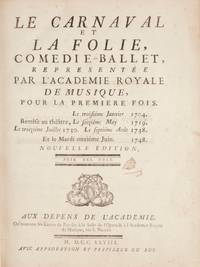
39101Quarto. Full mid-tan mottled calf with coat of arms gilt to both boards raised bands on spine in decorative compartments gilt marbled endpapers. With occasional decorative woodcut initials and head- and tailpieces throughout.<br /> <br /> 1. DESTOUCHES Andre Cardinal 1672-1749<br /> Le Carnaval et La Folie Comedie-Ballet representée par l'Academie Royale de Musique pour le premiere fois. Le troisième Janvier 1704. Remise au théâtre Le seizième May 1719. Le treizième Juillet 1730. Le septième Août 1738. Et le Mardi onziéme Juin. 1748. Nouvelle Édition Prix XXX. Sols. Paris: Aux Depens de l'Academie. On trouvera les Livres de Paroles à la Salle de l'Opera & à l'Academie Royale de Musique rue S. Nicaise. . Avec Approbation et Privilege du Roy. . De l'Imprimerie de la Veuve Delormel & Fils 1748. 1f. recto title verso "Les Paroles de Monsieur de la Motte. La Musique de Monsieur Destouches." 1f. cast list 5-51 i approbation and imprint. With manuscript paraph to title. <br /> <br /> Named cast includes:<br /> - "Acteurs Chantans dans les Choeurs" for the Côté du Roi performance Mlles. Dun Toulou Delorge Larcher Cazeau Rosalie Le Tourneur Duperey and Grimiaux and Messrs. Lefebre Le Page C Laubertie Fel Bourque Duchênet Rochette and Gratin; and for the Côté de la Reine performance Mlles. Cartou Masson Gondré Rôllet Delâtre Lablotiere Daliere Victoire Hery and Folliot and Messrs. S. Martin Le Mesle Bellanger Levasseur Belot Chapotin Favier and Le Roy<br /> - "Acteurs du Prologue" Mlle. Romainvile; Messrs. Person Le Page and de la Tour<br /> - Dancers Mlle. Puvigné in Hebé; Mlles. Lyonnois Courcelle and Thieri in Les Graces; Messrs. Devisse Caillez Laval Feuillade and Mion; Mlles. Dazenoncourt Briseval Minot and Puvigné in "Jeux & Plaisirs." <br /> <br /> A pupil of Campra Destouches achieved considerable success as a composer of stage music. His Isse was greatly admired by King Louis XIV. "Le carnaval et la folie is one of the first examples of a lyric comedy in France." James R. Anthony in Grove Music Online<br /> <br /> 2. CAMPRA André 1660-1744 Monteclair Bourgeois and Rameau<br /> Fragmens de Differens Ballets Représentés par l'Academie Royale de Musique Le Mardi 10 Séptembre 1748. Prix XXX. Sols. Paris: Aux Depens de l'Academie. On trouvera les Livres de Paroles à la Salle de l'Opera & à l'Academie Royale de Musique rue S. Nicaise. . Avec Approbation et Privilege du Roy. . De l'Imprimerie de la Veuve Delormel & Fils 1748. In a prologue and 3 acts.<br /> <br /> - 1f. recto title verso "Les Paroles de M. Danchet. La Musique de M. Campra." 3-4 cast list 5-8 "Prologue des Amours de Venus"<br /> <br /> Named cast includes:<br /> - "Acteurs Chantans dans les Choeurs" for the Côté du Roi performance Mlles. du Toulou Delorge Larcher Cazeau Rosalie Folliot Le Tourneur and Grimiau and Messieurs Lefebvre Le Page C. Laubertie Fel Bourque Duchênet Rochette and Gratin; and for the Côté de la Reine performance Mlles. Cartou Masson Gondré Rôllet Delâtre Lablotiere Daliere Chesdville Hery and Duperey and Messieurs S. Martin Le Mesle Bellanger Levasseur Belog Chapotin Favier and Le Roy <br /> - "Acteurs du Prologue" Mlle. Romainville Jacquet and Met<br /> - Dancers Mlles. Imblot Sauvage Parquet Amedée Carville Devaux Bellot L. and Bellot C; Mrs. Le Febvre Laurent Laval Caillé Feuillade and Bourgeois; Messieurs Le Lievre and Devisse. <br /> <br /> Campra was a leading figure in French theatrical and sacred music in the early 18th century.<br /> <br /> With:<br /> MONTECLAIR Michel Pignolet 1667-1737<br /> 1 Les Soirées de l'Eté tirées du ballet Des Festes de l'Eté: Le Paroles d de M. Pellegrin. La Musique de M. Monteclair. 2 cast list 3-22 pp. <br /> <br /> Named cast includes:<br /> - Actors Mlles. Coupée and Chevalier and Messieurs Person de la Tour and Le Page<br /> - Dancers Mlles. Camargo Lyonois Thierry Dazenoncourt Sauvage Beaufort and Briseval; Mrs. Dupré Dumay Matignon Hamoche and Caillé; Monsieurs Tessier and Levoir<br /> <br /> "Although not prolific Montéclair wrote in most of the genres cultivated during the early 18th century in France excepting only the keyboard. He was one of the most versatile of the generation between Lully's death 1687 and Rameau's advent as a stage composer 1733; composers of this 'préramiste' period are often described as 'imitators of Lully' but Montéclair and Campra are among those who influenced Rameau's dramatic music. In his stage works Montéclair was particularly sensitive to the dramatic function of orchestral colour. His operatic scores are much clearer than those of his contemporaries in giving directions for specific instruments like the off-stage horns 'played very softly to simulate the hunt in the distance' in the second entrée of Les festes de l'été Montéclair added that 'if no cors de chasse are available oboes and violins may play the following and remain in the orchestra'. In the same work a 'Prélude à trois basses' introduces the first scene of the third entrée where the main roles are sung by basses; the prelude to the second scene whose main roles are sung by sopranos is scored for violins and violas without continuo. The parts enter in reverse order and the melodic material is derived from the earlier prelude ex.1. Les festes de l'été and Jephté both contain an a cappella chorus and the former has a large-scale double chorus - an operatic counterpart to the choruses in Lalande's grands motets." James R. Anthony in Grove Music Online<br /> <br /> With: <br /> BOURGEOIS Thomas Louis 1676-1750 or 1751<br /> 1 L'Estime tiré Des Amours Déguisés. Les Paroles de Monsieur Fuzelier. La Musique de Monsieur Bourgeois. 2 cast list 3-14 pp.<br /> <br /> Named cast includes:<br /> - Actors Mlles. Fel Jacquet and Gondré; Messieurs de Chassé Poirier and Person<br /> - Dancers Mlles. Dallemand Thieri St. Germain Minot Sauvage Briseval and Himblot; Mrs. Dupré Lany Devisse Lyonnois Dumat Matignon Hamoche Laval and Feuillade; Mr. Doumoulin.<br /> <br /> A French composer and singer best known for his contributions to the 18th century French cantata Bourgeois also wrote ballets and divertissements.<br /> <br /> With: <br /> RAMEAU Jean-Philippe 1683-1754<br /> 1 Pigmalion Acte de Ballet. La Musique de Monsieur Rameau 2 cast list 3-10 1f. approbation and privilege<br /> <br /> "Rameau was one of the greatest figures in French musical history a theorist of European stature and France's leading 18th-century composer. He made important contributions to the cantata the motet and more especially keyboard music and many of his dramatic compositions stand alongside those of Lully and Gluck as the pinnacles of pre-Revolutionary French opera." Graham Sadler and Thomas Christensen in Grove Music Online<br /> <br /> 3. RAMEAU<br /> Les Festes de l'Himen et de L'Amour; ou Les Dieux d'Egypte Ballet Héroïque Donné à Versailles le quinze Mars 1747. Et Représenté pour la premiere fois par L'Academie Royale de Musique le Mardi 5 November 1748. Prix XXX. Sols. Paris: Aux Depens de l'Academie. On trouvera les Livres de Paroles à la Salle de l'Opera & à l'Academie Royale de Musique rue S. Nicaise. . Avec Approbation et Privilege du Roy. . De l'Imprimerie de la Veuve Delormel & Fils 1748. 1f. recto title verso blank 3 half-title with "La Poëme est de M. de Cahusac. La Musique de M. Rameau. La Danse de M. Laval Compositeur des Ballets du Roi." 4 cast list 5 synopsis 6 cast list 7-58 1f. privilege. With manuscript paraph to title. <br /> <br /> Named cast for the Prologue includes:<br /> - "Acteurs Chantans dans les Choeurs" for the Côté du Roi performance Melles. Dun Tulou Delorge Larcher Cazeau Rosalie Le Tourneur Dupereyand Grimiaux and Messieurs Lefebvre Le Page C. Laubertie Fel Bourque Duchênet Rochette and Gratin; and for the Côte de la Reine performance Mlles. Cartou Masson Gondré Rôllet Delâtre Lablotiere Daliere Victoire Hery Folliot and Messieurs S. Martin Le Mesle Bellanger Levasseur Belot Chapotin Favier and Le Roy.<br /> - "Acteurs du Prologue" Mlles. Coupée and Romainveille; Mr. Poirier<br /> - Dancers Mlles. Carville Courcelle and St. Germain in Les Graces; Mlles. Puvignée Dazenoncourt Himblot and Briseval and Mrs. Laval Laurent le Lievre and Bourgeois in Jeux et Plaisirs; Mlles. Minot Beaufort Thierry and Sauvage in Vertus. <br /> <br /> Named cast for the Premiere Entrée includes: <br /> - "Acteurs Chantans" Mlles. Chevalier and Gondré; Monsieur Jeliote<br /> - Dancers Mlles. Puvignée Derseuille Chevrier Masson Hutte St- Germain Courcelle Thiery Minot Dallemand Belnot C. Parquet Devaus Amedée Camargo Dazenoncourt Beaufort Belnot L. and Belnot C.; Mrs. Dupré F. Barrois Hamoche Mion Matignon Dumay Laval Dupré Feuillade Caillé le Liévre and Laurent; Messieurs Lany and Dumoulin<br /> <br /> Named cast for the Seconde Entrée includes:<br /> - "Acteurs Chantans" Mlle. Romainville; Messieurs le Page De la Tour and Albert<br /> - Dancers Mlles. Lyonnois Amedée Devaux Sauvage L. Belnot and C. Belnot; Mrs. Laval Matignon Dumay le Lievre Hamoche Feuillade Lyonnois Mion Laurent and Bourgeois; Messieurs Lyonnois and Dupré <br /> <br /> Named cast for the Troisieme Entrée includes:<br /> - "Acteurs Chantans" Mlles. Fel Coupée and d'Aliére; Messieurs Jeliote Person Poirier and Lamarre<br /> - Dancers Mlles. Camargo Dallemand Puvignée Lyonois St. Germain Courcelles Thiery Puvignée Desnoncourt and Minot; Mrs. Lany Dumoulin Tessier Laval Hamoche Caillez Feuillade Dumay and Dupré; Monsieur Device<br /> <br /> First Edition. Sonneck p. 500 editions of 1765 and 1778 only. <br /> <br /> 4. RAMEAU<br /> Platée Ballet Bouffon representé par L'Academie Royale de Musique pour le Carnaval De mil sept cent quarente!neuf. Le Mardi quatre Fevrier de la même année. Prix XXX Sols. Paris: Aux Depens de l'Academie. On trouvera les Livres de Paroles à la Salle de l'Opera & à l'Academie Royale de Musique rue S. Nicaise. . Avec Approbation et Privilege du Roy. . De l'Imprimerie de la Veuve Delormel & Fils 1749. 1 title 2 "Les Paroles de Monsieur Autreau. La Musique de Monsieur Rameau." 3-4 cast list 5-55. 1f. approbation and privilege. With manuscript paraph to title.<br /> <br /> Named cast include:<br /> - "Acteurs Chantans dans les Choeurs" for the Côte du Roi performance Mlles. dun Tulou Delorge Larcher Cazeau Rosalie Le Tourneur Deperey and Grimiaux and Messieurs Lefebvre le Page C. Laubertie Fel Bourque Duchênet Rochette and Gratin; and for the Côté de la Reine performance Mlles. Cartou Masson Rôllet Lablotiere Daliere Victoire Hery Folliot s. Martin Le Mesle Bellanger Levasseur Bellot Chapotin Favier and Le Roy<br /> - "Acteurs du Prologue" Mlles. Cartou Chesdeville Coupée and Rozalie; Messrs. Poirier Person De Lamare<br /> - Dancers Mlles L. Belnot C. Belnot Desiré Lyonnois Briseval Dazenoncourt Imblot Parquet and Amedée; Mrs. Laval Caillé Monservin Le Lievre Laurent Hamoche Bourgeois and Milon; Monsieur Lany<br /> - "Acteurs du Ballet" Mlles. Jacquet Fel and Coupée; Messrs. De la Tour Le Page Person Poirier and DeLamare<br /> - Dancers Mlles. Lany Courcelle St-Germain Thiery Minot Beaufort Sauvage Dallemand Carville Devaux L. Belnot C. Belnot Lyonnois Dallemand Desiré Dazenoncourt and Briseval; Mrs. Dumay Dupré Matignon Feuillade le Lievre Laval Hamoche Bourgeois Laurent and Mion; Me. Dourdet; Messrs. Lyonois Dupré Monservain Tessier Dumoulin Devise and Lany<br /> <br /> First Edition of the second version.<br /> <br /> 5. SALOMON Joseph-François 1649-1732<br /> Medée et Jason Tragedie Representée par L'Academie Royale de Musique pour la premiere fpois. Le vingt-quatrième jour d'avril 1713. Reprise le premier de May 1727. Et le vingt-deux Novembre 1736. Remise au Théâtre le Jeudi 20 Février 1749. Prix XXX Sols. Paris: Aux Depens de l'Academie. On trouvera les Livres de Paroles à la Salle de l'Opera & à l'Academie Royale de Musique rue S. Nicaise. . Avec Approbation et Privilege du Roy. . De l'Imprimerie de la Veuve Delormel & Fils 1749. 1 title 2 "Les Paroles de Monsieur Pellegrein. La Musique de Monsieur Salomon." 3-4 cast list 5-64 i approbation and privilege. With manuscript paraph to title. <br /> <br /> Not in Sonneck.<br /> <br /> A French composer and organist "Salomon's operas Medée et Jason and Théonoé are in the tradition of Lully and Campra." Guy Bourligueux in Grove Music Online<br /> <br /> Binding somewhat worn rubbed and bumped; minor loss to head and tail of spine; slightly shaken; hinges partially split. Minor internal wear; edges slightly browned; occasional foxing; two leaves loose. Very good crisp wide-margined copies overall. unknown
In-folio (mm 304x205). Pagine [12], 152, [2] con 2 tavole in una carta fuori testo. Numerose figure incise in legno nel testo, anche a piena pagina. Stemma mediceo al frontespizio e grande marca dello stampatore in fine. Piccoli strappi e lacune riparati al frontespizio, rimontato, altro strappo marginale riparato alle carte ff3-ff4 e alla tavola fuori testo in fine, lievi ma ampie gore d'acqua lungo il volume. Legatura inglese settecentesca in pieno vitello spruzzato con cornice a motivi floreali impressa a secco ai piatti e titoli dorati su tassello al dorso. Ex-libris Macclesfield al contropiatto anteriore.
1929AG20057<p><br /></p><p><b>SELECTIONS FROM REPERTOIRE OF OPERATIC SONGS AND TERPSICHOREAN MELODIES OF MEI LAN-FANG - by Professor Liu T</b><b>'</b><b>ien. Hua </b><b>梅兰芳æŒæ›²è°±</b></p><p>Published in 1929 specially edited and printed for Mei Lan-Fang's performance in the United States. Mei Lan-Fang was invited by America in the winter of 1929 to help the people better understand Chinese Opera the master of Chinese songs Liu Tianhua produced two volumes of books one in Chinese 126pp. and the other in English 118pp. which includes 18 Kunqu Opera with music script and score. Signed and stamped by the Author on the English version 1050 copies printed and only 50 copies were signed this is No. 43 on Chinese art paper 4to matching red silk sewn thread binding with printed gold paper labels very fine condition. </p><p><br /></p><p>本套书å°åˆ·äºŽ1929年,共分为2册,精装,æ¤ä¹¦ä¸ºæ¢…兰芳赴美演出特制,共1050部,其ä¸çš„50部为æˆåŒ–宣纸å°åˆ¶ï¼Œåˆ—有编å·ï¼Œç¬¬ä¸€å·ä»·æ ¼äº”百美元,二至五åå·ä¸€ç™¾ç¾Žå…ƒï¼Œæ¤å¥—为50部ä¸çš„第43å·ï¼Œæœ‰åˆ˜å¤©åŽäº²å°å¹¶è‹±æ–‡ç¾å。两套书分别为ä¸è‹±æ–‡ç‰ˆï¼Œå…±æ”¶å½•äº†18æ¡æ˜†æ›²çš„å”±è¯ã€å”±è…”工尺谱和五线谱,历ç»æ•°æœˆå®Œæˆ å“相如新,ä¿å˜å¦‚æ¤å®Œå¥½çš„éžå¸¸å°‘è§ã€‚</p> paperback
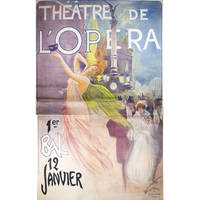
188019742<p><strong>Superb huge lithographed poster for a ball at the Opéra Garnier by painter and poster artist Edouard Charles Lucas 1866-1925 aka Charle Lucas.</strong></p> Impr. Chardin 17 passage Daudin
In-4 p. (mm. 288x200), p. pergamena antica (risg. rifatti), titolo ms. al dorso, 10 cc.nn., 583 cc.num., (1) c.nn.; frontespizio col titolo incluso nella grande cornice xilografica (già usata per le precedenti ediz.) con la marca del giglio araldico: stemma di Firenze e iniziali L.A.; al recto dell’ultima carta: Registro e sottoscrizione, Venetiis, apud Haeredes Lucantonii Iuntae florentini, mense martio 1544, al verso grande marca (giglio fiorentino e iniziali L.A. circondati da ghirlanda sorretta da due putti); al recto della c. v1 (145) altro frontespizio: “P. Virgilii Maronis Aeneis accuratissime recognita cum commentariis.. Venetiis 1543, con la marca del giglio fiorentino. Mancano le ultime due carte (D5 e D6) che sono bianche. La ns. è un’edizione della Variante ‘A’, che non comprende in fine i "Priapea", ultimo degli opuscoli, di 4 carte (584-587 + 1 c.nn.), Collazionato con esemplare presente su ICCU. Questa splendida edzione “è illustrata da 113 silografie ripodotte dal Grueninger (ed. 1502) giudicate di una ‘naiveté amusante’. Il commento dell’"Eneide" è di Tiberio Claudio Donato; gli altri commentatori sono: Servio per le "Bucoliche" e "Georgiche", Probo e Mancinelli per le "Bucoliche" e "Georgiche", Ascensio per lo opere complete, Agostino Dati per qualche passo dell’"Eneide", Jacopo Costanzo Fanense per diversi passi delle "Georgiche", Domizio Calderini per gli opuscoli. Vi sono pure annotazioni di J. Pierio Valeriano, di Filippo Beroaldo e di Angelo Poliziano”. Cosi’ Mambelli “Gli annali delle edizioni virgiliane”,195. Cfr. anche Camerini “Annali dei Giunti”, nn. 493 e 220 (x l’ed. del 1519): “Le xilografie provengono sempre dai disegni disposti per il prototipo del 1519. Settima replica delle Opere di Virgilio illustrate, con i Commenti antichi e più recenti. Il contenuto del volume è il seguente: a) Preliminari - b) Bucolica - c) Georgica - d) Aeneidos: Lib. XII - e) Aeneidos: Lib. XIII a M. Vegio composito - f) Appendix Virgiliana - g) Priapea. Le numerose xilografie che l’adornano, ne fanno uno dei libri più significativi dell’arte veneziana di quel tempo. Esse si differenziano in modo singolare da quelle contemporanee e - da inspirazione tedesca - sono trattate nella figurazione e nel disegno, con magistrale armonia tutta veneziana. Non si conosce il nome del Maestro che incise i legni, dopo averne ideati i disegni, ma egli dovette essere dotato di immaginazione fervida e di rara abilità. Benchè inspirati ai legni creati in Germania per il Virgilio di Strasburgo: Joh. Grueninger, 1502, sono strettamente originali, trattati in modo vivace, notevolissimi per la storia del costume, in quanto illustrano gli episodi dell’opera virgiliana come fossero contemporanei: vedute di città, figure di navi, armi, ecc. domostrano, per molti aspetti, la vita comune del primo cinquecento. Varii di dimensioni, alcuni sono grandissimi - fino ad occupare quasi tutta la facciata - ed il loro numero è di quasi 200. Questa ediz. (1519) venne ristampata negli anni: 1522, 1525, 1532, 1542, 1544, 1552, ma nelle repliche non compaiono tutte - né le stesse - xilografie che si trovano nella prima edizione”. Ns. esemplare: molto corto del marg. super. a partire dalla c. 512; frontesp. restaur. per mancanze solo margin. e con tracce di colore rosso sulle figure della cornice architettonica; ultima carta, priva dei margini, è stata sapientem. restaur. e applic. su un foglio antico; anche le cc. 581, 582, 583 sono state restaur. per mancanza del marg. interno ed esterno bianco; ca. 60 carte con ritagli a due margini bianchi, fatti da antico possessore; le cc. 244 e 245 con macchie; le cc. 566, 571 e 583 prive del marg. super.; con qualche arrossatura e alone. Malgrado tutti i difetti elencati, questo splendido libro illiustrato è conservato più che discretamente.
176813828Genf, de Tournes, 1768. 6 in 7 Bdn. 1 gefalt. Kupferporträt, 41 gefalt. Kupfertafeln und 1 gefalt. Tabelle. Kl.-4°. Pgmt. der Zeit mit Rückenschild (etw. verzogen, fleckig, bestoßen und wurmstichig).
157945077Paris, H. Thierry für Sebastian Nivelle, 1579. Fol. (39 x 27 cm). Mit 9 (wiederh.) Holzschn.-Druckermarken a. d. Titeln u. zahlr. Holzschn.-Vignetten u. -Initialen im Text. Ldr.-Bde. d. Zt. a. 6 Bünden m. goldgepr. Deckelfileten, Rückenverg. u. goldgepr. Rückentiteln.
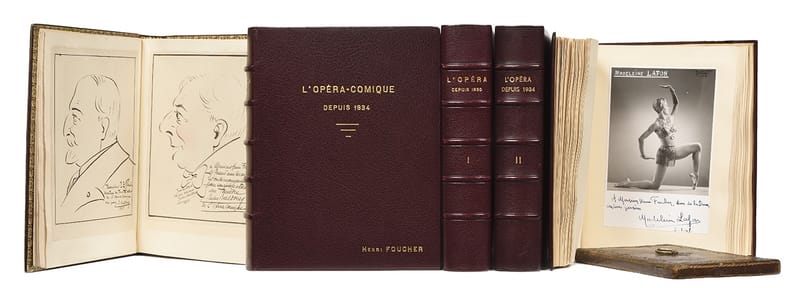
92281930-1952. 5 fort volumes in-8 (environ 220 x 175 mm). Maroquin et chagrin prune, titre et nom dorés sur le premier plat, dos à nerfs, dentelle ou deux filets intérieurs dorés, têtes dorées (Bernasconi; H. Lapersonne).
In 4 (29,5x22) Quattro volumi. Cartonato con legatura in tela, rilegato im mezza pelle amatoriale e marmorizzatura, cofanetto con finiture in pelle. Incisioni in rame.Tomo I pp.428, tomo II: pp.534, tomo III: pp.594, tomo IV: pp.528. Ottimo.
30832Executed in ink pencil gouache and silver paint on wove paper. Unsigned but with monogrammatic handstamp to lower left corner. With annotations in ink in Russian relative to various parts of the costume. 13.125" x 8.75" 332 x 222 mm.<br/><br/>Slightly worn and soiled; some edge tears and repairs; upper right corner with erasure resulting in minor paper loss. Korovine designed costumes for productions of Russian operas including Borodin's Prince Igor Mussorgsky's Khovanshchina and Rimsky-Korsakov's Sadko and Le Coq d'Or.<br/><br/>"Konstantine Korovine is one of the most famous of Russia's twentieth-century stage designers. He made his debut as a theatrical painter in 1885 when he executed the sets and costumes for the production of Snegurochka at Savva Mamontov's Private Opera after Vasnetsov's designs and thereafter he emerged rapidly as an independent stage designer - decorating according to one souce 80 operas 37 ballets and 17 dramas during his lifetime. Korovine brought to the Russian stage a vibrancy and richness that was lacking in the traditional Imperial theaters. He felt more at ease when called upon to design operas and ballets treating of Russian history and legend such as Prince Igor Sadko and The Golden Cockerel and he designed sets and costumes for such spectacles at home and abroad." Bowlt: Russian Stage Design Scenic Innovation 1900-1930 from the Collection of Mr. & Mrs. Nikita D. Lobanov-Rostovsky pp. 175-176. MacDougall Arts Ltd. London auction June 9 2011 lot 413 catalogue p. 17. unknown books
213321 Aquarelle signée en bas à gauche, 8.7 x 12 cm, (1911), encadrée.
167457834Basel, Johann König, 1674. Fol. Titel m. breiter illustr. Kupferbordüre. Mit einem ganzs. Kupferportrait, über 1300 Textholzschnitten u. zahlr. Holzschn.-Vignetten u. -Initialen. 61 Bll., 1027 (recte 1029) S., 11 Bll.; 236 S., 3 Bll., Marmor. Pgmt. d. Zt. m. überstehenden Kanten, durchzogenen Bünden, goldgepr. Rückenschild u. dreiseitig gespränkeltem Farbschnitt.