B Gartrell (artwork)Biblio.com
300 résultats
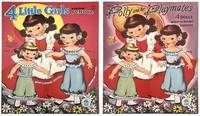
1951290008451Chicago Illinois: Merrill Company 1951. Very good. Toned modern tape repair. Two 2 different issues of the same paper doll book with notable differences showing the publisher's changes from one issue to another in response to changes in the market. Each paper doll book is uncut and the publisher has used the same artwork; however large changes have occurred between the issues including typography title coloring and the order of outfit pages within. One of the books has two more leaves than the other. The two books include:<br /> <br /> "Polly and her Playmates". Chicago: Merrill Publishers 1951. Single vol. 12.75" by 10.25" 8 leaves of uncut outfit pages stapled in original illustrated covers with two uncut dolls on each cover.<br /> <br /> "4 Little Girls from School". Chicago: Merrill Publishers c.1951. Single vol. 12.5" by 10.25" 6 leaves of uncut outfit pages stapled in original illustrated covers with two uncut dolls on each cover. Merrill Company unknown
19742082702114904255Tokyo Do 1974. Soft Cover. Fine. Number of pages: 156p Map size: 16x22cm Number of books: 1 Tokyo Do paperback
19432110502151000389drawing work 1943. Soft Cover. Fine. Volume: 1 drawing work paperback
19492082402113507518Artwork Research Institute 1949. Soft Cover. Fine. Number of books: books Artwork Research Institute paperback
19601327541Cairo: Egyptian State Tourism Department c. 1960. Artwork by M. Azmy; printed in Egypt by Institut Graphique Egyptien. Issued by the Egyptian State Tourism Department. Condition: Very Good. Slight age toning; one small tear which does not interfere with the image visible in upper right margin. Not examined out of frame. Dimensions<br /> 29.5 x 41.25 inches. 1327541. Shelved Dupont Bookstore. Egyptian State Tourism Department unknown books
19942090502126901766Gakushu Kenkyusha 1994. Soft Cover. Fine. Size: B5 wide format Gakushu Kenkyusha paperback
19812092902140602672Kodansha 1981. Soft Cover. Fine. Number of pages: 31p Size: 25x27cm Kodansha paperback
2110502150412024No label N.A. Soft Cover. Fine. Number of books: 1 point No label paperback
20012090202118102552Nihonbungeisha 2001. Soft Cover. Fine. The book is in fine condition. Nihonbungeisha paperback
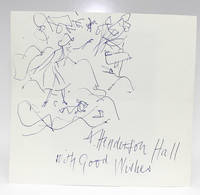
1975023492UK 1975. First Edition . Paper. Very Good. 12mo - over 6¾ - 7¾" tall. An Original Pen Drawing and Signed Paper by A Henderson Hall. Undated C1970. Arthur Henderson Hall Sedgefield County Durham 1906 - 1983 ARCA 1930 RE 1961 RWS 1970 Prix de Rome in Engraving 1931 MSIA; was an English painter in oil and water-colour draughtsman etcher and illustrator and glass designer. He was educated at Sedgefield Accrington and Coventry Schools of Art The Royal College of Art and The British School Rome. He was also Instructor of Drawing at London Central School of Art in 1947-1952; Head of School of Graphic Design at the Kingston School of Art in 1965-1971 Senior Lecturer in charge 1952-1965. He was illustrator of children's books and books on gardening. Size 210mm x 195mm Condition is very good. Light folding crease. More images can be taken upon request. Ref16654 <br/> <br/> unknown
30484No Place: Other Wind Press No Date. First edition. Loose Sheets. Fine. Very large single sheet of thick yellow paperstock illustrated in black and red and printed in black. Measuring 16 x 24" tall a most handsome poetry broadside of a work by Artaud as translated into English by Eshleman and Bedor. With artwork by Spero. This is copy 47 of 150 hand-numbered copies and has been SIGNED BY ESHLEMAN AND SPERO as called for. Fine condition. Will be shipped in a sturdy mailing tube. Other Wind Press unknown books
198253737Luxembourg: Imprimerie Saint-Paul 1982. First limited edition. Hardcover. Near fine. 176/225. Oblong Octavo. Unpaginated 28 leaves. Original illustrated cream paper-covered boards with gray and black lettering on cover white on spine. Gray endpapers. Title page with tan lettering. Printed to heavy paper. Inscribed "For Bettina ces signes en signe de haute amitié Arthur / 31/1/84" on verso of front free endpaper. Bettina Brendel was a German-American painter known for her computer-generated imagery. Edition of 250 with ten non-commecial copies marked HC fifteen numbered I to XV with an original ink and 225 copies numbered from 1 to 225. This is copy No. 176.<br /> <br /> Beautifully illustrated with eighteen high-quality offset reproductions of Arthur Unger's mysterious imagery one of them double-page and one on front cover. "Arthur Unger thus freed from the rules of calligraphic ideograms re-conquers the sign and draws from the present moment the physical energy that triggers his vision of the world. A feverish alchemist he constructs puzzles and traces enigmatic formulas objects of his fascination. The plastic rhythm underlies a kind of choreographic space that is animated by etheral creatures." Arnault Contains biographical notes exhibition history principal collection and publications at rear. Text in French. Minor wear to covers. Imprimerie Saint-Paul hardcover
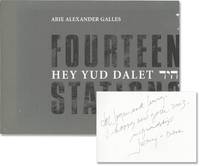
2002170980Morristown NJ: The Morris Museum 2002. First Edition. Softcover. First Edition. INSCRIBED by Jerome Rothenberg on the front wrapper verso: "for Joyce and Jerry / happy new year 2003 / in friendship / Jerry and Diane."<br /> <br /> Very Good or better in perfect-bound wrappers with light offsetting to the front wrapper and moderate rubbing to the fore-edges and bottom right corners. The Morris Museum unknown
197284826Canada: Rothmans of Pall Mall Canada Limited 1972. Softcover bilingual text French and English. Quarto 34cm; pictorial paper wrappers; 80pp; black-and-white and colorful photographs and illustrations throughout. Inscribed by author on front endpaper: "To Geoffrey Molder amité C.K. Appel / 28 Nov 78 NYC". Modest shelf-wear and soil with tiny nick to lower rear panel and inked note to introduction page; Good.<br /> <br /> Catalogue includes details on a Candian art exhibition by Appel an avant-garde movement CoBrA co-founder. Rothmans became interested in the project after his Holland exhibit 'Appel's Oog-Appels' The Appels of Appel's Eyes 1970 and this collection includes artwork selected and created by Appel on behalf of Canada. 84826. Rothmans of Pall Mall Canada Limited unknown
Woodblock "kawaraban" broadside illustrating the arrival of Commodore Perry's four American vessels at Uraga in 8 July 1853, featuring a prominent stylized portrait of Perry himself and one of his formidable "black ships". All text is in Japanese. Thin hand-made laid paper measuring approximately 35,5 x 27cm. Small tears at folds and margins, some professional repair to verso, otherwise in very good condition, with clear imagery. A pleasing example of an uncommon variant. A contemporary broadside to alert Japanese civilians of the arrival of Commodore Perry's formidable American vessels. News was travelling fast by word of mouth along the coast and trade routes, and also began being illustrated with the "kawaraban" - broadsides with woodblock prints - for distribution. Naturally, Edo commoners were curious to learn about the imposing vessels that suddenly appeared within sight of their city.] The Japanese named the American vessels "kurofune" (black ships) for the colour of the hulls which were covered in tar and for the black smoke from the coal-fired steam engines. four "Black Ships"
A special copy, bearing the South Korean Presidential Seal, quite conceivably a unique one-off presentation copy from the Korean Government, of the photogravure portfolio, showcasing a select few of the exquisite Korean art works, which were jointly selected by a Korean-American committee and displayed at the National Gallery of Art in Washington, D.C. exhibition "Masterpieces of Korean Arts" held from 15 December 1957 to 12 January 1958. Folio. Complete, with 12 full colour photogravures, each bordered with loosely placed captioned leaf, and contained in its own folding cardstock covers bearing the portfolio title to front and a detailed historical and physical description to interior. Folders open from left to right, suggesting that this work was printed in Korea. Text is in both Korean and English. Publisher's original cloth teal and gold patterned portfolio covers, with two intact bone clasps for secure closure, and gilt presidential seal to front. Photogravure leafs measure approximately 42,5 x 34 cm. Portfolio measures approximately 43 x 34,5 x 3,5 cm Mild age-toning and wear to boards with one cosmetic tear to cloth to interior of one flap, otherwise in very good and original condition, a most unusual variant of this beautiful work, and most likely a Presentation copy from the South Korean Government. The present item is quite rare in any state, but especially this one as it shows a gilt phoenix and flower (Rose of Sharon) emblem found on the presidential seal of South Korea. It is most likely a Presentation Copy from the Korean Government to America, as a memorial to their collaboration of hosting a superb exhibition of historic Korean Art. OCLC shows a few 'standard' editions in libraries. The status and authority of the President of South Korea, officially the Republic of Korea, is represented by a symbolic phoenix emblem. The virtues represented by the mythological bird are parallel to the values a king had to pursue in governing the people, and the design of phoenix was attached on the ceiling of the throne hall of Gyeongbokgung palace, which was the main palace during much of the Joseon Kingdom (1392-1910). The design of the phoenix is still used today as the emblem that represents the office of the President of Korea. The exhibition "Masterpieces of Korean Art" was held at the National Gallery of Art in Washington, D.C., from 15 December 1957 to 12 January 1958. A joint committee of Koreans and Americans selected 187 objects, with the aim of presenting a cross section of Korean art from 200 B.C. to about 1900.
Nine (9) portrait impressions of Chinese civilians, mostly scholars, two geishas, and at least one immortal, each handcrafted of silk, paper, and watercolour paints, each being a one-off unique two-dimensional figure. Figures measure approximately 6 x 20 cm. Six are mounted to paper, three per leaf, paper being creased. Two are not mounted. Very good original condition, bright, colourful, and fascinating nineteenth century peasant art from China. The present items were handcrafted circa 1890, as they come from a collection of varied arts from the estate of a Anglo-Chinese man who worked as Examiner for the Imperial Maritime Customs from circa 1895 to the 1910s. Items like these continued to be made after the turn of the century, expanding the choice of representations. They have been called paper dolls by modern collectors, however they were NOT made as children's play items, which is why they are usually in very good condition. These were ornamental artforms created by innovative Chinese artisans, to sell to foreign visitors who were fascinated by the costume, lifestyle, and ancient folklore of ancient China.
Creator: Hiroshi Hirabayashi. Kamishibai propaganda play / Japanese picture show (kamishibai) illustrating the benefits and immense moral obligation of collaborating with one other for survival. Folio. The complete work, comprising 20 offset full-colour printed illustrative cards which together form a story to educate or indoctrinate the viewer with nationalist concepts during the Second World War, each with printed story text to verso, one of the cards being the title and publishing information. Text is in Japanese. Contained in publisher's original paper portfolio covers, with title label to front. Story cards measure approximately 38 x 26 cm. Portfolio covers measure approximately 39 x 27 x 1 cm. Some age-toning and wear to portfolio, otherwise in very good and original condition, cards retaining vivid impression, a fascinating and scarce Second World War propaganda presentation. Japanese wartime propaganda was distributed through films, magazines and newspapers, radio, books, cartoons and the education system. Publications such as the present illustrative stories, promoted the ideal citizen's nationalistic point of view, indoctrinating civilians to work collectively and in support of their government's actions, even when creating some form of imposition on the citizen himself. Kamishibai are Japanese paper plays that gained popularity among children in the 1930s and were subsequently used as a medium for propaganda during World War II. Also referred to as a "Picture Card Show," they were made for influencing youth with their engaging storylines and vivid imagery. In 1940, elementary schools were renamed "Citizen's Schools." Textbooks became vivid, engaging, and contained militaristic picture-books. During the course of World War II, the Japanese government attempted to indoctrinate Japanese children through education and propaganda. Both methods nationalized youth and encouraged them to support the war effort. Science curriculum, for example education taught children about agriculture so they could better assist in food production for the nation. Youth were expected to volunteer in factories and farms to replace the conscripted labor force. Additionally, "kokutai," meaning the uniqueness of the Japanese people in having a leader with spiritual origins, was officially promulgated by the government, including a text book distributed by the Ministry of Education. The purpose of this instruction was to ensure that every child regarded himself first of all as a Japanese and was grateful for the "family polity" structure of government, with its apex in the emperor. Indeed, little effort was made during the course of the war to explain to the Japanese people what it was fought for; instead, it was presented as a chance to rally about the emperor. This is a dramatic story of collaboration and innovation, its ultimate message being that these virtues are necessary for survival of a society and the individual. Sustenance being the key to survival, the story unfolds as follows. A village in Western Japan suffering a long arid season which led to drought, was unable to support vegetation and was seeing abandonment as many farmers left the region. Evidently this was a large village, having five shoya (village headman), and the latter devised an irrigation plan to restore its agriculture and ultimately preserve the village. In order to instill the urgency of success with the undertaking, the local bugyo (governor) approved the project under the alarming condition that if the project failed, the five headmen who also owned estates in the region, would be burnt alive at the stake. He had five hanging platforms erected in preparation of failure, and also to motivate them to accomplish the task lest they meet a gruesome public fate. Villagers supported the idea and all hands worked diligently to ensure its success. Indeed, working together with a common goal was the key. The water flowed abundantly. The village was saved, and so were the lives of the five headmen. The hanging platforms were set ablaze (without victims) in celebration.
Kamishibai propaganda plays / Japanese picture show (kamishibai) illustrating the importance of taxation, specifically relating to the all-important commodity: rice. Folio. The complete work, comprising 20 offset full-colour printed illustrative cards which together form a story to educate or indoctrinate the viewer with nationalist concepts during the Second World War, each with printed story text to verso, one of the cards being the title and publishing information. Text is in Japanese. Contained in publisher's original paper portfolio covers, with title label to front. Story cards measure approximately 38 x 26 cm. Portfolio covers measure approximately 39 x 27 x 1 cm. Some age-toning and wear to portfolio, otherwise in very good and original condition, cards retaining vivid impression, a fascinating Second World War propaganda presentation. Japanese wartime propaganda was distributed through films, magazines and newspapers, radio, books, cartoons and the education system. Publications such as the present illustrative stories, promoted the ideal citizen's nationalistic point of view, indoctrinating civilians to work collectively and in support of their government's actions, even when creating some form of imposition on the citizen himself. Kamishibai are Japanese paper plays that gained popularity among children in the 1930s and were subsequently used as a medium for propaganda during World War II. Also referred to as a "Picture Card Show," they were made for influencing youth with their engaging storylines and vivid imagery. In 1940, elementary schools were renamed "Citizen's Schools." Textbooks became vivid, engaging, and contained militaristic picture-books. During the course of World War II, the Japanese government attempted to indoctrinate Japanese children through education and propaganda. Both methods nationalized youth and encouraged them to support the war effort. Science curriculum, for example education taught children about agriculture so they could better assist in food production for the nation. Youth were expected to volunteer in factories and farms to replace the conscripted labor force. Additionally, "kokutai," meaning the uniqueness of the Japanese people in having a leader with spiritual origins, was officially promulgated by the government, including a text book distributed by the Ministry of Education. The purpose of this instruction was to ensure that every child regarded himself first of all as a Japanese and was grateful for the "family polity" structure of government, with its apex in the emperor. Indeed, little effort was made during the course of the war to explain to the Japanese people what it was fought for; instead, it was presented as a chance to rally about the emperor. By using the example of the esteemed agrarian reformer and economic savant Ninomiya Kinjiro who was born into peasantry, lost his family and home in a disaster, and overcame all odds to become a notable leader and economic reformer, this story promotes the importance of government taxation, even on basic needs such as rice. Ninomiya Kinjiro (1787-1856) was an important agrarian reformer and economic thinker of the late Edo period. His legendary diligence and studiousness as a child made him a natural exemplar for Japanese schoolchildren. At one time, most every elementary school in Japan displayed a statue depicting Ninomiya as a youth with a bundle of firewood on his back and an open book in his hand.
Kamishibai propaganda play / Japanese picture show (kamishibai) illustrating Samurai warriors plying away in the fields aid in food production for the nation at war. Folio. The complete work, comprising 20 offset full-colour printed illustrative cards which together form a story to educate or indoctrinate the viewer with nationalist concepts during the Second World War, each with printed story text to verso, one of the cards being the title and publishing information. Text is in Japanese. Contained in publisher's original paper portfolio covers, with title label to front. Story cards measure approximately 38 x 26 cm. Portfolio covers measure approximately 39 x 27 x 1 cm. Some age-toning and wear to portfolio, otherwise in very good and original condition, cards retaining vivid impression, a fascinating and scarce Second World War propaganda presentation. Japanese wartime propaganda was distributed through films, magazines and newspapers, radio, books, cartoons and the education system. Publications such as the present illustrative stories, promoted the ideal citizen's nationalistic point of view, indoctrinating civilians to work collectively and in support of their government's actions, even when creating some form of imposition on the citizen himself. Kamishibai are Japanese paper plays that gained popularity among children in the 1930s and were subsequently used as a medium for propaganda during World War II. Also referred to as a "Picture Card Show," they were made for influencing youth with their engaging storylines and vivid imagery. In 1940, elementary schools were renamed "Citizen's Schools." Textbooks became vivid, engaging, and contained militaristic picture-books. During the course of World War II, the Japanese government attempted to indoctrinate Japanese children through education and propaganda. Both methods nationalized youth and encouraged them to support the war effort. Science curriculum, for example education taught children about agriculture so they could better assist in food production for the nation. Youth were expected to volunteer in factories and farms to replace the conscripted labor force. Additionally, "kokutai," meaning the uniqueness of the Japanese people in having a leader with spiritual origins, was officially promulgated by the government, including a text book distributed by the Ministry of Education. The purpose of this instruction was to ensure that every child regarded himself first of all as a Japanese and was grateful for the "family polity" structure of government, with its apex in the emperor. Indeed, little effort was made during the course of the war to explain to the Japanese people what it was fought for; instead, it was presented as a chance to rally about the emperor. This is a story of Samurai warriors working in the fields with ordinary people in order to help grow food, a clever example using the elite class that all look up to, in order to encourage citizens to contribute to Japan's efforts in World War II. It is cleverly named after the famous and revered Uesugi Yozan, who at the young age of 17 became daimyo of the economically failing Yonezawa domain, and through hard work and sacrifice, led his people and feudal land back to prosperity. Uesugi Yozan (1751-1822), the daimyo (feudal baron) who restored the fortunes of the impoverished Yonezawa domain, is famously known as one of Japan's most virtuous lords. Perhaps the most famous words left by Yozan are, "To achieve, one must act. To not act is to not achieve; this is true in all things. The inability to achieve is the result of inaction." Indeed, Yozan is a fitting an influential figure to support this propaganda and motivate citizens to contribute their efforts to winning the war.
Original oil painting of a striking and stylish Chinese junk (Vessel), on thick cardstock. Made circa 1901-1910. Measuring approximately 25,5 cm x 20,5 cm. Indication at perimeters of previous framing, otherwise in very good condition. With its two strong sails inscribed with Chinese lettering by the artist, this handsome artisan work memorializes the traditions of the ancient Chinese junk, by highlighting the revolutionary and long-standing sailing designs as well as a fascinating superstitious practice. The vessel features painted eyes and an open stern with far reaching tips which exudes speed. A dragon-like flag flies from one of the masts. A stern rudder helps steer through the rough waters of the harbour, which is surrounded by mountains, possibly representing Hong Kong's Victoria Harbour. The peaked and winged-style stern of the vessel suggests speed and agility at high seas. Five Chinese seafarers onboard are wearing traditional dress.
1984012067Friendswood Texas: Hackney Publishing Co 1984. 288pp/illus. Black boards with gilt title and decoration on front and gilt titles on spine are on this very attractive book. This book is about "a medal and the early airmen who sought to achieve the distinction of wearing it. The history of the coveted Pour le Merite is explored diligently and in-depth. "Clean . First Edition. Hard Cover. Fine/No Jacket. 8vo - over 7¾" - 9¾" tall. Hackney Publishing Co Hardcover
1984008113Friendswood Texas: Hackney Publishing Co 1984. 288pp/illus. Black boards with gilt title and decoration on front and gilt titles on spine are on this very attractive book. This book is about "a medal and the early airmen who sought to achieve the distinction of wearing it. The history of the coveted Pour le Merite is explored diligently and in-depth. "Clean . First Edition. Hard Cover. Fine/No Jacket. 8vo - over 7¾" - 9¾" tall. Hackney Publishing Co hardcover
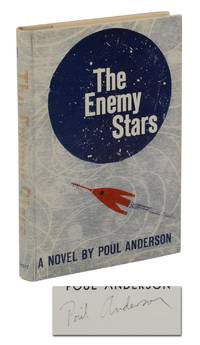
1959140945179Philadelphia: J.B. Lippincott Company 1959. First edition. First edition. Signed by Poul Anderson on title page. 189 pp. Bound in publisher's gray cloth with dark navy stamping. Fine in Very Good dust jacket sunned spine panel closed tear along joint at foot slight crease to back panel. A sci-fi novel with a jacket designed by children's author and artist Eric Carle. J.B. Lippincott Company unknown
17-1591Berkeley CA: American Artwork 2018. 8vo. 248 pp. Very Good. Soft Cover. Color plates throughout. 2 copies available. From the Collection of the Art Historian Peter Selz. Berkeley, CA: American Artwork, 2018. paperback