[MAGIC LANTERN SLIDES].Biblio.com
286 résultats
1900G1ADNMOA0S9LKopenhagen 1900. Housed in the original publisher's wooden boxes. Includes 2 original projectors and 1 camera. More than 400 glass slides depicting various motifs related to coal mining chemical processes and astronomy as well as topographical motifs from Asia Africa China Europe and America. Remarkable all-encompassing collection of turn-of-the-century magic lantern slides. Several of the slides show cavalry horses: the "Krigen 1848-1864" set includes no. 45 an equestrian portrait of General Bülow victor of the 1849 Battle of Fredericia painted by Aug. Jerndorff; no. 29 Friedrich von Schleppegrell riding at the battle of Isted; no. 26 General Krogh on horseback all V. Richter Kopenhagen; no. 20. captioned "Pferdeablieferung" horse delivery.A box lebelled "København" includes: no. 21 Brandmajoren rykker ud; no. 20 a fire at the time of King Frederik VI of Denmark d. 1839.Other slides show workhorses in Denmark and Sweden during haying-time or spreading manure as well as works of the Danish painter Otto Bache: the Coronation of Christian IV in 1596; the conspirators escaping from Finderup on horseback after having murdered Eric V of Denmark in 1286. The collection also contains copies of paintings by various artists such as Leonardo da Vinci Raphael and Rembrandt. Among the remaining slides we find astronomical illustrations and pictures of observatories Greenwich Delhi Potsdam etc.; as well as numerous photographs and paintings of landscapes people and architecture in Africa Asia Europe China and America. unknown
1833ST12867New York: N. C. Nafis 1833. 144 x 85 mm. 5 5/8 x 3 3/8". 71 pp. <br/> PUBLISHER'S ORIGINAL GRAY-GREEN PRINTED BOARDS upper cover with titling and an illustration of a gentleman identified as the author lower cover with two amusing woodcuts "The Lawyer and his Client" a bewigged gentleman astride an ass and "Hocus Poke-us" two boys fighting. In a brown cloth chemise and a slightly rubbed matching calf-backed slipcase. With a folding frontispiece depicting a conjurer and his assistant onstage before an amazed crowd. Toole-Stott 724. ◆Small stains at top and bottom of spine covers just slightly grubby endpapers a bit browned text with light inoffensive foxing but for what it is AN UNUSUALLY FINE COPY the fragile binding entirely sound and the text remarkably fresh and clean.<br/> <br/> Given the materials it was made from and the hard use it would have been expected to suffer this is an exceptionally well-preserved copy of a popular handbook of conjuring tricks an early American edition of a work first compiled in 1722 by the British magician Henry Dean. Dean's work was itself based on Reginald Scot's influential "Discoverie of Witchcraft" 1584 which sought to discredit belief in "supernatural" forces by exposing the tricks by which conjurers deceived their audience. In the publications of Dean and subsequent editors this exposé of witchcraft evolved into a guide for performing parlor tricks. Our edition is a reprint or reissue of the 1831 version published by R. Schoyer; because the word "renowned" is spelled "renowed" on both title pages Toole-Stott speculates that Nafis bought sheets from Schoyer suggesting that our item would have been a reissue. These insubstantial guide books typically experienced considerable uncareful use in the hands of amateur and often juvenile magicians; consequently the few copies that do appear on the market are in deplorable shape. N. C. Nafis unknown
1805303284-1Berlin u. Stettin, Nicolai 1789-1805. Mit 241 Kupferstichen auf 239 Tafeln (so komplett!). Pbde. d. Zt.
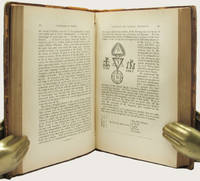
188634453London: George Redway 1886. Very Rare First Edition. Illustrated within the text with various symbols relating to magic and the genre. 8vo bound in early half-calf over marbled paper covered boards. xliii 1 349 1 pp. A rare survival the text-block quite clean and very well preserved the binding with evidence of use and age with rubbing to the extremities. VERY RARE AND THE TRUE FIRST EDITION VERY SELDOM ENCOUNTERED IN COMMERCE. Perhaps the first truly significant publication of Lévi's work in the English language. R. A. Gilbert tells that Waite was fascinated by the quotes from Lévi that he read in Blavatsky's "Isis Unveiled" 1877 and that Waite promptly acquired a copy of Lévi's major work "Dogme et Rituel de la Haute Magie" which he began translating into English. In 1885 Waite suggested to the prominent Theosophist A. P. Sinnett that an anthology of Lévi's writings based on these translations would make a good book. Sinnett evidently agreed and recommended him to the publisher George Redway who took on the project thus beginning what would turn out to be a lengthy collaboration with Waite. In addition to translating and editing Lévi's essays Waite contributed a Biographical and Critical Essay. Gilbert B1. Weiser <br> In the preface to The History of Magic Waite enumerates what he believed to be the nine key tenets of magic as codified in Levi's earlier work Doctrine and Ritual of Transcendental Magic.<br> They are: 1 There is a potent and real Magic popular exaggerations of which are actually below the truth. 2 There is a formidable secret which constitutes the fatal science of good and evil. 3 It confers on many powers apparently super-human. 4 It is the traditional science of the secrets of Nature which has been transmitted to us from the Magi. 5 Initiation therein gives empire over souls to the sage and full capacity for ruling human wills. 6. Arising apparently from this science there is one infallible indefectible and truly catholic religion which has always existed in the world but it is unadapted for the multitude. 7 For this reason there has come into being the exoteric religion of apologue parable fable and wonder-stories which is all that is possible for the profane : it has undergone various transformations and it is represented at this day by Latin Christianity under the obedience of Rome. 8 Its veils are valid in their symbolism and it may be called valid for the crowd but the doctrine of initiates is tantamount to a negation of any literal truth therein. 9 It is Magic alone which imparts true science. Levi<br> The three chief components of Levi's magical thesis were: Astral Light the Will and the Imagination. <br> "Eliphas Lévi" the name under which he published his books was his attempt to translate or transliterate his given names "Alphonse Louis" into Hebrew .In 1854 Lévi visited England where he met the novelist Edward Bulwer-Lytton who was interested in Rosicrucianism as a literary theme and was the president of a minor Rosicrucian order. With Bulwer-Lytton Lévi conceived the notion of writing a treatise on magic. This appeared in 1855 under the title Dogme et Rituel de la Haute Magie and was translated into English by Arthur Edward Waite as Transcendental Magic its Doctrine and Ritual . Its famous opening lines present the single essential theme of Occultism and gives some of the flavor of its atmosp:Lévi's version of magic became a great success especially after his death. That Spiritualism was popular on both sides of the Atlantic from the 1850s contributed to this success. His magical teachings were free from obvious fanaticisms even if they remained rather murky; he had nothing to sell and did not pretend to be the inititate of some ancient or fictitious secret society . He incorporated the Tarot cards into his magical system and as a result the Tarot has been an important part of the paraphernalia of Western magicians. He had a deep impact on the magic of the Hermetic Order of the Golden Dawn and later on the ex-Golden Dawn member Aleister Crowley . It was largely through the occultists inspired by him that Lévi is remembered as one of the key founders of the twentieth century revival of magic." wiki<br> Arthur Edward Waite was a scholarly mystic who wrote extensively on occult and esoteric matters and was the co-creator of the Rider-Waite Tarot deck. As his biographer R.A. Gilbert described him "Waite's name has survived because he was the first to attempt a systematic study of the history of western occultism — viewed as a spiritual tradition rather than as aspects of proto-science or as the pathology of religion." Waite was a prolific author with many of his works being well received in academic circles. He wrote occult texts on subjects including divination esotericism Rosicrucianism Freemasonry black and ceremonial magic Kabbalism and alchemy ; he also translated and reissued several important mystical and alchemical works. His works on the Holy Grail influenced by his friendship with Arthur Machen were particularly notable. wiki George Redway hardcover
180331718BBBerlin/Wien Pauli/Trattnern 1784-1803. 16 Bände. 8°. Mit insgesamt 115 gestochenen Kupfertafeln. Mit elektrischen, chemischen, metallurgischen, mechanischen und ökonomischen Versuchen. Band 1-4: Halbleder, Rückenschilder, Rückenvergold., 5 Bünde, 3seitiger Rotschnitt - Band 1-9/11-12 Halbleder, Rückenschilder, Rückenvergold., 5 Bünde, 3seitiger Rotschnitt. Band 10 Pappband. Einbände berieben und bestossen, Seiten mit Bräunung, teils fleckig, insgesamt sauber und gut erhalten.
180163820Berlin, Joachim Pauli, 1788-1801. 8°. Mit 12 (2 ankolor.) gest. Titelvignetten u. 84 gefalt. Kupfertafeln. Zus. ca. 7.000 S., HLdr.-Bde. d. Zt. m. etw. Rückenverg., goldgepr. Rückenschildern u. dreiseitigem Farbschnitt.
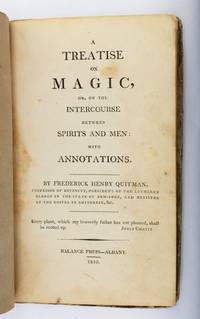
1810ST17557<p>Albany New York: Balance Press 1810. FIRST EDITION. 170 x 103 mm. 6 3/4 x 4". vi 76 pp. Errata slip tipped onto final page. <br />Contemporary marbled boards backed with sheepskin smooth spine divided into panels by single gilt rules. Front free endpaper with bookplate of the Ricky Jay Collection. Front pastedown with neat early owner's signature pencilled initials "M. A." in a juvenile hand adjacent to a rudimentary pencil sketch of two people; rear pastedown with pencilled signature of Sally E. Original errata slip pasted onto bottom half of final page the slip defective at lower left corner. Sabin 67364; Shaw & Shoemaker 21169. Sheepskin a bit rubbed marbled paper boards somewhat chafed stained and quite worn at corners endpaper a bit spotted torn or at back missing other minor defects but the unsophisticated original insubstantial binding still solid. Title page and front flyleaves with light dampstain to gutter and tail margin a little foxing and faint browning other imperfections but the volume still generally clean and surprisingly fresh despite its cheap paper.<br /><br />Written by a Lutheran minister in upstate New York this entertaining treatise gives a brief history of the supernatural from ancient times to the present day and seeks to educate the audience about the dangers and follies of harboring magical beliefs noting that "witchcraft can never take root unless it be supported by credulity." According to the author's preface Frederick Henry Quitman 1760-1832 was motivated to write this work after a neighbor's home was besieged by supposed "supernatural" occurrences that included thrown stones and theft. Even though Quitman a staunch skeptic endeavored to attribute the activity to mischievous entities of the human variety the damage had been done: "Scarcely had the rumour about the forementioned witchcraft a little subsided when we heard the report of the appearance of apparitions in several quarters of the town. And it is really to be feared that during this dull winter all the corners of the town for want of other employment will be infested with demons." The Annotations at the end of the book contain many amusing definitions and descriptions of such things as talismans popular magic gothic novels and ventriloquists. Our copy was owned by the eminent magician actor writer scholar and sleight of hand artist Ricky Jay 1946-2018. In their catalogue Sotheby's notes that "Ricky Jay's accomplishments were as varied as are the formats and subjects of the material in his celebrated Collection . . . . He is one of the very select company of persons who assembled a collection of the very first rank in a field in which he was not only a world-renowned practitioner but also a scholar of considerable note." Our 1810 printing--the only early edition of this work--is rare on the market with RBH recording just four copies at auction in more than 60 years.</p> Balance Press
183919929Stuttgart, Scheible, 1839. Kl. 8°, 379; 342; 324; 340; 338; 342 Seiten mit 1 lithogr. Frontispiz-Portrait und 46 gefalteten Kupfertafeln. Marmorierte Pappbände der Zeit mit goldgeprägtem Rückenschild und 3seitigem Marmorschnitt.
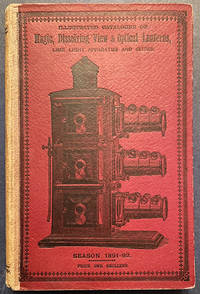
1891BB112<i>Magic Lantern Catalogue<br /></i><br /><b><i>Illustrated Catalogue of Magic</i></b> Dissolving View & Optical Lanterns Lime-light Apparatus and Slides. <br /><br />Rare generic trade catalogue for the entire industry almost certainly <br /><br />London 1891-92 but without imprint. <br /><br /><i>Wood-engraved illustrations of magic lanterns accessories and occasionally the projected image. <br /></i><i><br />8vo. 352 pp. with </i><i>detailed listings of sets of slides all with prices and various types of magic lanterns with optical projections a few pages browned pp 44/45; </i><i>original pictorial cloth lettered in black a little rubbed front cover beginning to warp. </i> No imprint, hardcover
1885WRCAM37786Providence: What Cheer Print 1885. Broadside 29 1/4 x 10 1/2 inches. Accompanied by 6 1/2 x 8 1/4-inch wood engraving signed by Jackson's Print. Printed on inexpensive advertising paper now a light brown tone. Three minor holes one barely affecting the image. Very good. A marvelous and extremely rare example of late 19th-century American advertising ephemera for Prof. H.B. Reynolds "the world renowned sorcerer necromancer and magician." The wood engraving shows the Professor on stage with a few of the elements to be seen during his performances including demons birds and cards in various stages of flight; a boiling cauldron; two separate card displays; and a table with three objects used in the act including an additional demon's head. The text of the broadside which is nearly two and a half feet in height details the wonders the audience will see. These include "original and more marvellous illusions than was sic ever performed by the Ancient Egyptians or the Necromancer of India.The wonderful power of producing realities from nothing and commanding articles to be constructed from the ashes of the earth.His marvellous power of conjuring is manifested by merely asking for or moving his hand that his desires are complied with." Reynolds also claimed to be "cabalistic in his superiority of multitude of mankind allowing himself to be bound with 100 feet of cord in the hands of the most expertitious in knot tying; when in a moment of unseen gesture he frees himself from the cords that bound him and is found within the silent enclosure of a structure whose walls have been permanently secured with screens and nails locked and sealed and bound with ropes." <br> <br> Although much detail is provided regarding Reynolds' skills and attributes the actual place of performance is not indicated. Space was intentionally left blank for the name of the venue to be added when available but the price of admission "15 and 25 cts. Children under 10 years 15 cents" and performance times "Doors open at 7 p.m. Oracles 8 p.m." are noted. Printed in Providence the name of the printing house What Cheer Print is derived from the Narragansett Indian's greeting to Roger Williams in June 1636 "What cheer Netop" friend. <br> <br> A fascinating example of late 19th-century American advertising ephemera. Extremely rare not in OCLC but one copy in the Smith Magic Collection at Brown University. What Cheer Print unknown books
1839303248-1Stuttgart, Scheible 1839. Kl.8°. 376; 342; 324; 340; 338; 342 S. Mit lithogr. Porträt u. 46 lithogr. Tafeln. Marmor. Pappbände d. Zt.
189010821ABO.O, o.J. (ca. 1890). 46 : 29 cm. 8 Seiten Anleitungen Mit ca. 30 verschiedenen Hilfsmitteln zur Vorführung von Zaubertricks. Original-Pappkasten mit farbiger Deckelillustration.
1801306156London: Printed for G. Kearsley Fleet Street; Bell and Bradfute Edinburgh; and Brash and Reid Glasgow by W. Glendinning 1801. First English edition. xix i errata 397 3 publisher's ads pp. 8vo. Contemporary half leather over gray paper-covered boards. Covers worn joints cracked but sewing sound lacking spine label text block roughly trimmed occasional light soiling along lower blank margins. Remnant of contemporary bookplate. In a custom redpaper slipcase and matching chemise. First English edition. xix i errata 397 3 publisher's ads pp. 8vo. The first English edition of this quite unusual and very entertaining compendium of conundrums problems parlor tricks and "interesting facts" - it is actually much more fun than the title would seem to suggest. The first French edition was published in London in 1799 under the title Choix d' amusements physiques et mathématiques. The work includes tricks with cards magic squares magic lanterns feats of artificial memory and proto-spiritualist conjuring through "palingenesy" by which a performer can make the images of the dead appear in a glass jar plus other optical illusions. A large collection of mathematical and physical curiosities including chapters on arithmetic "To arrange 30 criminals in such a manner as to save 15 of them &c." "A lady lamenting that her age was triple that of her daughter" and amusing "secrets" "To make people in a room have a hideous appearance". Toole Stott 240 Printed for G. Kearsley, Fleet Street; Bell and Bradfute, Edinburgh; and Brash and Reid, Glasgow, by W. Glendinning unknown
1801306156London: Printed for G. Kearsley Fleet Street; Bell and Bradfute Edinburgh; and Brash and Reid Glasgow by W. Glendinning 1801. First English edition. xix i errata 397 3 publisher's ads pp. 8vo. Contemporary half leather over gray paper-covered boards. Covers worn joints cracked but sewing sound lacking spine label text block roughly trimmed occasional light soiling along lower blank margins. Remnant of contemporary bookplate. In a custom slipcase and chemise. First English edition. xix i errata 397 3 publisher's ads pp. 8vo. The first English edition of this quite unusual and very entertaining compendium of conundrums problems parlor tricks and "interesting facts" - it is actually much more fun than the title would seem to suggest. The first French edition was published in London in 1799 under the title Choix d' amusements physiques et mathématiques. The work includes tricks with cards magic squares magic lanterns feats of artificial memory and proto-spiritualist conjuring through "palingenesy" by which a performer can make the images of the dead appear in a glass jar plus other optical illusions. A large collection of mathematical and physical curiosities including chapters on arithmetic "To arrange 30 criminals in such a manner as to save 15 of them &c." "A lady lamenting that her age was triple that of her daughter" and amusing "secrets" "To make people in a room have a hideous appearance". Toole Stott 240 Printed for G. Kearsley, Fleet Street; Bell and Bradfute, Edinburgh; and Brash and Reid, Glasgow, by W. Glendinning unknown books
180263050Graz, Christian Friedrich Trötscher, 1802. 8°. Mit einigen Holzschn.-Vignetten u. 2 gefalt. Tabellen. Zus. ca. 880 S., Ppbde. d. Zt. goldgepr. Rückenschildern.
18334360CBBerlin, Theod. Chr. Friedr. Enslin, 1833. Kl.-8°. VIII, 414 Seiten, 1 weißes Blatt, 22 Kupfertafeln mit 79 Abbildungen. OPp., Abbildung
1875WRCAM54787Buffalo: Courier Company Show Printing House 1875. Broadside 42 1/2 x 14 inches. One long diagonal tear from the top edge running into the large engraved image short closed tear in top margin. Very good. Mounted on linen and framed. An illustrated broadside printed on yellow paper announcing and describing a performance by the Austrian magician and showman De La Mano. His real name was Zell Dreitzehn and he performed for several years in the United States before he himself disappeared in upstate New York in 1882. A central engraving depicts Dreitzehn performing before a crowded theater audience while several smaller images show some of his various acts which are also listed. These includes tricks such as "The Enchanted Cross" "The Great East India Dagger Mystery" and "The Magic Omelet" among others. The broadside state in part: "This is no exhibition of Doubtful Merit but a permanently established and legitimate entertainment exhibited with pride and pleasure." <br> <br> An entertaining and rare example of 19th- century magic ephemera. OCLC records just one copy at the American Antiquarian Society. There is also a copy in the theatre collection at Harvard. OCLC 191290995. Courier Company Show Printing House unknown books
183719495Skippacksville Pa.: gedruckt bei A. Puwelle 1837. Some foxing; boards and spine a bit warped front hinge nearly cracked through; a good sound copy of an uncommon edition. 12mo contemporary black calf spine marbled boards 123 1 pages. An early edition of Hohman's well-known folk magic and remedy book first published in Reading in 1820 this edition predating the English translation. This copy includes the evidence of a contemporary ink autograph blotted SATOR square charm on its front free endpaper. American Imprints 45115. gedruckt bei A. Puwelle, unknown books
1893326724London: E.A. Beckett 111 & 113 Kingsland Road 1893. First Edition. Two folding plates of the Docwra Triple machine and numerous text illustrations. iv 195pp. 8vo. Original publisher's green cloth. First Edition. Two folding plates of the Docwra Triple machine and numerous text illustrations. iv 195pp. 8vo. E.A. Beckett, 111 & 113 Kingsland Road unknown
1835303241-1München, Lindauer 1835. XVI, 407 (1) S. Mit 4 Kupfertafeln. Original-Pappband
180665180Berlin-Stettin, Friedrich Nicolai, 1806. 8°. Mit 13 gefalt. Kupfertafeln. 1 Bl., VI, 230 S., S. [VII-]VIII, Marmor. Ppbd. d. Zt. m. etw. Rückenverg., goldgepr. Rückenschild u. gespränkeltem Rotschnitt.
1858AQ34883Hartford Connecticut: Calhoun Printing Company 66 State St. 1858. Large single leaf playbill printed within elaborate woodcut border. A fine copy. A finely preserved - and remarkably detailed - blank playbill for the elaborate combination of 'astounding novelties' performed by the showman magician and ventriloquist Albert Walker 1831-1899. Designed - as evidenced by the blank spaces - to be used in multiple locations with the time date and location to be completed in manuscript this broadside nevertheless is not short on detail of the programme involving several card tricks sleight of hand fire- eating Punch and Judy and ventriloquism to be performed: 'The following programme is merely intended as a foundation of Feats to be varied at each entertainment many of which are his own invention and have never before been attempted in America. The Wonderful fear of Santa Claus or the Juvenile Toy Shop. The Spanish Pin and Traveling Philosopher. The Changeable Cash or the Gambler outwitted. The Restored Card.The Flying Grain in which the assistant is frightend out of his mother wit. Suprising dexterity with Cards. The Flight of Rice.Prince Alladin's Glass or Chant of Electric Silver. This is a beautiful fear. -In this glass a piece of silver will dance and keep time with any tune played by the Orchester even when held by one of the audience'. The quotes reprinting 'opinions of the press' to the foot of this playbill provide the date. In 1858 at Worcester a reporter from the Munroe Democrat noted that 'On last saturday and Monday A. Walker favored our citizens with several entertainments consisting of magic ventriloquism music and fun of various sorts'. Rare; OCLC locates copies at just two locations worldwide Connecticut Museum of Culture and History and Michigan. . Dimensions 230 x 585 mm. Calhoun Printing Company, 66 State St. unknown
1880WRCAM54806N.p. likely Buffalo N.Y. 1880. Broadside 24 x 4 3/4 inches. Two small areas of discoloration near bottom edge else fine. Mounted and framed. A slim illustrated broadside printed on tan paper announcing and describing a performance by the Austrian magician and showman De La Mano here billed as French. His real name was Zell Dreitzehn and he performed for several years in the United States before he himself disappeared in upstate New York in 1882. The broadside offers a "Night of Mystery" and "Two Hours of Fun" for attendees who should expect to be treated to illusions such as "The Bird Cage of Leah" "The Mesemerized Cards" "The Aerial Suspension" "The Witches Knot" "The Chinese Paradox" "The Great 'Hindoo Box' Mystery" and "a Thousand and One other tricks." Three small illustrations depict scenes from De La Mano's act including the transformation stand the Inexhaustible Bottle and the Miser's Dream. The Inexhaustible Dream illustration is credited to "Mitchell Buffalo." <br> <br> The broadside claims: "This is no exhibition of doubtful merit but a permanently established and legitimate entertainment exhibited with pride and pleasure. Prof. De La Mano has traveled extensively in the Southern and Eastern States and has gained a reputation as a Magician excelled by none." <br> <br> A rare theatrical advertisement from a bygone age with only two copies listed in OCLC at the American Antiquarian Society and the Clements Library. OCLC 191290992 and 83859708. unknown books
1894Q121136Paris-Lyon, Delhomme et Briguet s.d. [ca. 1892-1894] Ouvrage complet en 2 volumes, 964,[56] + 960,[48] pp., avec plus de 120 portraits et illustrations dans le texte, 27cm., reliures uniformes cartonnées très solides et en bon état (br. orig. conservées et contrecollées aux plats et dos), texte très frais, bon état, rare, cfr. Caillet no. 4917, poids: 3.9kg., [A la fin du tome 1, on a relié: "Le diable au XIXe siècle. Bulletin mensuel (complément de la publication)" fascicules no.5 (5 aout 1893, 4pp.), no.10 (5septembre 1893, 8pp.), no.11 (5 octobre 1893, 8pp.), no.12 (novembre 1893, 4pp.), & no.1 (Janvier 1894, 32pp.) // A la fin du tome on a relié ce même bulletin, fascicules no.13 (décembre 1893, 4pp.), no.14 (janvier 1894, 4pp.), no.15 (février 1894, 4pp.), no.16 (mars 1894, 4pp.), no.17 (avril 1894, 4pp.), no.18 (mai 1894, 4pp.), no.19 (juin 1894, 4pp.), no.20 (juillet 1894, 4pp.), no.21 (aout 1894, 4pp.), no.22 (septembre 1894, 4pp.), no.23 (octobre 1894, 4pp.) & no.24 (novembre-décembre 1894), 4pp.) ], Q121136
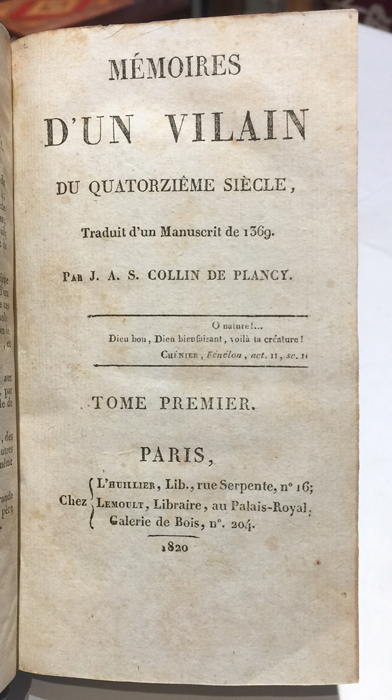
18203013Paris, L'Huillier et Lemoult (imp. de Pierre Gueffier), 1820 ; deux tomes in-12, reliés en un volume demi-veau vert foncé, dos lisse à faux-nerfs dorés, fleurons dorés, titre doré (reliure mi-XIXe) ; 284 pp., (2) ff., 248 pp.