179 résultats
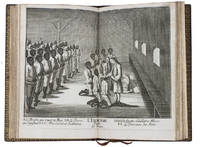
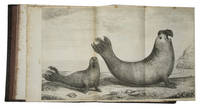
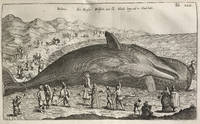
1767S13771Heilbronn:: Franciscus Josephus Eckebrecht 1767. 1767. Tall 4to. 335 x 211 mm 228 4 pp. 47 plates; text with some foxing. Original paper over boards. Housed in a custom clamshell box. Rare. FINE. An extensive work on the morphology of boned fish cartilaginous fish sharks rays skates and cetaceans. This work is illustrated with forty-seven full-page engraved plates that are executed in superb form. Plate XLII shows a beached baleen whale and its enormous size compared to the men in the engraving. A bit fanciful plate XL shows a pair of Mermen; a fish on plate XXVII has the features of a human face whilst a 'shark' on plate VII has semi-human fore-limbs. Except for these anomalies the zoological drawings are quite dramatic and relatively accurate. Jonston's works were frequently re-edited and translated into German Latin Dutch and English. Born in Poland but of Scottish origin Jonston was educated and traveled extensively. He attended St. Andrews 1623-5 studying botany and medicine at Cambridge Leiden and Frankfurt Universities. He earned degrees from Cambridge and in Leiden his M. D. in 1632 where he later practiced medicine and gained a great reputation. In 1642 he briefly taught at Frankfurt as professor of medicine. He retired to his private estate in Silesia in 1655. His "four dictionary-style works on fish birds quadrupeds and insects -- published between 1650 and 1653 with excellent illustrations -- were widely read and translated." DSB. BM Readex Vol. 13 p. 765; DNB Vol. X pp. 968-9; DSB Vol. VII p. 164-5; Nissen 2133. See Garrison and Morton 287. Franciscus Josephus Eckebrecht, 1767. hardcover books
1767S13771Heilbronn:: Franciscus Josephus Eckebrecht 1767. 1767. Tall 4to. 335 x 211 mm 228 4 pp. 47 plates; text with some foxing. Original paper over boards. Housed in a custom clamshell box. Rare. FINE. An extensive work on the morphology of boned fish cartilaginous fish sharks rays skates and cetaceans. This work is illustrated with forty-seven full-page engraved plates that are executed in superb form. Plate XLII shows a beached baleen whale and its enormous size compared to the men in the engraving. A bit fanciful plate XL shows a pair of Mermen; a fish on plate XXVII has the features of a human face whilst a 'shark' on plate VII has semi-human fore-limbs. Except for these anomalies the zoological drawings are quite dramatic and relatively accurate. Jonston's works were frequently re-edited and translated into German Latin Dutch and English. Born in Poland but of Scottish origin Jonston was educated and traveled extensively. He attended St. Andrews 1623-5 studying botany and medicine at Cambridge Leiden and Frankfurt Universities. He earned degrees from Cambridge and in Leiden his M. D. in 1632 where he later practiced medicine and gained a great reputation. In 1642 he briefly taught at Frankfurt as professor of medicine. He retired to his private estate in Silesia in 1655. His "four dictionary-style works on fish birds quadrupeds and insects -- published between 1650 and 1653 with excellent illustrations -- were widely read and translated." DSB. BM Readex Vol. 13 p. 765; DNB Vol. X pp. 968-9; DSB Vol. VII p. 164-5; Nissen 2133. See Garrison and Morton 287. Franciscus Josephus Eckebrecht, 1767. hardcover
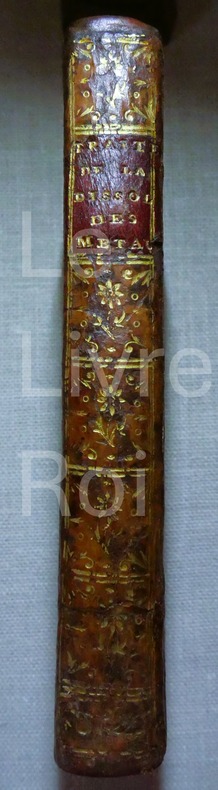
177513cb6in12 plein veau marbré. Pièce de titre rouge - titres, caissons, et fleurons dorés, tranches rouges. VIII+352 pp. Dissolutions du fer - dissolutions du cuivre - dissolutions de l'or - dissolutions de l'argent - dissolutions de l'étain - du plomb, du zinc, du bismuth, de l'antimoine, du cobalt, de l'arsenic et du mercure
171858200Various places including Camp Sprague Camp Brightwood and Douglas Hospital Washington D.C. July 10 1861 - June 7 1862. Fine original condition; postage clipped from envelopes. 8vo. The first letter is written from Hopeville Connecticut prior to enlistment. Subsequent letters describe the trip to Washington D.C. the camp there R.I. prisoners taken at Bulls Run; the capture of a spy bad news from "Missouria" entrenchment work rumors of the death of Jeff Davis passing within 30 ft. of Lincoln "He looks just like the pictures I have seen of him" and many other interesting details. Green had become a hospital orderly by early 1862 and describes hospital conditions sightseeing in wartime Washington and news from the battlefields. unknown
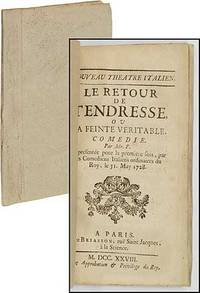
172878892Paris: Chez Briasson 1728. Softcover. Near Fine. First edition. Text in French. 52pp. Bound in old but probably later unprinted wrappers. An ink blot on the inside of the front wrap slight foxing to the pages a near fine copy. An Italian-style comedy play. Very scarce. OCLC locates no copies of this edition and only three copies of a 1729 printing. Chez Briasson unknown
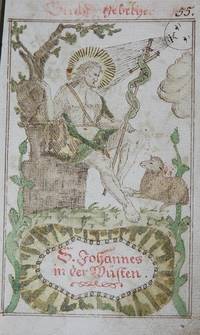
1797006602Keuth an der Crassen 1797. Full Blindstamped Calf. Good. A fine Folk Art manuscript prayer book from the late eighteenth century. 8vo. 17.5 by 10.5 cm. 3 516 13 1 pp. With eight full page paintings plus vignette decoration throughout. Besides the ubiquitous floral ornamentation all pretty accents the vignettes include a serpent a basilisk a skull etc. Most writing is a neat now archaic cursive but headings and the like rendered in an easily readable ornamental Fraktur Gothic. The paintings are the highlight most will find. Their subject matter is quintessential -- Momento Mori Saint Michael slaying the dragon Saint John in the desert Saint Sebastien the Christ child King David playing a harp etc. But while the subject matter may not be unusual the execution is done with uncommon flair even though it is resolutely naive or Folk Art. And the artist who we assume is one or both of the writers may be illustrating popular subjects there are original elements in his/her imagery or imagining of the subject. The authorship is stated but also a tad confusing. Our interpretation is that a Konrad Mueller created the book for Margaretha Pfaden-Hauerin. Condition: moderate wear to contemporary full calf binding. Unusual is a 13 page "Register" or Table of Contents in the rear. By unusual we mean for such a manuscript prayer book. Also a page of handwritten genealogical notes written on a prior blank leaf and written much later in the mid to late 19th Century. Moderate sometimes heavy soiling to margins of leaves. Corner cut out of front endpaper. Some loose gatherings. unknown
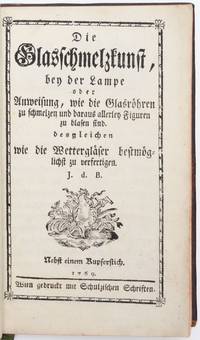
17691430Wien: gedruckt mit Schulzischen Schriften 1769. First edition. In contemporary leather. Spine gilt with red title vignette. Edges tinted. Woodcut headpiece on A1. Pages ruled with woodcut frame. Light brown stains on the plate. Otherwise clean. In fine condition. First edition. In contemporary leather. Spine gilt with red title vignette. Edges tinted. Woodcut headpiece on A1. Pages ruled with woodcut frame. 1 title page verso blank a–b8 c6 i.e. 24 leaves and 1 folded plate. <p><br /> A curious and scarce treatise on glassblowing and the making of scientific glass objects. <br /> <p><br /> <p><br /> The book is illustrated with an engraved plate showing a glassmaker or lampworker at his working table surrounded by examples of his craft various scientific apparatuses a Cartesian devil a glass eye and elaborate glass-figurines and a centerpiece whose technique of making together with the detailed instruction for manufacturing thermometers hydrometers barometers is described in the text. <br /> <p><br /> <p><br /> The author of Die Glasschmelzkunst remained unrevealed hidden behind the initials of “J. d. Bâ€. The second edition was published under different initials of “A. Z. G†Brünn: Tascher 1824. Both editions are often attributed erroneously to Karl Moritz Diesing 1800–1867. Duncan in the Bibliography of Glass attributes it to Disting. <br /> <p><br /> <p><br /> Duncan 3269.<br /> <p>. gedruckt mit Schulzischen Schriften unknown
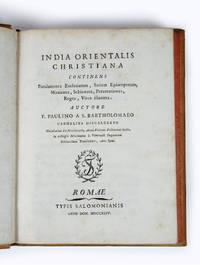
17943703905Rome: Typis Salomonianis 1794. Three works bound together quarto the first main work with folding map 2 plates and an engraved portrait vignette with two shorter pamphlets 24 & 26 pp.; an attractive copy in contemporary patterned vellum boards spine banded red morocco spine label faded. <p><p>Three works by Paulinus including his important India Orientalis Christiana a study of and introduction to the Carmelite missions in India in the late eighteenth century in a particularly attractive contemporary binding. The work is illustrated with two plates and a fine map of India as well as a smaller vignette portrait of Paulinus himself. Paulinus of St Bartholomew 1748-1806 also known as Johann Philipp Werdin or Wesdin was a missionary and orientalist. A member of the Carmelite Order in 1774 he was sent to India Malabar where he was appointed vicar general of his order. In 1789 he was recalled to Rome in order to report on the mission and given the task of preparing books for the use of missionaries.</p> <p>One of the first Orientalists to note and work on the close relationship between Indian and European languages Paulinus was the author of many learned studies on the east and is best known for having published the first Sanskrit grammar. As an antiquarian who worked from original sources he was fortunate to have the patronage of Cardinal Stefano Borgia 1731-1804; a good Borgia whom he served as private secretary and who financed many of his publications. Both men served long periods on the Congregatio de Propaganda Fide a body preoccupied with exotic languages insofar as they impacted on spreading the christian gospels but also in understanding exotic theologies. In this context the Propaganda Fide was a central recipient of missionary collecting in the field which gave Paulinus exceptional advantages which enabled him to undertake extensive linguistic studies.</p> <p>After Borgia's death his remarkable library and museum were gradually distributed with the important biblical manuscripts mostly being added to the Vatican libraries after the secular materials had chiefly made their way to the national library of Naples.</p> <p>The two rare pamphlets bound in here are both concerned with Borgia's museum: Scitismo Sviluppato. del Museo Borgiano Rome c. 1793 and Lettera. del Museo Borgiano Rome same period both written in Italian not Latin and both discussing the Museo Borgiano. Borgia was particularly expert on Coptic relics but here Paulinus discusses early Brahmanic and other Indian manuscripts in his collection.</p> <p>All of these works are rare although as often the pamphlets are the scarcer. Worldcat lists some 10 copies of the India Orientalis Christiana 2 copies of the Scitismo and only 1 of the Lettera.</p> </p> . Typis Salomonianis unknown
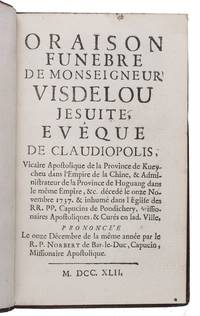
174289PBMXY3Z0MCAvignon: no publisher 1742. Contemporary calf gold-tooled spine with red label marbled endpapers red edges. 8vo. Second or third edition of the funeral oration for the sinologist and mathematician Claude de Visdelou 1656-1737 by Father Norbert of Bar-le-Duc 1703-1769 dedicated to Pope Benedict XIV. The oration prooved highly important in the so-called Struggle of the rites in China between the Jesuit missionaries and the Chinese emperor and the Pope.The author of the oration Norbert de Bar-le-Duc a Capuchin monk 1716 and priest 1729 also known as Norbert de Lorraine Curé Pierre Parisot or Abbé Platel was sent to Malabar and later to Pondicherry in December 1736 after being appointed procurator of the French mission. He stayed for three years in Pondicherry where he soon came into conflict with the Jesuits on the same issue - the struggle of the now Malabaric rites -which had lead to Visdelous exile in the same Capuchin monastery in the same town. So the anti-Jesuit Father Norbert de Bar-le-Duc understandably delivered Visdelous funeral oration .An undated 4to edition that names no printer or place of printing appears to be the first edition of the funeral oration. Sommervogel and Cordier mention an 8vo edition nominally printed by Antoine Pereira in Cadiz though other sources suggest it was printed in Avignon with the same collation as our edition and published in the same year making the present edition the second or third.Fine copy with bookplate on inside front cover: ''Devie Prêtre''. Binding skilfully repaired; head of second fly-leaf damaged.l De Backer & Sommervogel VIII col. 843; Cordier Sinica 1100-1; Librairie Polak Coll. de M.M.: Extreme oriênt du 16e siècle au 20e siècle 305; Adelhelm Jann Die katholischen Missionen in Indien China und Japan 1915 passim; Claudia von Collani & Claudio Filippo Grimaldi S.J. Zur Ankunft des päpstlichen Legatien Charles-Thomas Maillard de Tournon in China in: Monumenta Scrica 42 1944 pp. 329-359; Robert Streit & Joh. Dindinger eds. Bibliotheca Missionum 7 1932 pp. 105-107; Biogr. univ. XLIII cols. 638-640; not in Lust. [no publisher], unknown
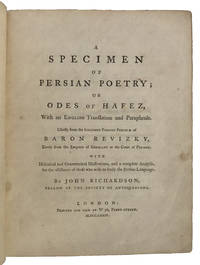
1774ME1081London:: Printed and Sold at No. 76 Fleet-Street 1774. 1774. 4to. iv xv 1 68 pp. Original full calf gilt spine; neatly rebacked to style preserving original endsheets. Inscribed by an early owner "This Book belonging to Monsieur Pierre Monneron." Extremely rare. This is the first edition in English of the ghazals of Hafez translated by one of the leading Persian orientalists of his day John Richardson FAS of Wadham College Oxford and famous for his seminal work written in conjunction with Sir William Jones the work being A Dictionary Persian Arabic and English 1777. / Hafez was previously unknown to the western world until Count Karl Emerich Reviczky von Revisnye 1737-1793 the Hungarian Orientalist and bibliophile 'discovered' him and brought his poetic classic to Europe with this Vienna printing. The work features an extensive text on Hafez and a translation of selected ghazals . Reviczky von Revisnye also issued in 1784 1794 a catalogue of his Greek and Latin library using the pseudonym of "Periergus Deltophilus". In the prefatory essay for that volume he shows an interest in the printing of Nicolas Jenson Aldus Manutius and the Estiennes. / Hafez was born in Shiraz Persia and lived approximately from 1325/26–1389/1390. He is considered a mystic and poet. His life and poems are the subject of much analysis commentary and interpretation influencing post-fourteenth century Persian writing more than any other author. FULL TITLE: A Specimen of Persian Poetry; or Odes of Hafez With an English Translation and Paraphrase. Chiefly from the Specimen Poeseos Persicae of Baron Revizky Envoy from the Emperor of Germany to the Court of Poland. With Historical and Grammatical Illustrations and a complete Analysis for the assistance of those who wish to study the Persian language. Printed and Sold at No. 76, Fleet-Street, 1774. unknown books
1759137120Paris: J. Barbou 1759. Full period French binding in Calf five raised bands gilt ornamentation on spine author and title in gilt on red leather spine label in second compartment. 8vo. Full period French binding in Calf five raised bands gilt ornamentation on spine author and title in gilt on red leather spine label in second compartment. 263 pages. First edition Bigmore and Wyman p.228. Minor soiling to the text block else a fine copy.<BR> <br /> <BR> <br /> In this volume Fournier sets out to prove that Gutenberg was not the inventor of the printing press by examining the history of printing. He believes that the technology Gutenberg made popular existed long before the German printer's work. <BR> <br /> <BR> <br /> "Peter Simon Fournier a French engraver and letter-founder was born at Paris 1712 and died 1768. He studied under Colson painter of the Academy of Saint Luc and devoted himself first to the art of wood-engraving; he afterwards as an engraver on steel rendered himself famous in all countries. In some of his works he seeks to prove that Gutenberg is not the inventor of printing and maintains that long before Gutenberg engraving on wood had been employed for printing images and inscriptions; that during his residence in Strasburg Gutenberg attempted the application of this art to the printing of books and that on his return to Mayence he first printed the Donatus and the Catholicon of Johannes de Janua with engraved and solid blocks. Fournier's ingenious theories were ably refuted by Baron Heinecken in his "Idée Générale d'une Collection complette d'Estamples" Leipsic: 1771" Bigmore & Wyman p 229. J. Barbou unknown
17161469Haarlem: Weduwe van Hermanus van Hulkenroy 1716. Early 19th-century marbled boards with a paper title label on the spine. 4to. With an etched frontispiece an etching of a mermaid on the title 2 folding etchings 2 full-page etchings and 21 etchings in the text all after Adriaen van Ostade. Further with musical annotation to all songs. First edition of a rare Dutch songbook with songs for farmer's festivals all with musical annotation. The work has been beautifully illustrated with etchings after the famous Dutch painter of country life Adriaen van Ostade 1610-1685. The fine etchings newly made and in reverse present an exemplary survey of Van Ostade's work showing busts of peasants women on their way to the market carrying baskets farmers smoking merry parties dancing in front of the farm a knife-grinder a schoolmaster etc. Together they give a lively impression of country life.The work was published anonymously but has been attributed to either Jan van Gijsen 1668-1722 or Aäron van Hulkenroy 1687-1733. Van Gijsen was a popular author who wrote a large number of occasional poems. His collected works were published at Amsterdam in three volumes in 1707-1711 but the present selection was probably published only once partly with the address of the Widow of Van Hulkenroy and partly with the address of J. van Egmont who had also published the collected works. Aäron van Hulkenroy was the son of publisher Hermanus van Hulkenroy and took over the publishing company after both his parents had passed. He was also a poet who wrote various poetry collections which were always published by his mother or later himself. The present work has been attributed to him because the very first poem on the verso of the half title is signed with his initials.The boards and spine are rubbed with some loss of material at the lower outer corner of the front board. The leaves and plates are somewhat foxed a small tear in the margin of first folding plate has been repaired on the back. Otherwise in good condition.l Goovaerts 1011; Cat. Muziekhist. Museum Scheurleer II p. 92; Scheepers I 284 "Hoogst zeldzaam"; Scheurleer Liedboeken 199 lists both 1716-issues; STCN 154032301; cf. Hollstein XV pp. 1-70 for the etchings; NNBW 8 col. 648 Gijsen and NNBW 4 col. 790 Hulkenroy; not in Arents Tobacco. Weduwe van Hermanus van Hulkenroy, hardcover
1758141839Paris: J. Barbou 1758. full brown leather border stamped in blind on the front and rear boards gilt ornaments on spine title in second compartment five raised bands all edges stained red marbled endsheets. small 8vo. full brown leather border stamped in blind on the front and rear boards gilt ornaments on spine title in second compartment five raised bands all edges stained red marbled endsheets. 1ff.-92 3 -263 pages. Pour éclaircir quelques traits de l"histoire de l'Imprimerie & prouver que Guttemberg n'en est pas l'Inventeur. Two works bound in one. Very rare first edition Bigmore and Wyman p.228. Private bookplate of Jackson Burke on the verso of the front free endpaper. Contemporary boards with some rubbing to the spine and extremities corners a bit worn gilt on the spine is lightly flaking evidence of bookplate removal to front and rear pastedowns. Else a fine copy of this very scarce work.<BR> <br /> <BR> <br /> Two works bound together. Complete titles are: Dissertation sur l'origine et les progrès de l'art de graver en bois 1758 and De l'origine et des productions de l'imprimerie primitive en taille de bois 1759.<BR> <br /> <BR> <br /> Fournier 1712--1768 was born in Paris and trained as a wood engraver. He later turned to steel engraving. In the first essay Fournier sets out to prove that Gutenberg was not the inventor of the printing press by examining the history of printing. He believes that the technology Gutenberg made popular existed long before the German printer's work. The second volume follows this up with further discussion of the origins of woodcut prints. <BR> <br /> <BR> <br /> Fournier wrongly disputes the dating of Mr. De Bure le Jeune concerning the Gutenberg Bible but he is the first with the help of an observation by Gerard Meerman to note the progressive increase in the number of lines per page in the early stages of Bible production. J. Barbou unknown
1758H6IG81I49TLCSaxony 1758. 8vo. Brown morocco Lyon ca. 1900 with gold-tooled turn-ins marbled end-papers headbands and ribbon marker in green red and yellow gilt edges signed by Louis GUÉTANT. With title-page printed in red and black and 16 numbered double-page engraved plates. 87 pp. First edition in French published one year after the first German edition of the first work attributed to David Cranz missionary in the Moravian United Brethren best known for his 1765 description of Greenland. The present work gives a history of the United Brethren their beliefs and their practices both in Europe and in their missions in America. The church was established in 1457 but the book concentrates on its history since its establishment in Herrnhut Saxony near the Moravian border under Count Nikolaus Ludwig von Zinzendorf in 1722. Under his guidance the church set up their mission in Greenland in 1733 and a 1747 act of Parliament under George II granted them permission to practice their religion freely in the British colonies in America. The illustrations show ordination induction baptism communion marriage exorcism an agape feast and other activities in the Moravian Church as well as their missionary work among black slaves in the West Indies 2 plates American Indians probably in Pennsylvania and native Greenlanders.With the gold-stamped leather armorial bookplate of Noé de Salvert. In very good condition with occasion light marginal foxing. The beautiful binding by the deluxe binder Louis Guétant active in Lyon ca. 1895-ca. 1920 is in fine condition with only a couple scratches on the back cover. A rare and important primary source for the Moravian United Brethren with remarkable plates of Greenland Eskimos American Indians and black West Indian slaves.l Brunet I col. 1258; James Ford Bell B-426; Sabin 7935 see also 97851 & note before 97846; KVK 3 copies; BN-OPALE plus 2 copies; Kirchenlexikon XVI cols. 324-336; not in Arctic Bibliography; Barbier; Church; Eberstadt; JCB; Quérard; Streeter. ABE CAT Alaska Canada & Greenland hardcover
175876869Paris: J. Barbou 1758. unbound cord tied housed in a green half-morocco goat over cloth boards clamshell case spine tooled in gold leaf with title author and date. large 12mo. unbound cord tied housed in a green half-morocco goat over cloth boards clamshell case spine tooled in gold leaf with title author and date. 92 3 pages. Pour éclaircir quelques traits de l"histoire de l'Imprimerie & prouver que Guttemberg n'en est pas l'Inventeur. Very rare first edition Bigmore and Wyman p.227. Unbound textblock lightly soiled with minor creasing at corners. Faint moisture staining throughout with some affecting the text. In this text Fournier sets out to prove that Gutenberg was not the inventor of the printing press by examining the history of printing. He believed that the technology Gutenberg made popular existed long before the German printer's work. Fournier also followed up this text with two additional works which are not present: De l'origine et des productions de l'imprimerie primitive en taille de bois 1759 and Observations sur un ouvrage intitulé Vindiciae Typographicae 1760. These two works provided further discussion of the origins of woodcut prints including a passage refuting popular belief about the origin wood engraving and some ideas for further study. <BR> <br /> <BR> <br /> Fournier 1712--1768 was born in Paris and trained as a wood engraver and type founder being a member of the 18th century dynasty of the well-known Fournier family. He later turned to steel engraving. He published a table of the proportions of the different printing characters whose purpose was to propose for all typefaces a fixed measurement in "typographic points" and a systematic gradation. He worked closely with the collaborators of the Encyclopédie providing the printer Le Breton with all the documentation relating to the typographic foundry and plans for his own instruments as well as providing Diderot with his collection of ancient alphabets. Finally after multiple disputes with his Parisian colleagues he became infamous for the printing of his famous Manuel Typographique 1764 1766 just prior to his death. J. Barbou unknown
1732B5857Amsterdam: Rudolf & Jacob Wetstein and G. Smith c.1732. 3 ff. unnumbered and fully engraved with 6 half page illustrations do according to Brunet account for pp. 265-270. Repaired marginal tear to title to Tome 2 repaired corner tear to 327/8; overall a near fine example of this finely illustrated work with text and plates clean and crisp. . Edition: First Edition Binding: Contemporary decorative calf; expertly rebacked; boards with central gilt medallions; spine with five 5 raised bands flanked by horizontal gilt fillet and decorative rolls with gilt designed corners and centres in compartments and gilt lettered title on morocco label on two; all edges red. Notes: Publius Ovidius Naso or Ovid 43 BC – AD 17/18 was a Roman poet who lived during the reign of Augustus. A contemporary of Virgil and Horace he is often ranked one of the three canonical poets of Latin literature and enjoyed enormous popularity. Augustus sent him into exile where he died. Today he is best known for his Metamorphoses a 15-book continuous mythological narrative written in the meter of epic and for works in elegiac couplets such as Ars Amatoria "The Art of Love" and Fasti. His poetry was much imitated during Late Antiquity and the Middle Ages and greatly influenced Western art and literature. The Metamorphoses remains one of the most important sources of classical mythology. <br>The Metamorphoses Ovid's most ambitious work was written in dactylic hexameter about transformations in Greek and Roman mythology set within a loose mytho-historical framework. The characters in this work undergo many different transformations. Within an extent of nearly 12000 verses almost 250 different myths are mentioned; each myth is set outdoors where the mortals are often vulnerable to external influences. The first book describes the formation of the world the ages of man the flood the story of Daphne's rape by Apollo and Io's by Jupiter; the second Phaethon and the love of Jupiter with Callisto and Europa; the third focuses on the mythology of Thebes with the stories of Cadmus Actaeon and Pentheus; the fourth on three pairs of lovers: Pyramus and Thisbe Salmacis and Hermaphroditus and Perseus and Andromeda; the fifth on the song of the Muses which describes the rape of Proserpina; the sixth on the rivalry between gods and mortals beginning with Arachne and ending with Philomela; the seventh on Medea as well as Cephalus and Procris; the eighth on Daedalus' flight the Calydonian boar hunt and the contrast between pious Baucis and Philemon and the wicked Erysichthon; the ninth on Heracles and the incestuous Byblis; the tenth on stories of doomed love such as Orpheus who sings about Hyacinthus as well as Pygmalion Myrrha and Adonis; the eleventh on marriages of Peleus and Thetis and the love of Ceyx and Alcyone; the twelfth moves from myth to history describing the exploits of Achilles the battle of the centaurs and Iphigeneia; the thirteenth discusses the contest over Achilles' arms and Polyphemus; the fourteenth moves to Italy describing the journey of Aeneas Pomona and Vertumnus and Romulus and the final or fifteenth opens with a philosophical lecture by Pythagoras and the deification of Caesar. The end of the poem praises Augustus and expresses Ovid's belief that his poem has earned him immortality.<br>In analyzing the Metamorphoses scholars have focused on Ovid's organization of his vast body of material. Ovid engages creatively with his predecessors alluding creatively to the full spectrum of classical poetry. <br><br>This 1732 first Amsterdam edition is superbly illustrated employing copper plate engravings attributed to the Dutch: Balthasar Bernaerts engraving c.1711–1737; Jacob Folkema 1692–1767; Wouter Jongman engraving c.1712–1744 Joseph Mulder c.1659/60-; Jan Schenk engraving c.1731–1746; Jan Wandelaar 1690–1759 Philip Van Gunst 1685–1732; the Flemish: Martin Bouche c. 1640–1693 Frederic Bouttats c.1610–1675 Peter Paul Bouche c.1646- and the French: Bernard Picart 1673–1733; after the works of the Dutch: Louis Fabritius Dubourg 1693–1775; Godfried Maes 1649-1700; Jan Punt 1711–1779; Jacob De Wit 1695–1754; the French: Charles LeBrun 1619–1690; Sebastien Leclerc 1637–1714; and the Italians: Giulio Romano 1499–1546; and Pietro Testa 1612–1650. <br> Size: folio 455 x300 mm Illustration: Illustrated with allegorical copper engraved frontispiece by Picart and onehundred twenty-nine 129 copper engravings throughout the text by and after illustrious and notable engravers and artists mostly listed under notes. Illustrations also include two 2 red and black ink printed titles each with a large vignette copper engraving; one 1 copper engraved vignette head piece introducing the dedication to the king; numerous in-text decorative wood-cut head and tail pieces and large thematic or ornamental rubricated initials. The French and Latin texts are in two parallel corresponding columns. Volume: Two tomes in one volume Provenance: watermarked on many leafs including on the 1.free endpaper and dedication to tome 1 as well as title to tome 2: “ BEAVUALS†at centre of leaf. 2.title and final page of tome 1: an upside-down design of a fleur de lis 3.lower free endpaper: “C D“ References: Brunet III: 599; Cohen-de Ricci: 768. Transation: Text in Latin with F Pages: Bl. 2 Frontispiece by Picard bl. Tome I: Red and black ink illustrated title bl. dedication 2 preface 6 1-247 bl. with 69 half page copper engravings. Tome 2: Red and black ink vignette illustrated title bl. 249-264 3 ff. of illustrations 271-524 with 60 half page copper engravings table des matieres 4 bl. 2. Category: Book Classics; Book Europe France; Book Plate Books General; Rudolf & Jacob Wetstein and G. Smith, hardcover
1706B6518Paris / probably Amsterdam: Gedrukt tot Parys inde Koninglyke druckery van den klyne Louis Carel Allard. Imprime a l'Imprimerie Royal du petit Louisâ€. Circa 1706. Very rare and desirable overall plates are crisp and clean; corner of title and edges of some plates slightly darkened; corner torn off at plate 13. . Notes: An important work on the War of the Spanish Succession with a collection of prints by Carel Allard or “Petit Louis†ridiculing the “Sun King†or Monarch Louis xiv in eclipse. Many of Allard’s prints initially separately were published in sets of varying combinations – including the present ‘Almanach’. For instance the Rijksmuseum owns a copy of a later 1713 publication entitled 't Lust-Hof van Momus Beplant met de voornaamste Gewassen van Mars in Europa Een opgepronkt met Staat-kundige Zinnebeelden Des Tegenwoordigen Oorlogs’ by Abraham Allard in which most of the prints of the present work are incorportated. Carel Allard known for depicting royalty inspired other later publications such as satirical engravings in the ‘South Sea Bubble’ published approximately a decade later. Muller comments on the rarity of the prints and the present series; only few known copies exist mainly owned by institutions; Muller states: "Their value as expressions of the spirit and life of the common people is inestimable: indeed there is almost no period in our history for which we possess such a rich treasure of prints." <br>While the title states that the publication was printed in Paris researchers claim the place of editing and printing to be Amsterdam that not the royal imprimerie of ‘Petit Louis’ was used but the printing house of Carol Allard in Amsterdam. Moreover it is claimed that Allard edited the work in Amsterdam. <br> Size: Small Folio 317 x206 mm Illustration: Text in Dutch and French.<br>Illustrated with engraved letterpress copper title and eighteen 18 copper engraved plates; of these seven 7 full page with letterpress text and eleven 11 double page; all accompanied by text each in Dutch and all except for the fifth entitled ‘DE FRANSCHE EN SPAANSCHE HUYLEBALKEN’ and the eighteenth entitled ‘HARPAGON den Ouden Schrok EN HARLEKYN Smit’- all in French. Work on the War of the Spanish Succession ridiculing the Sun King. Provenance: Pencilled and ink notations and signature on upper pasted and free endpaper References: Brunet I: 194-195; Cohen: col. 28; Muller F: ‘De Nederlandsche Geschiedenis in Platen - Beredeneerde Beschrijving van Nederlandsche Historieplaten …’ 1863-70 vol.1: xiii-xv; vol 4: 36 3037/3067/ 3068/3082. Pages: Ff: bl. title 7 full page plates 11 double page plates. Category: Book Caricatures; Book Plate Books General; Book Europe Benelux; Gedrukt tot Parys inde Koninglyke druckery van den klyne Louis [Carel Allard]. Imprime a l'Imprimerie Royal du petit Louisâ€. unknown
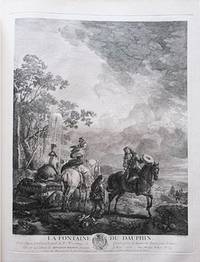
176241877Paris: Chez Moyreau 1762. Folio. 23 1/2 x 19 1/2 inches. Engraved portrait of Moyreau by Nonnette dated 1749 and 100 engraved plates numbered 1-100 with the engraved rococo title being numbered as plate 25. 88 plates engraved by Moyreau and the others by Cochin Chedel etc. The title is engraved by Le Parmentier after J. de la Joue. Included are 5 double page plates and one page with 2 plates on the page. The final 8 plates are numbered in manuscript and the last 2 plates are proofs 'before letters'. Full contemporary calf gilt hinges strengthened<br/> <br/> A rare magnificent collection of engravings showcasing the works of the renowned Dutch Golden Age painter Philips Wouwerman.<br/> <br/> Engraved by master engraver Jean Moyreau the illustrations meticulously reproduce Wouwerman's celebrated equestrian and rural scenes capturing the dynamic compositions intricate details of the originals. Featuring some of the artists finest works carefully selected from the most esteemed collections in Paris and beyond the volume serves as a homage to Wouwerman's enduring artistry.<br/> <br/> Cohen de Ricci 1068; Bulletin Morgand 1889 No. 17315 '1 frontispice et 100 planches; Thiebaud p. 945-946; Brunet V 1480. Chez Moyreau unknown
1703B7089Paris: Chez Simon Langlois c 1703. near fine with text clean and crisp. . Edition: First Edition. Binding: Contemporary full paper boards expertly rebacked; raised spine with five 5 bands black ink title on vellum label on two; central black fleur de lis design on four. Notes: Provenance: Upper pasted endpaper with owner’s armorial bookplate: “Watkin Williams Esq of Penbedw // in the County of Denbighâ€. Concerning this name Archaeologia Cambrensis states: “1789. Watkin Williams Esq. of Penbedw in the county of Denbigh but owner of property in the parishes of Mallwyd and Llan-y-mowddwy in the county of Merioneth M.P. first for Montgomeryshire and afterwards during nearly thirty years for the Flint contributary boroughs was appointed lieutenant and custos rotulorum for Merionethshire.†Final free endpaper watermarked. <br>This edition of this Canadiana publication is unique in that we are not able to locate another copy of the same anywhere. The second last paragraph of the introduction to the priests clergy and missionaries in this edition states that this publication encloses at the end of the first part or 'Rituel' a second part entitled 'les Statuts Ordonnances & Mandemens.' instructions prepared at various times by the Church for the conduct of all including those entrusted to the clergy that these instructions may not be ignored. The recipient are advised that they are restatements of instructions previously given to be read often just as such given in the Ritual itself; they are to be followed with precisions including all the rules contained not to be lost sight of observed faithfully in all works and ones conduct. The inclusion of this paragraph is unlike the introduction of another edition published at the same time and same location but not including this paragraph or the 'Statuts.'. <br>The present work describing festivals sacraments statutes and ordinances for the use by priests in Quebec is extremely rare and was immediately followed by a second edition published the same year: Gagnon reports that in a copy of the second edition of 1703 now at the Laval University library and previously owned by Abbé Plante a note says that the first edition “would have been almost completely destroyed by the sinking of the ship …carrying it to Canada and for this reason a second edition was immediately made.†<br>On the “privilege†included as the final leaf in our first edition example it is stated that the work was registered on March 30 1703 and completed for print for the first time on March 31 1703; <br><br>Saint-Valier was a supporter of the Counter Reformation. His initial intent in the New World was to engage in the conversion of the indigenous residents. He introduced Jesuits and Recollects in an attempt to evangelize New France. Many of these missions Illinois Louisiana and Mississippi resulted in conflicts between Bishop Saint-Vallier the Jesuits and the seminary of Quebec.<br><br>His various construction projects reflect a desire to restore and renew the authority in the Catholic Church as the main institution of administrative organization. In 1697 Saint-Valier built a palace in Quebec for his clergy and as a place of hospitality. During the same year he also established a nuns monastery in Trois-Rivières Saint-Vallier’s zeal for religious activities and establishments stretched from Quebec Montreal Acadia and Louisiana. His way of life embodied that of the ideals of the Council of Trent.<br><br>The Diocese of Quebec was vast and its population diverse and widespread. It included the whole of French North America or what was called New France divided in seven colonies: Newfoundland Acadia ÃŽle Royale Louisiana Illinois Upper Country and Canada inhabited by Indigenous people and the European settlers. During the tenure of Saint-Vallier immigration from France was mostly over; the European colonists were farmers fishermen sailors merchants and ‘coureurs des bois’ overseen by a small elite of aristocratic leaders but a great demographic explosion occurred between 1685 and 1730 the white population in New France jumping from c. 12000 inhabitants to c. 41500.<br><br>During the same time the number of Amerindian fell from c. 163500 to c. 61500. That loss mainly in the tribes of Louisiana was attributed to warfare and diseases brought to the valley of the Mississippi. The number of Aboriginals compared to white settlers is one reason for the presence of so many religious orders in New France. The missions and conversions to Christianity were deemed very important.<br><br>Priests of the Missions Étrangères of Paris the Jesuits the Recollets and the Sulpicians often worked in collaboration with the nuns from different orders like the Congrégation de Notre-Dame or the Canonesses of St. Augustine of the Mercy of Jesus at l’Hôtel-Dieu de Québec. The arrival of Saint-Vallier and his strong views on what should be the duties of the priests created a shock wave in the orders especially for the Seminary of Quebec newly founded by his predecessor Bishop Laval. … Saint-Vallier's tenure as bishop was defined by interminable quarrels with governmental and religious institutions in French North America. … his active leadership style brought him into conflict with various groups who perceived him as at times domineering and micromanaging.<br>While subject to much criticism Saint-Vallier was also admired in his diocese for his dedication and self-sacrifice. Rather than staying in Quebec or Montreal he tirelessly traveled the back-country. The founding of the Hôpital Général and installation of Jesuits and Recollets at Montreal were also to his credit.<br><br>There was a very strong suspicion in the colonies and in France that the Bishop of Quebec was in fact a follower of Jansenism. . In the beginning of the 18th century the Bishop wrote 3 books; the Ritual the Catechism and the ‘Statuts et ordonnances’ – two of which are bound in the present volume. <br>…the Superior of the jesuite order decided to attack Saint-Vallier’s authority by writing a long critic of those three books seeing them as a "lapse into Arianism Pelagianism Jansenism Lutheranism and Calvinism". Father Bouvart based his accusations on different passages of the works of the Bishop … who eventually appealed to the Sorbonne to have his works rehabilitated. The doctors of the Faculty of Theology declared the Ritual and the Catechism perfectly orthodox and censured the critic of Bouvart. Nevertheless Saint-Vallier decided to re-edit in 1713 the Ritual so as to cast away all doubts about his pretended Jansenist ideas. This book remained in use in the parishes until the middle of the 19th century. The present work is the unedited original and first edition of his ritual and statuts. <br><br>The disputes with the religious orders of New France the government and the merchants gave way to a more peaceful period that lasted until his death. Austere throughout his life he became more and more humble in his way of living and turned toward contemplation and simple duties. .He also took very seriously his duties of Bishop and developed parishes in the farthest corners of the diocese.<br><br> Size: Octavo 213 x133mm. Illustration: Text in French; with some text in Latin<br>Achevé d'imprimer pour la premiere fois ce 31 mars 1703. Relié avec le Rituel du même. <br><br>Illustrated with two printer's devices representing the arms of the archdiocese of Quebec; various head and tail pieces incl. vignettes; in-text music notes on Qiiii-Si; Ggii-iiii. References: Philéas Gagnon: Essai de bibliographie canadienne: Inventaire d'une bibliothèque . Volume 1: 3138 & 3139 p.437; Archaeologia Cambrensis Volume 1 p.142. Pages: Ff. 2 bl. ill. title bl. author to priests on the use of the book 4 Fetes Observe’es 4 604 table 2 errata 3 bl.; ill. title bl. letter 3 8-146 table 2 privilege 2 bl.2; In leaf collation: bl. v A-Z8 Aa-Nn8 Oo-Rr4 iiiff. table; a1 a3-a8 e8 i8 o8 u8 aa8 ee8 ii2 oo8 uu8 aaa1 ii bl. Category: Book Canada; Book Religious Christianity; Chez Simon Langlois, hardcover
1783B6593Ingoldstad Germany : Anton Attenkhouer c. 1783. . A very good example occasional minor browning. Edition: Second edition of Henrich Palmaz Leveling's German Binding: Full recent panelled calf triple gilt outer borders on speckled natural calf; central blind-stamped green panel; spine raised with five 5 bands; titles on two and four and compartments with central gilt ornament dated. Notes: Text in German. Gothic Script.<br>Second edition of Henrich Palmaz Leveling's German translation or Ingolstadt edition after the first of 1781.<br>This second Ingolstadt edition of only 1500 exemplars features beyond twohundred 200 in-text engravings printed from Vesalius’s original woodblocks; the woodblocks were destroyed during the WWII bombings of Munich. Leveling not only translated this work but introduced updated information often relying on the French Winslow as information source. Size: Folio 396x274mm. Illustration: Illustrated woodcut title depicting the dissection lecture hall; printed title with engraved vignette of the portrait of Heinrich Palmatius Leveling flanked on either side by the staff of Aesculapius and a skeleton respectively; headpieces at 2 A1 Bb1 Xx1 Nnn Yyy2r Ccc1r; and tailpieces at Q1 Bb1 Uu1v Eee2 Mmm2v Yyy1v Bbbb2v Hhhh2v 1v or final leaf; ornamental Gothic initials on title and dedication; in-text partial page illustrations at A1 A2v B1r 3 B2r B2v C1r 2 C1v 2 C2r D1r D1v D2r 2 D2v2 E1r E2v 2 F2r 2 G1r G2r 3G2v 3 H1v2 H2r 3 H2v2 I1r3 I2r 4 I2v3 K1v K2r5 L1v L2r6 L2v3 N1v2 O1v2 Nn1r Qq2r Ss1v2 Ss2v Tt1r8 Uu1r Zz1v 2 Aaa2v Bbb2v 2 Ccc1v Ccc2r Ggg2v Iii2v Lll2v Ooo1v Ppp2r Ppprv Qqq1v Qqq2v Rrr1v2 Rrr2r 2 Sss1v Xxx1v Xxx2v 2 Yyy1r Yyy2r Zzz2r Zzz2v Aaaa1r 2 Aaaa2r Aaaa2v 2; in-text half page illustrations often consisting of multiple illustrations at: A1v A2v F1v9 H1v H2r I2v K1v 5L1r2 M1v2 M2r4 M2v O2r15 Q1r Rr1r Rr1v Rr2v Ss1r Ss2r2 Tt2v Xx1r Zz2r Fff1r Nnn1r Nnn2r Ooo1r Ppp2r Qqq2r Sss2r Ttt1v Uuu1r Uuu2r Xxx2r Yyy2v Cccc1r Cccc2r Cccc2v Dddd1v Dddd2r Eeee1r Eeee2r Ffff1r Gggg2r Gggg2v Hhhh1v; in-text full page illustrations at: F1r N2r13 P1r P1v P2r Bb2r Cc2r Dd2r Ee2r Ff2r Gg2v Jj17r Jj2v Kk2v Ll2v Mm2v Nn2v Oo2r Pp2r Xx2v Zz2v Ccc2v folding Eee2v Fff1v Iii2v Kkk1r Mmm12 folding Ooo2v; <br>Moreover two double-paged woodcuts insert of Adam and Eve at Iiii2v. <br> Volume: Seven books in one volum Provenance: Signature: “H.Linder // 1875†on the margin of the upper free endpaper; Stamp on verso of final leaf: “Henry Linder //SCULPTOR Studio … // NEW-YORK.†Some of Linder’s work 1854-1910 renowned New York sculptor is exhibited at the Smithsonian America References: Choulant-Frank 185; Cushing VI A.15; Heirs of Hippocrates 1042; Osler 573; Waller 5752 Pages: Ll: Bl. 2 ill title printed title with portrait vignette of Leveling dedication 3 x1-xx2 preface x1-2 index; A1-Z2 Aa1 1st book Bb1-T2 U1 2nd book ; Xx1-Eee2 3rd book Fff1-Mmm2 4th book Nnn1-Yyy1 5th book Yyy2-Zzz2 Aaaa1-Bbbb2 6th book Cccc1-Hhhh2 7th book Iiii1-2 2 folding plates- of Adam and Eve Kkkk1-Oooo2 summarische Abhandlung 1-2 1 Index; bl.2. Category: Book Medical; Anton Attenkhouer, unknown
1748ABC_46957London 1748. Large 4to. printed for the author by John and Paul Knapton Bound by Marcus Ward & Co. founded 1833 with their bookbinder's label on the front paste-down in 19th-century calf gold-tooled and blind-tooled frame on both boards gold-tooled spine with red morocco spine label with title in gold gold-tooled board edges blind-tooled turn-ins red edges blue ribbon marker. With 42 engraved plates maps and plans all but one folding. 1 1 blank 32 1 blank 417 1 blank 2 pp. First edition of this important and popular account of the unfortunate and famous expedition of George Anson being considered as the one most sought after Borba de Moraes. It is an account of Ansons expedition to the western coast of South America to harass the Spanish trading territories and cutting off the Spanish supplies of wealth in this way after the outbreak of the War of Jenkinss Ear between Britain and Spain in 1739. Anson was the commander of 7 ships in 1740 including the Centurion but soon his expedition threatened to turn into a fiasco. His squadron was battered by storms and bad weather causing damage and shipwrecks and many of his crew died from scurvy typhus and dysentery. The remaining crew was transferred to the Centurion the last remaining vessel and Anson limped across the Pacific to Macao. In June 1743 he sailed to the Philippines were he achieved a substantial victory near Manila by capturing the Nuestra Senora de Covadonga a Spanish galleon filled with gold. After sailing around the world Anson returned to England in June 1744 and in spite of his enormous losses he returned with large profits.Ansons voyage being one of the greatest voyages in the history of exploration and naval warfare laid the foundation for British voyages and exploration of the Pacific and more specific for English trade in this area. The present account being based upon Ansons own ship journal describing this troubled expedition soon became highly popular in the 18th century and is even considered as the masterpiece of descriptive travel and the most popular book of maritime adventure of the eighteenth century Hill. With occasionally a correction of the text in brown ink and the name of Mr. Sweeting added to the list of subscribers. Binding slightly worn around the edges and with a few minor scratches on the boards some marginal foxing and staining to both the text leaves and plates especially in the first part barely affecting the plates except the map of the Pacific Ocean which is a little more stained folding lines of some plates especially all three large folding maps reinforced but sometimes still with some very small tears on the folding lines some corners of the folding plates slightly frayed but overall a copy of the first edition of this important 18th-century travelogue with all the plates which is still in good condition.l Alden/Landis 748/225; Borba de Moraes I p. 38; Cox I p. 49; ESTC T89475; Hill 1817; Howgego A-100; Kroepelien 1086; Sabin 101175 cf. 1625. hardcover
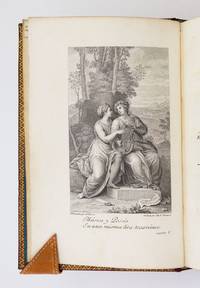
1779ST19371Madrid: Imprenta Real 1779. FIRST EDITION. 235 x 150 mm. 9 1/4 x 6". 10 p.l. 126 XL pp. 1 leaf errata. <br/> EXCELLENT CONTEMPORARY CRIMSON MOROCCO BY DEROME LE JEUNE his ticket with address of Rue St. Jacques on verso of front free endpaper covers framed with thick and thin gilt rules raised bands spine compartments with central floral sprig surrounded by a lozenge of small tools volute cornerpieces gilt titling gilt-rolled turn-ins gilt edges cobalt blue paste-paper endpapers. WITH SIX CHARMING ENGRAVED ALLEGORICAL PLATES after G. Ferre. Front pastedown with morocco bookplate of Mortimer L. Schiff and small book label with a gilt cipher on a red peach. A Large Paper Copy. Palau y Dulcet IV 107; RSIM B VI 429; MGG VI 1403 f.; Gregory-Bartlett I 129. Three minute dents to front board a hint of wear to bands and corners isolated faint foxing blank recto of frontispiece leaf and blank verso of final leaf with faint blue shadown from endpapers but all of these quite trivial and otherwise A BEAUTIFUL COPY--fresh clean and bright internally with very wide margins and strong impressions of the plates and in a lustrous binding showing with few signs of use.<br/> <br/> This is surely one of the handsomest poetical treatises on music ever produced and it is offered here in a binding done by one of the finest craftsmen working in Europe during the period of the book's publication. The work is written in the "silva" form of poetry used by persons of high rank illustrated with fine engravings and put into elegant morocco by the finest hands among the large Derome family of binders. According to Palau our first edition is "beautiful and printed on fine paper." He says further that although the strongly expressed opinions of the youthful author on contemporary composers caused the work to be "unfairly attacked" it was "appreciated by professors of music and collectors of literature in that genre" especially in Italy and America. A child of the Enlightenment Iriate 1750-91 gained entry to intellectual and artistic circles in Madrid through his uncle who was librarian to the king of Spain. He translated works by Horace and Virgil into Spanish by royal request and wrote criticism poetry and dramas. He is best known for his satirical fables on the contemporary literary scene "Fábulas literarias." There were no fewer than 18 members of the Derome family who made their livings as binders in Paris from the middle of the 17th century until the first quarter of the 19th but by far the most distinguished family member was Nicolas-Denis called "le jeune" 1731-88. Known for the gracefulness of his bindings and for being capable of "amazing delicacy" in Hobson's words Derome le jeune was simply the leading binder of the day and his work was much in demand. Because he refused to turn away customers Derome was forced to hire a number of assistants whose work he could not always supervise closely. However Thoinan says that the binder's best work is indicated by the presence of his ticket as here. The volume's provenance adds to its luster: it was in the distinguished library of American bibliophile Mortimer Schiff 1877-1931. In Dickinson's words Schiff a financier and philanthropist Schiff "brought together an unrivaled collection of decorative bindings." His library included works by great printers important illustrated books and works printed on vellum but chiefly fine and historic bindings. The "Reliures" database of the Bibliothèque Nationale de France commends Schiff for assembling "one of the most important inter-war libraries" noting that his collection was "renowned for its collection of French bindings.". Imprenta Real unknown
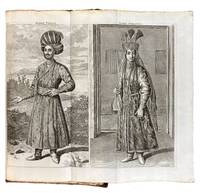
171842045Amsterdam: Chez les Freres Wetstein 1718. 2 volumes small folio. 13 3/4 x 8 1/2 inches. Half-title in volume I titles printed in red and black. Vol 1: engraved portrait of the author by G. Valck after G. Kneller engraved allegorical frontispiece by B. Picart dedication with engraved headpiece 3 engraved double-page maps 111 engraved plates numbered 1-110 plus 1 unnumbered on 52 sheets 29 double-page 7 folding 24 engraved illustrations within the text illustration on p. 164 pasted on slip as issued. Vol 2: 162 engraved plates numbered 111-262 plus 10 unnumbered on 56 sheets 33 double-page 9 folding 20 engraved illustrations within the text. Quarter calf and marbled paper boards spines with raised bands forming six compartments tooled and lettered gilt. Uncut<br/> <br/> Provenance: Princes of Liechtenstein bookplate "Ex Libris Liechtensteinianis" of Franz Joseph II 1906-1989 on front paste-downs<br/> <br/> A fine clean uncut copy of the First edition in French of Le Bruyn's important illustrated account of his voyage to Russia Persia India and Java. From the library of the Princes of Liechtenstein.<br/> <br/> In his first expedition of 1674 Dutch traveller and painter Cornelius Le Bruyn remained in the Levant for seven years travelling principally in Asia Minor Syria the Holy Land and Egypt. On his return he published his Voyages au Levant and encouraged by its success undertook a second more far-reaching expedition. "In 1701 Le Bruyn started on the second of his journeys taking a ship to the country of the Samoyeds . and then proceeding to Moscow. Travelling by way of Asia Minor he arrived in Persia where he remained for the years 1704-05. Leaving Persia he proceeded by ship to India stopping at Cochin Ceylon and the East Indies i.e. Batavia. He returned by much the same route residing in Persia between 1706 and 1707 and describing the ruins of Persepolis and Pasargades" Howgego. The numerous finely engraved illustrations include large folding panoramas of Moscow and Isfahan views of Astrakhan and the antiquities at Persepolis and many of the forts encountered on his journey as well as portraits of native peoples and depictions of the flora fish birds animals etc. Of particular note are Le Bruyn's description and images of the Samoyeds and their country among the earliest for the region. Le Bruyn also gives an account of an encounter with William Dampier in Batavia and describes the route taken by Everard Ysbrants Ides the Danish Russian ambassador to China.<br/> <br/> Brunet III:911 calls for 262 plates based on the numbering of the plate list which does not include the unnumbered plates; Chadenat II 5085; Chahine 2078; Cohen-de Ricci 610; Lipperheide Kaa 6 calls for 128 plates and 45 engraved illustrations; Howgego B177. Chez les Freres Wetstein unknown
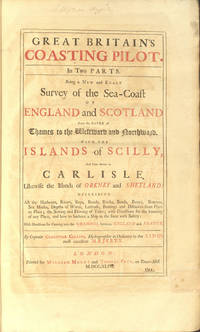
1744007689London: Tower-Hill: William Mount and Thomas Page 1744. Hardcover. Very Good. Elephant Folio - over 15 - 23" tall. COLLINS Greenvile Captain. A Landmark in the Charting of Great Britain. Folio 18th century mottled half calf over blue-green marbled paper boards decorative gilt spine red morocco lettering piece pp. iv 26. Fine allegorical copperplate title incorporating a small map of the British Isles letter press title printed in red & black 47 copperplate charts & profiles 5 folding 3 single page the remainder double page and one chart in the text at p18. A couple of the folding maps just torn at fold some browning and offsetting text spotted in places but still a handsome copy. First published in 1693 and reissued many times throughout the eighteenth century this formidable and costly project was the first systematic survey of British coastal waters Moreland & Bannister Antique Maps 3rd ed p163. 511322 mm. Phillips 5199. Moreland & Bannister. In 1667 the Dutch sailed up the Thames and destroyed a great part of the British Navy in the Medway and bombarded Chatham. an the Government was shaken. by the realisation that the Dutch new more about the coastline of England than the English themselves and their confidence was not increased when it was found that John Seller in producing the first volume of his marine atlas the English Pilot in 1671 was still using Dutch plates and often very old ones at that. As now government was tardy in action and it was not until 1681 that Samuel Pepys as Secretary of the Navy instructed Captain Greenville Collins to carry out a survey of British coasts and harbours. In due course after a seven year survey Captain Collins issued in 1693 the Great Britain's Coasting Pilot an outstanding work consisting of 48 charts the first complete Pilot Book in English of all the coasts of Great Britain and the surrounding islands with special attention of course to the ports Moreland & Bannister. In 1693 he finally published his results in a folio volume of two parts Great Britain's Coasting Pilot containing sailing directions tide tables coastal views and about forty-nine charts. The charts were not completely accurate but with all their shortcomings they were an enormous advance on anything before them and entitle Collins to rank not only with the earliest but with the best of English hydrographers. The work covered England and Scotland and though Collins proposed a further study to cover Ireland the plan came to nothing. Collins recorded that he had spent £40 on instruments and charged £80 for the 120 manuscript maps he delivered. With his claim for expenses set at £200 per annum and his wages of £394 10s. he claimed a total of £1914 10s. for his work which was eventually paid in arrears. The cost was more than three times the original estimate. His cousin Freeman Collins printed the Coasting Pilot which Richard Mount sold. Mount's subsequent firm then went on to publish twenty-one further editions of the pilot throughout the nineteenth century. <br/> <br/> William Mount and Thomas Page hardcover
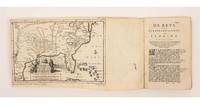
17063719Te Leyden: By Pieter Vander Aa Boekerkoper 1706. First edition. Later half-cloth boards covered with marbled paper spine with title vignette. Small wormhole affecting the first five leaves and the folding map; otherwise in very good condition. First edition. Later half-cloth boards covered with marbled paper spine with title vignette. 6 86 4 p. and an engraved folding map and 9 engraved folding plates. <p><br /> Scarce Dutch illustrated edition of the first eyewitness account of Hernando de Soto's expedition complete with a folding map of Florida and nine double-page engraved plates.<br /> <p><p><br /> Dutch abridged edition of the earliest published eyewitness narrative of Hernando de Soto's expedition to Florida and the interior of North America. The text derives from the Relaçam verdadeira dos trabalhos Évora 1557 written by an anonymous Portuguese gentleman from Elvas who participated in the expedition. That work is the first printed account of de Soto's journey and remains a foundational source for the early Spanish exploration of the southeastern regions of what is now the United States.<br /> <p><p><br /> De Soto landed in Florida in May 1539 and led a large expedition through present-day Florida Georgia the Carolinas Tennessee Alabama Mississippi Arkansas and Louisiana reaching the Mississippi River before his death in 1542. The narrative records sustained contact with Indigenous societies and documents the challenges of an extended inland expedition through the southeastern regions of North America.<br /> <p><p><br /> This Leiden edition was issued by Pieter van der Aa as part of his Naaukeurige versameling der gedenkwaardigste zee- en landreysen presenting the narrative in Dutch translation in an abridged form. It is illustrated with an emblematic engraved title a folding engraved map of Florida attributed to de Soto's discoveries and nine double-page engraved plates depicting episodes from the Spanish conquest. Van der Aa's engravings played a significant role in shaping early eighteenth-century European visual conceptions of Spanish America and its exploration.<br /> <p><p><br /> A well-preserved copy complete with the folding map and plates. An important Dutch contribution to European-Americana transmitting one of the principal sixteenth-century sources for the exploration of the North American interior.<br /> <p><p><br /> Not in Sabin. Scarce on the market; RBH records only four copies offered in the past 100 years. <br /> <p>. By Pieter Vander Aa, Boekerkoper unknown