(Leopold I., Römisch-Deutscher Kaiser)Antiquariat.de

100 résultats
166216811Graz, Widmannstetter, 1662. 2 Bll., 16 S. Kl.-4°. Mod. Pp. (leicht bestoßen). [7 Warenabbildungen]
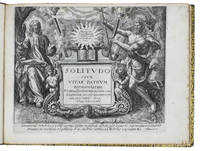
160663TA003RHVIKParis 1606. Small oblong folio 19 x 25.5 cm. Thomas de Leu Gold-tooled blue goatskin morocco ca. 1890 bound by Bernard David or his son Salvador David in Paris on 5 recessed supports each board with elegant double borders title and date reading up the spine with decorations above and below gold-tooled turn-ins and board edges curl-marbled endpapers signed with a stamp - in sans-serif capitals - in the corner of the first free endleaf DAVID. With an engraved allegorical title page including a 2-line quotation from Hebrews 11:37-38 and 29 engraved prints plate size ca. 15 x 19 cm: mostly numbered but a few unnumbered or irregularly numbered illustrating the lives of the early Christian hermits living in the desert 7 signed by Thomas de Leu as printer-publisher in 2 cases accompanied by the monogram NB the engraver Nicolaes de Bruyn. 1 29 engraved ll. Finely engraved title page and prints depicting the lives of hermits living in the desert as described by Hieronymus in his famous Vitae patrum. The engraved title page and prints were printed and published by Thomas de Leu or de Leeuw 1560-1612 a Flemish engraver in Paris who probably engraved many himself. He had begun his career in Antwerp and some of the prints signed by him excudit also bear the NB monogram of the engraver Nicolaes de Bruyn 1571-1656 in Antwerp. The Antwerp painter Maarten de Vos 1531/32-1603 had drawn numerous hermit scenes: four series engraved printed and published by Johannes I Sadeler ca. 1550-ca. 1600 and his brother Raphael I Sadeler 1560-1632 who continued alone with three further series making in total seven series containing 7 engraved title pages and 107 prints all published at Antwerp at least the first series in or before 1584. De Leu and De Bruyn very skillfully copied all seven series including the title pages and captions. The present selection includes the title page of the first series Solitudo which originally contained 29 prints but only 16 of the present 29 prints come from that series the other 13 are taken from series 2 Sylvae 1 3 Trophaeum 1 4 Oraculum 5 Sylvae 2 and 6 Trophaeum 2.Bernard David 1824-1895 studied under Lortic and other leading Paris bookbinders before setting up on his own there. His son Salvador d. 1929 took over the workshop in 1890. The laid endpapers show no watermark. With aa small marginal tear repaired occasional minor marginal spots and a few tiny and insignificant scuff marks on the edges of the binding. Book and binding otherwise in very good condition and with ample margins.l Hollstein XXI pp. 147-155 nos. 377-450 & pp. 240-245 nos. 118-157 the Sadeler eds. but noting the De Leu eds. at the end of each series; www.calcografica.it many of the prints in these De Leu series; USTC 6000645 3 copies; cf. for De Leu also: Benezit 6 p. 623; Thieme-Becker 23 pp. 143-144. unknown
167535334London: William and John Leake 1675. Two parts in one 8vo. 28 148; 16 159 1pp. Contemporary mottled calf covers ruled in blind rebacked to style flat spine ruled in blind red morocco lettering piece<br/> <br/>Provenance: F. H. early initials on the title<br/> <br/>The final edition complete with both parts of among the most influential English gardening books of the 17th century.<br/> <br/>"Sir Hugh Platt 1552-1608 held by Richard Weston to be 'the most ingenious husbandman of the age he lived in' . devoted his life to literary work and to the study of husbandry and gardening. He was also interested in all kinds of inventions and experiments and in consideration of his services in this field was knighted by James I on 22 May 1605 . His work on gardening entitled Floraes paradise . appeared in 1608 the year of his death . He wrote his book from his own practical experience as well as from information supplied to him by other gardeners . Floraes paradise continued to be published after the author's death but with the new title of The Garden of Eden and edited by Charles Bellingham . In 1660 was issued The second part of The Garden of Eden . Readers who questioned the authenticity of this work were invited to 'see the original manuscript under the authors own hand.'" Henrey. Styled on the title as the sixth edition it is the second combined edition of both parts and the final edition published in the 17th century. The second part includes its own title and pagination.<br/> <br/>Fussell pp.15-16; Henrey 299; Hunt 340; Wing P2388; ESTC R31801. William and John Leake unknown books
1636D6036Rome: Typis S. Cong de propag: Fide 1636. Hardcover. Very Good. 4to 230 x 170mm. xxiv 338pp. ii. Illustrated throughout with woodcut tables and charts of Egyptian characters and hieroglyphs. Contemporary vellum; intermittently browned occasional spots. <br/><br/>Father Athanasius Kircher was a 17th-century German Jesuit scholar and polymath who published around 40 works most notably in the fields of oriental studies geology and medicine. He was heralded as possessing the secret of deciphering hieroglyphics and was widely regarded as the physical embodiment of all the learning of his age. He had over 760 correspondents including scientists Jesuit missionaries and world potentates and wrote about an enormous range of interests ranging from optics to music from Egyptology to magnetism. Perhaps best known of his correspondents is Jan Marek Marci of Kronland 1595-1667 for sending Kircher a mysterious illustrated manuscript written in an unknown script famously known today as the Voynich Manuscript. In 1635 Kircher began to write his book Prodromus Coptus Introduction to Coptic Language and in the autumn of 1636 the book was printed. Kircher saw the ancient languages as an essential foundation for any pious philosophy. Kircher envisioned Rome as a unique center within to unlock the mysteries of Hermetic knowledge inscribed on the obelisks. The project of restoring Egyptian wisdom entailed nothing less than an effort to renovate the lost arts of communication that linked divine and human languages. Unfortunately while in other disciplines he made valuable discoveries his explanation of hieroglyphs was absolutely incorrect. We can probably explain it by his passion that might have sometimes blinded his reasoning. Yet Kirchers Prodomus remains an important study from a most respected scholar. Brunet III 668; Caillet II 5790. Typis S. Cong de propag: Fide hardcover books
16711002105London: E.T. and R.H. for H. Brome B. Tooke and T. Sawbridge 1671. First edition in English of the complete Colloquia Familiaria of Erasmus first published in 1518 and expanded by Erasmus over the next fifteen years a lively collection of Latin dialogues that found a readership far beyond the Renaissance schoolroom. Originally intended to model colloquial conversation for students of Latin the dialogues feature pointed free-thinking exchanges on modern political religious and philosophical questions. In "Of the Abbot and Learned Woman" an ignorant abbot tries and fails to get the better of the classically educated Magdalia a character almost certainly based on Thomas More's eldest daughter: "I think thou art some sophistress thou protest so wittily." Magdalia: "I will not tell thee what I think thou art." And later: "I have often heard it usually spoken that a wise woman is twice a fool." Magdalia: "Indeed it useth to be said so but by fools." The Colloquia Familiaria was widely read and debated across Europe drawing immediate notice for its anticlerical satire: "its influence on the dialogues of Reformation Germany and Tudor England is a critical commonplace" Zlatar Reformation Fictions 11. The original purpose of the Colloquies as a text for teaching Latin postponed its direct translation; this first complete English edition was published more than 150 years after the work's first appearance. The edition opens with a short life of Erasmus and concludes with the first appearance in English of De utilitate colloquiorum Erasmus's 1526 defense of the Colloquies published after the Sorbonne condemned the book for impiety. In response Erasmus makes a case for the educational value of his dialogues' humor: "I cannot tell whether any thing be learned more successfully than that which is learned in playing." Despite his efforts the Colloquies would remain on the Papal Index of banned books through the end of the nineteenth century. Wing E-3190; PMM 53. A very good copy of a humanist landmark in a handsome contemporary binding. Octavo measuring 6.5 x 4.25 inches: 8 555 1. Contemporary Cambridge-style full speckled calf boards ruled and ornamented in blind raised bands red morocco spine label lettered and decorated in gilt top edge stained black. Engraved frontispiece portrait of Erasmus. Final leaf containing second page of bookseller catalogue excised. Joints and spine head expertly repaired; evidence of bookplate removal on front pastedown; effaced signature on title page; some running titles shaved. E.T. and R.H. for H. Brome, B. Tooke, and T. Sawbridge unknown books
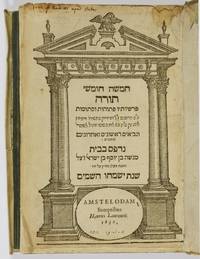
163155459Amsterdam: printed by Menasseh ben Israel for Henricus Laurentius 1631. First edition. Hardcover. Very good-. Octavo 16.8 by 11.4 cm. Collation: aleph-lamed-zayin8 = 296 leaves. 612 i.e. 592 pp: p. 464 erroneously numbered 484 465 as 485 and so on throughout. Two column text in unvocalized Hebrew; every fifth verse numbered in the margin. Title within architectural border; half titles with letterpress ornamentation for the Former and Latter Prophets. Contemporary vellumwith exposed thongs edges stained blue; yapp fore-edges; front joint cracked but holding strong. Intermittent light toning to text outmost leaves a bit more darkened; very occasional small stains. Title-page slighltly trimmed 4 mm at bottom edge; expert marginal repairs at bottom corners of 2 leaves; 1 leaf re-margined at fore-edge with no loss of text else a very good copy with crisp clean text.<br /> <br /> First Hebrew Bible published in Amsterdam printed by the rabbi diplomat publisher and religious thinker Menasseh ben Israel 1604-1657 one of the most distinguished members of the Portuguese Jewish community of Amsterdam and the first Jewish printer in the Northern Netherlands. The Amsterdam printer and publisher Hendrick Laurensz Lauretius provided the financing for this edition along with two other Bible editions and two editions of the Hebrew Psalms printed by Menasseh between 1631 and 1646. "These publications were not only made for the local market but mainly for international trade. Thanks to this financial help Menasseh was able to organize his printing office in a more professional way" Fuks hiring a Jewish compositor Judah Leb ben Mordecai Gimple from Posen and a gentile compositor Bartholomeus Laurensz. <br /> <br /> The printing activity of Menasseh was especially important in the steadily growing productions of the Hebrew press in the Northern Netherlands. Fulfilling the needs of the Sephardic community for Jewish ritual texts eliminated the need for expensive imports from Venice and Poland. Menasseh undersood that the relatively cheap paper and tools available in Amsterdam made it possible to compete in quality and prices with the Hebrew presses of Poland Italy and Basel. "Gentile publishers and booksellers in Amsterdam such as Jansonius and Laurentius were quick to see the opportunity of the opening Eastern European market and financed several of Menasseh's publications" Fuks. Menasseh was the first to introduce in the Netherlands waybertaytsch types for Yiddish publications along with illustrated Hebrew books. He was also the first Jewish printer to adopt the Dutch pocket-book format made famous by the Elzeviers.<br /> <br /> Notes on publication date and issue: The title is dated 1630 in Arabic numerals; the colophon notes the date of completion in Hebrew characters as 5 Adar 5391 = 7 February 1631 along with the printer's apology for being unable to provide the index of pericopes promised on the title-page due to lack of printing material. Darlow and Moule describe this issue as Variant A with a Latin imprint appearing in the cartouche beneath the Hebrew title.<br /> <br /> Provenance and annotations: early entry in brown ink at front paste-down with short Greek inscription Theos. dated 1700; old Latin inscription in black ink at top margin title in reference to Hebrew roots; date of 1812 beside Yiddish entry penned in black ink within imprint cartouche at title; old entry in German penned in black ink at verso title beneath which is an oval cartouche in imitation of the one at the title in which an owner has penned in black ink the Hebrew imprint information regarding Hendrick Laurensz as it would appear in the Varient B issue; old library shelf marks at rear paste-down; recent owner entry in blue ink in Hebrew at front paste-down. References: Darlow and Moule 5123a; Fuks/Fuks-Mansfeld no. 152; pp. 105; 111f.; Steinschneider no. 453; Vinograd Amsterdam 22.<br /> <br /> Full title and imprint: חמשה חומשי תורה פרשיותיו פתוחות וסתומות ×¢"פ ×”×¨×ž×‘× ×–"ל ומדוייק בחסירו' ויתרות להעתק ס"ת ×¢× ×œ×•×— בסופו מועיל לסופרי' ×•× ×‘×™××™× ×¨××©×•× ×™× ×•××—×¨×•× ×™× ×•×›×ª×•×‘×™×: × ×“×¤×¡ בבית ×ž× ×©×” בן ישר×ל ז׳׳צל והוגה בעיון × ×ž×¨×¥ על ידו ×©× ×ª ישמחו השמי×<br /> Amstelodami sumptibus Henrici Laurentii 1630. printed by Menasseh ben Israel for Henricus Laurentius hardcover
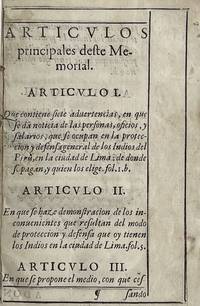
16262256En Madrid: En la Imrenta Real 1626. In later binding using old vellum. Title lettered in ink on the front panel. he engraved title page is not presented. Occasional inkblots and signs in ink and pencil at the margin. Traces of old restoration. 1 I2 restored with minor loss of text 2 G1 h1 “burnt†by ink with minor loss of text A2 “burnt†by ink. Wormholes from C4–F4 at gutter with some loss to the text from H1–I2 at outer margin no effect to the text. In good condition. In later binding using old vellum. Title lettered in ink on the front panel. ff. 2 34. Coll.: 2 A–H4 I2. Scarce first edition of this significant work on the Spanish administration of Peru.<br /> <p><p><br /> Larrinaga’s Memorial is related to the office and the role of the Defensor General of the Indians. In four articles he introduces the institution itself and its history describes its related problems and inconveniences and provides solutions to the problems and a working plan to achieve these proposals. Novoa 2016<br /> The author of the memorial Juan de Larrinaga Salazar 1588–1635 was a procurator for the city of Lima in Spain between 1625 and 1627 served as a regidor of Lima 1611–21 a professor at the San Marcos University in Lima 1618 later oidor in Panama 1628–35. Juan was the eldest son of Leandro de Larrinaga the first Creole lawyer to graduate from the San Marcos and advocate of Indians from 1601 to 1624 and the grandson of the Conquistador Juan de Larrinaga Salazar Ruiz de Urribari 1505–1600. The prominent Larrinaga or la Rynaga Reinaga or Reynaga family was linked to the protectorship institution as advocates of Indians and members of the family authored some of the most important sources of the early history of Peru and the protectorship institution.<br /> <p><p><br /> Extremely scarce. IB/USTC locates only 3 copies worldwide Houghton Library; JCB; Biblioteca Palafoxiana Puebla Mx.<br /> <p><p><br /> Literature:<br /> Novoa Mauricio. The Protectors of Indians in the Royal Audience of Lima: History Careers and Legal Culture 1575-1775. Leiden: Martinus Nijhoff Publishers 2015. [En la Imrenta Real] unknown
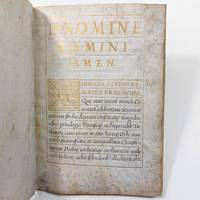
162819730<p><strong>Precious diploma in canon and civil law from the University of Rome calligraphed on vellum with the letterhead and the names of the protagonists written in gold ink.</strong><br /><strong>The document is also entirely underlined and framed in this ink.</strong><br />It was awarded to a certain Guillaume Drouaillet from Dole in Burgundy.</p><p>"<em>IN NOMINE DOMINI AMEN. GLORIOSA STUDIORUM MATER URBS ROMA Quae inter omnes mundi Ciuitates celeberrima Scientiarum omnium studio decorata existit . Dominus Guglielmus Drouaillet. Dolanus in Burgundia . Actum Romae in Gymnasio publico in regione S. Eustachii Anno Domini millesimo sexcentesimo uiges. octavo .</em>"</p><p>At the end of the document are signatures most likely of members of the University of Rome and two additional paragraphs handwritten by two different hands.</p><p>From the library of Bruno Monnier Franc-Comtois bibliophile and owner of the Château de Mantry with iron bookplate on the front flyleaf.</p><p><strong>An interesting testimony to the history of diplomas and writing.</strong></p>
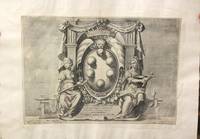
1617B6037Cruger c. 1617. Engravings mounted on watermarked laid paper. Some tears to lower margins not affecting the plates. Staining on one plate. A very good attractive and rare set. Binding: Loose folio in an 18th century wrapper. Notes: c. 1617; exception: one leaf dated 1561 and signed by Antonio Salamanca in Rome. Size: Folio sheets of 405x555m Illustration: Folio set of 14 leaves of copper engravings. References confirm 14 including the tile. Illustrated allegorical title with the Medici arms flanked by female personifications of Justice at left and Faith at right; lettered with a dedication to Cosimo II of Tuscany by Jacobus Chitus with bottom right Teodoro Cruger sculp: 1617 altered in ink to 1618 Florentiae and at lower left five privileges: Cum Privil. S. Pontif S.C. Maiest. Repi. Venet. // M.D. Etrur. Reip Genuens et V.R.Neap. - p. x An.; frontis after self-portrait by Andra Del Sarto; twelve engravings depicting the story of Saint John the Baptist after paintings / frescos and later curtains by Andrea del Sarto at Florence and Franciabigio. References: Hollstein German 6 176 35; Hollstein 33; Le Blanc 1854-1890 2 72 7-20; Virtuelles Kupferstichkabinett 6382 and 6384 mention 14 plates. Pages: Ff: Title; Self-Portrait; 12 engravings. Category: Book Europe Italy; Book Religious Christianity; Book Plate Books General; Cruger unknown
160433228-471Leiden Henricus Hondius 1604-1605. Two printed titles with elaborate engr. architectural borders woodcut initials 1 of 2 engr. portrait in the text and 49 engr. plates in vol. 1 33 34 on 1 leaf and 24 engr. plates in vol. 2. Text printed in 2 cols. 9 of 10 unn. leaves; 3 unn. leaves. Oblong folio 280 x 350 mm. 17th cent. marbled boards new endpapers. Leiden Henricus Hondius 1604-1605. First edition of Vredeman's "Perspective" issued by Hondius and printed simultaneously also in French Dutch and German. Present here is the valuable Latin version "the classical language in which Vredeman's architecture is clad and thus becomes timeless in its character" Millard p. 20f. This is one of the most celebrated works on such a subject and was issued by the Flemish born Hendrik Hondius the Elder 1573-1650. The plates for the most part are engraved and a few signed by him after Hans Vredeman. Plate 14 in part 2 is after Paul Vredeman and 4 plates in this part are signed with the monogram DB probably Theodore de Bry or Bartholomaeus Dolendo. The painter and architect Hans or Jan Vredeman de Vries was born 1527 to a German soldier in Leeuwarden Netherlands and probably died in Antwerp 1604. "The King of Architects" Fowler together with Hans van Schille worked at the fortification of the city of Antwerp and also at the triumphal arches built for the entry of the future Philip II into Antwerp in 1549. As a consequence of the religious upheavals of the period Vredeman worked in Hamburg Danzig and Prague before returning to Holland. He wrote and illustrated the present guidebook on perspective for designers painters and architects. It became one of the major books on this subject and through Vredeman de Vries' various publications he is recognised as the "foremost among sixteenth century Netherlandish architectural authors" Millard p. 19. The two volumes illustrate stage perspective interiors furniture palace and garden architecture. Vredeman de Vries was capable of truly artistic landscaping in the Northern Renaissance and served as a model for some patrician gardens in Germany cf. E. Haupt Baukunst der Renaissance in Frankreich und Deutschland 1916. The book includes a number of scenes and projections employ one-and-multi-point perspective. These were essential demonstrations for artists of those days. This work on perspective summarizes Vredeman's knowledge of art science and geometry. This copy has the same collation as the Fowler copy at Johns Hopkins University library which also lacks at the beginning of vol. 1 the leaf A1v with an engraved portrait on left half and a printed poem on right half of this leaf. There are complete copies known but in fact there is no copy of this Latin edition in the holdings of the BL London the Royal Library The Hague Utrecht Dresden Heidelberg Beinecke or Centre d'Architecture at Montreal. The only two but incomplete copies in Austria are in the holdings of the University of Technology Library at Vienna and in the Univ. Libr. Salzburg. The only copy in Switzerland in the holdings of the ETH- Library in Zurich is also incomplete and a mixed-up one 1st part in Latin 2nd part in French. Other incomplete copies are known in the holdings of the Bavarian State Library Munich the V & A Mus. London the Pierpont Morgan Library New York.- Engr. titles slightly frayed at lower margin some foxing otherwise a neat and rare copy. - Cf. Cicognara 867 French ed.; Millard Northern European Books 139 lacking engr. title to part II; Berlin Cat. 4704; Fowler 432 same collation; cf. Nagler I 1757; Borggrefe Heiner. Hans Vredeman 2002. ART - GENERAL & APPLIED ; SCIENCE: ARCHITECTURE ; SCIENCE: GENERAL ; Leiden, Henricus Hondius hardcover
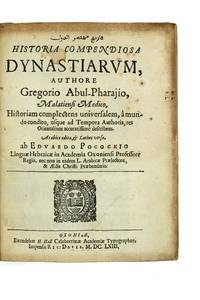
16634120<p>Oxford: H.Hall. Impensis Ric: Davis 1663. First edition thus in the Arabic edition and Latin translation by Edward Pococke. 4to. 203x155mm. pp. 12 368 90 66 5bl 565 2. The final part 565 2 in Arabic paginates from the rear of the book. The two blanks are present. Three parts in one volume i.e. the Latin translation the Supplementum and the Arabic edition each with its own title page. Bound in twentieth century brown full calf by Sangorski and Sutcliffe lettered in gilt to spine. Contemporary manuscript title to fore-edge. Some light fading to the spine slight toning to edges of first and last leaves and a small hole to foot of the final leaf not affecting the text but overall in very good condition throughout. Front pastedown has the bookplate of the Middle East scholar R.M.Burrell. His important library of books on the Middle East was sold by Sotheby's in 1999 this was lot 319. On 17th October 1630 Edward Pococke 1604-1691 arrived in Aleppo as Chaplain of the Levant Company. While there he deepened his study of the languages and culture of the region and began to collect Arabic manuscripts. In 1636 Pococke returned to England at the request of Archbishop Laud who had recently established a Chair of Arabic at Oxford and wanted Pococke to be the first holder of it. One of the manuscripts brought back by Pococke was the al-Mukhtasar fî'l-Duwal 'History of the Dynasties' of Abu'l-Faraj Bar Hebraeus 1226-1286. The lack of material in England on Islamic history and geography meant that Pococke felt unable to prepare his edition and translation and so he secured a sabbatical from Oxford and sailed for Constantinople where he spent the next three years collecting manuscripts. He returned to England shortly before the outbreak of the Civil War and it was only in 1650 that he published extracts from the "History" in his Specimen historiae Arabum which included other material culled from his now extensive collection of manuscripts. Pococke was a Royalist and the years of the Protectorate were hard: he almost lost his professorship and his priestly living. At the Restoration he returned to Oxford and began work on the complete Historia Compendiosa Dynastiarum. Finally in 1663 almost thirty years after Pococke had returned from Aleppo with the manuscript of al-Mukhtasar fî'l-Duwal his far-reaching Historia which opened up Arab history to Western was published and "remained the standard edition until the twentieth century" ODNB.</p> Oxford: H.Hall. Impensis Ric: Davis.
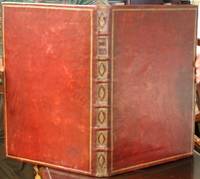
1650B6295Rome/Romae: Formis Io. Iacobi de Rubei apud templum S. Mariae de Pace. Undated c.1650-latest c.1690 most probably c.1660 c.1675-1677. . Lacks folding double-page plan of the Villa Pamphilia and the first of 5 folding plates “Primusâ€. Otherwise a very good example plates are crisp and clean. . Edition: First and only edition. Italic and Roman type. Tex Binding: Contemporary panelled full burgundy morocco double-gilt filleted; spine with six 6 raised bands gilt lettered title on two with remaining compartments gilt ornamented; all edges gilt; contemporary endpapers with watermark of a fleur-de-lis within two concentric circles. Wide margin paper. Notes: An architectural plate book depicting statues and fountains displayed in Villa Pamphili an important 16th-17th century Roman villa designed by the painter Giovanni Francesco Grimaldi 1606 - 1680 and Alessandro Algardi 1598 - 1654 followed by the construction of the garden layout; …1652-1657. The publication of the present work printed by G.G. de Rossi possibly c.1675-1677 was commissioned by Pamphili’s son and heir Giambattista with the engraver Dominique Barrière documenting the statues placed both in cornices of the villa and the gardens and with further plates included such as some by Giovanni Battista Falda's ‘Le fontane di Roma’ fountains of Rome plus general views of the villa and its gardens.<br> <br>Giovanni Battista Falda c.1643 – 1678 Rome was an Italian architect engraver and artist. He is known for his engravings of both contemporary and antique buildings and structures of Rome. Falda studied and worked under Bernini; his draughtsmanship drew G. G. de Rossi’s attention. He became well-known for his “Le fontane di Roma†Fountains in Rome and “Palazzi di Roma†Palaces of Rome particularly popular with visitors to Rome.<br> <br>Giovanni Giacomo de Rossi Italian engraver and printer active in Rome during the second half of the 17th century. His father Giuseppe de Rossi 1570-1639 was the founder of the most important and active printing press of the 17th century in Rome. The press started in 1633 it was then passed to Giovanni Giacomo and his brother Giandomenico; and later to Lorenzo Filippo. In 1738 it became the “Calcografia Camerale†from 1870-1945 the “Regia Calcograficaâ€; today it is known as the “Calcografia Nazionaleâ€. Here are conserved amongst many others the plates of Giambattista Piranesi 1720-1778. Giovanni Giacomo de Rossi the most involved of all family members who ran the press from 1638-1691 took the company to its height of success. He printed etchings for artists including Giovanni Benedetto Castiglione 1609-1665 Pietro Testa 1612-1650 and Giovan. Francesco Grimaldi 1606–1680.<br> <br>Barrière c.1622–1678 was a French painter and engraver. Barrière was born at Marseilles in about 1622. He spent most of his career in Rome where he engraved a considerable number of plates after Claude and other landscape painters as well as other subjects. They are neatly etched in the manner of Stefano della Bella. He died in Rome in 1678. <br> <br> Size: Folio 434x312mm. Illustration: Fine illustrations of the famous Villa Pamphili the most important architectural constructions of Baroque Rome with its Italian garden and the fine collection of antiquities. <br>Illustrated dedication with head- & tail-vignettes and a large rubricated initial; plus a total of 82 full page and double page oblong folding copper-engraved plates.<br> References: Woodfall G.; British Museum: Catalogue of Maps Prints Drawings Etc. Forming the Geographical and Topographical Collection vol. II p. 146 1829. Rossetti 4827. Cicognara 3911. Berlin Katalog 3491. Kissner 394. Vinciana 4360. Giorgetta F. Hortus libro Category: Book Europe Italy; Book Art Architecture & Design; Book Plate Books General; Formis Io. Iacobi de Rubei, apud templum S. Mariae de Pace. hardcover
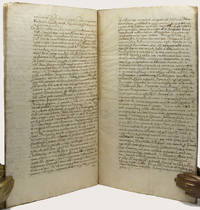
16113462Latin manuscript on vellum with large 6 in diameter suspended black wax seal of James I of England and autograph of Anne of Denmark dated July 23 1610 granting title to Corrodownan Manor in County Cavan Ulster to one John Browne Gent. of Gorgiemill near Edinburgh and his descendants during the Plantation i.e. colonization of Ulster under James I beginning in 1609. The colonists were settled on land confiscated from the Irish inhabitants following the conquest of Ulster 1594-1603 under James's predecessor Elizabeth I. The Plantation was intended to consolidate royal control of Ulster and repress rebellion by importing a substantial Protestant population. Like John Browne and indeed James himself many of the new colonists were Scottish. Some of these families went on to form the backbone of the Protestant Ascendancy in the province. John Browne and his heirs however were not among them. Sir George Carew sent by the king in 1611 to report on the progress of the Plantation noted that "he Browne . sent an agent who took possession set the lands to the Irish returned to Scotland and . performed nothing." The land was sold in 1613 to another Scottish colonist Archibald Acheson. Acheson's descendants were raised to the peerage of Ireland in 1806 as Earls of Gosford and still owned the property in the late nineteenth century. The first nineteen lines of the document grant the Scottish Browne the rights and privileges of James's English and Irish citizens. Especially notable are the requirement that the grantee maintain an adequate supply of arms for defense against the king's enemies lines 77-80 the attempt to encourage the growth of towns 74-76 and the ban on sale of the property to "mere Irish" or to anyone who failed to acknowledge the sovereign as head of the church thus excluding all Catholics by swearing the Oath of Supremacy 114-121. See Rev. George Hill The Conquest of Ireland. An Historical Account of the Plantation of Ulster at the Commencement of the Seventeenth Century 1608-1620 Belfast 1877 308; idem Plantation Papers. Containing a Summary Sketch of the Great Ulster Plantation in the Year 1610 Belfast 1889 188-190; F.J. McCaughey Arvagh. Sources for a Local History Arvagh 1998 16.; Moiré chemise lined with exact recess for seal housed in handsome ruled red morocco clamshell case with gilt title to front cover and raised bands gilt particulars and decoration to spine; gilt rolled edges. Two leaves 65 x 81 cm; the first illuminated with a portrait of the king. Stain to upper left see image.; 65 x 81 cm; 1 pages; Signed by Notable Personage Related; All shipments through USPS insured Priority Mail. . hardcover books
162134518Lisbon and Hangzhou China: Manuscripts ca.1623 and 1621. Very Rare A Similar Manuscript Exists in Brussels. We know of no others. The Latin text of both letters is written in a neat uniform cursive hand in brown. Folio leaves 33 x 20.5 cm The transcripts bound in 18th Century stiff blue wrappers the blank paste-downs and endpapers are late 18th century most likely the third quarter between 1745/1753 and 1776 since they contain a clear "lion/vryheit/pro patria" watermark with a crowned GR countermark which resembles Heawood 3148 3149 and 3154. The paper used for the manuscript contains a faint double-headed eagle watermark and it has been reinforced in the gutters. A very pleasing survival very well preserved edges slightly mellowed the wrappers show some signs of wear. VERY RARE MANUSCRIPT TRANSCRIPTS. Chrysostomus Johann Gall 1586-1643 was a German Jesuit and scholar. He left Ingolstadt Germany to teach astronomy mathematics and navigation in Lisbon fro 1620to 1627 before leaving to work in the Jesuit missions in India. The Colégio de Santo Antŕo benefitted from the arrival of many foreign mathematicians and other scholars as Lisbon serves as a gateway for all missionaries departing for Asia. The original letter by Gall was written in Lisbon September 1623 and concerns a newspaper style description of various events including details of the perseution of Christians in Japan particularly the execution of large numbers of the Christian community in Nagasaki in 1622.<br> The second letter in the present work is especially interesting as the original was written by Johannes Terentius also known as Johannes Schreck an Deng Yuhan Hanpo 1576-1630. Terentius was a prominent Jesuit scholar specialized in natural science and mathematics. Before joining the Jesuits as a novice1611 he already enjoyed a grea reputation in Germany as a scholar. In 1621 Terentius left for China to join the Jesuit mission. The original letter by Terentius was written in Hangzhou China on 30 August 1621 to the rector of teh Jesuit College in Munich Jakob Keller 1568-1631. He discusses his journey to China which he started in 1618 his intentions to participate in the planned calendar reform in China and his impressions of the city of Hangzhou which he reached in 1621 Terentius wrote several works on european medicine mathematics and technology in Chinese and together with Johann Adam Schall von Bell and G. Roho introduced European tigonometry and European astronomical instruments to China. In 1629 he began to reform the calendar which J.A. Schall von Bell ocmpleted after Terentius' early death a year later.<br><br>Backer & Sommervogel VII col. 1929-F<br> Manuscripts unknown
160922968Brussels: Rutger Velpius 1609. Contemporary brown calf sewn on 4 supports with corresponding raised bands on the spine gold-tooled spine with the title lettered in gold in the second compartment red sprinkled edges. 8vo. With a small woodcut vignette on both title-pages some woodcut head- and tail-pieces and woodcut decorated initials. Ad 1 with an engraved illustration depicting a Biblical scene mounted as a frontispiece on the verso of the second free flyleaf. 2 works in 1 volume the 2nd in 2 parts. With:2 GLEN Jean Baptise de and Aleixo de MENEZES. La messe des anciens Chrestiens dicts de S. Thomas en l' évesché d' Angamal és Indes Orientales . Brussels Rutger Velpius 1609. Ad 1: First French edition of António de Gouvea's account Jornada do Arcebispo de Goa Dom Frey Aleixo de Menezes first published in Portuguese in Coimbra 1606. It details the Jesuit-Portuguese success in aligning the St. Thomas Christians of Malabar with the Latin Church which was related to the trade struggles in the 16th and early 17th century between the Portuguese and their European and Indian rivals. The original Portuguese text was translated into French by Jean Baptiste de Glen 1552-1613 an Augustinian theologian. There are two issues of this edition with two different imprints: one published by J. Verdussen in Antwerp and one our copy published in Brussels by R. Velpius. The text was also translated into Spanish by Francois Munoz but remained in manuscript. Ad 2: Published under a separate title these two texts do in fact belong together. The Historie orientale and the two texts in La messe des anciens Chrestiens form a single book. Following the dedication to Abbot Gilles de Sprimont is the Remonstrance Catholique by Jean Baptise Glen. He expands on the Histoire Orientale and presents the edifying lessons the inhabitants of the Southern Netherlands can draw from it including interesting remarks on the Christian Syro-Malabar ritual and liturgy purified from the influence of Nestorianism a Christian heresy that held Jesus to be two distinct persons.The subsequent part is by Aleixo de Menezes on the Mass of the first Christians La messe des anciens Chrestiens on pp. 77-123 in which he deals with the content of the Mass and in which he gives the full Latin text. These two parts together published as one book are considered as a major contribution to the history of Christianity in India in general and the St. Thomas Christians on the Malabar Coast in particular.With a contemporary manuscript inscription on the recto of the second free flyleaf and a contemporary manuscript inscription on the title-page of ad 1. The binding shows some signs of wear second free flyleaf the title-page and the the first page of the dedication to ad 1 are restored in the upper outer corner the top margin is cut rather close to the text without affecting it. Otherwise in good condition.l Bibl. Belg. III G3; Cioranescu 33232 33233; Lach Asia in the Making of Europe III I pp. 320-1 395; USTC 6167300 7 copies; cf. STCV 6689348 1 copy other issue Rutger Velpius, hardcover
163457767London. 1634. 1st. Ed. 1st. Iss. pp.xx 326 iv with woodcuts throughout the text last 4 leaves with woodcut illus. Royal 4to. Hardback. Title page professionally reinforced at gutter lightly chipped to fore-edge. Overall contents in nr. fine condition. Contemporary full-calf boards in thoroughly vg. condition more recent spine in fine condition. A very pleasing copy indeed. One of three variant imprints Lisney identifies this variant as the first issue given the appearance of 'apud Benjam Allen' on the title page. Lisney 3 British Bee Books 25. A very significant work indeed. A first edition first issue copy of the first book about insects published in Britain. Partly compiled from the writings of Edward Wotton Conrad Gesner and Gesner's assistant Thomas Penny Moffett's copiously illustrated treatise remained the 'standard work' on insects until the early 1700s. London. hardcover
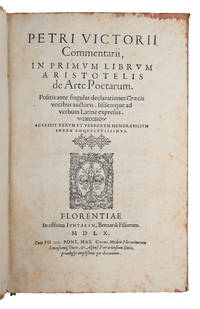
161062508Florence, In officina Iuntaru, Barnardi Filiorum, 1560. Small folio. 18th century full vellum with gilt labels to spine. Wear to capitals and small worm tracts towrad opper hinges. Corners a bit bumped. A very nice and sturdy binding. Marbled edges. Some browspotting throughout. Small wormholes to blank margin of final leaf, far from affecting imprint. Woodcut vignette to title-page and to verso of colophon-leaf. (10), 308, (12) ff.
161062508Florence In officina Iuntaru Barnardi Filiorum 1560. Small folio. 18th century full vellum with gilt labels to spine. Wear to capitals and small worm tracts towrad opper hinges. Corners a bit bumped. A very nice and sturdy binding. Marbled edges. Some browspotting throughout. Small wormholes to blank margin of final leaf far from affecting imprint. Woodcut vignette to title-page and to verso of colophon-leaf. 10 308 12 ff. <br/><br/><em>The rare first edition of Vittore's main work his great edition translation and commentary on Aristotle's Poetics which is arguably the most important and influential commentary on the work ever published profoundly shaping our understanding and interpretation of Aristotelian literary theory. Petrus Victorius or Piero/ Pietro Vittore/Vettore 1499-1584 is not only the “first great editor of the Poetics†McMahon he is also considered "the greatest Greek scholar of Italy" Whibley “the leading Italian scholar of his time†Encycl. Britt. “the last great figure from that period in the domain of Greek studies†Willamowitz and “the foremost representative of classical scholarship in Italy during the sixteenth century which for Italy at least may well be called the “saeculum Victorianumâ€.†Sandys. His magnum opus and without doubt most influential work is his edition with commentary of Aristotle’s Poetics which is of seminal importance in several respects. It is crucial to our understanding of Aristotle’s great work shaping the way that all later scholars have read it. The understanding of Aristotle’s work on poetry came to define the way that we have understood literature and fiction ever since the Renaissance and Victorius is the leading interpreter. ““From the sixteenth century to Romanticism European literary theory used the term marvel or wonder It. meraviglia ammirabile Fr. merveille Sp. maravilla to designate everything that was on the conceptual margins of the poetics of probability and imitation. The discovery and complete reception of Aristotle’s Poetics between the fifteenth and sixteenth centuries resulted in the dissemination of an idea of poetry as the imitation of the actions of men whose main part was the plot or the structuring of actions ordered according to the laws of necessity credibility and probability. This formed the basis of Neo-Aristotelian poetics which determined the ways of thinking about literature and fiction for more than four centuries.†Vega p. 280. Especially the idea of “wonder†in Aristotle’s Poetics came to be one of the founding ideas of modern literary theory. And especially here Victurius’ reading is groundbreaking playing a central part in the reception and understanding of the work over the centuries to come. “A single editorial decision in just one passage and what is more in a complex fragmentary unfinished text like the Poetics affects the entire work…†Vega p. 284. “The text of the Poetics that can be read in the editions and translations of the sixteenth century and a large part of the seventeenth with one exception as we shall see NB. This exception is Victorius does not include the term alogon in the passage that deals with wonder. It does not appear in the first Greek edition the famous Aldine princeps of 1508 or in the Latin translations of the end of the fifteenth century; it is not in the edition and translation by Alexander Paccius or Pazzi the one most widely read in the sixteenth century neither does it appear in the edition with commentary by Francesco Robortello nor in Vincenzo Maggi’s Enarrationes nor in the vernacular commentaries of Ludovico Castelvetro and Alessandro Piccolomini. What is more a detailed revision of the history of the text reveals that no manuscript of the Poetics and no direct or indirect testimonies not even in the Arabic branch of its transmission have ever included the term alogon.†Vega p. 282. It is Victorius who is solely responsible for the reading that is generally accepted today as well. “The moment when the idea of irrationality alogon appears for the first time in Aristotle’s text can be identified without hesitation as 1560 which is the date when the edition translation and commentary on the Poetics by the philologist and Hellenist Pier Vettori or Victorius was printed on the presses of Giunti in Florence. Vettori is the one who first edits alogon even though no testimony provides him with this reading and he does so fully aware of his choice and its implications†Vega pp. 287-89. “The success of Victorius’ reading while not immediate was extraordinary.†Vega p. 287 Antonio Viperano accepts the reading “alogon†with all it involves De poetica libri tres Ricciboni adapts it in his edition of Aristotle’s Poetics Tasso embraces it Discorsi dell’arte poetica Discorsi del poema eroico and it is implicit in Alonso López Pinciano’s Philosophia Antigua Poetica. Vossius in 17th century Germany makes abundant glosses on alogon in his books on poetics and the commentators and translators of the “Poetics†in France preferred Victorius’ reading in every case. “Victorius’ conjecture seems to have convinced all editors and commentators who reproduce it without question in every case.†Vega p. 289. The influence of Victorius’ interpretation of Aristotelian literary theory that he presented in his magnum opus i.e. the present work was not limited to the use of specific words that changed the reception history of Aristotle’s Poetics. His entire view of poetry through an interpretation of Aristotle was highly original and came to define the way we understand literature in general. Victorius was one of the first to put forth the belief that heroic poetry should present a Platonic idea of perfect virtue contributing to the centuries long doctrine of the perfect hero as perfect exemplar and he was one of the first to revive Aristotle’s idea of purgation from tragedy still widespread today and to also understand the existence of a purgation from poetry. “He viewed poetry as a moderator of minds “By reading poetry men “become moderate in temper and their turbid motions are extinguished.†Poems “purge our minds of blemish and spotâ€. Vettori realized that Aristotle’s reference to catharsis should be applied to tragedy alone but he added that similar purgations could be achieved by other kinds of poetry effective however on other passions than pity and fear and with the aid of other instruments.†Hathaway pp. 292-93. Apart from his overall interpretation of Aristotle’s literary theory and his groundbreaking reading of the most central passages of the Poetics Victorius was also the first to determine that the Aristotelian text that has come down to us is not complete. “Victorius was the first to see that the treatise now known as the Poetics is only the surviving portion of a larger work.†Bywater p. XX. “during his lifetime five medals were struck in his i.e. Victorius’ honour and his portrait was painted by Titian… His fame was not limited to his own land or his own time. His scrupulous care and unwearied industry are lauded by Turnebus who declines to be compared with him even for a moment; the epiteths doctissiums optimus and fidelissimus are applied to him by the younger and the greater of the two Scaligers while Muretus calls him eruditorum coryphaeus; and similar eulogies might be quoted from Justus Lipsius. Dacius … and Graevius. He is described as having climbed the “hill of virtue†and taken his place on its summit between Cicero and Aristotle. In his funeral oration Salviati says of him in the personification of Italia: “Now no more shall distant peoples cross the snows of the Alps to see Victorius or men of mark arrive from every land to hear him; or princes hold converse with him. Now no more shall the works of scholars in all parts of the world be sent here for his approval; or youth learn wisdom from his lips.†Sandys pp. 139-40. “No one said a contemporary of his in a funerary laudatio ‘left Aristotle in a cleaner state purgatior’.†Baldi. _____________________________________________ Adams: 1905; Brunet V: 1179; Graesse I: 213 â€Ã©dition excellente quant à la critique†and noting that some copies bear the dates 1563 and 1564. Sandys: A History of Classical Scholarship Vol. II 2003 pp. 135-140. Hathaway Baxter: The Age of Criticism: The Late Renaissance in Italy. Cornell University Press 1962. A.Philip McMahon: On the Second Book of Aristotle's Poetics and the Source of Theophrastus' Definition of Tragedy Authors. In: Harvard Studies in Classical Philology 1917 Vol. 28 1917 pp. 1-46. Christopher Rowe: Petrus Victorius and Aristotle’s Eudemian Ethics Cambridge University Press online 2025. Vega Maria José: Wonder and the Irrational. The Invention of Aristotle’s Poetics in the Sixteenth Century. In: Nous Polis Nomos. Berlin Academia Verlag 2016. Baldi: Il greco a Firenze e Pier Vettori 1499–1585 Alessandria 2014 117. </em> hardcover
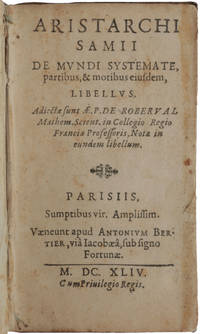
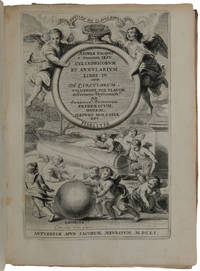
16445431Paris: Antoine Bertier 1644. First edition. <p>First edition exceptionally rare of Roberval's cosmology in which he expresses covertly his support for Copernicus and also formulates for the first time the law of universal attraction - that any two material bodies in the universe attract each other. This principle is normally ascribed to Robert Hooke who published it three decades later and to Newton in the Principia 1687.</p>. <p>THE LAW OF UNIVERSAL ATTRACTION</p> . <p>First edition exceptionally rare of Roberval's cosmology in which he expresses covertly his support for Copernicus and also formulates for the first time the law of universal attraction - that any two material bodies in the universe attract each other. This principle is normally ascribed to Robert Hooke who published it three decades later and to Newton in the Principia 1687. Roberval 1602-75 was one of the most brilliant members of Mersenne's circle. He developed indivisibles independently of Cavalieri invented an original method of drawing tangents and solved many of the problems on the cycloid that were formulated and solved by Pascal two decades later. However since almost nothing of his work was published in his lifetime he was for long eclipsed by Fermat Pascal and above all by Descartes his irreconcilable adversary. In fact Roberval himself published only two works the Traité de mécanique 1636 and the Aristarchi offered here; several of his other works appeared posthumously in the Divers ouvrages de mathématique et de physique 1693 but many remain unpublished even today. "Roberval's positivism appears in a particularly nuanced form in the book De mundi systemate of 1644 where he claimed to have translated an Arabic manuscript of Aristarchus to which he had added his own notes all of them favorable to the author. Yet he did not adhere to the system of Aristarchus to the exclusion of those of Ptolemy and Tycho Brahe. In the dedication of the work Roberval wrote: 'Perhaps all three of these systems are false and the true one unknown. Still that of Aristarchus seemed to me to be the simplest and the best adapted to the laws of nature.' It is with this reservation that Roberval expressed his opinion on the great system of the world the solar system the minor systems planetary the motions of the sun and the planets the declination of the moon the apogees and perigees the agitation of the oceans the precession of the equinoxes and the comets. Despite this reservation Roberval appeared convinced of the existence of universal attraction which-under the inspiration of Kepler-he put forth as the foundation of his entire astronomy: 'In all this worldly matter the fluid of which the world is composed according to our author and in each of its parts resides a certain property or accident by the force of which this matter contracts into a single continuous body'" DSB. Like Copernicus Aristarchus ca. 310-230 BCE maintained that the Earth rotates on its axis and revolves around the Sun. However Aristarchus's work has not survived and the Arabic manuscript which Roberval claimed to have translated almost certainly did not exist. Roberval uses it as a cover to express his support albeit nuanced for heliocentrism still a dangerous idea at the time. OCLC lists Cornell Huntington and Linda Hall in US. No other copies in auction records.</p> <br /> <p>"Gilles Personne was born in the village of Roberval near Senlis in 1602. Nothing is known about his early education; his father was a poor farmer or farmworker and the young mathematician who would later add 'de Roberval' his surname seems to have led the peripatetic life of an impoverished student passing through several universities and alternately studying and teaching. In 1628 he settled in Paris; there he got to know Mersenne who recognised his talents and encouraged him to work on the problem of the curve known as the 'trochoid' 'roulette' or 'cycloid.' In 1632 Roberval was given a teaching post at the Collège de Maître Gervais; two years later he obtained a more eminent position the Ramus chair of mathematics at the Collège Royal. He would remain in this professorship for forty-one years - a permanent fixture as it were of Parisian intellectual life - until his death in 1675. But the peculiar terms on which holders of this Ramus chair were appointed had a very negative influence on both his work and his later reputation. The chair was tenable for a period of three years; at the end of that time it was opened to a public competition in which anyone including the incumbent could apply for it. Candidates were required not only to lecture but also to demonstrate theorems and solve problems put to them by all comers. As a result the practice grew up of the incumbent trying to ensure his reappointment by proposing problems which only he could solve. Whatever were the most advanced discoveries Roberval was making at any time therefore he had an incentive to keep them secret so that he could use them to confound his competitors on these triennial occasions. One consequence was that most of his important work in his special field - geometry - remained unpublished in his lifetime. And another consequence was that Roberval would more than once become embroiled in disputes about precedence insisting that he had made key discoveries long before they were published by others; in 1646 for example he would make bitter accusations against Torricelli alleging that his analysis of the cycloid had been derived in an underhand way from Roberval's unpublished work. Even when he did allow some of his work to circulate he favoured a method of publication that was both limited and carefully monitored. As the English mathematician John Pell would later recall 'many yeares agoe some pieces of Mr Roberval were published after the old fashion. That is they were not given to a Printer; but any man that would pay for the transcribing might have had a coppy of them.'</p> <br /> <p>"Roberval was by all accounts a prickly character quick to take offence and with a high opinion of his own worth. As those were also the most prominent characteristics of René Descartes it is hardly surprisingly that a fierce enmity quickly sprang up between them. Roberval was almost ostentatiously unimpressed by Descartes' 'Géométrie' one of the essays published with his Discours de la méthode in 1637; his cool and critical comments transmitted to the author by their mutual friend Mersenne elicited an angry reaction. Relations between them were further soured by Descartes' quarrel with Fermat about the construction of tangents in 1638 in which Roberval became one of Fermat's leading defenders; not long afterwards Descartes accused Roberval of purloining his own ideas about the cycloid. Meanwhile Mersenne himself remained on the best of terms with both of these disputants. Indeed he seems to have had not only a deep admiration of Roberval's mathematical talents - he described him as scarcely inferior to Archimedes - but also a real personal fondness for him. Mersenne made a special effort to promote the writings of this far from prolific author: he added Roberval's brief treatise on mechanics at the end of book 3 of his own Harmonie universelle Paris 1636; he included material from the Latin version of that treatise in his compilation of 1644 Cogitata physico-mathematica; he encouraged and assisted the publication of Roberval's astronomical work Aristarchi Samii de mundi systemate libellus in 1644; he also reprinted that entire work in his own later compilation of 1647 Novarum observationum . tomus III. And throughout his own writings Mersenne referred to Roberval in terms both laudatory and affectionate calling him simply 'our geometer' - 'Geometra noster'" Malcolm pp. 157-8. </p> <br /> <p>"In 1644 Gilles Personne de Roberval published a small cosmological treatise entitled Aristarchi Samii de Mundi Systemate partibus & motibus eiusdem libellus. The book is attributed to the ancient Aristarchus of Samos and Roberval claims it to be an annotated translation of a recently recovered Arabic manuscript . Roberval tells the reader that the Arabic manuscript was translated under his and Mersenne's supervision at the expense of the royal counsellor. He does not explicitly defend the authenticity of the manuscript or even its origin as a true ancient source. Roberval does however imply the manuscript's authenticity at least by the style and disposition of the treatise. The epistle informs us that in addition to the translated text Roberval will also help the reader by inserting certain notes. These are given within the text are labelled as 'NOTA' and end with the abbreviation 'P.N.E.M.' 'pondere numero et mensura' the motto of the mathematicians of the Collège Royal. Usually the notes present new discoveries which were unknown by the author in order to corroborate or refute Aristarchus's opinions.</p> <br /> <p>"Not many took the book to be an authentic ancient treatise. Most philosophers mathematicians or scientists realized that the book was not authentic and that the name of Aristarchus was used just as a cover for a seventeenth century author. They were of course right. However as Heath observed more than a hundred years ago 'there was every excuse for Roberval. The times were dangerous.' Only ten years before he wrote the Aristarchi Galileo's Dialogue on the Two Chief Systems of the World was condemned. The French context was uncertain as geocentric systems were actively defended in the 1630s. In 1632 Libert Froidmond arguing against Philip and Jacob Lansbergen's heliocentric system published the Anti-Aristarchus sive Orbis-terrae immobilis. Two years later Froidmond followed up with another treatise the Vesta sive Ant-Aristarchi Vindex. Furthermore Roberval's Parisian colleague Jean Baptiste Morin had published the Famosi et antique problematis de telluris motu strongly arguing against Galileo and Copernicanism" Babeş pp. 95-97.</p> <br /> <p>In the Aristarchi Roberval not only discusses heliocentrism he gives a complete theory of the motion of the Earth Moon and planets. It is based on three principles.</p> <br /> <p>"The Sun as a cause of motion. From the very first chapter of the Aristarchi Roberval explains all motion of the system of the world by two principles. One of them is a principle of attraction stating that the fluid heavenly matter has in every one of its parts a certain property by which it tends to unite with all the other parts of matter. If the Sun would be absent from the world all heavenly matter would reunite in a perfect sphere. The second principle concerns the action of the Sun. By its heat the Sun continuously rarefies the surrounding matter. The rarefaction results in the elongation of matter which is pushed towards the extremity of the system. The sun also has an axial motion of its own by which the eviction of the rarefied matter takes place. This motion impresses upon the celestial bodies their periodical movement around the Sun. However throughout the Sun's axial rotations the ejections of rarefied matter do not have a constant flux and thus the motions of heavenly bodies around the sun are not uniform.</p> <br /> <p>"The movements of the Earth's system. As one of the planetary systems the Earth is moved around the Sun by the continuous pushing of the elongated matter coupled with the attractive property of the celestial matter. The system of the Earth retains its quasi-spherical shape due to an analogous attractive property of the elemental matter which accounts for the weight of terrestrial bodies. The terrestrial matter is however different from the heavenly matter. It is very mixed and it is unevenly disposed on the surface of the Earth. Therefore the Sun unevenly elongates the airy and fiery atmosphere surrounding the Earth and as a result the diurnal motion of the Earth is irregular. To this is added a third reason of the irregularity the influence of the Moon.</p> <br /> <p>"The periodical movement of the Moon. According to Roberval the Moon is a part of the system of the Earth. Its density is similar to that of the superior atmosphere such that it revolves together with the air and fire around the Earth. Roberval claims that the moon floats in the superior atmosphere in the same way as a submerged piece of wax floats in water. Its orbit however in not circular but oval-shaped. This shape is responsible for the ebb of the seas: at its perigee the Moon compresses the air below it which in turn exerts a pressure on the ocean. Likewise the Moon disturbs the flow of rarefied matter coming from the Sun which also affects the diurnal motion of the Earth" Babeş pp. 110-111.</p> <br /> <p>What is particularly noteworthy here is the "property of matter by which it tends to unite with all the other parts of matter" the first suggestion of the 'universal attraction' between material bodies.</p> <br /> <p>"In his System of the World Roberval asserts that each part of the fluid matter which fills the universe is endowed with a certain property that makes all parts draw together and attract each other reciprocally p. 39. At the same time he admits that in addition to this universal attraction there are other similar forces proper to each of the planets something that Copernicus and Kepler also admitted which hold them together and explain their spherical shapes .</p> <br /> <p>"Roberval's cosmology as it is presented in his System of the World . was heartily condemned by Descartes and Newton was deeply angered by Leibniz's identification of Newton's views with those of Roberval. Yet historically Roberval's work is interesting not only because it was the first attempt to develop a 'system of world' on the basis of universal attraction but also because it presented some characteristic features or patterns of explanation which or at least the analogues of which we shall find discussed later by Hooke and advocated by Newton and Leibniz.</p> <br /> <p>"Thus according to Roberval the fluid and diaphanous matter which fills or constitutes the 'great system of the world' forms a huge - but finite - sphere in the center of which is the sun. The sun a hot and rotating body exerts a double influence on this fluid matter: a It heats and thus rarefies it; it is this rarefaction and the ensuing expansion of the world-matter that counterbalances the force of the mutual attraction of its various parts and prevents them from falling upon the sun. This rarefaction also confers on the world-sphere a particular structure; the density of its matter increases with the distance from the sun. b The sun's rotating motion spreads through the whole world-sphere the matter of which turns around the sun with speeds diminishing with its distance from the sun. The planets are considered as small systems analogous to the great one which swim or place them selves at distances from the sun corresponding to their densities that is in regions the density of which is equal to their own; thus they are carried around the sun by the circular motion of the celestial matter as is the case with bodies swimming in a rotating vessel. Strangely enough Roberval - who never takes any account of centrifugal forces - believes that these bodies will describe circular trajectories!" Koyré pp. 59-60.</p> <br /> <p>The engraved plate which is repeated in this copy appears to be often lacking: it is not present in the BNF copy digitized on Gallica for example. In the reprint of the work in Mersenne's Novarum observationum . tomus III the two astronomical diagrams on the plate are printed within the text each of them several times.</p> <br /> <p>Babeş 'Roberval's scepticism in the Aristarchi Samii De Mundi Systemate' Studia Ubb. Philosophia 65 2020 pp. 95-114. Koyré Newtonian Studies 1965. Malcolm Aspects of Hobbes 2002.</p> <br/> <br/> 12mo 142 x 83mm pp. viii 148 with one engraved plate showing two astronomical diagrams bound before title and repeated at end two small paper flaws in aii affecting three letters but not the sense occasional light browning and foxing. Contemporary vellum darkened and stained. A genuine untouched copy of an extremely rare book. Antoine Bertier unknown
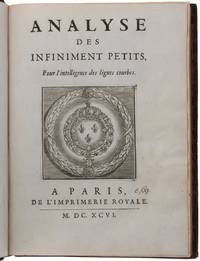
17002848Paris: L'imprimerie Royale; Jean Boudot 1700. First edition. First editions. L'Hôpital's treatise on differential calculus was based on lessons he received from Johann Bernoulli and it was under the influence of Malebranche that some years later appeared the first work on the integral calculus by Louis Carré. Hardcover. THE FIRST BOOKS ON DIFFERENTIAL AND INTEGRAL CALCULUS. <p>A fine sammelband comprising the first editions of the first books on the differential and integral calculus respectively. "In France it was through the Oratorian circle of Nicolas Malebranche that Johann Bernoulli introduced in 1691 the Leibnizian calculus. His lessons to the Marquis de l'Hôpital led to the draft of the first treatise of differential calculus 1696 and it was under the influence of Malebranche that some years later appeared the first works on the integral calculus by Louis Carré in 1700 and Charles René Reyneau in 1708. The spread and acceptance of the Leibnizian calculus was transferred in this way to the wide public" Landmark Writings p. 56. "The importance of L'Hospital's work lay in its dissemination throughout Europe of the concepts and early development of the calculus whose cause L'Hospital advanced as well through his many contacts; these included Christiaan Huygens who is reputed to have learned the calculus from L'Hospital" DSB. Bernoulli's lectures also covered integral calculus but L'Hospital dropped plans to write a continuation to his Analyse des infiniment petits dealing with this subject "in deference to Leibniz who had let him know that he had similar intentions" ibid. Leibniz never wrote such a text however and Bernoulli's lectures on integral calculus remained unpublished until they appeared in his Opera 1742. The task of completing L'Hospital's book was instead taken up by Carré a pupil of Malebranche and assistant to Pierre Varignon from whom he probably learnt calculus. "Following the classical custom his Analyse des infiniment petits starts with a set of definitions and axioms . The difference differential is defined as the infinitely small portion by which a variable quantity increases or decreases continuously. Of the two axioms the first postulates that quantities which differ only by infinitely small amounts may be substituted for one another while the second states that a curve may be thought of as a polygonal line with an infinite number of infinitely small sides such that the angle between adjacent lines determines the curvature of the curve. Following the axioms the basic rules of the differential calculus are given and exemplified. The second chapter applies these rules to the determination of the tangent to a curve in a given point . The third chapter deals with maximum-minimum problems and includes examples drawn from mechanics and geography. Next comes a treatment of points of inflection and cusps. This involves the introduction of higher-order differentials each supposed infinitely small compared to its predecessor. Later chapters deal with evolutes and with caustics. L'Hospital's rule is given in chapter 9" ibid. The tenth and final chapter of the Analyse discusses the methods of Descartes and Johann Hudde. The companion work by Carré is "the first treatise on the integral calculus in any language which is here applied to the determination of the area of superficies surfaces and solids and their centres of gravity problems of percussion oscillation etc." Sotheran. On this last topic the determination of the centres of oscillation of solids Carré made a significant error. This was known to Bernoulli but not publicized at the time and so was propagated into several later calculus texts such as Charles Hayes' Treatise on Fluxions 1704 and Edmund Stone's The Method of Fluxions both Direct and Inverse 1730. Both works are rare on the market: ABPC/RBH list four copies of L'Hospital's book since the Norman copy which realised $6325 in 1998; and only two copies of Carré's work in the last half century. </p> <br /> <p>"Differential and integral calculus are generally considered to have their origins in the works of Newton and Leibniz in the late 17th century although the roots of the subject reach far back into that century and arguably even into antiquity. Leibniz first described his new calculus in a cryptic article more than a decade before the publication of the Analyse. For all practical purposes Leibniz' early papers were not understood until Jakob Bernoulli and his younger brother Johann began studying them in about 1687 and making discoveries of their own using his techniques.</p> <br /> <p>"Bernard de Fontenelle became the secretary of the Académie des Sciences in Paris in 1697 and wrote the eulogy of l'Hôpital for the academy's journal. He said that in 1696 'the Geometry of the Infinitely small was still nothing but a kind of Mystery and so to speak a Cabalistic Science shared among five or six people. They often gave their Solutions in the Journals without revealing the Method that produced them and even when one could discover it it was only a few feeble rays of this Science that had escaped and the clouds immediately closed again.' Later on Montucla went one step further and listed the only people that he believed understood Leibniz' calculus before 1696: Leibniz himself Jakob and Johann Bernoulli Pierre Varignon and l'Hôpital. L'Hôpital's Analyse changed all of this and for much of the 18th century his book served aspiring French mathematicians as their first introduction to the new calculus.</p> <br /> <p>"For all that the Analyse was a popular and successful introduction to the differential calculus it's remarkable that there is no account of the integral calculus in the book. In his Preface l'Hôpital explained why: 'In all of this there is only the first part of Mr. Leibniz' calculus . The other part which we call integral calculus consists in going back from these infinitely small quantities to the magnitudes or the wholes of which they are the differences that is to say in finding their sums. I had also intended to present this. However Mr. Leibniz having written me that he is working on a Treatise titled De Scientiâ infiniti I took care not to deprive the public of such a beautiful Work' p. iii. Unfortunately Leibniz never completed this book On the Science of the Infinite.</p> <br /> <p>"The Analyse consists of ten chapters which l'Hôpital called 'sections.' We consider it to have three parts. The first part an introduction to the differential calculus consists of the first four chapters:</p> <br /> <br /> In which we give the Rules of this calculus. <br /> <br /> Use of the differential calculus for finding the Tangents of all kinds of curved <br /> lines. <br /> <br /> Use of the differential calculus for finding the greatest and the least ordinates to which are reduced questions De maximis & minimis. <br /> <br /> Use of the differential calculus for finding inflection points and cusps.<br /> <br /> <p>"Taken together these chapters provide a thorough introduction to the differential calculus in about 70 pages. The next five chapters are devoted to what can only be described as an advanced text on differential geometry motivated in part by what were then cutting-edge research problems in optics and other fields" Bradley et al. pp. v-vi.</p> <br /> <p>These subsequent chapters no longer mirror the structure of Bernoulli's lectures. Chapter 5 the longest in the Analyse deals with evolutes and involutes including the cycloid and various spirals. Chapters 6-8 are on envelopes of lines and curves i.e. curves that are tangent to every member of a family of lines or curves - this includes the study of caustics in geometrical optics. Chapter 9 contains "the solution of various problems that depend upon the previous Methods;" the first of these is the celebrated rule that we now call L'Hôpital's Rule which was first discovered by Bernoulli. In his final chapter of the Analyse l'Hôpital demonstrates how all of the methods of Descartes and Hudde may be easily derived and justified using Leibniz's differential calculus.</p> <br /> <p>Born into a noble family L'Hospital 1661-1704 abandoned a military career due to poor eyesight to pursue his interest in mathematics. "Some time around 1690 L'Hôpital joined Nicolas Malebranche's circle which was engaged among other things in the study of higher mathematics. It was there in November 1691 that he met the 24-year-old Johann Bernoulli who was visiting Paris and had been invited by Malebranche to present his construction of the catenary at the salon . Bernoulli told Pierre Rémond de Montmort that upon meeting the Marquis he soon found him to be a good enough mathematician with regard to ordinary mathematics but that he knew nothing of the differential calculus other than its name and had not even heard of the integral calculus. L'Hôpital had apparently mastered Fermat's method of finding maxima and minima and told Bernoulli that he had used it to invent a rule for determining the radius of curvature for arbitrary curves. The method was unwieldy and actually could only be used at local extrema of algebraic curves. Bernoulli showed him the formula for the radius of curvature that he had developed with his brother Jakob which employed second-order differentials. Apparently this so impressed the Marquis that he visited Bernoulli the very next day and engaged him as his tutor in the differential and integral calculus.</p> <br /> <p>"Bernoulli tutored the Marquis in his Paris apartment four times a week from late 1691 through the end of July 1692 . In the summer of 1692 Bernoulli accompanied the Marquis to his estate in Oucques near the French city of Blois where he continued giving him tutorials until some time in October . Bernoulli kept copies of his lessons to the Marquis throughout his long and productive career. The first part on the differential calculus was incorporated by l'Hôpital into the first four chapters of the Analyse. Bernoulli himself published the much larger second part concerning the integral calculus in his collected works. Titled Lectiones mathematicae de methodo integralium this treatise bears the subtitle 'written for the use of the Illustrious Marquis de l'Hôpital while the author spent time in Paris in the years 1691 & 1692' . Because Bernoulli chose not to publish this part it was impossible in the 18th century to say how closely l'Hôpital's textbook coincided with Bernoulli's lessons. A comparison finally became possible when Paul Schafheitlin discovered a manuscript copy of the full set of lessons on both the differential and integral calculus in the library of the University of Basel in 1921 . Because the latter part was a near-perfect match to what Bernoulli had published in 1741 he could be quite certain that the first part was essentially the same set of lessons l'Hôpital had used when composing the Analyse .</p> <br /> <p>"Since the appearance of the Lectiones various authors have characterized the Analyse as having essentially been written by Bernoulli. Indeed Bernoulli himself in an angry letter to Varignon of February 26 1707 said that 'to speak frankly Mr. de l'Hôpital had no other part in the production of this book than to have translated into French the material that I gave him for the most part in Latin.' The truth is much more nuanced. The superstructure of l'Hôpital's first four chapters is certainly due to Bernoulli and many of the details are essentially the same in both texts. However l'Hôpital added much in both quantity and quality. For one thing Bernoulli's Lectiones occupied 37 manuscript pages compared to 70 typeset pages for the first four chapters of the Analyse but the Marquis added much more than mere verbiage to Bernoulli's lesson. He was a very talented pedagogue. He organized his material very well extracting general propositions where Bernoulli gave examples and explained matters clearly and in some detail. Furthermore he frequently included many illustrative examples gradually increasing in difficulty generally providing an appropriate level of detail but always leaving some things for readers to work out for themselves" Bradley pp. vii-xi. The last six chapters were not taken directly from Bernoulli's lectures although l'Hôpital has drawn on material provided to him in Bernoulli's letters or in his lessons on the integral calculus.</p> <br /> <p>Louis Carré's 1663-1711 father a prosperous farmer wanted him to become a priest but after having spent three years studying theology in Paris he refused to take holy orders and his father cut off all financial support for his son. Carré managed to avoid poverty by becoming an amanuensis to Malebranche. The group Malebranche had assembled at the Oratory in Paris included Varignon and l'Hôpital among others. Carré spent seven years with Malebranche after which he became a private tutor in Paris specializing in the teaching of women then barred from a university education many of whom were nuns.At this stage Carré seems to have been interested mainly in philosophy and did not take much interest in current mathematical research. However on 4 February 1699 Varignon admitted him as one of his élèves in the Academy of Sciences. This stimulated Carré's interest in mathematics and he began working on his Methode pour Ia mesure des surfaces .</p> <br /> <p>The work is divided into four Sections:</p> <br /> <br /> On the measure i.e. area of surfaces.<br /> On the dimension i.e. volume of solids.3<br /> On centres of gravity.<br /> On centres of percussion and oscillation.<br /> <br /> <p>The centre of percussion is the point on a solid body attached to a pivot where a perpendicular impact will produce no reactive shock at the pivot. The same point is called the centre of oscillation for the body suspended from the pivot as a pendulum meaning that a simple pendulum with all its mass concentrated at that point will have the same period of oscillation. The formula for the centre of oscillation originally derived by Huygens in his Horologium oscillatorium 1673 requires certain integrations to be performed. Carré made an error in calculating the integral for the moment of inertia of a cone suspended from its vertex a mistake that led to an incorrect expression for the centre of oscillation of the cone. Lenore Feigenbaum explains that the story of Carré's mistake and the subsequent propagation of his error in eighteenth-century calculus textbooks "is instructive in several regards: first in showing how some of the methods of the calculus were interpreted and absorbed during the early 18th century; second in shedding light on the nature of the textbook industry of the time; and finally in providing us with a modicum of historical sympathy when we find our own students making the same kind of mistakes."</p> <br /> <p>Between 1701 and 1705 Carré published over a dozen papers on a variety of mathematical and physical subjects which led to him being admitted to the Academy of Sciences as an Associate Mechanician on 15 February 1702 and being promoted to Pensioner on 18 August 1706. This provided him with an income which allowed him to devote himself entirely to his academic studies during the final five years of his life. At age 46 he suffered an attack of dyspepsia from which he died in 1711. </p> <br /> <p>I. Babson Supplement p.30; Honeyman 2006 & 2007; Norman 1345; Sotheran First Supplement 1411; not in Macclesfield. II. Macclesfield 481; Poggendorff I 383-384; Sotheran I 704. Bradley Petrilli & Sandifer. L'Hôpital's Analyse des infiniments petits. An Annotated Translation with Source Material by Johann Bernoulli 2015. Grattan-Guinness ed. Landmark writings in Western mathematics 1640-1940 2005.</p> <br/> <br/> Two works bound in one volume 4to 251 x 186 mm pp. xviii 181 3 with 11 folding engraved plates; pp. xii 115 1 blank and 4 folding engraved plates. Old signature cut from first title and expertly repaired. Contemporary French calf spine gilt with red lettering-piece. Fine copies. / Hardcover. L'imprimerie Royale; Jean Boudot unknown
16515427Antwerp: Jacob van Meurs 1651. First edition. <p>First edition very rare and a fine copy. "Tacquet's most important mathematical work Cylindricorum et annularium contained a number of original theorems on cylinders and rings. Its main importance however lay in its concern with questions of method. Tacquet rejected all notions originating with Cavalieri that solids are composed of planes planes of lines etc." DSB. "It was Tacquet's decisive influence followed by Pascal's large-scale implementation which allowed the passage from indivisibles to infinitesimals" Julien Seventeenth-Century Indivisibles Revisited.</p>. <p>'ALLOWED THE PASSAGE FROM INDIVISIBLES TO INFINITESIMALS'</p> . <p>First edition very rare and a fine copy. "Tacquet's most important mathematical work Cylindricorum et annularium contained a number of original theorems on cylinders and rings. Its main importance however lay in its concern with questions of method. Tacquet rejected all notions originating with Cavalieri that solids are composed of planes planes of lines and so on except as heuristic devices for finding solutions. The approach he adopted was that of Luca Valerio and Gregorius of Saint-Vincent an essentially Archimedean method" DSB. "Tacquet's criticisms must have been effective because indivisibles became homogeneous magnitudes as a result of innovations introduced during the course of the seventeenth century" Rossini p. 465. The historian of mathematics Henri Bosmans "states that it was Tacquet's decisive influence followed by Pascal's large-scale implementation which allowed what is sometimes referred to as the passage from indivisibles to infinitesimals" Julien p. 187. "In this work the ideas that the tangent and the area under a curve were inverse to each other appeared. It arises from the way that Tacquet thought of curves generated by moving points but not actually comprising of points. Of course this idea is an early form of what would become clear when the calculus was invented namely that the derivative and integral were inverse to each other. This book had a considerable effect on Pascal and was important in setting the scene for the invention of the calculus" MacTutor. Bosmans has pointed out the debt owed to Tacquet's Cylindricorum et annularium by Pascal in his preparation of the Lettres de Dettonville 1659. Indeed in the Lettre à Carcavy Pascal writes that Tacquet's book is full of "learned geometry" praises how Tacquet "handles the indivisibles with all desirable rigour" and refers specifically to Tacquet for a result on the approximation of a surface by inscribed and circumscribed polyhedra see Descotes. "The change in Pascal to a clear point of view with respect to infinitesimals may well have come from Pascal's reading of Tacquet's Cylindricorum et annularium in which the author denied the validity of concluding anything about the ratio of surfaces from the ratio of their indivisibles or lines" Boyer p. 151. This is a rare work particularly in commerce. ABPC/RBH list only the Turner copy from the University of Keele offered by a prominent London dealer in 2002 and subsequently sold at Reiss in 2005 quite a poor copy in modern binding with some paper repairs and a partially removed library stamp. Ours is a fine untouched copy in contemporary binding.</p> <br /> <p>Provenance: Contemporary ownership inscription on title of "Conde da Torre" possibly the Portuguese nobleman João de Mascarenhas 1633-1681 second Count of Torre and first Marquis of Fronteira. </p> <br /> <p>"The Jesuit mathematician André Tacquet 1612-60 was by the standards of his time a man of the world. Although he may never have left his native Flanders his network of correspondents spanned Europe's religious divide reaching to Italy and France but also to Protestant Holland and England. Only months before his death he entertained the Dutch polymath Christiaan Huygens who had travelled to Antwerp with the express purpose of meeting Tacquet by then regarded as one of the brightest mathematical stars ever to come out of the Society of Jesus . It was his mathematical excellence that transcended 17th-century prejudices. In England Henry Oldenburg secretary of the Royal Society of London and no friend of the Jesuits spent so much time describing Tacquet's Opera mathematica at the Society's meeting in January 1669 that he felt compelled to apologise to the fellows for abusing their patience. But it was he insisted 'one of the best books ever written on mathematics'" Alexander p. 118.</p> <br /> <p>"In 1651 André Tacquet the urbane Fleming whose work was celebrated by Catholics and Protestants alike published hisCylindricorum et annularium libri IV 'Four books on cylinders and rings' a work dedicated to the study of geometrical features of these figures and their applications. Befitting a Jesuit publication the frontispiece shows two angels bathed in divine light holding up a ring enclosing the book's title; on the ground below them a band of cherubs is busy putting the theory into practice. The implication is clear: divine mathematics universal and perfectly rational orders and arranges the physical world to the best possible effect. It is a fetching visual depiction of the Jesuit view of the role and nature of mathematics.</p> <br /> <p>"The Cylindricorum et annularium is Tacquet's most celebrated work the one that established his reputation as one of Europe's most original and creative mathematicians. As it turned out it may have been a bit too 'original and creative' for his superiors: when Tacquet sent a copy of the book the newly appointed superior general Goswin Nickel the general's response was surprisingly cool. After thanking the mathematician and congratulating him on the book Nickel added that it would be better if Tacquet applied his impressive gifts to producing textbooks of elementary geometry for use by students at the Society's colleges rather than original works aimed at a select audience of professional mathematicians . Tacquet a good soldier in the Army of Christ obeyed. From then on he published no more original work but concentrating instead on producing textbooks some of which are of such quality that they became standards in the field for over a century .</p> <br /> <p>"In his critique Tacquet is respectful even deferential toward his rivals. He refers to Cavalieri as 'a noble geometer' and insists that he 'does not wish to detract from the deserved glory' of Cavalieri's 'most beautiful invention' Geometria indivisibilibus 1635. Tacquet knew of what he spoke because he was himself deeply familiar with the work of Cavalieri and Torricelli and was no less capable than they of using their method to arrive at new results. But once he gets beyond his congenial style and mathematical mastery it becomes clear that Tacquet's opposition to the infinitely small is . unyielding . 'I cannot consider the method of proof by indivisibles as either legitimate or geometrical' he states flatly at the opening of his discussion of indivisibles. 'It proceeds from lines to surfaces from surfaces to solids and applies to the surface the quality or proportion obtained from the lines and transfers what was obtained from the surfaces to the solid.' 'By this method' he concludes 'nothing can be proven by anyone'" ibid. pp. 161-2.</p> <br /> <p>"André or Andreas Tacquet resembles his contemporary Torricelli in the generality of his adoption from his predecessors of varied infinitesimal methods. In his Cylindricorum et annularium libri IV he gave for example four demonstrations of the proposition that the volume of a sphere is equal to that of a cylindrical wedge whose base is half a great circle of the sphere and whose altitude is equal to the circumference of the sphere. This theorem had been given by a number of mathematicians since Kepler as well as by Archimedes in the Method probably not then extant. Tacquet however after proving the theorem in two ways by the use of inscribed and circumscribed figures gave two further demonstrations by indivisibles based on the equality of triangles and circular sections. Torricelli had himself been satisfied with the rigor of proofs by means of indivisibles although he supplied alternative demonstrations for the benefit of others. Tacquet on the other hand said that he did not consider that the method of Cavalieri was to be admitted as either legitimate or geometrical. He maintained that the cylindrical wedge could not in all strictness be considered as made up of triangles; nor could the sphere be regarded as composed of circles . A geometrical magnitude he asserted is made up only of homogenea that is parts of like dimension - a solid of small solids and area of small areas and a line of small lines - and not of heterogenea or parts of a lower dimension as Cavalieri had maintained. He therefore felt that a proposed magnitude is exhausted a word he undoubtedly acquired from Gregory of St. Vincent by inscribing homogenea within them 'as in the manner of the ancients'" Boyer pp. 139-140.</p> <br /> <p>Tacquet gave a famous example where Cavalieri's method led to incorrect results. On pp. 23-24 he considers a right-angled triangle with one horizontal and one vertical side. Rotating this triangle around the vertical side generates a cone. Each plane section of the cone parallel to the base determines a circle and the circumference of each of these circles bears the same ratio to its radius namely 2π to use our notation. Since the surface of the cone is made up of all these circular cross-sections and the triangle is made up of all the radii Cavalieri's method would imply that the same ratio is also that between the surface area of the cone and the area of the triangle. But this is not the case.</p> <br /> <p>Archimedes had used a double reductio ad absurdum style of proof to find areas and volumes and this argument continued to be used until the publication of Cavalieri's work. To show that the area of a given region is equal to A Archimedes showed that for any number B smaller than A an inscribed figure could be constructed whose area is greater than B the inscribed area was usually composed of rectangles or triangles so that its area could easily be determined. This shows that the area of the given region cannot be smaller than A. A similar argument with circumscribed figures shows that the area cannot be larger than A. This technique is usually referred to as the 'method of exhaustion.'</p> <br /> <p>In the Cylindricorum et annularium Tacquet gives two proofs of most of his results on rings and cylinders the first using a modified form of the exhaustion technique the second using indivisibles; the precision and rigour of the traditional method is repeatedly stressed. But Tacquet introduces a number of innovations in the use of the method of exhaustion.</p> <br /> <p>"Tacquet's book has two theorems dealing with exhaustion which are the foundation for nearly all other theorems in the book. The first proposition of the first book is reminiscent of Valerio's theorem De Centro Gravitatis Solidorum Libri Tres 1604:</p> <br /> <p>Let A and B be two magnitudes either areas or volumes and let the ratio of E to F be given. If one can consecutively inscribe into A and B a sequence of magnitudes that relate to one another as E to F and if these magnitudes exhaust A and B i.e. they differ from these by an arbitrarily small amount then the magnitude A will relate to the magnitude B as E to F.</p> <br /> <p>"Tacquet's general theorem has the advantage that he does not have to repeat a double reductio ad absurdum with each proof .</p> <br /> <p>"The first proposition of the second book introduces another exhaustion method:</p> <br /> <p>If a sequence of magnitudes Ain and Bin can be inscribed in magnitudes A and B and if likewise a sequence of magnitudes Acn and Bcn can be circumscribed about magnitudes A and B and if moreover Ain and Acn exhaust A and for the corresponding magnitudes we have Ain / Bin = E/F and Acn / Bcn = E/F then A/B = E/F.</p> <br /> <p>"The simplification lies in the fact that it is no longer necessary to exhaust the inscribed and circumscribed magnitudes for each of the magnitudes A and B as it suffices to calculate the ratio for one or the other .</p> <br /> <p>"An important new concept is found in Tacquet's definitions of surfaces and solids. He defines the cylinder for instance as a solid that is generated by the movement of a circle in such a way that one of the points of the circle segment moves along a straight line. The axis of this cylinder is the straight line joining the centre of two of the generated circles. Despite this definition he does not accept that the cylinder is composed of circles" ibid. pp. 214-5.</p> <br /> <p>An important example of Tacquet's 'kinetic' method of generating curves and surfaces is contained in the second part of the Cylindricorum et annularium entitled 'Dissertatio physico-mathematica de circulorum volutionibus' in which Tacquet studies the cycloid a curve traced out by a point on the circumference of a circle as it is rolled along a straight line. This curve was to be the focus of Blaise Pascal's work on indivisibles published in the Lettres de A. Dettonville 1659.</p> <br /> <p>"Although Pascal was undoubtedly attracted by the power of indivisible methods he was impressed by the careful geometrical approach of Grégoire de Saint-Vincent and swayed by the vigorous criticism of Cavalierian indivisibles launched by André Tacquet in his work Cylindricorum et annularium. Pascal was accordingly impelled to examine carefully the basis for the use of indivisibles in geometry" Baron pp. 199-200.</p> <br /> <p>"Blaise Pascal in a sense represents the highest development of the method of infinitesimals carried out under the tradition of classical geometry . Pascal was not a professional geometer and as a result his geometrical work was accomplished in two periods which were separated by an interval of mathematical inactivity from 1654 to 1658 during which he devoted his interests to theology. These two periods moreover are characterised by somewhat different views as to the nature of infinitesimals . In this connection he enunciated in the Potestatum numericarum summa of 1654 the theorem on the integral of xn . The essential point in Pascal's demonstration is the omission of terms of lower dimension . The geometrical intuition of indivisibles of lower dimension was carried over into arithmetic to justify the neglect of certain terms of lower degree .</p> <br /> <p>"In the later period of his mathematical activity his view appears to be modified. In connection with problems such as those in his Traité des sinus du quart de cercle of 1659 contained in the Lettres de Dettonville . he used the language of infinitesimals in speaking of the sum of all the ordinates; but he added that one need not fear to do this inasmuch as what is really meant is the sum of arbitrarily small rectangles" Boyer pp. 147-151.</p> <br /> <p>Bosmans sees Pascal's Potestatum numericarum summa as containing two mutually incompatible ideas about indivisibles. On the one hand Pascal sometimes regards indivisibles as rigorously null quantities as had Cavalieri. On the other hand he sometimes regards indivisibles as simply quantities that are negligible in comparison to other quantities. "Bosmans then strongly underlines the difference with the clarity of the Lettres de Dettonville where Pascal expresses himself with impeccable rigour substituting for the strict indivisibles of Cavalieri homogeneous quantities whosesums differ from that to be measured by less than any given quantity. He then finds the reason for this progress in the reading that Pascal would have made between 1654 and 1658 of the book published by Tacquet in 1651" Descotes pp. 1-2 our translation.</p> <br /> <p>In the last section of the Lettre à Carcavy Pascal refers specifically to Tacquet in his discussion of the problem of finding the area of a surface obtained by rotating a curve around a vertical axis. When an infinitesimal section of the curve is rotated one obtains a circular band; these bands together make up the whole surface. "This is properly what according to Dettonville Tacquet has demonstrated: 'The sum of these semi-circumferences of the surface of the semi-solid makes up this very surface as others have demonstrated among them Tacquet'. We find in fact in the Cylindricorum et annularium Book II 1st part a Proposition VI which corresponds to Pascal's words. Its object is to prove that if we consider in a great-circle BICQ on a sphere with diameter BC if we inscribe and circumscribe regular polygons on the semi-circle BIC and if we rotate these polygons around the diameter BC they inscribe and circumscribe in the sphere with solids whose surfaces differ from that of the sphere by a quantity which can be made as small as one wishes. We see how it accords with Pascal's thought: the inscribed and circumscribed segments generate bands during the rotation which at the limit can be said to compose the curved surface. In accordance with his principles Father Tacquet demonstrates it in the manner of the Ancients" ibid. p. 4.</p> <br /> <p>"Tacquet was the son of Pierre Tacquet a merchant and Agnes Wandelen of Nuremberg. His father apparently died while the boy was still young but left the family with some means. Tacquet received an excellent education in the Jesuit collège of his native town and a contemporary report describes him as a gifted if somewhat delicate child. In 1629 he entered the Jesuit order as a novice and spent the first two years in Malines and the next four in Louvain where he studied logic physics and mathematics. His mathematics teacher was William Boelmans a student of and secretary to Gregorius Saint Vincent. After his preliminary training Tacquet taught in various Jesuit collèges for five years notably Greek and poetry at Bruges from 1637 to 1639. From 1640 to 1644 he studied theology in Louvain and in 1644-45 he taught mathematics there. He took his vows on 1 November 1646 and subsequently taught mathematics in the collèges of Louvain 1649-55 and Antwerp 1645-49 1655-60" DSB.</p> <br /> <p>A second edition of the Cylindricorum et annularium was published in 1659 with the addition of a fifth book devoted to an unrelated subject the paradox of 'Aristotle's wheel'. The perceived unsuitability of the Cylindricorum at annularium for the Jesuit colleges may explain why it was not added to all copies of the Opera mathematica 1669 it was not present in the Macclesfield copy for example.</p> <br /> <p>De Backer-Sommervogel VII 1806 3; Poggendorff II 1064. Alexander Infinitesimal 2014. Baron The Origins of the Infinitesimal Calculus 1969. Boyer The History of the Calculus and its Conceptual Development 1949. Descotes 'Documents relatifs aux lettres de A. Dettonville I. Pascal et le Père Tacquet' Courrier du Centre international Blaise Pascal 14 1992 pp. 1-13. Julien ed. Seventeenth-Century Indivisibles Revisited 2015. Malet From indivisibles to infinitesimals 1996. Meskens Between Tradition and Innovation: Gregorio a San Vicente and the Flemish Jesuit Mathematics School 2021. Rossini 'Giordano Bruno and Bonaventura Cavalieri's theories of indivisibles: a case of shared knowledge' Intellectual History Review 28 2018 pp. 461-476.</p> <br/> <br/> Small 4to 217 x 162 mm pp. xx 284 4 with 18 folding engraved plates the first 9 bound preceding title the remainder at end as in the instructions to binder on p. 286 full-page engraving on title second work with special half-title occasional light browning and spotting. Contemporary yapped limp vellum with manuscript title on spine remains of ties a few stains and light rubbing. Jacob van Meurs unknown
1669B6290London: Printed by John Macock for the Author Ogilby. c.1669. A fine attractive and handsome copy with text and plates clean and crisp. Edition: First or 1669 Edition in English. Binding: Contemporary mottled full calf rebacked expertly saving the original spine spine with seven raised gilt bands; compartments densely gilt ornamentated; with gilt lettered title on brown morocco label on two and three. Blind dentelle pattern tooled on edges of covers; pasted and free endpapers marbled. <br><br><br> Notes: John or Johann Nieuhof 1618 – 1672 is best known for the account of his journey from "Guangzhou"Canton to Peking in 1655-1657 which enabled him to become an authoritative Western writer on China. The book was first published in Dutch in 1665 by Johan's brother Hendrik and the Amsterdam based publisher and printer Jacob van Meurs. The publication was successful several edited editions followed geared towards commercial interests also translated into French German Latin and eventually into English. The English version was not published by Van Meurs but by John Ogilby instead. The book consists of the notes and illustrations that Nieuhof made in his position as a steward on Peter de Goyer and Jacob de Keizer's embassy to the emperor of China. The work itself is split into two parts. The first part contains the written account of the embassy led by Peter de Goyer and Jacob de Keizer to the emperor of China. It details the entire journey from "Guangzhou"Canton to Peking and back again. This part also contains descriptions and depictions of all that the embassy came to pass on its trip. The second part consists of an overview of China describing bridges mountains temples customs and costumes supported by illustrations. Prior to this period the image of the Chinese in Europe was dominated by fantasy illustrations. Many subsequent artists and architects based their work on Nieuhof's pictures. The present copy John Ogilby’s translation and the first Edition in English. Apart from 'An embassy from the East-India Company…’ Nieuhoff’s account of his journey it also includes ‘A Narrative of the Success of an Embassage sent by John Maatzuyker's de Badem General of Batavia…’ and Kircher’s ‘An Appendix or Special Remarks taken at large out of Athanasius Kircher/ His / Antiquities of China.’<br><br> Size: Folio 418 x 270mm. Illustration: engraved frontispiece portrait of John Ogilby by Lilly and engraved by Lombart; engraved illustrated title signed and dated by ‘W.enceslas Hollar 1668.’; printed title in red and black ink; map of China signed by Hollar double page dedication leaf to King Charles; with 17 full-page and 2 double-page plates. 121 in-text illustrations throughout as well as head-piece vignettes and rubricated historiated initials at openings of dedication and sections; one endpiece.<br>Wide margined large paper copy; main text jumps from 184 to 205 without loss of content. References: Cordier Sinica II 2347; Lust 536; Wing N1153 Transation: John Ogilby’s Englis Pages: PP. illustrated title blank printed title blank map; dedication leaf to King Charles; 327 bl.; 1-18; appendix 1-106 19 ill. Category: Book Voyages General; Book Asia Far East Printed by John Macock for the Author [Ogilby],. unknown
161567051615. 14; 13 folding leaves. Two parts in one vol. Large 8vo cont. or later dark wrappers dyed with persimmon juice shibubiki new stitching. Japan probably Kyoto: printed with moveable types ca. 1615-40.<br/> <br/> A very rare edition printed with moveable types apparently unrecorded in the standard bibliographies of the story — or legend — of the creation of the first statue of Siddhartha Gautama or Gautama Buddha the founder of Buddhism. The statue executed while Buddha was still alive was commissioned by King Udayana of Kaushambi a contemporary of Buddha. It was the very first image of Buddha and is especially important as it was carved from life. Copies of this statue made their way to China with the spread of Buddhism and later as we shall see to Japan.<br/> <br/> The text provides a history of the creation of the first statue of Buddha which is perhaps the most famous of all Buddha images. King Udayana commissioned the statue “so that he could gaze upon the sacred form of the Buddha while the latter was off preaching to his mother in the heaven of Indra. Buddha’s disciple Maudgalyayana transported thirty-two craftsmen up to the heavenly realm so that they could observe the special marks of the Buddha firsthand thereby insuring the representational accuracy of the image they created. When the Buddha eventually returned to the earth King Udayana’s statue rose into the air to greet him of its own accord and the Buddha proclaimed that it would one day help to transmit his teachings.â€â€“Brown ed. The Oxford Handbook of Religion and the Arts p. 371. We learn that the statue was carved out of sandalwood and that later copies were made of gold silver bronze lead tin or iron as well as of wood.<br/> <br/> This text was translated by the Khotanese monk Tiyunbanruo d. 691 or 692 whose original Sanskrit name was Devendraprajna. Khotan was an ancient Iranian Saka Buddhist kingdom on the branch of the Silk Road that ran along the southern edge of the Taklamakan Desert near modern-day Xinjiang. Tiyunbanruo came to Luoyang the “Eastern Capital†of the Tang dynasty of China in about 688 with a considerable reputation as a Buddhist missionary and set up a bureau to translate Buddhist texts into Chinese. An earlier edition of this text was published in Beijing in 1593 and only one copy is known at the BnF.<br/> <br/> This book was probably printed and issued as a way to reinforce the legitimacy of the famous Buddha statue of the temple of Seiryoji in the Saga fields of Kyoto. It is one of the chief objects of religious veneration in Kyoto. A copy of the original statue also commissioned by King Udayana was brought from the castle at Kaushambi in north-central India to China by Hsuan-tsang in 645. The statue moved many times and ultimately arrived at Kaifeng the Sung capital. The Japanese monk Chonen 938-1016 who spent the years 983-86 in China studying and collecting texts had worshiped the statue in Kaifeng and commissioned men in 984 to carve a copy to bring back to Japan. The copy was ultimately installed at Seiryoji and according to Japanese tradition the Chinese “original†and Chonen’s copy had miraculously changed places — the Seiryoji Buddha was actually the authentic example commissioned by Udayana.<br/> <br/> The Seiryoji Buddha is “probably the most important best-documented and best-preserved sculpture now existing which represents the school and tradition of Buddhist sculpture connected with the sacred Udayana image of the living Buddha of which Hsuan-tsang brought a copy to the court at Ch’ang-an.â€â€“Henderson & Hurvitz “The Buddha of Seiryoji: New Finds and New Theory†Artibus Asiae Vol. 19 No. 1 1956 p. 43–and see the whole fascinating article.<br/> <br/> As mentioned above this rare work is printed with moveable types. It was at one time owned by the great Japanese dealer Shigeo Sorimachi. The chitsu has the characteristic handwriting on the label of Sorimachi’s assistant Mr. Mori who has written: “Zozo kudoku kyo. Genna kan’ei chu kan. Kokatsu ban†“Creation of the Statue a Pious Act. From Genna to mid-Kan’ei edition ca. 1615-40. Moveable typeâ€. It is not cited by Kazuma Kawase Kokatsuji-ban no kenkyu Study of the Early Typographic Editions of Japan 1967 the definitive bibliography of Japanese moveable type books. There is no copy in WorldCat nor the Union Catalogue of Early Japanese Books.<br/> <br/> In very good condition. The first ten folding leaves which are a little stained have some repaired worming and strengthening. The following leaves have some worming some carefully repaired and others as the worming lessens not repaired. Several characters affected by the worming. As mentioned above the wrappers have been dyed with persimmon juice which serves a dual purpose: to strengthen the paper and act as an insect repellent.<br/> <br/> ⧠Wang Zhenping “Chonen’s Pilgrimage to China 983-986†Asia Major Third Series Vol. 7 No. 2 1994 pp. 63-97. Martha L. Carter The Mystery of the Udayana Buddha Naples: 1990. unknown
1630B6616Leiden/Leyden: bij de Elzeviers. Anno 1630. 1630. An important work in near fine condition; some maps watermarked. Brazil map with reinforcement; otherwise text and plates clean and crisp. Binding: Contemporary vellum; heavily tooled with a central medallion of a golden castle at the heart. Spine rebacked saving the original spine. Notes: Joannes or Johannes De Laet Latinized as Ioannes Latius 1581-1649 was a Dutch geographer and director of the Dutch West India Company in 1620 an office he retained for the rest of his life. The city of Leiden sent him as an elder-delegate to the great Synod of Dort 1618–1619. De Laet was the first to use expression derivatives developed later; i.e. ‘Manhattes’ ‘Manhatans’ and ‘Nieuvv-Amsterdam’ in-text; ‘Manbat tes’ and ‘N. Amsterdam’ on his NOVA ANGLIA map to describe the recently founded New York; and ‘Noordt Rivier’ and ‘Zuyd’ ‘Rivier’ for the Hudson and Delaware rivers. The first edition published in Dutch in 1625 as “Nieuwe Wereldt ofte Beschrijvinghe van West-Indien uit veelerhande Schriften ende Aen-teekeningen van verscheyden Natien†was followed by the second the present work in 1630 which was greatly improved due to its four additional maps and illustrations depicting animals and plants indigenous to America. <br>In terms of pagination and the maps in our work they are congruent with John Carter Brown Library’s copy. Concerning this work and the following maps in particular Burden states: <br>"Considerable effort went into the text and maps of this work which was the most accurate description of the Americas available at the time. It is arguably the finest published in the seventeenth century. The exhaustive research involved de Laet reading all of the published and manuscript material that he could find. For the cartographic work he had much to call on being a director of the recently formed Dutch West India Company in charge of all Dutch interests in America and Africa. He therefore had access to the latest geographic knowledge. He drew upon the fine talents of Hessel Gerritsz the official cartographer to the Company since 1617. Gerritsz attained this post before Willem Blaeu under whom he was apprenticed and who was his senior by ten years. <br>"The maps were some of the first to depart from the heavier style of the Mercator and Ortelius period. This more open style of engraving was one that both Blaeu and Janssonius would use in their atlases. The first edition of the book contained ten maps which with the exception of this one the NOVA HISPANIA. // NOVA GALICIA. // GVATIMALA. - Leiden 1625 concentrated on South America. There were none of North America until the second edition in 1630. Although many maps had been produced of New Spain few extended north into the area of present-day Texas. The Rio Grande is here still named the R. Palmas. The B. del Spiritu Santo possibly represents the Mississippi River. Some authorities have questioned this usual assumption. On the west coast of Florida we find the landing place of Juan Ponce de Leon. The delineation of the coastlines particularly of the Gulf of Mexico and the north-west coast of Mexico as the most accurate to date. The map appeared in the subsequent editions in Dutch 1630 Latin 1633 and French 1640. In all these there is no text on the reverse."<br>Burden: 215 p.267 <br>Re: De Laet's AMERICAE// sive// INDIAE OCCIDENTALIS// Tabula Generalis: <br>"The first of these maps was a general one of the continent. Its most interesting feature is that although we know de Laet had seen maps of California as an island he relies on the more trustworthy accounts such as Herrera in depicting a peninsular form. The map has the best west coast delineation to date. He also does not get drawn into the debate about the North West Passage preferring to cut his map short of these latitudes. It appeared in the subsequent editions in Latin 1633 and French 1640. In all these there is no text on the reverse." Burden: 229 p.284/5.<br>Reference: General: Alden & Landis 30/88; Borba de Moraes: 384; Sabin 38555; Shirley: 1554 G.LAET-1b. <br>Also for individual maps in this work: Burden The Mapping of North America 1996: 267 284-288; Cumming 1962: 35; Delanglez 1945; Keuning 1949: 61-2; O'Dea 1971: fig.18; Phillips 1909: 1147-1150; Stokes 1915 II: 86-88 141; Stokes 1915 VI: 261/2; Wagner1937: 309 p.94.<br><br> Size: Folio 281x183mm Illustration: Illustrated with engraved frontispiece title signed by Cornelius Claessen Dusent sculpsit with portraits by Pieter Heyn and Hendrick Lonck; fourteen 14 maps with accompanying text and in-text woodblocks depicting plants and animals; ornamental initials head- and tailpieces. <br>Tweede druck second edition with 14 maps and illustrations after the first of 1625 with 10 maps<br>Text in Dutch. Captions added in Latin.<br> Provenance: plate mark of a Czar with two accompany angles Fading manuscript ink note in contemporary hand on verso of final free endpaper. Pages: Bl.4 644 14 maps bl.4; signatures: bl. printed title illustrated title 3-4 1-6 1-4 2 maps. A1-C6 D1-4 map E1-G6 H1-4 map I1-O6 P1-4 2 maps Q1-S6 T1-8 U1-Z6 Aa1-Bb6 Cc1-4 map Dd1-Ee6 Ff1-4 Gg1-Hh6 map Ii1-Nn6 Oo1-4 map Pp1-Qq6 map Rr1-6 Ss1-8 map Tt1-Uu6 map Xx1-6 Yy1-4 2 Zz31-34 2 Aaa1-8 map Bbb1-Ddd6 Eee1-4 map Fff1-Hhh6 Iii1-4 bl. Category: Book Voyages General; Book Americas West Indies; Book Europe Benelux; bij de Elzeviers. A[nn]o 1630. hardcover
1634107041634. Several woodcut illus. in the text. 25 vols. Folio 346 x 230 mm. orig. wrappers rubbed & several with some wear three vols. with some staining occasional minor foxing orig. stitching. HansÅng: colophon in Vol. 2 dated 1634.<br /> <BR> <BR> Second edition 1st ed.: 1613 of a very great rarity “the greatest of all Korean medical treatises which devotes its last chapters to acupuncture and moxibustion.â€â€“Lu & Needham Celestial Lancets p. 263n. It is considered to have one of the finest classification systems in traditional East Asian medicine.<br /> <BR> <BR> HÅ Chun 1539/46-1615 was a court physician of the Yangcheon HÅ clan during the reign of King Seonjo 1568-1608 of the Joseon dynasty in Korea. During the Japanese invasion of Korea 1592-98 HÅ faithfully accompanied the king through numerous difficult campaigns. Following the conflict the king commissioned HÅ to write a medical book for his citizens who suffered from post-war famines and epidemics. In 1610 HÅ completed his masterwork which was first published in 1613 an even rarer book.<br /> <BR> <BR> The TongÅi pogam is divided into five broad sections: internal medicine four vols. external medicine four vols. miscellaneous diseases 11 vols. herbal remedies three vols. and acupuncture one vol. all preceded by a most useful two-volume Table of Contents. In the first section on internal medicine HÅ describes the interdependence of the liver lung kidney heart and spleen. The section on external medicine explains how the skin muscles blood vessels tendons and bones allow for movement and maintenance of posture. The part on miscellaneous diseases describes the symptoms diagnoses and treatment methods of various diseases. HÅ’s remedies rely on readily found medicinal herbs and plants and he provides impressively detailed instructions on how to extract maintain and consume the herbs. The last section explains acupuncture strategies.<br /> <BR> <BR> The work spread to other East Asian countries like China Japan and Vietnam and is still regarded as one of the classics of Asian medicine. “The Treasured mirror of eastern medicine was in fact one of the very few non-Buddhist works written outside China that achieved a wide circulation within China. It was written by HÅ Chun 1539-1615 as a summation of Korean medical knowledge and was printed in Korea in 1613. Copies were sent directly to China in 1721 and 1728 and a copy reached Japan in 1681. A revised edition was printed in Japan with glosses in 1724 and again in 1799; copies of the 1799 edition were sent to China via Nagasaki in 1811 and 1837. The Treasured mirror of eastern medicine was reprinted in China in the eighteenth and nineteenth centuries either from the Korean edition or from one of the Japanese editions with the glosses removed. This was a rare sign of high esteem for a book written outside China.â€â€“Peter Kornicki Languages Scripts and Chinese Texts in East Asia Oxford: 2018 p. 144.<br /> <BR> <BR> HÅ Chun remains famous in Korea today: there are several recently created television series and films about him and his achievements; a best-selling novel about him was published in 1990; and a museum in Seoul is devoted to his life and works.<br /> <BR> <BR> A very good “married†set with the first volume of miscellaneous diseases coming from another set. One volume has a hole to about ten leaves touching a few characters.<br /> <BR> <BR> ⧠For an extended and excellent discussion of the contents and importance of this work see Yeonseok Kang “History and Characteristics of Korean Medicine†in Routledge Handbook of Chinese Medicine 2022 pp. 507-08. unknown