100 résultats
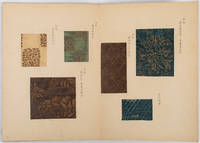
1618177408Japan.: No publisher. Meiji 16 1883. Japanese accordion style book orihon 10 numbered double page colour lithograph illustrations multiple images per page 24.7 x 17.5 cm patterned cloth-covered boards. Some soiling wear to cover extremities some even browning to pages but overall the contents are in very good condition. The illustrations feature details of brocade cloths with gold thread and silver thread as well as damask textile and gold foiled textile. Some of the samples are enlarged so that it is possible to see the details of the weave. The book is exquisitely printed in colour to give the effect of the real thing. It is an early example of Japanese colour lithography and an item of interest to fabric and clothing historians. The chop on the last page says that it was printed in the Printing Agency of the Treasury dated on July 28 Meiji 16 1883. . No publisher. hardcover
164823711n.p. London: n.d. Richard Roylston 1648. First edition. Hardcover. Good. 112mo. Folding frontispiece. viii 269pp. Recent black leather gilt spine title and gilt crown and 'C.R.' on the upper board. Textblock generally soiled and with stains form old tape marks but still in good condition. <br /> <P><br /> The second issue with the place of publication and publisher removed from the title page but with the misnumbering on section G uncorrected. The frontispiece in state 'a ii' with the pattern in the roof above the inscription similar to that in the remaining panels the right edge of the window cutting the 'c' of 'specto' and with three plants to the left of the palm tree top. <br /> <p><br /> This state according to Maden appeared within a few days of the King's death. <br /> <p><br /> Maden I second issue.<br /> <p>. n.d. (Richard Roylston) hardcover
164724501London: Printed by M. S. for H. Blunden at the Castle in Corne-hill 1647. 1st Edition variant issue Wing B-3408A. Another issue of the same year has the printer's name "Matth. Simmons. in the yeare 1647". Period full leather with modern rebacking to style. Red morocco title label in second spine compartment. Modern eps. An overall VG copy text paper beginning to brown at edges with some associated chipping/repaired hole to lower right quarter of E2 affects last few words of two lines on p 25 and first few words of four lines on page 26/occasional po marginal pencil annotation a/o check mark. 18 155 7 28 4 pp. Separate t.p. for "Clavis". Last 4 pp: 2 pp 'Catalogue of Bookes' viz. bibliographical list by Behmen 1 pp of "Faults Escaped in Printing" & a blank. Inserted table & plate imperfect lacking 'folded' left side approx. 1 - 1.5". 4to: ¢4 -¢1 a half-title a2 a3 B1 A4 -A1 C - 2B4 2C2. <br/><br/>Bohme a German philosophical mystic who had a profound influence on such later intellectual movements as idealism and Romanticism. Born of poor parents in Goerlitz Germany as a boy he tended cattle later becoming a shoemaker marrying & fathering 4 children. Boehme at the robust age of 37 in 1612 wrote his first treatise Aurora oder Die Morgenroete in Aufgang. In 1613 an unauthorized copy of the manuscript was copied and circulated by Karl von Ender. Its reception "raised him out of his homely sphere and made him the centre of a local circle of liberal thinkers considerably above him in station and culture." However the local pastor primarius of Gorlitz Gregorius Richter leveled a charge of heresy. The local muncipal council administered an admonishment to no further "meddle in such matters." This charge Boehme publicly followed for 5 years. In 1618 Boehme again started writing expository & polemical treatises. The majority of his works were written though not formally published from 1619 - 1624. A second major work Der Weg zu Christo was published in 1624 and signaled a renewal of clerical hostility. Boehem however was destined to suffer but a short period of this second persecution; he died of an illness on 17 November 1624. Boehme has been said to have a "fertility of ideas" and a "trasncendent greatness of religious insight." Boehme was studied by Sir Isaac Newton and influenced the work Henry More as well as and especially William Law 1686 - 1761. Xl Questions concerning the Soule was translated by the English mystic John Sparrow in collaboration with John Ellstone & financed by Humphrey Blunden. This the first of several works by Boehme that Sparrow & Ellstone were to translate into English between 1644 - 1662. Boehme proved to be highly popular in England where there were regular societies of Behmenists at the time. This work XL Questions went into a second edition in 1648 and a third edition in 1665. 11th EB. A scarce title in the Boehme canon. We find no copies currently offered via the major on-line databases OCLC records but 4 institional cc and the work has only appeared at auction 3 times in the last 25 years the last in 1989. Printed by M. S. for H. Blunden, at the Castle in Corne-hill hardcover books
1689V66520London: Leake for Meredith & J.H for Meredith 4th edition 1689 1690. Hardcover. Very Good. Two Volumes in One octavo near contemporary panelled calf top cover detached/tips worn TPvi232pp; 197pp catal of books by Goodman & others. Two pages with short marginal tears neither touching text but one with narrow strip of paper loss to margin. With half title separating parts One & Two but through paginated then full titlepage to Part III with diff. printer but same publisher In the publisher's catalogue Goodman is given as the author of Winter-evening. The third part was first printed in 1686 for the third edition of the first two parts and here is reprinted for Meredith to augement Meredith's printing of the first two parts for the first time by this publisher WING 11331139. A philosophical discussion between four friends of differing beliefs including an agnostic a pious and a frivolous temperament. In dialogue form. Leake for Meredith & J.H for Meredith 4th edition hardcover
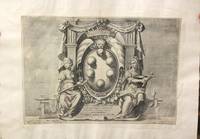
1617B6037Cruger c. 1617. Engravings mounted on watermarked laid paper. Some tears to lower margins not affecting the plates. Staining on one plate. A very good attractive and rare set. Binding: Loose folio in an 18th century wrapper. Notes: c. 1617; exception: one leaf dated 1561 and signed by Antonio Salamanca in Rome. Size: Folio sheets of 405x555m Illustration: Folio set of 14 leaves of copper engravings. References confirm 14 including the tile. Illustrated allegorical title with the Medici arms flanked by female personifications of Justice at left and Faith at right; lettered with a dedication to Cosimo II of Tuscany by Jacobus Chitus with bottom right Teodoro Cruger sculp: 1617 altered in ink to 1618 Florentiae and at lower left five privileges: Cum Privil. S. Pontif S.C. Maiest. Repi. Venet. // M.D. Etrur. Reip Genuens et V.R.Neap. - p. x An.; frontis after self-portrait by Andra Del Sarto; twelve engravings depicting the story of Saint John the Baptist after paintings / frescos and later curtains by Andrea del Sarto at Florence and Franciabigio. References: Hollstein German 6 176 35; Hollstein 33; Le Blanc 1854-1890 2 72 7-20; Virtuelles Kupferstichkabinett 6382 and 6384 mention 14 plates. Pages: Ff: Title; Self-Portrait; 12 engravings. Category: Book Europe Italy; Book Religious Christianity; Book Plate Books General; Cruger unknown
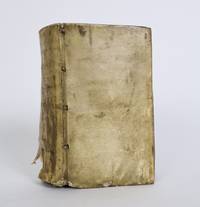
16331409373Lugduni Batavorum Leiden: Joannis Maire 1633. Hardcover. 12mo 36 613 pages. In Very Good minus condition. Bound in early vellum with faded illegible writing on spine. Tearing up rear hinge with a large chunk of material missing from tail of spine. Yapped edges. Edges of textblock dyed. Adhesive residue to endpapers. Bookplate to front pastedown. Light foxing scattered throughout interior. <br /> <br> <br /> Contemporary signature to front free endpaper dated 1633.<br /> <br> <br /> Shelved in Case 3. USTC: 1011674. Signatures in 8 and 12.<br /> <br> <br /> Vegtius was a Roman citizen writing during the late 4th century/early fifth century. "De re militari" is his treatise on Roman military principles. It gained a renewed popularity as a manual on warfare during the Middle Ages. 1409373. Shelved Dupont Bookstore. Joannis Maire hardcover
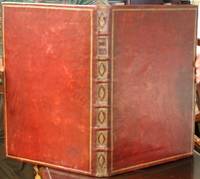
1650B6295Rome/Romae: Formis Io. Iacobi de Rubei apud templum S. Mariae de Pace. Undated c.1650-latest c.1690 most probably c.1660 c.1675-1677. . Lacks folding double-page plan of the Villa Pamphilia and the first of 5 folding plates “Primusâ€. Otherwise a very good example plates are crisp and clean. . Edition: First and only edition. Italic and Roman type. Tex Binding: Contemporary panelled full burgundy morocco double-gilt filleted; spine with six 6 raised bands gilt lettered title on two with remaining compartments gilt ornamented; all edges gilt; contemporary endpapers with watermark of a fleur-de-lis within two concentric circles. Wide margin paper. Notes: An architectural plate book depicting statues and fountains displayed in Villa Pamphili an important 16th-17th century Roman villa designed by the painter Giovanni Francesco Grimaldi 1606 - 1680 and Alessandro Algardi 1598 - 1654 followed by the construction of the garden layout; …1652-1657. The publication of the present work printed by G.G. de Rossi possibly c.1675-1677 was commissioned by Pamphili’s son and heir Giambattista with the engraver Dominique Barrière documenting the statues placed both in cornices of the villa and the gardens and with further plates included such as some by Giovanni Battista Falda's ‘Le fontane di Roma’ fountains of Rome plus general views of the villa and its gardens.<br> <br>Giovanni Battista Falda c.1643 – 1678 Rome was an Italian architect engraver and artist. He is known for his engravings of both contemporary and antique buildings and structures of Rome. Falda studied and worked under Bernini; his draughtsmanship drew G. G. de Rossi’s attention. He became well-known for his “Le fontane di Roma†Fountains in Rome and “Palazzi di Roma†Palaces of Rome particularly popular with visitors to Rome.<br> <br>Giovanni Giacomo de Rossi Italian engraver and printer active in Rome during the second half of the 17th century. His father Giuseppe de Rossi 1570-1639 was the founder of the most important and active printing press of the 17th century in Rome. The press started in 1633 it was then passed to Giovanni Giacomo and his brother Giandomenico; and later to Lorenzo Filippo. In 1738 it became the “Calcografia Camerale†from 1870-1945 the “Regia Calcograficaâ€; today it is known as the “Calcografia Nazionaleâ€. Here are conserved amongst many others the plates of Giambattista Piranesi 1720-1778. Giovanni Giacomo de Rossi the most involved of all family members who ran the press from 1638-1691 took the company to its height of success. He printed etchings for artists including Giovanni Benedetto Castiglione 1609-1665 Pietro Testa 1612-1650 and Giovan. Francesco Grimaldi 1606–1680.<br> <br>Barrière c.1622–1678 was a French painter and engraver. Barrière was born at Marseilles in about 1622. He spent most of his career in Rome where he engraved a considerable number of plates after Claude and other landscape painters as well as other subjects. They are neatly etched in the manner of Stefano della Bella. He died in Rome in 1678. <br> <br> Size: Folio 434x312mm. Illustration: Fine illustrations of the famous Villa Pamphili the most important architectural constructions of Baroque Rome with its Italian garden and the fine collection of antiquities. <br>Illustrated dedication with head- & tail-vignettes and a large rubricated initial; plus a total of 82 full page and double page oblong folding copper-engraved plates.<br> References: Woodfall G.; British Museum: Catalogue of Maps Prints Drawings Etc. Forming the Geographical and Topographical Collection vol. II p. 146 1829. Rossetti 4827. Cicognara 3911. Berlin Katalog 3491. Kissner 394. Vinciana 4360. Giorgetta F. Hortus libro Category: Book Europe Italy; Book Art Architecture & Design; Book Plate Books General; Formis Io. Iacobi de Rubei, apud templum S. Mariae de Pace. hardcover
165854802no publisher stated Lugduni ie Paris - Jacob L'Aîne Rue Philosophie N°6 Orleans 1658 ie 1793 . 1st edition. Hardback. Diced calf VG. 172iv94pp marbled endpapers gilt dentelles all edges gilt leather a little rubbed & upper hinge cracked but holding Ex Libris Caroli Waldstein with their armorial bookplate neat late 19th century annotation to the first blank pages of the second title a little browned a nice copy. Two political tracts published in France in the early days of the Republic which look back to the English protectorate & the lessons to be learnt. The first is a translation of 'Killing Noe Murder' 1658 a pamphlet which advocates the assassination of Oliver Cromwell. Authorship has been attributed to either Edward Sexby or Silius Titus. Cromwell is considered a tyrant equal to Caligula and Nero - the people must rise up & rid them selves of such a despot and tyrannicide can not be regarded as an act of murder. The second work published in 1797 is based upon the 'The Syracusan Tyrant or the Life of Agathocles' by Richard Perrinchief originally published in 1661 an attack on Oliver Cromwell presented as a biography of Agathocles. Both works probably relating to Thermidor & the the overthrow of revolutionary radical Maximilien Robespierre & a retreat from more radical goals and strategies during a revolution. no publisher stated, Lugduni [ ie Paris ] - Jacob L'Aîne, Rue Philosophie N°6, Orleans hardcover
168661090Kiøbenhavn (Copenhagen), Bockenhoffer, 1686. 8vo. In contemporary full calf with three raised bands. Small paper-label to upper part of spine. Light wear and soiling to extremeties, head of spine chipped. Internally with a few vague stains but generally nice and clean. 629, (11) pp. Engraved half-title included in the pagination.
168661090Kiøbenhavn Copenhagen Bockenhoffer 1686. 8vo. In contemporary full calf with three raised bands. Small paper-label to upper part of spine. Light wear and soiling to extremeties head of spine chipped. Internally with a few vague stains but generally nice and clean. 629 11 pp. Engraved half-title included in the pagination. <br/><br/><em>The rare first Danish translation by Pakington’s popular “The practise of Christian gracesâ€. The original English version went through more than 30 editions and three more Danish editions were published in 1740 1765 and finally in 1779. For two centuries it was both a popular and influential work within primarily Anglican but also protestant tradition. It was first published anonymously in 1658 with an introduction by Henry Hammond 1605-1660. The authorship was initially attributed to Lady Dorothy Pakington but the consensus view of modern scholars attributes the book to Richard Allestree. The authorship remained a secret and over the years it has been attributed to at least 27 people beginning with Hammond himself. Thesaurus 312Biblioteca Danica 1 282. </em> hardcover
16933937London: Printed for Jacob Tonson 1693. Folio 12-3/4" x 8-3/4". 2 parts in 1 each with a title-page. Each of the satires is preceded by its own half-title and followed by explanatory notes. Orig. speckled calf worn rebacked orig. brown morocco spine label laid back down. Repair to the fore-margin of the title affecting the ruled border and one letter. Tiny bookplate on front pastedown. The first edition of the John Dryden 1631-1700 translation. Wing J1288. Printed for Jacob Tonson unknown books
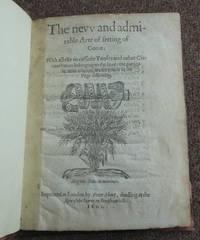
160152944<p>Imprinted at London by Peter Short dwelling at the signe of the Starre on Bredstreet hill 1601. SECOND EDITION 1601 first edition published in 1600 divided into 8 chapters the running title: The new found arte of setting corne printed signature H. Plat Esquire on final page. Small 4to approximately 175 x 130 mm 7 x 5 inches woodcut vignette on title headpiece and large initial to first page 32 unnumbered pages signatures: A-D4 plus 70 blank cream pages as padding at rear modern full speckled calf green gilt lettered title label to spine authors name in gilt an hilt rules and date to spine new brown endpapers. All inner margins have strip of tape for some reason as there appears to me no damage to paper brown stain to leaves A2 and D3 all text readable tips of top corners of 4 leaves neatly repaired nowhere near text. Fair copy only. Another issue of STC 19993.5 according to ESTC quires A and C reset. See: ESTC S114898; Luborsky & Ingram English Illustrated Books 1536-1603 page 633 No. 19993; Mary S. Aslin Catalogue of the Printed Books on Agriculture 1471-1840 page 103; G. E. Fussell Old English Farming Books Volume 1 page 15; Blanche Henrey Volume 1 British Botanical and Horticultural Literature before 1800 page 155: "New and admirable arte of setting of corne a treatise in which this author advocates growing corn by setting the seed at regular distances apart the usual method of sowing corn at that time being by broadcast. On the title-page is a woodcut of a growing plant of corn over which is a spade lying in a scroll bearing the words 'Adam's toole revived'; Donald McDonald Agricultural Writers 1200-1800 page 58 with illustration opposite. MORE IMAGES ATTACHED TO THIS LISTING ALL ZOOMABLE FURTHER IMAGES ON REQUEST. POSTAGE AT COST AND ALL PARCELS SENT FULLY TRACKED AND FULLY INSURED.</p> Imprinted at London, by Peter Short, dwelling at the signe of the Starre on Bredstreet hill, 1601. hardcover
1630007124London: Godfrey Emondson and Thomas Alchorne 1630. First Edition . Hardcover. Very Good. 12mo - over 6¾ - 7¾" tall. VG 1st ed 1630. In contemporary calf corners a little worn. Spine relaid raised bands decorative gilt tooling & titles. Internally 2 5 dedication 1 8-4 ff 142 pp 2 blank some offsetting worm marks blank fep nearly loose ink name & notes to fpd Robt Chambers 1767. 176132 mm. ESTC S109765. Allibone 508. Dodderidge who as a lawyer was known as the Sleeping Judge not because of any shortcoming on his part but because of his habit of concentrating on legal argument with eyes firmly closed. ODNB. <br/> <br/> Godfrey Emondson, and Thomas Alchorne hardcover
1630007469London: Godfrey Emondson and Thomas Alchorne 1630. First Edition . Hardcover. Very Good. 12mo - over 6¾ - 7¾" tall. VG 1st ed 1630. In modern calf to style by Period Binders blind tooling. Spine raised bands gilt tooling. Internally 16 142 pp new endpapers ink initials to tp J.T. evidence of removed bookplate to fpd signatures: 1 ff C2-C4 1-4 A-S3. 183131 mm. ESTC S109765. Allibone 508. Dodderidge who as a lawyer was known as the Sleeping Judge not because of any shortcoming on his part but because of his habit of concentrating on legal argument with eyes firmly closed. ODNB. <br/> <br/> Godfrey Emondson, and Thomas Alchorne hardcover
168916034London: Printed by Edw. Jones for Abel Swall.and Henry Bonwicke. 1689 Second English edition of an important history of the Reformation. Contemporary reverse calf ruled in blind. Folio. Title-page printed in black and red. The Bohun work with separate title-page. With six engraved portrait plates. Joints starting to crack but sound. Armorial bookplate of Cobbold of Ipswich later ownership annotation dated 1980 on front pastedown. A good clean copy. Johannes Sleidanus 1506-66 was born in Schleidan Luxembourg and studied ancient languages and literatures at Liège and Cologne and law and jurisprudence at Paris and Orléans. At Lièges he encountered humanist scholars and developed an interest in Protestant ideas. He went to work for Cardinal du Bellay and was employed in the futile negotiations of the French court to make an alliance with the German Protestants against the Emperor Charles V. In 1542 he settled in Strassbourg. He was in the habit of copying all papers that had any bearing on the Reformation to which he had access and Martin Bucer who had seen his papers suggested that Philip of Hesse appoint him historian of the Reformation giving him a salary and access to all necessary documents. Thus began his great work the first volume of which appeared in 1545. That same year he traveled to England in a French embassy to Henry VIII and there he collected further materials for his work. He later went to Marburg to view the archives of Philip of Hesse. In 1551 he attended the Council of Trent. He finished his history in 1554 despite financial problems. He died in poverty the following year. Printed by Edw. Jones, for Abel Swall...and Henry Bonwicke.. unknown
167535334London: William and John Leake 1675. Two parts in one 8vo. 28 148; 16 159 1pp. Contemporary mottled calf covers ruled in blind rebacked to style flat spine ruled in blind red morocco lettering piece<br/> <br/>Provenance: F. H. early initials on the title<br/> <br/>The final edition complete with both parts of among the most influential English gardening books of the 17th century.<br/> <br/>"Sir Hugh Platt 1552-1608 held by Richard Weston to be 'the most ingenious husbandman of the age he lived in' . devoted his life to literary work and to the study of husbandry and gardening. He was also interested in all kinds of inventions and experiments and in consideration of his services in this field was knighted by James I on 22 May 1605 . His work on gardening entitled Floraes paradise . appeared in 1608 the year of his death . He wrote his book from his own practical experience as well as from information supplied to him by other gardeners . Floraes paradise continued to be published after the author's death but with the new title of The Garden of Eden and edited by Charles Bellingham . In 1660 was issued The second part of The Garden of Eden . Readers who questioned the authenticity of this work were invited to 'see the original manuscript under the authors own hand.'" Henrey. Styled on the title as the sixth edition it is the second combined edition of both parts and the final edition published in the 17th century. The second part includes its own title and pagination.<br/> <br/>Fussell pp.15-16; Henrey 299; Hunt 340; Wing P2388; ESTC R31801. William and John Leake unknown books
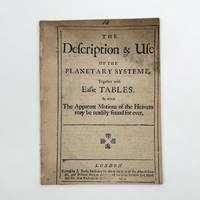
1675371490London: Printed by J. Darby for Robert Morden . and William Berry 1675. Second issue with the added Postscript. 26 2 blank 4pp. Tables. 4to. Disbound. Trimmed close minor soiling. Second issue with the added Postscript. 26 2 blank 4pp. Tables. 4to. This second issue with the added Postscript dated 1675 in which the author defends himself from criticism by John Flamsteed. The work is an early use of the term "planetary system" in the title and includes a 12-line poem on the solar system on the final page.<br /> <br /> Streete 1621-1689 Irish-born astronomer is best known for his 1661 work Astronomia Carolina a new theorie of Coelestial Motions which was read and praised by Halley Newton Flamsteed and others. A follower of Kepler Streete argued that the Earth's velocity in its annual revolution around the sun was not uniform and increases in velocity as it approaches the Sun and decreased as it moves away. ESTC calls for a plate but we find no reference to one in other extant copies. Scarce. ESTC R606; cf. Wing S5955 Printed by J. Darby, for Robert Morden ... and William Berry unknown
16711002105London: E.T. and R.H. for H. Brome B. Tooke and T. Sawbridge 1671. First edition in English of the complete Colloquia Familiaria of Erasmus first published in 1518 and expanded by Erasmus over the next fifteen years a lively collection of Latin dialogues that found a readership far beyond the Renaissance schoolroom. Originally intended to model colloquial conversation for students of Latin the dialogues feature pointed free-thinking exchanges on modern political religious and philosophical questions. In "Of the Abbot and Learned Woman" an ignorant abbot tries and fails to get the better of the classically educated Magdalia a character almost certainly based on Thomas More's eldest daughter: "I think thou art some sophistress thou protest so wittily." Magdalia: "I will not tell thee what I think thou art." And later: "I have often heard it usually spoken that a wise woman is twice a fool." Magdalia: "Indeed it useth to be said so but by fools." The Colloquia Familiaria was widely read and debated across Europe drawing immediate notice for its anticlerical satire: "its influence on the dialogues of Reformation Germany and Tudor England is a critical commonplace" Zlatar Reformation Fictions 11. The original purpose of the Colloquies as a text for teaching Latin postponed its direct translation; this first complete English edition was published more than 150 years after the work's first appearance. The edition opens with a short life of Erasmus and concludes with the first appearance in English of De utilitate colloquiorum Erasmus's 1526 defense of the Colloquies published after the Sorbonne condemned the book for impiety. In response Erasmus makes a case for the educational value of his dialogues' humor: "I cannot tell whether any thing be learned more successfully than that which is learned in playing." Despite his efforts the Colloquies would remain on the Papal Index of banned books through the end of the nineteenth century. Wing E-3190; PMM 53. A very good copy of a humanist landmark in a handsome contemporary binding. Octavo measuring 6.5 x 4.25 inches: 8 555 1. Contemporary Cambridge-style full speckled calf boards ruled and ornamented in blind raised bands red morocco spine label lettered and decorated in gilt top edge stained black. Engraved frontispiece portrait of Erasmus. Final leaf containing second page of bookseller catalogue excised. Joints and spine head expertly repaired; evidence of bookplate removal on front pastedown; effaced signature on title page; some running titles shaved. E.T. and R.H. for H. Brome, B. Tooke, and T. Sawbridge unknown books
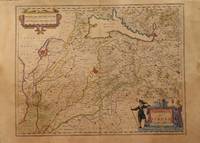
16403045<p>Amstedam. Very Good. 1640. Map. Image size 19"x 15 1/2". Paper size 17"x23". Orginal 17th century hand coloring. ; 8vo 8" - 9" tall; All shipments through USPS insured Priority Mail. .</p>
160962191609 à Paris chez Laurens Sonnius rue St Jacques au coq et compas d'or 1609 édition dernière revue corrigée et augmentée par l'auteur In12 relié plein parchemin 518 pages et index non paginé (35 pages)
168259641682 A Paris chez Helie Josset rue saint Jacques à la Fleur-de-Lys d'or 1682 In8 plein veau dos à 5 ners fleurons 294 pages
16843938Amsterdam: Apud Henricum Wetstenium 1684. 2 parts in 1. 4852595;11218pp. Indices at end of each part. Added engraved title. Title-page printed in red & black. Cont. speckled calf some rubbing small chip at head of spine & label lacking but quite sound. Apud Henricum Wetstenium unknown books
16869790261Jeremiam Schrey 1686. This is an ex-library book and may have the usual library/used-book markings inside.This book has hardback covers. In fair condition suitable as a study copy. No dust jacket. Re-bound by library. In Greek and Latin. Non-standard size 9.5 x 15 ins. Quarter-bound in green cloth boards with black leather on spine. Some general shelf wear lightly bumped corners untrimmed page edges. Binding firm. Pages age-toned with moderate foxing. Please note the Image in this listing is a stock photo and may not match the covers of the actual item3350grams ISBN: Jeremiam Schrey hardcover
1678H7589Amberes: Iuan Bautista Verdussen 1678. Hardcover. Good. Folio 12.5 inches 32 cm tall old but probably not original vellum hand lettered on spine 18 34 6 398 Empresa Politica 2 pp Sumario; lacking at least one more page of the Sumario at end with woodcut emblems throughout. Good text with dampstaining the Table page of Republica Literaria and last page of text have wear pp. 370-378 have some lining to the outer margins and flipping through the book there are probably a handful of other pages similarly lined. Rare edition of this Anti-Machiavellian emblem book. Iuan Bautista Verdussen hardcover
1636D6036Rome: Typis S. Cong de propag: Fide 1636. Hardcover. Very Good. 4to 230 x 170mm. xxiv 338pp. ii. Illustrated throughout with woodcut tables and charts of Egyptian characters and hieroglyphs. Contemporary vellum; intermittently browned occasional spots. <br/><br/>Father Athanasius Kircher was a 17th-century German Jesuit scholar and polymath who published around 40 works most notably in the fields of oriental studies geology and medicine. He was heralded as possessing the secret of deciphering hieroglyphics and was widely regarded as the physical embodiment of all the learning of his age. He had over 760 correspondents including scientists Jesuit missionaries and world potentates and wrote about an enormous range of interests ranging from optics to music from Egyptology to magnetism. Perhaps best known of his correspondents is Jan Marek Marci of Kronland 1595-1667 for sending Kircher a mysterious illustrated manuscript written in an unknown script famously known today as the Voynich Manuscript. In 1635 Kircher began to write his book Prodromus Coptus Introduction to Coptic Language and in the autumn of 1636 the book was printed. Kircher saw the ancient languages as an essential foundation for any pious philosophy. Kircher envisioned Rome as a unique center within to unlock the mysteries of Hermetic knowledge inscribed on the obelisks. The project of restoring Egyptian wisdom entailed nothing less than an effort to renovate the lost arts of communication that linked divine and human languages. Unfortunately while in other disciplines he made valuable discoveries his explanation of hieroglyphs was absolutely incorrect. We can probably explain it by his passion that might have sometimes blinded his reasoning. Yet Kirchers Prodomus remains an important study from a most respected scholar. Brunet III 668; Caillet II 5790. Typis S. Cong de propag: Fide hardcover books