100 résultats
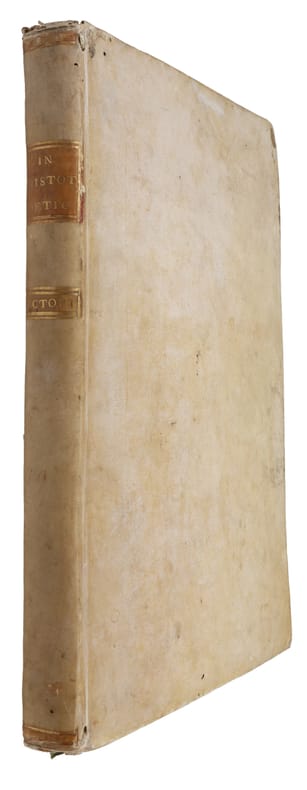
161062508Florence, In officina Iuntaru, Barnardi Filiorum, 1560. Small folio. 18th century full vellum with gilt labels to spine. Wear to capitals and small worm tracts towrad opper hinges. Corners a bit bumped. A very nice and sturdy binding. Marbled edges. Some browspotting throughout. Small wormholes to blank margin of final leaf, far from affecting imprint. Woodcut vignette to title-page and to verso of colophon-leaf. (10), 308, (12) ff.
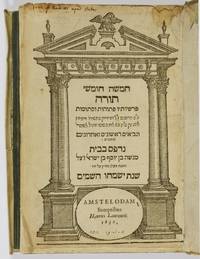
163155459Amsterdam: printed by Menasseh ben Israel for Henricus Laurentius 1631. First edition. Hardcover. Very good-. Octavo 16.8 by 11.4 cm. Collation: aleph-lamed-zayin8 = 296 leaves. 612 i.e. 592 pp: p. 464 erroneously numbered 484 465 as 485 and so on throughout. Two column text in unvocalized Hebrew; every fifth verse numbered in the margin. Title within architectural border; half titles with letterpress ornamentation for the Former and Latter Prophets. Contemporary vellumwith exposed thongs edges stained blue; yapp fore-edges; front joint cracked but holding strong. Intermittent light toning to text outmost leaves a bit more darkened; very occasional small stains. Title-page slighltly trimmed 4 mm at bottom edge; expert marginal repairs at bottom corners of 2 leaves; 1 leaf re-margined at fore-edge with no loss of text else a very good copy with crisp clean text.<br /> <br /> First Hebrew Bible published in Amsterdam printed by the rabbi diplomat publisher and religious thinker Menasseh ben Israel 1604-1657 one of the most distinguished members of the Portuguese Jewish community of Amsterdam and the first Jewish printer in the Northern Netherlands. The Amsterdam printer and publisher Hendrick Laurensz Lauretius provided the financing for this edition along with two other Bible editions and two editions of the Hebrew Psalms printed by Menasseh between 1631 and 1646. "These publications were not only made for the local market but mainly for international trade. Thanks to this financial help Menasseh was able to organize his printing office in a more professional way" Fuks hiring a Jewish compositor Judah Leb ben Mordecai Gimple from Posen and a gentile compositor Bartholomeus Laurensz. <br /> <br /> The printing activity of Menasseh was especially important in the steadily growing productions of the Hebrew press in the Northern Netherlands. Fulfilling the needs of the Sephardic community for Jewish ritual texts eliminated the need for expensive imports from Venice and Poland. Menasseh undersood that the relatively cheap paper and tools available in Amsterdam made it possible to compete in quality and prices with the Hebrew presses of Poland Italy and Basel. "Gentile publishers and booksellers in Amsterdam such as Jansonius and Laurentius were quick to see the opportunity of the opening Eastern European market and financed several of Menasseh's publications" Fuks. Menasseh was the first to introduce in the Netherlands waybertaytsch types for Yiddish publications along with illustrated Hebrew books. He was also the first Jewish printer to adopt the Dutch pocket-book format made famous by the Elzeviers.<br /> <br /> Notes on publication date and issue: The title is dated 1630 in Arabic numerals; the colophon notes the date of completion in Hebrew characters as 5 Adar 5391 = 7 February 1631 along with the printer's apology for being unable to provide the index of pericopes promised on the title-page due to lack of printing material. Darlow and Moule describe this issue as Variant A with a Latin imprint appearing in the cartouche beneath the Hebrew title.<br /> <br /> Provenance and annotations: early entry in brown ink at front paste-down with short Greek inscription Theos. dated 1700; old Latin inscription in black ink at top margin title in reference to Hebrew roots; date of 1812 beside Yiddish entry penned in black ink within imprint cartouche at title; old entry in German penned in black ink at verso title beneath which is an oval cartouche in imitation of the one at the title in which an owner has penned in black ink the Hebrew imprint information regarding Hendrick Laurensz as it would appear in the Varient B issue; old library shelf marks at rear paste-down; recent owner entry in blue ink in Hebrew at front paste-down. References: Darlow and Moule 5123a; Fuks/Fuks-Mansfeld no. 152; pp. 105; 111f.; Steinschneider no. 453; Vinograd Amsterdam 22.<br /> <br /> Full title and imprint: חמשה חומשי תורה פרשיותיו פתוחות וסתומות ×¢"פ ×”×¨×ž×‘× ×–"ל ומדוייק בחסירו' ויתרות להעתק ס"ת ×¢× ×œ×•×— בסופו מועיל לסופרי' ×•× ×‘×™××™× ×¨××©×•× ×™× ×•××—×¨×•× ×™× ×•×›×ª×•×‘×™×: × ×“×¤×¡ בבית ×ž× ×©×” בן ישר×ל ז׳׳צל והוגה בעיון × ×ž×¨×¥ על ידו ×©× ×ª ישמחו השמי×<br /> Amstelodami sumptibus Henrici Laurentii 1630. printed by Menasseh ben Israel for Henricus Laurentius hardcover
164823711n.p. London: n.d. Richard Roylston 1648. First edition. Hardcover. Good. 112mo. Folding frontispiece. viii 269pp. Recent black leather gilt spine title and gilt crown and 'C.R.' on the upper board. Textblock generally soiled and with stains form old tape marks but still in good condition. <br /> <P><br /> The second issue with the place of publication and publisher removed from the title page but with the misnumbering on section G uncorrected. The frontispiece in state 'a ii' with the pattern in the roof above the inscription similar to that in the remaining panels the right edge of the window cutting the 'c' of 'specto' and with three plants to the left of the palm tree top. <br /> <p><br /> This state according to Maden appeared within a few days of the King's death. <br /> <p><br /> Maden I second issue.<br /> <p>. n.d. (Richard Roylston) hardcover
166216811Graz, Widmannstetter, 1662. 2 Bll., 16 S. Kl.-4°. Mod. Pp. (leicht bestoßen). [7 Warenabbildungen]
168661090Kiøbenhavn (Copenhagen), Bockenhoffer, 1686. 8vo. In contemporary full calf with three raised bands. Small paper-label to upper part of spine. Light wear and soiling to extremeties, head of spine chipped. Internally with a few vague stains but generally nice and clean. 629, (11) pp. Engraved half-title included in the pagination.
168661090Kiøbenhavn Copenhagen Bockenhoffer 1686. 8vo. In contemporary full calf with three raised bands. Small paper-label to upper part of spine. Light wear and soiling to extremeties head of spine chipped. Internally with a few vague stains but generally nice and clean. 629 11 pp. Engraved half-title included in the pagination. <br/><br/><em>The rare first Danish translation by Pakington’s popular “The practise of Christian gracesâ€. The original English version went through more than 30 editions and three more Danish editions were published in 1740 1765 and finally in 1779. For two centuries it was both a popular and influential work within primarily Anglican but also protestant tradition. It was first published anonymously in 1658 with an introduction by Henry Hammond 1605-1660. The authorship was initially attributed to Lady Dorothy Pakington but the consensus view of modern scholars attributes the book to Richard Allestree. The authorship remained a secret and over the years it has been attributed to at least 27 people beginning with Hammond himself. Thesaurus 312Biblioteca Danica 1 282. </em> hardcover
16437081<p>Amsterdam: Jodocum Janssonium 1643 Contemporary stiff vellum with title in manuscript on spine. Twelvemo. Engraved title-page. A few pages a little browned. Generally a very good clean copy. Scarce: OCLC lists five copies two in North America.</p> Jodocum Janssonium, hardcover
1670FREP[BRE75Amsterdam: np c1670. 1670. 12mo. pp. 15 p.l. 179 lacking 1 presumably blank. sphere device on title. woodcut headpiece & initials. contemporary mottled calf very worn joints split library bookplate & number on lower spine. First Edition. Barbier III 813. Brunet Imprimeurs Imaginaires et Libraires Supposés p. 58. Goldsmith BM STC French 1742. Cioranescu 16388. Baldner p. 97. cfWilliams p. 18. F. [Amsterdam?: np, c1670]. unknown
166258118Graz, Widmannstetter, 9. August 1662. 4°. Titel m. Holzschn.-Bordüre u. großem Wappenholzschnitt (Doppeladler). Mit einigen Holzschn.-Bordüren bzw. -Initialen. 2 Bll., 16 S., Geheftet.
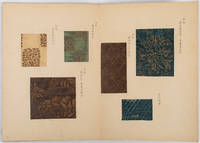
1618177408Japan.: No publisher. Meiji 16 1883. Japanese accordion style book orihon 10 numbered double page colour lithograph illustrations multiple images per page 24.7 x 17.5 cm patterned cloth-covered boards. Some soiling wear to cover extremities some even browning to pages but overall the contents are in very good condition. The illustrations feature details of brocade cloths with gold thread and silver thread as well as damask textile and gold foiled textile. Some of the samples are enlarged so that it is possible to see the details of the weave. The book is exquisitely printed in colour to give the effect of the real thing. It is an early example of Japanese colour lithography and an item of interest to fabric and clothing historians. The chop on the last page says that it was printed in the Printing Agency of the Treasury dated on July 28 Meiji 16 1883. . No publisher. hardcover
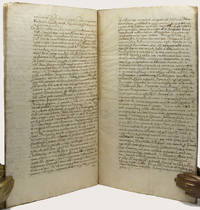
162134518Lisbon and Hangzhou China: Manuscripts ca.1623 and 1621. Very Rare A Similar Manuscript Exists in Brussels. We know of no others. The Latin text of both letters is written in a neat uniform cursive hand in brown. Folio leaves 33 x 20.5 cm The transcripts bound in 18th Century stiff blue wrappers the blank paste-downs and endpapers are late 18th century most likely the third quarter between 1745/1753 and 1776 since they contain a clear "lion/vryheit/pro patria" watermark with a crowned GR countermark which resembles Heawood 3148 3149 and 3154. The paper used for the manuscript contains a faint double-headed eagle watermark and it has been reinforced in the gutters. A very pleasing survival very well preserved edges slightly mellowed the wrappers show some signs of wear. VERY RARE MANUSCRIPT TRANSCRIPTS. Chrysostomus Johann Gall 1586-1643 was a German Jesuit and scholar. He left Ingolstadt Germany to teach astronomy mathematics and navigation in Lisbon fro 1620to 1627 before leaving to work in the Jesuit missions in India. The Colégio de Santo Antŕo benefitted from the arrival of many foreign mathematicians and other scholars as Lisbon serves as a gateway for all missionaries departing for Asia. The original letter by Gall was written in Lisbon September 1623 and concerns a newspaper style description of various events including details of the perseution of Christians in Japan particularly the execution of large numbers of the Christian community in Nagasaki in 1622.<br> The second letter in the present work is especially interesting as the original was written by Johannes Terentius also known as Johannes Schreck an Deng Yuhan Hanpo 1576-1630. Terentius was a prominent Jesuit scholar specialized in natural science and mathematics. Before joining the Jesuits as a novice1611 he already enjoyed a grea reputation in Germany as a scholar. In 1621 Terentius left for China to join the Jesuit mission. The original letter by Terentius was written in Hangzhou China on 30 August 1621 to the rector of teh Jesuit College in Munich Jakob Keller 1568-1631. He discusses his journey to China which he started in 1618 his intentions to participate in the planned calendar reform in China and his impressions of the city of Hangzhou which he reached in 1621 Terentius wrote several works on european medicine mathematics and technology in Chinese and together with Johann Adam Schall von Bell and G. Roho introduced European tigonometry and European astronomical instruments to China. In 1629 he began to reform the calendar which J.A. Schall von Bell ocmpleted after Terentius' early death a year later.<br><br>Backer & Sommervogel VII col. 1929-F<br> Manuscripts unknown
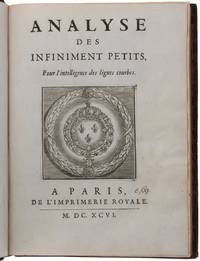
17002848Paris: L'imprimerie Royale; Jean Boudot 1700. First edition. First editions. L'Hôpital's treatise on differential calculus was based on lessons he received from Johann Bernoulli and it was under the influence of Malebranche that some years later appeared the first work on the integral calculus by Louis Carré. Hardcover. THE FIRST BOOKS ON DIFFERENTIAL AND INTEGRAL CALCULUS. <p>A fine sammelband comprising the first editions of the first books on the differential and integral calculus respectively. "In France it was through the Oratorian circle of Nicolas Malebranche that Johann Bernoulli introduced in 1691 the Leibnizian calculus. His lessons to the Marquis de l'Hôpital led to the draft of the first treatise of differential calculus 1696 and it was under the influence of Malebranche that some years later appeared the first works on the integral calculus by Louis Carré in 1700 and Charles René Reyneau in 1708. The spread and acceptance of the Leibnizian calculus was transferred in this way to the wide public" Landmark Writings p. 56. "The importance of L'Hospital's work lay in its dissemination throughout Europe of the concepts and early development of the calculus whose cause L'Hospital advanced as well through his many contacts; these included Christiaan Huygens who is reputed to have learned the calculus from L'Hospital" DSB. Bernoulli's lectures also covered integral calculus but L'Hospital dropped plans to write a continuation to his Analyse des infiniment petits dealing with this subject "in deference to Leibniz who had let him know that he had similar intentions" ibid. Leibniz never wrote such a text however and Bernoulli's lectures on integral calculus remained unpublished until they appeared in his Opera 1742. The task of completing L'Hospital's book was instead taken up by Carré a pupil of Malebranche and assistant to Pierre Varignon from whom he probably learnt calculus. "Following the classical custom his Analyse des infiniment petits starts with a set of definitions and axioms . The difference differential is defined as the infinitely small portion by which a variable quantity increases or decreases continuously. Of the two axioms the first postulates that quantities which differ only by infinitely small amounts may be substituted for one another while the second states that a curve may be thought of as a polygonal line with an infinite number of infinitely small sides such that the angle between adjacent lines determines the curvature of the curve. Following the axioms the basic rules of the differential calculus are given and exemplified. The second chapter applies these rules to the determination of the tangent to a curve in a given point . The third chapter deals with maximum-minimum problems and includes examples drawn from mechanics and geography. Next comes a treatment of points of inflection and cusps. This involves the introduction of higher-order differentials each supposed infinitely small compared to its predecessor. Later chapters deal with evolutes and with caustics. L'Hospital's rule is given in chapter 9" ibid. The tenth and final chapter of the Analyse discusses the methods of Descartes and Johann Hudde. The companion work by Carré is "the first treatise on the integral calculus in any language which is here applied to the determination of the area of superficies surfaces and solids and their centres of gravity problems of percussion oscillation etc." Sotheran. On this last topic the determination of the centres of oscillation of solids Carré made a significant error. This was known to Bernoulli but not publicized at the time and so was propagated into several later calculus texts such as Charles Hayes' Treatise on Fluxions 1704 and Edmund Stone's The Method of Fluxions both Direct and Inverse 1730. Both works are rare on the market: ABPC/RBH list four copies of L'Hospital's book since the Norman copy which realised $6325 in 1998; and only two copies of Carré's work in the last half century. </p> <br /> <p>"Differential and integral calculus are generally considered to have their origins in the works of Newton and Leibniz in the late 17th century although the roots of the subject reach far back into that century and arguably even into antiquity. Leibniz first described his new calculus in a cryptic article more than a decade before the publication of the Analyse. For all practical purposes Leibniz' early papers were not understood until Jakob Bernoulli and his younger brother Johann began studying them in about 1687 and making discoveries of their own using his techniques.</p> <br /> <p>"Bernard de Fontenelle became the secretary of the Académie des Sciences in Paris in 1697 and wrote the eulogy of l'Hôpital for the academy's journal. He said that in 1696 'the Geometry of the Infinitely small was still nothing but a kind of Mystery and so to speak a Cabalistic Science shared among five or six people. They often gave their Solutions in the Journals without revealing the Method that produced them and even when one could discover it it was only a few feeble rays of this Science that had escaped and the clouds immediately closed again.' Later on Montucla went one step further and listed the only people that he believed understood Leibniz' calculus before 1696: Leibniz himself Jakob and Johann Bernoulli Pierre Varignon and l'Hôpital. L'Hôpital's Analyse changed all of this and for much of the 18th century his book served aspiring French mathematicians as their first introduction to the new calculus.</p> <br /> <p>"For all that the Analyse was a popular and successful introduction to the differential calculus it's remarkable that there is no account of the integral calculus in the book. In his Preface l'Hôpital explained why: 'In all of this there is only the first part of Mr. Leibniz' calculus . The other part which we call integral calculus consists in going back from these infinitely small quantities to the magnitudes or the wholes of which they are the differences that is to say in finding their sums. I had also intended to present this. However Mr. Leibniz having written me that he is working on a Treatise titled De Scientiâ infiniti I took care not to deprive the public of such a beautiful Work' p. iii. Unfortunately Leibniz never completed this book On the Science of the Infinite.</p> <br /> <p>"The Analyse consists of ten chapters which l'Hôpital called 'sections.' We consider it to have three parts. The first part an introduction to the differential calculus consists of the first four chapters:</p> <br /> <br /> In which we give the Rules of this calculus. <br /> <br /> Use of the differential calculus for finding the Tangents of all kinds of curved <br /> lines. <br /> <br /> Use of the differential calculus for finding the greatest and the least ordinates to which are reduced questions De maximis & minimis. <br /> <br /> Use of the differential calculus for finding inflection points and cusps.<br /> <br /> <p>"Taken together these chapters provide a thorough introduction to the differential calculus in about 70 pages. The next five chapters are devoted to what can only be described as an advanced text on differential geometry motivated in part by what were then cutting-edge research problems in optics and other fields" Bradley et al. pp. v-vi.</p> <br /> <p>These subsequent chapters no longer mirror the structure of Bernoulli's lectures. Chapter 5 the longest in the Analyse deals with evolutes and involutes including the cycloid and various spirals. Chapters 6-8 are on envelopes of lines and curves i.e. curves that are tangent to every member of a family of lines or curves - this includes the study of caustics in geometrical optics. Chapter 9 contains "the solution of various problems that depend upon the previous Methods;" the first of these is the celebrated rule that we now call L'Hôpital's Rule which was first discovered by Bernoulli. In his final chapter of the Analyse l'Hôpital demonstrates how all of the methods of Descartes and Hudde may be easily derived and justified using Leibniz's differential calculus.</p> <br /> <p>Born into a noble family L'Hospital 1661-1704 abandoned a military career due to poor eyesight to pursue his interest in mathematics. "Some time around 1690 L'Hôpital joined Nicolas Malebranche's circle which was engaged among other things in the study of higher mathematics. It was there in November 1691 that he met the 24-year-old Johann Bernoulli who was visiting Paris and had been invited by Malebranche to present his construction of the catenary at the salon . Bernoulli told Pierre Rémond de Montmort that upon meeting the Marquis he soon found him to be a good enough mathematician with regard to ordinary mathematics but that he knew nothing of the differential calculus other than its name and had not even heard of the integral calculus. L'Hôpital had apparently mastered Fermat's method of finding maxima and minima and told Bernoulli that he had used it to invent a rule for determining the radius of curvature for arbitrary curves. The method was unwieldy and actually could only be used at local extrema of algebraic curves. Bernoulli showed him the formula for the radius of curvature that he had developed with his brother Jakob which employed second-order differentials. Apparently this so impressed the Marquis that he visited Bernoulli the very next day and engaged him as his tutor in the differential and integral calculus.</p> <br /> <p>"Bernoulli tutored the Marquis in his Paris apartment four times a week from late 1691 through the end of July 1692 . In the summer of 1692 Bernoulli accompanied the Marquis to his estate in Oucques near the French city of Blois where he continued giving him tutorials until some time in October . Bernoulli kept copies of his lessons to the Marquis throughout his long and productive career. The first part on the differential calculus was incorporated by l'Hôpital into the first four chapters of the Analyse. Bernoulli himself published the much larger second part concerning the integral calculus in his collected works. Titled Lectiones mathematicae de methodo integralium this treatise bears the subtitle 'written for the use of the Illustrious Marquis de l'Hôpital while the author spent time in Paris in the years 1691 & 1692' . Because Bernoulli chose not to publish this part it was impossible in the 18th century to say how closely l'Hôpital's textbook coincided with Bernoulli's lessons. A comparison finally became possible when Paul Schafheitlin discovered a manuscript copy of the full set of lessons on both the differential and integral calculus in the library of the University of Basel in 1921 . Because the latter part was a near-perfect match to what Bernoulli had published in 1741 he could be quite certain that the first part was essentially the same set of lessons l'Hôpital had used when composing the Analyse .</p> <br /> <p>"Since the appearance of the Lectiones various authors have characterized the Analyse as having essentially been written by Bernoulli. Indeed Bernoulli himself in an angry letter to Varignon of February 26 1707 said that 'to speak frankly Mr. de l'Hôpital had no other part in the production of this book than to have translated into French the material that I gave him for the most part in Latin.' The truth is much more nuanced. The superstructure of l'Hôpital's first four chapters is certainly due to Bernoulli and many of the details are essentially the same in both texts. However l'Hôpital added much in both quantity and quality. For one thing Bernoulli's Lectiones occupied 37 manuscript pages compared to 70 typeset pages for the first four chapters of the Analyse but the Marquis added much more than mere verbiage to Bernoulli's lesson. He was a very talented pedagogue. He organized his material very well extracting general propositions where Bernoulli gave examples and explained matters clearly and in some detail. Furthermore he frequently included many illustrative examples gradually increasing in difficulty generally providing an appropriate level of detail but always leaving some things for readers to work out for themselves" Bradley pp. vii-xi. The last six chapters were not taken directly from Bernoulli's lectures although l'Hôpital has drawn on material provided to him in Bernoulli's letters or in his lessons on the integral calculus.</p> <br /> <p>Louis Carré's 1663-1711 father a prosperous farmer wanted him to become a priest but after having spent three years studying theology in Paris he refused to take holy orders and his father cut off all financial support for his son. Carré managed to avoid poverty by becoming an amanuensis to Malebranche. The group Malebranche had assembled at the Oratory in Paris included Varignon and l'Hôpital among others. Carré spent seven years with Malebranche after which he became a private tutor in Paris specializing in the teaching of women then barred from a university education many of whom were nuns.At this stage Carré seems to have been interested mainly in philosophy and did not take much interest in current mathematical research. However on 4 February 1699 Varignon admitted him as one of his élèves in the Academy of Sciences. This stimulated Carré's interest in mathematics and he began working on his Methode pour Ia mesure des surfaces .</p> <br /> <p>The work is divided into four Sections:</p> <br /> <br /> On the measure i.e. area of surfaces.<br /> On the dimension i.e. volume of solids.3<br /> On centres of gravity.<br /> On centres of percussion and oscillation.<br /> <br /> <p>The centre of percussion is the point on a solid body attached to a pivot where a perpendicular impact will produce no reactive shock at the pivot. The same point is called the centre of oscillation for the body suspended from the pivot as a pendulum meaning that a simple pendulum with all its mass concentrated at that point will have the same period of oscillation. The formula for the centre of oscillation originally derived by Huygens in his Horologium oscillatorium 1673 requires certain integrations to be performed. Carré made an error in calculating the integral for the moment of inertia of a cone suspended from its vertex a mistake that led to an incorrect expression for the centre of oscillation of the cone. Lenore Feigenbaum explains that the story of Carré's mistake and the subsequent propagation of his error in eighteenth-century calculus textbooks "is instructive in several regards: first in showing how some of the methods of the calculus were interpreted and absorbed during the early 18th century; second in shedding light on the nature of the textbook industry of the time; and finally in providing us with a modicum of historical sympathy when we find our own students making the same kind of mistakes."</p> <br /> <p>Between 1701 and 1705 Carré published over a dozen papers on a variety of mathematical and physical subjects which led to him being admitted to the Academy of Sciences as an Associate Mechanician on 15 February 1702 and being promoted to Pensioner on 18 August 1706. This provided him with an income which allowed him to devote himself entirely to his academic studies during the final five years of his life. At age 46 he suffered an attack of dyspepsia from which he died in 1711. </p> <br /> <p>I. Babson Supplement p.30; Honeyman 2006 & 2007; Norman 1345; Sotheran First Supplement 1411; not in Macclesfield. II. Macclesfield 481; Poggendorff I 383-384; Sotheran I 704. Bradley Petrilli & Sandifer. L'Hôpital's Analyse des infiniments petits. An Annotated Translation with Source Material by Johann Bernoulli 2015. Grattan-Guinness ed. Landmark writings in Western mathematics 1640-1940 2005.</p> <br/> <br/> Two works bound in one volume 4to 251 x 186 mm pp. xviii 181 3 with 11 folding engraved plates; pp. xii 115 1 blank and 4 folding engraved plates. Old signature cut from first title and expertly repaired. Contemporary French calf spine gilt with red lettering-piece. Fine copies. / Hardcover. L'imprimerie Royale; Jean Boudot unknown
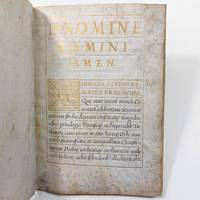
162819730<p><strong>Precious diploma in canon and civil law from the University of Rome calligraphed on vellum with the letterhead and the names of the protagonists written in gold ink.</strong><br /><strong>The document is also entirely underlined and framed in this ink.</strong><br />It was awarded to a certain Guillaume Drouaillet from Dole in Burgundy.</p><p>"<em>IN NOMINE DOMINI AMEN. GLORIOSA STUDIORUM MATER URBS ROMA Quae inter omnes mundi Ciuitates celeberrima Scientiarum omnium studio decorata existit . Dominus Guglielmus Drouaillet. Dolanus in Burgundia . Actum Romae in Gymnasio publico in regione S. Eustachii Anno Domini millesimo sexcentesimo uiges. octavo .</em>"</p><p>At the end of the document are signatures most likely of members of the University of Rome and two additional paragraphs handwritten by two different hands.</p><p>From the library of Bruno Monnier Franc-Comtois bibliophile and owner of the Château de Mantry with iron bookplate on the front flyleaf.</p><p><strong>An interesting testimony to the history of diplomas and writing.</strong></p>
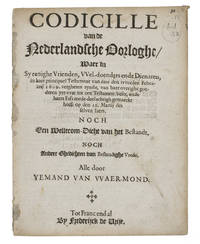
1609A86ACTMRTZ41Franc end al" = Amsterdam: Frederijck de Vrije" 1609. Disbound. Small 4to. Poems celebrating the truce with Spain though attributed to a former opponent of the truce with the Dutch poems in textura types and Latin marginal notes in roman. A political pamphlet in verse celebrating peace and dated less than a month before the signing of the Twelve Years' Truce between Spain and the Dutch Republic. The main poem takes the form of a "codicil" to War's "last will and testament." It recites the various legacies both good and bad that the War has left to people on both sides and even to people and countries not directly involved in the fighting. Asher mistakenly lists the present pamphlet as no. 11 in the Bye-Korf series: it was published about six months after the Bye-Korf was banned but later collectors often inserted it and the associated Testament in place of the earlier Testament which should have been Asher 26-28/10. The author place of publication and publisher given on the title-page are all word plays "Yemand van Waer-Mond" for example suggesting "someone of honest mouth." The STCN attributes the pamphlet with a query to Nierop who propagandized against peace in one of the Bye-Korf pamphlets Asher 28/37 but rejoiced in it once it came. Alden & Landis attributes the associated Testament ofte Wtersten Wille to Middelgeest. The poet's four-line verse on the back of the title-page is signed with the motto: "Yet Meer en mocht/Min en docht Niet."A nice view of popular feelings about the Truce just before it formally took effect.With some tears at the fold of the outermost bifolium and only slightly browned otherwise a very good copy.l Asher 26-28/11; Knuttel 1584; Simoni W 34; Tiele 751; OCLC WorldCat 3 copies. Frederijck de Vrije", unknown
16709851London: Henry Brome 1670. Fictionalised and satirical life of the supposedly chivalric highwayman Claude Du Vall who inspired a number of biographers and playwrights to add to his legend with claims of alchemy gambling and much womanising. Duval 1643-1670 was born in France worked for exiled Royalists before coming to England at the Restoration where he robbed stagecoaches on the roads to London being found guilty of six such robberies in January 1670. DESCRIPTION: Loose modern card wrappers; old flyleaf inscribed: 'John Sumner/ Sharston/ 1760' - perhaps the Provost of King's College Cambridge d.1772. Browned paper-stock: 2 pp22; old stab-sewing; wrinkling and several short marginal closed tears to foreedge of final leaf. This is one of four versions of Duval's life to appear following his execution: OCLC 27091282 Please contact Christian White Rare Books Ltd for more information or images of this item 1670 Henry Brome unknown
1665053762No Place Given: Printed in the Yeere 1665 1665. First Edition . Hardcover. Very Good Plus. Small Octavo. JULY SALE 40% OFF! FIRST EDITION No place of printing given; assumed to be in Holland : 1665. Hardback. Nineteenth century full calf-leather; simple blind-tooled panels to covers. All edges red. Board-edges decorated in gilt. Later re-spine in matching calf. Gilt-letter dark-green leather-label. Dated 1665 to spine foot; simple blind-tooled. No owner name or internal markings. The author's name and place of publication written to title-page in small neat contemporary hand. Tight bright and clean. Text complete. Minor wear only. VERY GOOD INDEED. xxxii 424 vii pages. VERY SCARCE. Referenced by: Wing B5026. This book was deemed to be dangerous and was banned by proclamation of the Privy Council of Scotland in 1666 which also ordered that a copy be publicly burnt on the high Street of Edinburgh near to the Mercat-Cross by the hand of the Hang-man and was re-banned again in August 1688. JOHN BROWN OF WAMPHRAY was a Church of Scotland theologian who served as the minister of the parish of Wamphray in Annandale during the mid-17th century. He removed to Wamphray to begin serving the parish at an unknown date estimates vary from 1637 until 1655 and remained in residence until 1662 when he was imprisoned and later exiled to the Netherlands for his public opposition to the royal imposition of bishops on the Church. Sm.8vo. Will be well-packed for posting/shipping. Rosley Books for Antiquarian books CHS Cumberland Everyman GKC Inklings Keswick Literature MacDonald Rarities Theology and History. . FULL-TITLE: An Apologeticall relation of the particular sufferings of the faithfull ministers & professours of the Church of Scotland since August 1660. PRINTED IN THE YEERE 1665. <br/> <br/> Printed in the Yeere 1665 hardcover
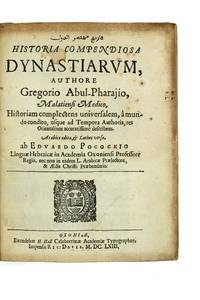
16634120<p>Oxford: H.Hall. Impensis Ric: Davis 1663. First edition thus in the Arabic edition and Latin translation by Edward Pococke. 4to. 203x155mm. pp. 12 368 90 66 5bl 565 2. The final part 565 2 in Arabic paginates from the rear of the book. The two blanks are present. Three parts in one volume i.e. the Latin translation the Supplementum and the Arabic edition each with its own title page. Bound in twentieth century brown full calf by Sangorski and Sutcliffe lettered in gilt to spine. Contemporary manuscript title to fore-edge. Some light fading to the spine slight toning to edges of first and last leaves and a small hole to foot of the final leaf not affecting the text but overall in very good condition throughout. Front pastedown has the bookplate of the Middle East scholar R.M.Burrell. His important library of books on the Middle East was sold by Sotheby's in 1999 this was lot 319. On 17th October 1630 Edward Pococke 1604-1691 arrived in Aleppo as Chaplain of the Levant Company. While there he deepened his study of the languages and culture of the region and began to collect Arabic manuscripts. In 1636 Pococke returned to England at the request of Archbishop Laud who had recently established a Chair of Arabic at Oxford and wanted Pococke to be the first holder of it. One of the manuscripts brought back by Pococke was the al-Mukhtasar fî'l-Duwal 'History of the Dynasties' of Abu'l-Faraj Bar Hebraeus 1226-1286. The lack of material in England on Islamic history and geography meant that Pococke felt unable to prepare his edition and translation and so he secured a sabbatical from Oxford and sailed for Constantinople where he spent the next three years collecting manuscripts. He returned to England shortly before the outbreak of the Civil War and it was only in 1650 that he published extracts from the "History" in his Specimen historiae Arabum which included other material culled from his now extensive collection of manuscripts. Pococke was a Royalist and the years of the Protectorate were hard: he almost lost his professorship and his priestly living. At the Restoration he returned to Oxford and began work on the complete Historia Compendiosa Dynastiarum. Finally in 1663 almost thirty years after Pococke had returned from Aleppo with the manuscript of al-Mukhtasar fî'l-Duwal his far-reaching Historia which opened up Arab history to Western was published and "remained the standard edition until the twentieth century" ODNB.</p> Oxford: H.Hall. Impensis Ric: Davis.
165854802no publisher stated Lugduni ie Paris - Jacob L'Aîne Rue Philosophie N°6 Orleans 1658 ie 1793 . 1st edition. Hardback. Diced calf VG. 172iv94pp marbled endpapers gilt dentelles all edges gilt leather a little rubbed & upper hinge cracked but holding Ex Libris Caroli Waldstein with their armorial bookplate neat late 19th century annotation to the first blank pages of the second title a little browned a nice copy. Two political tracts published in France in the early days of the Republic which look back to the English protectorate & the lessons to be learnt. The first is a translation of 'Killing Noe Murder' 1658 a pamphlet which advocates the assassination of Oliver Cromwell. Authorship has been attributed to either Edward Sexby or Silius Titus. Cromwell is considered a tyrant equal to Caligula and Nero - the people must rise up & rid them selves of such a despot and tyrannicide can not be regarded as an act of murder. The second work published in 1797 is based upon the 'The Syracusan Tyrant or the Life of Agathocles' by Richard Perrinchief originally published in 1661 an attack on Oliver Cromwell presented as a biography of Agathocles. Both works probably relating to Thermidor & the the overthrow of revolutionary radical Maximilien Robespierre & a retreat from more radical goals and strategies during a revolution. no publisher stated, Lugduni [ ie Paris ] - Jacob L'Aîne, Rue Philosophie N°6, Orleans hardcover
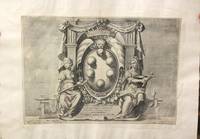
1617B6037Cruger c. 1617. Engravings mounted on watermarked laid paper. Some tears to lower margins not affecting the plates. Staining on one plate. A very good attractive and rare set. Binding: Loose folio in an 18th century wrapper. Notes: c. 1617; exception: one leaf dated 1561 and signed by Antonio Salamanca in Rome. Size: Folio sheets of 405x555m Illustration: Folio set of 14 leaves of copper engravings. References confirm 14 including the tile. Illustrated allegorical title with the Medici arms flanked by female personifications of Justice at left and Faith at right; lettered with a dedication to Cosimo II of Tuscany by Jacobus Chitus with bottom right Teodoro Cruger sculp: 1617 altered in ink to 1618 Florentiae and at lower left five privileges: Cum Privil. S. Pontif S.C. Maiest. Repi. Venet. // M.D. Etrur. Reip Genuens et V.R.Neap. - p. x An.; frontis after self-portrait by Andra Del Sarto; twelve engravings depicting the story of Saint John the Baptist after paintings / frescos and later curtains by Andrea del Sarto at Florence and Franciabigio. References: Hollstein German 6 176 35; Hollstein 33; Le Blanc 1854-1890 2 72 7-20; Virtuelles Kupferstichkabinett 6382 and 6384 mention 14 plates. Pages: Ff: Title; Self-Portrait; 12 engravings. Category: Book Europe Italy; Book Religious Christianity; Book Plate Books General; Cruger unknown
1694V67948London: Rhodes Meredith Harris & Newborough 1st edition in English 1694. Hardcover. Good. Folio calf but lacking spine leather damage to cover leather also/corners v.worn Licence leaf precedes TP TP in red & black 6pp of Subscribers 4p=Preface over 1165pp which is A-Z with Finis in mid page of last leaf. TP & License leaf with tears but no loss verso's sl.soiled and re-inserted.Newer EPS. Good wide margins no writing no worming a neat complete copy of the best edition of this first Historical Dictionary in English. Later editions were edited by Collier and appear under his name while this has no translator or editor given although the work is a compilation of the major classical dictionaries in Latin and French WING M-2725. Rhodes, Meredith, Harris & Newborough (1st edition in English) hardcover
167612766Hamburg, Gottfried Schultze, 1676. 8vo. Mit 1 Kupfertaf. m. 5 Figuren. 2 Bl., 128 S., 1 Bl., S. 129-204, 2 Bl. Pgt. d. Zeit. Blauschnitt.
163769657Lugd. Batavorum Leiden: Elzevirios 1637. Hardcover. Very good. Presumed to be the first edition thus: Elzevier produced two editions in 1637; in this example pages 207 and 209 are erroneously numbered 107 and 109 which according to Willems #452 and others indicates the earliest printing. "Barclay's Euphormionis Lusinini Satyricon 1603-7 - a severe satire on the Jesuits the medical profession and contemporary scholarship education and literature - is modeled on the style of the Roman satirist Gaius Petronius Arbiter; it is an urbane and facile mixture of prose and verse. Filled with villians and rogues it contributed to the later development of the picaresque novel" EB. 717 p. with an engraved title page. 12mo. Period full vellum binding with holographic titles on the spine. Some minor soiling to the vellum; else very good. Elzevirios hardcover books
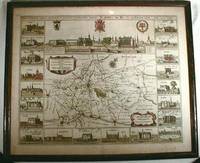
1647006302Amsterdam: N.P. 1647. Hard to find hand colored map included only in Blaeu's Atlas Major centering in the towns of Ipres and Rouselare near Bruges and Belgium with smaller engravings of towns surrounding the main map. Measures 18" tall by 21.75" wide mounted on paper board. Some foxing to margins no chips or tears colors bright. Behind glass in old black painted wooden frame with many paint chips. An attractive map. Good. N.P. unknown
165697617Leodii [Liège / Lüttich], Henricus et Jean Hovius, 1656. [10] Bl., Titelseite in Rot und Schwarz mit Holzschnitt-Druckerzeichen, 620 S., [14] Bl. Folio. 34,5 cm. Ganzleder auf 5 Bünden mit Rückenschild und dekorative Rückenvergoldung.
1606SZEPEBKS007590IVenetiis: Andreae Muschij or Muschius 1606. Hardcover. Good. Title continues: " . Patauium ac finitimos attinentia opportune interseruntur". - Venetiis M. DC. VI. / Ex Typographia Andreae Muschij. - 8vo. - 24306 pp. - With a 2-page dedication to the Archbishop of Milan: "Illustrissimo et Amplissimo D. Federico Borromeo S.R.E. Cardinali Archiepiscopo Mediol."; and with an "Errata sic corrigito" at the end of the Index. - Disbound old waterspot on lower left corner of the first 24 pages small closed tear on upper right corner of p. 33; else fine. - Splendid engraved coat-of-arms on title-page; engraved initials head- and tail-pieces. - Contemporary ownership inscription in ink on title-page. - First edition a second edition was published with identical number of pages by the Typographia Seminarii in Padua in 1696. - History of the Benedictine monastery of Santa Giustina di Padova as well as of the city of Padua. - Quite rare: OCLC locates only 5 copies all in Germany. - Shelf No.: c 159. <br/> <br/> Andreae Muschij (or Muschius) hardcover