91 résultats
168916034London: Printed by Edw. Jones for Abel Swall.and Henry Bonwicke. 1689 Second English edition of an important history of the Reformation. Contemporary reverse calf ruled in blind. Folio. Title-page printed in black and red. The Bohun work with separate title-page. With six engraved portrait plates. Joints starting to crack but sound. Armorial bookplate of Cobbold of Ipswich later ownership annotation dated 1980 on front pastedown. A good clean copy. Johannes Sleidanus 1506-66 was born in Schleidan Luxembourg and studied ancient languages and literatures at Liège and Cologne and law and jurisprudence at Paris and Orléans. At Lièges he encountered humanist scholars and developed an interest in Protestant ideas. He went to work for Cardinal du Bellay and was employed in the futile negotiations of the French court to make an alliance with the German Protestants against the Emperor Charles V. In 1542 he settled in Strassbourg. He was in the habit of copying all papers that had any bearing on the Reformation to which he had access and Martin Bucer who had seen his papers suggested that Philip of Hesse appoint him historian of the Reformation giving him a salary and access to all necessary documents. Thus began his great work the first volume of which appeared in 1545. That same year he traveled to England in a French embassy to Henry VIII and there he collected further materials for his work. He later went to Marburg to view the archives of Philip of Hesse. In 1551 he attended the Council of Trent. He finished his history in 1554 despite financial problems. He died in poverty the following year. Printed by Edw. Jones, for Abel Swall...and Henry Bonwicke.. unknown
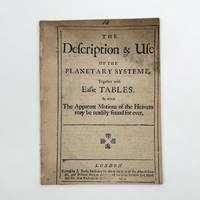
1675371490London: Printed by J. Darby for Robert Morden . and William Berry 1675. Second issue with the added Postscript. 26 2 blank 4pp. Tables. 4to. Disbound. Trimmed close minor soiling. Second issue with the added Postscript. 26 2 blank 4pp. Tables. 4to. This second issue with the added Postscript dated 1675 in which the author defends himself from criticism by John Flamsteed. The work is an early use of the term "planetary system" in the title and includes a 12-line poem on the solar system on the final page.<br /> <br /> Streete 1621-1689 Irish-born astronomer is best known for his 1661 work Astronomia Carolina a new theorie of Coelestial Motions which was read and praised by Halley Newton Flamsteed and others. A follower of Kepler Streete argued that the Earth's velocity in its annual revolution around the sun was not uniform and increases in velocity as it approaches the Sun and decreased as it moves away. ESTC calls for a plate but we find no reference to one in other extant copies. Scarce. ESTC R606; cf. Wing S5955 Printed by J. Darby, for Robert Morden ... and William Berry unknown
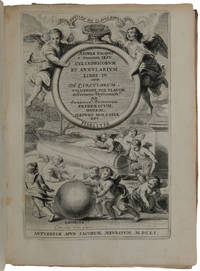
16515427Antwerp: Jacob van Meurs 1651. First edition. <p>First edition very rare and a fine copy. "Tacquet's most important mathematical work Cylindricorum et annularium contained a number of original theorems on cylinders and rings. Its main importance however lay in its concern with questions of method. Tacquet rejected all notions originating with Cavalieri that solids are composed of planes planes of lines etc." DSB. "It was Tacquet's decisive influence followed by Pascal's large-scale implementation which allowed the passage from indivisibles to infinitesimals" Julien Seventeenth-Century Indivisibles Revisited.</p>. <p>'ALLOWED THE PASSAGE FROM INDIVISIBLES TO INFINITESIMALS'</p> . <p>First edition very rare and a fine copy. "Tacquet's most important mathematical work Cylindricorum et annularium contained a number of original theorems on cylinders and rings. Its main importance however lay in its concern with questions of method. Tacquet rejected all notions originating with Cavalieri that solids are composed of planes planes of lines and so on except as heuristic devices for finding solutions. The approach he adopted was that of Luca Valerio and Gregorius of Saint-Vincent an essentially Archimedean method" DSB. "Tacquet's criticisms must have been effective because indivisibles became homogeneous magnitudes as a result of innovations introduced during the course of the seventeenth century" Rossini p. 465. The historian of mathematics Henri Bosmans "states that it was Tacquet's decisive influence followed by Pascal's large-scale implementation which allowed what is sometimes referred to as the passage from indivisibles to infinitesimals" Julien p. 187. "In this work the ideas that the tangent and the area under a curve were inverse to each other appeared. It arises from the way that Tacquet thought of curves generated by moving points but not actually comprising of points. Of course this idea is an early form of what would become clear when the calculus was invented namely that the derivative and integral were inverse to each other. This book had a considerable effect on Pascal and was important in setting the scene for the invention of the calculus" MacTutor. Bosmans has pointed out the debt owed to Tacquet's Cylindricorum et annularium by Pascal in his preparation of the Lettres de Dettonville 1659. Indeed in the Lettre à Carcavy Pascal writes that Tacquet's book is full of "learned geometry" praises how Tacquet "handles the indivisibles with all desirable rigour" and refers specifically to Tacquet for a result on the approximation of a surface by inscribed and circumscribed polyhedra see Descotes. "The change in Pascal to a clear point of view with respect to infinitesimals may well have come from Pascal's reading of Tacquet's Cylindricorum et annularium in which the author denied the validity of concluding anything about the ratio of surfaces from the ratio of their indivisibles or lines" Boyer p. 151. This is a rare work particularly in commerce. ABPC/RBH list only the Turner copy from the University of Keele offered by a prominent London dealer in 2002 and subsequently sold at Reiss in 2005 quite a poor copy in modern binding with some paper repairs and a partially removed library stamp. Ours is a fine untouched copy in contemporary binding.</p> <br /> <p>Provenance: Contemporary ownership inscription on title of "Conde da Torre" possibly the Portuguese nobleman João de Mascarenhas 1633-1681 second Count of Torre and first Marquis of Fronteira. </p> <br /> <p>"The Jesuit mathematician André Tacquet 1612-60 was by the standards of his time a man of the world. Although he may never have left his native Flanders his network of correspondents spanned Europe's religious divide reaching to Italy and France but also to Protestant Holland and England. Only months before his death he entertained the Dutch polymath Christiaan Huygens who had travelled to Antwerp with the express purpose of meeting Tacquet by then regarded as one of the brightest mathematical stars ever to come out of the Society of Jesus . It was his mathematical excellence that transcended 17th-century prejudices. In England Henry Oldenburg secretary of the Royal Society of London and no friend of the Jesuits spent so much time describing Tacquet's Opera mathematica at the Society's meeting in January 1669 that he felt compelled to apologise to the fellows for abusing their patience. But it was he insisted 'one of the best books ever written on mathematics'" Alexander p. 118.</p> <br /> <p>"In 1651 André Tacquet the urbane Fleming whose work was celebrated by Catholics and Protestants alike published hisCylindricorum et annularium libri IV 'Four books on cylinders and rings' a work dedicated to the study of geometrical features of these figures and their applications. Befitting a Jesuit publication the frontispiece shows two angels bathed in divine light holding up a ring enclosing the book's title; on the ground below them a band of cherubs is busy putting the theory into practice. The implication is clear: divine mathematics universal and perfectly rational orders and arranges the physical world to the best possible effect. It is a fetching visual depiction of the Jesuit view of the role and nature of mathematics.</p> <br /> <p>"The Cylindricorum et annularium is Tacquet's most celebrated work the one that established his reputation as one of Europe's most original and creative mathematicians. As it turned out it may have been a bit too 'original and creative' for his superiors: when Tacquet sent a copy of the book the newly appointed superior general Goswin Nickel the general's response was surprisingly cool. After thanking the mathematician and congratulating him on the book Nickel added that it would be better if Tacquet applied his impressive gifts to producing textbooks of elementary geometry for use by students at the Society's colleges rather than original works aimed at a select audience of professional mathematicians . Tacquet a good soldier in the Army of Christ obeyed. From then on he published no more original work but concentrating instead on producing textbooks some of which are of such quality that they became standards in the field for over a century .</p> <br /> <p>"In his critique Tacquet is respectful even deferential toward his rivals. He refers to Cavalieri as 'a noble geometer' and insists that he 'does not wish to detract from the deserved glory' of Cavalieri's 'most beautiful invention' Geometria indivisibilibus 1635. Tacquet knew of what he spoke because he was himself deeply familiar with the work of Cavalieri and Torricelli and was no less capable than they of using their method to arrive at new results. But once he gets beyond his congenial style and mathematical mastery it becomes clear that Tacquet's opposition to the infinitely small is . unyielding . 'I cannot consider the method of proof by indivisibles as either legitimate or geometrical' he states flatly at the opening of his discussion of indivisibles. 'It proceeds from lines to surfaces from surfaces to solids and applies to the surface the quality or proportion obtained from the lines and transfers what was obtained from the surfaces to the solid.' 'By this method' he concludes 'nothing can be proven by anyone'" ibid. pp. 161-2.</p> <br /> <p>"André or Andreas Tacquet resembles his contemporary Torricelli in the generality of his adoption from his predecessors of varied infinitesimal methods. In his Cylindricorum et annularium libri IV he gave for example four demonstrations of the proposition that the volume of a sphere is equal to that of a cylindrical wedge whose base is half a great circle of the sphere and whose altitude is equal to the circumference of the sphere. This theorem had been given by a number of mathematicians since Kepler as well as by Archimedes in the Method probably not then extant. Tacquet however after proving the theorem in two ways by the use of inscribed and circumscribed figures gave two further demonstrations by indivisibles based on the equality of triangles and circular sections. Torricelli had himself been satisfied with the rigor of proofs by means of indivisibles although he supplied alternative demonstrations for the benefit of others. Tacquet on the other hand said that he did not consider that the method of Cavalieri was to be admitted as either legitimate or geometrical. He maintained that the cylindrical wedge could not in all strictness be considered as made up of triangles; nor could the sphere be regarded as composed of circles . A geometrical magnitude he asserted is made up only of homogenea that is parts of like dimension - a solid of small solids and area of small areas and a line of small lines - and not of heterogenea or parts of a lower dimension as Cavalieri had maintained. He therefore felt that a proposed magnitude is exhausted a word he undoubtedly acquired from Gregory of St. Vincent by inscribing homogenea within them 'as in the manner of the ancients'" Boyer pp. 139-140.</p> <br /> <p>Tacquet gave a famous example where Cavalieri's method led to incorrect results. On pp. 23-24 he considers a right-angled triangle with one horizontal and one vertical side. Rotating this triangle around the vertical side generates a cone. Each plane section of the cone parallel to the base determines a circle and the circumference of each of these circles bears the same ratio to its radius namely 2π to use our notation. Since the surface of the cone is made up of all these circular cross-sections and the triangle is made up of all the radii Cavalieri's method would imply that the same ratio is also that between the surface area of the cone and the area of the triangle. But this is not the case.</p> <br /> <p>Archimedes had used a double reductio ad absurdum style of proof to find areas and volumes and this argument continued to be used until the publication of Cavalieri's work. To show that the area of a given region is equal to A Archimedes showed that for any number B smaller than A an inscribed figure could be constructed whose area is greater than B the inscribed area was usually composed of rectangles or triangles so that its area could easily be determined. This shows that the area of the given region cannot be smaller than A. A similar argument with circumscribed figures shows that the area cannot be larger than A. This technique is usually referred to as the 'method of exhaustion.'</p> <br /> <p>In the Cylindricorum et annularium Tacquet gives two proofs of most of his results on rings and cylinders the first using a modified form of the exhaustion technique the second using indivisibles; the precision and rigour of the traditional method is repeatedly stressed. But Tacquet introduces a number of innovations in the use of the method of exhaustion.</p> <br /> <p>"Tacquet's book has two theorems dealing with exhaustion which are the foundation for nearly all other theorems in the book. The first proposition of the first book is reminiscent of Valerio's theorem De Centro Gravitatis Solidorum Libri Tres 1604:</p> <br /> <p>Let A and B be two magnitudes either areas or volumes and let the ratio of E to F be given. If one can consecutively inscribe into A and B a sequence of magnitudes that relate to one another as E to F and if these magnitudes exhaust A and B i.e. they differ from these by an arbitrarily small amount then the magnitude A will relate to the magnitude B as E to F.</p> <br /> <p>"Tacquet's general theorem has the advantage that he does not have to repeat a double reductio ad absurdum with each proof .</p> <br /> <p>"The first proposition of the second book introduces another exhaustion method:</p> <br /> <p>If a sequence of magnitudes Ain and Bin can be inscribed in magnitudes A and B and if likewise a sequence of magnitudes Acn and Bcn can be circumscribed about magnitudes A and B and if moreover Ain and Acn exhaust A and for the corresponding magnitudes we have Ain / Bin = E/F and Acn / Bcn = E/F then A/B = E/F.</p> <br /> <p>"The simplification lies in the fact that it is no longer necessary to exhaust the inscribed and circumscribed magnitudes for each of the magnitudes A and B as it suffices to calculate the ratio for one or the other .</p> <br /> <p>"An important new concept is found in Tacquet's definitions of surfaces and solids. He defines the cylinder for instance as a solid that is generated by the movement of a circle in such a way that one of the points of the circle segment moves along a straight line. The axis of this cylinder is the straight line joining the centre of two of the generated circles. Despite this definition he does not accept that the cylinder is composed of circles" ibid. pp. 214-5.</p> <br /> <p>An important example of Tacquet's 'kinetic' method of generating curves and surfaces is contained in the second part of the Cylindricorum et annularium entitled 'Dissertatio physico-mathematica de circulorum volutionibus' in which Tacquet studies the cycloid a curve traced out by a point on the circumference of a circle as it is rolled along a straight line. This curve was to be the focus of Blaise Pascal's work on indivisibles published in the Lettres de A. Dettonville 1659.</p> <br /> <p>"Although Pascal was undoubtedly attracted by the power of indivisible methods he was impressed by the careful geometrical approach of Grégoire de Saint-Vincent and swayed by the vigorous criticism of Cavalierian indivisibles launched by André Tacquet in his work Cylindricorum et annularium. Pascal was accordingly impelled to examine carefully the basis for the use of indivisibles in geometry" Baron pp. 199-200.</p> <br /> <p>"Blaise Pascal in a sense represents the highest development of the method of infinitesimals carried out under the tradition of classical geometry . Pascal was not a professional geometer and as a result his geometrical work was accomplished in two periods which were separated by an interval of mathematical inactivity from 1654 to 1658 during which he devoted his interests to theology. These two periods moreover are characterised by somewhat different views as to the nature of infinitesimals . In this connection he enunciated in the Potestatum numericarum summa of 1654 the theorem on the integral of xn . The essential point in Pascal's demonstration is the omission of terms of lower dimension . The geometrical intuition of indivisibles of lower dimension was carried over into arithmetic to justify the neglect of certain terms of lower degree .</p> <br /> <p>"In the later period of his mathematical activity his view appears to be modified. In connection with problems such as those in his Traité des sinus du quart de cercle of 1659 contained in the Lettres de Dettonville . he used the language of infinitesimals in speaking of the sum of all the ordinates; but he added that one need not fear to do this inasmuch as what is really meant is the sum of arbitrarily small rectangles" Boyer pp. 147-151.</p> <br /> <p>Bosmans sees Pascal's Potestatum numericarum summa as containing two mutually incompatible ideas about indivisibles. On the one hand Pascal sometimes regards indivisibles as rigorously null quantities as had Cavalieri. On the other hand he sometimes regards indivisibles as simply quantities that are negligible in comparison to other quantities. "Bosmans then strongly underlines the difference with the clarity of the Lettres de Dettonville where Pascal expresses himself with impeccable rigour substituting for the strict indivisibles of Cavalieri homogeneous quantities whosesums differ from that to be measured by less than any given quantity. He then finds the reason for this progress in the reading that Pascal would have made between 1654 and 1658 of the book published by Tacquet in 1651" Descotes pp. 1-2 our translation.</p> <br /> <p>In the last section of the Lettre à Carcavy Pascal refers specifically to Tacquet in his discussion of the problem of finding the area of a surface obtained by rotating a curve around a vertical axis. When an infinitesimal section of the curve is rotated one obtains a circular band; these bands together make up the whole surface. "This is properly what according to Dettonville Tacquet has demonstrated: 'The sum of these semi-circumferences of the surface of the semi-solid makes up this very surface as others have demonstrated among them Tacquet'. We find in fact in the Cylindricorum et annularium Book II 1st part a Proposition VI which corresponds to Pascal's words. Its object is to prove that if we consider in a great-circle BICQ on a sphere with diameter BC if we inscribe and circumscribe regular polygons on the semi-circle BIC and if we rotate these polygons around the diameter BC they inscribe and circumscribe in the sphere with solids whose surfaces differ from that of the sphere by a quantity which can be made as small as one wishes. We see how it accords with Pascal's thought: the inscribed and circumscribed segments generate bands during the rotation which at the limit can be said to compose the curved surface. In accordance with his principles Father Tacquet demonstrates it in the manner of the Ancients" ibid. p. 4.</p> <br /> <p>"Tacquet was the son of Pierre Tacquet a merchant and Agnes Wandelen of Nuremberg. His father apparently died while the boy was still young but left the family with some means. Tacquet received an excellent education in the Jesuit collège of his native town and a contemporary report describes him as a gifted if somewhat delicate child. In 1629 he entered the Jesuit order as a novice and spent the first two years in Malines and the next four in Louvain where he studied logic physics and mathematics. His mathematics teacher was William Boelmans a student of and secretary to Gregorius Saint Vincent. After his preliminary training Tacquet taught in various Jesuit collèges for five years notably Greek and poetry at Bruges from 1637 to 1639. From 1640 to 1644 he studied theology in Louvain and in 1644-45 he taught mathematics there. He took his vows on 1 November 1646 and subsequently taught mathematics in the collèges of Louvain 1649-55 and Antwerp 1645-49 1655-60" DSB.</p> <br /> <p>A second edition of the Cylindricorum et annularium was published in 1659 with the addition of a fifth book devoted to an unrelated subject the paradox of 'Aristotle's wheel'. The perceived unsuitability of the Cylindricorum at annularium for the Jesuit colleges may explain why it was not added to all copies of the Opera mathematica 1669 it was not present in the Macclesfield copy for example.</p> <br /> <p>De Backer-Sommervogel VII 1806 3; Poggendorff II 1064. Alexander Infinitesimal 2014. Baron The Origins of the Infinitesimal Calculus 1969. Boyer The History of the Calculus and its Conceptual Development 1949. Descotes 'Documents relatifs aux lettres de A. Dettonville I. Pascal et le Père Tacquet' Courrier du Centre international Blaise Pascal 14 1992 pp. 1-13. Julien ed. Seventeenth-Century Indivisibles Revisited 2015. Malet From indivisibles to infinitesimals 1996. Meskens Between Tradition and Innovation: Gregorio a San Vicente and the Flemish Jesuit Mathematics School 2021. Rossini 'Giordano Bruno and Bonaventura Cavalieri's theories of indivisibles: a case of shared knowledge' Intellectual History Review 28 2018 pp. 461-476.</p> <br/> <br/> Small 4to 217 x 162 mm pp. xx 284 4 with 18 folding engraved plates the first 9 bound preceding title the remainder at end as in the instructions to binder on p. 286 full-page engraving on title second work with special half-title occasional light browning and spotting. Contemporary yapped limp vellum with manuscript title on spine remains of ties a few stains and light rubbing. Jacob van Meurs unknown
161567051615. 14; 13 folding leaves. Two parts in one vol. Large 8vo cont. or later dark wrappers dyed with persimmon juice shibubiki new stitching. Japan probably Kyoto: printed with moveable types ca. 1615-40.<br/> <br/> A very rare edition printed with moveable types apparently unrecorded in the standard bibliographies of the story — or legend — of the creation of the first statue of Siddhartha Gautama or Gautama Buddha the founder of Buddhism. The statue executed while Buddha was still alive was commissioned by King Udayana of Kaushambi a contemporary of Buddha. It was the very first image of Buddha and is especially important as it was carved from life. Copies of this statue made their way to China with the spread of Buddhism and later as we shall see to Japan.<br/> <br/> The text provides a history of the creation of the first statue of Buddha which is perhaps the most famous of all Buddha images. King Udayana commissioned the statue “so that he could gaze upon the sacred form of the Buddha while the latter was off preaching to his mother in the heaven of Indra. Buddha’s disciple Maudgalyayana transported thirty-two craftsmen up to the heavenly realm so that they could observe the special marks of the Buddha firsthand thereby insuring the representational accuracy of the image they created. When the Buddha eventually returned to the earth King Udayana’s statue rose into the air to greet him of its own accord and the Buddha proclaimed that it would one day help to transmit his teachings.â€â€“Brown ed. The Oxford Handbook of Religion and the Arts p. 371. We learn that the statue was carved out of sandalwood and that later copies were made of gold silver bronze lead tin or iron as well as of wood.<br/> <br/> This text was translated by the Khotanese monk Tiyunbanruo d. 691 or 692 whose original Sanskrit name was Devendraprajna. Khotan was an ancient Iranian Saka Buddhist kingdom on the branch of the Silk Road that ran along the southern edge of the Taklamakan Desert near modern-day Xinjiang. Tiyunbanruo came to Luoyang the “Eastern Capital†of the Tang dynasty of China in about 688 with a considerable reputation as a Buddhist missionary and set up a bureau to translate Buddhist texts into Chinese. An earlier edition of this text was published in Beijing in 1593 and only one copy is known at the BnF.<br/> <br/> This book was probably printed and issued as a way to reinforce the legitimacy of the famous Buddha statue of the temple of Seiryoji in the Saga fields of Kyoto. It is one of the chief objects of religious veneration in Kyoto. A copy of the original statue also commissioned by King Udayana was brought from the castle at Kaushambi in north-central India to China by Hsuan-tsang in 645. The statue moved many times and ultimately arrived at Kaifeng the Sung capital. The Japanese monk Chonen 938-1016 who spent the years 983-86 in China studying and collecting texts had worshiped the statue in Kaifeng and commissioned men in 984 to carve a copy to bring back to Japan. The copy was ultimately installed at Seiryoji and according to Japanese tradition the Chinese “original†and Chonen’s copy had miraculously changed places — the Seiryoji Buddha was actually the authentic example commissioned by Udayana.<br/> <br/> The Seiryoji Buddha is “probably the most important best-documented and best-preserved sculpture now existing which represents the school and tradition of Buddhist sculpture connected with the sacred Udayana image of the living Buddha of which Hsuan-tsang brought a copy to the court at Ch’ang-an.â€â€“Henderson & Hurvitz “The Buddha of Seiryoji: New Finds and New Theory†Artibus Asiae Vol. 19 No. 1 1956 p. 43–and see the whole fascinating article.<br/> <br/> As mentioned above this rare work is printed with moveable types. It was at one time owned by the great Japanese dealer Shigeo Sorimachi. The chitsu has the characteristic handwriting on the label of Sorimachi’s assistant Mr. Mori who has written: “Zozo kudoku kyo. Genna kan’ei chu kan. Kokatsu ban†“Creation of the Statue a Pious Act. From Genna to mid-Kan’ei edition ca. 1615-40. Moveable typeâ€. It is not cited by Kazuma Kawase Kokatsuji-ban no kenkyu Study of the Early Typographic Editions of Japan 1967 the definitive bibliography of Japanese moveable type books. There is no copy in WorldCat nor the Union Catalogue of Early Japanese Books.<br/> <br/> In very good condition. The first ten folding leaves which are a little stained have some repaired worming and strengthening. The following leaves have some worming some carefully repaired and others as the worming lessens not repaired. Several characters affected by the worming. As mentioned above the wrappers have been dyed with persimmon juice which serves a dual purpose: to strengthen the paper and act as an insect repellent.<br/> <br/> â§ Wang Zhenping “Chonen’s Pilgrimage to China 983-986†Asia Major Third Series Vol. 7 No. 2 1994 pp. 63-97. Martha L. Carter The Mystery of the Udayana Buddha Naples: 1990. unknown
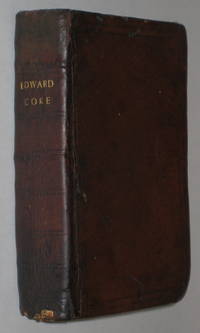
1640000034London: Londini Excus. per assignat. I. More armigeri. 1640. 1640. 1st Edition . Leather. Very Good. Description: Sm. 8vo 5¾ × 3¾ in: 12 579 1 p. Early calf; "Edward Coke" lettered in gilt on spine. · Register: 8º: ¶6 B-2O8 2P2. · Condition: Spine chipped at bottom. Initial blank signed with a fleuron present in this copy. Margin of leaf O2 torn with loss not affecting text. · Comments: Sole edition. Although the title is in Latin the text is in Law French. This copy contains numerous manuscript references to the first edition of Hobart's Reports printed in quarto in 1641. The references must be to the first edition because in some of the citations the page number is higher than 350 which is the last page of the 1650 folio second edition and all subsequent editions. · References: S&M 1:29723; STC 5527; ESTC S108467. <br/> <br/> Londini Excus. per assignat. I. More armigeri. 1640. hardcover
16331409373Lugduni Batavorum Leiden: Joannis Maire 1633. Hardcover. 12mo 36 613 pages. In Very Good minus condition. Bound in early vellum with faded illegible writing on spine. Tearing up rear hinge with a large chunk of material missing from tail of spine. Yapped edges. Edges of textblock dyed. Adhesive residue to endpapers. Bookplate to front pastedown. Light foxing scattered throughout interior. <br /> <br> <br /> Contemporary signature to front free endpaper dated 1633.<br /> <br> <br /> Shelved in Case 3. USTC: 1011674. Signatures in 8 and 12.<br /> <br> <br /> Vegtius was a Roman citizen writing during the late 4th century/early fifth century. "De re militari" is his treatise on Roman military principles. It gained a renewed popularity as a manual on warfare during the Middle Ages. 1409373. Shelved Dupont Bookstore. Joannis Maire hardcover
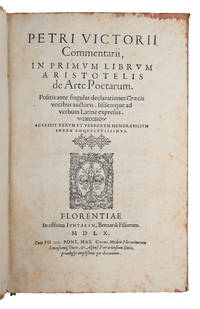
161062508Florence In officina Iuntaru Barnardi Filiorum 1560. Small folio. 18th century full vellum with gilt labels to spine. Wear to capitals and small worm tracts towrad opper hinges. Corners a bit bumped. A very nice and sturdy binding. Marbled edges. Some browspotting throughout. Small wormholes to blank margin of final leaf far from affecting imprint. Woodcut vignette to title-page and to verso of colophon-leaf. 10 308 12 ff. <br/><br/><em>The rare first edition of Vittore's main work his great edition translation and commentary on Aristotle's Poetics which is arguably the most important and influential commentary on the work ever published profoundly shaping our understanding and interpretation of Aristotelian literary theory. Petrus Victorius or Piero/ Pietro Vittore/Vettore 1499-1584 is not only the “first great editor of the Poetics†McMahon he is also considered "the greatest Greek scholar of Italy" Whibley “the leading Italian scholar of his time†Encycl. Britt. “the last great figure from that period in the domain of Greek studies†Willamowitz and “the foremost representative of classical scholarship in Italy during the sixteenth century which for Italy at least may well be called the “saeculum Victorianumâ€.†Sandys. His magnum opus and without doubt most influential work is his edition with commentary of Aristotle’s Poetics which is of seminal importance in several respects. It is crucial to our understanding of Aristotle’s great work shaping the way that all later scholars have read it. The understanding of Aristotle’s work on poetry came to define the way that we have understood literature and fiction ever since the Renaissance and Victorius is the leading interpreter. ““From the sixteenth century to Romanticism European literary theory used the term marvel or wonder It. meraviglia ammirabile Fr. merveille Sp. maravilla to designate everything that was on the conceptual margins of the poetics of probability and imitation. The discovery and complete reception of Aristotle’s Poetics between the fifteenth and sixteenth centuries resulted in the dissemination of an idea of poetry as the imitation of the actions of men whose main part was the plot or the structuring of actions ordered according to the laws of necessity credibility and probability. This formed the basis of Neo-Aristotelian poetics which determined the ways of thinking about literature and fiction for more than four centuries.†Vega p. 280. Especially the idea of “wonder†in Aristotle’s Poetics came to be one of the founding ideas of modern literary theory. And especially here Victurius’ reading is groundbreaking playing a central part in the reception and understanding of the work over the centuries to come. “A single editorial decision in just one passage and what is more in a complex fragmentary unfinished text like the Poetics affects the entire work…†Vega p. 284. “The text of the Poetics that can be read in the editions and translations of the sixteenth century and a large part of the seventeenth with one exception as we shall see NB. This exception is Victorius does not include the term alogon in the passage that deals with wonder. It does not appear in the first Greek edition the famous Aldine princeps of 1508 or in the Latin translations of the end of the fifteenth century; it is not in the edition and translation by Alexander Paccius or Pazzi the one most widely read in the sixteenth century neither does it appear in the edition with commentary by Francesco Robortello nor in Vincenzo Maggi’s Enarrationes nor in the vernacular commentaries of Ludovico Castelvetro and Alessandro Piccolomini. What is more a detailed revision of the history of the text reveals that no manuscript of the Poetics and no direct or indirect testimonies not even in the Arabic branch of its transmission have ever included the term alogon.†Vega p. 282. It is Victorius who is solely responsible for the reading that is generally accepted today as well. “The moment when the idea of irrationality alogon appears for the first time in Aristotle’s text can be identified without hesitation as 1560 which is the date when the edition translation and commentary on the Poetics by the philologist and Hellenist Pier Vettori or Victorius was printed on the presses of Giunti in Florence. Vettori is the one who first edits alogon even though no testimony provides him with this reading and he does so fully aware of his choice and its implications†Vega pp. 287-89. “The success of Victorius’ reading while not immediate was extraordinary.†Vega p. 287 Antonio Viperano accepts the reading “alogon†with all it involves De poetica libri tres Ricciboni adapts it in his edition of Aristotle’s Poetics Tasso embraces it Discorsi dell’arte poetica Discorsi del poema eroico and it is implicit in Alonso López Pinciano’s Philosophia Antigua Poetica. Vossius in 17th century Germany makes abundant glosses on alogon in his books on poetics and the commentators and translators of the “Poetics†in France preferred Victorius’ reading in every case. “Victorius’ conjecture seems to have convinced all editors and commentators who reproduce it without question in every case.†Vega p. 289. The influence of Victorius’ interpretation of Aristotelian literary theory that he presented in his magnum opus i.e. the present work was not limited to the use of specific words that changed the reception history of Aristotle’s Poetics. His entire view of poetry through an interpretation of Aristotle was highly original and came to define the way we understand literature in general. Victorius was one of the first to put forth the belief that heroic poetry should present a Platonic idea of perfect virtue contributing to the centuries long doctrine of the perfect hero as perfect exemplar and he was one of the first to revive Aristotle’s idea of purgation from tragedy still widespread today and to also understand the existence of a purgation from poetry. “He viewed poetry as a moderator of minds “By reading poetry men “become moderate in temper and their turbid motions are extinguished.†Poems “purge our minds of blemish and spotâ€. Vettori realized that Aristotle’s reference to catharsis should be applied to tragedy alone but he added that similar purgations could be achieved by other kinds of poetry effective however on other passions than pity and fear and with the aid of other instruments.†Hathaway pp. 292-93. Apart from his overall interpretation of Aristotle’s literary theory and his groundbreaking reading of the most central passages of the Poetics Victorius was also the first to determine that the Aristotelian text that has come down to us is not complete. “Victorius was the first to see that the treatise now known as the Poetics is only the surviving portion of a larger work.†Bywater p. XX. “during his lifetime five medals were struck in his i.e. Victorius’ honour and his portrait was painted by Titian… His fame was not limited to his own land or his own time. His scrupulous care and unwearied industry are lauded by Turnebus who declines to be compared with him even for a moment; the epiteths doctissiums optimus and fidelissimus are applied to him by the younger and the greater of the two Scaligers while Muretus calls him eruditorum coryphaeus; and similar eulogies might be quoted from Justus Lipsius. Dacius … and Graevius. He is described as having climbed the “hill of virtue†and taken his place on its summit between Cicero and Aristotle. In his funeral oration Salviati says of him in the personification of Italia: “Now no more shall distant peoples cross the snows of the Alps to see Victorius or men of mark arrive from every land to hear him; or princes hold converse with him. Now no more shall the works of scholars in all parts of the world be sent here for his approval; or youth learn wisdom from his lips.†Sandys pp. 139-40. “No one said a contemporary of his in a funerary laudatio ‘left Aristotle in a cleaner state purgatior’.†Baldi. _____________________________________________ Adams: 1905; Brunet V: 1179; Graesse I: 213 â€Ã©dition excellente quant à la critique†and noting that some copies bear the dates 1563 and 1564. Sandys: A History of Classical Scholarship Vol. II 2003 pp. 135-140. Hathaway Baxter: The Age of Criticism: The Late Renaissance in Italy. Cornell University Press 1962. A.Philip McMahon: On the Second Book of Aristotle's Poetics and the Source of Theophrastus' Definition of Tragedy Authors. In: Harvard Studies in Classical Philology 1917 Vol. 28 1917 pp. 1-46. Christopher Rowe: Petrus Victorius and Aristotle’s Eudemian Ethics Cambridge University Press online 2025. Vega Maria José: Wonder and the Irrational. The Invention of Aristotle’s Poetics in the Sixteenth Century. In: Nous Polis Nomos. Berlin Academia Verlag 2016. Baldi: Il greco a Firenze e Pier Vettori 1499–1585 Alessandria 2014 117. </em> hardcover
160433228-471Leiden Henricus Hondius 1604-1605. Two printed titles with elaborate engr. architectural borders woodcut initials 1 of 2 engr. portrait in the text and 49 engr. plates in vol. 1 33 34 on 1 leaf and 24 engr. plates in vol. 2. Text printed in 2 cols. 9 of 10 unn. leaves; 3 unn. leaves. Oblong folio 280 x 350 mm. 17th cent. marbled boards new endpapers. Leiden Henricus Hondius 1604-1605. First edition of Vredeman's "Perspective" issued by Hondius and printed simultaneously also in French Dutch and German. Present here is the valuable Latin version "the classical language in which Vredeman's architecture is clad and thus becomes timeless in its character" Millard p. 20f. This is one of the most celebrated works on such a subject and was issued by the Flemish born Hendrik Hondius the Elder 1573-1650. The plates for the most part are engraved and a few signed by him after Hans Vredeman. Plate 14 in part 2 is after Paul Vredeman and 4 plates in this part are signed with the monogram DB probably Theodore de Bry or Bartholomaeus Dolendo. The painter and architect Hans or Jan Vredeman de Vries was born 1527 to a German soldier in Leeuwarden Netherlands and probably died in Antwerp 1604. "The King of Architects" Fowler together with Hans van Schille worked at the fortification of the city of Antwerp and also at the triumphal arches built for the entry of the future Philip II into Antwerp in 1549. As a consequence of the religious upheavals of the period Vredeman worked in Hamburg Danzig and Prague before returning to Holland. He wrote and illustrated the present guidebook on perspective for designers painters and architects. It became one of the major books on this subject and through Vredeman de Vries' various publications he is recognised as the "foremost among sixteenth century Netherlandish architectural authors" Millard p. 19. The two volumes illustrate stage perspective interiors furniture palace and garden architecture. Vredeman de Vries was capable of truly artistic landscaping in the Northern Renaissance and served as a model for some patrician gardens in Germany cf. E. Haupt Baukunst der Renaissance in Frankreich und Deutschland 1916. The book includes a number of scenes and projections employ one-and-multi-point perspective. These were essential demonstrations for artists of those days. This work on perspective summarizes Vredeman's knowledge of art science and geometry. This copy has the same collation as the Fowler copy at Johns Hopkins University library which also lacks at the beginning of vol. 1 the leaf A1v with an engraved portrait on left half and a printed poem on right half of this leaf. There are complete copies known but in fact there is no copy of this Latin edition in the holdings of the BL London the Royal Library The Hague Utrecht Dresden Heidelberg Beinecke or Centre d'Architecture at Montreal. The only two but incomplete copies in Austria are in the holdings of the University of Technology Library at Vienna and in the Univ. Libr. Salzburg. The only copy in Switzerland in the holdings of the ETH- Library in Zurich is also incomplete and a mixed-up one 1st part in Latin 2nd part in French. Other incomplete copies are known in the holdings of the Bavarian State Library Munich the V & A Mus. London the Pierpont Morgan Library New York.- Engr. titles slightly frayed at lower margin some foxing otherwise a neat and rare copy. - Cf. Cicognara 867 French ed.; Millard Northern European Books 139 lacking engr. title to part II; Berlin Cat. 4704; Fowler 432 same collation; cf. Nagler I 1757; Borggrefe Heiner. Hans Vredeman 2002. ART - GENERAL & APPLIED ; SCIENCE: ARCHITECTURE ; SCIENCE: GENERAL ; Leiden, Henricus Hondius hardcover
1655QQ0521No publisher 1655. Early or original speckled sheep boards. Rebacked in brown leather printed label to spine. Mild wear to boards; faint cupmark and two abrasions to rear board. Small 8vo 9.4 x 14.1cm. Endpapers reinforced at gutters. Recent bookplate of P. R. Glazebrook legal scholar to inside front board. Heythrop Library stamp and label to front free endpaper. Annot. in old hand to inside front board: '2.8 Campbell'. Numerical annots in old hand to blank front endpage and pen trials to t.p. Loss to t.p. bottom outer corner has been professionally repaired: some loss to t.p. text with lost imprint date handwritten in. Typographic headpiece and decorated initial. Scattered foxing. Variously attributed: pencil annot to blank front endpage has 'by H. Whitfield SJ'. De Backer and Sommervogel attribute to Thomas Whitfield SJ 1615-1686 born in Durham and active in Northampton and Devon. Clancy has 'Henry Wilkinson 1594-1673 alias Whitfield was an English Jesuit'. Scarce. De Backer and Sommervogel VIII 1098; ESTC R208388; Clancy 1099. Robust packaging. Tracking is always added to USA orders. It can be added to other overseas orders on request. Used books are exempt from USA tariffs. 1st edition. Binding sound text unmarked. Good. xvi 266 2pp. No publisher Hardcover
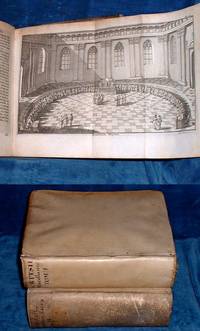
1692V70980Utrecht: Francis Halman Halman & William vande Water BOTH 1st First editions 1692 1700. Hardcover. Good. Frontis of Hebrews with background of sea monsters and emblematic Christ spouting fire with 7 candles by G. Hoet/J. Mulder. Woodcut printers mark to 1st TP & copperplate of a different printer's mark to 2nd TP 5 folding plates one with flap to be lifted. Two Volumes quarto laced through full vellum not quite uniform bindings spine darkened to second volume/tips worn. All edges sprinkled red and both stamped Ambrose Swasey Library to lower fore-edge. Frontis Titlepage with emblematic woodcut printer's mark 24pp Dedication & to Reader 859pp 49pp index Volume 2 titlepage in red and black with copperplate printer's mark 14pp dedication & contents folding portrait if Wits 951pp 56pp indices. There are 11 blindstamps of the Crozier Theological Seminary to each volume none on printed area except that on frontispiece which encroaches on the imprint below illustration. Plates are of building of the Tabernacle includes a neat flap engraved as a curtain that can be lifted to see the inner sactum. Entirely clean though a few pages are minimally more tanned as paper quality varied. Deals with various more esoteric theology such as prophesy revelations ecstacies Beasts of Daniel IV Jewish rites and customs some 60 pages about America etc by this noted Dutch theologian. Text in Latin with Greek and Hebrew. Shoulder notes printed through out and a few large floriated head- and tailpieces. Clean and crisp. Francis Halman + Halman & William vande Water BOTH 1st First editions hardcover