15 963 résultats
201317122Paris, Editions alsatia , 1946 ; in-8, 176 pp., br. Page non coupé.
202600513Paris, De borée , 2010 ; in-8, 392 pp., br.
Catalogue de l'exposition présentée en 1991 aux Musées royaux d'art et d'histoire de Bruxelles: 166 pièces - objets en or, mais aussi en bois, bronze, terre cuite, cuir, tissu - avec notices, commentaires, dessins et photos couleurs, avec textes en alternance sur les civilisations des différents peuples, de la civilisation de Maïkop (3è millénaire avant J.-C.) à celle des Sarmates (IIè siècle avant J.-C.- IIè siècle après J.-C.); préface, introduction et texte sur l' "Histoire de la civilisation des Scythes de la région du nord de la mer Noire" de Boris PIOTROVSKY, directeur du Musée de l'Ermitage; morceaux choisis d'HERODOTE à propos des Scythes in fine; cartes; bibliographie. Français
Catalogue de l'exposition présentée en 1994 à l'Arsenal de Metz par le Conseil général de la Moselle sur le travail, l'utilisation et la mythologie de l'or, symbole divin, des civilisations précolombiennes du Pérou, de l'Equateur et de la Colombie; sous la direction de Daniel LEVINE, du département Amérique du Musée de l'Homme; cartes, nombreuses photos couleurs, croquis techniques en noir; bibliographie. Exemplaire bien complet de sa jaquette. Français
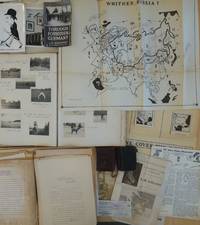
1950List2425Europe and California 1950. Includes two small diaries from 1901 and 1917 with sporadic entries a large photo album measuring 14 x 11 with appx. 400 small photographs from 1906-1909 attached to album pages most measuring 3 x 2 as well as a few larger format images laid in. With 100 plus pages of typed pages including retained correspondence story ideas and various other manuscripts. With eleven maps produced for his “Of Men and Maps†series including five copies of a large map entitled “Whither Russia†in varied states and in large sizes up to 30 by 36 inches and a handful of small ephemeral pieces. Generally near fine condition with the exception of the album which is missing its rear board and has some pages loose and torn. Very Good. J.M. de Beaufort a war correspondent for the London Daily Telegraph and New York American during World War I recounted his wartime adventures in the 1917 book "Behind the German Veil: A Record of a Journalistic War Pilgrimage." Originally arriving in Chicago in 1909 he married a steel magnate's daughter and pursued a career in show business. However by 1912 he had gone through a divorce and transitioned to newspaper work earning the moniker of the "Dude Reporter." Originally born in the Netherlands as Jacques Albert Uilenbroek he was thought to be a deserter. He spent the latter part of his life in the United States apparently jailed in San Francisco for a stint in the 1920s and eventually settled in Los Angeles. <br /> Offered here is an interesting smattering of material from the life of the mysterious De Beaufort which bookends his most unusual career and life with a large visual photographic record of his life in Europe as a young man and over a hundred pages of manuscript material from late in his life with a highlight being several maps in draft form for an apparently unpublished project called “Of Men and Maps.†As a group the material shows the work of an ex-con artist and war correspondent trying to regain his form while living in Los Angeles. He was still writing as a “Special Correspondent†at this point though the title seems to have been fully honorary. Also included are two small pocket journals with sporadic notations from his life in Europe in 1900 and in 1917. In its entirety the group gives an interesting visual and manuscript record of a literary fraudulent and imaginative transatlantic life and intellect. <br /> The cartographic highlight of the group is several iterations of a large map called “Whither Russia†in varied forms which show an interesting interpretation of the sphere of influence of the USSR and its growth from 1939 to 1946. Also included are two drafts of a map of Operation Market-Garden in the Netherlands in 1944 an unidentifed tactical map of a military battlefield a map called “Middle East Jackpot†showing the division of territory between the Allied and Axis powers a map called “Dawn’s Early Light some reproduced small format maps from the De Beaufort’s and a small map called “Gifts from Yalta.†De Beaufort was working on these maps for a column called “Of Men Maps and Memories†that was published in the East Los Angeles Tribune. He also sent the columns out in newsletter form from his address at 1635 N. Ogden Drive in Los Angeles. <br /> The collection of manuscripts drafts and retained correspondence tackle a range of subjects perhaps most interestingly those detailing De Beaufort’s creative process - drafts of stories lists of ideas for stories and letters. His over the top style is on display in a lot of the writings some of which are of unknown origin and purpose. The documents contain correspondence between De Beaufort and Edwin Pauley the oil man and presidential advisor. In one untitled essay he asks himself the question “What has been your most thrilling experience†and his reply is “ Silly questions. Who or at least what newspaperman of some 25 turbulent years standing - and falling - could answer such a question. A reporter’s life has a thousand thrills. There was that rainy day in Marcy 1915 in the fortress of Loetzen when I stood face to face with Hindenburg. Hm yes that was quite a thrill…†De Beaufort was entrenched in the Los Angeles journalistic scene at this point and the documents show the degree to which he relied on his former glories to attempt various career revitalizations endeavors. <br /> The album of photographs from 1906-1909 over 400 in total give a visual record of the young Uilenbroek’s life in Europe. The star of the collection is his bulldog Bob who travels throughout Europe with him and eventually comes to America by 1907. Mary who we presume to be his future wife is featured heavily in the images. It is unclear whether he was working at this point the images show affluent young people and their dog in varied cities and are purely of a personal nature. Other photographs laid in are relics from his war correspondent period. The loose photographs and ephemera are a mix of portraits from different periods from his life including two pictures of Sydney Turing Barlow Lawson one signed by his widow. The journals are sporadically filled and hard to decipher though one legible passage says “drinking all day.â€<br /> Overall the group gives evidence of this intriguing life and is the only extant group of material relating to Beaufort to our knowledge with the exception of a single journal from his time in Belgium during WWI that was sold at Bonhams and is still available in the trade as of this writing. unknown
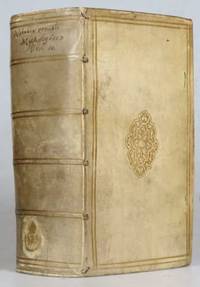
159650569Francofurti Frankfurt: Apud Andreæ Wecheli heredes heirs of Andreas Wechelus Claudium Marnium & Ioan. Aubrium 1596. 8vo. 16 1137 54 1138-1193 1 pp. Early full vellum with yapp edges lacking ties spine with gilt ruled bands contemporary hand written title to upper panel a gilt device with the motto "Rinasce piu Gloriosa" to the foot of the spine decorative gilt centrepieces and double gilt ruled borders to the boards 18th century armorial bookplate "Sinclair" - "Fide Sed Pugna" to the front pastedown an earlier inscription to the head of the front free endpaper. Leaf O4 pp. 215-6 with some marginal loss mostly mild dampstaining at intervals some soiling and light wear to the vellum but a decent copy overall. First published in Venice in 1567 the work came to be known as one of the standard Renaissance works on the study of classical mythology. It went through a number of editions in the late 16th and early 17th centuries with additions to the original text being incorporated in the 1580s. Francofurti [Frankfurt]: Apud Andreæ Wecheli heredes [heirs of Andreas Wechelus], Claudium Marnium & Ioan. Aubrium unknown
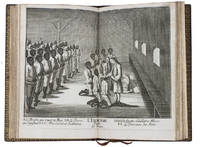
1758H6IG81I49TLCSaxony 1758. 8vo. Brown morocco Lyon ca. 1900 with gold-tooled turn-ins marbled end-papers headbands and ribbon marker in green red and yellow gilt edges signed by Louis GUÉTANT. With title-page printed in red and black and 16 numbered double-page engraved plates. 87 pp. First edition in French published one year after the first German edition of the first work attributed to David Cranz missionary in the Moravian United Brethren best known for his 1765 description of Greenland. The present work gives a history of the United Brethren their beliefs and their practices both in Europe and in their missions in America. The church was established in 1457 but the book concentrates on its history since its establishment in Herrnhut Saxony near the Moravian border under Count Nikolaus Ludwig von Zinzendorf in 1722. Under his guidance the church set up their mission in Greenland in 1733 and a 1747 act of Parliament under George II granted them permission to practice their religion freely in the British colonies in America. The illustrations show ordination induction baptism communion marriage exorcism an agape feast and other activities in the Moravian Church as well as their missionary work among black slaves in the West Indies 2 plates American Indians probably in Pennsylvania and native Greenlanders.With the gold-stamped leather armorial bookplate of Noé de Salvert. In very good condition with occasion light marginal foxing. The beautiful binding by the deluxe binder Louis Guétant active in Lyon ca. 1895-ca. 1920 is in fine condition with only a couple scratches on the back cover. A rare and important primary source for the Moravian United Brethren with remarkable plates of Greenland Eskimos American Indians and black West Indian slaves.l Brunet I col. 1258; James Ford Bell B-426; Sabin 7935 see also 97851 & note before 97846; KVK 3 copies; BN-OPALE plus 2 copies; Kirchenlexikon XVI cols. 324-336; not in Arctic Bibliography; Barbier; Church; Eberstadt; JCB; Quérard; Streeter. ABE CAT Alaska Canada & Greenland hardcover
1712000749London: W. Taylor 1712. 16 416pp. Full contemporary panelled calf later rebacked and recornered in a lighter toned leather raised bands spine in six panels new endpapers. Small gouge to front board with some loss to leather. Endpapers have later nineteenth century inscriptions small tear to fore-edge of ffep internally browned foxed and occasionally stained not affecting sense with old marginalia in pencil to many pages. "A translation of La Guerre dEspagne which is largely fictitious; generally attributed to Gatien Courtilz de Sandras but also attributed by some authorities to Gabriel Alphonse de Sassenage" Estc. Estc T171988 showing only National Library of Scotland and New York Public Library with this edition. Second Edition. Full Calf. Good. 8vo. W. Taylor Hardcover
1989LFA-126746827Une revue de 98 pages, format 215 x 285 mm, illustrée, brochée couverture couleurs, bon état
141328 Leigh St Burton Crescent London1 Dec. no year. Two pages 12mo bifolium tipped on to larger piece of paper substantial good condition. "My dear Sir.- I have alled on you twice . Mr Roscoe tells me that it is decided by you Mr Campbell & Mr Colburn that Mr Galiano see Note 2 below should write an Article for the New Monthly - on the subject of Spanish romance - taking as a text my romances - Of course this is highly desirable & I have no doubt Mr Galiano would do justice to the subject which I think will be interesting - But as I have already spoken to Mr Galiano about the other article - I think the communication would come with a better grace from you & Mr Roscoe - as I was unsuccessful in the first negotiation & besides as my 'Castilian' a work of his is to be noticed in the same article that the propposal should come from a third person. Will you write me a word or appoint a meeting - Is the article to be for this or for the next month - because if it is the first case there's no time to be lost."WITH: two copies of the cartoon of Trueba y Cosio that appeared in Maclise's "Gallery of Literary Characters" in "Fraser's Magazine" as "The Author of 'The Exquisites' a farce published in 1832 by Bentley with a copy of the accompanying letterpress in which it is claimed he is English not Spanish and his work e.g. "The Exquisites or a new portraiture of exclusive society" slated.Notes:1. He contributed to the autobiographical collection "Our Exile in England: autobiographical sketches of Spanish Refugees" in the "New Monthly Magazine" vol.44.44-49 May 1835 and "The Spanish Novelists" in the "Foreign Quarterly Review" vol.2:486-511 June 1828; 2. Antonio Galiano "Born June 22 1789 in Cadiz; died Apr. 11 1865 in Madrid. Spanish political figure; participant in the military uprising of R. Riego y Núñez which led to the reestablishment of the constitutional structure in Spain 1820. During the revolution of 1820–23 Alcalá Galiano was one of the prominent leaders of the Exaltados. Between 1822 and 1823 he served as deputy in the Cortes. He opposed the Comuneros—the leftmost wing in the Spanish revolution. After the defeat of the revolution Alcalá Galiano emigrated to England returning after the amnesty of 1834. He joined the moderate party the Moderados. In 1834 he served as minister of the navy and in 1865 as minister of the economy." In fact in collaboration with Sir John Bowring he wrote an article on "Spanish Novels" published in the "Westminster Review" vol. 6.278-303 October 1826 - does this suggest an approximate date for this letter. 8 Leigh St, Burton Crescent, [London]1 Dec. (no year) unknown
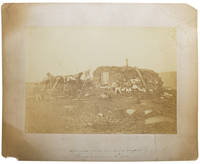
1872303445London 1872. Albumen print measuring 11-5/8 x 16-1/4 in 295 x 412 mm. Laid down on thick cream card with manuscript caption measuring 17 x 21 in. Image slightly faded card chipped with some minor soiling one tear not affecting image. Albumen print measuring 11-5/8 x 16-1/4 in 295 x 412 mm. A rare survival. This image appears in William Bradford's fabled book of photographs Arctic Regions. It was taken by either Dunmore or Critcherson the two professional photographers from Boston who accompanied Bradford on his 1869 expedition to the Arctic on the steamship Panther. It was probably taken at Upernavik a settlement on an island off Greenland's west coast or Godhavn.<br /> <br /> Arctic Regions included 141 albumen prints in addition to Bradford's account of the voyage. The title of the photograph here varies from the printed caption in the book where it reads: "Plate Number: 116 Esquimaux igloe or winter hut made of turf and stones. The entrance is to the left through a door which is about three and a half feet high. The length of the passage is about twelve or fifteen feet and at the farther end is another door through which one almost has to crawl on his hands and knees. After passing through there is then room to stand erect but one is forced to leave very soon owing to the bad air." <br /> <br /> This photograph is slightly larger than the one in the book which is 277 x 365mm. Furthermore the image in the book is cropped closer on the right and left margins. <br /> <br /> The New York Public Library has a folio of 26 images of near identicle size mounted on card. The portfolio was donated to the library in 1892 as part of the Robert Stuart Collection. According to Horch originally all of these images were captioned in manuscript though were later remounted with typed captions as "the original ink-written captions for the photographs had badly faded by 1940." It's interesting that the caption on their duplicate of this image is the same as ours and the image itself has not been cropped. Horch writes that Bradford probably not only selected these images himself but "closely directed the actual taking of the photographs." <br /> <br /> It's entirely likely that Bradford would have had extra prints made to distribute to friends repay favors and most of all to solicit subscribers to what was a very expensive book to publish. Given how it conforms to the examples in the Robert Stuart portfolio this particular image is probably one of them. Horch Frank. "Photographs and Paintings by William Bradford". American Art Journal 5.2 1973: pp 61-70; cf Parr and Badger I p31Prm/photo unknown
18563459n.p.: n.p. 1856. Hardcover. Fair. This quarto-sized scrapbook in green cloth over boards was manufactured c. 1850 by Eayrs & Fairbanks No. 133 Washington St. Boston. It is about half full of contemporary news clippings affixed with paste. The scrapbooker did not comment on them with the exception of one instruction to "See the loose piece."The first 40 pages are from 1856-1857. The majority of articles deal with slavery especially political events in the Kansas Territory "Bleeding Kansas" the Dred Scott Case and President James Buchanan. The first clipping is from Feb. 9 1856 and details a pro-slavery meeting in Missouri addressed by David Atchison. The last clipping in this section is from April 24 1857 and reports on Stanton's speech at Lawrence Kansas.After a break of three blank pages the scrapbook resumes with news of Reconstruction from June 30 1868. There are 6 more pages of eclectica: political news clippings interspersed with a poem by Whittier and advice on How to Keep the Feet Dry.While the scrapbook is unsigned it can be tentatively identified with the Orton family since the last page contains an 1868 20th reunion announcement from the Hamilton College class of 1848 along with 1868 clippings from southwestern Ohio newspapers including the Springfield Ohio Republic. The only surviving member of that class residing near the Dayton-Springfield area is Prof. Edward Orton Sr. Yellow Springs OH where he was president of Antioch College. The 1850s clippings come mostly from New York newspapers particularly the Tribune and the Orton family was living in Chester Orange County NY at that time.Orton went on to become the first President of the Ohio State University from 1873 to 1881.The scrapbook is in fair condition; the pages and paper have held up remarkably well. However the spine is mostly detached and the binding is weak at several signatures. 003477 n.p. hardcover
5002No date mid-to late Nineteenth-Century. Four pages folio chipped with small loss of text. IN FRENCH. He begins: "Les nombreuses experiences que j'ai fait sur la lumiere electriquee l'appareil que j'ai confectionne me mettant en meme de pouvoir l'appliquer a l'eclairage des villes avec avantage et economie sur tout autre systeme". He discusses the expense of gas and gives a precis of his plan "L'agende" giving letters which correspond to a "dessin" which is not present and listing his points with a little detail: un ballon de gaz; filet ensoie; cordes en soie; Lampe electrique . . .; deux cabines; contre poids; deux meches en charbon lengthy description; un reflection en coupe parabolique; conducteur en Rubans de cuire; Etablissement au centre d'une ville d'ou eleverait sous les soirs le ball; fourneau; laboratoire; piles en fonction; poulie a tour mort. He mentions "difficultes meteorologique" in some detail accidents caused by electrical phenomenon. "Je liens du Sieur Lasseigne . . . qui a fait plus de cinq cent ascensions en ballon . . . ." In the final paragraph he says: Je travaille a une regulation qui fonctionant avec un tres petit nombre des elements me permettait d'appliquer la lumiere electrique a l'eclairage des magasins et des coins de rue j'en dormerai la description . . .Signed Charles Dubos. " Note: a Charles Dubos received an award for improvements to electrical lighting 1878 and invented something to improve the bicycle in 1868 see Net. This may give some idea of when he was operating - and how much of a pioneer he was in street- and domestic lighting at least in theory. IMage on request. No date (mid-to late Nineteenth-Century). unknown
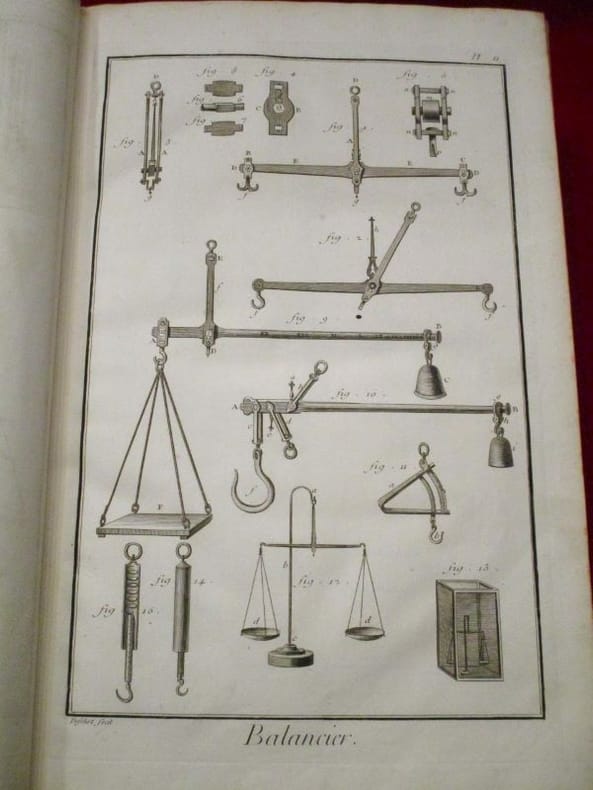
1763116905briasson david le breton durand 1763 in-folio A Paris, chez Briasson, David, Le Breton, Durand, 1763, 1 volume grand in-folio de 260x410 mm environ, complet des 233 planches et du texte explicatif. Pleine reliure d'époque, dos à six nerfs portant titres et tomaisons dorés, caissons ornés, encadrement des plats à froid, coupes filetées, tranches rouges, gardes de papier marbré à la coquille. Reliure en mauvais état mais exemplaire solide et intérieur frais : coiffes absentes, mors fendus, importantes épidermures.
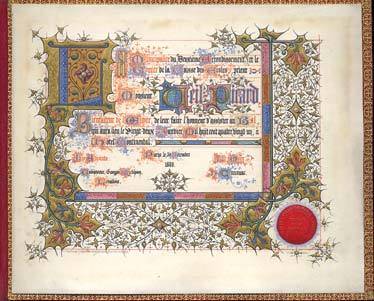
18811235Un feuillet de vélin richement enluminé, cachet de cire rouge " Mairie de la Bourse " sous chemise en plein chagrin bordeaux, " A Monsieur Veil Picard " à froid, roulette dorée d’encadrement sur les plats intérieurs.
Granada, s.a. (hacia 1750) [y] Madrid, s.a. (hacia 1760). Dos documentos en folio; 49 hojas foliadas, firmadas por los Licenciados Don Joseph Cayetano de Lindoso y Don Manuel de Meruelo + 103 pp. numeradas, firmadas por el Licenciado Don Diego de la Fuente y Vargas. Cubiertas mudas en cartulina.
Manuscrito en clara caligrafía de primer tercio del siglo XVIII. Folio; 2 hojas manuscritas por ambas caras, precedidas de una portadilla en la que aparece, tambien manuscrito, un aviso que reza: "Ojo a las razones que refiere para prettender que estte tributo no se deve pagar, por estar transigido con su Santidad, y consttar de bulas de Sumos Pontifices". Cubiertas mudas en cartulina.
Zaragoza, 1990. 4to.; 48 pp., 1 h., con 36 reproducciones de portadas y grabados, entre el texto. Cubiertas originales.
1924027454Boston / New York: Houghton Mifflin / Pelican Press 1924. First Edition Thus 1st Printing. Soft cover. Fine. Two Copies #210 And #211 Finely Printed In England At The Pelican Press Each Bound In Different Batik Paper Covers Signed By Postgate. Each Copy In Its Original Card Slipcase And All Enclosed In A Box Half Morocco Five Bands With Gilt Title At Top And "Pelican Press 1924" At Bottom. Both Copies Are Fine Slipcases Near Fine With Short Tears At Center Of Open Ends Clamshell Box Near Fine With A Little Rubbing To The Rear Cloth-Covered Corners. <br/> <br/> Houghton Mifflin / Pelican Press paperback
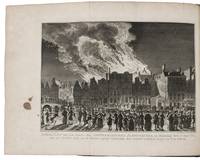
17723909Amsterdam: Gerrit Warnars and Petrus den Hengst 1772. Contemporary marbled calf gold-tooled spine and board edges red sprinkled edges. 4to. With an engraved frontispiece a small engraved illustration by Noach van der Meer II on both title-pages 4 folding engraved plates of the old theatre; 5 folding engraved plates of the new theatre all engraved by the publishers after designs by Van der Meer and 1 by Simon Fokke. 2 works in 1 volume. Large-paper copies of the first editions of two works on the schouwburg theatre of Amsterdam the first on the old theatre which burned down in 1772 and the second on the new theatre which was built on the Leidseplein and finished in 1775. The large engraved plates show the exterior of the new theatre together with the surrounding buildings and with people on the foreground and the interior of both the theatres the balconies and stages. Two plates depict the old theatre going up in flames and another plate shows the ruins. The text gives a history of both the theatres including a description of the building process the restorations and renovations the staff the stage equipment lightning decor hoist tools costumes etc. and also including a vivid description of the fire. The first work is often ascribed to Jan Fokke but both works are also frequently ascribed to Myndert de Boer who wrote the long poems in both works.With bookplates. Binding rubbed along the extremities slightly worn at the head and foot of the spine. The plate of the external fire with a large tear some occasional spots and stains but otherwise in very good condition.l Van Aken III p. 65 & 70; Muller Historieplaten 4253a & 4283a; cf. Sluijter-Seijffert "De Amsterdamse schouwburg van 1774" in: Oud Holland XC 1 1976 pp. 21-64. Gerrit Warnars and Petrus den Hengst, unknown
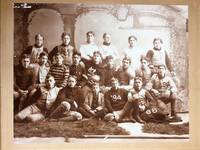
189433580np 1894. Framed photograph 10-1/2" x 13-1/2" matted behind glass within ornate gilt frame 21" x 23-1/2". Light wear to surface of photograph. Matting has some spotting. Some wear to frame and small chip to frame edge. Else Very Good. <br /> <br /> The squad is dressed in various football uniforms including laced smock vests over long sleeved shirts caped sweaters and knee length pants. Each of the two young men wearing military style uniforms has a small billed cap. unknown
1994LFA016deN° 183 - Mai 1994 : une revue de 182 pages, format 270 x 215 mm, illustrée, brochée
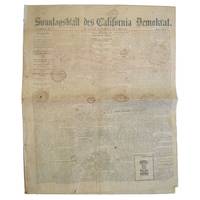
18982144San Francisco: Cal. Demokrat Publishing Co. 1898. Fair. 21-1/2 x 17-1/4 inches. 8pp. Tabloid format newspaper printed in seven columns per page. Occasional b&w illustrations. Text in German. In fair condition only with significant soiling and large light stains somewhat affecting readability; numerous small holes to first two leaves most pinhole-sized or slightly bigger a few as large as pea-sized all sporadically affecting text; several short tears to edges and last leaf; old folds. A scarce issue of this influential German-language daily which ran from 1852-1918. The front page devotes considerable space to coverage of the looming Spanish-American War which is here termed "unvermeidlich" inevitable. The increasingly ominous preparations of the two countries since the sinking of the USS Maine are described at length as well as England and various European countries beginning to choose sides. Also included in this issue is content about Japan's imperial ambitions in China viewed here as in a positive light given the potential for spreading Christianity to China news about the Klondike Gold Rush various events occuring on the Pacific Coast and more as well as advertisements in both English and German.Not located in OCLC although several institutions hold other issues of this paper and its earlier iteration the California Chronik. Cal. Demokrat Publishing Co. unknown
1956102703Paris, Société des Africanistes, Musée de l’Homme 1956 In-4 28,5 x 19,5 cm. Broché, couverture ivoire, report du titre en noir sur le dos et le premier plat, 173 pp., 6 cartes, 3 planches, 1 tableau hors-texte, table bibliographique. Couverture ternie, intérieur frais.
17161469Haarlem: Weduwe van Hermanus van Hulkenroy 1716. Early 19th-century marbled boards with a paper title label on the spine. 4to. With an etched frontispiece an etching of a mermaid on the title 2 folding etchings 2 full-page etchings and 21 etchings in the text all after Adriaen van Ostade. Further with musical annotation to all songs. First edition of a rare Dutch songbook with songs for farmer's festivals all with musical annotation. The work has been beautifully illustrated with etchings after the famous Dutch painter of country life Adriaen van Ostade 1610-1685. The fine etchings newly made and in reverse present an exemplary survey of Van Ostade's work showing busts of peasants women on their way to the market carrying baskets farmers smoking merry parties dancing in front of the farm a knife-grinder a schoolmaster etc. Together they give a lively impression of country life.The work was published anonymously but has been attributed to either Jan van Gijsen 1668-1722 or Aäron van Hulkenroy 1687-1733. Van Gijsen was a popular author who wrote a large number of occasional poems. His collected works were published at Amsterdam in three volumes in 1707-1711 but the present selection was probably published only once partly with the address of the Widow of Van Hulkenroy and partly with the address of J. van Egmont who had also published the collected works. Aäron van Hulkenroy was the son of publisher Hermanus van Hulkenroy and took over the publishing company after both his parents had passed. He was also a poet who wrote various poetry collections which were always published by his mother or later himself. The present work has been attributed to him because the very first poem on the verso of the half title is signed with his initials.The boards and spine are rubbed with some loss of material at the lower outer corner of the front board. The leaves and plates are somewhat foxed a small tear in the margin of first folding plate has been repaired on the back. Otherwise in good condition.l Goovaerts 1011; Cat. Muziekhist. Museum Scheurleer II p. 92; Scheepers I 284 "Hoogst zeldzaam"; Scheurleer Liedboeken 199 lists both 1716-issues; STCN 154032301; cf. Hollstein XV pp. 1-70 for the etchings; NNBW 8 col. 648 Gijsen and NNBW 4 col. 790 Hulkenroy; not in Arents Tobacco. Weduwe van Hermanus van Hulkenroy, hardcover