164 résultats
1793H3339Madrid: En La Imprenta Real 1793. First printing. Hardcover. Very Good. First edition 1793 original flame calf deep red spine label very good copy 8 290 3 pp. In three parts the first lessons for children on their obligations when they are grown to their king and lord the second addressed to priests and the third part addressed to Pius VI regarding the revolution in France and what it portends. The author was a well known priest orator and educator on very good terms with Spanish royalty who rewarded him by making him a bishop with his base in Rio de la Plata Argentina but also with bishoprics in Cordoba and Catamarca Bolivia. This book would have been part of his efforts to educate South American children on their duties to Spain one of his chief goals. En La Imprenta Real hardcover
1703B7089Paris: Chez Simon Langlois c 1703. near fine with text clean and crisp. . Edition: First Edition. Binding: Contemporary full paper boards expertly rebacked; raised spine with five 5 bands black ink title on vellum label on two; central black fleur de lis design on four. Notes: Provenance: Upper pasted endpaper with owner’s armorial bookplate: “Watkin Williams Esq of Penbedw // in the County of Denbighâ€. Concerning this name Archaeologia Cambrensis states: “1789. Watkin Williams Esq. of Penbedw in the county of Denbigh but owner of property in the parishes of Mallwyd and Llan-y-mowddwy in the county of Merioneth M.P. first for Montgomeryshire and afterwards during nearly thirty years for the Flint contributary boroughs was appointed lieutenant and custos rotulorum for Merionethshire.†Final free endpaper watermarked. <br>This edition of this Canadiana publication is unique in that we are not able to locate another copy of the same anywhere. The second last paragraph of the introduction to the priests clergy and missionaries in this edition states that this publication encloses at the end of the first part or 'Rituel' a second part entitled 'les Statuts Ordonnances & Mandemens.' instructions prepared at various times by the Church for the conduct of all including those entrusted to the clergy that these instructions may not be ignored. The recipient are advised that they are restatements of instructions previously given to be read often just as such given in the Ritual itself; they are to be followed with precisions including all the rules contained not to be lost sight of observed faithfully in all works and ones conduct. The inclusion of this paragraph is unlike the introduction of another edition published at the same time and same location but not including this paragraph or the 'Statuts.'. <br>The present work describing festivals sacraments statutes and ordinances for the use by priests in Quebec is extremely rare and was immediately followed by a second edition published the same year: Gagnon reports that in a copy of the second edition of 1703 now at the Laval University library and previously owned by Abbé Plante a note says that the first edition “would have been almost completely destroyed by the sinking of the ship …carrying it to Canada and for this reason a second edition was immediately made.†<br>On the “privilege†included as the final leaf in our first edition example it is stated that the work was registered on March 30 1703 and completed for print for the first time on March 31 1703; <br><br>Saint-Valier was a supporter of the Counter Reformation. His initial intent in the New World was to engage in the conversion of the indigenous residents. He introduced Jesuits and Recollects in an attempt to evangelize New France. Many of these missions Illinois Louisiana and Mississippi resulted in conflicts between Bishop Saint-Vallier the Jesuits and the seminary of Quebec.<br><br>His various construction projects reflect a desire to restore and renew the authority in the Catholic Church as the main institution of administrative organization. In 1697 Saint-Valier built a palace in Quebec for his clergy and as a place of hospitality. During the same year he also established a nuns monastery in Trois-Rivières Saint-Vallier’s zeal for religious activities and establishments stretched from Quebec Montreal Acadia and Louisiana. His way of life embodied that of the ideals of the Council of Trent.<br><br>The Diocese of Quebec was vast and its population diverse and widespread. It included the whole of French North America or what was called New France divided in seven colonies: Newfoundland Acadia ÃŽle Royale Louisiana Illinois Upper Country and Canada inhabited by Indigenous people and the European settlers. During the tenure of Saint-Vallier immigration from France was mostly over; the European colonists were farmers fishermen sailors merchants and ‘coureurs des bois’ overseen by a small elite of aristocratic leaders but a great demographic explosion occurred between 1685 and 1730 the white population in New France jumping from c. 12000 inhabitants to c. 41500.<br><br>During the same time the number of Amerindian fell from c. 163500 to c. 61500. That loss mainly in the tribes of Louisiana was attributed to warfare and diseases brought to the valley of the Mississippi. The number of Aboriginals compared to white settlers is one reason for the presence of so many religious orders in New France. The missions and conversions to Christianity were deemed very important.<br><br>Priests of the Missions Étrangères of Paris the Jesuits the Recollets and the Sulpicians often worked in collaboration with the nuns from different orders like the Congrégation de Notre-Dame or the Canonesses of St. Augustine of the Mercy of Jesus at l’Hôtel-Dieu de Québec. The arrival of Saint-Vallier and his strong views on what should be the duties of the priests created a shock wave in the orders especially for the Seminary of Quebec newly founded by his predecessor Bishop Laval. … Saint-Vallier's tenure as bishop was defined by interminable quarrels with governmental and religious institutions in French North America. … his active leadership style brought him into conflict with various groups who perceived him as at times domineering and micromanaging.<br>While subject to much criticism Saint-Vallier was also admired in his diocese for his dedication and self-sacrifice. Rather than staying in Quebec or Montreal he tirelessly traveled the back-country. The founding of the Hôpital Général and installation of Jesuits and Recollets at Montreal were also to his credit.<br><br>There was a very strong suspicion in the colonies and in France that the Bishop of Quebec was in fact a follower of Jansenism. . In the beginning of the 18th century the Bishop wrote 3 books; the Ritual the Catechism and the ‘Statuts et ordonnances’ – two of which are bound in the present volume. <br>…the Superior of the jesuite order decided to attack Saint-Vallier’s authority by writing a long critic of those three books seeing them as a "lapse into Arianism Pelagianism Jansenism Lutheranism and Calvinism". Father Bouvart based his accusations on different passages of the works of the Bishop … who eventually appealed to the Sorbonne to have his works rehabilitated. The doctors of the Faculty of Theology declared the Ritual and the Catechism perfectly orthodox and censured the critic of Bouvart. Nevertheless Saint-Vallier decided to re-edit in 1713 the Ritual so as to cast away all doubts about his pretended Jansenist ideas. This book remained in use in the parishes until the middle of the 19th century. The present work is the unedited original and first edition of his ritual and statuts. <br><br>The disputes with the religious orders of New France the government and the merchants gave way to a more peaceful period that lasted until his death. Austere throughout his life he became more and more humble in his way of living and turned toward contemplation and simple duties. .He also took very seriously his duties of Bishop and developed parishes in the farthest corners of the diocese.<br><br> Size: Octavo 213 x133mm. Illustration: Text in French; with some text in Latin<br>Achevé d'imprimer pour la premiere fois ce 31 mars 1703. Relié avec le Rituel du même. <br><br>Illustrated with two printer's devices representing the arms of the archdiocese of Quebec; various head and tail pieces incl. vignettes; in-text music notes on Qiiii-Si; Ggii-iiii. References: Philéas Gagnon: Essai de bibliographie canadienne: Inventaire d'une bibliothèque . Volume 1: 3138 & 3139 p.437; Archaeologia Cambrensis Volume 1 p.142. Pages: Ff. 2 bl. ill. title bl. author to priests on the use of the book 4 Fetes Observe’es 4 604 table 2 errata 3 bl.; ill. title bl. letter 3 8-146 table 2 privilege 2 bl.2; In leaf collation: bl. v A-Z8 Aa-Nn8 Oo-Rr4 iiiff. table; a1 a3-a8 e8 i8 o8 u8 aa8 ee8 ii2 oo8 uu8 aaa1 ii bl. Category: Book Canada; Book Religious Christianity; Chez Simon Langlois, hardcover
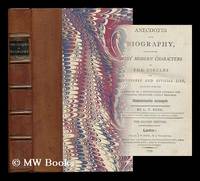
1799181979London : Printed by J.W. Myers No. 2 Paternoster-row for Crosby and Letterman Stationer's-Court near PaterNoster-Row; and R. Pitkeathley Tavistock-Street 1799. Second Edition. Hardback. Finely bound in modern aniline calf over marble boards. Raised bands with the original gilt-blocked leather label laid-back. An exceptional copy - scans and additional bibliographic detail on request.; 8vo 8"" - 9"" tall; 461 pages; Physical desc.: xvi4611p. ; 8°. Notes: A reissue of the first edition with a cancel titlepage. With a half-title. ESTC citation no.: T95919. Subject: Anecdotes - Early works to 1800. Biography - Early works to 1800. London : Printed by J.W. Myers, No. 2, Paternoster-row, for Crosby and Letterman, Stationer's-Court, near PaterNoster-Row; and R hardcover
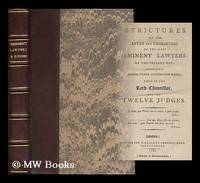
1790194448London: Printed for G. Kearsley 1790. First Edition. Hardback. Closed tear to the title. Finely and period sympathetically bound in modern aniline calf over marble boards. Raised bands with gilt cross-bands and the title blocked direct in gilt. An uncommonly good example; of presentation quality - scans and additional bibliographic detail on request.; 8vo 8"" - 9"" tall; 232 pages; Physical description; xv1232p. ; 8°. Notes; Anonymous. By Leman Thomas Rede the elder. Referenced by: English Short Title Catalog ESTCT100328. Subjects; Judges - Great Britain. Lawyers - Great Britain. London: Printed for G. Kearsley hardcover
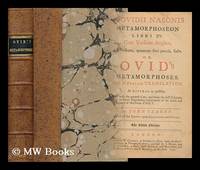
1732B5857Amsterdam: Rudolf & Jacob Wetstein and G. Smith c.1732. 3 ff. unnumbered and fully engraved with 6 half page illustrations do according to Brunet account for pp. 265-270. Repaired marginal tear to title to Tome 2 repaired corner tear to 327/8; overall a near fine example of this finely illustrated work with text and plates clean and crisp. . Edition: First Edition Binding: Contemporary decorative calf; expertly rebacked; boards with central gilt medallions; spine with five 5 raised bands flanked by horizontal gilt fillet and decorative rolls with gilt designed corners and centres in compartments and gilt lettered title on morocco label on two; all edges red. Notes: Publius Ovidius Naso or Ovid 43 BC – AD 17/18 was a Roman poet who lived during the reign of Augustus. A contemporary of Virgil and Horace he is often ranked one of the three canonical poets of Latin literature and enjoyed enormous popularity. Augustus sent him into exile where he died. Today he is best known for his Metamorphoses a 15-book continuous mythological narrative written in the meter of epic and for works in elegiac couplets such as Ars Amatoria "The Art of Love" and Fasti. His poetry was much imitated during Late Antiquity and the Middle Ages and greatly influenced Western art and literature. The Metamorphoses remains one of the most important sources of classical mythology. <br>The Metamorphoses Ovid's most ambitious work was written in dactylic hexameter about transformations in Greek and Roman mythology set within a loose mytho-historical framework. The characters in this work undergo many different transformations. Within an extent of nearly 12000 verses almost 250 different myths are mentioned; each myth is set outdoors where the mortals are often vulnerable to external influences. The first book describes the formation of the world the ages of man the flood the story of Daphne's rape by Apollo and Io's by Jupiter; the second Phaethon and the love of Jupiter with Callisto and Europa; the third focuses on the mythology of Thebes with the stories of Cadmus Actaeon and Pentheus; the fourth on three pairs of lovers: Pyramus and Thisbe Salmacis and Hermaphroditus and Perseus and Andromeda; the fifth on the song of the Muses which describes the rape of Proserpina; the sixth on the rivalry between gods and mortals beginning with Arachne and ending with Philomela; the seventh on Medea as well as Cephalus and Procris; the eighth on Daedalus' flight the Calydonian boar hunt and the contrast between pious Baucis and Philemon and the wicked Erysichthon; the ninth on Heracles and the incestuous Byblis; the tenth on stories of doomed love such as Orpheus who sings about Hyacinthus as well as Pygmalion Myrrha and Adonis; the eleventh on marriages of Peleus and Thetis and the love of Ceyx and Alcyone; the twelfth moves from myth to history describing the exploits of Achilles the battle of the centaurs and Iphigeneia; the thirteenth discusses the contest over Achilles' arms and Polyphemus; the fourteenth moves to Italy describing the journey of Aeneas Pomona and Vertumnus and Romulus and the final or fifteenth opens with a philosophical lecture by Pythagoras and the deification of Caesar. The end of the poem praises Augustus and expresses Ovid's belief that his poem has earned him immortality.<br>In analyzing the Metamorphoses scholars have focused on Ovid's organization of his vast body of material. Ovid engages creatively with his predecessors alluding creatively to the full spectrum of classical poetry. <br><br>This 1732 first Amsterdam edition is superbly illustrated employing copper plate engravings attributed to the Dutch: Balthasar Bernaerts engraving c.1711–1737; Jacob Folkema 1692–1767; Wouter Jongman engraving c.1712–1744 Joseph Mulder c.1659/60-; Jan Schenk engraving c.1731–1746; Jan Wandelaar 1690–1759 Philip Van Gunst 1685–1732; the Flemish: Martin Bouche c. 1640–1693 Frederic Bouttats c.1610–1675 Peter Paul Bouche c.1646- and the French: Bernard Picart 1673–1733; after the works of the Dutch: Louis Fabritius Dubourg 1693–1775; Godfried Maes 1649-1700; Jan Punt 1711–1779; Jacob De Wit 1695–1754; the French: Charles LeBrun 1619–1690; Sebastien Leclerc 1637–1714; and the Italians: Giulio Romano 1499–1546; and Pietro Testa 1612–1650. <br> Size: folio 455 x300 mm Illustration: Illustrated with allegorical copper engraved frontispiece by Picart and onehundred twenty-nine 129 copper engravings throughout the text by and after illustrious and notable engravers and artists mostly listed under notes. Illustrations also include two 2 red and black ink printed titles each with a large vignette copper engraving; one 1 copper engraved vignette head piece introducing the dedication to the king; numerous in-text decorative wood-cut head and tail pieces and large thematic or ornamental rubricated initials. The French and Latin texts are in two parallel corresponding columns. Volume: Two tomes in one volume Provenance: watermarked on many leafs including on the 1.free endpaper and dedication to tome 1 as well as title to tome 2: “ BEAVUALS†at centre of leaf. 2.title and final page of tome 1: an upside-down design of a fleur de lis 3.lower free endpaper: “C D“ References: Brunet III: 599; Cohen-de Ricci: 768. Transation: Text in Latin with F Pages: Bl. 2 Frontispiece by Picard bl. Tome I: Red and black ink illustrated title bl. dedication 2 preface 6 1-247 bl. with 69 half page copper engravings. Tome 2: Red and black ink vignette illustrated title bl. 249-264 3 ff. of illustrations 271-524 with 60 half page copper engravings table des matieres 4 bl. 2. Category: Book Classics; Book Europe France; Book Plate Books General; Rudolf & Jacob Wetstein and G. Smith, hardcover
1715ZB533523Venetiis: Apud Paulum Belleonium 1715. small quarto 22 cm. tall three volumes in one as issued with continuous pagination; 4 leaves beginning with half title 711 pp. text double column; contemporary vellum darkened and rubbed signature of early owner on title with his marginalia on paste downs hand stamps of modern owner to the top margin of the title page margins cut down but not close internally clean and tight. - If you are reading this this item is actually physically in our stock and ready for shipment once ordered. We are not bookjackers. Buyer is responsible for any additional duties taxes or fees required by recipient's country. Photos available upon request. Venetiis: Apud Paulum Belleonium hardcover
1762B6600Romae: Veneunt apud Auctorem in ædibus Comitis Thomati via Felice prope templum SS. Trinitatis in Monte Pincio; c.1762. Fine thick laid 18th century Italian paper with wide margined paper watermarked engravings; spine and corners worn – A handsome and attractive example plates are clean and crisp. Binding: Contemporary half calf; double gilt fillets bordering marbled boards; spine with five 5 matching gilt fillets on raised bands embossed gilt lettered title on two and four; pasted and free endpapers marbled; all edges marbled. Notes: Text in Latin and Italian.<br>This work was dedicated by Piranesi to one of his highly esteemed co-workers during the 1750’s Robert Adam. Concerning this Rome 1762 edition Luigi Ficacci states: “Edition Rome 1762. Engraved title on the title page: The Campus Martius of Ancient Rome the Work of G. B. Piranesi Fellow of the Royal Society of Antiquaries London. The Latin title page bears the title the date of the edition and the dedication to Robert Adam. The address is: “Veneunt apud Auctorem in aedibus Comitis Thomati via Felice prope Templum SS. Trinitatis in Monte Pincioâ€.<br>The volume is composed of 2 title pages Latin and Italian whose sequence varies according to the copy 2 ornamented letters 4 vignettes 42 plates by Piranesi 5 of these plates are composed of several copperplates and 1 engraved by Vesterhout 68 pages of text in Italian and Latin preceded by 6 pages of dedication to Robert Adam and followed by 29 pages of indices. …<br>The genesis of the work goes back to the second half of the 1750s: its publication is announced as imminent in the first volume of Antichita Romane 1756. The large Plan of Campo Marzio and 6 copperplates “Ichnographia†or plan of the Campus Martius ill. 493 executed in collaboration with Robert Adam and dedicated to him is dated 1757 on the plate. The approbatio is dated 1761. The plate by Vesterhout plate XXXI … reproduces the technical solution adopted by Carlo and Francesco Fontana for restoration of the Column of Antonius Pius in 1705.â€<br><br>Plate XXXI depicting the excavation of the Antonine column in 1705 was signed by both its engraver Arnold Van Westerhout or Vesterhout and by its designer and artist Franciscus Fontana. <br>The second illustrated title or title in Italian reads: 'Il Campo Marzio Dell'Antica Roma'.<br><br><br> Size: Folio 542 x 406mm. Illustration: Copper engravings with illustrated title in Latin illustrated title in Italian two half-page head-piece vignettes opening dedication at a1v-2r; two engraved decorative copper initials opening the text at A1v and A2r; two large end-piece vignettes at R2v and R3r; moreover Tab. I-XLVIII with fifty-two 52 copper engraved plates; these include: a double-page plate numbered XXXII two triple or oversized folding plates numbered II and XXXI; a larger oversized engraving 1500x1500mm encompassing plates V-X forming the plan of the Campus Martius; a single page numbered XLVIII depicting three copper plates entitled “Elevazione de’ Teatri…†“Elevazione del Pantheon…†and “Elevazione dell’ Anfiteatroâ€; single pages two half-page copper plates each - numbered XII entitled “Hypsographia…†and “Sectio…†and XLVI entitled “A Reliquiae…†and “Orthographia…†respectively; the remaining copper plates full or single page sized. Provenance: Upper marginal corner of upper pasted endpaper with sticker reading “C.E.Rappaport // Libri Rari // Romaâ€- References: Luigi Ficacci pp. 394-431; Focillon 1964: 428-479; Hind 1978: 85; Millard iv 2000: 91; RIBA Early Pr. iii 1999: 2551; Wilton-Ely 1994: 559-612. Pages: Ll: Bl. 2 Illustrated title in Latin illustrated title in Italian a1-b2 with dedication A1-Q2 R1-3 with approbation and explanatory texts; a1-c2 with Index ; 1-2 1-3 with catalogues; illustrations: Tab.I-XLVIII; bl. 2. Category: Book Art Architecture & Design; Book Europe Italy; Book Plate Books General; Book Antiquities; Veneunt apud Auctorem in ædibus Comitis Thomati via Felice prope templum SS. Trinitatis in Monte Pincio; hardcover
1770B6607Romae/Rome: Veneunt apud Auctorem in ædibus Comitis Thomati via Felice prope templum SS. Trinitatis in Monte Pincio; watermarks indicate: c.1770’s-1790’s. Plates and text crisp and clean near fine. Thick wide margined paper. Binding: Contemporary half calf with marbled boards; spine with five 5 blind raised bands flanked by gilt tooling; gilt lettered title on Morocco label on two; contemporary pasted and free endpapers; all edges speckled red. Notes: Text in Italian; captions in Latin.<br>This work was dedicated by Piranesi to one of his highly esteemed co-workers during the 1750’s Robert Adam. Concerning the Rome 1762 edition Luigi Ficacci states: “Edition Rome 1762. Engraved title on the title page: The Campus Martius of Ancient Rome the Work of G. B. Piranesi Fellow of the Royal Society of Antiquaries London. The Latin title page bears the title the date of the edition and the dedication to Robert Adam. The address is: “Veneunt apud Auctorem in aedibus Comitis Thomati via Felice prope Templum SS. Trinitatis in Monte Pincioâ€.<br>The genesis of the work goes back to the second half of the 1750s: its publication is announced as imminent in the first volume of Antichita Romane 1756. The large Plan of Campo Marzio and 6 copperplates “Ichnographia†or plan of the Campus Martius ill. 493 executed in collaboration with Robert Adam and dedicated to him is dated 1757 on the plate. The approbatio is dated 1761. The plate by Vesterhout plate XXXI … reproduces the technical solution adopted by Carlo and Francesco Fontana for restoration of the Column of Antonius Pius in 1705.â€<br> Size: Folio 542x406mm. Illustration: Etched copper engravings with illustrated title in Latin illustrated title in Italian ornamental head-piece and engraved decorative copper initial at A1r; the initial opens the text. Tab. I-XLVIII plus three full page engravings entitled “Sepulchrum Mariae Honorij Imp. Uxoris …†“Labrum aegyptiacum porphyreticum…†and Nonnulla monumenta sepulcralia quae recensentur…â€; these 51etchings include double-page plates numbered V-X forming the plan of the Campus Martius and one double page plate # XXXII; two triple or oversized folding plates numbered II and XXXI; a single page numbered XLVIII depicting three copper plates entitled “Elevazione de’ Teatri…†“Elevazione del Pantheon…†and “Elevazione dell’ Anfiteatroâ€; single pages two half-page copper plates each - numbered XII entitled “Hypsographia…†and “Sectio…†and XLVI entitled “A Reliquiae…†and “Orthographia…†respectively; the remaining copper plates are full page in size. Plate XXXI was engraved by Vesterhout after Fontana.<br>Thick wide margined paper; many watermarks pointing this Roman edition to the time frame of 1770’s -1790’s. Examples of watermarks: an unlisted on both free endpapers with an inner fleur de lis design within a circle; #19 1790’s at plate 43; #68 probably 1790’s at plate 35; #59 mid 1770’s -1790’s at plates 31 and 32; #64 1790’s also on plate 31; # 12 late 1780’s -1790’s at plate 30; #14 mid 1761 or #16 1790’s at plate 29; #59 mid 1770’s -1790’s and 64 1790’s at insert plate 21 entitled Scenographia Machinae qua Clemente XI. Pont. Max. An. D. MDCCV; #74 1790’s on unnumbered plate entitled “Sepulchrum Mariae Honorij Imp. Uxoris†generally featured as headpiece vignette of the Latin text.; #12 late 1780’s -1790’s on unnumbered plate entitled “Labrum aegyptiacum porphyreticum…†here as full plate otherwise a headpiece of the Latin text. <br>Plate XXXI depicting the excavation of the Antonine column in 1705 was signed by both its engraver Arnold Van Westerhout or Vesterhout and by its designer and artist Franciscus Fontana. The second illustrated title or title in Italian reads: 'Il Campo Marzio Dell'Antica Roma'.<br> References: Luigi Ficacci pp. 394-431; Focillon 1964: 428-479; Hind 1978: 85; Millard iv 2000: 91; RIBA Early Pr. iii 1999: 2551; Wilton-Ely 1994: plates 559-612. Pages: Ll: Bl. Illustrated title in Latin A1-H2 a1-c2 with catalogue and indices; illustrated title in Italian; Tab.I-XLVIII plus three full-leaf unnumbered plates bl. Category: Book Art Architecture & Design; Book Europe Italy; Book Antiquities; Book Plate Books General; Veneunt apud Auctorem in ædibus Comitis Thomati via Felice prope templum SS. Trinitatis in Monte Pincio; [ watermarks indicate: hardcover
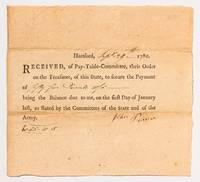
1780423856Hartford Connecticut 1780. Unbound. Near Fine. Approximately 7" x 6. 5" on laid paper with a deckled edge. Old folds near fine. Receipt of payment from the Pay-Table Committee of 55 pounds to John Pearce or Pierce Signed as received by him as Pearce. Docketed as received on the verso as Pierce. unknown
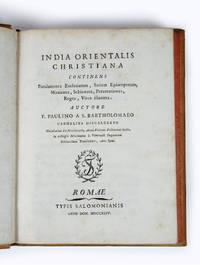
17943703905Rome: Typis Salomonianis 1794. Three works bound together quarto the first main work with folding map 2 plates and an engraved portrait vignette with two shorter pamphlets 24 & 26 pp.; an attractive copy in contemporary patterned vellum boards spine banded red morocco spine label faded. <p><p>Three works by Paulinus including his important India Orientalis Christiana a study of and introduction to the Carmelite missions in India in the late eighteenth century in a particularly attractive contemporary binding. The work is illustrated with two plates and a fine map of India as well as a smaller vignette portrait of Paulinus himself. Paulinus of St Bartholomew 1748-1806 also known as Johann Philipp Werdin or Wesdin was a missionary and orientalist. A member of the Carmelite Order in 1774 he was sent to India Malabar where he was appointed vicar general of his order. In 1789 he was recalled to Rome in order to report on the mission and given the task of preparing books for the use of missionaries.</p> <p>One of the first Orientalists to note and work on the close relationship between Indian and European languages Paulinus was the author of many learned studies on the east and is best known for having published the first Sanskrit grammar. As an antiquarian who worked from original sources he was fortunate to have the patronage of Cardinal Stefano Borgia 1731-1804; a good Borgia whom he served as private secretary and who financed many of his publications. Both men served long periods on the Congregatio de Propaganda Fide a body preoccupied with exotic languages insofar as they impacted on spreading the christian gospels but also in understanding exotic theologies. In this context the Propaganda Fide was a central recipient of missionary collecting in the field which gave Paulinus exceptional advantages which enabled him to undertake extensive linguistic studies.</p> <p>After Borgia's death his remarkable library and museum were gradually distributed with the important biblical manuscripts mostly being added to the Vatican libraries after the secular materials had chiefly made their way to the national library of Naples.</p> <p>The two rare pamphlets bound in here are both concerned with Borgia's museum: Scitismo Sviluppato. del Museo Borgiano Rome c. 1793 and Lettera. del Museo Borgiano Rome same period both written in Italian not Latin and both discussing the Museo Borgiano. Borgia was particularly expert on Coptic relics but here Paulinus discusses early Brahmanic and other Indian manuscripts in his collection.</p> <p>All of these works are rare although as often the pamphlets are the scarcer. Worldcat lists some 10 copies of the India Orientalis Christiana 2 copies of the Scitismo and only 1 of the Lettera.</p> </p> . Typis Salomonianis unknown
171830530Amsterdam: Steenhouwer 1718. First Edition. hardcover. very good. Titles in red and black with engraved vignettes woodcut head and tailpieces. 2 volumes. 2 410; 6 438 pages. Thick 12mo original sprinkled calf covers bowed and joints cracked; some ex-library stamps. Amsterdam: Steenhouwer & Uytwerf 1718. Very good.<br/> <br/> "Gui Patin is unique in our annals . Scores of doctors have written letters; none save his remain as a permanent contribution to literature." Osler 5277. Voltaire praised Patin's letters "parce qu'il contient de nouvelles anecdotes que tout le monde aime et des satires que l'on aime davantage." BIOGR. MED VI 375.<br/> <br/> Steenhouwer unknown
177545627J Dodsley 1775. First Edition. Hardback. Very Good hardback. Light edgewear pages gently tanned but still crisp. Free endpaper and half title has slight area of grubbiness along shelf edge. 4to half calf with marbled boards red leather title label and gilt lettering. Blind and gilt decoration to spine. The picture on the listing page is of the actual book for sale. J Dodsley hardcover
1752129645London : Printed For W. Clarke; And Sold By J. MacE And G. Ferraby At Hull; Mess. Stabler And Barstow And N. Bell At York; And P. Hodges At Hereford 1752. Third Edition. Hardback. Benjamin Chadwick's copy dated. Finely bound in modern speckled calf over marble boards. Raised bands with a dark morocco gilt-blocked label. T.p. in black and red. An exceptional copy - scans and additional bibliographic detail on request. ; 479 pages; Physical desc. : viii 479 1p. ; 8°. Latin text with English prose translation. ESTC citation no.: N19366 London : Printed For W. Clarke; And Sold By J. MacE, And G. Ferraby, At Hull; Mess. Stabler And Barstow, And N. Bell, At York; A hardcover
1768057505Dublin: Printed by W.G. Jones; for Thomas Ewing and W. and W. Smith in Dame-Street. 1768. Not Given . Hardcover. Very Good Plus. Small 8vo. DUBLIN : 1768. Hardback. Contemporary dark-brown full sheepskin leather. Original dark red gilt lettered label; raised bands. Original end-papers. Neat owner name contemporary of Nevelle F. Board to head of title-page and one other later name to fly-leaf. Two neat textual corrections; otherwise no owner markings. Tight bright and clean. Internally VERY GOOD INDEED. Binding average; worn and rubbed; hinges cracked; strong and sound. xxviii 326 pages. CONTENTS include 'The three epistles of Aulus i.e. Angelus Sabinus . made English by Mr. Salisbury i.e. Salusbury' pp. 185-202. Referenced by: English Short Title Catalog T169736. Will be well-packed for posting/shipping. Sm.8vo. Rosley Books for Antiquarian books CHS Cumberland Everyman GKC Inklings Keswick Literature MacDonald Rarities Theology and History. . Printed by W.G. Jones; for Thomas Ewing and W. and W. Smith in Dame-Street MDCCLXVIII. SCARCE DUBLIN PRINTING. <br/> <br/> Printed by W.G. Jones; for Thomas Ewing, and W. and W. Smith in Dame-Street. hardcover
1771372964Amsterdam: Marc Michel Rey 1771. New Edition. Hardcover. Poor copy in vellum covered boards with a tape repair. Spine bands worn with some loss. Text remains in fine condition; clear without blemish. Physical description: 223 pages. Notes: Text is in French. Subjects: Ovid. Roman literature. Amsterdam: Marc Michel Rey hardcover
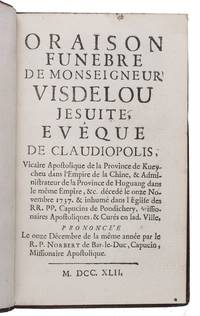
174289PBMXY3Z0MCAvignon: no publisher 1742. Contemporary calf gold-tooled spine with red label marbled endpapers red edges. 8vo. Second or third edition of the funeral oration for the sinologist and mathematician Claude de Visdelou 1656-1737 by Father Norbert of Bar-le-Duc 1703-1769 dedicated to Pope Benedict XIV. The oration prooved highly important in the so-called Struggle of the rites in China between the Jesuit missionaries and the Chinese emperor and the Pope.The author of the oration Norbert de Bar-le-Duc a Capuchin monk 1716 and priest 1729 also known as Norbert de Lorraine Curé Pierre Parisot or Abbé Platel was sent to Malabar and later to Pondicherry in December 1736 after being appointed procurator of the French mission. He stayed for three years in Pondicherry where he soon came into conflict with the Jesuits on the same issue - the struggle of the now Malabaric rites -which had lead to Visdelous exile in the same Capuchin monastery in the same town. So the anti-Jesuit Father Norbert de Bar-le-Duc understandably delivered Visdelous funeral oration .An undated 4to edition that names no printer or place of printing appears to be the first edition of the funeral oration. Sommervogel and Cordier mention an 8vo edition nominally printed by Antoine Pereira in Cadiz though other sources suggest it was printed in Avignon with the same collation as our edition and published in the same year making the present edition the second or third.Fine copy with bookplate on inside front cover: ''Devie Prêtre''. Binding skilfully repaired; head of second fly-leaf damaged.l De Backer & Sommervogel VIII col. 843; Cordier Sinica 1100-1; Librairie Polak Coll. de M.M.: Extreme oriênt du 16e siècle au 20e siècle 305; Adelhelm Jann Die katholischen Missionen in Indien China und Japan 1915 passim; Claudia von Collani & Claudio Filippo Grimaldi S.J. Zur Ankunft des päpstlichen Legatien Charles-Thomas Maillard de Tournon in China in: Monumenta Scrica 42 1944 pp. 329-359; Robert Streit & Joh. Dindinger eds. Bibliotheca Missionum 7 1932 pp. 105-107; Biogr. univ. XLIII cols. 638-640; not in Lust. [no publisher], unknown
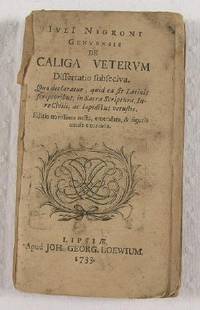
1733019525Lipsiae: Joh. Georg. Loewium 1733. In Latin. 1733. This title is usually bound together with Balduinus' De Calceo Antiquo but in this case has been issued separately. Tan softcover 210 25 pages. Front cover absent spine and rear cover chipped text block shaken and held together in some spots by the spine covering pages age-toned but clean title page a bit more soiled due to lack of front cover. Soft Cover. Good. 16mo - over 5¾" - 6¾" tall. Joh. Georg. Loewium Paperback
178621241London Chelsea: William Watts 1786. First Edition. Framed and matted. John Claude Nates or Nattes. The print visible is 16 by 21 cm. The pictorial part of the print: 12.5 by 18 cm. The frame: 35 by 40 cm. The frame is a somewhat elaborate production with an outer band of blond painted wood which rises to a narrower more tradition gilt molded piece. The matting is an off-white fabric with a narrow inner gilt piece. The print is browned and foxed with the picture itself consequently darkened a bit. The hand-coloring was done with considerable care but the color application was done with a light touch we are speaking of the amount of coloring not the palette used. The result is muted but pleasingly so and we do think the color teases out some detail and actually adds to the illusion of dimensionality. The matting has a light dampstain. The frame itself has some minor surface loss. We think the frame is worth preserving and as to the outer part of it having an issue albeit a minor one we would recommend just painting over this part and with gilt leaf it will look far better than this frame ever looked. William Watts unknown
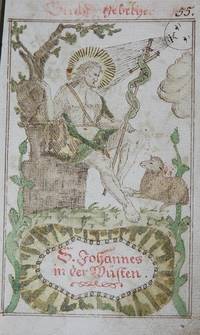
1797006602Keuth an der Crassen 1797. Full Blindstamped Calf. Good. A fine Folk Art manuscript prayer book from the late eighteenth century. 8vo. 17.5 by 10.5 cm. 3 516 13 1 pp. With eight full page paintings plus vignette decoration throughout. Besides the ubiquitous floral ornamentation all pretty accents the vignettes include a serpent a basilisk a skull etc. Most writing is a neat now archaic cursive but headings and the like rendered in an easily readable ornamental Fraktur Gothic. The paintings are the highlight most will find. Their subject matter is quintessential -- Momento Mori Saint Michael slaying the dragon Saint John in the desert Saint Sebastien the Christ child King David playing a harp etc. But while the subject matter may not be unusual the execution is done with uncommon flair even though it is resolutely naive or Folk Art. And the artist who we assume is one or both of the writers may be illustrating popular subjects there are original elements in his/her imagery or imagining of the subject. The authorship is stated but also a tad confusing. Our interpretation is that a Konrad Mueller created the book for Margaretha Pfaden-Hauerin. Condition: moderate wear to contemporary full calf binding. Unusual is a 13 page "Register" or Table of Contents in the rear. By unusual we mean for such a manuscript prayer book. Also a page of handwritten genealogical notes written on a prior blank leaf and written much later in the mid to late 19th Century. Moderate sometimes heavy soiling to margins of leaves. Corner cut out of front endpaper. Some loose gatherings. unknown