15 958 résultats
Madrid, Imprenta de A. Pérez Dubrull, 1882. 4to. menor; 3 hs., 175 pp., 1 h. Cubiertas originales.
Madrid, Calpe, 1922 (Col. Universal). 4to. menor; 232 pp., 1 h. Encuadernación en media tela.
Madrid, Editora Nacional, 1978. 4to. menor; 661 pp. Impresión en papel biblia. Cubiertas originales.
Madrid, Signo, 1936 ("Primavera y Flor"). 4to. menor; 184 pp., 1 h. Encuadernación original en tela estampada.
Pamplona, 2005. 4to. mayor; 635 pp. Cubiertas originales.
Valencia, Prometeo, s.a. (hacia 1915). 4to.; 210 pp., 1 h. Cubiertas originales, con alguna pérdida de papel.
Madrid, 2002. 4to.; 167 pp. Cubiertas originales.
(Codice NU/0474) In 4° (31,5x21 cm) 4 pp. Su carta a mano, grande decorativo stemma, capolettera figurato, pieni margini con barbe. Antica nota in ultima pagina, qualche ingiallitura. Ottimo stato. Astuccio protettivo in cartoncino moderno. ~~~ SPEDIZIONE IN ITALIA SEMPRE TRACCIATA
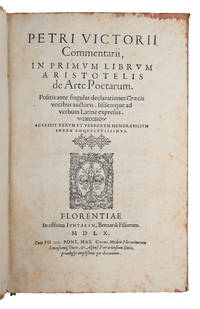
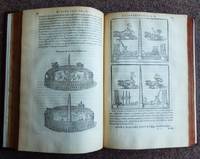
161062508Florence In officina Iuntaru Barnardi Filiorum 1560. Small folio. 18th century full vellum with gilt labels to spine. Wear to capitals and small worm tracts towrad opper hinges. Corners a bit bumped. A very nice and sturdy binding. Marbled edges. Some browspotting throughout. Small wormholes to blank margin of final leaf far from affecting imprint. Woodcut vignette to title-page and to verso of colophon-leaf. 10 308 12 ff. <br/><br/><em>The rare first edition of Vittore's main work his great edition translation and commentary on Aristotle's Poetics which is arguably the most important and influential commentary on the work ever published profoundly shaping our understanding and interpretation of Aristotelian literary theory. Petrus Victorius or Piero/ Pietro Vittore/Vettore 1499-1584 is not only the “first great editor of the Poetics†McMahon he is also considered "the greatest Greek scholar of Italy" Whibley “the leading Italian scholar of his time†Encycl. Britt. “the last great figure from that period in the domain of Greek studies†Willamowitz and “the foremost representative of classical scholarship in Italy during the sixteenth century which for Italy at least may well be called the “saeculum Victorianumâ€.†Sandys. His magnum opus and without doubt most influential work is his edition with commentary of Aristotle’s Poetics which is of seminal importance in several respects. It is crucial to our understanding of Aristotle’s great work shaping the way that all later scholars have read it. The understanding of Aristotle’s work on poetry came to define the way that we have understood literature and fiction ever since the Renaissance and Victorius is the leading interpreter. ““From the sixteenth century to Romanticism European literary theory used the term marvel or wonder It. meraviglia ammirabile Fr. merveille Sp. maravilla to designate everything that was on the conceptual margins of the poetics of probability and imitation. The discovery and complete reception of Aristotle’s Poetics between the fifteenth and sixteenth centuries resulted in the dissemination of an idea of poetry as the imitation of the actions of men whose main part was the plot or the structuring of actions ordered according to the laws of necessity credibility and probability. This formed the basis of Neo-Aristotelian poetics which determined the ways of thinking about literature and fiction for more than four centuries.†Vega p. 280. Especially the idea of “wonder†in Aristotle’s Poetics came to be one of the founding ideas of modern literary theory. And especially here Victurius’ reading is groundbreaking playing a central part in the reception and understanding of the work over the centuries to come. “A single editorial decision in just one passage and what is more in a complex fragmentary unfinished text like the Poetics affects the entire work…†Vega p. 284. “The text of the Poetics that can be read in the editions and translations of the sixteenth century and a large part of the seventeenth with one exception as we shall see NB. This exception is Victorius does not include the term alogon in the passage that deals with wonder. It does not appear in the first Greek edition the famous Aldine princeps of 1508 or in the Latin translations of the end of the fifteenth century; it is not in the edition and translation by Alexander Paccius or Pazzi the one most widely read in the sixteenth century neither does it appear in the edition with commentary by Francesco Robortello nor in Vincenzo Maggi’s Enarrationes nor in the vernacular commentaries of Ludovico Castelvetro and Alessandro Piccolomini. What is more a detailed revision of the history of the text reveals that no manuscript of the Poetics and no direct or indirect testimonies not even in the Arabic branch of its transmission have ever included the term alogon.†Vega p. 282. It is Victorius who is solely responsible for the reading that is generally accepted today as well. “The moment when the idea of irrationality alogon appears for the first time in Aristotle’s text can be identified without hesitation as 1560 which is the date when the edition translation and commentary on the Poetics by the philologist and Hellenist Pier Vettori or Victorius was printed on the presses of Giunti in Florence. Vettori is the one who first edits alogon even though no testimony provides him with this reading and he does so fully aware of his choice and its implications†Vega pp. 287-89. “The success of Victorius’ reading while not immediate was extraordinary.†Vega p. 287 Antonio Viperano accepts the reading “alogon†with all it involves De poetica libri tres Ricciboni adapts it in his edition of Aristotle’s Poetics Tasso embraces it Discorsi dell’arte poetica Discorsi del poema eroico and it is implicit in Alonso López Pinciano’s Philosophia Antigua Poetica. Vossius in 17th century Germany makes abundant glosses on alogon in his books on poetics and the commentators and translators of the “Poetics†in France preferred Victorius’ reading in every case. “Victorius’ conjecture seems to have convinced all editors and commentators who reproduce it without question in every case.†Vega p. 289. The influence of Victorius’ interpretation of Aristotelian literary theory that he presented in his magnum opus i.e. the present work was not limited to the use of specific words that changed the reception history of Aristotle’s Poetics. His entire view of poetry through an interpretation of Aristotle was highly original and came to define the way we understand literature in general. Victorius was one of the first to put forth the belief that heroic poetry should present a Platonic idea of perfect virtue contributing to the centuries long doctrine of the perfect hero as perfect exemplar and he was one of the first to revive Aristotle’s idea of purgation from tragedy still widespread today and to also understand the existence of a purgation from poetry. “He viewed poetry as a moderator of minds “By reading poetry men “become moderate in temper and their turbid motions are extinguished.†Poems “purge our minds of blemish and spotâ€. Vettori realized that Aristotle’s reference to catharsis should be applied to tragedy alone but he added that similar purgations could be achieved by other kinds of poetry effective however on other passions than pity and fear and with the aid of other instruments.†Hathaway pp. 292-93. Apart from his overall interpretation of Aristotle’s literary theory and his groundbreaking reading of the most central passages of the Poetics Victorius was also the first to determine that the Aristotelian text that has come down to us is not complete. “Victorius was the first to see that the treatise now known as the Poetics is only the surviving portion of a larger work.†Bywater p. XX. “during his lifetime five medals were struck in his i.e. Victorius’ honour and his portrait was painted by Titian… His fame was not limited to his own land or his own time. His scrupulous care and unwearied industry are lauded by Turnebus who declines to be compared with him even for a moment; the epiteths doctissiums optimus and fidelissimus are applied to him by the younger and the greater of the two Scaligers while Muretus calls him eruditorum coryphaeus; and similar eulogies might be quoted from Justus Lipsius. Dacius … and Graevius. He is described as having climbed the “hill of virtue†and taken his place on its summit between Cicero and Aristotle. In his funeral oration Salviati says of him in the personification of Italia: “Now no more shall distant peoples cross the snows of the Alps to see Victorius or men of mark arrive from every land to hear him; or princes hold converse with him. Now no more shall the works of scholars in all parts of the world be sent here for his approval; or youth learn wisdom from his lips.†Sandys pp. 139-40. “No one said a contemporary of his in a funerary laudatio ‘left Aristotle in a cleaner state purgatior’.†Baldi. _____________________________________________ Adams: 1905; Brunet V: 1179; Graesse I: 213 â€Ã©dition excellente quant à la critique†and noting that some copies bear the dates 1563 and 1564. Sandys: A History of Classical Scholarship Vol. II 2003 pp. 135-140. Hathaway Baxter: The Age of Criticism: The Late Renaissance in Italy. Cornell University Press 1962. A.Philip McMahon: On the Second Book of Aristotle's Poetics and the Source of Theophrastus' Definition of Tragedy Authors. In: Harvard Studies in Classical Philology 1917 Vol. 28 1917 pp. 1-46. Christopher Rowe: Petrus Victorius and Aristotle’s Eudemian Ethics Cambridge University Press online 2025. Vega Maria José: Wonder and the Irrational. The Invention of Aristotle’s Poetics in the Sixteenth Century. In: Nous Polis Nomos. Berlin Academia Verlag 2016. Baldi: Il greco a Firenze e Pier Vettori 1499–1585 Alessandria 2014 117. </em> hardcover
155252798<p>Lugduni apud Joan. Tornaesium 1552. TITLE CONTINUED: Accesserunt Gulielmi Philandri Castilionii civis Romani annotationes castigatiores & plus tertia parte locupletiores. Adiecta est Epitome in omnes Georgii Agricolae de mensuris & ponderibus libros eodem autoter cum Graeco pariter & Latino indice lucupletissimo. FIRST JEAN DE TOURNES EDITION OF VITRUVIUS 1552 Latin text. 4to approximately 235 x 155 mm 9¼ x 6¼ inches printer's device of vipers on title page a different De Tournes device on verso final page 83 woodcut illustrations 1 folding plate of an inscription portrait of Philandrier the editor on final page of prelims arabesque headpieces to the 10 books and historiated initials throughout pages: 16 447 57 - including index errata and Extrait du Privilege with last line: Achevé d'imprimer le huitieme février 1552 the last leaf with printer's device on verso bound in modern full blind panelled calf raised bands blind rules and gilt lettered morocco label to spine all edges red new endpapers. Small repair to inner edge of title page plus 2 ink names pages lightly age-browned tiny chip to fore-edge of 1 prelim page small closed tear to 1 margin repaired neatly some early mostly neat ink marginal notes some small corrections to text and a little neat underlining a couple of small ink stains and smudges text still easily legible very light foxing to a few margins. A good tight copy. This edition published in Lyon by Jean de Tournes was the second edited by Guillaume Philandrier the first was published in Strasbourg in 1550 as a 16mo. As the secretary to the bishop of Rodez the French humanist Philandrier friend of Rabelais had spent 10 years in Italy in Venice and Rome many of them studying Vitruvius and in 1544 he published his illustrated annotations separately in Rome. See: Laurence Hall Fowler The Fowler Architectural Collection of the Johns Hopkins University pages 318-319; Adams Books Printed in Europe 1501-1600 Volume II V908; Harvard French 16th Century Books Volume II No. 550. MORE IMAGES ATTACHED TO THIS LISTING ALL ZOOMABLE. FURTHER IMAGES ON REQUEST. POSTAGE AT COST.</p> Lugduni, apud Joan. Tornaesium, 1552. hardcover
Madrid, en la Imprenta de Juan de Ariztia, 1737. 4to.; 3 hs., 679 pp., 4 hs. Portada reforzada. Encuadernación del siglo XIX en piel.
Pamplona, 2006. 4to.; 326 pp. Cubiertas originales.
Madrid, 2008. 4to.; 542 pp. Cubiertas originales.
Barcelona, en la Imprenta de Juan Pablo Marti, 1722. 4to.; 4 hs., 679 pp., 4 hs. Ligerísimo rastro de polilla en margen inferior de las primeras veinte páginas. Encuadernación en pergamino de la época.
Un cuaderno de tres hojas en folio, en apretada caligrafía, manuscritas por ambas caras. Cubiertas mudas en cartulina.
(Codice OR/0306) In 8° XVI-705 pp. Con 31 tabelle, 451 figure in nero e 16 tavole a colori. Brossura editoriale a risvolti, ottimo stato: COME NUOVO.. ~~~ SPEDIZIONE IN ITALIA SEMPRE TRACCIATA
Lo straordinario sistema hawaiano per gioire di una vita meravigliosa in cui tutto è davvero possibile.
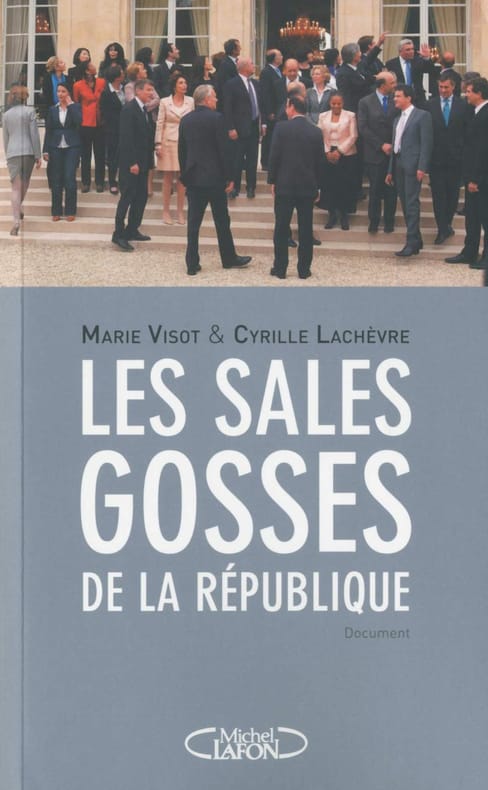
2014500112008MICHEL LAFON 2014 284 pages 13 8x2 6x22 4cm. 2014. Broché. 284 pages.
196230233<p>HBDJ1962 Early Issue ReprintVG/VG AS-IS WITH WOMAN ON FRONT OF DJ LARGER FORMAT Reprint as No 949 in the Dent Everyman series the larger format 12mo 242pp introduction D M Hoare VG Copy in sound lilac DJ LITELY frayed and nicked at head of spine and somewhat sun-faded COPPER TITLES ON spine COVER. Size: 12mo BACK OF DJ SAYS FEW 500 AUTHORS</p> EVERYMAN’S LIBRARY DENT LONDON hardcover
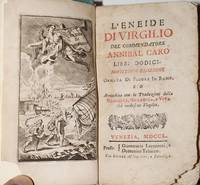
1750002388Venezia: Giammaria Lazaroni e Domenico Tabacco 1750. Pebbled Half Cloth Faux Leather over Paper Pastedown on Boards. Good Minus. 8vo. 20 568 pp. With fifteen woodcut plates with frontis one for each canto of the Aenied and one for the Bucolica and Georgica respectively. Some soiling throughout. All leaves of the Bucolica and a few of the Georgica have severe wormholing in the lower corner with only trivial touching of text. A few other leaves have corners overtrimmed or with loss. Still an uncommon edition with only three copies located on OCLC. <br /><br /> Giammaria Lazaroni, e Domenico Tabacco hardcover books
1750002388Venezia: Giammaria Lazaroni e Domenico Tabacco 1750. Pebbled Half Cloth Faux Leather over Paper Pastedown on Boards. Good Minus. 8vo. 20 568 pp. With fifteen woodcut plates with frontis one for each canto of the Aenied and one for the Bucolica and Georgica respectively. Some soiling throughout. All leaves of the Bucolica and a few of the Georgica have severe wormholing in the lower corner with only trivial touching of text. A few other leaves have corners overtrimmed or with loss. Still an uncommon edition with only three copies located on OCLC. Giammaria Lazaroni, e Domenico Tabacco unknown
1586250702001Mantoua Italy: Francesco Osano 1586. Soft cover Ars Rustica. Very Good. Two works published separately in 1586 bound together: <br /> 1. La Bucolica et la Georgica di Vergilio<br /> <br /> The Bucolics and the Georgics of Virgil translated into blank verse. One by M. Andrea Lori: the other by M. Bernardino Danielli with the arguments. Newly corrected and reprinted. <br /> <br /> 2. L'Eneide di Virgilio del Commendatore Annibal Caro Virgil's Aeneid translated by and with commentary from Annibal Caro.<br /> <br /> A 435-year-old edition of Virgil's complete works in 17th to 18th century carta rustica thick paper binding. Collated and complete including most of the original blank flyleaves. Italian text. In VERY GOOD 16th century antiquarian condition. <br /> <br /> PROVENANCE <br /> <br /> From the Virgil Collection of Craig Kallendorf 1954 - 2023 who owned the largest private collection of antiquarian Virgil works 1150 editions not including Incunable books in the world. Only a handful of prominent institutions like the British Library had larger collections. Eighth-nine of the books in his collection were the only known surviving copies 71 only had one other known copy. He worked closely with Princeton University in helping to assemble supplement and catalog its Junius Spencer Morgan Virgil collection. Craig Kallendorf was Professor of English and Classics at Texas A&M University. He was the author or editor of 27 books and more than 170 articles book chapters and reference work entries. Among Kallendorf's groundbreaking monographs on the Virgilian tradition special note might be made of his Virgil and the Myth of Venice: Books and Readers in the Italian Renaissance Oxford: Clarendon Press 1999 which shows how the wide reading of the Aeneid accessed in both Latin and Italian editions contributed to Venetian ideology and the so-called "myth of Venice." With its publication according to reviewer Diana Robin Renaissance Quarterly 55.4 2002 p. 1394 Kallendorf is to be recognized as "the leading authority on the Virgilian tradition in early modern print culture in Italy." <br /> <br /> ABOUT THE BOOK <br /> <br /> Published in 1586 by Francesco Osana in Mantua modern Italy. Italian text. Rebound in 17th to 18th century carta rustica with its characteristic thick paper binding exposed cords on the joints and antiquarian spine writing. Wide-margined untrimmed paper. Octavo 6 1/8" x 3 1/2". Collated and complete: Book 1: 4 163 1 pp; Book 2: 4 original blank preliminary leaves for the Aeneid then 8 472 pp. followed by four original blank flyleaves. Woodcut printer's device on both Book 1 and Book 2 title page. Decorated woodcut initials. <br /> <br /> CONDITION REPORT: VERY GOOD <br /> <br /> Endpapers refreshed and without front blank flyleaf for Book 1. Both works are textually collated and complete. The Aeneid retains all of its original blank flyleaves scarce during a rebind. Exterior and binding - rubbed and soiled carta rustica thick antiquarian paper binding. Spine sun-darkened with the remnants of small round sticker adhered to it and what appears to be a tape stain. Rear board with some antiquarian ink writing. Bumped corners. Toned edges. Uncut/irregularly cut pages. Binding strained in a few areas with exposed cords in gutters and the text block pulling away from spine. Overall in remarkably good condition for a thick paper binding hundreds of years old. I<br /> <br /> Interior is VERY GOOD for a 435-year-old binding. Most of the text block is clean and bright white with mostly light foxing to margins. About 20% of text block shows a bit heavier foxing and/or is darkened. Pages are untrimmed and inconsistently cut with rough edges. Raggedy edges and a few leaves with tears or loss of margin corners not affecting text. A few old paper restoration repairs. Minimal worming mostly a few small holes to margins of first and last few leaves and pastedowns. Fore-edge margins browned in multiple places. A bit grubby and soiled endpapers. Former owner ink writing on title page for the Bucolic and Georgics and Kallendorf's ex libris sticker on FFEP. Francesco Osano unknown
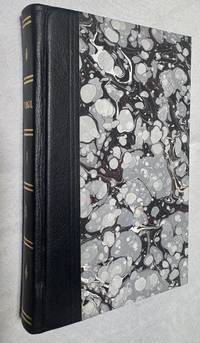
1540250506002Venice Venezia: Comin Da Trino & Niccolo Zoppino 1540. Hardcover. Very Good. I sei primi libri del Eneide di Vergilio tradotti piu illustri & honorate donne.Et tra l'altre la nobilissima & divina madonna Aurelia Tolomei de Borghesi cui ancho indirizzato tutto il presente volume<br /> <br /> The first six books of the Aeneid by Virgil translated to the most illustrious and honored ladies. And among others to the most noble and divine Madonna Aurelia Tolomei de Borghesi to whom also the present volume is addressed. <br /> <br /> NOTE: Incomplete. Missing Title page Book 1 and first 8 leaves of Book 2. Normally this scarce edition typically sells between $2000-2500 when found complete. <br /> <br /> PROVENANCE<br /> <br /> From the Virgil Collection of Craig Kallendorf 1954 - 2023 who owned the largest private collection of Virgil works 1150 editions not including Incunable books in the world. Only a handful of prominent institutions like the British Library had larger collections. Eighth-nine of the books in his collection were the only known surviving copies 71 only had one other known copy. He worked closely with Princeton University in helping to assemble supplement and catalog its Junius Spencer Morgan Virgil collection. Craig Kallendorf was Professor of English and Classics at Texas A&M University. He was the author or editor of 27 books and more than 170 articles book chapters and reference work entries. Among Kallendorf's groundbreaking monographs on the Virgilian tradition special note might be made of his Virgil and the Myth of Venice: Books and Readers in the Italian Renaissance Oxford: Clarendon Press 1999 which shows how the wide reading of the Aeneid accessed in both Latin and Italian editions contributed to Venetian ideology and the so-called "myth of Venice." With its publication according to reviewer Diana Robin Renaissance Quarterly 55.4 2002 p. 1394 Kallendorf is to be recognized as "the leading authority on the Virgilian tradition in early modern print culture in Italy." <br /> <br /> ABOUT THE BOOK<br /> <br /> Post-Incunable edition of the first six books of the Aeneid by Virgil. In Italian. Published in 1540 by Comin da Trino & Niccolo Zoppino in Venice. Each book translated into Italian from Latin by a different individual: A2 Hippolito de Medici A3 Bernardino Borghesi A4 Bartolomeo Carli Piccolomini A5 Aldobrando Cerretani and A6 Alessandro Piccolomini. Rebound in modern 1/4-calf over marbled paper and gilt tooled spine bordering lettering and compartment devices. Marbled endpapers. Six parts in one volume. Octavo 6 1/2" x 4 1/8". Foliation in leaves: 15 20; 19 1; 27 1; 25 7. Fifteen vignette woodcuts and separate engraved title pages for Books 3-6. <br /> <br /> CONDITION REPORT<br /> <br /> Missing Title page Book 1 leaves and first 8 leaves of Book 2 including its title page. 15/22 woodcuts.<br /> <br /> The exterior is in FINE condition. Fresh supple unfaded leather and unblemished marbled paper. A few areas of light dust. Square spine very firm hinges and joints sharp corners and tight pages. Foxing to text block edges. <br /> <br /> The interior condition - refreshed endpapers and blank flyleaves. Trimmed pages. Light foxing to margins. Heavier foxing to preliminaries and last few leaves of the volume. Signs of handling - a few smudges bent corners and some creasing. No marginalia or underlining. One corner clipped. A few minor spots of worming in the margins. Rear blank flyleaf with period one-line Latin inscription in faded antiquarian ink claiming that the possessor of the book was a heteronymous eunuch! Front pastedown with the ex libris sticker "from the Virgil collection of Craig W. Kallendorf." <br /> <br /> In excellent shape for a nearly 500-year-old book - a beautifully bound and scarce post-incunable mostly complete edition of the first 6 books of The Aeneid by Virgil. Comin Da Trino & Niccolo Zoppino hardcover
1586250509002Venice Venezia: Appresso Giacomo Cornetti 1586. Hardcover. Good. The works of Vergil namely the Bucolic Georgic & Aeneid again translated into blank verse by various most excellent authors.<br /> <br /> Uncommon copy. Missing the final leaf of the Aneid otherwise complete. <br /> <br /> RECENT PROVENANCE<br /> <br /> From the Virgil Collection of Craig Kallendorf 1954 - 2023 who owned the largest private collection of Virgil works 1150 editions not including Incunable books in the world. Only a handful of prominent institutions like the British Library had larger collections. Eighty-nine of the books in his collection were the only known surviving copies 71 only had one other known copy. He worked closely with Princeton University in helping to assemble supplement and catalog its Junius Spencer Morgan Virgil collection. Craig Kallendorf was Professor of English and Classics at Texas A&M University. He was the author or editor of 27 books and more than 170 articles book chapters and reference work entries. <br /> <br /> HISTORIC PROVENANCE<br /> <br /> Federico Caproni Born in Massone Italy a hamlet of the Trentino municipality of Arco and died in Vizzola Ticino a municipality in the Varese area. Founder together with his younger brother Giovanni Battista of the Caproni Aeronautical Industries. He was a scholar of agricultural sciences. In the 1930s he purchased a large estate near Vizzola Ticino undertaking an intense reclamation project that changed the uncultivated nature of the territory and allowed the construction of a modern agricultural company. His private library consisted of approximately 85000 works divided by subject. Caproni Aeronautical Industries 1908 - 1950 was a pioneering Italian aircraft manufacturer. Caproni was responsible for completing the first aircraft of Italian construction in 1911. During 1927 the Caproni Museum was established in Taliedo by Giovanni Caproni and his wife Timina Caproni. It is the oldest aviation museum in Italy. <br /> <br /> ABOUT THE BOOK<br /> <br /> Published in 1586 by Appresso Giacomo Cornetti in Venice. Text in Italian and in italic type. The Eclogues Bucolics are translated by Andrea Lori; the Georgics by Bernardino Daniello; each of the twelve books of the Aeneid has a different translator: Alessandro Sansedoni Cardinale Hippolito de' Medici Bernardino Borghesi Lodovico Martelli Thomaso Porcacchi Alessandro Piccolomini Giuseppe Betussi Leonardo Ghini Bernardetto Minerbetti Lodovico Domenichi Bernardino Daniello and Paolo Mini. Bound in 19th century 1/4 mottled calf over mottled paper covered boards. Five compartment spine with smooth gilt bands with a gilt lettered black morocco spine label in compartment two and tooled gilt fleurons in the other compartments. All edges stained red. Octavo 5.5" x 4" foliated 8 28; 67 1; 279 leaves. 25 half-page woodcuts some repeats. Cornetti's rose device on title page within scrolled cartouche encircled with motto "Dabo omnibus gratum odorem"; ornamental initials; head- and tail-pieces.<br /> <br /> CONDITION REPORT<br /> <br /> Missing the final leaf of the Aeneid otherwise textually complete. Renewed endpapers. Multiple leaves numbered incorrectly and a few leaves sans number by the printer as it is with other copies. <br /> <br /> Margins trimmed. Spine is square firm hinges and joints. Offsetting and darkened areas on board paper. Some minor rubbing and a nick along joints. Dusty top edge. Rubbed boards and edges. Corners gently bumped. An old cataloguing sticker at heel of spine. A few pages with professional paper restoration to a corner. Quite a bit of water dampening throughout with staining. Heavily darkened title page. Only a few pages with antiquarian marginalia. Signs of handling- a few pages with margin tears some smudges some creasing and a few bent corners. Front pastedown with the bookplate of Federico Caproni. FFEP affixed with the ex libris sticker "from the Virgil collection of Craig W. Kallendorf." Some pencil writing on the front endpapers. Appresso Giacomo Cornetti hardcover
1149115459.Gpaperback. Good. Access codes and supplements are not guaranteed with used items. May be an ex-library book. paperback