Diderot, Denis und Jean Baptiste le Rond D'AlembertAntiquariat.de

180 résultats
1771900926AGParis:, Briasson, David, Le Breton, Durand, 1771. 7 gestochene Tafeln, 2 Seiten Erläuterungen, primitive Leimheftung, Blattmaß: je 39,5 x 26 cm.
1736CCC-1403Mb.edition Rouen Cabut 1736. In-4, plein veau de l'époque, dos à 5 nerfs orné de compartiments fleuronnés et cloisonnés. Nombreuses illustrations sur bois. "Nouvelle édition" de cet ouvrage, demeuré anonyme illustré de nombreuses reproductions de médailles et monnaies gravées sur bois. Le recensement des différentes monnaies se présente sous forme de tableaux illustrés: "Fabrications & réformes" "Date des édits, déclarations & arrêts" "Dates des Mutations" - "Noms des espèces & matières" "Leur titre" - "Leur taille" - " Leur valeur ..." . Très bon exemplaire, très frais, bien relié d'époque. Photos possibles
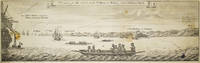
1745316296London: Thomas Astley 1745. Engraving. 4 x 13-1/4 inches. Creased from prior folding a few wormholes soiling and foxing. Engraving. 4 x 13-1/4 inches. Engraving showing "Negro Canoas carying Slaves aboard at Mansrow" extracted from A New Collection of Voyages and Travels 4 vols London: Thomas Astley 1745-7. <br/><br/> Thomas Astley unknown
1775005756Paris [Londres] S.n. 1775 In-12 Demi maroquin rouge à coins
173564772Augsburg: Mertz & Meyer 1735. Vellum. Very Good. 17.5 x 10.5 cm. 16mo. Double-page title page fontispiece single page two color title 24 907pp. Bound in contemporary vellum. Plays in Latin language with German language commentary. Front gutter cracked but still holding. Soiling to the boards. Terrence 190 B.C. - 159 B.C. was a North African slave of a Roman senator Terentius Lucanus. He was the author of 6 major palys. His style deviated from earlier dramatic form. He avoided monologues favoring dialogue that was more like ordinary conversation devoid of flamboyance. His prologues were essays in literary crticism and he was deeply concerned with unity in the plot sometimes incorporating passages from other plays. He moved drama in the direction of realism and was influential on the writings of Cicero Horace and the early Christian Church fathers. This edition of his plays was prepared for German students with extensive notes explaining the most difficult passages the Latin idiomatic expressions and Greek roots of som eof the words. A long preface in German is a commentary on pre-Christian authors and their works. Mertz & Meyer unknown
177293442Birminghamiae : Typis Johannis Baskerville 1772. 1st Edition in this form. Hardback. Very good copy in the original gilt-blocked calf-backed marble boards. Slightest suggestion only of dulling and toning to the spine bands and panel edges. Remains particularly well-preserved overall; tight bright clean and strong. ; 307 pages; Physical desc. : 2 307 1 p ; 18 cm. 12mo. . Notes: Sig. G2 is a cancel Gaskell . Subjects; Baskerville John 1706-1775 printer. Latin drama Comedy . Referenced by: Gaskell 47. ESTC t137488. Straus and Dent 94. Language: Latin. Signatures: pi1 A-2Bsup6 2Csup4. Birminghamiae : Typis Johannis Baskerville hardcover
173376597London: Johannes Pine 1733. Hardcover. The second issue with the corrected Caesar medallion in the second volume. Octavo two volumes. In contemporary burgundy calf bindings with a black leather spine label five raised bands elaborate gilt stamping ornamental dentelles and marbled endpapers. Period ink notation to the first blank leaf in the first volume. The bookplates of Sir Robert Peel 2nd Baronet FRS 1788-1850 and noted collector Francis A. Gaskill appear on the front endpapers. The spines are darkened with a bit of wear to the extremities.<br /> <br /> A tour-de-force of 18th century book design Pine's Horace is entirely engraved both text and illustration and liberally supplied with initials head- and tailpieces and vignettes exhibiting a harmony and delicacy reminiscent of the best French printing of the period. Johannes Pine hardcover
1715ZB533523Venetiis: Apud Paulum Belleonium 1715. small quarto 22 cm. tall three volumes in one as issued with continuous pagination; 4 leaves beginning with half title 711 pp. text double column; contemporary vellum darkened and rubbed signature of early owner on title with his marginalia on paste downs hand stamps of modern owner to the top margin of the title page margins cut down but not close internally clean and tight. - If you are reading this this item is actually physically in our stock and ready for shipment once ordered. We are not bookjackers. Buyer is responsible for any additional duties taxes or fees required by recipient's country. Photos available upon request. Venetiis: Apud Paulum Belleonium hardcover
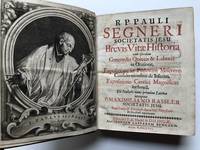
1707H4643Augustae Vindel. & Dilinae: apud Joannem Casparum Bencard 1707. Hardcover. Very Good. Published 1707 quarto 8 inches 20 cm contemporary polished dark brown calf gilt spine with raised bands red spine label 10 142 8 252 2 250 45 7 62 pp. with title pages for each new title. Very good crisp bright copy with lovely frontispiece of the author. The author an Italian Jesuit preacher was one of the most popular preachers of his time. His work included in this volume Concordia Quietis & Laboris is considered a classic on religious meditation. apud Joannem Casparum Bencard hardcover
176042569London: Printed for the Author. 1760. First Edition. Disbound. Fair. 16mo; vi 2 120 pages; Sold by T. Kinnersley in St. Paul's Church-Yard; and to be had of all other Booksellers in Town and Country. OCLC 504455151 ESTC t126448 This book lacks most of the leather backstrip and the entire rear board; the front calf covered board is present but detached. The ffep and title page are still attached to the front board; the rest of the text block are held firmly by the original stitching and remainder of the spine. Text is clean but for a couple brief pencil notes marking where the reader left off. Quite a scarce volume; a good cadidate for rebinding. "Most of the pieces in this entertaining miscellany originally appeared in Lloyd's Evening Post." These anonymously published essays skip from a reminiscence of the author's charming youthful infatuation with his nurse and a string of other women into adulthood to a day at an auction house to his arrival at Bath and an odd "exchange" of verses with one "Jack Meggot." A few years later "Honest Ranger" published a second book A Visit to the Ideal World 1763. This author who published under the psedonym "Honest Ranger" has variously been identified as Arthur Murphy or John Ingledew but is to be distinguished from the "Honest Ranger" who published the infamous Harris’s List of the ladies of Covent Garden. . Printed for the Author unknown
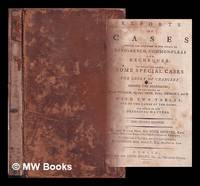
1791372230In the savoy: printed by Henry Lintot ect. 1791. First Edition. Hardcover. Poor copy bound in the original leather. Front board detached but present with the back board missing. Wear and tear as with age with loss to the spine. Text remains well preserved overall; bright and clean. Physical description; 348 pages. Subjects; Law reports digests etc. Great Britain. In the savoy: printed by Henry Lintot [ect.] hardcover
1703B7089Paris: Chez Simon Langlois c 1703. near fine with text clean and crisp. . Edition: First Edition. Binding: Contemporary full paper boards expertly rebacked; raised spine with five 5 bands black ink title on vellum label on two; central black fleur de lis design on four. Notes: Provenance: Upper pasted endpaper with owner’s armorial bookplate: “Watkin Williams Esq of Penbedw // in the County of Denbighâ€. Concerning this name Archaeologia Cambrensis states: “1789. Watkin Williams Esq. of Penbedw in the county of Denbigh but owner of property in the parishes of Mallwyd and Llan-y-mowddwy in the county of Merioneth M.P. first for Montgomeryshire and afterwards during nearly thirty years for the Flint contributary boroughs was appointed lieutenant and custos rotulorum for Merionethshire.†Final free endpaper watermarked. <br>This edition of this Canadiana publication is unique in that we are not able to locate another copy of the same anywhere. The second last paragraph of the introduction to the priests clergy and missionaries in this edition states that this publication encloses at the end of the first part or 'Rituel' a second part entitled 'les Statuts Ordonnances & Mandemens.' instructions prepared at various times by the Church for the conduct of all including those entrusted to the clergy that these instructions may not be ignored. The recipient are advised that they are restatements of instructions previously given to be read often just as such given in the Ritual itself; they are to be followed with precisions including all the rules contained not to be lost sight of observed faithfully in all works and ones conduct. The inclusion of this paragraph is unlike the introduction of another edition published at the same time and same location but not including this paragraph or the 'Statuts.'. <br>The present work describing festivals sacraments statutes and ordinances for the use by priests in Quebec is extremely rare and was immediately followed by a second edition published the same year: Gagnon reports that in a copy of the second edition of 1703 now at the Laval University library and previously owned by Abbé Plante a note says that the first edition “would have been almost completely destroyed by the sinking of the ship …carrying it to Canada and for this reason a second edition was immediately made.†<br>On the “privilege†included as the final leaf in our first edition example it is stated that the work was registered on March 30 1703 and completed for print for the first time on March 31 1703; <br><br>Saint-Valier was a supporter of the Counter Reformation. His initial intent in the New World was to engage in the conversion of the indigenous residents. He introduced Jesuits and Recollects in an attempt to evangelize New France. Many of these missions Illinois Louisiana and Mississippi resulted in conflicts between Bishop Saint-Vallier the Jesuits and the seminary of Quebec.<br><br>His various construction projects reflect a desire to restore and renew the authority in the Catholic Church as the main institution of administrative organization. In 1697 Saint-Valier built a palace in Quebec for his clergy and as a place of hospitality. During the same year he also established a nuns monastery in Trois-Rivières Saint-Vallier’s zeal for religious activities and establishments stretched from Quebec Montreal Acadia and Louisiana. His way of life embodied that of the ideals of the Council of Trent.<br><br>The Diocese of Quebec was vast and its population diverse and widespread. It included the whole of French North America or what was called New France divided in seven colonies: Newfoundland Acadia ÃŽle Royale Louisiana Illinois Upper Country and Canada inhabited by Indigenous people and the European settlers. During the tenure of Saint-Vallier immigration from France was mostly over; the European colonists were farmers fishermen sailors merchants and ‘coureurs des bois’ overseen by a small elite of aristocratic leaders but a great demographic explosion occurred between 1685 and 1730 the white population in New France jumping from c. 12000 inhabitants to c. 41500.<br><br>During the same time the number of Amerindian fell from c. 163500 to c. 61500. That loss mainly in the tribes of Louisiana was attributed to warfare and diseases brought to the valley of the Mississippi. The number of Aboriginals compared to white settlers is one reason for the presence of so many religious orders in New France. The missions and conversions to Christianity were deemed very important.<br><br>Priests of the Missions Étrangères of Paris the Jesuits the Recollets and the Sulpicians often worked in collaboration with the nuns from different orders like the Congrégation de Notre-Dame or the Canonesses of St. Augustine of the Mercy of Jesus at l’Hôtel-Dieu de Québec. The arrival of Saint-Vallier and his strong views on what should be the duties of the priests created a shock wave in the orders especially for the Seminary of Quebec newly founded by his predecessor Bishop Laval. … Saint-Vallier's tenure as bishop was defined by interminable quarrels with governmental and religious institutions in French North America. … his active leadership style brought him into conflict with various groups who perceived him as at times domineering and micromanaging.<br>While subject to much criticism Saint-Vallier was also admired in his diocese for his dedication and self-sacrifice. Rather than staying in Quebec or Montreal he tirelessly traveled the back-country. The founding of the Hôpital Général and installation of Jesuits and Recollets at Montreal were also to his credit.<br><br>There was a very strong suspicion in the colonies and in France that the Bishop of Quebec was in fact a follower of Jansenism. . In the beginning of the 18th century the Bishop wrote 3 books; the Ritual the Catechism and the ‘Statuts et ordonnances’ – two of which are bound in the present volume. <br>…the Superior of the jesuite order decided to attack Saint-Vallier’s authority by writing a long critic of those three books seeing them as a "lapse into Arianism Pelagianism Jansenism Lutheranism and Calvinism". Father Bouvart based his accusations on different passages of the works of the Bishop … who eventually appealed to the Sorbonne to have his works rehabilitated. The doctors of the Faculty of Theology declared the Ritual and the Catechism perfectly orthodox and censured the critic of Bouvart. Nevertheless Saint-Vallier decided to re-edit in 1713 the Ritual so as to cast away all doubts about his pretended Jansenist ideas. This book remained in use in the parishes until the middle of the 19th century. The present work is the unedited original and first edition of his ritual and statuts. <br><br>The disputes with the religious orders of New France the government and the merchants gave way to a more peaceful period that lasted until his death. Austere throughout his life he became more and more humble in his way of living and turned toward contemplation and simple duties. .He also took very seriously his duties of Bishop and developed parishes in the farthest corners of the diocese.<br><br> Size: Octavo 213 x133mm. Illustration: Text in French; with some text in Latin<br>Achevé d'imprimer pour la premiere fois ce 31 mars 1703. Relié avec le Rituel du même. <br><br>Illustrated with two printer's devices representing the arms of the archdiocese of Quebec; various head and tail pieces incl. vignettes; in-text music notes on Qiiii-Si; Ggii-iiii. References: Philéas Gagnon: Essai de bibliographie canadienne: Inventaire d'une bibliothèque . Volume 1: 3138 & 3139 p.437; Archaeologia Cambrensis Volume 1 p.142. Pages: Ff. 2 bl. ill. title bl. author to priests on the use of the book 4 Fetes Observe’es 4 604 table 2 errata 3 bl.; ill. title bl. letter 3 8-146 table 2 privilege 2 bl.2; In leaf collation: bl. v A-Z8 Aa-Nn8 Oo-Rr4 iiiff. table; a1 a3-a8 e8 i8 o8 u8 aa8 ee8 ii2 oo8 uu8 aaa1 ii bl. Category: Book Canada; Book Religious Christianity; Chez Simon Langlois, hardcover
1755H41295Paris: Pissot 1755. Hardcover. Very good. 6th edition. 2 of 3 volumes lacking the first volume. 8vo old or original acid-bitten calf very good light wear and rubbing to bindings contents clean and bright light foxing. 594 & 427 pp. Wikipedia: "Dubos' principle work Réflexions critiques sur la poésie et sur la peinture was published for the first time in 1719 2 vols but often reprinted in three volumes. In France it was considered an important text for the study of aesthetics and was a popular textbook until the 19th century. Like his history of the League of Cambray it was highly praised by Voltaire. The work was rendered more remarkable by the fact that its author had no practical acquaintance with any one of the arts whose principles he discussed. This work has been noted for elevating criticism to a place among the arts. Pissot hardcover
172546352Stivagii: Joannis Martini Heller Typographi & Bibliopolae 1725. Very Good. Stivagii: Joannis Martini Heller Typographi & Bibliopolae 1725. First Edition. Folio; contemporary calf over paper-covered boards with leather title label to spine; edges sprayed red; 566 8pp. index collated and complete. Contemporary library label to spine; boards lightly worn with general scuffing; cracked along top of front hinge but boards secure and binding sound; interior unmarked. A Very Good copy of a scarce title. The second volume would be published in 1731 and neither currently available in retail. Joannis Martini Heller, Typographi & Bibliopolae unknown
1771900925AGParis:, Briasson, David, Le Breton, Durand, 1771. 5 gestochene Tafeln, 2 Seiten Erläuterungen, primitive Leimheftung, Blattmaß: Tafel I: 39,5 x 26 cm. Tafeln II-V (gefaltet): 39,5 x 52 cm.
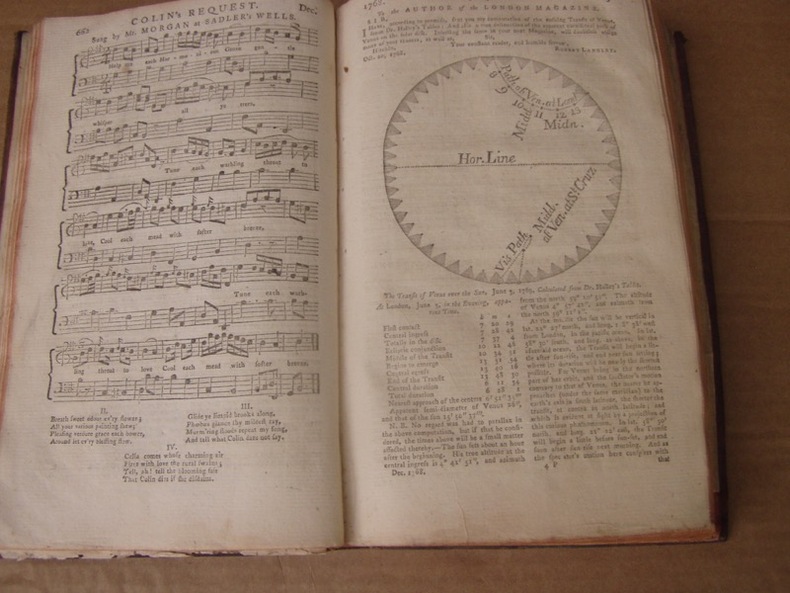
1781279281781 R. Baldwin, London.- 1 volume in8 reliure pleine basane époque,dos orné; plusieurs numéros London Magazine; pagination multiplr, dont = Scarce Revolutionary War Era Map Showing the Seat of War in the Southern Colonies- Detailed map of the Carolinas and Virginia, illustrating the progress of the American Revolutionary War, prepared by Thomas Kitchen for the June 1781 edition of the London Magazine with text- The map extends from the Chesapeake, Gloucester and Henrico Counties in the Northeast, to the Fluvanna River and the southern Alleghany Mountains and Blue Mountains in the Northwest and from the Camden and Ninety Six Districts in South Carolina in the Southwest to the Coast and the mouth of the Great Pedee River in South Carolina along the East Coast.- 13.5 x 11 inches,- and more
17903249Dumbarton Scotland 1790. Good. Folio half-sheet 1 p. 20 lines name of the recipient on verso 2 vertical and 4 horizontal folds evidence of wax seal on verso old tape repair at top margin not affecting text ink gall corrosion on outer margin affecting one word. Preserved in mylar sleeve. An extremely curious provincial Scottish letter dated 1790 which incorporates misspellings based on non-standard sociolects of the Scottish dialect. While "worthless" relics such as this were almost invariably discarded they remain of the great interest in Ortheopy the study of pronunciation. Indeed much of what is known about Vulgar Latin pronunciation is preserved in graffiti in the ruins of Pompei. <br/><br/>Concerning the content of the letter: William Steuart or Stewart writes to John Adam Esq. describing water damage to four rooms in Dumbarton Castle: two were newly painted the other two newly wall-papered. An associate suggested that he procure a carpenter in Inversnaid to the amount of GBP 35 and therefore "if you have any masonwork to do I can do it at the time."<br/><br/>The letter is signed by Steuart but was clearly dictated by him to an unnamed scribe. Our transcription of the letter retains the original spelling:<br/><br/>"Dumbarton May 24th 1790. Dear Sir<br/>I received both your letters one of the 10th & the other of the 13th curant & have noted the contents. I told Capt. Roberson what work was to be don sic at the Castle hear sic this year when he simed i.e. seemed much surprised that his hous sic was not rough cast. Ther sic is 2 rooms neu sic painted & other two neu sic pappred sic which will be quite spiled i.e. spoiled with the watter sic comin through the wall & he has wrot i.e. wrote to Campt. Rudyard about it. Last neight sic I had a letter from Mr. Young beiging i.e. begging of me to go to Inversnaid to gat sic som sic Carpenter work don sic ther sic to the amount of GBP 35 so if you have any masson sic work to do I can do it at the time. I am Dear Sir your very humbel sic Serv't" shaky signature of William Steuart. <br/><br/>Questions remain: Why go to Inversnaid to procure a carpenter This extremely tiny village was located 30 miles away from Dumbarton Castle while Glasgow was only 13 miles away. And was recipient of the present letter to be identified with the architect John Adam Esq. of Edinburgh 1721-1792 son of William Adam and older brother of Robert Adam unknown books
1777h42069Amsterdam: Jacob ben Solomon Proops 1777. Hardcover. Very good. Small quarto 10.5 x 8.25 inches mid-20th century cloth 2 volumes bound in one book contents very good and clean bookplates and signature of Solomon Freehof an important leader in American Reform Judaism rabbi at Rodef Shalom in Pittsburgh. Edition of the 16th century commentary on the Pentateuch. In Hebrew. It was first published in Belvedere near Istanbul in 1593 and with indices in Venice in 1601. Early printings of this are very uncommon. Jacob ben Solomon Proops hardcover
170266660Amsterdam: Henricum Wetstenium 1702. First Edition. Hardcover. The first edition of Broekhuizen's Elegies of Propertius. Janus Broukhusius or Jan van Broehuizen 1649-1707 was an influential classical scholar and poet whose editions of Propertius and Catullus were long influential. Many 19th and early 20th century editions of Propertius drew heavily on him including Pieter Burmann The Younger's 1780 edition completed by Van Sanlen. Brunet speaks well of the scholarship of Broekhuizen's edition Brunet III p.847; Schweiger II p.830-3. Square quarto. Cover measures 22.4 x 17.7 cm 8¾ x 7"; leaves = 21.5 x 16.4 cm. Typographic title page in black and red; second title page engraved by Mulder signed in the plate. Errata list on p.28. Pagination: 28 423 1 100 pp. Foliation: - 3 in fours 4in two A-3T in fours 3V in two. Textblock trimmed no loss. Full vellum binding possibly original certainly early with two binders blanks. Covers have blind-stamped rules and gilt lozenges. The spine is ink lettered. Slits for ribbon ties present but the ties are now departed. Fifteen possibly more pages have scholarly notes in Latin in an early hand. Very clean copy with virtually no foxing and what is there is very light and unobtrusive. Cover gilt is rubbed one small flaw in the top cover vellum. Henricum Wetstenium hardcover books
1790194448London: Printed for G. Kearsley 1790. First Edition. Hardback. Closed tear to the title. Finely and period sympathetically bound in modern aniline calf over marble boards. Raised bands with gilt cross-bands and the title blocked direct in gilt. An uncommonly good example; of presentation quality - scans and additional bibliographic detail on request.; 8vo 8"" - 9"" tall; 232 pages; Physical description; xv1232p. ; 8°. Notes; Anonymous. By Leman Thomas Rede the elder. Referenced by: English Short Title Catalog ESTCT100328. Subjects; Judges - Great Britain. Lawyers - Great Britain. London: Printed for G. Kearsley hardcover
17898793[sans lieu], [sans nom], 1789. Brochure in-8 de 45 pages.
176361466Graz, Akademische Druck- u. Verlagsanstalt, 1975 (Nachdruck der Ausgabe London, 1763). 4°. Mit zahlr. Abbildungen auf tlw. gefalt. Tafeln. 1 Bl., IV, 161, 216 S., OLwd. m. illustr. OUmschlag.
177134864London Printed For G. Woodfall Etc. 1771. Second Edition. Hardback. Finely bound all in modern aniline calf over marble boards. Raised bands with contrasting title and volume gilt-blocked labels. Spine compartments uniformly tooled in gilt. An exceptional copy - scans and additional detail on request. ; 0 pages; Edited and continued from the 1741 edition. Illustrated with 346 plates coats of arms - Plates printed on both sides. Subjects: Nobility--England--Early works to 1800. Baronetage--Genealogy England and Nova Scotia --Early works to 1800. London, Printed For G. Woodfall [Etc. ] hardcover
17941801060006New York: John Buel--for the Society 1794. Paperback. Good. Unbound. 32 pages. Perforated stamp on dedication page. Signed Gardiner Baker 1974. An early American sermon preached for the July 4th holiday. "Fair Library is ours!" Evans 27525. John Buel--for the Society paperback
17893236<br /><p>The scarce first edition of this delightful collection of moral tales attributed to the prolific children's writer Richard Johnson. Illustrations by Bewick were added to the second and subsequent editions of which there were many including four in America in Philadelphia Wilmington and New York. The author is given on the title page as 'by the editor of the Looking Glass for the Mind' which was printed by Newbery in 1787 and which was actually by the French children's writer Arnaud Berquin. It was translated by 'J. Cooper' one of the many pseudonyms of Richard Johnson.</p><p>In his preface the editor praises Berquin and other foreign writers whose books for the juvenile market 'merit the highest encomiums' and who have humbled themselves to deal in 'the plain language of youth in order to teach them wisdom virtue and morality'. The text comprises some 23 short stories of varied length style and setting including such titles as 'Juvenile Tyranny conquered' 'The Book of Nature' 'The happy Effects of Sunday Schools on the Morals of the rising Generation' 'The Happy Villager' 'The Indolent Beauty' and 'Female Courage properly considered'. </p><i>12mo 170 x 100 mm attractive engraved frontispiece and pp. vi 212 engraved title-page vignette tear to p. 85 through text but with no loss</i> <i>in contemporary plain sheep spine cracking some scuffing to covers plain spine ruled in gilt with faded ink title headcap chipped worn at extremities with the contemporary ownership inscription of Ann Elliot on the front pastedown.</i><p>Roscoe J39 1; Osborne II 900. </p> Elizabeth Newbery