180 résultats
1783B6593Ingoldstad Germany : Anton Attenkhouer c. 1783. . A very good example occasional minor browning. Edition: Second edition of Henrich Palmaz Leveling's German Binding: Full recent panelled calf triple gilt outer borders on speckled natural calf; central blind-stamped green panel; spine raised with five 5 bands; titles on two and four and compartments with central gilt ornament dated. Notes: Text in German. Gothic Script.<br>Second edition of Henrich Palmaz Leveling's German translation or Ingolstadt edition after the first of 1781.<br>This second Ingolstadt edition of only 1500 exemplars features beyond twohundred 200 in-text engravings printed from Vesalius’s original woodblocks; the woodblocks were destroyed during the WWII bombings of Munich. Leveling not only translated this work but introduced updated information often relying on the French Winslow as information source. Size: Folio 396x274mm. Illustration: Illustrated woodcut title depicting the dissection lecture hall; printed title with engraved vignette of the portrait of Heinrich Palmatius Leveling flanked on either side by the staff of Aesculapius and a skeleton respectively; headpieces at 2 A1 Bb1 Xx1 Nnn Yyy2r Ccc1r; and tailpieces at Q1 Bb1 Uu1v Eee2 Mmm2v Yyy1v Bbbb2v Hhhh2v 1v or final leaf; ornamental Gothic initials on title and dedication; in-text partial page illustrations at A1 A2v B1r 3 B2r B2v C1r 2 C1v 2 C2r D1r D1v D2r 2 D2v2 E1r E2v 2 F2r 2 G1r G2r 3G2v 3 H1v2 H2r 3 H2v2 I1r3 I2r 4 I2v3 K1v K2r5 L1v L2r6 L2v3 N1v2 O1v2 Nn1r Qq2r Ss1v2 Ss2v Tt1r8 Uu1r Zz1v 2 Aaa2v Bbb2v 2 Ccc1v Ccc2r Ggg2v Iii2v Lll2v Ooo1v Ppp2r Ppprv Qqq1v Qqq2v Rrr1v2 Rrr2r 2 Sss1v Xxx1v Xxx2v 2 Yyy1r Yyy2r Zzz2r Zzz2v Aaaa1r 2 Aaaa2r Aaaa2v 2; in-text half page illustrations often consisting of multiple illustrations at: A1v A2v F1v9 H1v H2r I2v K1v 5L1r2 M1v2 M2r4 M2v O2r15 Q1r Rr1r Rr1v Rr2v Ss1r Ss2r2 Tt2v Xx1r Zz2r Fff1r Nnn1r Nnn2r Ooo1r Ppp2r Qqq2r Sss2r Ttt1v Uuu1r Uuu2r Xxx2r Yyy2v Cccc1r Cccc2r Cccc2v Dddd1v Dddd2r Eeee1r Eeee2r Ffff1r Gggg2r Gggg2v Hhhh1v; in-text full page illustrations at: F1r N2r13 P1r P1v P2r Bb2r Cc2r Dd2r Ee2r Ff2r Gg2v Jj17r Jj2v Kk2v Ll2v Mm2v Nn2v Oo2r Pp2r Xx2v Zz2v Ccc2v folding Eee2v Fff1v Iii2v Kkk1r Mmm12 folding Ooo2v; <br>Moreover two double-paged woodcuts insert of Adam and Eve at Iiii2v. <br> Volume: Seven books in one volum Provenance: Signature: “H.Linder // 1875†on the margin of the upper free endpaper; Stamp on verso of final leaf: “Henry Linder //SCULPTOR Studio … // NEW-YORK.†Some of Linder’s work 1854-1910 renowned New York sculptor is exhibited at the Smithsonian America References: Choulant-Frank 185; Cushing VI A.15; Heirs of Hippocrates 1042; Osler 573; Waller 5752 Pages: Ll: Bl. 2 ill title printed title with portrait vignette of Leveling dedication 3 x1-xx2 preface x1-2 index; A1-Z2 Aa1 1st book Bb1-T2 U1 2nd book ; Xx1-Eee2 3rd book Fff1-Mmm2 4th book Nnn1-Yyy1 5th book Yyy2-Zzz2 Aaaa1-Bbbb2 6th book Cccc1-Hhhh2 7th book Iiii1-2 2 folding plates- of Adam and Eve Kkkk1-Oooo2 summarische Abhandlung 1-2 1 Index; bl.2. Category: Book Medical; Anton Attenkhouer, unknown
17161469Haarlem: Weduwe van Hermanus van Hulkenroy 1716. Early 19th-century marbled boards with a paper title label on the spine. 4to. With an etched frontispiece an etching of a mermaid on the title 2 folding etchings 2 full-page etchings and 21 etchings in the text all after Adriaen van Ostade. Further with musical annotation to all songs. First edition of a rare Dutch songbook with songs for farmer's festivals all with musical annotation. The work has been beautifully illustrated with etchings after the famous Dutch painter of country life Adriaen van Ostade 1610-1685. The fine etchings newly made and in reverse present an exemplary survey of Van Ostade's work showing busts of peasants women on their way to the market carrying baskets farmers smoking merry parties dancing in front of the farm a knife-grinder a schoolmaster etc. Together they give a lively impression of country life.The work was published anonymously but has been attributed to either Jan van Gijsen 1668-1722 or Aäron van Hulkenroy 1687-1733. Van Gijsen was a popular author who wrote a large number of occasional poems. His collected works were published at Amsterdam in three volumes in 1707-1711 but the present selection was probably published only once partly with the address of the Widow of Van Hulkenroy and partly with the address of J. van Egmont who had also published the collected works. Aäron van Hulkenroy was the son of publisher Hermanus van Hulkenroy and took over the publishing company after both his parents had passed. He was also a poet who wrote various poetry collections which were always published by his mother or later himself. The present work has been attributed to him because the very first poem on the verso of the half title is signed with his initials.The boards and spine are rubbed with some loss of material at the lower outer corner of the front board. The leaves and plates are somewhat foxed a small tear in the margin of first folding plate has been repaired on the back. Otherwise in good condition.l Goovaerts 1011; Cat. Muziekhist. Museum Scheurleer II p. 92; Scheepers I 284 "Hoogst zeldzaam"; Scheurleer Liedboeken 199 lists both 1716-issues; STCN 154032301; cf. Hollstein XV pp. 1-70 for the etchings; NNBW 8 col. 648 Gijsen and NNBW 4 col. 790 Hulkenroy; not in Arents Tobacco. Weduwe van Hermanus van Hulkenroy, hardcover
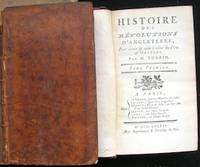
1786NS0165Paris Chez. M.DCC. LXXXVI 1786. This is a continuation of the history of "Revolutions in England" by the Jesuit Pierre D'Orleans first published 1695. This <i>Histoire</i> is the story of the Stuarts as rulers and pretenders considered as the legitimate Catholic rulers of England unfairly usurped. Turpin continues the story from the expulsion of James II through efforts to recover the throne. The rarity of these volumes may reflect the fact that France faced a more violent revolution within three years and neither side cared much for the fate of the Stuarts after that. Cioranescu 18th 62562. Hard Cover. Two volumes: 4 leaves xliv pages 4 leaves 446 pages; 4 leaves 439 3 pages; 17.5cm.; 12mo. Bound in full contemporary leather. Vg/ spines worn. Stock#NS0165. Chez... M.DCC. LXXXVI. hardcover
1713E0012Paris: Chez les T'Serstevens 1713<br /><br /> 2 volumes: i-x44816 pages with illustrations 2 folding maps and index; iv28516 pages with illustrations folding map and index. Duodecimo 6 1/2" x 4 1/4" bound early calf with labeled spines. From the Society of Writers to the Signet. European Americana 713/77 this edition not in Sabin Early French edition. Rare French edition of one of the most famous books of the period Exquemelin's account of the adventures life morals and customs of the pirates roaming the seas together with a full description of the Caribbean where they mainly operated. The French edition was just like the Dutch edition directly based on the original manuscript and was adapted by Thomas de Frontigniers. Alexandre Olivier Exquemelin called Oexmelin by the French was a chemist of French Protestant origin who spent several years with the pirates as a ship's surgeon. He took part in their daring exploits like the expeditions of the notorious English buccaneer Henry Morgan called John in the book including his raid on Maracaibo in 1669 or a year later his attack on Panama. The first edition of Exquemelin's eye witness account was published in Dutch in Amsterdam by Jan ten Hoorn in 1678 an edition so rare that it long escaped bibliographers. Exquemelin who once before in 1672 had shortly been in Amsterdam returned there in 1677 to take the 'chirurgijn' exams he sorely needed to exercise this profession at Jamaica where he had settled and in 1679 he made his last 'proof'. Meanwhile he also offered his manuscript to the publisher's Ten Hoorn who printed it in 1678. The book became immediately so polular that editions were published everywhere. The Spanish edition of 1681 probably also published in Amsterdam was long taken for the first. The first French edition was published two years before the present but both editions are equally extremely rare. In 1684 Exquemelin had sailed for France and the captain of the ship impressed with his stories saw to it that Exquemelin's manuscript was made ready for publication. The French edition altough seemingly much the same as the first Dutch edition from which most translations were made proves by closer comparison to be considerably enlarged. Several extra chapters are added mostly treating the natural history of the Spanish Americas and the romantic figure of Monbars is found here for the first time. For both the Dutch and French editions Exquemelin's manuscript had been adapted but according to De la Fontaine Verwey has kept the French edition the closest to the original. The illustrations for the French edition were newly made as well and where the Dutch edition mainly shows the portraits and atrocious acts of the pirates the plates of the French edition pay more attention to the geographical and natural historical aspects including for the fist time the plate with a buccaneer in hunting costume. Another plate shows the catching of turtles at night and the illustration in the text shows a sea-cow of which Exquemelin made a special study. The maps were also newly designed with the help of AbbBaudrand who wanted to remain anonymous; they include a map of the Isthmus of Panama drawn by Exquemelin himself. The book therefore is an important 'Americanum' as well. Of special interest are the two "Appendices" with an account of the possessions revenues and offices of the Spaniards in America including a complete list of all ecclesiastical functionaries in Spanish America together with their salaries. No book in any language was ever the parent of so many imitations and the source of so many legends and it still is popular today. The Society of Writers to Her Majestys Signet is the oldest legal society in the world. It is a private society of Scottish solicitors. The Society dates back to 1594 and is part of the College of Justice. Writers to the Signet originally had special privileges in relation to the drawing up of documents which required to be signeted but these have disappeared and the Society is now an independent non-regulatory association of solicitors most of whom are based in Edinburgh. Members of the Society. Condition: Joints begining gilt embossed stamps of the Society of Writers to the Signet on front boards 4 leaves of Volume II soiled and slightly defective along outer margins; book plates on front pastedowns 3 folding maps each with moderate browning and very short closed tears else about a very good set. . Early French Edition. Full-Leather. About Very Good. Duodecimo. Chez les T'Serstevens hardcover books
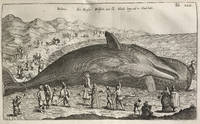
1767S13771Heilbronn:: Franciscus Josephus Eckebrecht 1767. 1767. Tall 4to. 335 x 211 mm 228 4 pp. 47 plates; text with some foxing. Original paper over boards. Housed in a custom clamshell box. Rare. FINE. An extensive work on the morphology of boned fish cartilaginous fish sharks rays skates and cetaceans. This work is illustrated with forty-seven full-page engraved plates that are executed in superb form. Plate XLII shows a beached baleen whale and its enormous size compared to the men in the engraving. A bit fanciful plate XL shows a pair of Mermen; a fish on plate XXVII has the features of a human face whilst a 'shark' on plate VII has semi-human fore-limbs. Except for these anomalies the zoological drawings are quite dramatic and relatively accurate. Jonston's works were frequently re-edited and translated into German Latin Dutch and English. Born in Poland but of Scottish origin Jonston was educated and traveled extensively. He attended St. Andrews 1623-5 studying botany and medicine at Cambridge Leiden and Frankfurt Universities. He earned degrees from Cambridge and in Leiden his M. D. in 1632 where he later practiced medicine and gained a great reputation. In 1642 he briefly taught at Frankfurt as professor of medicine. He retired to his private estate in Silesia in 1655. His "four dictionary-style works on fish birds quadrupeds and insects -- published between 1650 and 1653 with excellent illustrations -- were widely read and translated." DSB. BM Readex Vol. 13 p. 765; DNB Vol. X pp. 968-9; DSB Vol. VII p. 164-5; Nissen 2133. See Garrison and Morton 287. Franciscus Josephus Eckebrecht, 1767. hardcover
1767S13771Heilbronn:: Franciscus Josephus Eckebrecht 1767. 1767. Tall 4to. 335 x 211 mm 228 4 pp. 47 plates; text with some foxing. Original paper over boards. Housed in a custom clamshell box. Rare. FINE. An extensive work on the morphology of boned fish cartilaginous fish sharks rays skates and cetaceans. This work is illustrated with forty-seven full-page engraved plates that are executed in superb form. Plate XLII shows a beached baleen whale and its enormous size compared to the men in the engraving. A bit fanciful plate XL shows a pair of Mermen; a fish on plate XXVII has the features of a human face whilst a 'shark' on plate VII has semi-human fore-limbs. Except for these anomalies the zoological drawings are quite dramatic and relatively accurate. Jonston's works were frequently re-edited and translated into German Latin Dutch and English. Born in Poland but of Scottish origin Jonston was educated and traveled extensively. He attended St. Andrews 1623-5 studying botany and medicine at Cambridge Leiden and Frankfurt Universities. He earned degrees from Cambridge and in Leiden his M. D. in 1632 where he later practiced medicine and gained a great reputation. In 1642 he briefly taught at Frankfurt as professor of medicine. He retired to his private estate in Silesia in 1655. His "four dictionary-style works on fish birds quadrupeds and insects -- published between 1650 and 1653 with excellent illustrations -- were widely read and translated." DSB. BM Readex Vol. 13 p. 765; DNB Vol. X pp. 968-9; DSB Vol. VII p. 164-5; Nissen 2133. See Garrison and Morton 287. Franciscus Josephus Eckebrecht, 1767. hardcover books
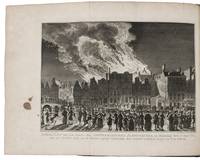
17723909Amsterdam: Gerrit Warnars and Petrus den Hengst 1772. Contemporary marbled calf gold-tooled spine and board edges red sprinkled edges. 4to. With an engraved frontispiece a small engraved illustration by Noach van der Meer II on both title-pages 4 folding engraved plates of the old theatre; 5 folding engraved plates of the new theatre all engraved by the publishers after designs by Van der Meer and 1 by Simon Fokke. 2 works in 1 volume. Large-paper copies of the first editions of two works on the schouwburg theatre of Amsterdam the first on the old theatre which burned down in 1772 and the second on the new theatre which was built on the Leidseplein and finished in 1775. The large engraved plates show the exterior of the new theatre together with the surrounding buildings and with people on the foreground and the interior of both the theatres the balconies and stages. Two plates depict the old theatre going up in flames and another plate shows the ruins. The text gives a history of both the theatres including a description of the building process the restorations and renovations the staff the stage equipment lightning decor hoist tools costumes etc. and also including a vivid description of the fire. The first work is often ascribed to Jan Fokke but both works are also frequently ascribed to Myndert de Boer who wrote the long poems in both works.With bookplates. Binding rubbed along the extremities slightly worn at the head and foot of the spine. The plate of the external fire with a large tear some occasional spots and stains but otherwise in very good condition.l Van Aken III p. 65 & 70; Muller Historieplaten 4253a & 4283a; cf. Sluijter-Seijffert "De Amsterdamse schouwburg van 1774" in: Oud Holland XC 1 1976 pp. 21-64. Gerrit Warnars and Petrus den Hengst, unknown
1702007452Augsburg 1702. First Edition. Full Straight-Grained Morocco. Very Good. A fine collection of highly detailed Baroque copper engravings. 8vo. 18.5 by 13 cm. 188 leaves of plates. Plates most often have two copper engraved illustrations each approximately half the page but a good number of plates two or more smaller vignettes in lieu of a larger rectangular illustration in the bottom half of the page. There are also an abundance of title pages -- these are included in the pagination -- with two title pages per section each with a frontis and also a title for the work overall. Well over 300 separate illustrations. Printing on only one side of each leaf. Condition: rubbing along joints and some other scratches and wear to straight grained morocco. Scattered foxing and/or other soiling never disconcerting fortunately. A few short-ish closed tears. unknown
1765900929AGParis:, Briasson, David, Le Breton, Durand, 1765. 64 gestochene Tafeln, 25 Seiten Erläuterungen, primitive Leimheftung, Blattmaß: je 43 x 27,5 cm.
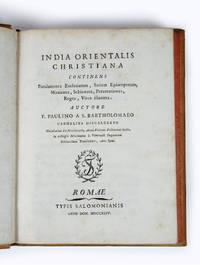
17943703905Rome: Typis Salomonianis 1794. Three works bound together quarto the first main work with folding map 2 plates and an engraved portrait vignette with two shorter pamphlets 24 & 26 pp.; an attractive copy in contemporary patterned vellum boards spine banded red morocco spine label faded. <p><p>Three works by Paulinus including his important India Orientalis Christiana a study of and introduction to the Carmelite missions in India in the late eighteenth century in a particularly attractive contemporary binding. The work is illustrated with two plates and a fine map of India as well as a smaller vignette portrait of Paulinus himself. Paulinus of St Bartholomew 1748-1806 also known as Johann Philipp Werdin or Wesdin was a missionary and orientalist. A member of the Carmelite Order in 1774 he was sent to India Malabar where he was appointed vicar general of his order. In 1789 he was recalled to Rome in order to report on the mission and given the task of preparing books for the use of missionaries.</p> <p>One of the first Orientalists to note and work on the close relationship between Indian and European languages Paulinus was the author of many learned studies on the east and is best known for having published the first Sanskrit grammar. As an antiquarian who worked from original sources he was fortunate to have the patronage of Cardinal Stefano Borgia 1731-1804; a good Borgia whom he served as private secretary and who financed many of his publications. Both men served long periods on the Congregatio de Propaganda Fide a body preoccupied with exotic languages insofar as they impacted on spreading the christian gospels but also in understanding exotic theologies. In this context the Propaganda Fide was a central recipient of missionary collecting in the field which gave Paulinus exceptional advantages which enabled him to undertake extensive linguistic studies.</p> <p>After Borgia's death his remarkable library and museum were gradually distributed with the important biblical manuscripts mostly being added to the Vatican libraries after the secular materials had chiefly made their way to the national library of Naples.</p> <p>The two rare pamphlets bound in here are both concerned with Borgia's museum: Scitismo Sviluppato. del Museo Borgiano Rome c. 1793 and Lettera. del Museo Borgiano Rome same period both written in Italian not Latin and both discussing the Museo Borgiano. Borgia was particularly expert on Coptic relics but here Paulinus discusses early Brahmanic and other Indian manuscripts in his collection.</p> <p>All of these works are rare although as often the pamphlets are the scarcer. Worldcat lists some 10 copies of the India Orientalis Christiana 2 copies of the Scitismo and only 1 of the Lettera.</p> </p> . Typis Salomonianis unknown
17102501100018xbvkAmsterdam, Offizin Hendrik Wetstein, 1710. Copperplate-titlepage, printed titlepage in red and black with woodblock flower-bucket; (8) 315 pages, 1 blank sheet; ALL ON UNTRIMMED PAPER. - Vellum-binding with gilt-titled red spinelabel; small-8vo.(ca. 16 x 9 x 2 cm).
1762B6600Romae: Veneunt apud Auctorem in ædibus Comitis Thomati via Felice prope templum SS. Trinitatis in Monte Pincio; c.1762. Fine thick laid 18th century Italian paper with wide margined paper watermarked engravings; spine and corners worn – A handsome and attractive example plates are clean and crisp. Binding: Contemporary half calf; double gilt fillets bordering marbled boards; spine with five 5 matching gilt fillets on raised bands embossed gilt lettered title on two and four; pasted and free endpapers marbled; all edges marbled. Notes: Text in Latin and Italian.<br>This work was dedicated by Piranesi to one of his highly esteemed co-workers during the 1750’s Robert Adam. Concerning this Rome 1762 edition Luigi Ficacci states: “Edition Rome 1762. Engraved title on the title page: The Campus Martius of Ancient Rome the Work of G. B. Piranesi Fellow of the Royal Society of Antiquaries London. The Latin title page bears the title the date of the edition and the dedication to Robert Adam. The address is: “Veneunt apud Auctorem in aedibus Comitis Thomati via Felice prope Templum SS. Trinitatis in Monte Pincioâ€.<br>The volume is composed of 2 title pages Latin and Italian whose sequence varies according to the copy 2 ornamented letters 4 vignettes 42 plates by Piranesi 5 of these plates are composed of several copperplates and 1 engraved by Vesterhout 68 pages of text in Italian and Latin preceded by 6 pages of dedication to Robert Adam and followed by 29 pages of indices. …<br>The genesis of the work goes back to the second half of the 1750s: its publication is announced as imminent in the first volume of Antichita Romane 1756. The large Plan of Campo Marzio and 6 copperplates “Ichnographia†or plan of the Campus Martius ill. 493 executed in collaboration with Robert Adam and dedicated to him is dated 1757 on the plate. The approbatio is dated 1761. The plate by Vesterhout plate XXXI … reproduces the technical solution adopted by Carlo and Francesco Fontana for restoration of the Column of Antonius Pius in 1705.â€<br><br>Plate XXXI depicting the excavation of the Antonine column in 1705 was signed by both its engraver Arnold Van Westerhout or Vesterhout and by its designer and artist Franciscus Fontana. <br>The second illustrated title or title in Italian reads: 'Il Campo Marzio Dell'Antica Roma'.<br><br><br> Size: Folio 542 x 406mm. Illustration: Copper engravings with illustrated title in Latin illustrated title in Italian two half-page head-piece vignettes opening dedication at a1v-2r; two engraved decorative copper initials opening the text at A1v and A2r; two large end-piece vignettes at R2v and R3r; moreover Tab. I-XLVIII with fifty-two 52 copper engraved plates; these include: a double-page plate numbered XXXII two triple or oversized folding plates numbered II and XXXI; a larger oversized engraving 1500x1500mm encompassing plates V-X forming the plan of the Campus Martius; a single page numbered XLVIII depicting three copper plates entitled “Elevazione de’ Teatri…†“Elevazione del Pantheon…†and “Elevazione dell’ Anfiteatroâ€; single pages two half-page copper plates each - numbered XII entitled “Hypsographia…†and “Sectio…†and XLVI entitled “A Reliquiae…†and “Orthographia…†respectively; the remaining copper plates full or single page sized. Provenance: Upper marginal corner of upper pasted endpaper with sticker reading “C.E.Rappaport // Libri Rari // Romaâ€- References: Luigi Ficacci pp. 394-431; Focillon 1964: 428-479; Hind 1978: 85; Millard iv 2000: 91; RIBA Early Pr. iii 1999: 2551; Wilton-Ely 1994: 559-612. Pages: Ll: Bl. 2 Illustrated title in Latin illustrated title in Italian a1-b2 with dedication A1-Q2 R1-3 with approbation and explanatory texts; a1-c2 with Index ; 1-2 1-3 with catalogues; illustrations: Tab.I-XLVIII; bl. 2. Category: Book Art Architecture & Design; Book Europe Italy; Book Plate Books General; Book Antiquities; Veneunt apud Auctorem in ædibus Comitis Thomati via Felice prope templum SS. Trinitatis in Monte Pincio; hardcover
1770B6607Romae/Rome: Veneunt apud Auctorem in ædibus Comitis Thomati via Felice prope templum SS. Trinitatis in Monte Pincio; watermarks indicate: c.1770’s-1790’s. Plates and text crisp and clean near fine. Thick wide margined paper. Binding: Contemporary half calf with marbled boards; spine with five 5 blind raised bands flanked by gilt tooling; gilt lettered title on Morocco label on two; contemporary pasted and free endpapers; all edges speckled red. Notes: Text in Italian; captions in Latin.<br>This work was dedicated by Piranesi to one of his highly esteemed co-workers during the 1750’s Robert Adam. Concerning the Rome 1762 edition Luigi Ficacci states: “Edition Rome 1762. Engraved title on the title page: The Campus Martius of Ancient Rome the Work of G. B. Piranesi Fellow of the Royal Society of Antiquaries London. The Latin title page bears the title the date of the edition and the dedication to Robert Adam. The address is: “Veneunt apud Auctorem in aedibus Comitis Thomati via Felice prope Templum SS. Trinitatis in Monte Pincioâ€.<br>The genesis of the work goes back to the second half of the 1750s: its publication is announced as imminent in the first volume of Antichita Romane 1756. The large Plan of Campo Marzio and 6 copperplates “Ichnographia†or plan of the Campus Martius ill. 493 executed in collaboration with Robert Adam and dedicated to him is dated 1757 on the plate. The approbatio is dated 1761. The plate by Vesterhout plate XXXI … reproduces the technical solution adopted by Carlo and Francesco Fontana for restoration of the Column of Antonius Pius in 1705.â€<br> Size: Folio 542x406mm. Illustration: Etched copper engravings with illustrated title in Latin illustrated title in Italian ornamental head-piece and engraved decorative copper initial at A1r; the initial opens the text. Tab. I-XLVIII plus three full page engravings entitled “Sepulchrum Mariae Honorij Imp. Uxoris …†“Labrum aegyptiacum porphyreticum…†and Nonnulla monumenta sepulcralia quae recensentur…â€; these 51etchings include double-page plates numbered V-X forming the plan of the Campus Martius and one double page plate # XXXII; two triple or oversized folding plates numbered II and XXXI; a single page numbered XLVIII depicting three copper plates entitled “Elevazione de’ Teatri…†“Elevazione del Pantheon…†and “Elevazione dell’ Anfiteatroâ€; single pages two half-page copper plates each - numbered XII entitled “Hypsographia…†and “Sectio…†and XLVI entitled “A Reliquiae…†and “Orthographia…†respectively; the remaining copper plates are full page in size. Plate XXXI was engraved by Vesterhout after Fontana.<br>Thick wide margined paper; many watermarks pointing this Roman edition to the time frame of 1770’s -1790’s. Examples of watermarks: an unlisted on both free endpapers with an inner fleur de lis design within a circle; #19 1790’s at plate 43; #68 probably 1790’s at plate 35; #59 mid 1770’s -1790’s at plates 31 and 32; #64 1790’s also on plate 31; # 12 late 1780’s -1790’s at plate 30; #14 mid 1761 or #16 1790’s at plate 29; #59 mid 1770’s -1790’s and 64 1790’s at insert plate 21 entitled Scenographia Machinae qua Clemente XI. Pont. Max. An. D. MDCCV; #74 1790’s on unnumbered plate entitled “Sepulchrum Mariae Honorij Imp. Uxoris†generally featured as headpiece vignette of the Latin text.; #12 late 1780’s -1790’s on unnumbered plate entitled “Labrum aegyptiacum porphyreticum…†here as full plate otherwise a headpiece of the Latin text. <br>Plate XXXI depicting the excavation of the Antonine column in 1705 was signed by both its engraver Arnold Van Westerhout or Vesterhout and by its designer and artist Franciscus Fontana. The second illustrated title or title in Italian reads: 'Il Campo Marzio Dell'Antica Roma'.<br> References: Luigi Ficacci pp. 394-431; Focillon 1964: 428-479; Hind 1978: 85; Millard iv 2000: 91; RIBA Early Pr. iii 1999: 2551; Wilton-Ely 1994: plates 559-612. Pages: Ll: Bl. Illustrated title in Latin A1-H2 a1-c2 with catalogue and indices; illustrated title in Italian; Tab.I-XLVIII plus three full-leaf unnumbered plates bl. Category: Book Art Architecture & Design; Book Europe Italy; Book Antiquities; Book Plate Books General; Veneunt apud Auctorem in ædibus Comitis Thomati via Felice prope templum SS. Trinitatis in Monte Pincio; [ watermarks indicate: hardcover
1706B6518Paris / probably Amsterdam: Gedrukt tot Parys inde Koninglyke druckery van den klyne Louis Carel Allard. Imprime a l'Imprimerie Royal du petit Louisâ€. Circa 1706. Very rare and desirable overall plates are crisp and clean; corner of title and edges of some plates slightly darkened; corner torn off at plate 13. . Notes: An important work on the War of the Spanish Succession with a collection of prints by Carel Allard or “Petit Louis†ridiculing the “Sun King†or Monarch Louis xiv in eclipse. Many of Allard’s prints initially separately were published in sets of varying combinations – including the present ‘Almanach’. For instance the Rijksmuseum owns a copy of a later 1713 publication entitled 't Lust-Hof van Momus Beplant met de voornaamste Gewassen van Mars in Europa Een opgepronkt met Staat-kundige Zinnebeelden Des Tegenwoordigen Oorlogs’ by Abraham Allard in which most of the prints of the present work are incorportated. Carel Allard known for depicting royalty inspired other later publications such as satirical engravings in the ‘South Sea Bubble’ published approximately a decade later. Muller comments on the rarity of the prints and the present series; only few known copies exist mainly owned by institutions; Muller states: "Their value as expressions of the spirit and life of the common people is inestimable: indeed there is almost no period in our history for which we possess such a rich treasure of prints." <br>While the title states that the publication was printed in Paris researchers claim the place of editing and printing to be Amsterdam that not the royal imprimerie of ‘Petit Louis’ was used but the printing house of Carol Allard in Amsterdam. Moreover it is claimed that Allard edited the work in Amsterdam. <br> Size: Small Folio 317 x206 mm Illustration: Text in Dutch and French.<br>Illustrated with engraved letterpress copper title and eighteen 18 copper engraved plates; of these seven 7 full page with letterpress text and eleven 11 double page; all accompanied by text each in Dutch and all except for the fifth entitled ‘DE FRANSCHE EN SPAANSCHE HUYLEBALKEN’ and the eighteenth entitled ‘HARPAGON den Ouden Schrok EN HARLEKYN Smit’- all in French. Work on the War of the Spanish Succession ridiculing the Sun King. Provenance: Pencilled and ink notations and signature on upper pasted and free endpaper References: Brunet I: 194-195; Cohen: col. 28; Muller F: ‘De Nederlandsche Geschiedenis in Platen - Beredeneerde Beschrijving van Nederlandsche Historieplaten …’ 1863-70 vol.1: xiii-xv; vol 4: 36 3037/3067/ 3068/3082. Pages: Ff: bl. title 7 full page plates 11 double page plates. Category: Book Caricatures; Book Plate Books General; Book Europe Benelux; Gedrukt tot Parys inde Koninglyke druckery van den klyne Louis [Carel Allard]. Imprime a l'Imprimerie Royal du petit Louisâ€. unknown
17527865Prag, Johann Carl Hraba, 1752. 4 Bll., 136 S., 3 Bll. (Register). 1 Kupfer-Frontisp. und 15 Kupfertafeln. Gr.-8°. Ldr. der Zeit auf 5 Bünden mit Rückenschild (beschabt und etw. bestoßen, oberes Kapitel mit kl. Einriss, kl. Bibliotheksschidchen am vorderen Deckel).
17870056311787 Paris et Liège, desoer, 1787. In-8 (203 X 130 mm) veau fauve granité, dos à nerfs, caissons dorés ornés de fers dorés, chainettes dorées en queue, pièce de titre maroquin fauve, coupes et coiffes filetées or, tranches rouges (Reliure de l'époque) ; XXXII-380 pages, (1) f. blanc. MANQUE le premier feuillet de faux-titre.
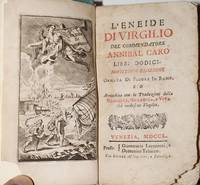
1750002388Venezia: Giammaria Lazaroni e Domenico Tabacco 1750. Pebbled Half Cloth Faux Leather over Paper Pastedown on Boards. Good Minus. 8vo. 20 568 pp. With fifteen woodcut plates with frontis one for each canto of the Aenied and one for the Bucolica and Georgica respectively. Some soiling throughout. All leaves of the Bucolica and a few of the Georgica have severe wormholing in the lower corner with only trivial touching of text. A few other leaves have corners overtrimmed or with loss. Still an uncommon edition with only three copies located on OCLC. Giammaria Lazaroni, e Domenico Tabacco unknown
1750002388Venezia: Giammaria Lazaroni e Domenico Tabacco 1750. Pebbled Half Cloth Faux Leather over Paper Pastedown on Boards. Good Minus. 8vo. 20 568 pp. With fifteen woodcut plates with frontis one for each canto of the Aenied and one for the Bucolica and Georgica respectively. Some soiling throughout. All leaves of the Bucolica and a few of the Georgica have severe wormholing in the lower corner with only trivial touching of text. A few other leaves have corners overtrimmed or with loss. Still an uncommon edition with only three copies located on OCLC. <br /><br /> Giammaria Lazaroni, e Domenico Tabacco hardcover books
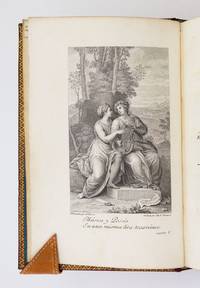
1779ST19371Madrid: Imprenta Real 1779. FIRST EDITION. 235 x 150 mm. 9 1/4 x 6". 10 p.l. 126 XL pp. 1 leaf errata. <br/> EXCELLENT CONTEMPORARY CRIMSON MOROCCO BY DEROME LE JEUNE his ticket with address of Rue St. Jacques on verso of front free endpaper covers framed with thick and thin gilt rules raised bands spine compartments with central floral sprig surrounded by a lozenge of small tools volute cornerpieces gilt titling gilt-rolled turn-ins gilt edges cobalt blue paste-paper endpapers. WITH SIX CHARMING ENGRAVED ALLEGORICAL PLATES after G. Ferre. Front pastedown with morocco bookplate of Mortimer L. Schiff and small book label with a gilt cipher on a red peach. A Large Paper Copy. Palau y Dulcet IV 107; RSIM B VI 429; MGG VI 1403 f.; Gregory-Bartlett I 129. Three minute dents to front board a hint of wear to bands and corners isolated faint foxing blank recto of frontispiece leaf and blank verso of final leaf with faint blue shadown from endpapers but all of these quite trivial and otherwise A BEAUTIFUL COPY--fresh clean and bright internally with very wide margins and strong impressions of the plates and in a lustrous binding showing with few signs of use.<br/> <br/> This is surely one of the handsomest poetical treatises on music ever produced and it is offered here in a binding done by one of the finest craftsmen working in Europe during the period of the book's publication. The work is written in the "silva" form of poetry used by persons of high rank illustrated with fine engravings and put into elegant morocco by the finest hands among the large Derome family of binders. According to Palau our first edition is "beautiful and printed on fine paper." He says further that although the strongly expressed opinions of the youthful author on contemporary composers caused the work to be "unfairly attacked" it was "appreciated by professors of music and collectors of literature in that genre" especially in Italy and America. A child of the Enlightenment Iriate 1750-91 gained entry to intellectual and artistic circles in Madrid through his uncle who was librarian to the king of Spain. He translated works by Horace and Virgil into Spanish by royal request and wrote criticism poetry and dramas. He is best known for his satirical fables on the contemporary literary scene "Fábulas literarias." There were no fewer than 18 members of the Derome family who made their livings as binders in Paris from the middle of the 17th century until the first quarter of the 19th but by far the most distinguished family member was Nicolas-Denis called "le jeune" 1731-88. Known for the gracefulness of his bindings and for being capable of "amazing delicacy" in Hobson's words Derome le jeune was simply the leading binder of the day and his work was much in demand. Because he refused to turn away customers Derome was forced to hire a number of assistants whose work he could not always supervise closely. However Thoinan says that the binder's best work is indicated by the presence of his ticket as here. The volume's provenance adds to its luster: it was in the distinguished library of American bibliophile Mortimer Schiff 1877-1931. In Dickinson's words Schiff a financier and philanthropist Schiff "brought together an unrivaled collection of decorative bindings." His library included works by great printers important illustrated books and works printed on vellum but chiefly fine and historic bindings. The "Reliures" database of the Bibliothèque Nationale de France commends Schiff for assembling "one of the most important inter-war libraries" noting that his collection was "renowned for its collection of French bindings.". Imprenta Real unknown
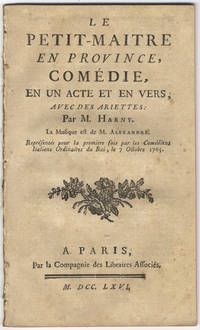
176626741Paris: La Compagnie des Libraires Associés 1766. Octavo. 1f. title 3 preface 4 named cast list 5-34 pp. With decorative woodcut head- and tailpieces to pp. 5 and 33.<br/><br/>Disbound. Very light foxing and mottled browning title and p. 34. Rare. Not in Sonneck. Worldcat 3 copies only at Cornell Southern Methodist University and the National Library of Australia. This edition contains the one-page preface which appeared in the 1765 edition published by Duchesne.<br/><br/>Le petit-maître was first performed at the Comédie-Italienne in Paris on October 7 1865. "The opera which exposed the morals of 18th-century society was performed 12 times in the first month and was praised by the Mercure de France for being in the French taste." Barry S. Brook et. al. in Grove Music Online. La Compagnie des Libraires Associés unknown books
1775BOOKS050960IParis: Chez Clousier 1775. HC. very good full calf raised bands hardcover EXCEPTIONAL !!. engravings by C. Boissel. Title translates roughly to: "The Philosopher without Claim or the Rare Man Works Physical Chemical Political and Moral." A curious work of science fiction in which the author expounds upon his theories in physics and chemistry. A visitor from Mercury arrives on Earth ina an 'electrical flying machine' as seen in the frontispiece. This machine is considered the first forerunner of the dynamo powered by static electricity when its two globes are rubbed with camphor. The Mercurian Ormaris presents Lafolie's own scientific opinions in the fields of electricity geology mineralogy and chemistry. In addition he scoffs the theories of the fixed air of Priestley as well as the conversion of air into water. The author was the first to discover the yellow dyeing extracted and to successful fix it on wire of the red color of the Indies. Text in French. An exceptional copy of museum quality!!! Frontis is bound instead with Chapter 1. 350pp. Chez Clousier unknown
174221160A Ridiculomanie : Chez Georges l'Admirateur rue de la Raison Perdue à l'Enseigne de l'Antithèse 1742. Date on spine states "1742" and "1742" handwritten in pencil at bottom of title page. 12mo. 60 pp. Text in French. Title page printed in red and black; woodcut head-pieces tail-pieces and initials. Early three-quarter brown morocco over marbled paper covered boards; gilt lettering & decoration on spine. floral endpapers. Some scuffing to corners and spine ends; intriguing and early ink drawing on title page lower corner; internally clean. Le pot de chambre cassé tragédie pour rire ou comédie pour pleurer dediée à un habitant de l'autre monde avec un discours préliminaire sur l'excellence des nouvelles découvertes en poësie. Représentée pour la premiere fois à Ridiculomanie capitale du grand royaume de Bavardise à l'occasion du mariage du génie Pompon & de la fée Clinquantine le 12 de la lune du verseau remise au théâtre le 19 de la lune de l'écrevisse l'an 30 depuis le renouvellement de l'ortographe. A Ridiculomanie, : Chez Georges l'Admirateur, rue de la Raison Perdue, à l'Enseigne de l'Antithèse unknown
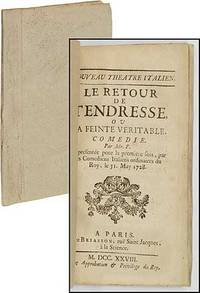
172878892Paris: Chez Briasson 1728. Softcover. Near Fine. First edition. Text in French. 52pp. Bound in old but probably later unprinted wrappers. An ink blot on the inside of the front wrap slight foxing to the pages a near fine copy. An Italian-style comedy play. Very scarce. OCLC locates no copies of this edition and only three copies of a 1729 printing. Chez Briasson unknown
1732B5857Amsterdam: Rudolf & Jacob Wetstein and G. Smith c.1732. 3 ff. unnumbered and fully engraved with 6 half page illustrations do according to Brunet account for pp. 265-270. Repaired marginal tear to title to Tome 2 repaired corner tear to 327/8; overall a near fine example of this finely illustrated work with text and plates clean and crisp. . Edition: First Edition Binding: Contemporary decorative calf; expertly rebacked; boards with central gilt medallions; spine with five 5 raised bands flanked by horizontal gilt fillet and decorative rolls with gilt designed corners and centres in compartments and gilt lettered title on morocco label on two; all edges red. Notes: Publius Ovidius Naso or Ovid 43 BC – AD 17/18 was a Roman poet who lived during the reign of Augustus. A contemporary of Virgil and Horace he is often ranked one of the three canonical poets of Latin literature and enjoyed enormous popularity. Augustus sent him into exile where he died. Today he is best known for his Metamorphoses a 15-book continuous mythological narrative written in the meter of epic and for works in elegiac couplets such as Ars Amatoria "The Art of Love" and Fasti. His poetry was much imitated during Late Antiquity and the Middle Ages and greatly influenced Western art and literature. The Metamorphoses remains one of the most important sources of classical mythology. <br>The Metamorphoses Ovid's most ambitious work was written in dactylic hexameter about transformations in Greek and Roman mythology set within a loose mytho-historical framework. The characters in this work undergo many different transformations. Within an extent of nearly 12000 verses almost 250 different myths are mentioned; each myth is set outdoors where the mortals are often vulnerable to external influences. The first book describes the formation of the world the ages of man the flood the story of Daphne's rape by Apollo and Io's by Jupiter; the second Phaethon and the love of Jupiter with Callisto and Europa; the third focuses on the mythology of Thebes with the stories of Cadmus Actaeon and Pentheus; the fourth on three pairs of lovers: Pyramus and Thisbe Salmacis and Hermaphroditus and Perseus and Andromeda; the fifth on the song of the Muses which describes the rape of Proserpina; the sixth on the rivalry between gods and mortals beginning with Arachne and ending with Philomela; the seventh on Medea as well as Cephalus and Procris; the eighth on Daedalus' flight the Calydonian boar hunt and the contrast between pious Baucis and Philemon and the wicked Erysichthon; the ninth on Heracles and the incestuous Byblis; the tenth on stories of doomed love such as Orpheus who sings about Hyacinthus as well as Pygmalion Myrrha and Adonis; the eleventh on marriages of Peleus and Thetis and the love of Ceyx and Alcyone; the twelfth moves from myth to history describing the exploits of Achilles the battle of the centaurs and Iphigeneia; the thirteenth discusses the contest over Achilles' arms and Polyphemus; the fourteenth moves to Italy describing the journey of Aeneas Pomona and Vertumnus and Romulus and the final or fifteenth opens with a philosophical lecture by Pythagoras and the deification of Caesar. The end of the poem praises Augustus and expresses Ovid's belief that his poem has earned him immortality.<br>In analyzing the Metamorphoses scholars have focused on Ovid's organization of his vast body of material. Ovid engages creatively with his predecessors alluding creatively to the full spectrum of classical poetry. <br><br>This 1732 first Amsterdam edition is superbly illustrated employing copper plate engravings attributed to the Dutch: Balthasar Bernaerts engraving c.1711–1737; Jacob Folkema 1692–1767; Wouter Jongman engraving c.1712–1744 Joseph Mulder c.1659/60-; Jan Schenk engraving c.1731–1746; Jan Wandelaar 1690–1759 Philip Van Gunst 1685–1732; the Flemish: Martin Bouche c. 1640–1693 Frederic Bouttats c.1610–1675 Peter Paul Bouche c.1646- and the French: Bernard Picart 1673–1733; after the works of the Dutch: Louis Fabritius Dubourg 1693–1775; Godfried Maes 1649-1700; Jan Punt 1711–1779; Jacob De Wit 1695–1754; the French: Charles LeBrun 1619–1690; Sebastien Leclerc 1637–1714; and the Italians: Giulio Romano 1499–1546; and Pietro Testa 1612–1650. <br> Size: folio 455 x300 mm Illustration: Illustrated with allegorical copper engraved frontispiece by Picart and onehundred twenty-nine 129 copper engravings throughout the text by and after illustrious and notable engravers and artists mostly listed under notes. Illustrations also include two 2 red and black ink printed titles each with a large vignette copper engraving; one 1 copper engraved vignette head piece introducing the dedication to the king; numerous in-text decorative wood-cut head and tail pieces and large thematic or ornamental rubricated initials. The French and Latin texts are in two parallel corresponding columns. Volume: Two tomes in one volume Provenance: watermarked on many leafs including on the 1.free endpaper and dedication to tome 1 as well as title to tome 2: “ BEAVUALS†at centre of leaf. 2.title and final page of tome 1: an upside-down design of a fleur de lis 3.lower free endpaper: “C D“ References: Brunet III: 599; Cohen-de Ricci: 768. Transation: Text in Latin with F Pages: Bl. 2 Frontispiece by Picard bl. Tome I: Red and black ink illustrated title bl. dedication 2 preface 6 1-247 bl. with 69 half page copper engravings. Tome 2: Red and black ink vignette illustrated title bl. 249-264 3 ff. of illustrations 271-524 with 60 half page copper engravings table des matieres 4 bl. 2. Category: Book Classics; Book Europe France; Book Plate Books General; Rudolf & Jacob Wetstein and G. Smith, hardcover
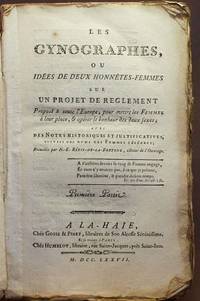
17776329The Hague but Paris: Gosse et Pinet; Humblot 1777. First edition. Fine/The collected works of Restif de la Bretonne would probably fill an entire wall case. He wrote tirelessly producing some 250 books--a considerable physical task if not the intellectual achievement of some of his contemporaries in the French siècle des Lumières. Restif was a libertine and he wrote quite a lot about sex. He also bravely ignored standard literary forms forging his own way into autobiography polemic essay pornography and fiction leaving trails that are yet to be explored. The volumes offered here in their completely original unsophisticated state form a part of an ambitious series of books that appeared over two decades under the umbrella title "Idées singulières" Modest Proposals an extensive compendium of rules and regulations for the creation of a utopia. Each title in the series proposes a reform project for a particular aspect of society. In the case of Les gynographes that aspect is the status of women in society. While not entirely a 21st-century feminist disappointingly he is unable to exceed received patriarchal attitudes Restif makes some presciently modern arguments including that gender inequality is a social construct and is not biologically determined and that education is the key to gender equality. Indeed the text betrays a disconcerting mix of statements that can be interpreted as misogynistic alongside truly revolutionary ideas about the condition of women in society. Even the 19th-century bibliographer P.L. Jacob notes that "some very singular and very original ideas" occur juxtaposed against "severe and unjust comments" about women. . 2 volumes octavo 22; viii 238; 239- 567 1 pages. Unbound untrimmed unmarked and completely unsophisticated copy in original publisher's marbled paper wraps. Pages not bright. Some dampstains and occasional spots. References: Courbin "Rétif et son oeuvre" #14595; Rives Childs XVI p. 245; Jacob XVII p. 143. Gosse et Pinet; Humblot paperback books