91 résultats
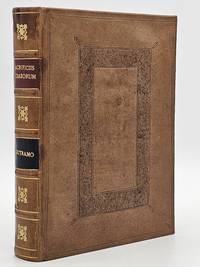
1606SZEPEBKS007590IVenetiis: Andreae Muschij or Muschius 1606. Hardcover. Good. Title continues: " . Patauium ac finitimos attinentia opportune interseruntur". - Venetiis M. DC. VI. / Ex Typographia Andreae Muschij. - 8vo. - 24306 pp. - With a 2-page dedication to the Archbishop of Milan: "Illustrissimo et Amplissimo D. Federico Borromeo S.R.E. Cardinali Archiepiscopo Mediol."; and with an "Errata sic corrigito" at the end of the Index. - Disbound old waterspot on lower left corner of the first 24 pages small closed tear on upper right corner of p. 33; else fine. - Splendid engraved coat-of-arms on title-page; engraved initials head- and tail-pieces. - Contemporary ownership inscription in ink on title-page. - First edition a second edition was published with identical number of pages by the Typographia Seminarii in Padua in 1696. - History of the Benedictine monastery of Santa Giustina di Padova as well as of the city of Padua. - Quite rare: OCLC locates only 5 copies all in Germany. - Shelf No.: c 159. <br/> <br/> Andreae Muschij (or Muschius) hardcover
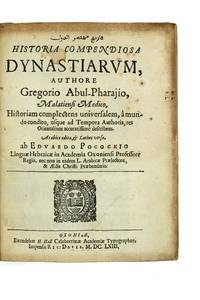
16634120<p>Oxford: H.Hall. Impensis Ric: Davis 1663. First edition thus in the Arabic edition and Latin translation by Edward Pococke. 4to. 203x155mm. pp. 12 368 90 66 5bl 565 2. The final part 565 2 in Arabic paginates from the rear of the book. The two blanks are present. Three parts in one volume i.e. the Latin translation the Supplementum and the Arabic edition each with its own title page. Bound in twentieth century brown full calf by Sangorski and Sutcliffe lettered in gilt to spine. Contemporary manuscript title to fore-edge. Some light fading to the spine slight toning to edges of first and last leaves and a small hole to foot of the final leaf not affecting the text but overall in very good condition throughout. Front pastedown has the bookplate of the Middle East scholar R.M.Burrell. His important library of books on the Middle East was sold by Sotheby's in 1999 this was lot 319. On 17th October 1630 Edward Pococke 1604-1691 arrived in Aleppo as Chaplain of the Levant Company. While there he deepened his study of the languages and culture of the region and began to collect Arabic manuscripts. In 1636 Pococke returned to England at the request of Archbishop Laud who had recently established a Chair of Arabic at Oxford and wanted Pococke to be the first holder of it. One of the manuscripts brought back by Pococke was the al-Mukhtasar fî'l-Duwal 'History of the Dynasties' of Abu'l-Faraj Bar Hebraeus 1226-1286. The lack of material in England on Islamic history and geography meant that Pococke felt unable to prepare his edition and translation and so he secured a sabbatical from Oxford and sailed for Constantinople where he spent the next three years collecting manuscripts. He returned to England shortly before the outbreak of the Civil War and it was only in 1650 that he published extracts from the "History" in his Specimen historiae Arabum which included other material culled from his now extensive collection of manuscripts. Pococke was a Royalist and the years of the Protectorate were hard: he almost lost his professorship and his priestly living. At the Restoration he returned to Oxford and began work on the complete Historia Compendiosa Dynastiarum. Finally in 1663 almost thirty years after Pococke had returned from Aleppo with the manuscript of al-Mukhtasar fî'l-Duwal his far-reaching Historia which opened up Arab history to Western was published and "remained the standard edition until the twentieth century" ODNB.</p> Oxford: H.Hall. Impensis Ric: Davis.
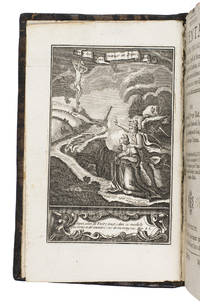
160922968Brussels: Rutger Velpius 1609. Contemporary brown calf sewn on 4 supports with corresponding raised bands on the spine gold-tooled spine with the title lettered in gold in the second compartment red sprinkled edges. 8vo. With a small woodcut vignette on both title-pages some woodcut head- and tail-pieces and woodcut decorated initials. Ad 1 with an engraved illustration depicting a Biblical scene mounted as a frontispiece on the verso of the second free flyleaf. 2 works in 1 volume the 2nd in 2 parts. With:2 GLEN Jean Baptise de and Aleixo de MENEZES. La messe des anciens Chrestiens dicts de S. Thomas en l' évesché d' Angamal és Indes Orientales . Brussels Rutger Velpius 1609. Ad 1: First French edition of António de Gouvea's account Jornada do Arcebispo de Goa Dom Frey Aleixo de Menezes first published in Portuguese in Coimbra 1606. It details the Jesuit-Portuguese success in aligning the St. Thomas Christians of Malabar with the Latin Church which was related to the trade struggles in the 16th and early 17th century between the Portuguese and their European and Indian rivals. The original Portuguese text was translated into French by Jean Baptiste de Glen 1552-1613 an Augustinian theologian. There are two issues of this edition with two different imprints: one published by J. Verdussen in Antwerp and one our copy published in Brussels by R. Velpius. The text was also translated into Spanish by Francois Munoz but remained in manuscript. Ad 2: Published under a separate title these two texts do in fact belong together. The Historie orientale and the two texts in La messe des anciens Chrestiens form a single book. Following the dedication to Abbot Gilles de Sprimont is the Remonstrance Catholique by Jean Baptise Glen. He expands on the Histoire Orientale and presents the edifying lessons the inhabitants of the Southern Netherlands can draw from it including interesting remarks on the Christian Syro-Malabar ritual and liturgy purified from the influence of Nestorianism a Christian heresy that held Jesus to be two distinct persons.The subsequent part is by Aleixo de Menezes on the Mass of the first Christians La messe des anciens Chrestiens on pp. 77-123 in which he deals with the content of the Mass and in which he gives the full Latin text. These two parts together published as one book are considered as a major contribution to the history of Christianity in India in general and the St. Thomas Christians on the Malabar Coast in particular.With a contemporary manuscript inscription on the recto of the second free flyleaf and a contemporary manuscript inscription on the title-page of ad 1. The binding shows some signs of wear second free flyleaf the title-page and the the first page of the dedication to ad 1 are restored in the upper outer corner the top margin is cut rather close to the text without affecting it. Otherwise in good condition.l Bibl. Belg. III G3; Cioranescu 33232 33233; Lach Asia in the Making of Europe III I pp. 320-1 395; USTC 6167300 7 copies; cf. STCV 6689348 1 copy other issue Rutger Velpius, hardcover
1661V75228London: William Lee 6th and last edition. 1661. Hardcover. Good. Full page "brasse" plate with 6 heresies scenes of repentance & destruction 7 half-page engraved portraits of "heretics" or "sectaries". . Octavo handsome tan roan on 5 raised bands with red gilt titled spine label covers re-attached. Facing engraved titlepage is a listing of the Sectaries & some contents of the text. Printed title says "added this year 1661 many new additions not heretofore extant in print together with brasse plates of the most eminent Sectaries" 22pp prelims inc. publisher's account of author's life & material added to this 1661 edition 279pp 18pp Postscript index and publisher's catalogue collated complete. Coat of arms of Andrew Robert Vaughan Daubeney 1873-1971 on pastedown 1 leaf with 2 ink crossings out and 2 marginal ink "corrections". Frontispiece and facing page are a bit squeezed into gutter and the plate is cropped at fore-edge but otherwise all margins are good and side notes are not cropped. A nice copy with some signs of use. Highlights include chapters on Brownists and Quakers. There is a plate of an Adamite on p117. Pagitt or Pagit was a committed Royalist. This 6th posthumous edition is the last publication of his most notable work with many more pages of new material and portrait plates added by the publisher William Lee after his 5th edition. The last section with portrait of James Naylor 1618-1660 notably says "The Quaker is an upstart branch of the Anabaptists lately sprung up but thickest set in the North parts; the body of this Heresie is composed and made up out of the dregs of the common people" Referenced by ESTC R24442 Wing CD-Rom 1996 P181. William Lee, 6th and last edition. hardcover
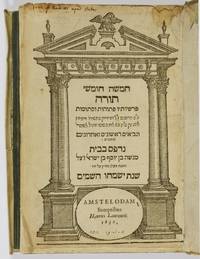
163155459Amsterdam: printed by Menasseh ben Israel for Henricus Laurentius 1631. First edition. Hardcover. Very good-. Octavo 16.8 by 11.4 cm. Collation: aleph-lamed-zayin8 = 296 leaves. 612 i.e. 592 pp: p. 464 erroneously numbered 484 465 as 485 and so on throughout. Two column text in unvocalized Hebrew; every fifth verse numbered in the margin. Title within architectural border; half titles with letterpress ornamentation for the Former and Latter Prophets. Contemporary vellumwith exposed thongs edges stained blue; yapp fore-edges; front joint cracked but holding strong. Intermittent light toning to text outmost leaves a bit more darkened; very occasional small stains. Title-page slighltly trimmed 4 mm at bottom edge; expert marginal repairs at bottom corners of 2 leaves; 1 leaf re-margined at fore-edge with no loss of text else a very good copy with crisp clean text.<br /> <br /> First Hebrew Bible published in Amsterdam printed by the rabbi diplomat publisher and religious thinker Menasseh ben Israel 1604-1657 one of the most distinguished members of the Portuguese Jewish community of Amsterdam and the first Jewish printer in the Northern Netherlands. The Amsterdam printer and publisher Hendrick Laurensz Lauretius provided the financing for this edition along with two other Bible editions and two editions of the Hebrew Psalms printed by Menasseh between 1631 and 1646. "These publications were not only made for the local market but mainly for international trade. Thanks to this financial help Menasseh was able to organize his printing office in a more professional way" Fuks hiring a Jewish compositor Judah Leb ben Mordecai Gimple from Posen and a gentile compositor Bartholomeus Laurensz. <br /> <br /> The printing activity of Menasseh was especially important in the steadily growing productions of the Hebrew press in the Northern Netherlands. Fulfilling the needs of the Sephardic community for Jewish ritual texts eliminated the need for expensive imports from Venice and Poland. Menasseh undersood that the relatively cheap paper and tools available in Amsterdam made it possible to compete in quality and prices with the Hebrew presses of Poland Italy and Basel. "Gentile publishers and booksellers in Amsterdam such as Jansonius and Laurentius were quick to see the opportunity of the opening Eastern European market and financed several of Menasseh's publications" Fuks. Menasseh was the first to introduce in the Netherlands waybertaytsch types for Yiddish publications along with illustrated Hebrew books. He was also the first Jewish printer to adopt the Dutch pocket-book format made famous by the Elzeviers.<br /> <br /> Notes on publication date and issue: The title is dated 1630 in Arabic numerals; the colophon notes the date of completion in Hebrew characters as 5 Adar 5391 = 7 February 1631 along with the printer's apology for being unable to provide the index of pericopes promised on the title-page due to lack of printing material. Darlow and Moule describe this issue as Variant A with a Latin imprint appearing in the cartouche beneath the Hebrew title.<br /> <br /> Provenance and annotations: early entry in brown ink at front paste-down with short Greek inscription Theos. dated 1700; old Latin inscription in black ink at top margin title in reference to Hebrew roots; date of 1812 beside Yiddish entry penned in black ink within imprint cartouche at title; old entry in German penned in black ink at verso title beneath which is an oval cartouche in imitation of the one at the title in which an owner has penned in black ink the Hebrew imprint information regarding Hendrick Laurensz as it would appear in the Varient B issue; old library shelf marks at rear paste-down; recent owner entry in blue ink in Hebrew at front paste-down. References: Darlow and Moule 5123a; Fuks/Fuks-Mansfeld no. 152; pp. 105; 111f.; Steinschneider no. 453; Vinograd Amsterdam 22.<br /> <br /> Full title and imprint: חמשה חומשי תורה פרשיותיו פתוחות וסתומות ×¢"פ ×”×¨×ž×‘× ×–"ל ומדוייק בחסירו' ויתרות להעתק ס"ת ×¢× ×œ×•×— בסופו מועיל לסופרי' ×•× ×‘×™××™× ×¨××©×•× ×™× ×•××—×¨×•× ×™× ×•×›×ª×•×‘×™×: × ×“×¤×¡ בבית ×ž× ×©×” בן ישר×ל ז׳׳צל והוגה בעיון × ×ž×¨×¥ על ידו ×©× ×ª ישמחו השמי×<br /> Amstelodami sumptibus Henrici Laurentii 1630. printed by Menasseh ben Israel for Henricus Laurentius hardcover
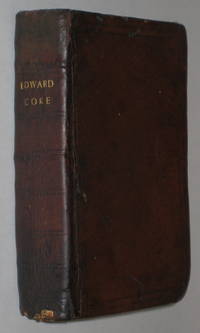
1640000034London: Londini Excus. per assignat. I. More armigeri. 1640. 1640. 1st Edition . Leather. Very Good. Description: Sm. 8vo 5¾ × 3¾ in: 12 579 1 p. Early calf; "Edward Coke" lettered in gilt on spine. · Register: 8º: ¶6 B-2O8 2P2. · Condition: Spine chipped at bottom. Initial blank signed with a fleuron present in this copy. Margin of leaf O2 torn with loss not affecting text. · Comments: Sole edition. Although the title is in Latin the text is in Law French. This copy contains numerous manuscript references to the first edition of Hobart's Reports printed in quarto in 1641. The references must be to the first edition because in some of the citations the page number is higher than 350 which is the last page of the 1650 folio second edition and all subsequent editions. · References: S&M 1:29723; STC 5527; ESTC S108467. <br/> <br/> Londini Excus. per assignat. I. More armigeri. 1640. hardcover
1694V67948London: Rhodes Meredith Harris & Newborough 1st edition in English 1694. Hardcover. Good. Folio calf but lacking spine leather damage to cover leather also/corners v.worn Licence leaf precedes TP TP in red & black 6pp of Subscribers 4p=Preface over 1165pp which is A-Z with Finis in mid page of last leaf. TP & License leaf with tears but no loss verso's sl.soiled and re-inserted.Newer EPS. Good wide margins no writing no worming a neat complete copy of the best edition of this first Historical Dictionary in English. Later editions were edited by Collier and appear under his name while this has no translator or editor given although the work is a compilation of the major classical dictionaries in Latin and French WING M-2725. Rhodes, Meredith, Harris & Newborough (1st edition in English) hardcover
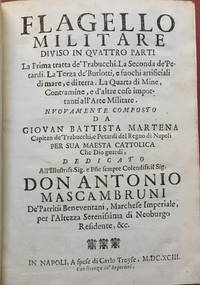
1693H1280Napoli / Naples: Carlo Troyse 1693. Hardcover. Very Good. Large 8vo 8.5 x 6.25 inches bound in late 19th century half vellum and cloth boards red calf label gilt spine 10 211 1 pp with portrait and 18 folding copperplates — this may lack an engraved title page preceding the printed title — text fine binding a little worn and soiled some fading and discoloration to cloth boards. Very Good. Divided into four parts this military treatise discusses the use of trebuchets — machines used to hurl stones or projectiles especially over walls; “petardi†— encased bombs and explosives with remarks on the preparation of gunpowder; the arming of boats and ships; and a section on mines for land and sea and counter-mines. The first part in particular has a long and detailed discussion on various types of artillery mortars and explosive shells. The author was a vaunted artillery-man and military author born in Taranto in 1610. He participated as a miner in various sieges; in 1645 he was master bombardier in the citadel of Turin. He proved to be an expert bombardier in Asti and at the siege of Portolongone. In 1676 he published the first edition of Flagello Militare; a second edition came out in 1687 and this is the third edition. All editions are rare in the trade. Carlo Troyse hardcover
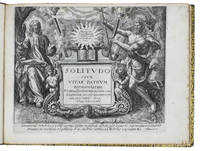
160663TA003RHVIKParis 1606. Small oblong folio 19 x 25.5 cm. Thomas de Leu Gold-tooled blue goatskin morocco ca. 1890 bound by Bernard David or his son Salvador David in Paris on 5 recessed supports each board with elegant double borders title and date reading up the spine with decorations above and below gold-tooled turn-ins and board edges curl-marbled endpapers signed with a stamp - in sans-serif capitals - in the corner of the first free endleaf DAVID. With an engraved allegorical title page including a 2-line quotation from Hebrews 11:37-38 and 29 engraved prints plate size ca. 15 x 19 cm: mostly numbered but a few unnumbered or irregularly numbered illustrating the lives of the early Christian hermits living in the desert 7 signed by Thomas de Leu as printer-publisher in 2 cases accompanied by the monogram NB the engraver Nicolaes de Bruyn. 1 29 engraved ll. Finely engraved title page and prints depicting the lives of hermits living in the desert as described by Hieronymus in his famous Vitae patrum. The engraved title page and prints were printed and published by Thomas de Leu or de Leeuw 1560-1612 a Flemish engraver in Paris who probably engraved many himself. He had begun his career in Antwerp and some of the prints signed by him excudit also bear the NB monogram of the engraver Nicolaes de Bruyn 1571-1656 in Antwerp. The Antwerp painter Maarten de Vos 1531/32-1603 had drawn numerous hermit scenes: four series engraved printed and published by Johannes I Sadeler ca. 1550-ca. 1600 and his brother Raphael I Sadeler 1560-1632 who continued alone with three further series making in total seven series containing 7 engraved title pages and 107 prints all published at Antwerp at least the first series in or before 1584. De Leu and De Bruyn very skillfully copied all seven series including the title pages and captions. The present selection includes the title page of the first series Solitudo which originally contained 29 prints but only 16 of the present 29 prints come from that series the other 13 are taken from series 2 Sylvae 1 3 Trophaeum 1 4 Oraculum 5 Sylvae 2 and 6 Trophaeum 2.Bernard David 1824-1895 studied under Lortic and other leading Paris bookbinders before setting up on his own there. His son Salvador d. 1929 took over the workshop in 1890. The laid endpapers show no watermark. With aa small marginal tear repaired occasional minor marginal spots and a few tiny and insignificant scuff marks on the edges of the binding. Book and binding otherwise in very good condition and with ample margins.l Hollstein XXI pp. 147-155 nos. 377-450 & pp. 240-245 nos. 118-157 the Sadeler eds. but noting the De Leu eds. at the end of each series; www.calcografica.it many of the prints in these De Leu series; USTC 6000645 3 copies; cf. for De Leu also: Benezit 6 p. 623; Thieme-Becker 23 pp. 143-144. unknown
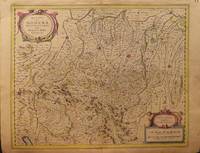
16403044<p>Amsterdam. Very Good. C.1640. Map. Verso text in Latin. Orginal 17th century hand color. Foxing to lower edges. Image size 19 1/3"- 15 1/2". Paper size 20 1/2"- 15 1/2" ; All shipments through USPS insured Priority Mail. .</p>
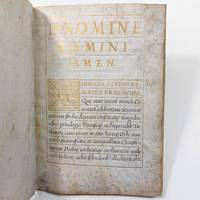
162819730<p><strong>Precious diploma in canon and civil law from the University of Rome calligraphed on vellum with the letterhead and the names of the protagonists written in gold ink.</strong><br /><strong>The document is also entirely underlined and framed in this ink.</strong><br />It was awarded to a certain Guillaume Drouaillet from Dole in Burgundy.</p><p>"<em>IN NOMINE DOMINI AMEN. GLORIOSA STUDIORUM MATER URBS ROMA Quae inter omnes mundi Ciuitates celeberrima Scientiarum omnium studio decorata existit . Dominus Guglielmus Drouaillet. Dolanus in Burgundia . Actum Romae in Gymnasio publico in regione S. Eustachii Anno Domini millesimo sexcentesimo uiges. octavo .</em>"</p><p>At the end of the document are signatures most likely of members of the University of Rome and two additional paragraphs handwritten by two different hands.</p><p>From the library of Bruno Monnier Franc-Comtois bibliophile and owner of the Château de Mantry with iron bookplate on the front flyleaf.</p><p><strong>An interesting testimony to the history of diplomas and writing.</strong></p>
166216811Graz, Widmannstetter, 1662. 2 Bll., 16 S. Kl.-4°. Mod. Pp. (leicht bestoßen). [7 Warenabbildungen]
166258118Graz, Widmannstetter, 9. August 1662. 4°. Titel m. Holzschn.-Bordüre u. großem Wappenholzschnitt (Doppeladler). Mit einigen Holzschn.-Bordüren bzw. -Initialen. 2 Bll., 16 S., Geheftet.
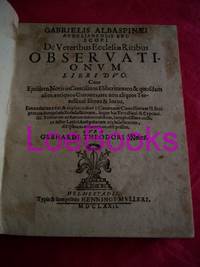
1672025969Helmestadii: Henning Mulleri Muller 1672. Book. Very Good. Hardcover. 8vo. pp. 16 504 48. Printer's device to title page engraved head and tail pieces. Later Victorian attractive half speckled calf to style with 4 raised bands and gilt decoration to the spine red title label gilt; marbled paper covered boards. All edges dyed red. Binding very good with a little general wear only corners rubbed. Contents clean and tight a few pages lightly tanned with a few spots but generally very clean. A very good copy. Henning Mulleri [Muller] Hardcover
1668V70198Antwerp: Andreae Frisi 1668. Hardcover. Good. Copperplates 45 numbered of cruel tortures including the engraved pictorial titlepage by Antonio Tempesta large copperplate printer's device of man consulting books in a library optimi Consultores Mortui. Duodecimo contemporary calf blind rules with corner floral ornaments spine with gilt label top cover nearly detached tips worn chipped to head/foot of spine All edges red sprinkled. Engraved Titlepage of the stoning of a martyr Titlepage 19pp dedication & preface 1p blank 576pp 47pp index 1p blank A-Cc12. Page 456 with small adhesion obscuring 2 or 3 letters and initial. Inscription E.lib R.S. on blank back of engraved Title. Endpapers bit browned else a clean tight neat copy needing repair to front hinge. All copperplates are present shewing gruesomely detailed plates of all the possible torture methods being administered to the martyrs which also are in crisp V.G. condition.The early editionshad fewer plates from 25 with later additions Andreae Frisi hardcover
1677355680London.: T. Roycroft impensis Richardi Chiswell 1677. 1st Edition. Small 4to. 20th century full brown calf raised bands gilt spine decorations red and black spine labels gilt spine titles blind ruled borders inlaid panels. Very good small scar to spine slight discoloration to spine head small owner’s stamp to endpaper. 20.6x15.5x3.8 cm. Latin text with Hebrew and Greek reference passages. Important 17th century treatise on the theological relevance of the ancient sacrifices to the sacrifice of Christ in a nice later binding. weight: 1.9 lb. T. Roycroft impensis Richardi Chiswell, hardcover
1687V75887Amsterdam: Johann Wolters & Ysrand Haring 1687. Hardcover. engravings in the text 50 1 full-page engraving & 2 woodcut diagrams. 12mo Covers worn and edges damaged and the spine is renewed. Titlepage 3 leaves of dedication 1 leaf of index of chapters 398pp 4pp of addenda 8pp =index Two leaves torn with loss to fore-margin but text intact except for part of 2 words affected. Text is in Latin with propotion of Greek text and there are two founts used in the latin text. The author was a scholar & a medical doctor who was also known as a poet of both latin and french. In trying to prove the existance of Amazons in early times he included references to Christopher Columbus and Amazons in America in the final chapter. This final chapter was not present in the first edition of 1685. Johann Wolters & Ysrand Haring hardcover
161567051615. 14; 13 folding leaves. Two parts in one vol. Large 8vo cont. or later dark wrappers dyed with persimmon juice shibubiki new stitching. Japan probably Kyoto: printed with moveable types ca. 1615-40.<br/> <br/> A very rare edition printed with moveable types apparently unrecorded in the standard bibliographies of the story — or legend — of the creation of the first statue of Siddhartha Gautama or Gautama Buddha the founder of Buddhism. The statue executed while Buddha was still alive was commissioned by King Udayana of Kaushambi a contemporary of Buddha. It was the very first image of Buddha and is especially important as it was carved from life. Copies of this statue made their way to China with the spread of Buddhism and later as we shall see to Japan.<br/> <br/> The text provides a history of the creation of the first statue of Buddha which is perhaps the most famous of all Buddha images. King Udayana commissioned the statue “so that he could gaze upon the sacred form of the Buddha while the latter was off preaching to his mother in the heaven of Indra. Buddha’s disciple Maudgalyayana transported thirty-two craftsmen up to the heavenly realm so that they could observe the special marks of the Buddha firsthand thereby insuring the representational accuracy of the image they created. When the Buddha eventually returned to the earth King Udayana’s statue rose into the air to greet him of its own accord and the Buddha proclaimed that it would one day help to transmit his teachings.â€â€“Brown ed. The Oxford Handbook of Religion and the Arts p. 371. We learn that the statue was carved out of sandalwood and that later copies were made of gold silver bronze lead tin or iron as well as of wood.<br/> <br/> This text was translated by the Khotanese monk Tiyunbanruo d. 691 or 692 whose original Sanskrit name was Devendraprajna. Khotan was an ancient Iranian Saka Buddhist kingdom on the branch of the Silk Road that ran along the southern edge of the Taklamakan Desert near modern-day Xinjiang. Tiyunbanruo came to Luoyang the “Eastern Capital†of the Tang dynasty of China in about 688 with a considerable reputation as a Buddhist missionary and set up a bureau to translate Buddhist texts into Chinese. An earlier edition of this text was published in Beijing in 1593 and only one copy is known at the BnF.<br/> <br/> This book was probably printed and issued as a way to reinforce the legitimacy of the famous Buddha statue of the temple of Seiryoji in the Saga fields of Kyoto. It is one of the chief objects of religious veneration in Kyoto. A copy of the original statue also commissioned by King Udayana was brought from the castle at Kaushambi in north-central India to China by Hsuan-tsang in 645. The statue moved many times and ultimately arrived at Kaifeng the Sung capital. The Japanese monk Chonen 938-1016 who spent the years 983-86 in China studying and collecting texts had worshiped the statue in Kaifeng and commissioned men in 984 to carve a copy to bring back to Japan. The copy was ultimately installed at Seiryoji and according to Japanese tradition the Chinese “original†and Chonen’s copy had miraculously changed places — the Seiryoji Buddha was actually the authentic example commissioned by Udayana.<br/> <br/> The Seiryoji Buddha is “probably the most important best-documented and best-preserved sculpture now existing which represents the school and tradition of Buddhist sculpture connected with the sacred Udayana image of the living Buddha of which Hsuan-tsang brought a copy to the court at Ch’ang-an.â€â€“Henderson & Hurvitz “The Buddha of Seiryoji: New Finds and New Theory†Artibus Asiae Vol. 19 No. 1 1956 p. 43–and see the whole fascinating article.<br/> <br/> As mentioned above this rare work is printed with moveable types. It was at one time owned by the great Japanese dealer Shigeo Sorimachi. The chitsu has the characteristic handwriting on the label of Sorimachi’s assistant Mr. Mori who has written: “Zozo kudoku kyo. Genna kan’ei chu kan. Kokatsu ban†“Creation of the Statue a Pious Act. From Genna to mid-Kan’ei edition ca. 1615-40. Moveable typeâ€. It is not cited by Kazuma Kawase Kokatsuji-ban no kenkyu Study of the Early Typographic Editions of Japan 1967 the definitive bibliography of Japanese moveable type books. There is no copy in WorldCat nor the Union Catalogue of Early Japanese Books.<br/> <br/> In very good condition. The first ten folding leaves which are a little stained have some repaired worming and strengthening. The following leaves have some worming some carefully repaired and others as the worming lessens not repaired. Several characters affected by the worming. As mentioned above the wrappers have been dyed with persimmon juice which serves a dual purpose: to strengthen the paper and act as an insect repellent.<br/> <br/> â§ Wang Zhenping “Chonen’s Pilgrimage to China 983-986†Asia Major Third Series Vol. 7 No. 2 1994 pp. 63-97. Martha L. Carter The Mystery of the Udayana Buddha Naples: 1990. unknown
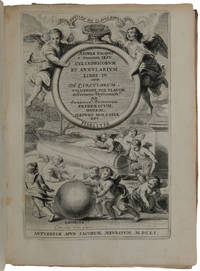
16515427Antwerp: Jacob van Meurs 1651. First edition. <p>First edition very rare and a fine copy. "Tacquet's most important mathematical work Cylindricorum et annularium contained a number of original theorems on cylinders and rings. Its main importance however lay in its concern with questions of method. Tacquet rejected all notions originating with Cavalieri that solids are composed of planes planes of lines etc." DSB. "It was Tacquet's decisive influence followed by Pascal's large-scale implementation which allowed the passage from indivisibles to infinitesimals" Julien Seventeenth-Century Indivisibles Revisited.</p>. <p>'ALLOWED THE PASSAGE FROM INDIVISIBLES TO INFINITESIMALS'</p> . <p>First edition very rare and a fine copy. "Tacquet's most important mathematical work Cylindricorum et annularium contained a number of original theorems on cylinders and rings. Its main importance however lay in its concern with questions of method. Tacquet rejected all notions originating with Cavalieri that solids are composed of planes planes of lines and so on except as heuristic devices for finding solutions. The approach he adopted was that of Luca Valerio and Gregorius of Saint-Vincent an essentially Archimedean method" DSB. "Tacquet's criticisms must have been effective because indivisibles became homogeneous magnitudes as a result of innovations introduced during the course of the seventeenth century" Rossini p. 465. The historian of mathematics Henri Bosmans "states that it was Tacquet's decisive influence followed by Pascal's large-scale implementation which allowed what is sometimes referred to as the passage from indivisibles to infinitesimals" Julien p. 187. "In this work the ideas that the tangent and the area under a curve were inverse to each other appeared. It arises from the way that Tacquet thought of curves generated by moving points but not actually comprising of points. Of course this idea is an early form of what would become clear when the calculus was invented namely that the derivative and integral were inverse to each other. This book had a considerable effect on Pascal and was important in setting the scene for the invention of the calculus" MacTutor. Bosmans has pointed out the debt owed to Tacquet's Cylindricorum et annularium by Pascal in his preparation of the Lettres de Dettonville 1659. Indeed in the Lettre à Carcavy Pascal writes that Tacquet's book is full of "learned geometry" praises how Tacquet "handles the indivisibles with all desirable rigour" and refers specifically to Tacquet for a result on the approximation of a surface by inscribed and circumscribed polyhedra see Descotes. "The change in Pascal to a clear point of view with respect to infinitesimals may well have come from Pascal's reading of Tacquet's Cylindricorum et annularium in which the author denied the validity of concluding anything about the ratio of surfaces from the ratio of their indivisibles or lines" Boyer p. 151. This is a rare work particularly in commerce. ABPC/RBH list only the Turner copy from the University of Keele offered by a prominent London dealer in 2002 and subsequently sold at Reiss in 2005 quite a poor copy in modern binding with some paper repairs and a partially removed library stamp. Ours is a fine untouched copy in contemporary binding.</p> <br /> <p>Provenance: Contemporary ownership inscription on title of "Conde da Torre" possibly the Portuguese nobleman João de Mascarenhas 1633-1681 second Count of Torre and first Marquis of Fronteira. </p> <br /> <p>"The Jesuit mathematician André Tacquet 1612-60 was by the standards of his time a man of the world. Although he may never have left his native Flanders his network of correspondents spanned Europe's religious divide reaching to Italy and France but also to Protestant Holland and England. Only months before his death he entertained the Dutch polymath Christiaan Huygens who had travelled to Antwerp with the express purpose of meeting Tacquet by then regarded as one of the brightest mathematical stars ever to come out of the Society of Jesus . It was his mathematical excellence that transcended 17th-century prejudices. In England Henry Oldenburg secretary of the Royal Society of London and no friend of the Jesuits spent so much time describing Tacquet's Opera mathematica at the Society's meeting in January 1669 that he felt compelled to apologise to the fellows for abusing their patience. But it was he insisted 'one of the best books ever written on mathematics'" Alexander p. 118.</p> <br /> <p>"In 1651 André Tacquet the urbane Fleming whose work was celebrated by Catholics and Protestants alike published hisCylindricorum et annularium libri IV 'Four books on cylinders and rings' a work dedicated to the study of geometrical features of these figures and their applications. Befitting a Jesuit publication the frontispiece shows two angels bathed in divine light holding up a ring enclosing the book's title; on the ground below them a band of cherubs is busy putting the theory into practice. The implication is clear: divine mathematics universal and perfectly rational orders and arranges the physical world to the best possible effect. It is a fetching visual depiction of the Jesuit view of the role and nature of mathematics.</p> <br /> <p>"The Cylindricorum et annularium is Tacquet's most celebrated work the one that established his reputation as one of Europe's most original and creative mathematicians. As it turned out it may have been a bit too 'original and creative' for his superiors: when Tacquet sent a copy of the book the newly appointed superior general Goswin Nickel the general's response was surprisingly cool. After thanking the mathematician and congratulating him on the book Nickel added that it would be better if Tacquet applied his impressive gifts to producing textbooks of elementary geometry for use by students at the Society's colleges rather than original works aimed at a select audience of professional mathematicians . Tacquet a good soldier in the Army of Christ obeyed. From then on he published no more original work but concentrating instead on producing textbooks some of which are of such quality that they became standards in the field for over a century .</p> <br /> <p>"In his critique Tacquet is respectful even deferential toward his rivals. He refers to Cavalieri as 'a noble geometer' and insists that he 'does not wish to detract from the deserved glory' of Cavalieri's 'most beautiful invention' Geometria indivisibilibus 1635. Tacquet knew of what he spoke because he was himself deeply familiar with the work of Cavalieri and Torricelli and was no less capable than they of using their method to arrive at new results. But once he gets beyond his congenial style and mathematical mastery it becomes clear that Tacquet's opposition to the infinitely small is . unyielding . 'I cannot consider the method of proof by indivisibles as either legitimate or geometrical' he states flatly at the opening of his discussion of indivisibles. 'It proceeds from lines to surfaces from surfaces to solids and applies to the surface the quality or proportion obtained from the lines and transfers what was obtained from the surfaces to the solid.' 'By this method' he concludes 'nothing can be proven by anyone'" ibid. pp. 161-2.</p> <br /> <p>"André or Andreas Tacquet resembles his contemporary Torricelli in the generality of his adoption from his predecessors of varied infinitesimal methods. In his Cylindricorum et annularium libri IV he gave for example four demonstrations of the proposition that the volume of a sphere is equal to that of a cylindrical wedge whose base is half a great circle of the sphere and whose altitude is equal to the circumference of the sphere. This theorem had been given by a number of mathematicians since Kepler as well as by Archimedes in the Method probably not then extant. Tacquet however after proving the theorem in two ways by the use of inscribed and circumscribed figures gave two further demonstrations by indivisibles based on the equality of triangles and circular sections. Torricelli had himself been satisfied with the rigor of proofs by means of indivisibles although he supplied alternative demonstrations for the benefit of others. Tacquet on the other hand said that he did not consider that the method of Cavalieri was to be admitted as either legitimate or geometrical. He maintained that the cylindrical wedge could not in all strictness be considered as made up of triangles; nor could the sphere be regarded as composed of circles . A geometrical magnitude he asserted is made up only of homogenea that is parts of like dimension - a solid of small solids and area of small areas and a line of small lines - and not of heterogenea or parts of a lower dimension as Cavalieri had maintained. He therefore felt that a proposed magnitude is exhausted a word he undoubtedly acquired from Gregory of St. Vincent by inscribing homogenea within them 'as in the manner of the ancients'" Boyer pp. 139-140.</p> <br /> <p>Tacquet gave a famous example where Cavalieri's method led to incorrect results. On pp. 23-24 he considers a right-angled triangle with one horizontal and one vertical side. Rotating this triangle around the vertical side generates a cone. Each plane section of the cone parallel to the base determines a circle and the circumference of each of these circles bears the same ratio to its radius namely 2π to use our notation. Since the surface of the cone is made up of all these circular cross-sections and the triangle is made up of all the radii Cavalieri's method would imply that the same ratio is also that between the surface area of the cone and the area of the triangle. But this is not the case.</p> <br /> <p>Archimedes had used a double reductio ad absurdum style of proof to find areas and volumes and this argument continued to be used until the publication of Cavalieri's work. To show that the area of a given region is equal to A Archimedes showed that for any number B smaller than A an inscribed figure could be constructed whose area is greater than B the inscribed area was usually composed of rectangles or triangles so that its area could easily be determined. This shows that the area of the given region cannot be smaller than A. A similar argument with circumscribed figures shows that the area cannot be larger than A. This technique is usually referred to as the 'method of exhaustion.'</p> <br /> <p>In the Cylindricorum et annularium Tacquet gives two proofs of most of his results on rings and cylinders the first using a modified form of the exhaustion technique the second using indivisibles; the precision and rigour of the traditional method is repeatedly stressed. But Tacquet introduces a number of innovations in the use of the method of exhaustion.</p> <br /> <p>"Tacquet's book has two theorems dealing with exhaustion which are the foundation for nearly all other theorems in the book. The first proposition of the first book is reminiscent of Valerio's theorem De Centro Gravitatis Solidorum Libri Tres 1604:</p> <br /> <p>Let A and B be two magnitudes either areas or volumes and let the ratio of E to F be given. If one can consecutively inscribe into A and B a sequence of magnitudes that relate to one another as E to F and if these magnitudes exhaust A and B i.e. they differ from these by an arbitrarily small amount then the magnitude A will relate to the magnitude B as E to F.</p> <br /> <p>"Tacquet's general theorem has the advantage that he does not have to repeat a double reductio ad absurdum with each proof .</p> <br /> <p>"The first proposition of the second book introduces another exhaustion method:</p> <br /> <p>If a sequence of magnitudes Ain and Bin can be inscribed in magnitudes A and B and if likewise a sequence of magnitudes Acn and Bcn can be circumscribed about magnitudes A and B and if moreover Ain and Acn exhaust A and for the corresponding magnitudes we have Ain / Bin = E/F and Acn / Bcn = E/F then A/B = E/F.</p> <br /> <p>"The simplification lies in the fact that it is no longer necessary to exhaust the inscribed and circumscribed magnitudes for each of the magnitudes A and B as it suffices to calculate the ratio for one or the other .</p> <br /> <p>"An important new concept is found in Tacquet's definitions of surfaces and solids. He defines the cylinder for instance as a solid that is generated by the movement of a circle in such a way that one of the points of the circle segment moves along a straight line. The axis of this cylinder is the straight line joining the centre of two of the generated circles. Despite this definition he does not accept that the cylinder is composed of circles" ibid. pp. 214-5.</p> <br /> <p>An important example of Tacquet's 'kinetic' method of generating curves and surfaces is contained in the second part of the Cylindricorum et annularium entitled 'Dissertatio physico-mathematica de circulorum volutionibus' in which Tacquet studies the cycloid a curve traced out by a point on the circumference of a circle as it is rolled along a straight line. This curve was to be the focus of Blaise Pascal's work on indivisibles published in the Lettres de A. Dettonville 1659.</p> <br /> <p>"Although Pascal was undoubtedly attracted by the power of indivisible methods he was impressed by the careful geometrical approach of Grégoire de Saint-Vincent and swayed by the vigorous criticism of Cavalierian indivisibles launched by André Tacquet in his work Cylindricorum et annularium. Pascal was accordingly impelled to examine carefully the basis for the use of indivisibles in geometry" Baron pp. 199-200.</p> <br /> <p>"Blaise Pascal in a sense represents the highest development of the method of infinitesimals carried out under the tradition of classical geometry . Pascal was not a professional geometer and as a result his geometrical work was accomplished in two periods which were separated by an interval of mathematical inactivity from 1654 to 1658 during which he devoted his interests to theology. These two periods moreover are characterised by somewhat different views as to the nature of infinitesimals . In this connection he enunciated in the Potestatum numericarum summa of 1654 the theorem on the integral of xn . The essential point in Pascal's demonstration is the omission of terms of lower dimension . The geometrical intuition of indivisibles of lower dimension was carried over into arithmetic to justify the neglect of certain terms of lower degree .</p> <br /> <p>"In the later period of his mathematical activity his view appears to be modified. In connection with problems such as those in his Traité des sinus du quart de cercle of 1659 contained in the Lettres de Dettonville . he used the language of infinitesimals in speaking of the sum of all the ordinates; but he added that one need not fear to do this inasmuch as what is really meant is the sum of arbitrarily small rectangles" Boyer pp. 147-151.</p> <br /> <p>Bosmans sees Pascal's Potestatum numericarum summa as containing two mutually incompatible ideas about indivisibles. On the one hand Pascal sometimes regards indivisibles as rigorously null quantities as had Cavalieri. On the other hand he sometimes regards indivisibles as simply quantities that are negligible in comparison to other quantities. "Bosmans then strongly underlines the difference with the clarity of the Lettres de Dettonville where Pascal expresses himself with impeccable rigour substituting for the strict indivisibles of Cavalieri homogeneous quantities whosesums differ from that to be measured by less than any given quantity. He then finds the reason for this progress in the reading that Pascal would have made between 1654 and 1658 of the book published by Tacquet in 1651" Descotes pp. 1-2 our translation.</p> <br /> <p>In the last section of the Lettre à Carcavy Pascal refers specifically to Tacquet in his discussion of the problem of finding the area of a surface obtained by rotating a curve around a vertical axis. When an infinitesimal section of the curve is rotated one obtains a circular band; these bands together make up the whole surface. "This is properly what according to Dettonville Tacquet has demonstrated: 'The sum of these semi-circumferences of the surface of the semi-solid makes up this very surface as others have demonstrated among them Tacquet'. We find in fact in the Cylindricorum et annularium Book II 1st part a Proposition VI which corresponds to Pascal's words. Its object is to prove that if we consider in a great-circle BICQ on a sphere with diameter BC if we inscribe and circumscribe regular polygons on the semi-circle BIC and if we rotate these polygons around the diameter BC they inscribe and circumscribe in the sphere with solids whose surfaces differ from that of the sphere by a quantity which can be made as small as one wishes. We see how it accords with Pascal's thought: the inscribed and circumscribed segments generate bands during the rotation which at the limit can be said to compose the curved surface. In accordance with his principles Father Tacquet demonstrates it in the manner of the Ancients" ibid. p. 4.</p> <br /> <p>"Tacquet was the son of Pierre Tacquet a merchant and Agnes Wandelen of Nuremberg. His father apparently died while the boy was still young but left the family with some means. Tacquet received an excellent education in the Jesuit collège of his native town and a contemporary report describes him as a gifted if somewhat delicate child. In 1629 he entered the Jesuit order as a novice and spent the first two years in Malines and the next four in Louvain where he studied logic physics and mathematics. His mathematics teacher was William Boelmans a student of and secretary to Gregorius Saint Vincent. After his preliminary training Tacquet taught in various Jesuit collèges for five years notably Greek and poetry at Bruges from 1637 to 1639. From 1640 to 1644 he studied theology in Louvain and in 1644-45 he taught mathematics there. He took his vows on 1 November 1646 and subsequently taught mathematics in the collèges of Louvain 1649-55 and Antwerp 1645-49 1655-60" DSB.</p> <br /> <p>A second edition of the Cylindricorum et annularium was published in 1659 with the addition of a fifth book devoted to an unrelated subject the paradox of 'Aristotle's wheel'. The perceived unsuitability of the Cylindricorum at annularium for the Jesuit colleges may explain why it was not added to all copies of the Opera mathematica 1669 it was not present in the Macclesfield copy for example.</p> <br /> <p>De Backer-Sommervogel VII 1806 3; Poggendorff II 1064. Alexander Infinitesimal 2014. Baron The Origins of the Infinitesimal Calculus 1969. Boyer The History of the Calculus and its Conceptual Development 1949. Descotes 'Documents relatifs aux lettres de A. Dettonville I. Pascal et le Père Tacquet' Courrier du Centre international Blaise Pascal 14 1992 pp. 1-13. Julien ed. Seventeenth-Century Indivisibles Revisited 2015. Malet From indivisibles to infinitesimals 1996. Meskens Between Tradition and Innovation: Gregorio a San Vicente and the Flemish Jesuit Mathematics School 2021. Rossini 'Giordano Bruno and Bonaventura Cavalieri's theories of indivisibles: a case of shared knowledge' Intellectual History Review 28 2018 pp. 461-476.</p> <br/> <br/> Small 4to 217 x 162 mm pp. xx 284 4 with 18 folding engraved plates the first 9 bound preceding title the remainder at end as in the instructions to binder on p. 286 full-page engraving on title second work with special half-title occasional light browning and spotting. Contemporary yapped limp vellum with manuscript title on spine remains of ties a few stains and light rubbing. Jacob van Meurs unknown
1671GSQroPAS57Leyden: Joannis à Gelder 1671. 1671. 8vo. pp. 8 p.l. 730 37index 1errata. additional etched title. woodcut device on title. woodcut ornaments & initials. contemporary vellum overlapping fore-edges soiled. Second Edition first: 1610 of this historical treatise on crowns. The author a negotiator and antiquary served Henry IV of France as ambassador to England in 1589. Brunet IV 404. Graesse V 148. Leyden: Joannis à Gelder, 1671. hardcover
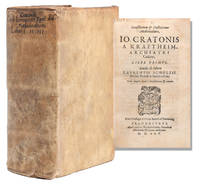
160927318Frankfurt Hanover & Hanover: Apud Andrea Wecheli heredes Claudium Marnium & Joann Aubrium; Parts 2 & 3 Typis Wechelianis apud Claudium Marnium & Heredes Joan. Aubrii 1609. First published 1591-94. 1 vols. Sm. 8vo. Three parts in one volume. Vellum. Some soiling and browning of vellum and text ties lacking else a very good copy with bookplate of Alfred Jerome Brown. First published 1591-94. 1 vols. Sm. 8vo. This work was ultimately completed in seven parts. <br /> 'The Polish-German physician was the personal physician to both Emperor Ferdinand and Maximilian II in Austria. He wrote several medical works and was a follower of the Galenic school of medicine. He was one of the first to study the contagiousness of certain diseases. "Sixteenth Century Books in the National Library of Medicine" 1077 for the 1591-94 edition; Osler 2387 & 2388 earlier editions Apud Andrea Wecheli heredes, Claudium Marnium & Joann Aubrium; [Parts 2 & 3] Typis Wechelianis, apud Claudium Marnium & Heredes unknown