509 résultats
1858003173Paris Schulz et Thuillié 1858 In-12 Demi-reliure Edition originale
1850List1929California 1850. With thirteen letters most multi-page written from Monterey in 1850 a 7 pp facsimile transcription of a 1834 Mexican land grant on cloth measuring 11 x 14 inches and and eleven page document on paper in Spanish relating to a Monterey land grant transcribing an 1841 document. Letters heavily worn with some loss at margins but mostly legible land grant in good to very good condition transcribed document in Spanish in fair condition with water damage to margins. Fair. An interesting archive of 1850s-era material relating to the life and career of the surveyor Edward Williams which recently surfaced in the central mother lode region. The group includes his personal letters from the California Gold Rush as well as well two interesting documents form his work for the Surveyor General J.W. Mandeville in 1858 where he transcribed two Mexican land grants. <br /> <br /> Lt. Edward Williams was a member of Company E New York Volunteers under Capt. Nelson Taylor. He came to California around 1847 and found employment as a deputy surveyor later working for the Office of the Surveyor General of the Unites States for California. In 1858 Surveyor General J.W. Mandeville commissioned a report on Mexican-era California Land Grants. Mandeville had Williams copy the original documents exactly - inclusive of an ink copy on linen that is an "exact tracing" of the original documents starting with 1834 up through about 1840. These "copies" were submitted to the Surveyor General in 1858 for use in the report. Williams continued the title work by copying other documents from about 1841 though this time not as a tracing but hand copied on the usual blue paper of the 1850s.<br /> <br /> The documents illustrate the length officials went to while they investigated Mexican Land Grant titles to California properties in the 1850s. The process was difficult and involved two distinctly separate cultures and legal systems that clearly conflicted. The Mexican Government granted rights for these large land parcels in California to various people but clearly stated they could not sell parts of the property. The wording was used many times in litigation of the period in both defense of the land grants and in opposition to how the land grants were handled. The issues were actually quite simple in that the Mexican legal standards for land grants was far different from those in the United States and the two differing forms of written land ownership and use clashed. <br /> <br /> These documents reflect a parcel of land granted to Francisco Mesa at "Corral de Tierra" a large parcel in Monterrey County California. Mesa had requested land for "his personal use and that of his family." In the Grant the title papers reflect "while the land is under Francisco's possession it cannot be divided mortgaged or a levy placed on it nor handed down." These original documents help illustrate the complex story of Mexican Land Grants in California. <br /> <br /> Also included are thirteen letters from Ed aka "Ned" to various family members primarily his mother and sister Alice and vice versa. About half are from Ed the other half are written to him. The dates of the letters are; 1850: February 10th April 15th April 16th April 28th June 10th July 30th October 11th and November 17th and 1851: September 9th. One undated letter with heavy loss is written from Panama. The letters are generally readable but the condition far from perfect with water stains throughout and chips abundant along edges and significant textual loss. The letters are generally at least two pages sometimes four or more inclusive of writing in the crossed line custom to save paper. Most are datelined at Monterrey where he discusses the people the customs setting and more. <br /> <br /> Despite the condition flaws there is much to be gleaned from his correspondence. In his April 15 1850 letter . he describes his trip to San Juan Bautista from Monterrey in detail while he was on his way to San Francisco. Williams writes of his great pleasure on tasting cooked beef by the Indians that he found was the best he ever tasted as they camped on the way to San Jose with the ultimate goal Mission Dolores in San Francisco: “this the beef they put on the embers of the fire and broiled it - I never tasted anything like it before so tender so juicy…†One of his first notes on San Francisco: "There are regular streets filled with all kinds of sorts of stores… The shipping covers the water as far as you can see. And those nearest the shore are converted into store houses the rigging being taken down and the and holes cut in the sides for doors.The best houses in town are occupied by gamblers . a large saloon filled with tables on which are played all kinds of games of chance - at some of the tables are displayed immense amounts of coin and gold in lumps worth from 1 to 5000 dollars which some poor infatuated fool of a miner has at some time lost to them."<br /> In his letter of April 16th he discusses both his difficulties with women in California and his lack of fitting in back east: “The Spanish Girls are very nice and all that sort of thing but the trouble is to find one that is educated. I can’t bear an uneducated wom an and I think I shall have to come to N.Y. and bring one out here… I know one or two in N.Y. but I don’t believe they would have such an uncouth specimen of an ‘hombre’ as me…†In his next letter he describes Carmel in detail. He states: “I haven’t been to the mines nor have I any inclination to go†though he intends to settle in California permanently. In his next letter he discusses the people he’s met and how he detests the anglophone community there: “How do I like the People Those of Spanish whom I call my friends I love with all my soul - there is not much society except among them… the Eng. and Am. population I detest from the bottom of my heart. This may sound strange but you will know the por que when you arrive.†He then praises the climate and scenery of Monterey. One letter written from Panama which has unfortunately sustained heavy losses at margins offers some details of the trip on the Chagres River. The replies to Williams from his family offer details on life in New York and are similarly compromised in condition but overall there is enough to glean from the group to provide a detailed example of family correspondence from the period. <br /> <br /> Overall a very interesting and unusual archive of a young professional who moved to California during the Gold Rush period and rejected the Anglophone mining community with particular interest to historians of Monterey and of the systems of land grants that shaped Mexican and American land policy in the nineteenth century. unknown
187750732Wien, Verlag von Friedrich Beck, 1877. Gr.-8°. 3 Bll., 240 S., Blindgepr. (Orig.-?)Lwd. d. Zt. m. goldgepr. Deckel- u. Rückentitel.
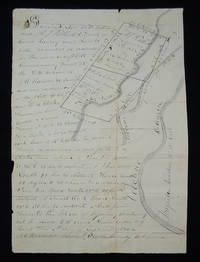
185268368Placer County California 1852. GOLD RUSH. Gold Rush Map Manuscript. Being a Survey for the adjoining plots of land belonging to H.H. Watson and A.J. Polhill. Placer County California: 1852.<br> <br> Two pages on a single sheet 17 1/8 x 10 7/8 in.; 438 x 275 mm. Manuscript document with map dated variously between 4-24 September 1852 and signed by H.H. Watson A.J. Polhill and others. Sheet with some mild staining and ink blots. Some minor chipping at edges and some separations at the creases. Creases reinforced with nearly invisible tape. Overall a very interesting piece of gold rush history. We could not find any other California mine surveys at auction in the past 50 years.<br> <br> "Survey for H.H. Watson and A.J. Polhill. A Tract of land laying near ville bounded as described in the annex plot commencing point as the S.W. corner of J.H. Hancock survey." "Survey made by N.O. Hinman County Surveyor."<br> <br> "In the present survey the tracts of land being issued to Watson and Polhill are bounded on the right by the Volcano Mining Company Ditch and Volcano Canion sic with the Todds sic Valley Company Ditch running through each plot. The Volcano Gold Gravel Mining Company was one of the most extensive gravel mines during the Gold Rush and hundreds of acres of valuable mining lands were drained by its enterprises. Placer County falls in both the Sacramento Valley and Sierra Nevada regions in what is known as the Gold Country. The discovery of gold in this region in 1848 brought tens of thousands of miners from around the world and thousands more settled in the area to provide goods and services to them. The name "Placer" is taken from the Spanish word for gravel or sand deposits containing gold." From Sotheby's.<br> <br> HBS 68368.<br> <br> $3500. Placer County, California unknown
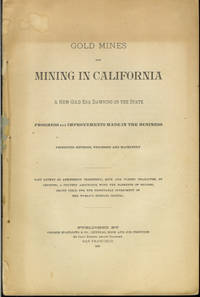
188523852San Francisco: George Spaulding & Co. General Book and Job Printers 1885. First edition. Paperback. Lacking front wrapper and front blank leaves toning to top of title page text clean and complete. Original wrappers lacking front wrapper 349 pp. 18 pp adverts and inserted litho advert on cardstock at rear engraved illustrations in the text. In protective paper chemise and card slipcase. <br/><br/>Scarce OCLC/Worldcat finds 9 library holdings. Cowan 1933 edition page 240. George Spaulding & Co., General Book and Job Printers paperback
185113408Edinburgh: The Edinburgh Evening Courant 1851. With an article on the back page column 3 entitled "Gold In Australia" measuring 13 column inches which states "The discovery of the fact by Mr. Hargraves that the country from the Mountain Ranges to an indefinite extent in the interior is an immense gold field" which has ignited "a universal rush to the diggings". The article goes on to describe the rapid rise in the cost of provisions; a description of miners returning to town with gold nuggets; the government geologist's visit to the site; and the need to appoint a "Commissioner over the gold regions. in which Mr. Hargraves being the discoverer. points him out as the most suitable and worthy person for the appointment." An article picked up by the Edinburgh Courant from the Sydney Morning Herald of May 20 which took it from The Bathurst Free Press of May 17th. Small chips at top edges a little browned. Single issue of four page newspaper disbound measuring 19" X 25" Saturday September 6 1851 Number 22168with red newspaper tax stamp at upper right hand corner and black Edinburgh Evening Courant stamp. The Edinburgh Evening Courant unknown
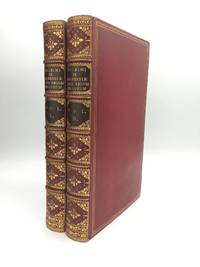
184071584London: Sumptibus Societatis 1840. First Edition. Hardcover. Very good. William of Malmesbury's Deeds of the English Kings is one of the great histories of England and one of the most important historical works of the European Middle Ages. Although its focus is national its scope encompasses most of Western Europe and beyond providing a full-scale account of the First Crusade. Apart from its formidable learning it is characterized by narrative skill and entertainment value with topics including unpowered flight and Henry I's zoo. This edition is edited by English archivist and antiquary Thomas Duffus Hardy 1804-78 from the early 12th century manuscript. The text is in Latin with Hardy's preface footnates shoulder notes and an index in English. From the library of John Patrick Crichton-Stuart 3rd Marquess of Bute 1847-1900 the industrial magnate antiquarian and philanthropist whose vast inheritance reportedly made him the richest man in the world with his armorial bookplate to each front pastedown. Tall octavo two volumes. Sumptuously bound in full red morocco with decorative gilt stamping five raised bands black leather onlays ornamental dentelles and marbled endpapers. The spines are darkened just a touch with some light rubbing to the corners and tips. A striking set. Sumptibus Societatis hardcover books
183666509Pesth, C. A. Hartleben?s Verlag, 1834-1836. 8°. Mit 8 gefalt. Kupferstichkarten u. einem großen, mehrf. gefalt. Kupferstichplan von Konstantinopel. Zus. ca. 3.600 S., HLdr.-Bde. d. Zt. a. 4 Bünden m. Rückenverg., je 2 goldgepr. Rückenschildern u. Farbschnitt.
189833202-888St. Petersburg n.pr. 1898. Gold-enhanced chomolithographic Art Nouveau title in red with ms. presentation 2 chromolithogr. plates 3 wood-engraved plates and 1 engraved plate by W. W. Matthé. 272 pp. 1 leaf VI ff. plates. Large 4to 310 x 220 mm. Orig. white cloth richtly decorated and lettered richly in gold and black colored printed endpapers all edges decorated in gold and red with dark red book jacket. In orig. dark red box. St. Petersburg n.pr. 1898. First German edition limited to 100 copies. This is copy no. 51 with a handwritten presentation to "Herrn Medicinalrath Dr. Grödel". Isidor Maximilian Mayer Grödel 1850-1921 was a student of the Munich radiologist G. Rieder and pioneer in balneaolgy and cardiology. This is Vladimir Vasil'evich Stasov's 1824-1906 rare report on the most elaborate book production of Russia in the 19th century N. P. Kondakov's monumental publication on Byzantine Enamels Collection A.V. Zvenigorodskoi. His book appeared in 1892 and is an important document of technological capacity of Russian printing industries. Kondakov's book than cost 120'000 gold roubles by the exchange rate for 1892.- Splendid copy. GREECE; ART; GENERAL & APPLIED ; St. Petersburg, n.pr. hardcover
1845288207Boston: Waite Peirce And Company. 1845 Brown/Gilt Embossed Covers/Spine Clean Tight. Book Store Small Paste Down Colesworth's Book Store .60 Cornhill Boston Mass. A Small Oval Imprint Top Fep. Engraved Shipwreck Frontispiece Engraved Title Page Some Foxing. 8 Nautical Vocabulary. 2 11 395 Pgs. Full Page Envravings. A Fine Copy Of Scarce Maritime Literature. 8vo - over 7¾ - 9¾" tall. 3rd Edition. Decorative Cloth. Very Good. Waite, Peirce, And Company. hardcover
189471028Washington: United States Geological Survey 1894-1900. First edition of all seven folios. 21 2/4 x 18 1/2 inches each. Folio 3 Placerville. 3 maps. 1894. Folio 5 Sacramento. 2 maps. 1894. Folio 29 Nevada City Special. 9 maps. 1896. Folio 41 Sonora. 4 maps. 14x4" portion of rear wrapper torn off affecting lettering on inside rear wrapper; plates and text fine. 1897. Folio 51 Big Trees. 3 maps & 1 plate reproducing 5 photographs. 1898. Folio 63 Mother Lode District. 8 maps. 1900. Folio 66 Colfax. 3 maps. 1900. All in original printed wrappers and cloth spines. Cursive stamp of Chas. S. Sawyer to each volume. Bit of soiling ad corner wear but altogether a very good collection of this attractive group of atlases. United States Geological Survey hardcover
183956346Kjøbenhavn Bianco Lunø 1839. Samtidigt hldrbd. Stempel på titelbladet. Samtidigt hldrbd. Rygforgyldning. Forgyldt skindtitel. En papirsetiket påsat ryg. Stempel på titelbladet. Litograferet portræt. 82190 pp. 1 litograferet foldekort. Trykt på velin-papir. ren. Med dedikation "ærbødigst fra Forfatteren" øverst på titelbladet. unknown
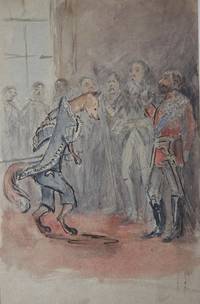
18800064001880-1917. Full Morocco. Very Good. Oblong 21 by 30 cm. 92 numbered leaves with content with log entries more or less statistical on all the versos and pictures and/or original drawings mostly mounted on 58 rectos with some additional loose material. 129 numbered leaves in all. Several of the log pages have mounted photos obscuring the log as it is clear that this game book was at some point re-purposed to be a more general album with some emphasis on sports including also fishing foxhunting and sailing but also there are two pages of photos from South Africa with photos of native tribesmen ostriches a hut Cecil Rhodes house etc. 13 original works of art -- watercolored pencil pen and ink -- in addition to numerous painted fish hook and fly vignettes these sometimes done directly onto the page. Most charming are the comical illustrations of anthropomorphic foxes. Sepia photos are of the country estates their stately homes and rural settings of the hunts as well as the people involved -- the hosts and guests during these country weekends. Many but by no means all of the photos have captions helpfully identifying the participants or the locations. And the log proper provides the names of those participating in the shooting and often what would now be regarded as obscenely large kills. Among the many aristocrats and wealthy in the photographs and/or logs are Lady Randolph Churchill Jennie Churchill Arthur Balfour Lady Minto Mary the famous 4th Countess Henry Lascelles the 5th Earl of Harewood the 5th Earl of Carnavon of King Tut fame as well as the owner of the castle used in Downton Abbey Baron Rothschild Lord de Grey Lord Ashburton Prince Murat the Duke of Buccleuch Prince Duleep de Singh Lord Rosebery and on and on. Country homes include Longleat Greystoke Castle the Hirsel Highcliffe Castle etc. Alexander McDonnell was a son of the 5th Earl of Antrim and a clerk in the House of Lords. Obviously he was very well connected and surely very popular among the upper echelons of English society back then. And we would note that many of the most illustriously titled have frequent entries here; what we have here is a window into a cohesive social network it is our sense. Condition: morocco binding has moderate to heavy wear along edges some scuffs on the boards and spine. The leaves can have a waviness the result of the interaction of the mounted material upon the leaves. A few photos are loose. There is a little bit of a scrappy quality to the book as befitting a log book that was partially turned into something much more and this quality is part of its charm as well. <br /><br /> books
188513975E. H. Mayer, Köln und Leipzig 1865 - 1885. 600-800 S. je Band mit zahlreichen Hozschnitt-Abbildnungen und wenigen Tafeln und Karten, Groß 8°, marmoriertes Halb-Leder der Zeit mit Rückentitel und mit schlichter Rückenvergoldung, Bibliotheksexemplare (ordnungsgemäß entwidmet), Stempel auf Titel und Vorsatz, Einbände gering berieben und bestoßen, Rücken in Klarsichtfolie eingeschlagen, leichte Rückstände und Klebereste im Bereich des ehemaligen Rückenschildes, Papier vereinzelt leicht braunfelckig, dekorative Exemplare in gutem Gesamtzustand,
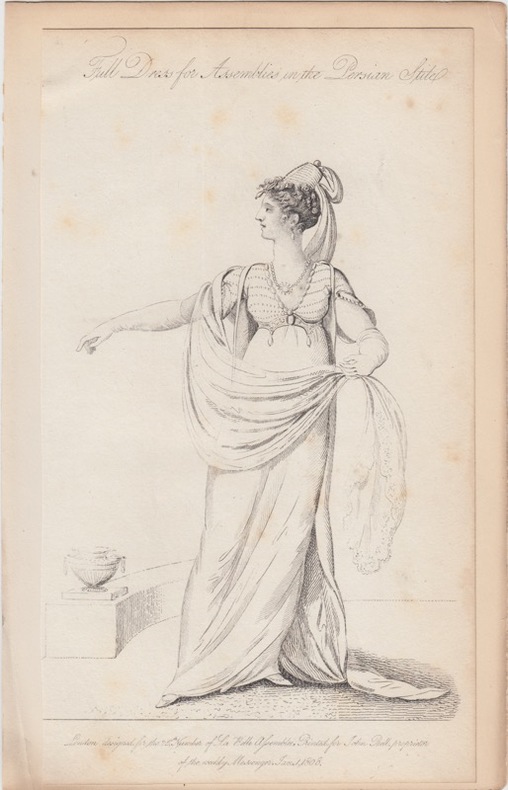
1808255991808 London,la Belle Assemblée fashionable magazine,J.BELL 1808 - black and white print,line engraving,
1822029216London: Rodwell & Martin 1822. First Edition. Quarto. engraving accompanied by a tissue guard and descriptive text in English and French. Captain Batty was an officer who served with the 1st Grenadier guards and he fought with the 3rd battalion at Quatre Bras. His battalion played an important role at Waterloo and served in the occupation of France. He made sketches and etched the plates in this work. His work was exhibited at the Royal Academy and his drawing of buildings showed a remarkable understanding of architectural principles. Handsomely bound in maroon straight grained morocco both boards with corners decoratively stamped in gilt within gilt frame raised bands and lettering gilt all other compartments fully gilt decorated all edges gilt light scattered marginal foxing joints strengthened. A very good copy. Rodwell & Martin unknown
1873007094Paris Tresse éditeur 1873 In-16 Bradel demi-percaline d'époque Edition originale
189355608Seattle WA & Silverton WA: Stillaguamish & Sultan Mining Co. 606 Bailey Bldg. ca. 1893. Four albumen cabinet photographs sized 3.9 x 4.9 in. mounted on thick studio board stock sized 4.25 x 5.25 in. w/ all four containing manuscript annotations in ink on versos minor dustsoiling edgewear minor over-exposure to a couple images still a nice grouping with consistent contrast and definition. These scarce original albumen photos show the canyon water fall power and miners along the Hoodoo Quartz Claim Mineral Survey No. 403A and B which was filed originally in 1892 and are neatly numbered 3 6 15 & 11. The first image shows a heavily forested canyon with creek running through and annotations on verso detailing that the “Anaconda and Roman Senator lodes at the head of gulch.†The second photo shows fast running water fall and creek -- “water power that will be utilized in the development of the Stilliguamish sic and Sultan Mining Co’s property. Copper Lake Canyon.†Third photo depicts gold miners carrying and working with pick axes in “Hoodoo Canyon 500 feet higher up. . . the vein is found in the bed of the gulch at this point.†The series of mines developed by the Stillaguamish & Sultan Mining Co. had a well-defined fissure vein carrying iron and copper pyrites and pyrrhotite with bell metal all contained in a lime quartz gangue. The main tunnel was driven 420 feet on the Hoodoo ledge with about another 200 feet of tunneling ore concentrate worth about $83 a ton including gold silver and copper ores. The description on back of four describes “passageway where work was shot away for approach to Hoodoo tunnel. The snow banks in the distance and at the right are at the foot of Big Four Mountain. . . seen plainly from Monte Cristo 8 miles East.†By 1905 the company was largely dormant and later the mines would be owned by the Sykes Estate of which the Continental Illinois National Bank & Trust Co. of Chicago was the trustee. See: L.K. Hodges Mining in the Pacific Northwest: A Complete Reivew of the Mineral Resources of Washington and British Columbia 1897; The Copper Handbook: A Manual of the Copper Industry of the World 1905 Vol. V p. 655; Carithers & Guard Geology and Ore Deposits of the Sultan Basin Snohomish County Washington Bulletin No. 36 1949 pp. 49-50. Stillaguamish & Sultan Mining Co., 606 Bailey Bldg., unknown
189676724New York: G.W. Dillingham Publisher 1896. First Edition. Hardcover. Very good. Reminiscences of an Indian Agent's wife. "The author's husband Oklahoma City's first mayor resented certain allusions to his conduct and succeeded in destroying many copies" Howes D-619. The couple divorced in 1897. Octavo: 216 p. with 10 photographic plates. Original blue cloth binding with decorative stamping in gilt and black. Some mild rubbing to the corners and tips; otherwise very good. G.W. Dillingham, Publisher hardcover
18617043Paris, Poulet-Malassis et de Broise (imprimé à Alençon), 1861 ; petit in-8, broché ; (4), 93, (3) pp. et couverture orange imprimée.
185183020London: John Van Voorst 1851. First edition. Hardcover. Very Good. 23 x 14.5 cm. Slim octavo. viii 74pp 2 ads. Small stamp on page vii. Complete with 6 lithographs of flies by Paul Jerrard of which 5 are vibrantly hand colored and one that is not in color of other tackle. Bound in original brown cloth. Spine is faded and head and tail of spine are chipped. ~ 8 cm closed tear to front free endpaper. With sections on salmon white trout trout pike grayling sea fly-fishing and lengthy appendix including a section on angling in America. Authorship is unattributed internally but various sources give either Mrs. Hutchinson or Richard Bowden-Smith as the author. Uncommon work. References: Heckscher 1075. Westwood & Satchell p 95. John Van Voorst hardcover
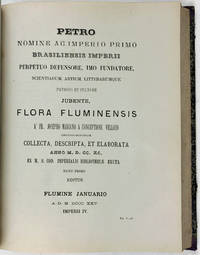
188145183Flumine Januario / Rio de Janeiro: Typ. Economica 1881. First complete edition. Half black morocco over marbled boards gilt spine title. A very good copy boards rubbed repaired tear and closed tear on Volume V half title and title page. xii vii 467 1 pp. 4to. Published in and taking up the entire volume of Archivos do Museu Nacional do Rio De Janeiro. Volume V. 1880 1881. Added title page: Petro nomine ac imperio primo Brasiliensis imperii perpetuo defensore . jubente Flora fluminensis a' fr. Josepho Mariano a Conceptione Vellozo Ordinis monorum collecta descripta et elaborata anno M.D. CC. XC. Ex M.S. cod. Imperialis bibliothecæ eruta nunc primo etitur. Flumine Januario A.D.M. DCCC. XXV imperii IV. José Xavier Veloso 1742-1811 born in what is now Minas Gerais Brazil was ordained in 1766 in the convent of St. Anthony in Rio de Janeiro where he studied philosophy and theology later geometry in San Paulo and finally natural history. He collected plants animals and minerals in the Rio de Janeiro area from 1783 to 1790 at which time he moved to Lisbon where he worked at the Royal Academy of Sciences while preparing Florae Fluminensis his greatest work for publication. Using the Linnaeus' system of sexual classification of plants he prepared very highly detailed texts and 1700 prints many of them of new species. But the publication of the work was beset by problems. First sent to Venice the plates were never completed. Later the French invasion of the Iberian peninsular sent the Portuguese government then Veloso and his manuscripts into exile in Brazil where he died in 1811. In 1825 an abbreviated version of the text was published followed by the eleven volumes of the Icones in 1827 of which few copies survive. The complete text was not published until this edition in 1881. Bound with and proceeded by Archivos do Museu Nacional do Rio De Janeiro. Volume IV. 1879. Rio 1881. viii 151 1 pp vii plates. Folded color plate split at fold. Volume subtitle: Insectologia. Includes Müller Fritz: A metamorphose de um insecto diptero among other works. Rodrigues 2473. Sabin 98833n. For the shorter version of 1825 see: Barba de Moraes II p. 343. Pritzel 468. Jackson 377. Innocencio V.5 4258; V.13 p.122. Also see Nissen BBI 2046. Typ. Economica hardcover books
188145183Flumine Januario / Rio de Janeiro: Typ. Economica 1881. First complete edition. Half black morocco over marbled boards gilt spine title. A very good copy boards rubbed repaired tear and closed tear on Volume V half title and title page. xii vii 467 1 pp. 4to. Published in and taking up the entire volume of Archivos do Museu Nacional do Rio De Janeiro. Volume V. 1880 1881. Added title page: Petro nomine ac imperio primo Brasiliensis imperii perpetuo defensore . jubente Flora fluminensis a' fr. Josepho Mariano a Conceptione Vellozo Ordinis monorum collecta descripta et elaborata anno M.D. CC. XC. Ex M.S. cod. Imperialis bibliothecæ eruta nunc primo etitur. Flumine Januario A.D.M. DCCC. XXV imperii IV. José Xavier Veloso 1742-1811 born in what is now Minas Gerais Brazil was ordained in 1766 in the convent of St. Anthony in Rio de Janeiro where he studied philosophy and theology later geometry in San Paulo and finally natural history. He collected plants animals and minerals in the Rio de Janeiro area from 1783 to 1790 at which time he moved to Lisbon where he worked at the Royal Academy of Sciences while preparing Florae Fluminensis his greatest work for publication. Using the Linnaeus’ system of sexual classification of plants he prepared very highly detailed texts and 1700 prints many of them of new species. But the publication of the work was beset by problems. First sent to Venice the plates were never completed. Later the French invasion of the Iberian peninsular sent the Portuguese government then Veloso and his manuscripts into exile in Brazil where he died in 1811. In 1825 an abbreviated version of the text was published followed by the eleven volumes of the Icones in 1827 of which few copies survive. The complete text was not published until this edition in 1881.<br /> <br /> Bound with and proceeded by Archivos do Museu Nacional do Rio De Janeiro. Volume IV. 1879. Rio 1881. viii 151 1 pp vii plates. Folded color plate split at fold. Volume subtitle: Insectologia. Includes Müller Fritz: A metamorphose de um insecto diptero among other works. Rodrigues 2473. Sabin 98833n. For the shorter version of 1825 see: Barba de Moraes II p. 343. Pritzel 468. Jackson 377. Innocencio V.5 4258; V.13 p.122. Also see Nissen BBI 2046. Typ. Economica hardcover
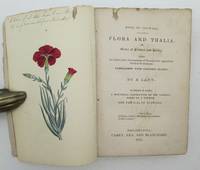
183610803Carey Lea and Blanchard 1836. First American Edition. hardcover. Acceptable. 0x0x0. Bound in black leather both front and rear boards are not attached spine quite worn - still present. First 40 pages have a worm hole at the top edge endpapers taped in. Twenty-four beautifully hand-colored plates some with pencil names on the top. 1836 first American edition book attributed to "A Lady." Probable author is Louisa Anne Twamley or Maria Rundell. All orders packed with care most dust jackets protected by Brodart sleeve independent bookseller since 2011 Carey, Lea and Blanchard hardcover
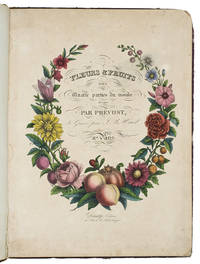
1837ABC_47224Paris 1837. Folio ca. 35 x 26.5 cm. Dauty Contemporary half sheepskin maroon watered silk sides title in gold on the front board. With an engraved title-page and 11 of 23 engraved botanical prints: 4 showing 5 kinds of fruits each 3 showing 9 types of flowers each and 4 showing flower bouquets. All prints are stipple engravings and coloured by a contemporary hand some parts glazed with egg white. 12 ll. Extremely rare botanical print series showing both European and exotic fruits and flowers engraved by Jean-Baptiste Huet the younger 1772-1852 after designs of Benoît-Louis Prévost 1735-1804 or Jean-Louis Prévost 1760-1810. It also includes four plates showing bouquets from Europe America Asia and Africa. Only one complete copy is known at the Bibliothèque nationale de France we have traced no copy in sale or auction records and it is not mentioned in the usual botanical bibliographical works. The BnF copy is described in the Inventaire du fonds français après 1800 where the series consists of 23 prints issued all together under this title. The BnF and the IFF date the work ca. 1837-1839 but it is more likely that it is ca. 1837-1838 as Dauty died in 1838 and he printed at Rue de Bibliothèque no. 16 only in 1827 and 1835-1838. The BnF ascribes the designs for the prints to Benoît-Louis Prévost but Jean-Louis Prévost remains a possibility for he produced another famous print series of flowers and fruits in the same style of stipple engravings Collection des fleurs et fruits 1805.With a contemporary inscription "A M.elle Vincent" on the first free endleaf dedicating it to or belonging to the famous French 19th-century botanical painter Henriette Vincent 1786-1834 who was a student of Gerard van Spaendonck and Pierre-Joseph Redouté. Head and foot of the spine damaged and spine slightly worn boards a little rubbed edges slightly worn corners bumped. Some light browning and foxing throughout title-page a little more browned and with a light marginal water stain. Lacking 12 plates according to IFF. Otherwise in good condition. An extremely rare botanical print series vividly hand-coloured.l BnF FRBNF40503621; IFF Inventaire du fonds français après 1800 Huet p. 518; not in Nissen BBI; Pritzel; Stafleu & Cowan. hardcover